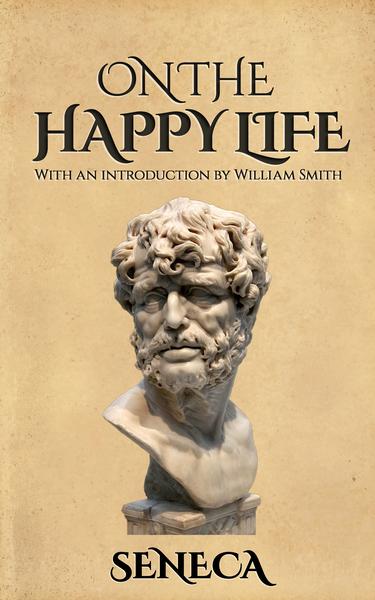
Seneca Six Pack
Seneca
Francis Caldwell Holland
––––––––
Translated by Richard Mott Gummere, Ella Isabel Harris, Aubrey Stewart
Seneca Six Pack
On the Happy Life by Seneca. Translated by Aubrey Stewart. First published in 1900.
Letters from a Stoic: Volume I by Seneca. Translated by Richard Mott Gummere. First published in 1917.
Medea by Seneca. Translated by Ella Isabel Harris. First published in 1899.
On Leisure by Seneca. Translated by Aubrey Stewart. First published in 1900.
The Daughters of Troy by Seneca. Translated by Ella Isabel Harris. First published in 1899.
The Stoic: A biography of Seneca by Francis Caldwell Holland. First published as Seneca in 1920.
––––––––
Seneca Six Pack. Published by Enhanced Media, 2016.
I II III IV V VI VII VIII IX X
(Epistulae Morales Ad Lucilium)
Letter II - On Discursiveness in Reading
Letter III - On True and False Friendship
Letter IV - On the Terrors of Death
Letter V - On the Philosopher's Mean
Letter VI - On Sharing Knowledge
Letter VIII - On the Philosopher's Seclusion
Letter IX - On Philosophy and Friendship
Letter X - On Living to Oneself
Letter XI - On the Blush of Modesty
Letter XIII - On Groundless Fears
Letter XIV - On the Reasons for Withdrawing from the World
Letter XV - On Brawn and Brains
Letter XVI - On Philosophy, the Guide of Life
Letter XVII - On Philosophy and Riches
Letter XVIII - On Festivals and Fasting
Letter XIX - On Worldliness and Retirement
Letter XX - On Practising what you Preach
Letter XXI - On the Renown which my Writings will Bring you
Letter XXII - On the Futility of Half-Way Measures
Letter XXIII - On the True Joy which Comes from Philosophy
Letter XXIV - On Despising Death
Letter XXVI - On Old Age and Death
Letter XXVII - On the Good which Abides
Letter XXVIII - On Travel as a Cure for Discontent
Letter XXIX - On the Critical Condition of Marcellinus
Letter XXX - On Conquering the Conqueror
Letter XXXIII - On the Futility of Learning Maxims
Letter XXXIV - On a Promising Pupil
Letter XXXV - On the Friendship of Kindred Minds
Letter XXXVI - On the Value of Retirement
Letter XXXVII - On Allegiance to Virtue
Letter XXXVIII - On Quiet Conversation
Letter XXXIX - On Noble Aspirations
Letter XL - On the Proper Style for a Philosopher's Discourse
Letter XLI - On the God within Us
Letter XLIII - On the Relativity of Fame
Letter XLIV - On Philosophy and Pedigrees
Letter XLV - On Sophistical Argumentation
Letter XLVI - On a New Book by Lucilius
Letter XLVII - On Master and Slave
Letter XLVIII - On Quibbling as Unworthy of the Philosopher
Letter XLIX - On the Shortness of Life
Letter L - On our Blindness and its Cure
Letter LI - On Baiae and Morals
Letter LII - On Choosing our Teachers
Letter LIII - On the Faults of the Spirit
Letter LIV - On Asthma and Death
Letter LVI - On Quiet and Study
Letter LVII - On the Trials of Travel
Letter LIX - On Pleasure and Joy
Letter LX - On Harmful Prayers
Letter LXI - On Meeting Death Cheerfully
Letter LXIII - On Grief for Lost Friends
Letter LXIV - On the Philosopher's Task
Letter LXV - On the First Cause
The Stoic: a biography of Seneca
MARCUS ANNAEUS SENECA AND SONS — CONTROVERSIAE — HELVIA — BATTLE OF THE BOOKS
EARLY YEARS AND EDUCATION — SOTION, ATTALUS, FABIANUS
THE PRINCIPATE OF CALIGULA, A.D. 37-42
RETURN FROM EXILE — LAST YEARS OF CLAUDIUS, A.D. 48-54
THE QUINQUENNIUM NERONIS, A.D. 54-59
THE TRAGEDY OF BAIAE - INSTITUTION OF THE ‘JUVENALIA’
DECLINE OF SENECA'S INFLUENCE— DEATH OF BURRHUS AND OF OCTAVIA, A.D. 60-62
SENECA IN RETIREMENT— HIS FRIENDS AND OCCUPATIONS
LETTER TO LUCILIUS ON AETNA — SENECA'S RICHES AND APOLOGIA
––––––––
[Addressed to Gallio]
––––––––
ALL MEN, brother Gallio, wish to live happily, but are dull at perceiving exactly what it is that makes life happy: and so far is it from being easy to attain the happiness that the more eagerly a man struggles to reach it the further he departs from it, if he takes the wrong road; for, since this leads in the opposite direction, his very swiftness carries him all the further away. We must therefore first define clearly what it is at which we aim: next we must consider by what path we may most speedily reach it, for on our journey itself, provided it be made in the right direction, we shall learn how much progress we have made each day, and how much nearer we are to the goal towards which our natural desires urge us. But as long as we wander at random, not following any guide except the shouts and discordant clamours of those who invite us to proceed in different directions, our short life will be wasted in useless roamings, even if we labour both day and night to get a good understanding.
Let us not therefore decide whither we must tend, and by what path, without the advice of some experienced person who has explored the region which we are about to enter, because this journey is not subject to the same conditions as others; for in them some distinctly understood track and inquiries made of the natives make it impossible for us to go wrong, but here the most beaten and frequented tracks are those which lead us most astray. Nothing, therefore, is more important than that we should not, like sheep, follow the flock that has gone before us, and thus proceed not whither we ought, but whither the rest are going. Now nothing gets us into greater troubles than our subservience to common rumour, and our habit of thinking that those things are best which are most generally received as such, of taking many counterfeits for truly good things, and of living not by reason but by imitation of others. This is the cause of those great heaps into which men rush till they are piled one upon another. In a great crush of people, when the crowd presses upon itself, no one can fall without drawing someone else down upon him, and those who go before cause the destruction of those who follow them. You may observe the same thing in human life: no one can merely go wrong by himself, but he must become both the cause and adviser of another's wrong doing.
It is harmful to follow the march of those who go before us, and since everyone had rather believe another than form his own opinion, we never pass a deliberate judgment upon life, but some traditional error always entangles us and brings us to ruin, and we perish because we follow other men's examples: we should be cured of this if we were to disengage ourselves from the herd; but as it is, the mob is ready to fight against reason in defence of its own mistake. Consequently the same thing happens as at elections, where, when the fickle breeze of popular favour has veered round, those who have been chosen consuls and praetors are viewed with admiration by the very men who made them so. That we should all approve and disapprove of the same things is the end of every decision which is given according to the voice of the majority.
When we are considering a happy life, you cannot answer me as though after a division of the House, "This view has most supporters;" because for that very reason it is the worse of the two: matters do not stand so well with mankind that the majority should prefer the better course: the more people do a thing the worse it is likely to be. Let us therefore inquire, not what is most commonly done, but what is best for us to do, and what will establish us in the possession of undying happiness, not what is approved of by the vulgar, the worst possible exponents of truth.
By "the vulgar" I mean both those who wear woollen cloaks and those who wear crowns; for I do not regard the colour of the clothes with which they are covered: I do not trust my eyes to tell me what a man is: I have a better and more trustworthy light by which I can distinguish what is true from what is false: let the mind find out what is good for the mind. If a man ever allows his mind some breathing space and has leisure for communing with himself, what truths he will confess to himself, after having been put to the torture by his own self! He will say, "Whatever I have hitherto done I wish were undone: when I think over what I have said, I envy dumb people: whatever I have longed for seems to have been what my enemies would pray might befall me: good heaven, how far more endurable what I have feared seems to be than what I have lusted after.
I have been at enmity with many men, and have changed my dislike of them into friendship, if friendship can exist between bad men: yet I have not yet become reconciled to myself," I have striven with all my strength to raise myself above the common herd, and to make myself remarkable for some talent: what have I effected save to make myself a mark for the arrows of my enemies, and show those who hate me where to wound me? Do you see those who praise your eloquence, who covet your wealth, who court your favour, or who vaunt your power?
All these either are, or, which comes to the same thing, may be your enemies: the number of those who envy you is as great as that of those who admire you; why do I not rather seek for some good thing which I can use and feel, not one which I can show? these good things which men gaze at in wonder, which they crowd to see, which one points out to another with speechless admiration, are outwardly brilliant, but within are miseries to those who possess them."
Let us seek for some blessing, which does not merely look fine, but is sound and good throughout alike, and most beautiful in the parts which are least seen: let us unearth this. It is not far distant from us; it can be discovered: all that is necessary is to know whither to stretch out your hand: but, as it is, we behave as though we were in the dark, and reach out beyond what is nearest to us, striking as we do so against the very things that we want. However, that I may not draw you into digressions, I will pass over the opinions of other philosophers, because it would take a long time to state and confute them all: take ours.
When, however, I say "ours," I do not bind myself to any one of the chiefs of the Stoic school, for I too have a right to form my own opinion. I shall, therefore, follow the authority of some of them, but shall ask some others to discriminate their meaning: perhaps, when after having reported all their opinions, I am asked for my own, I shall impugn none of my predecessors' decisions, and shall say, "I will also add somewhat to them."
Meanwhile I follow nature, which is a point upon which every one of the Stoic philosophers are agreed: true wisdom consists in not departing from nature and in moulding our conduct according to her laws and model. A happy life, therefore, is one which is in accordance with its own. nature, and cannot be brought about unless in the first place the mind be sound and remain so without interruption, and next, be bold and vigorous, enduring all things with most admirable courage, suited to the times in which it lives, careful of the body and its appurtenances, yet not troublesomely careful. It must also set due value upon all the things which adorn our lives, without over-estimating any one of them, and must be able to enjoy the bounty of Fortune without becoming her slave. You understand without my mentioning it that an unbroken calm and freedom ensue, when we have driven away all those things which either excite us or alarm us: for in the place of sensual pleasures and those slight perishable matters which are connected with the basest crimes, we thus gain an immense, unchangeable, equable joy, together with peace, calmness and greatness of mind, and kindliness: for all savageness is a sign of weakness.
Our highest good may also be defined otherwise that is to say, the same idea may be expressed in different language. Just as the same army may at one time be extended more widely, at another contracted into a smaller compass, and may either be curved towards the wings by a depression in the line of the centre, or drawn up in a straight line, while, in whatever figure it be arrayed, its strength and loyalty remain unchanged; so also our definition of the highest good may in some cases be expressed diffusely and at great length, while in others it is put into a short and concise form.
Thus, it will come to the same thing, if I say "The highest good is a mind which despises the accidents of fortune, and takes pleasure in virtue": or, "It is an unconquerable strength of mind, knowing the world well, gentle in its dealings, showing great courtesy and consideration for those with whom it is brought into contact." Or we may choose to define it by calling that man happy who knows good and bad only in the form of good or bad minds: who worships honour, and is satisfied with his own virtue, who is neither puffed up by good fortune nor cast down by evil fortune, who knows no other good than that which he is able to bestow upon himself, whose real pleasure lies in despising pleasures.
If you choose to pursue this digression further, you can put this same idea into many other forms, without impairing or weakening its meaning: for what prevents our saying that a happy life consists in a mind which is free, upright, undaunted, and steadfast, beyond the influence of fear or desire, which thinks nothing good except honour, and nothing bad except blame, and regards everything else as a mass of mean details which can neither add anything to nor take anything away from the happiness of life, but which come and go without either increasing or diminishing the highest good?
A man of these principles, whether he will or no, must be accompanied by a continual cheerfulness, a high happiness, which comes indeed from on high because he delights in what he has, and desires no greater pleasures than those which his home affords. Is he not right in allowing these to turn the scale against petty, ridiculous and short-lived movements of his wretched body? on the day on which he becomes proof against pleasure he also becomes proof against pain.
See, on the other hand, how evil and guilty a slavery the man is forced to serve who is dominated in turn by pleasures and pains, those most untrustworthy and passionate of masters. We must, therefore, escape from them into freedom. This nothing will bestow upon us save contempt of Fortune: but if we attain to this, then there will dawn upon us those invaluable blessings, the repose of a mind that is at rest in a safe haven, its lofty imaginings, its great and steady delight at casting out errors and learning to know the truth, its courtesy, and its cheerfulness, in all of which we shall take delight, not regarding them as good things, but as proceeding from the proper good of man.
Since I have begun to make my definitions without a too strict adherence to the letter, a man may be called "happy" who, thanks to reason, has ceased either to hope or to fear: but rocks also feel neither fear nor sadness, nor do cattle, yet no one would call those things happy which cannot comprehend what happiness is. With them you may class men whose dull nature and want of self-knowledge reduces them to the level of cattle, mere animals: there is no difference between the one and the other, because the latter have no reason, while the former have only a corrupted form of it, crooked and cunning to their own hurt.
For no one can be styled happy who is beyond the influence of truth: and consequently a happy life is unchangeable, and is founded upon a true and trustworthy discernment; for the mind is uncontaminated and freed from all evils only when it is able to escape not merely from wounds but also from scratches, when it will always be able to maintain the position which it has taken up, and defend it even against the angry assaults of Fortune: for with regard to sensual pleasures, though they were to surround one on every side, and use every means of assault, trying to win over the mind by caresses and making trial of every conceivable stratagem to attract either our entire selves or our separate parts, yet what mortal that retains any traces of human origin would wish to be tickled day and night, and, neglecting his mind, to devote himself to bodily enjoyments?
"But," says our adversary, "the mind also will have pleasures of its own."
Let it have them, then, and let it sit in judgment over luxury and pleasures; let it indulge itself to the full in all those matters which give sensual delights: then let it look back upon what it enjoyed before, and with all those faded sensualities fresh in its memory let it rejoice and look eagerly forward to those other pleasures which it experienced long ago, and intends to experience again, and while the body lies in helpless repletion in the present, let it send its thoughts onward towards the future, and take stock of its hopes: all this will make it appear, in my opinion, yet more wretched, because it is insanity to choose evil instead of good: now no insane person can be happy, and no one can be sane if he regards what is injurious as the highest good and strives to obtain it.
The happy man, therefore, is he who can make a right judgment in all things: he is happy who in his present circumstances, whatever they may be, is satisfied and on friendly terms with the conditions of his life. That man is happy, whose reason recommends to him the whole posture of his affairs.
Even those very people who declare the highest good to be in the belly, see what a dishonourable position they have assigned to it: and therefore they say that pleasure cannot be parted from virtue, and that no one can either live honourably without living cheerfully, nor yet live cheerfully without living honourably. I do not see how these very different matters can have any connection with one another. What is there, I pray you, to prevent virtue existing apart from pleasure? Of course the reason is that all good things derive their origin from virtue, and therefore even those things which you cherish and seek for come originally from its roots. Yet, if they were entirely inseparable, we should not see some things to be pleasant, but not honourable, and others most honourable indeed, but hard and only to be attained by suffering. Add to this, that pleasure visits the basest lives, but virtue cannot co-exist with an evil life; yet some unhappy people are not without pleasure, nay, it is owing to pleasure itself that they are unhappy; and this could not take place if pleasure had any connection with virtue, whereas virtue is often without pleasure, and never stands in need of it.
Why do you put together two things which are unlike and even incompatible one with another? virtue is a lofty quality, sublime, royal, unconquerable, untiring: pleasure is low, slavish, weakly, perishable; its haunts and homes are the brothel and the tavern. You will meet virtue in the temple, the market-place, the senate house, manning the walls, covered with dust, sunburnt, horny-handed: you will find pleasure skulking out of sight, seeking for shady nooks at the public baths, hot chambers, and places which dread the visits of the aedile, soft, effeminate, reeking of wine and perfumes, pale or perhaps painted and made up with cosmetics.
The highest good is immortal: it knows no ending, and does not admit of either satiety or regret: for a right-thinking mind never alters or becomes hateful to itself, nor do the best things ever undergo any change: but pleasure dies at the very moment when it charms us most: it has no great scope, and therefore it soon cloys and wearies us, and fades away as soon as its first impulse is over: indeed, we cannot depend upon anything whose nature is to change.
Consequently it is not even possible that there should be any solid substance in that which comes and goes so swiftly, and which perishes by the very exercise of its own functions, for it arrives at a point at which it ceases to be, and even while it is beginning always keeps its end in view.
What answer are we to make to the reflection that pleasure belongs to good and bad men alike, and that bad men take as much delight in their shame as good men in noble things? This was why the ancients bade us lead the highest, not the most pleasant life, in order that pleasure might not be the guide but the companion of a right-thinking and honourable mind; for it is Nature whom we ought to make our guide: let our reason watch her, and be advised by her. To live happily, then, is the same thing as to live according to Nature: what this may be, I will explain. If we guard the endowments of the body and the advantages of nature with care and fearlessness, as things soon to depart and given to us only for a day; if we do not fall under their dominion, nor allow ourselves to become the slaves of what is no part of our own being; if we assign to all bodily pleasures and external delights the same position which is held by auxiliaries and light-armed troops in a camp; if we make them our servants, not our masters—then and then only are they of value to our minds.
A man should be unbiased and not to be conquered by external things: he ought to admire himself alone, to feel confidence in his own spirit, and so to order his life as to be ready alike for good or for bad fortune. Let not his confidence be without knowledge, nor his knowledge without steadfastness: let him always abide by what he has once determined, and let there be no erasure in his doctrines. It will be understood, even though I append it not, that such a man will be tranquil and composed in his demeanour, high-minded and courteous in his actions. Let reason be encouraged by the senses to seek for the truth, and draw its first principles from thence: indeed it has no other base of operations or place from which to start in pursuit of truth: it must fall back upon itself.
Even the all-embracing universe and God who is its guide extends himself forth into outward things, and yet altogether returns from all sides back to himself. Let our mind do the same thing: when, following its bodily senses it has by means of them sent itself forth into the things of the outward world, let it remain still their master and its own. By this means we shall obtain a strength and an ability which are united and allied together, and shall derive from it that reason which never halts between two opinions, nor is dull in forming its perceptions, beliefs, or convictions.
Such a mind, when it has ranged itself in order, made its various parts agree together, and, if I may so express myself, harmonized them, has attained to the highest good: for it has nothing evil or hazardous remaining, nothing to shake it or make it stumble: it will do everything under the guidance of its own will, and nothing unexpected will befall it, but whatever may be done by it will turn out well, and that, too, readily and easily, without the doer having recourse to any underhand devices: for slow and hesitating action are the signs of discord and want of settled purpose. You may, then, boldly declare that the highest good is singleness of mind: for where agreement and unity are, there must the virtues be: it is the vices that are at war one with another.
"But," says our adversary, "you yourself only practise virtue because you hope to obtain some pleasure from it."
In the first place, even though virtue may afford us pleasure, still we do not seek after her on that account: for she does not bestow this, but bestows this to boot, nor is this the end for which she labours, but her labour wins this also, although it be directed to another end. As in a tilled-field, when ploughed for corn, some flowers are found amongst it, and yet, though these posies may charm the eye, all this labour was not spent in order to produce them — the man who sowed the field had another object in view, he gained this over and above it — so pleasure is not the reward or the cause of virtue, but comes in addition to it; nor do we choose virtue because she gives us pleasure, but she gives us pleasure also if we choose her.
The highest good lies in the act of choosing her, and in the attitude of the noblest minds, which when once it has fulfilled its function and established itself within its own limits has attained to the highest good, and needs nothing more: for there is nothing outside of the whole, any more than there is anything beyond the end. You are mistaken, therefore, when you ask me what it is on account of which I seek after virtue: for you are seeking for something above the highest.
Do you ask what I seek from virtue? I answer, Herself: for she has nothing better; she is her own reward. Does this not appear great enough, when I tell you that the highest good is an unyielding strength of mind, wisdom, magnanimity, sound judgment, freedom, harmony, beauty? Do you still ask me for something greater, of which these may be regarded as the attributes? Why do you talk of pleasures to me? I am seeking to find what is good for man, not for his belly; why, cattle and whales have larger ones than he.
"You purposely misunderstand what I say," says he, "for I too say that no one can live pleasantly unless he lives honorably also, and this cannot be the case with dumb animals who measure the extent of their happiness by that of their food. I loudly and publicly proclaim that what I call a pleasant life cannot exist without the addition of virtue."
Yet who does not know that the greatest fools drink the deepest of those pleasures of yours? or that vice is full of enjoyments, and that the mind itself suggests to itself many perverted, vicious forms of pleasure? — in the first place arrogance, excessive self-esteem, swaggering precedence over other men, a shortsighted, nay, a blind devotion to his own interests, dissolute luxury, excessive delight springing from the most trifling and childish causes, and also talkativeness, pride that takes a pleasure in insulting others, sloth, and the decay of a dull mind which goes to sleep over itself.
All these are dissipated by virtue, which plucks a man by the ear, and measures the value of pleasures before she permits them to be used; nor does she set much store by those which she allows to pass current, for she merely allows their use, and her cheerfulness is not due to her use of them, but to her moderation in using them. "Yet when moderation lessens pleasure, it impairs the highest good." You devote yourself to pleasures, I check them; you indulge in pleasure, I use it; you think that it is the highest good, I do not even think it to be good: for the sake of pleasure I do nothing, you do everything.
When I say that I do nothing for the sake of pleasure, I allude to that wise man, whom alone you admit to be capable of pleasure: now I do not call a man wise who is overcome by anything, let alone by pleasure: yet, if engrossed by pleasure, how will he resist toil, danger, want, and all the ills which surround and threaten the life of man? How will he bear the sight of death or of pain? How will he endure the tumult of the world, and make head against so many most active foes, if he be conquered by so effeminate an antagonist? He will do whatever pleasure advises him: well, do you not see how many things it will advise him to do? "It will not," says our adversary, "be able to give him any bad advice, because it is combined with virtue?" Again, do you not see what a poor kind of highest good that must be which requires a guardian to ensure its being good at all? and how is virtue to rule pleasure if she follows it, seeing that to follow is the duty of a subordinate, to rule that of a commander? do you put that which commands in the background?
According to your school, virtue has the dignified office of preliminary tester of pleasures. We shall, however, see whether virtue still remains virtue among those who treat her with such contempt, for if she leaves her proper station she can no longer keep her proper name: in the meanwhile, to keep to the point, I will show you many men beset by pleasures, men upon whom Fortune has showered all her gifts, whom you must needs admit to be bad men.
Look at Nomentanus and Apicius, who digest all the good things, as they call them, of the sea and land, and review upon their tables the whole animal kingdom. Look at them as they lie on beds of roses gloating over their banquet, delighting their ears with music, their eyes with exhibitions, their palates with flavours: their whole bodies are titillated with soft and soothing applications, and lest even their nostrils should be idle, the very place in which they solemnized the rites of luxury is scented with various perfumes. You will say that these men live in the midst of pleasures. Yet they are ill at ease, because they take pleasure in what is not good.
"They are ill at ease," replies he, "because many things arise which distract their thoughts, and their minds are disquieted by conflicting opinions."
I admit that this is true: still these very men, foolish, inconsistent, and certain to feel remorse as they are, do nevertheless receive great pleasure, and we must allow that in so doing they are as far from feeling any trouble as they are from forming a right judgment, and that, as is the case with many people, they are possessed by a merry madness, and laugh while they rave.
The pleasures of wise men, on the other hand, are mild, decorous, verging on dullness, kept under restraint and scarcely noticeable, and are neither invited to come nor received with honour when they come of their own accord, nor are they welcomed with any delight by those whom they visit, who mix them up with their lives and fill up empty spaces with them, like an amusing farce in the intervals of serious business. Let them no longer, then, join incongruous matters together, or connect pleasure with virtue, a mistake whereby they court the worst of men.
The reckless profligate, always in liquor and belching out the fumes of wine, believes that he lives with virtue, because he knows that he lives with pleasure, for he hears it said that pleasure cannot exist apart from virtue; consequently he dubs his vices with the title of wisdom and parades all that he ought to conceal. So, men are not encouraged by Epicurus to run riot, but the vicious hide their excesses in the lap of philosophy, and flock to the schools in which they hear the praises of pleasure.
They do not consider how sober and temperate — for so, by Hercules, I believe it to be — that "pleasure" of Epicurus is, but they rush at his mere name, seeking to obtain some protection and cloak for their vices. They lose, therefore, the one virtue which their evil life possessed, that of being ashamed of doing wrong: for they praise what they used to blush at, and boast of their vices.
Thus modesty can never reassert itself, when shameful idleness is dignified with an honourable name. The reason why that praise which your school lavishes upon pleasure is so hurtful, is because the honourable part of its teaching passes unnoticed, but the degrading part is seen by all.
I myself believe, though my Stoic comrades would be unwilling to hear me say so, that the teaching of Epicurus was upright and holy, and even, if you examine it narrowly, stern: for this much talked of pleasure is reduced to a very narrow compass, and he bids pleasure submit to the same law which we bid virtue do — I mean, to obey nature. Luxury, however, is not satisfied with what is enough for nature. What is the consequence?
Whoever thinks that happiness consists in lazy sloth, and alternations of gluttony and profligacy, requires a good patron for a bad action, and when he has become an Epicurean, having been led to do so by the attractive name of that school, he follows, not the pleasure which he there hears spoken of, but that which he brought thither with him, and, having learned to think that his vices coincide with the maxims of that philosophy, he indulges in them no longer timidly and in dark corners, but boldly in the face of day. I will not, therefore, like most of our school, say that the sect of Epicurus is the teacher of crime, but what I say is: it is ill spoken of, it has a bad reputation, and yet it does not deserve it.
"Who can know this without having been admitted to its inner mysteries?"
Its very outside gives opportunity for scandal, and encourages men's baser desires: it is like a brave man dressed in a woman's gown: your chastity is assured, your manhood is safe, your body is submitted to nothing disgraceful, but your hand holds a drum (like a priest of Cybele).
Choose, then, some honourable superscription for your school, some writing which shall in itself arouse the mind: that which at present stands over your door has been invented by the vices. He who ranges himself on the side of virtue gives thereby a proof of a noble disposition : he who follows pleasure appears to be weakly, worn out, degrading his manhood, likely to fall into infamous vices unless someone discriminates his pleasures for him, so that he may know which remain within the bounds of natural desire, which are frantic and boundless, and become all the more insatiable the more they are satisfied. But come! let virtue lead the way: then every step will be safe.
Too much pleasure is hurtful: but with virtue we need fear no excess of any kind, because moderation is contained in virtue herself. That which is injured by its own extent cannot be a good thing: besides, what better guide can there be than reason for beings endowed with a reasoning nature? so if this combination pleases you, if you are willing to proceed to a happy life thus accompanied, let virtue lead the way, let pleasure follow and hang about the body like a shadow: it is the part of a mind incapable of great things to hand over virtue, the highest of all qualities, as a handmaid to pleasure.
Let virtue lead the way and bear the standard: we shall have pleasure for all that, but we shall be her masters and controllers; she may win some concessions from us, but will not force us to do anything. On the contrary, those who have permitted pleasure to lead the van, have neither one nor the other: for they lose virtue altogether, and yet they do not possess pleasure, but are possessed by it, and are either tortured by its absence or choked by its excess, being wretched if deserted by it, and yet more wretched if overwhelmed by it, like those who are caught in the shoals of the Syrtes and at one time are left on dry ground and at another tossed on the flowing waves.
This arises from an exaggerated want of self-control, and a hidden love of evil: for it is dangerous for one who seeks after evil instead of good to attain his object. As we hunt wild beasts with toil and peril, and even when they are caught find them an anxious possession, for they often tear their keepers to pieces, even so are great pleasures: they turn out to be great evils and take their owners prisoner.
The more numerous and the greater they are, the more inferior and the slave of more masters does that man become whom the vulgar call a happy man. I may even press this analogy further: as the man who tracks wild animals to their lairs, and who sets great store on — "Seeking with snares the wandering brutes to noose," and "Making their hounds the spacious glade surround," that he may follow their tracks, neglects far more desirable things, and leaves many duties unfulfilled, so he who pursues pleasure postpones everything to it, disregards that first essential, liberty, and sacrifices it to his belly; nor does he buy pleasure for himself, but sells himself to pleasure.
"But what," asks our adversary, "is there to hinder virtue and pleasure being combined together, and a highest good being thus formed, so that honour and pleasure may be the same thing?"
Because nothing except what is honourable can form a part of honour, and the highest good would lose its purity if it were to see within itself anything unlike its own better part. Even the joy which arises from virtue, although it be a good thing, yet is not a part of absolute good, any more than cheerfulness or peace of mind, which are indeed good things, but which merely follow the highest good, and do not contribute to its perfection, although they are generated by the noblest causes.
Whoever on the other hand forms an alliance, and that, too, a one-sided one, between virtue and pleasure, clogs whatever strength the one may possess by the weakness of the other, and sends liberty under the yoke, for liberty can only remain unconquered as long as she knows nothing more valuable than herself: for he begins to need the help of Fortune, which is the most utter slavery: his life becomes anxious, full of suspicion, timorous, fearful of accidents, waiting in agony for critical moments of time. You do not afford virtue a solid immovable base if you bid it stand on what is unsteady: and what can be so unsteady as dependence on mere chance, and the vicissitudes of the body and of those things which act on the body? How can such a man obey God and receive everything which comes to pass in a cheerful spirit, never complaining of fate, and putting a good construction upon everything that befalls him, if he be agitated by the petty pin-pricks of pleasures and pains?
A man cannot be a good protector of his country, a good avenger of her wrongs, or a good defender of his friends, if he be inclined to pleasures. Let the highest good, then, rise to that height from whence no force can dislodge it, whither neither pain can ascend, nor hope, nor fear, nor anything else that can impair the authority of the "highest good."
Thither virtue alone can make her way: by her aid that hill must be climbed: she will bravely stand her ground and endure whatever may befall her not only resignedly, but even willingly: she will know that all hard times come in obedience to natural laws, and like a good soldier she will bear wounds, count scars, and when transfixed and dying will yet adore the general for whom she falls: she will bear in mind the old maxim "Follow God."
On the other hand, he who grumbles and complains and bemoans himself is nevertheless forcibly obliged to obey orders, and is dragged away, however much against his will, to carry them out: yet what madness is it to be dragged rather than to follow? as great, by Hercules, as it is folly and ignorance of one's true position to grieve because one has not got something or because something has caused us rough treatment, or to be surprised or indignant at those ills which befall good men as well as bad ones, I mean diseases, deaths, illnesses, and the other cross accidents of human life. Let us bear with magnanimity whatever the system of the universe makes it needful for us to bear: we are all bound by this oath: "To bear the ills of mortal life, and to submit with a good grace to what we cannot avoid."
We have been born into a monarchy: our liberty is to obey God.
True happiness, therefore, consists in virtue: and what will this virtue bid you do? Not to think anything bad or good which is connected neither with virtue nor with wickedness: and in the next place, both to endure unmoved the assaults of evil, and, as far as is right, to form a god out of what is good. What reward does she promise you for this campaign? an enormous one, and one that raises you to the level of the gods: you shall be subject to no restraint and to no want; you shall be free, safe, unhurt; you shall fail in nothing that you attempt; you shall be debarred from nothing; everything shall turn out according to your wish; no misfortune shall befall you; nothing shall happen to you except what you expect and hope for.
"What! does virtue alone suffice to make you happy?" why, of course, consummate and god-like virtue such as this not only suffices, but more than suffices: for when a man is placed beyond the reach of any desire, what can he possibly lack? If all that he needs is concentrated in himself, how can he require anything from without? He, however, who is only on the road to virtue, although he may have made great progress along it, nevertheless needs some favour from fortune while he is still struggling among mere human interests, while he is untying that knot, and all the bonds which bind him to mortality.
What, then, is the difference between them? it is that some are tied more or less tightly by these bonds, and some have even tied themselves with them as well; whereas he who has made progress towards the upper regions and raised himself upwards drags a looser chain, and though not yet free, is yet as good as free.
If, therefore, any one of those dogs who yelp at philosophy were to say, as they are wont to do, "Why, then, do you talk so much more bravely than you live? Why do you check your words in the presence of your superiors, and consider money to be a necessary implement: why are you disturbed when you sustain losses, and weep on hearing of the death of your wife or your friend? Why do you pay regard to common rumour, and feel annoyed by calumnious gossip? Why is your estate more elaborately kept than its natural use requires? Why do you not dine according to your own maxims? Why is your furniture smarter than it need be? Why do you drink wine that is older than yourself? Why are your grounds laid out? Why do you plant trees which afford nothing except shade? Why does your wife wear in her ears the price of a rich man's house? Why are your children at school dressed in costly clothes? Why is it a science to wait upon you at table? Why is your silver plate not set down anyhow or at random, but skillfully disposed in regular order, with a superintendent to preside over the carving of the viands?"
Add to this, if you like, the questions "Why do you own property beyond the seas? Why do you own more than you know of? it is a shame to you not to know your slaves by sight: for you must be very neglectful of them if you only own a few, or very extravagant if you have too many for your memory to retain." I will add some reproaches afterwards, and will bring more accusations against myself than you think of: for the present I will make you the following answer.
"I am not a wise man, and I will not be one in order to feed your spite: so do not require me to be on a level with the best of men, but merely to be better than the worst: I am satisfied, if every day I take away something from my vices and correct my faults. I have not arrived at perfect soundness of mind, indeed, I never shall arrive at it: I compound palliatives rather than remedies for my gout, and am satisfied if it comes at rarer interval - and does not shoot so painfully. Compared with your feet, which are lame, I am a racer."
I make this speech, not on my own behalf, for I am steeped in vices of every kind, but on behalf of one who has made some progress in virtue.
"You talk one way," objects our adversary, "and live another."
You most spiteful of creatures, you who always show the bitterest hatred to the best of men, this reproach was flung at Plato, at Epicurus, at Zeno: for all these declared how they ought to live, not how they did live. I speak of virtue, not of myself, and when I blame vices, I blame my own first of all: when I have the power, I shall live as I ought to do: spite, however deeply steeped in venom, shall not keep me back from what is best: that poison itself with which you bespatter others, with which you choke yourselves, shall not hinder me from continuing to praise that life which I do not, indeed, lead, but which I know I ought to lead, from loving virtue and from following after her, albeit a long way behind her and with halting gait.
Am I to expect that evil speaking will respect anything, seeing that it respected neither Rutilius nor Cato? Will anyone care about being thought too rich by men for whom Diogenes the Cynic was not poor enough? That most energetic philosopher fought against all the desires of the body, and was poorer even than the other Cynics, in that besides having given up possessing anything he had also given up asking for anything: yet they reproached him for not being sufficiently in want: as though forsooth it were poverty, not virtue, of which he professed knowledge.
They say that Diodorus, the Epicurean philosopher, who within these last few days put an end to his life with his own hand, did not act according to the precepts of Epicurus, in cutting his throat: some choose to regard this act as the result of madness, others of recklessness; he, meanwhile, happy and filled with the consciousness of his own goodness, has borne testimony to himself by his manner of departing from life, has commended the repose of a life spent at anchor in a safe harbour, and has said what you do not like to hear, because you too ought to do it.
"I've lived, I've run the race which Fortune set me."
You argue about the life and death of another, and yelp at the name of men whom some peculiarly noble quality has rendered great, just as tiny curs do at the approach of strangers: for it is to your interest that no one should appear to be good, as if virtue in another were a reproach to all your crimes. You enviously compare the glories of others with your own dirty actions, and do not understand how greatly to your disadvantage it is to venture to do so: for if they who follow after virtue be greedy, lustful, and fond of power, what must you be, who hate the very name of virtue? You say that no one acts up to his professions, or lives according to the standard which he sets up in his discourses: what wonder, seeing that the words which they speak are brave, gigantic, and able to weather all the storms which wreck mankind, whereas they themselves are struggling to tear themselves away from crosses into which each one of you is driving his own nail. Yet men who are crucified hang from one single pole, but these who punish themselves are divided between as many crosses as they have lusts, but yet are given to evil speaking, and are so magnificent in their contempt of the vices of others that I should suppose that they had none of their own, were it not that some criminals when on the gibbet spit upon the spectators.
"Philosophers do not carry into effect all that they teach."
No; but they effect much good by their teaching, by the noble thoughts which they conceive in their minds: would, indeed, that they could act up to their talk: what could be happier than they would be? but in the meanwhile you have no right to despise good sayings and hearts full of good thoughts. Men deserve praise for engaging in profitable studies, even though they stop short of producing any results. Why need we wonder if those who begin to climb a steep path do not succeed in ascending it very high? yet, if you be a man, look with respect on those who attempt great things, even though they fall.
It is the act of a generous spirit to proportion its efforts not to its own strength but to that of human nature, to entertain lofty aims, and to conceive plans which are too vast to be carried into execution even by those who are endowed with gigantic intellects, who appoint for themselves the following rules: "I will look upon death or upon a comedy with the same expression of countenance: I will submit to labours, however great they may be, supporting the strength of my body by that of my mind: I will despise riches when I have them as much as when I have them not; if they be elsewhere I will not be more gloomy, if they sparkle around me I will not be more lively than I should otherwise be: whether Fortune comes or goes I will take no notice of her: I will view all lands as though they belong to me, and my own as though they belonged to all mankind: I will so live as to remember that I was born for others, and will thank Nature on this account: for in what fashion could she have done better for me? she has given me alone to all, and all to me alone.
Whatever I may possess, I will neither hoard it greedily nor squander it recklessly. I will think that I have no possessions so real as those which I have given away to deserving people: I will not reckon benefits by their magnitude or number, or by anything except the value set upon them by the receiver: I never will consider a gift to be a large one if it be bestowed upon a worthy object. I will do nothing because of public opinion, but everything because of conscience: whenever I do anything alone by myself I will believe that the eyes of the Roman people are upon me while I do it. In eating and drinking my object shall be to quench the desires of Nature, not to fill and empty my belly. I will be agreeable with my friends, gentle and mild to my foes: I will grant pardon before I am asked for it, and will meet the wishes of honourable men half way: I will bear in mind that the world is my native city, that its governors are the gods, and that they stand above and around me, criticizing whatever I do or say. Whenever either Nature demands my breath again, or reason bids me dismiss it, I will quit this life, calling all to witness that I have loved a good conscience, and good pursuits; that no one's freedom, my own least of all, has been impaired through me." He who sets up these as the rules of his life will soar aloft and strive to make his way to the gods: of a truth, even though he fails, yet he
“Fails in a high emprise.”
But you, who hate both virtue and those who practise it, do nothing at which we need be surprised, for sickly lights cannot bear the sun, nocturnal creatures avoid the brightness of day, and at its first dawning become bewildered and all betake themselves to their dens together: creatures that fear the light hide themselves in crevices. So croak away, and exercise your miserable tongues in reproaching good men: open wide your jaws, bite hard: you will break many teeth before you make any impression.
"But how is it that this man studies philosophy and nevertheless lives the life of a rich man? Why does he say that wealth ought to be despised and yet possess it? that life should be despised, and yet live? that health should be despised, and yet guard it with the utmost care, and wish it to be as good as possible?
Does he consider banishment to be an empty name, and say, "What evil is there in changing one country for another?" And yet, if permitted, does he not grow old in his native land? Does he declare that there is no difference between a longer and a shorter time, and yet, if he be not prevented, lengthen out his life and flourish in a green old age?"
His answer is, that these things ought to be despised, not that he should not possess them, but that he should not possess them with fear and trembling: he does not drive them away from him, but when they leave him he follows after them unconcernedly. Where, indeed, can fortune invest riches more securely than in a place from whence they can always be recovered without any squabble with their trustee? Marcus Cato, when he was praising Curius and Coruncanius and that century in which the possession of a few small silver coins were an offence which was punished by the Censor, himself owned four million sesterces; a less fortune, no doubt, than that of Crassus, but larger than of Cato the Censor. If the amounts be compared, he had outstripped his great-grandfather further than he himself was outdone by Crassus, and if still greater riches had fallen to his lot, he would not have spurned them: for the wise man does not think himself unworthy of any chance presents: he does not love riches, but he prefers to have them; he does not receive them into his spirit, but only into his house: nor does he cast away from him what he already possesses, but keeps them, and is willing that his virtue should receive a larger subject-matter for its exercise.
Who can doubt, however, that the wise man, if he is rich, has a wider field for the development of his powers than if he is poor, seeing that in the latter case the only virtue which he can display is that of neither being perverted nor crushed by his poverty, whereas if he has riches, he will have a wide field for the exhibition of temperance, generosity, laboriousness, methodical arrangement, and grandeur. The wise man will not despise himself, however short of stature he may be, but nevertheless he will wish to be tall: even though he be feeble and one-eyed he may be in good health, yet he would prefer to have bodily strength, and that too, while he knows all the while that he has something which is even more powerful: he will endure illness, and will hope for good health: for some things, though they may be trifles compared with the sum total, and though they may be taken away without destroying the chief good, yet add somewhat to that constant cheerfulness which arises from virtue.
Riches encourage and brighten up such a man just as a sailor is delighted at a favourable wind that bears him on his way, or as people feel pleasure at a fine day or at a sunny spot in the cold weather. What wise man, I mean of our school, whose only good is virtue, can deny that even these matters which we call neither good nor bad have in themselves a certain value, and that some of them are preferable to others? to some of them we show a certain amount of respect, and to some a great deal. Do not, then, make any mistake: riches belong to the class of desirable things.
"Why then," say you, "do you laugh at me, since you place them in the same position that I do?"
Do you wish to know how different the position is in which we place them? If my riches leave me, they will carry away with them nothing except themselves: you will be bewildered and will seem to be left without yourself if they should pass away from you: with me riches occupy a certain place, but with you they occupy the highest place of all. In fine, my riches belong to me, you belong to your riches.
Cease, then, forbidding philosophers to possess money: no one has condemned wisdom to poverty. The philosopher may own ample wealth, but will not own wealth that which has been torn from another, or which is stained with another's blood: his must be obtained without wronging any man, and without its being won by base means; it must be alike honourably come by and honourably spent, and must be such as spite alone could shake its head at. Raise it to whatever figure you please, it will still be an honourable possession, if, while it includes much which every man would like to call his own, there be nothing which any one can say is his own.
Such a man will not forfeit his right to the favour of Fortune, and will neither boast of his inheritance nor blush for it if it was honourably acquired: yet he will have something to boast of, if he throw his house open, let all his countrymen come among his property, and say, "If any one recognizes here anything belonging to him, let him take it."
What a great man, how excellently rich will he be, if after this speech he possesses as much as he had before! I say, then, that if he can safely and confidently submit his accounts to the scrutiny of the people, and no one can find in them any item upon which he can lay hands, such a man may boldly and unconcealed enjoy his riches.
The wise man will not allow a single ill-won penny to cross his threshold: yet he will not refuse or close his door against great riches, if they are the gift of fortune and the product of virtue: what reason has he for grudging them good quarters: let them come and be his guests: he will neither brag of them nor hide them away: the one is the part of a silly, the other of a cowardly and paltry spirit, which, as it were, muffles up a good thing in its lap.
Neither will he, as I said before, turn them out of his house: for what will he say? will he say, "You are useless," or "I do not know how to use riches?" As he is capable of performing a journey upon his own feet, but yet would prefer to mount a carriage, just so he will be capable of being poor, yet will wish to be rich; he will own wealth, but will view it as an uncertain possession which will someday fly away from him. He will not allow it to be a burden either to himself or to any one else: he will give it — why do you prick up your ears? why do you open your pockets?—he will give it either to good men or to those whom it may make into good men. He will give it after having taken the utmost pains to choose those who are fittest to receive it, as becomes one who bears in mind that he ought to give an account of what he spends as well as of what he receives. He will give for good and commendable reasons, for a gift ill bestowed counts as a shameful loss: he will have an easily opened pocket, but not one with a hole in it, so that much may be taken out of it, yet nothing may fall out of it.
––––––––
He who believes giving to be an easy matter, is mistaken: it offers very great difficulties, if we bestow our bounty rationally, and do not scatter it impulsively and at random. I do this man a service, I requite a good turn done me by that one: I help this other, because I pity him: this man, again, I teach to be no fit object for poverty to hold down or degrade. I shall not give some men anything, although they are in want, because, even if I do give to them they will still be in want: I shall proffer my bounty to some, and shall forcibly thrust it upon others: I cannot be neglecting my own interests while I am doing this: at no time do I make more people in my debt than when I am giving things away.
"What?" say you, "do you give that you may receive again?"
At any rate I do not give that I may throw my bounty away: what I give should be so placed that although I cannot ask for its return, yet it may be given back to me. A benefit should be invested in the same manner as a treasure buried deep in the earth, which you would not dig up unless actually obliged. Why, what opportunities of conferring benefits the mere house of a rich man affords? for who considers generous behaviour due only to those who wear the toga? Nature bids me do good to mankind—what difference does it make whether they be slaves or freemen, free-born or emancipated, whether their freedom be legally acquired or bestowed by arrangement among friends?
Wherever there is a human being, there is an opportunity for a benefit: consequently, money may be distributed even within one's own threshold, and a field may be found there for the practice of free handedness, which is not so called because it is our duty towards free men, but because it takes its rise in a free-born mind. In the case of the wise man, this never falls upon base and unworthy recipients, and never becomes so exhausted as not, whenever it finds a worthy object, to flow as if its store was undiminished.
You have, therefore, no grounds for misunderstanding the honourable, brave, and spirited language which you hear from those who are studying wisdom: and first of all observe this, that a student of wisdom is not the same thing as a man who has made himself perfect in wisdom. The former will say to you, "In my talk I express the most admirable sentiments, yet I am still weltering amid countless ills. You must not force me to act up to my rules: at the present time I am forming myself, moulding my character, and striving to rise myself to the height of a great example. If I should ever succeed in carrying out all that I have set myself to accomplish, you may then demand that my words and deeds should correspond."
But he who has reached the summit of human perfection will deal otherwise with you, and will say, "In the first place, you have no business to allow yourself to sit in judgment upon your betters." I have already obtained one proof of my righteousness in having become an object of dislike to bad men: however, to make you a rational answer, which I grudge to no man, listen to what I declare, and at what price I value all things. Riches, I say, are not a good thing; for if they were, they would make men good: now since that which is found even among bad men cannot be termed good, I do not allow them to be called so: nevertheless I admit that they are desirable and useful and contribute great comforts to our lives.
Learn, then, since we both agree that they are desirable, what my reason is amongst counting them among good things, and in what respects I should behave differently to you if I possessed them.
Place me as master in the house of a very rich man: place me where gold and silver plate is used for the commonest purposes; I shall not think more of myself because of things which even though they are in my house are yet no part of me. Take me away to the wooden bridge and put me down there among the beggars: I shall not despise myself because I am sitting among those who hold out their hands for alms: for what can the lack of a piece of bread matter to one who does not lack the power of dying? Well, then? I prefer the magnificent house to the beggar's bridge.
Place me among magnificent furniture and all the appliances of luxury: I shall not think myself any happier because my, cloak is soft, because my guests rest upon purple. Change the scene: I shall be no more miserable if my weary head rests upon a bundle of hay, if I lie upon a cushion from the circus, with all the stuffing on the point of coming out through its patches of threadbare cloth. Well, then? I prefer, as far as my feelings go, to show myself in public dressed in woollen and in robes of office, rather than with naked or half-covered shoulders: I should like every day's business to turn out just as I wish it to do, and new congratulations to be constantly following upon the former ones: yet I will not pride myself upon this: change all this good fortune for its opposite, let my spirit be distracted by losses, grief, various kinds of attacks: let no hour pass without some dispute: I shall not on this account, though beset by the greatest miseries, call myself the most miserable of beings, nor shall I curse any particular day, for I have taken care to have no unlucky days.
What, then, is the upshot of all this? it is that I prefer to have to regulate joys than to stifle sorrows. The great Socrates would say the same thing to you.
"Make me," he would say, "the conqueror of all nations: let the voluptuous car of Bacchus bear me in triumph to Thebes from the rising of the sun: let the kings of the Persians receive laws from me: yet I shall feel myself to be a man at the very moment when all around salute me as a God."
Straightway connect this lofty height with a headlong fall into misfortune: let me be placed upon a foreign chariot that I may grace the triumph of a proud and savage conqueror: I will follow another's car with no more humility than I showed when I stood in my own. What then? In spite of all this, I had rather be a conqueror than a captive. I despise the whole dominion of Fortune, but still, if I were given my choice, I would choose its better parts. I shall make whatever befalls me become a good thing, but I prefer that what befalls me should be comfortable and pleasant and unlikely to cause me annoyance: for you need not suppose that any virtue exists without labour, but some virtues need spurs, while others need the curb.
As we have to check our body on a downward path, and to urge it to climb a steep one; so also the path of some virtues leads downhill, that of others uphill. Can we doubt that patience, courage, constancy, and all the other virtues which have to meet strong opposition, and to trample Fortune under their feet, are climbing, struggling, winning their way up a steep ascent? Why! is it not equally evident that generosity, moderation, and gentleness glide easily downhill? With the latter we must hold in our spirit, lest it run away with us: with the former we must urge and spur it on. We ought, therefore to apply these energetic, combative virtues to poverty, and to riches those other more thrifty ones which trip lightly along, and merely support their own weight. This being the distinction between them, I would rather have to deal with those which I could practise in comparative quiet, than those of which one can only make trial through blood and sweat.
"Wherefore," says the sage, "I do not talk one way and live another: but you do not rightly understand what I say: the sound of my words alone reaches your ears, you do not try to find out their meaning."
"What difference, then, is there between me, who am a fool, and you, who are a wise man?"
All the difference in the world: for riches are slaves in the house of a wise man, but masters in that of a fool. You accustom yourself to them and cling to them as if somebody had promised that they should be yours forever, but a wise man never thinks so much about poverty as when he is surrounded by riches.
No general ever trusts so implicitly in the maintenance of peace as not to make himself ready for a war, which, though it may not actually be waged, has nevertheless been declared; you are rendered over-proud by a fine house, as though it could never be burned or fall down, and your heads are turned by riches as though they were beyond the reach of all dangers and were so great that Fortune has not sufficient strength to swallow them up.
You sit idly playing with your wealth and do not foresee the perils in store for it, as savages generally do when besieged, for, not understanding the use of siege artillery, they look on idly at the labours of the besiegers and do not understand the object of the machines which they are putting together at a distance: and this is exactly what happens to you: you go to sleep over your property, and never reflect how many misfortunes loom menacingly around you on all sides, and soon will plunder you of costly spoils , but if one takes away riches from the wise man, one leaves him still in possession of all that is his: for he lives happy in the present, and without fear for the future.
The great Socrates, or anyone else who had the same superiority to and power to withstand the things of this life, would say,' I have no more fixed principle than that of not altering the course of my life to suit your prejudices: you may pour your accustomed talk upon me from all sides: I shall not think that you are abusing me, but that you are merely wailing like poor little babies.'"
This is what the man will say who possesses wisdom, whose mind, being free from, vices, bids him reproach others, not because he hates them, but in order to improve them: and to this he will add, "Your opinion of me affects me with pain, not for my own sake but for yours, because to hate perfection and to assail virtue is in itself a resignation of all hope of doing well. You do me no harm; neither do men harm the gods when they overthrow their altars: but it is clear that your intention is an evil one and that you will wish to do -harm even where you are not able. I bear with your prating in the same spirit in which Jupiter, best and greatest, bears with the idle tales of the poets, one of whom represents him with wings, another with horns, another as an adulterer staying out all night, another is dealing harshly with the gods, another as unjust to men, another as the seducer of noble youths whom he carries off by force, and those, too, his own relatives, another as a parricide and the conqueror of another's kingdom, and that his father's.
The only result of such tales is that men feel less shame at committing sin if they believe the gods to be guilty of such actions. But although this conduct of yours does not hurt me, yet, for your own sakes, I advise you, respect virtue: believe those who having long followed her cry aloud that what they follow is a thing of might, and daily appears mightier.
Reverence her as you would the gods, and reverence her followers as you would the priests of the gods: and whenever any mention of sacred writings is made, favete linguis, favour us with silence: this word is not derived, as most people imagine, from favour, but commands silence, that divine service may be performed without being interrupted by any words of evil omen. It is much more necessary that you should be ordered to do this, in order that whenever utterance is made by that oracle, you may listen to it with attention and in silence. Whenever anyone beats a sistrum, pretending to do so by divine command, any proficient in grazing his own skin covers his arms and shoulders with blood from light cuts, any one crawls on his knees howling along the street, or any old man clad in linen comes forth in daylight with a lamp and laurel branch and cries out that one of the gods is angry, you crowd round him and listen to his words, and each increases the other's wonderment by declaring him to be divinely inspired.
Behold! from that prison of his, which by entering he cleansed from shame and rendered more honourable than any senate house, Socrates addresses you, saying: “What is this madness of yours? what is this disposition, at war alike with gods and men, which leads you to calumniate virtue and to outrage holiness with malicious accusations?
Praise good men, if you are able: if not, pass them by in silence: if indeed you take pleasure in this offensive abusiveness, fall foul of one another: for when you rave against Heaven, I do not say that you commit sacrilege, but you waste your time.
I once afforded Aristophanes with the subject of a jest: since then all the crew of comic poets have made me a mark for their envenomed wit: my virtue has been made to shine more brightly by the very blows which have been aimed at it, for it is to its advantage to be brought before the public and exposed to temptation, nor do any people understand its greatness more than those who by their assaults have made trial of its strength.
The hardness of flint is known to none so well as to those who strike it. I offer myself to all attacks, like some lonely rock in a shallow sea, which the waves never cease to beat upon from whatever quarter they may come, but which they cannot thereby move from its place nor yet wear away, for however many years they may unceasingly dash against it. Bound upon me, rush upon me, I will overcome you by enduring your onset: whatever strikes against that which is firm and unconquerable merely injures itself by its own violence. Wherefore, seek some soft and yielding object to pierce with your darts.
But have you leisure to peer into other men's evil deeds and to sit in judgment upon anybody? to ask how it is that this philosopher has so roomy a house, or that one so good a dinner? Do you look at other people's pimples while yon yourselves are covered with countless ulcers?
This is as though one who was eaten up by the mange were to point with scorn at the moles and warts on the bodies of the handsomest men. Reproach Plato with having sought for money, reproach Aristotle with having obtained it, Democritus with having disregarded it, Epicurus with having spent it: cast Phaedrus and Alcibiades in my own teeth, you who reach the height of enjoyment whenever you get an opportunity of imitating our vices!
Why do you not rather cast your eyes around yourselves at the ills which tear you to pieces on every side, some attacking you from without, some burning in your own bosoms? However little you know your own place, mankind has not yet come to such a pass that you can have leisure to wag your tongues to the reproach of your betters.
This you do not understand, and you bear a countenance which does not befit your condition, like many men who sit in the circus or the theatre without having learned that their home is already in mourning: but I, looking forward from a lofty standpoint, can see what storms are either threatening you, and will burst in torrents upon you somewhat later, or are close upon you and on the point of sweeping away all that you possess.
Why, though you are hardly aware of it, is there not a whirling hurricane at this moment spinning round and confusing your minds, making them seek and avoid the very same things, now raising them aloft and now dashing them below?"
THE END
Greetings from Seneca to his friend Lucilius.
Continue to act thus, my dear Lucilius – set yourself free for your own sake; gather and save your time, which till lately has been forced from you, or filched away, or has merely slipped from your hands. Make yourself believe the truth of my words, – that certain moments are torn from us, that some are gently removed, and that others glide beyond our reach. The most disgraceful kind of loss, however, is that due to carelessness. Furthermore, if you will pay close heed to the problem, you will find that the largest portion of our life passes while we are doing ill, a goodly share while we are doing nothing, and the whole while we are doing that which is not to the purpose. What man can you show me who places any value on his time, who reckons the worth of each day, who understands that he is dying daily? For we are mistaken when we look forward to death; the major portion of death has already passed. Whatever years be behind us are in death's hands.
Therefore, Lucilius, do as you write me that you are doing: hold every hour in your grasp. Lay hold of to-day's task, and you will not need to depend so much upon to-morrow's. While we are postponing, life speeds by. Nothing, Lucilius, is ours, except time. We were entrusted by nature with the ownership of this single thing, so fleeting and slippery that anyone who will can oust us from possession. What fools these mortals be! They allow the cheapest and most useless things, which can easily be replaced, to be charged in the reckoning, after they have acquired them; but they never regard themselves as in debt when they have received some of that precious commodity, – time! And yet time is the one loan which even a grateful recipient cannot repay.
You may desire to know how I, who preach to you so freely, am practising. I confess frankly: my expense account balances, as you would expect from one who is free-handed but careful. I cannot boast that I waste nothing, but I can at least tell you what I am wasting, and the cause and manner of the loss; I can give you the reasons why I am a poor man. My situation, however, is the same as that of many who are reduced to slender means through no fault of their own: every one forgives them, but no one comes to their rescue.
What is the state of things, then? It is this: I do not regard a man as poor, if the little which remains is enough for him. I advise you, however, to keep what is really yours; and you cannot begin too early. For, as our ancestors believed, it is too late to spare when you reach the dregs of the cask. Of that which remains at the bottom, the amount is slight, and the quality is vile. Farewell.
Judging by what you write me, and by what I hear, I am forming a good opinion regarding your future. You do not run hither and thither and distract yourself by changing your abode; for such restlessness is the sign of a disordered spirit. The primary indication, to my thinking, of a well-ordered mind is a man's ability to remain in one place and linger in his own company. Be careful, however, lest this reading of many authors and books of every sort may tend to make you discursive and unsteady. You must linger among a limited number of master thinkers, and digest their works, if you would derive ideas which shall win firm hold in your mind. Everywhere means nowhere. When a person spends all his time in foreign travel, he ends by having many acquaintances, but no friends. And the same thing must hold true of men who seek intimate acquaintance with no single author, but visit them all in a hasty and hurried manner. Food does no good and is not assimilated into the body if it leaves the stomach as soon as it is eaten; nothing hinders a cure so much as frequent change of medicine; no wound will heal when one salve is tried after another; a plant which is often moved can never grow strong. There is nothing so efficacious that it can be helpful while it is being shifted about. And in reading of many books is distraction.
Accordingly, since you cannot read all the books which you may possess, it is enough to possess only as many books as you can read. "But," you reply, "I wish to dip first into one book and then into another." I tell you that it is the sign of an overnice appetite to toy with many dishes; for when they are manifold and varied, they cloy but do not nourish. So you should always read standard authors; and when you crave a change, fall back upon those whom you read before. Each day acquire something that will fortify you against poverty, against death, indeed against other misfortunes as well; and after you have run over many thoughts, select one to be thoroughly digested that day. This is my own custom; from the many things which I have read, I claim some one part for myself.
The thought for today is one which I discovered in Epicurus; for I am wont to cross over even into the enemy's camp, – not as a deserter, but as a scout. He says: "Contented poverty is an honourable estate." Indeed, if it be contented, it is not poverty at all. It is not the man who has too little, but the man who craves more, that is poor. What does it matter how much a man has laid up in his safe, or in his warehouse, how large are his flocks and how fat his dividends, if he covets his neighbour's property, and reckons, not his past gains, but his hopes of gains to come? Do you ask what is the proper limit to wealth? It is, first, to have what is necessary, and, second, to have what is enough. Farewell.
You have sent a letter to me through the hand of a "friend" of yours, as you call him. And in your very next sentence you warn me not to discuss with him all the matters that concern you, saying that even you yourself are not accustomed to do this; in other words, you have in the same letter affirmed and denied that he is your friend. Now if you used this word of ours in the popular sense, and called him "friend" in the same way in which we speak of all candidates for election as "honourable gentlemen," and as we greet all men whom we meet casually, if their names slip us for the moment, with the salutation "my dear sir," – so be it. But if you consider any man a friend whom you do not trust as you trust yourself, you are mightily mistaken and you do not sufficiently understand what true friendship means. Indeed, I would have you discuss everything with a friend; but first of all discuss the man himself. When friendship is settled, you must trust; before friendship is formed, you must pass judgment. Those persons indeed put last first and confound their duties, who, violating the rules of Theophrastus, judge a man after they have made him their friend, instead of making him their friend after they have judged him. Ponder for a long time whether you shall admit a given person to your friendship; but when you have decided to admit him, welcome him with all your heart and soul. Speak as boldly with him as with yourself. As to yourself, although you should live in such a way that you trust your own self with nothing which you could not entrust even to your enemy, yet, since certain matters occur which convention keeps secret, you should share with a friend at least all your worries and reflections. Regard him as loyal, and you will make him loyal. Some, for example, fearing to be deceived, have taught men to deceive; by their suspicions they have given their friend the right to do wrong. Why need I keep back any words in the presence of my friend? Why should I not regard myself as alone when in his company?
There is a class of men who communicate, to anyone whom they meet, matters which should be revealed to friends alone, and unload upon the chance listener whatever irks them. Others, again, fear to confide in their closest intimates; and if it were possible, they would not trust even themselves, burying their secrets deep in their hearts. But we should do neither. It is equally faulty to trust everyone and to trust no one. Yet the former fault is, I should say, the more ingenuous, the latter the more safe. In like manner you should rebuke these two kinds of men, – both those who always lack repose, and those who are always in repose. For love of bustle is not industry, – it is only the restlessness of a hunted mind. And true repose does not consist in condemning all motion as merely vexation; that kind of repose is slackness and inertia. Therefore, you should note the following saying, taken from my reading in Pomponius: "Some men shrink into dark corners, to such a degree that they see darkly by day." No, men should combine these tendencies, and he who reposes should act and he who acts should take repose. Discuss the problem with Nature; she will tell you that she has created both day and night. Farewell.
Keep on as you have begun, and make all possible haste, so that you may have longer enjoyment of an improved mind, one that is at peace with itself. Doubtless you will derive enjoyment during the time when you are improving your mind and setting it at peace with itself; but quite different is the pleasure which comes from contemplation when one's mind is so cleansed from every stain that it shines. You remember, of course, what joy you felt when you laid aside the garments of boyhood and donned the man's toga, and were escorted to the forum; nevertheless, you may look for a still greater joy when you have laid aside the mind of boyhood and when wisdom has enrolled you among men. For it is not boyhood that still stays with us, but something worse, – boyishness. And this condition is all the more serious because we possess the authority of old age, together with the follies of boyhood, yea, even the follies of infancy. Boys fear trifles, children fear shadows, we fear both.
All you need to do is to advance; you will thus understand that some things are less to be dreaded, precisely because they inspire us with great fear. No evil is great which is the last evil of all. Death arrives; it would be a thing to dread, if it could remain with you. But death must either not come at all, or else must come and pass away.
"It is difficult, however," you say, "to bring the mind to a point where it can scorn life." But do you not see what trifling reasons impel men to scorn life? One hangs himself before the door of his mistress; another hurls himself from the house-top that he may no longer be compelled to bear the taunts of a bad-tempered master; a third, to be saved from arrest after running away, drives a sword into his vitals. Do you not suppose that virtue will be as efficacious as excessive fear? No man can have a peaceful life who thinks too much about lengthening it, or believes that living through many consulships is a great blessing. Rehearse this thought every day, that you may be able to depart from life contentedly; for many men clutch and cling to life, even as those who are carried down a rushing stream clutch and cling to briars and sharp rocks.
Most men ebb and flow in wretchedness between the fear of death and the hardships of life; they are unwilling to live, and yet they do not know how to die. For this reason, make life as a whole agreeable to yourself by banishing all worry about it. No good thing renders its possessor happy, unless his mind is reconciled to the possibility of loss; nothing, however, is lost with less discomfort than that which, when lost, cannot be missed. Therefore, encourage and toughen your spirit against the mishaps that afflict even the most powerful. For example, the fate of Pompey was settled by a boy and a eunuch, that of Crassus by a cruel and insolent Parthian. Gaius Caesar ordered Lepidus to bare his neck for the axe of the tribune Dexter; and he himself offered his own throat to Chaerea. No man has ever been so far advanced by Fortune that she did not threaten him as greatly as she had previously indulged him. Do not trust her seeming calm; in a moment the sea is moved to its depths. The very day the ships have made a brave show in the games, they are engulfed. Reflect that a highwayman or an enemy may cut your throat; and, though he is not your master, every slave wields the power of life and death over you. Therefore I declare to you: he is lord of your life that scorns his own. Think of those who have perished through plots in their own home, slain either openly or by guile; you will that just as many have been killed by angry slaves as by angry kings. What matter, therefore, how powerful he be whom you fear, when every one possesses the power which inspires your fear? "But," you will say, "if you should chance to fall into the hands of the enemy, the conqueror will command that you be led away," – yes, whither you are already being led. Why do you voluntarily deceive yourself and require to be told now for the first time what fate it is that you have long been labouring under? Take my word for it: since the day you were born you are being led thither. We must ponder this thought, and thoughts of the like nature, if we desire to be calm as we await that last hour, the fear of which makes all previous hours uneasy.
But I must end my letter. Let me share with you the saying which pleased me to-day. It, too, is culled from another man's Garden: "Poverty brought into conformity with the law of nature, is great wealth." Do you know what limits that law of nature ordains for us? Merely to avert hunger, thirst, and cold. In order to banish hunger and thirst, it is not necessary for you to pay court at the doors of the purse-proud, or to submit to the stern frown, or to the kindness that humiliates; nor is it necessary for you to scour the seas, or go campaigning; nature's needs are easily provided and ready to hand. It is the superfluous things for which men sweat, – the superfluous things that wear our togas threadbare, that force us to grow old in camp, that dash us upon foreign shores. That which is enough is ready to our hands. He who has made a fair compact with poverty is rich. Farewell.
I commend you and rejoice in the fact that you are persistent in your studies, and that, putting all else aside, you make it each day your endeavour to become a better man. I do not merely exhort you to keep at it; I actually beg you to do so. I warn you, however, not to act after the fashion of those who desire to be conspicuous rather than to improve, by doing things which will rouse comment as regards your dress or general way of living. Repellent attire, unkempt hair, slovenly beard, open scorn of silver dishes, a couch on the bare earth, and any other perverted forms of self-display, are to be avoided. The mere name of philosophy, however quietly pursued, is an object of sufficient scorn; and what would happen if we should begin to separate ourselves from the customs of our fellow-men? Inwardly, we ought to be different in all respects, but our exterior should conform to society. Do not wear too fine, nor yet too frowzy, a toga. One needs no silver plate, encrusted and embossed in solid gold; but we should not believe the lack of silver and gold to be proof of the simple life. Let us try to maintain a higher standard of life than that of the multitude, but not a contrary standard; otherwise, we shall frighten away and repel the very persons whom we are trying to improve. We also bring it about that they are unwilling to imitate us in anything, because they are afraid lest they might be compelled to imitate us in everything.
The first thing which philosophy undertakes to give is fellow-feeling with all men; in other words, sympathy and sociability. We part company with our promise if we are unlike other men. We must see to it that the means by which we wish to draw admiration be not absurd and odious. Our motto, as you know, is "Live according to Nature"; but it is quite contrary to nature to torture the body, to hate unlaboured elegance, to be dirty on purpose, to eat food that is not only plain, but disgusting and forbidding. Just as it is a sign of luxury to seek out dainties, so it is madness to avoid that which is customary and can be purchased at no great price. Philosophy calls for plain living, but not for penance; and we may perfectly well be plain and neat at the same time. This is the mean of which I approve; our life should observe a happy medium between the ways of a sage and the ways of the world at large; all men should admire it, but they should understand it also.
"Well then, shall we act like other men? Shall there be no distinction between ourselves and the world?" Yes, a very great one; let men find that we are unlike the common herd, if they look closely. If they visit us at home, they should admire us, rather than our household appointments. He is a great man who uses earthenware dishes as if they were silver; but he is equally great who uses silver as if it were earthenware. It is the sign of an unstable mind not to be able to endure riches.
But I wish to share with you to-day's profit also. I find in the writings of our Hecato that the limiting of desires helps also to cure fears: "Cease to hope," he says, "and you will cease to fear." "But how," you will reply, "can things so different go side by side?" In this way, my dear Lucilius: though they do seem at variance, yet they are really united. Just as the same chain fastens the prisoner and the soldier who guards him, so hope and fear, dissimilar as they are, keep step together; fear follows hope. I am not surprised that they proceed in this way; each alike belongs to a mind that is in suspense, a mind that is fretted by looking forward to the future. But the chief cause of both these ills is that we do not adapt ourselves to the present, but send our thoughts a long way ahead. And so foresight, the noblest blessing of the human race, becomes perverted. Beasts avoid the dangers which they see, and when they have escaped them are free from care; but we men torment ourselves over that which is to come as well as over that which is past. Many of our blessings bring bane to us; for memory recalls the tortures of fear, while foresight anticipates them. The present alone can make no man wretched. Farewell.
I feel, my dear Lucilius, that I am being not only reformed, but transformed. I do not yet, however, assure myself, or indulge the hope, that there are no elements left in me which need to be changed. Of course there are many that should be made more compact, or made thinner, or be brought into greater prominence. And indeed this very fact is proof that my spirit is altered into something better, – that it can see its own faults, of which it was previously ignorant. In certain cases sick men are congratulated because they themselves have perceived that they are sick.
I therefore wish to impart to you this sudden change in myself; I should then begin to place a surer trust in our friendship, – the true friendship which hope and fear and self-interest cannot sever, the friendship in which and for the sake of which men meet death.
I can show you many who have lacked, not a friend, but a friendship; this, however, cannot possibly happen when souls are drawn together by identical inclinations into an alliance of honourable desires. And why can it not happen? Because in such cases men know that they have all things in common, especially their troubles.
You cannot conceive what distinct progress I notice that each day brings to me. And when you say: "Give me also a share in these gifts which you have found so helpful," I reply that I am anxious to heap all these privileges upon you, and that I am glad to learn in order that I may teach. Nothing will ever please me, no matter how excellent or beneficial, if I must retain the knowledge of it to myself. And if wisdom were given me under the express condition that it must be kept hidden and not uttered, I should refuse it. No good thing is pleasant to possess, without friends to share it.
I shall therefore send to you the actual books; and in order that you may not waste time in searching here and there for profitable topics, I shall mark certain passages, so that you can turn at once to those which I approve and admire. Of course, however, the living voice and the intimacy of a common life will help you more than the written word. You must go to the scene of action, first, because men put more faith in their eyes than in their ears, and second, because the way is long if one follows precepts, but short and helpful, if one follows patterns.
Cleanthes could not have been the express image of Zeno, if he had merely heard his lectures; he shared in his life, saw into his hidden purposes, and watched him to see whether he lived according to his own rules. Plato, Aristotle, and the whole throng of sages who were destined to go each his different way, derived more benefit from the character than from the words of Socrates. It was not the class-room of Epicurus, but living together under the same roof, that made great men of Metrodorus, Hermarchus, and Polyaenus. Therefore I summon you, not merely that you may derive benefit, but that you may confer benefit; for we can assist each other greatly.
Meanwhile, I owe you my little daily contribution; you shall be told what pleased me to-day in the writings of Hecato; it is these words: "What progress, you ask, have I made? I have begun to be a friend to myself." That was indeed a great benefit; such a person can never be alone. You may be sure that such a man is a friend to all mankind. Farewell.
Do you ask me what you should regard as especially to be avoided? I say, crowds; for as yet you cannot trust yourself to them with safety. I shall admit my own weakness, at any rate; for I never bring back home the same character that I took abroad with me. Something of that which I have forced to be calm within me is disturbed; some of the foes that I have routed return again. Just as the sick man, who has been weak for a long time, is in such a condition that he cannot be taken out of the house without suffering a relapse, so we ourselves are affected when our souls are recovering from a lingering disease. To consort with the crowd is harmful; there is no person who does not make some vice attractive to us, or stamp it upon us, or taint us unconsciously therewith. Certainly, the greater the mob with which we mingle, the greater the danger.
But nothing is so damaging to good character as the habit of lounging at the games; for then it is that vice steals subtly upon one through the avenue of pleasure. What do you think I mean? I mean that I come home more greedy, more ambitious, more voluptuous, and even more cruel and inhuman, because I have been among human beings. By chance I attended a mid-day exhibition, expecting some fun, wit, and relaxation, – an exhibition at which men's eyes have respite from the slaughter of their fellow-men. But it was quite the reverse. The previous combats were the essence of compassion; but now all the trifling is put aside and it is pure murder. The men have no defensive armour. They are exposed to blows at all points, and no one ever strikes in vain. Many persons prefer this programme to the usual pairs and to the bouts "by request." Of course they do; there is no helmet or shield to deflect the weapon. What is the need of defensive armour, or of skill? All these mean delaying death. In the morning they throw men to the lions and the bears; at noon, they throw them to the spectators. The spectators demand that the slayer shall face the man who is to slay him in his turn; and they always reserve the latest conqueror for another butchering. The outcome of every fight is death, and the means are fire and sword. This sort of thing goes on while the arena is empty. You may retort: "But he was a highway robber; he killed a man!" And what of it? Granted that, as a murderer, he deserved this punishment, what crime have you committed, poor fellow, that you should deserve to sit and see this show? In the morning they cried "Kill him! Lash him! Burn him! Why does he meet the sword in so cowardly a way? Why does he strike so feebly? Why doesn't he die game? Whip him to meet his wounds! Let them receive blow for blow, with chests bare and exposed to the stroke!" And when the games stop for the intermission, they announce: "A little throat-cutting in the meantime, so that there may still be something going on!"
Come now; do you not understand even this truth, that a bad example reacts on the agent? Thank the immortal gods that you are teaching cruelty to a person who cannot learn to be cruel. The young character, which cannot hold fast to righteousness, must be rescued from the mob; it is too easy to side with the majority. Even Socrates, Cato, and Laelius might have been shaken in their moral strength by a crowd that was unlike them; so true it is that none of us, no matter how much he cultivates his abilities, can withstand the shock of faults that approach, as it were, with so great a retinue. Much harm is done by a single case of indulgence or greed; the familiar friend, if he be luxurious, weakens and softens us imperceptibly; the neighbour, if he be rich, rouses our covetousness; the companion, if he be slanderous, rubs off some of his rust upon us, even though we be spotless and sincere. What then do you think the effect will be on character, when the world at large assaults it! You must either imitate or loathe the world.
But both courses are to be avoided; you should not copy the bad simply because they are many, nor should you hate the many because they are unlike you. Withdraw into yourself, as far as you can. Associate with those who will make a better man of you. Welcome those whom you yourself can improve. The process is mutual; for men learn while they teach. There is no reason why pride in advertising your abilities should lure you into publicity, so that you should desire to recite or harangue before the general public. Of course I should be willing for you to do so if you had a stock-in-trade that suited such a mob; as it is, there is not a man of them who can understand you. One or two individuals will perhaps come in your way, but even these will have to be moulded and trained by you so that they will understand you. You may say: "For what purpose did I learn all these things?" But you need not fear that you have wasted your efforts; it was for yourself that you learned them.
In order, however, that I may not to-day have learned exclusively for myself, I shall share with you three excellent sayings, of the same general purport, which have come to my attention. This letter will give you one of them as payment of my debt; the other two you may accept as a contribution in advance. Democritus says: "One man means as much to me as a multitude, and a multitude only as much as one man." The following also was nobly spoken by someone or other, for it is doubtful who the author was; they asked him what was the object of all this study applied to an art that would reach but very few. He replied: "I am content with few, content with one, content with none at all." The third saying – and a noteworthy one, too – is by Epicurus, written to one of the partners of his studies: "I write this not for the many, but for you; each of us is enough of an audience for the other." Lay these words to heart, Lucilius, that you may scorn the pleasure which comes from the applause of the majority. Many men praise you; but have you any reason for being pleased with yourself, if you are a person whom the many can understand? Your good qualities should face inwards. Farewell.
"Do you bid me," you say, "shun the throng, and withdraw from men, and be content with my own conscience? Where are the counsels of your school, which order a man to die in the midst of active work?" As to the course which I seem to you to be urging on you now and then, my object in shutting myself up and locking the door is to be able to help a greater number. I never spend a day in idleness; I appropriate even a part of the night for study. I do not allow time for sleep but yield to it when I must, and when my eyes are wearied with waking and ready to fall shut, I keep them at their task. I have withdrawn not only from men, but from affairs, especially from my own affairs; I am working for later generations, writing down some ideas that may be of assistance to them. There are certain wholesome counsels, which may be compared to prescriptions of useful drugs; these I am putting into writing; for I have found them helpful in ministering to my own sores, which, if not wholly cured, have at any rate ceased to spread.
I point other men to the right path, which I have found late in life, when wearied with wandering. I cry out to them: "Avoid whatever pleases the throng: avoid the gifts of Chance! Halt before every good which Chance brings to you, in a spirit of doubt and fear; for it is the dumb animals and fish that are deceived by tempting hopes. Do you call these things the 'gifts' of Fortune? They are snares. And any man among you who wishes to live a life of safety will avoid, to the utmost of his power, these limed twigs of her favour, by which we mortals, most wretched in this respect also, are deceived; for we think that we hold them in our grasp, but they hold us in theirs. Such a career leads us into precipitous ways, and life on such heights ends in a fall. Moreover, we cannot even stand up against prosperity when she begins to drive us to leeward; nor can we go down, either, 'with the ship at least on her course,' or once for all; Fortune does not capsize us, – she plunges our bows under and dashes us on the rocks.
"Hold fast, then, to this sound and wholesome rule of life – that you indulge the body only so far as is needful for good health. The body should be treated more rigorously, that it may not be disobedient to the mind. Eat merely to relieve your hunger; drink merely to quench your thirst; dress merely to keep out the cold; house yourself merely as a protection against personal discomfort. It matters little whether the house be built of turf, or of variously coloured imported marble; understand that a man is sheltered just as well by a thatch as by a roof of gold. Despise everything that useless toil creates as an ornament and an object of beauty. And reflect that nothing except the soul is worthy of wonder; for to the soul, if it be great, naught is great."
When I commune in such terms with myself and with future generations, do you not think that I am doing more good than when I appear as counsel in court, or stamp my seal upon a will, or lend my assistance in the senate, by word or action, to a candidate? Believe me, those who seem to be busied with nothing are busied with the greater tasks; they are dealing at the same time with things mortal and things immortal.
But I must stop, and pay my customary contribution, to balance this letter. The payment shall not be made from my own property; for I am still conning Epicurus. I read to-day, in his works, the following sentence: "If you would enjoy real freedom, you must be the slave of Philosophy." The man who submits and surrenders himself to her is not kept waiting; he is emancipated on the spot. For the very service of Philosophy is freedom.
It is likely that you will ask me why I quote so many of Epicurus's noble words instead of words taken from our own school. But is there any reason why you should regard them as sayings of Epicurus and not common property? How many poets give forth ideas that have been uttered, or may be uttered, by philosophers! I need not touch upon the tragedians and our writers of national drama; for these last are also somewhat serious, and stand half-way between comedy and tragedy. What a quantity of sagacious verses lie buried in the mime! How many of Publilius's lines are worthy of being spoken by buskin-clad actors, as well as by wearers of the slipper! I shall quote one verse of his, which concerns philosophy, and particularly that phase of it which we were discussing a moment ago, wherein he says that the gifts of Chance are not to be regarded as part of our possessions:
Still alien is whatever you have gained/By coveting
I recall that you yourself expressed this idea much more happily and concisely:
What Chance has made yours is not really yours.
And a third, spoken by you still more happily, shall not be omitted:
The good that could be given, can be removed.
I shall not charge this up to the expense account, because I have given it to you from your own stock. Farewell.
You desire to know whether Epicurus is right when, in one of his letters, he rebukes those who hold that the wise man is self-sufficient and for that reason does not stand in need of friendships. This is the objection raised by Epicurus against Stilbo and those who believe that the Supreme Good is a soul which is insensible to feeling.
We are bound to meet with a double meaning if we try to express the Greek term "lack of feeling" summarily, in a single word, rendering it by the Latin word impatientia. For it may be understood in the meaning the opposite to that which we wish it to have. What we mean to express is, a soul which rejects any sensation of evil; but people will interpret the idea as that of a soul which can endure no evil. Consider, therefore, whether it is not better to say "a soul that cannot be harmed," or "a soul entirely beyond the realm of suffering." There is this difference between ourselves and the other school: our ideal wise man feels his troubles, but overcomes them; their wise man does not even feel them. But we and they alike hold this idea, – that the wise man is self-sufficient. Nevertheless, he desires friends, neighbours, and associates, no matter how much he is sufficient unto himself. And mark how self-sufficient he is; for on occasion he can be content with a part of himself. If he lose a hand through disease or war, or if some accident puts out one or both of his eyes, he will be satisfied with what is left, taking as much pleasure in his impaired and maimed body as he took when it was sound. But while he does not pine for these parts if they are missing, he prefers not to lose them. In this sense the wise man is self-sufficient, that he can do without friends, not that he desires to do without them. When I say "can," I mean this: he endures the loss of a friend with equanimity.
But he need never lack friends, for it lies in his own control how soon he shall make good a loss. Just as Phidias, if he lose a statue, can straightway carve another, even so our master in the art of making friendships can fill the place of a friend he has lost. If you ask how one can make oneself a friend quickly, I will tell you, provided we are agreed that I may pay my debt at once and square the account, so far as this letter is concerned. Hecato, says: "I can show you a philtre, compounded without drugs, herbs, or any witch's incantation: 'If you would be loved, love.'" Now there is great pleasure, not only in maintaining old and established friendships, but also in beginning and acquiring new ones. There is the same difference between winning a new friend and having already won him, as there is between the farmer who sows and the farmer who reaps. The philosopher Attalus used to say: "It is more pleasant to make than to keep a friend, as it is more pleasant to the artist to paint than to have finished painting." When one is busy and absorbed in one's work, the very absorption affords great delight; but when one has withdrawn one's hand from the completed masterpiece, the pleasure is not so keen. Henceforth it is the fruits of his art that he enjoys; it was the art itself that he enjoyed while he was painting. In the case of our children, their young manhood yields the more abundant fruits, but their infancy was sweeter.
Let us now return to the question. The wise man, I say, self-sufficient though he be, nevertheless desires friends if only for the purpose of practising friendship, in order that his noble qualities may not lie dormant. Not, however, for the purpose mentioned by Epicurus in the letter quoted above: "That there may be someone to sit by him when he is ill, to help him when he is in prison or in want;" but that he may have someone by whose sick-bed he himself may sit, someone a prisoner in hostile hands whom he himself may set free. He who regards himself only, and enters upon friendships for this reason, reckons wrongly. The end will be like the beginning: he has made friends with one who might assist him out of bondage; at the first rattle of the chain such a friend will desert him. These are the so-called "fair-weather" friendships; one who is chosen for the sake of utility will be satisfactory only so long as he is useful. Hence prosperous men are blockaded by troops of friends; but those who have failed stand amid vast loneliness their friends fleeing from the very crisis which is to test their worth. Hence, also, we notice those many shameful cases of persons who, through fear, desert or betray. The beginning and the end cannot but harmonize. He who begins to be your friend because it pays will also cease because it pays. A man will be attracted by some reward offered in exchange for his friendship, if he be attracted by aught in friendship other than friendship itself.
For what purpose, then, do I make a man my friend? In order to have someone for whom I may die, whom I may follow into exile, against whose death I may stake my own life, and pay the pledge, too. The friendship which you portray is a bargain and not a friendship; it regards convenience only, and looks to the results. Beyond question the feeling of a lover has in it something akin to friendship; one might call it friendship run mad. But, though this is true, does anyone love for the sake of gain, or promotion, or renown? Pure love, careless of all other things, kindles the soul with desire for the beautiful object, not without the hope of a return of the affection. What then? Can a cause which is more honourable produce a passion that is base? You may retort: "We are now discussing the question whether friendship is to be cultivated for its own sake." On the contrary, nothing more urgently requires demonstration; for if friendship is to be sought for its own sake, he may seek it who is self-sufficient. "How, then," you ask, "does he seek it?" Precisely as he seeks an object of great beauty, not attracted to it by desire for gain, nor yet frightened by the instability of Fortune. One who seeks friendship for favourable occasions, strips it of all its nobility.
"The wise man is self-sufficient." This phrase, my dear Lucilius, is incorrectly explained by many; for they withdraw the wise man from the world, and force him to dwell within his own skin. But we must mark with care what this sentence signifies and how far it applies; the wise man is sufficient unto himself for a happy existence, but not for mere existence. For he needs many helps towards mere existence; but for a happy existence he needs only a sound and upright soul, one that despises Fortune.
I should like also to state to you one of the distinctions of Chrysippus, who declares that the wise man is in want of nothing, and yet needs many things. "On the other hand," he says, "nothing is needed by the fool, for he does not understand how to use anything, but he is in want of everything." The wise man needs hands, eyes, and many things that are necessary for his daily use; but he is in want of nothing. For want implies a necessity, and nothing is necessary to the wise man. Therefore, although he is self-sufficient, yet he has need of friends. He craves as many friends as possible, not, however, that he may live happily; for he will live happily even without friends. The Supreme Good calls for no practical aids from outside; it is developed at home, and arises entirely within itself. If the good seeks any portion of itself from without, it begins to be subject to the play of Fortune.
People may say: "But what sort of existence will the wise man have, if he be left friendless when thrown into prison, or when stranded in some foreign nation, or when delayed on a long voyage, or when out upon a lonely shore?" His life will be like that of Jupiter, who, amid the dissolution of the world, when the gods are confounded together and Nature rests for a space from her work, can retire into himself and give himself over to his own thoughts. In some such way as this the sage will act; he will retreat into himself, and live with himself. As long as he is allowed to order his affairs according to his judgment, he is self-sufficient – and marries a wife; he is self-sufficient – and brings up children; he is self-sufficient – and yet could not live if he had to live without the society of man. Natural promptings, and not his own selfish needs, draw him into Friendships. For just as other things have for us an inherent attractiveness, so has friendship. As we hate solitude and crave society, as nature draws men to each other, so in this matter also there is an attraction which makes us desirous of friendship. Nevertheless, though the sage may love his friends dearly, often comparing them with himself, and putting them ahead of himself, yet all the good will be limited to his own being, and he will speak the words which were spoken by the very Stilbo whom Epicurus criticizes in his letter. For Stilbo, after his country was captured and his children and his wife lost, as he emerged from the general desolation alone and yet happy, spoke as follows to Demetrius, called Sacker of Cities because of the destruction he brought upon them, in answer to the question whether he had lost anything: "I have all my goods with me!" There is a brave and stout-hearted man for you! The enemy conquered, but Stilbo conquered his conqueror. "I have lost nothing!" Aye, he forced Demetrius to wonder whether he himself had conquered after all. "My goods are all with me!" In other words, he deemed nothing that might be taken from him to be a good.
We marvel at certain animals because they can pass through fire and suffer no bodily harm; but how much more marvellous is a man who has marched forth unhurt and unscathed through fire and sword and devastation! Do you understand now how much easier it is to conquer a whole tribe than to conquer one man? This saying of Stilbo makes common ground with Stoicism; the Stoic also can carry his goods unimpaired through cities that have been burned to ashes; for he is self-sufficient. Such are the bounds which he sets to his own happiness.
But you must not think that our school alone can utter noble words; Epicurus himself, the reviler of Stilbo, spoke similar language; put it down to my credit, though I have already wiped out my debt for the present day. He says: "Whoever does not regard what he has as most ample wealth, is unhappy, though he be master of the whole world." Or, if the following seems to you a more suitable phrase, – for we must try to render the meaning and not the mere words: "A man may rule the world and still be unhappy, if he does not feel that he is supremely happy." In order, however, that you may know that these sentiments are universal, suggested, of course, by Nature, you will find in one of the comic poets this verse;
Unblest is he who thinks himself unblest.
or what does your condition matter, if it is bad in your own eyes? You may say; "What then? If yonder man, rich by base means, and yonder man, lord of many but slave of more, shall call themselves happy, will their own opinion make them happy?" It matters not what one says, but what one feels; also, not how one feels on one particular day, but how one feels at all times. There is no reason, however, why you should fear that this great privilege will fall into unworthy hands; only the wise man is pleased with his own. Folly is ever troubled with weariness of itself. Farewell.
Yes, I do not change my opinion: avoid the many, avoid the few, avoid even the individual. I know of no one with whom I should be willing to have you shared. And see what an opinion of you I have; for I dare to trust you with your own self. Crates, they say, the disciple of the very Stilbo whom I mentioned in a former letter, noticed a young man walking by himself, and asked him what he was doing all alone. "I am communing with myself," replied the youth. "Pray be careful, then," said Crates, "and take good heed; you are communing with a bad man!"
When persons are in mourning, or fearful about something, we are accustomed to watch them that we may prevent them from making a wrong use of their loneliness. No thoughtless person ought to be left alone; in such cases he only plans folly, and heaps up future dangers for himself or for others; he brings into play his base desires; the mind displays what fear or shame used to repress; it whets his boldness, stirs his passions, and goads his anger. And finally, the only benefit that solitude confers, – the habit of trusting no man, and of fearing no witnesses, – is lost to the fool; for he betrays himself.
Mark therefore what my hopes are for you, – nay, rather, what I am promising myself, inasmuch as hope is merely the title of an uncertain blessing: I do not know any person with whom I should prefer you to associate rather than yourself. I remember in what a great-souled way you hurled forth certain phrases, and how full of strength they were! I immediately congratulated myself and said: "These words did not come from the edge of the lips; these utterances have a solid foundation. This man is not one of the many; he has regard for his real welfare." Speak, and live, in this way; see to it that nothing keeps you down. As for your former prayers, you may dispense the gods from answering them; offer new prayers; pray for a sound mind and for good health, first of soul and then of body. And of course you should offer those prayers frequently. Call boldly upon God; you will not be asking him for that which belongs to another.
But I must, as is my custom, send a little gift along with this letter. It is a true saying which I have found in Athenodorus: "Know that thou art freed from all desires when thou hast reached such a point that thou prayest to God for nothing except what thou canst pray for openly." But how foolish men are now! They whisper the basest of prayers to heaven; but if anyone listens, they are silent at once. That which they are unwilling for men to know, they communicate to God. Do you not think, then, that some such wholesome advice as this could be given you: "Live among men as if God beheld you; speak with God as if men were listening"? Farewell.
Your friend and I have had a conversation. He is a man of ability; his very first words showed what spirit and understanding he possesses, and what progress he has already made. He gave me a foretaste, and he will not fail to answer thereto. For he spoke not from forethought, but was suddenly caught off his guard. When he tried to collect himself, he could scarcely banish that hue of modesty, which is a good sign in a young man; the blush that spread over his face seemed so to rise from the depths. And I feel sure that his habit of blushing will stay with him after he has strengthened his character, stripped off all his faults, and become wise. For by no wisdom can natural weaknesses of the body be removed. That which is implanted and inborn can be toned down by training, but not overcome. The steadiest speaker, when before the public, often breaks into a perspiration, as if he had wearied or over-heated himself; some tremble in the knees when they rise to speak; I know of some whose teeth chatter, whose tongues falter, whose lips quiver. Training and experience can never shake off this habit; nature exerts her own power and through such a weakness makes her presence known even to the strongest. I know that the blush, too, is a habit of this sort, spreading suddenly over the faces of the most dignified men. It is, indeed more prevalent in youth, because of the warmer blood and the sensitive countenance; nevertheless, both seasoned men and aged men are affected by it. Some are most dangerous when they redden, as if they were letting all their sense of shame escape. Sulla, when the blood mantled his cheeks, was in his fiercest mood. Pompey had the most sensitive cast of countenance; he always blushed in the presence of a gathering, and especially at a public assembly. Fabianus also, I remember, reddened when he appeared as a witness before the senate; and his embarrassment became him to a remarkable degree. Such a habit is not due to mental weakness, but to the novelty of a situation; an inexperienced person is not necessarily confused, but is usually affected, because he slips into this habit by natural tendency of the body. Just as certain men are full-blooded, so others are of a quick and mobile blood, that rushes to the face at once.
As I remarked, Wisdom can never remove this habit; for if she could rub out all our faults, she would be mistress of the universe. Whatever is assigned to us by the terms of our birth and the blend in our constitutions, will stick with us, no matter how hard or how long the soul may have tried to master itself. And we cannot forbid these feelings any more than we can summon them. Actors in the theatre, who imitate the emotions, who portray fear and nervousness, who depict sorrow, imitate bashfulness by hanging their heads, lowering their voices, and keeping their eyes fixed and rooted upon the ground. They cannot, however, muster a blush; for the blush cannot be prevented or acquired. Wisdom will not assure us of a remedy, or give us help against it; it comes or goes unbidden, and is a law unto itself.
But my letter calls for its closing sentence. Hear and take to heart this useful and wholesome motto: "Cherish some man of high character, and keep him ever before your eyes, living as if he were watching you, and ordering all your actions as if he beheld them." Such, my dear Lucilius, is the counsel of Epicurus; he has quite properly given us a guardian and an attendant. We can get rid of most sins, if we have a witness who stands near us when we are likely to go wrong. The soul should have someone whom it can respect, – one by whose authority it may make even its inner shrine more hallowed. Happy is the man who can make others better, not merely when he is in their company, but even when he is in their thoughts! And happy also is he who can so revere a man as to calm and regulate himself by calling him to mind! One who can so revere another, will soon be himself worthy of reverence. Choose therefore a Cato; or, if Cato seems too severe a model, choose some Laelius, a gentler spirit. Choose a master whose life, conversation, and soul-expressing face have satisfied you; picture him always to yourself as your protector or your pattern. For we must indeed have someone according to whom we may regulate our characters; you can never straighten that which is crooked unless you use a ruler. Farewell.
Wherever I turn, I see evidences of my advancing years. I visited lately my country-place, and protested against the money which was spent on the tumble-down building. My bailiff maintained that the flaws were not due to his own carelessness; "he was doing everything possible, but the house was old." And this was the house which grew under my own hands! What has the future in store for me, if stones of my own age are already crumbling? I was angry, and I embraced the first opportunity to vent my spleen in the bailiff's presence. "It is clear," I cried, "that these plane-trees are neglected; they have no leaves. Their branches are so gnarled and shrivelled; the boles are so rough and unkempt! This would not happen, if someone loosened the earth at their feet, and watered them." The bailiff swore by my protecting deity that "he was doing everything possible, and never relaxed his efforts, but those trees were old." Between you and me, I had planted those trees myself, I had seen them in their first leaf. Then I turned to the door and asked: "Who is that broken-down dotard? You have done well to place him at the entrance; for he is outward bound. Where did you get him? What pleasure did it give you to take up for burial some other man's dead?" But the slave said: "Don't you know me, sir? I am Felicio; you used to bring me little images. My father was Philositus the steward, and I am your pet slave." "The man is clean crazy," I remarked. "Has my pet slave become a little boy again? But it is quite possible; his teeth are just dropping out."
I owe it to my country-place that my old age became apparent whithersoever I turned. Let us cherish and love old age; for it is full of pleasure if one knows how to use it. Fruits are most welcome when almost over; youth is most charming at its close; the last drink delights the toper, the glass which souses him and puts the finishing touch on his drunkenness. Each pleasure reserves to the end the greatest delights which it contains. Life is most delightful when it is on the downward slope, but has not yet reached the abrupt decline. And I myself believe that the period which stands, so to speak, on the edge of the roof, possesses pleasures of its own. Or else the very fact of our not wanting pleasures has taken the place of the pleasures themselves. How comforting it is to have tired out one's appetites, and to have done with them! "But," you say, "it is a nuisance to be looking death in the face!" Death, however, should be looked in the face by young and old alike. We are not summoned according to our rating on the censor's list. Moreover, no one is so old that it would be improper for him to hope for another day of existence. And one day, mind you, is a stage on life's journey.
Our span of life is divided into parts; it consists of large circles enclosing smaller. One circle embraces and bounds the rest; it reaches from birth to the last day of existence. The next circle limits the period of our young manhood. The third confines all of childhood in its circumference. Again, there is, in a class by itself, the year; it contains within itself all the divisions of time by the multiplication of which we get the total of life. The month is bounded by a narrower ring. The smallest circle of all is the day; but even a day has its beginning and its ending, its sunrise and its sunset. Hence Heraclitus, whose obscure style gave him his surname, remarked: "One day is equal to every day." Different persons have interpreted the saying in different ways. Some hold that days are equal in number of hours, and this is true; for if by "day" we mean twenty-four hours' time, all days must be equal, inasmuch as the night acquires what the day loses. But others maintain that one day is equal to all days through resemblance, because the very longest space of time possesses no element which cannot be found in a single day, – namely, light and darkness, – and even to eternity day makes these alternations more numerous, not different when it is shorter and different again when it is longer. Hence, every day ought to be regulated as if it closed the series, as if it rounded out and completed our existence.
Pacuvius, who by long occupancy made Syria his own, used to hold a regular burial sacrifice in his own honour, with wine and the usual funeral feasting, and then would have himself carried from the dining-room to his chamber, while eunuchs applauded and sang in Greek to a musical accompaniment: "He has lived his life, he has lived his life!" Thus Pacuvius had himself carried out to burial every day. Let us, however, do from a good motive what he used to do from a debased motive; let us go to our sleep with joy and gladness; let us say:
I have lived; the course which Fortune set for me/Is finished.
And if God is pleased to add another day, we should welcome it with glad hearts. That man is happiest, and is secure in his own possession of himself, who can await the morrow without apprehension. When a man has said: "I have lived!", every morning he arises he receives a bonus.
But now I ought to close my letter. "What?" you say; "shall it come to me without any little offering? "Be not afraid; it brings something, – nay, more than something, a great deal. For what is more noble than the following saying of which I make this letter the bearer: "It is wrong to live under constraint; but no man is constrained to live under constraint." Of course not. On all sides lie many short and simple paths to freedom; and let us thank God that no man can be kept in life. We may spurn the very constraints that hold us. "Epicurus," you reply, "uttered these words; what are you doing with another's property?" Any truth, I maintain, is my own property. And I shall continue to heap quotations from Epicurus upon you, so that all persons who swear by the words of another, and put a value upon the speaker and not upon the thing spoken, may understand that the best ideas are common property. Farewell.
I know that you have plenty of spirit; for even before you began to equip yourself with maxims which were wholesome and potent to overcome obstacles, you were taking pride in your contest with Fortune; and this is all the more true, now that you have grappled with Fortune and tested your powers. For our powers can never inspire in us implicit faith in ourselves except when many difficulties have confronted us on this side and on that, and have occasionally even come to close quarters with us. It is only in this way that the true spirit can be tested, – the spirit that will never consent to come under the jurisdiction of things external to ourselves. This is the touchstone of such a spirit; no prizefighter can go with high spirits into the strife if he has never been beaten black and blue; the only contestant who can confidently enter the lists is the man who has seen his own blood, who has felt his teeth rattle beneath his opponent's fist, who has been tripped and felt the full force of his adversary's charge, who has been downed in body but not in spirit, one who, as often as he falls, rises again with greater defiance than ever. So then, to keep up my figure, Fortune has often in the past got the upper hand of you, and yet you have not surrendered, but have leaped up and stood your ground still more eagerly. For manliness gains much strength by being challenged; nevertheless, if you approve, allow me to offer some additional safeguards by which you may fortify yourself.
There are more things, Lucilius, likely to frighten us than there are to crush us; we suffer more often in imagination than in reality. I am not speaking with you in the Stoic strain but in my milder style. For it is our Stoic fashion to speak of all those things, which provoke cries and groans, as unimportant and beneath notice; but you and I must drop such great-sounding words, although, heaven knows, they are true enough. What I advise you to do is, not to be unhappy before the crisis comes; since it may be that the dangers before which you paled as if they were threatening you, will never come upon you; they certainly have not yet come. Accordingly, some things torment us more than they ought; some torment us before they ought; and some torment us when they ought not to torment us at all. We are in the habit of exaggerating, or imagining, or anticipating, sorrow.
The first of these three faults may be postponed for the present, because the subject is under discussion and the case is still in court, so to speak. That which I should call trifling, you will maintain to be most serious; for of course I know that some men laugh while being flogged, and that others wince at a box on the ear. We shall consider later whether these evils derive their power from their own strength, or from our own weakness.
Do me the favour, when men surround you and try to talk you into believing that you are unhappy, to consider not what you hear but what you yourself feel, and to take counsel with your feelings and question yourself independently, because you know your own affairs better than anyone else does. Ask: "Is there any reason why these persons should condole with me? Why should they be worried or even fear some infection from me, as if troubles could be transmitted? Is there any evil involved, or is it a matter merely of ill report, rather than an evil?" Put the question voluntarily to yourself: "Am I tormented without sufficient reason, am I morose, and do I convert what is not an evil into what is an evil?" You may retort with the question: "How am I to know whether my sufferings are real or imaginary?" Here is the rule for such matters: we are tormented either by things present, or by things to come, or by both. As to things present, the decision is easy. Suppose that your person enjoys freedom and health, and that you do not suffer from any external injury. As to what may happen to it in the future, we shall see later on. To-day there is nothing wrong with it. "But," you say, "something will happen to it." First of all, consider whether your proofs of future trouble are sure. For it is more often the case that we are troubled by our apprehensions, and that we are mocked by that mocker, rumour, which is wont to settle wars, but much more often settles individuals. Yes, my dear Lucilius; we agree too quickly with what people say. We do not put to the test those things which cause our fear; we do not examine into them; we blench and retreat just like soldiers who are forced to abandon their camp because of a dust-cloud raised by stampeding cattle, or are thrown into a panic by the spreading of some unauthenticated rumour. And somehow or other it is the idle report that disturbs us most. For truth has its own definite boundaries, but that which arises from uncertainty is delivered over to guesswork and the irresponsible license of a frightened mind. That is why no fear is so ruinous and so uncontrollable as panic fear. For other fears are groundless, but this fear is witless.
Let us, then, look carefully into the matter. It is likely that some troubles will befall us; but it is not a present fact. How often has the unexpected happened! How often has the expected never come to pass! And even though it is ordained to be, what does it avail to run out to meet your suffering? You will suffer soon enough, when it arrives; so look forward meanwhile to better things. What shall you gain by doing this? Time. There will be many happenings meanwhile which will serve to postpone, or end, or pass on to another person, the trials which are near or even in your very presence. A fire has opened the way to flight. Men have been let down softly by a catastrophe. Sometimes the sword has been checked even at the victim's throat. Men have survived their own executioners. Even bad fortune is fickle. Perhaps it will come, perhaps not; in the meantime it is not. So look forward to better things.
The mind at times fashions for itself false shapes of evil when there are no signs that point to any evil; it twists into the worst construction some word of doubtful meaning; or it fancies some personal grudge to be more serious than it really is, considering not how angry the enemy is, but to what lengths he may go if he is angry. But life is not worth living, and there is no limit to our sorrows, if we indulge our fears to the greatest possible extent; in this matter, let prudence help you, and contemn with a resolute spirit even when it is in plain sight. If you cannot do this, counter one weakness with another, and temper your fear with hope. There is nothing so certain among these objects of fear that it is not more certain still that things we dread sink into nothing and that things we hope for mock us.
Accordingly, weigh carefully your hopes as well as your fears, and whenever all the elements are in doubt, decide in your own favour; believe what you prefer. And if fear wins a majority of the votes, incline in the other direction anyhow, and cease to harass your soul, reflecting continually that most mortals, even when no troubles are actually at hand or are certainly to be expected in the future, become excited and disquieted. No one calls a halt on himself, when he begins to be urged ahead; nor does he regulate his alarm according to the truth. No one says; "The author of the story is a fool, and he who has believed it is a fool, as well as he who fabricated it." We let ourselves drift with every breeze; we are frightened at uncertainties, just as if they were certain. We observe no moderation. The slightest thing turns the scales and throws us forthwith into a panic.
But I am ashamed either to admonish you sternly or to try to beguile you with such mild remedies. Let another say. "Perhaps the worst will not happen." You yourself must say. "Well, what if it does happen? Let us see who wins! Perhaps it happens for my best interests; it may be that such a death will shed credit upon my life." Socrates was ennobled by the hemlock draught. Wrench from Cato's hand his sword, the vindicator of liberty, and you deprive him of the greatest share of his glory. I am exhorting you far too long, since you need reminding rather than exhortation. The path on which I am leading you is not different from that on which your nature leads you; you were born to such conduct as I describe. Hence there is all the more reason why you should increase and beautify the good that is in you.
But now, to close my letter, I have only to stamp the usual seal upon it, in other words, to commit thereto some noble message to be delivered to you: "The fool, with all his other faults, has this also, he is always getting ready to live." Reflect, my esteemed Lucilius, what this saying means, and you will see how revolting is the fickleness of men who lay down every day new foundations of life, and begin to build up fresh hopes even at the brink of the grave. Look within your own mind for individual instances; you will think of old men who are preparing themselves at that very hour for a political career, or for travel, or for business. And what is baser than getting ready to live when you are already old? I should not name the author of this motto, except that it is somewhat unknown to fame and is not one of those popular sayings of Epicurus which I have allowed myself to praise and to appropriate. Farewell.
I confess that we all have an inborn affection for our body; I confess that we are entrusted with its guardianship. I do not maintain that the body is not to be indulged at all; but I maintain that we must not be slaves to it. He will have many masters who makes his body his master, who is over-fearful in its behalf, who judges everything according to the body. We should conduct ourselves not as if we ought to live for the body, but as if we could not live without it. Our too great love for it makes us restless with fears, burdens us with cares, and exposes us to insults. Virtue is held too cheap by the man who counts his body too dear. We should cherish the body with the greatest care; but we should also be prepared, when reason, self-respect, and duty demand the sacrifice, to deliver it even to the flames.
Let us, however, in so far as we can, avoid discomforts as well as dangers, and withdraw to safe ground, by thinking continually how we may repel all objects of fear. If I am not mistaken, there are three main classes of these: we fear want, we fear sickness, and we fear the troubles which result from the violence of the stronger. And of all these, that which shakes us most is the dread which hangs over us from our neighbour's ascendancy; for it is accompanied by great outcry and uproar. But the natural evils which I have mentioned, – want and sickness, steal upon us silently with no shock of terror to the eye or to the ear. The other kind of evil comes, so to speak, in the form of a huge parade. Surrounding it is a retinue of swords and fire and chains and a mob of beasts to be let loose upon the disembowelled entrails of men. Picture to yourself under this head the prison, the cross, the rack, the hook, and the stake which they drive straight through a man until it protrudes from his throat. Think of human limbs torn apart by chariots driven in opposite directions, of the terrible shirt smeared and interwoven with inflammable materials, and of all the other contrivances devised by cruelty, in addition to those which I have mentioned! It is not surprising, then, if our greatest terror is of such a fate; for it comes in many shapes and its paraphernalia are terrifying. For just as the torturer accomplishes more in proportion to the number of instruments which he displays, – indeed, the spectacle overcomes those who would have patiently withstood the suffering, – similarly, of all the agencies which coerce and master our minds, the most effective are those which can make a display. Those other troubles are of course not less serious; I mean hunger, thirst, ulcers of the stomach, and fever that parches our very bowels. They are, however, secret; they have no bluster and no heralding; but these, like huge arrays of war, prevail by virtue of their display and their equipment.
Let us, therefore, see to it that we abstain from giving offence. It is sometimes the people that we ought to fear; or sometimes a body of influential oligarchs in the Senate, if the method of governing the State is such that most of the business is done by that body; and sometimes individuals equipped with power by the people and against the people. It is burdensome to keep the friendship of all such persons; it is enough not to make enemies of them. So the wise man will never provoke the anger of those in power; nay, he will even turn his course, precisely as he would turn from a storm if he were steering a ship. When you travelled to Sicily, you crossed the Straits. The reckless pilot scorned the blustering South Wind, – the wind which roughens the Sicilian Sea and forces it into choppy currents; he sought not the shore on the left, but the strand hard by the place where Charybdis throws the seas into confusion. Your more careful pilot, however, questions those who know the locality as to the tides and the meaning of the clouds; he holds his course far from that region notorious for its swirling waters. Our wise man does the same he shuns a strong man who may be injurious to him, making a point of not seeming to avoid him, because an important part of one's safety lies in not seeking safety openly; for what one avoids, one condemns,
We should therefore look about us, and see how we may protect ourselves from the mob. And first of all, we should have no cravings like theirs; for rivalry results in strife. Again, let us possess nothing that can be snatched from us to the great profit of a plotting foe. Let there be as little booty as possible on your person. No one sets out to shed the blood of his fellow-men for the sake of bloodshed, – at any rate very few. More murderers speculate on their profits than give vent to hatred. If you are empty-handed, the highwayman passes you by: even along an infested road, the poor may travel in peace. Next, we must follow the old adage and avoid three things with special care: hatred, jealousy, and scorn. And wisdom alone can show you how this may be done. It is hard to observe a mean; we must be chary of letting the fear of jealousy lead us into becoming objects of scorn, lest, when we choose not to stamp others down, we let them think that they can stamp us down. The power to inspire fear has caused many men to be in fear. Let us withdraw ourselves in every way; for it is as harmful to be scorned as to be admired.
One must therefore take refuge in philosophy; this pursuit, not only in the eyes of good men, but also in the eyes of those who are even moderately bad, is a sort of protecting emblem. For speechmaking at the bar, or any other pursuit that claims the people's attention, wins enemies for a man; but philosophy is peaceful and minds her own business. Men cannot scorn her; she is honoured by every profession, even the vilest among them. Evil can never grow so strong, and nobility of character can never be so plotted against, that the name of philosophy shall cease to be worshipful and sacred.
Philosophy itself, however should be practised with calmness and moderation. "Very well, then," you retort, "do you regard the philosophy of Marcus Cato as moderate? Cato's voice strove to check a civil war. Cato parted the swords of maddened chieftains. When some fell foul of Pompey and others fell foul of Caesar, Cato defied both parties at once!" Nevertheless, one may well question whether, in those days, a wise man ought to have taken any part in public affairs, and ask: "What do you mean, Marcus Cato? It is not now a question of freedom; long since has freedom gone to rack and ruin. The question is, whether it is Caesar or Pompey who controls the State. Why, Cato, should you take sides in that dispute? It is no business of yours; a tyrant is being selected. What does it concern you who conquers? The better man may win; but the winner is bound to be the worse man." I have referred to Cato's final role. But even in previous years the wise man was not permitted to intervene in such plundering of the state; for what could Cato do but raise his voice and utter unavailing words? At one time he was "bustled" by the mob and spat upon and forcibly removed from the forum and marked for exile; at another, he was taken straight to prison from the senate-chamber.
However, we shall consider later whether the wise man ought to give his attention to politics; meanwhile, I beg you to consider those Stoics who, shut out from public life, have withdrawn into privacy for the purpose of improving men's existence and framing laws for the human race without incurring the displeasure of those in power. The wise man will not upset the customs of the people, nor will he invite the attention of the populace by any novel ways of living.
"What then? Can one who follows out this Plan be safe in any case?" I cannot guarantee you this any more than I can guarantee good health in the case of a man who observes moderation; although, as a matter of fact, good health results from such moderation. Sometimes a vessel perishes in harbour; but what do you think happens on the open sea? And how much more beset with danger that man would be, who even in his leisure is not secure, if he were busily working at many things! Innocent persons sometimes perish; who would deny that? But the guilty perish more frequently. A soldier's skill is not at fault if he receives the death-blow through his armour. And finally, the wise man regards the reason for all his actions, but not the results. The beginning is in our own power; fortune decides the issue, but I do not allow her to pass sentence upon myself. You may say: "But she can inflict a measure of suffering and of trouble." The highwayman does not pass sentence when he slays.
Now you are stretching forth your hand for the daily gift. Golden indeed will be the gift with which I shall load you; and, inasmuch as we have mentioned gold, let me tell you how its use and enjoyment may bring you greater pleasure. "He who needs riches least, enjoys riches most." "Author's name, please!" you say. Now, to show you how generous I am, it is my intent to praise the dicta of other schools. The phrase belongs to Epicurus, or Metrodorus, or some one of that particular thinking-shop. But what difference does it make who spoke the words? They were uttered for the world. He who craves riches feels fear on their account. No man, however, enjoys a blessing that brings anxiety; he is always trying to add a little more. While he puzzles over increasing his wealth, he forgets how to use it. He collects his accounts, he wears out the pavement in the forum, he turns over his ledger, – in short, he ceases to be master and becomes a steward. Farewell.
The old Romans had a custom which survived even into my lifetime. They would add to the opening words of a letter: "If you are well, it is well; I also am well." Persons like ourselves would do well to say. "If you are studying philosophy, it is well." For this is just what "being well" means. Without philosophy the mind is sickly, and the body, too, though it may be very powerful, is strong only as that of a madman or a lunatic is strong. This, then, is the sort of health you should primarily cultivate; the other kind of health comes second, and will involve little effort, if you wish to be well physically. It is indeed foolish, my dear Lucilius, and very unsuitable for a cultivated man, to work hard over developing the muscles and broadening the shoulders and strengthening the lungs. For although your heavy feeding produce good results and your sinews grow solid, you can never be a match, either in strength or in weight, for a first-class bull. Besides, by overloading the body with food you strangle the soul and render it less active. Accordingly, limit the flesh as much as possible, and allow free play to the spirit. Many inconveniences beset those who devote themselves to such pursuits. In the first place, they have their exercises, at which they must work and waste their life-force and render it less fit to bear a strain or the severer studies. Second, their keen edge is dulled by heavy eating. Besides, they must take orders from slaves of the vilest stamp, – men who alternate between the oil-flask and the flagon, whose day passes satisfactorily if they have got up a good perspiration and quaffed, to make good what they have lost in sweat, huge draughts of liquor which will sink deeper because of their fasting. Drinking and sweating, – it's the life of a dyspeptic!
Now there are short and simple exercises which tire the body rapidly, and so save our time; and time is something of which we ought to keep strict account. These exercises are running, brandishing weights, and jumping, – high-jumping or broad-jumping, or the kind which I may call, "the Priest's dance," or, in slighting terms, "the clothes-cleaner's jump." Select for practice any one of these, and you will find it plain and easy. But whatever you do, come back soon from body to mind. The mind must be exercised both day and night, for it is nourished by moderate labour. and this form of exercise need not be hampered by cold or hot weather, or even by old age. Cultivate that good which improves with the years. Of course I do not command you to be always bending over your books and your writing materials; the mind must have a change, – but a change of such a kind that it is not unnerved, but merely unbent. Riding in a litter shakes up the body, and does not interfere with study: one may read, dictate, converse, or listen to another; nor does walking prevent any of these things.
You need not scorn voice-culture; but I forbid you to practise raising and lowering your voice by scales and specific intonations. What if you should next propose to take lessons in walking! If you consult the sort of person whom starvation has taught new tricks, you will have someone to regulate your steps, watch every mouthful as you eat, and go to such lengths as you yourself, by enduring him and believing in him, have encouraged his effrontery to go. "What, then?" you will ask; "is my voice to begin at the outset with shouting and straining the lungs to the utmost?" No; the natural thing is that it be aroused to such a pitch by easy stages, just as persons who are wrangling begin with ordinary conversational tones and then pass to shouting at the top of their lungs. No speaker cries "Help me, citizens!" at the outset of his speech. Therefore, whenever your spirit's impulse prompts you, raise a hubbub, now in louder now in milder tones, according as your voice, as well as your spirit, shall suggest to you, when you are moved to such a performance. Then let your voice, when you rein it in and call it back to earth, come down gently, not collapse; it should trail off in tones half way between high and low, and should not abruptly drop from its raving in the uncouth manner of countrymen. For our purpose is, not to give the voice exercise, but to make it give us exercise.
You see, I have relieved you of no slight bother; and I shall throw in a little complementary present, – it is Greek, too. Here is the proverb; it is an excellent one: "The fool's life is empty of gratitude and full of fears; its course lies wholly toward the future." "Who uttered these words?" you say. The same writer whom I mentioned before. And what sort of life do you think is meant by the fool's life? That of Baba and Isio? No; he means our own, for we are plunged by our blind desires into ventures which will harm us, but certainly will never satisfy us; for if we could be satisfied with anything, we should have been satisfied long ago; nor do we reflect how pleasant it is to demand nothing, how noble it is to be contented and not to be dependent upon Fortune. Therefore continually remind yourself, Lucilius, how many ambitions you have attained. When you see many ahead of you, think how many are behind! If you would thank the gods, and be grateful for your past life, you should contemplate how many men you have outstripped. But what have you to do with the others? You have outstripped yourself.
Fix a limit which you will not even desire to pass, should you have the power. At last, then, away with all these treacherous goods! They look better to those who hope for them than to those who have attained them. If there were anything substantial in them, they would sooner or later satisfy you; as it is, they merely rouse the drinkers' thirst. Away with fripperies which only serve for show! As to what the future's uncertain lot has in store, why should I demand of Fortune that she give rather than demand of myself that I should not crave? And why should l crave? Shall I heap up my winnings, and forget that man's lot is unsubstantial? For what end should I toil? Lo, to-day is the last; if not, it is near the last. Farewell.
It is clear to you, I am sure, Lucilius, that no man can live a happy life, or even a supportable life, without the study of wisdom; you know also that a happy life is reached when our wisdom is brought to completion, but that life is at least endurable even when our wisdom is only begun. This idea, however, clear though it is, must be strengthened and implanted more deeply by daily reflection; it is more important for you to keep the resolutions you have already made than to go on and make noble ones. You must persevere, must develop new strength by continuous study, until that which is only a good inclination becomes a good settled purpose. Hence you no longer need to come to me with much talk and protestations; I know that you have made great progress. I understand the feelings which prompt your words; they are not feigned or specious words. Nevertheless I shall tell you what I think, – that at present I have hopes for you, but not yet perfect trust. And I wish that you would adopt the same attitude towards yourself; there is no reason why you should put confidence in yourself too quickly and readily. Examine yourself; scrutinize and observe yourself in divers ways; but mark, before all else, whether it is in philosophy or merely in life itself that you have made progress. Philosophy is no trick to catch the public; it is not devised for show. It is a matter, not of words, but of facts. It is not pursued in order that the day may yield some amusement before it is spent, or that our leisure may be relieved of a tedium that irks us. It moulds and constructs the soul; it orders our life, guides our conduct, shows us what we should do and what we should leave undone; it sits at the helm and directs our course as we waver amid uncertainties. Without it, no one can live fearlessly or in peace of mind. Countless things that happen every hour call for advice; and such advice is to be sought in philosophy.
Perhaps someone will say: "How can philosophy help me, if Fate exists? Of what avail is philosophy, if God rules the universe? Of what avail is it, if Chance governs everything? For not only is it impossible to change things that are determined, but it is also impossible to plan beforehand against what is undetermined; either God has forestalled my plans, and decided what I am to do, or else Fortune gives no free play to my plans." Whether the truth, Lucilius, lies in one or in all of these views, we must be philosophers; whether Fate binds us down by an inexorable law, or whether God as arbiter of the universe has arranged everything, or whether Chance drives and tosses human affairs without method, philosophy ought to be our defence. She will encourage us to obey God cheerfully, but Fortune defiantly; she will teach us to follow God and endure Chance. But it is not my purpose now to be led into a discussion as to what is within our own control, – if foreknowledge is supreme, or if a chain of fated events drags us along in its clutches, or if the sudden and the unexpected play the tyrant over us; I return now to my warning and my exhortation, that you should not allow the impulse of your spirit to weaken and grow cold. Hold fast to it and establish it firmly, in order that what is now impulse may become a habit of the mind.
If I know you well, you have already been trying to find out, from the very beginning of my letter, what little contribution it brings to you. Sift the letter, and you will find it. You need not wonder at any genius of mine; for as yet I am lavish only with other men's property. – But why did I say "other men"? Whatever is well said by anyone is mine. This also is a saying of Epicurus: "If you live according to nature, you will never be poor; if you live according to opinion, you will never be rich." Nature's wants are slight; the demands of opinion are boundless. Suppose that the property of many millionaires is heaped up in your possession. Assume that fortune carries you far beyond the limits of a private income, decks you with gold, clothes you in purple, and brings you to such a degree of luxury and wealth that you can bury the earth under your marble floors; that you may not only possess, but tread upon, riches. Add statues, paintings, and whatever any art has devised for the luxury; you will only learn from such things to crave still greater.
Natural desires are limited; but those which spring from false opinion can have no stopping-point. The false has no limits. When you are travelling on a road, there must be an end; but when astray, your wanderings are limitless. Recall your steps, therefore, from idle things, and when you would know whether that which you seek is based upon a natural or upon a misleading desire, consider whether it can stop at any definite point. If you find, after having travelled far, that there is a more distant goal always in view, you may be sure that this condition is contrary to nature. Farewell.
Cast away everything of that sort, if you are wise; nay, rather that you may be wise; strive toward a sound mind at top speed and with your whole strength. If any bond holds you back, untie it, or sever it. "But," you say, "my estate delays me; I wish to make such disposition of it that it may suffice for me when I have nothing to do, lest either poverty be a burden to me, or I myself a burden to others." You do not seem, when you say this, to know the strength and power of that good which you are considering. You do indeed grasp the all important thing, the great benefit which philosophy confers, but you do not yet discern accurately its various functions, nor do you yet know how great is the help we receive from philosophy in everything, everywhere, – how, (to use Cicero's language,) it not only succours us in the greatest matters but also descends to the smallest. Take my advice; call wisdom into consultation; she will advise you not to sit for ever at your ledger. Doubtless, your object, what you wish to attain by such postponement of your studies, is that poverty may not have to be feared by you. But what if it is something to be desired? Riches have shut off many a man from the attainment of wisdom; poverty is unburdened and free from care. When the trumpet sounds, the poor man knows that he is not being attacked; when there is a cry of "Fire,"he only seeks a way of escape, and does not ask what he can save; if the poor man must go to sea, the harbour does not resound, nor do the wharves bustle with the retinue of one individual. No throng of slaves surrounds the poor man, – slaves for whose mouths the master must covet the fertile crops of regions beyond the sea. It is easy to fill a few stomachs, when they are well trained and crave nothing else but to be filled. Hunger costs but little; squeamishness costs much. Poverty is contented with fulfilling pressing needs.
Why, then, should you reject Philosophy as a comrade? Even the rich man copies her ways when he is in his senses. If you wish to have leisure for your mind, either be a poor man, or resemble a poor man. Study cannot be helpful unless you take pains to live simply; and living simply is voluntary poverty. Away, then, with all excuses like: "I have not yet enough; when I have gained the desired amount, then I shall devote myself wholly to philosophy." And yet this ideal, which you are putting off and placing second to other interests, should be secured first of all; you should begin with it. You retort: "I wish to acquire something to live on." Yes, but learn while you are acquiring it; for if anything forbids you to live nobly, nothing forbids you to die nobly. There is no reason why poverty should call us away from philosophy, – no, nor even actual want. For when hastening after wisdom, we must endure even hunger. Men have endured hunger when their towns were besieged, and what other reward for their endurance did they obtain than that they did not fall under the conqueror's power? How much greater is the promise of the prize of everlasting liberty, and the assurance that we need fear neither God nor man! Even though we starve, we must reach that goal. Armies have endured all manner of want, have lived on roots, and have resisted hunger by means of food too revolting to mention. All this they have suffered to gain a kingdom, and, – what is more marvellous, – to gain a kingdom that will be another's. Will any man hesitate to endure poverty, in order that he may free his mind from madness?
Therefore one should not seek to lay up riches first; one may attain to philosophy, however, even without money for the journey. It is indeed so. After you have come to possess all other things, shall you then wish to possess wisdom also? Is philosophy to be the last requisite in life, – a sort of supplement? Nay, your plan should be this: be a philosopher now, whether you have anything or not, – for if you have anything, how do you know that you have not too much already? – but if you have nothing, seek understanding first, before anything else. "But," you say, "I shall lack the necessities of life." In the first place, you cannot lack them; because nature demands but little, and the wise man suits his needs to nature. But if the utmost pinch of need arrives, he will quickly take leave of life and cease being a trouble to himself. If, however, his means of existence are meagre and scanty, he will make the best of them, without being anxious or worried about anything more than the bare necessities; he will do justice to his belly and his shoulders; with free and happy spirit he will laugh at the bustling of rich men, and the flurried ways of those who are hastening after wealth, and say: "Why of your own accord postpone your real life to the distant future? Shall you wait for some interest to fall due, or for some income on your merchandise, or for a place in the will of some wealthy old man, when you can be rich here and now. Wisdom offers wealth in ready money, and pays it over to those in whose eyes she has made wealth superfluous." These remarks refer to other men; you are nearer the rich class. Change the age in which you live, and you have too much. But in every age, what is enough remains the same.
I might close my letter at this point, if I had not got you into bad habits. One cannot greet Parthian royalty without bringing a gift; and in your case I cannot say farewell without paying a price. But what of it? I shall borrow from Epicurus: "The acquisition of riches has been for many men, not an end, but a change, of troubles." I do not wonder. For the fault is not in the wealth, but in the mind itself. That which had made poverty a burden to us, has made riches also a burden. Just as it matters little whether you lay a sick man on a wooden or on a golden bed, for whithersoever he be moved he will carry his malady with him; so one need not care whether the diseased mind is bestowed upon riches or upon poverty. His malady goes with the man. Farewell,
It is the month of December, and yet the city is at this very moment in a sweat. License is given to the general merrymaking. Everything resounds with mighty preparations, – as if the Saturnalia differed at all from the usual business day! So true it is that the difference is nil, that I regard as correct the remark of the man who said: "Once December was a month; now it is a year."
If I had you with me, I should be glad to consult you and find out what you think should be done, – whether we ought to make no change in our daily routine, or whether, in order not to be out of sympathy with the ways of the public, we should dine in gayer fashion and doff the toga. As it is now, we Romans have changed our dress for the sake of pleasure and holiday-making, though in former times that was only customary when the State was disturbed and had fallen on evil days. I am sure that, if I know you aright, playing the part of an umpire you would have wished that we should be neither like the liberty-capped throng in all ways, nor in all ways unlike them; unless, perhaps, this is just the season when we ought to lay down the law to the soul, and bid it be alone in refraining from pleasures just when the whole mob has let itself go in pleasures; for this is the surest proof which a man can get of his own constancy, if he neither seeks the things which are seductive and allure him to luxury, nor is led into them. It shows much more courage to remain dry and sober when the mob is drunk and vomiting; but it shows greater self-control to refuse to withdraw oneself and to do what the crowd does, but in a different way, – thus neither making oneself conspicuous nor becoming one of the crowd. For one may keep holiday without extravagance.
I am so firmly determined, however, to test the constancy of your mind that, drawing from the teachings of great men, I shall give you also a lesson: Set aside a certain number of days, during which you shall be content with the scantiest and cheapest fare, with coarse and rough dress, saying to yourself the while: "Is this the condition that I feared?" It is precisely in times of immunity from care that the soul should toughen itself beforehand for occasions of greater stress, and it is while Fortune is kind that it should fortify itself against her violence. In days of peace the soldier performs manoeuvres, throws up earthworks with no enemy in sight, and wearies himself by gratuitous toil, in order that he may be equal to unavoidable toil. If you would not have a man flinch when the crisis comes, train him before it comes. Such is the course which those men have followed who, in their imitation of poverty, have every month come almost to want, that they might never recoil from what they had so often rehearsed.
You need not suppose that I mean meals like Timon's, or "paupers' huts," or any other device which luxurious millionaires use to beguile the tedium of their lives. Let the pallet be a real one, and the coarse cloak; let the bread be hard and grimy. Endure all this for three or four days at a time, sometimes for more, so that it may be a test of yourself instead of a mere hobby. Then, I assure you, my dear Lucilius, you will leap for joy when filled with a pennyworth of food, and you will understand that a man's peace of mind does not depend upon Fortune; for, even when angry she grants enough for our needs.
There is no reason, however, why you should think that you are doing anything great; for you will merely be doing what many thousands of slaves and many thousands of poor men are doing every day. But you may credit yourself with this item, – that you will not be doing it under compulsion, and that it will be as easy for you to endure it permanently as to make the experiment from time to time. Let us practise our strokes on the "dummy"; let us become intimate with poverty, so that Fortune may not catch us off our guard. We shall be rich with all the more comfort, if we once learn how far poverty is from being a burden.
Even Epicurus, the teacher of pleasure, used to observe stated intervals, during which he satisfied his hunger in niggardly fashion; he wished to see whether he thereby fell short of full and complete happiness, and, if so, by what amount he fell short, and whether this amount was worth purchasing at the price of great effort. At any rate, he makes such a statement in the well known letter written to Polyaenus in the archonship of Charinus. Indeed, he boasts that he himself lived on less than a penny, but that Metrodorus, whose progress was not yet so great, needed a whole penny. Do you think that there can be fullness on such fare? Yes, and there is pleasure also, – not that shifty and fleeting Pleasure which needs a fillip now and then, but a pleasure that is steadfast and sure. For though water, barley-meal, and crusts of barley-bread, are not a cheerful diet, yet it is the highest kind of Pleasure to be able to derive pleasure from this sort of food, and to have reduced one's needs to that modicum which no unfairness of Fortune can snatch away. Even prison fare is more generous; and those who have been set apart for capital punishment are not so meanly fed by the man who is to execute them. Therefore, what a noble soul must one have, to descend of one's own free will to a diet which even those who have been sentenced to death have not to fear! This is indeed forestalling the spear thrusts of Fortune.
So begin, my dear Lucilius, to follow the custom of these men, and set apart certain days on which you shall withdraw from your business and make yourself at home with the scantiest fare. Establish business relations with poverty.
Dare, O my friend, to scorn the sight of wealth,
And mould thyself to kinship with thy God.
For he alone is in kinship with God who has scorned wealth. Of course I do not forbid you to possess it, but I would have you reach the point at which you possess it dauntlessly; this can be accomplished only by persuading yourself that you can live happily without it as well as with it, and by regarding riches always as likely to elude you.
But now I must begin to fold up my letter. "Settle your debts first," you cry. Here is a draft on Epicurus; he will pay down the sum: "Ungoverned anger begets madness." You cannot help knowing the truth of these words, since you have had not only slaves, but also enemies. But indeed this emotion blazes out against all sorts of persons; it springs from love as much as from hate, and shows itself not less in serious matters than in jest and sport. And it makes no difference how important the provocation may be, but into what kind of soul it penetrates. Similarly with fire; it does not matter how great is the flame, but what it falls upon. For solid timbers have repelled a very great fire; conversely, dry and easily inflammable stuff nourishes the slightest spark into a conflagration. So it is with anger, my dear Lucilius; the outcome of a mighty anger is madness, and hence anger should be avoided, not merely that we may escape excess, but that we may have a healthy mind. Farewell.
I leap for joy whenever I receive letters from you. For they fill me with hope; they are now not mere assurances concerning you, but guarantees. And I beg and pray you to proceed in this course; for what better request could I make of a friend than one which is to be made for his own sake? If possible, withdraw yourself from all the business of which you speak; and if you cannot do this, tear yourself away. We have dissipated enough of our time already – let us in old age begin to pack up our baggage. Surely there is nothing in this that men can begrudge us. We have spent our lives on the high seas; let us die in harbour. Not that I would advise you to try to win fame by your retirement; one's retirement should neither be paraded nor concealed. Not concealed, I say, for I shall not go so far in urging you as to expect you to condemn all men as mad and then seek out for yourself a hiding-place and oblivion; rather make this your business, that your retirement be not conspicuous, though it should be obvious. In the second place, while those whose choice is unhampered from the start will deliberate on that other question, whether they wish to pass their lives in obscurity, in your case there is not a free choice. Your ability and energy have thrust you into the work of the world; so have the charm of your writings and the friendships you have made with famous and notable men. Renown has already taken you by storm. You may sink yourself into the depths of obscurity and utterly hide yourself; yet your earlier acts will reveal you. You cannot keep lurking in the dark; much of the old gleam will follow you wherever you fly.
Peace you can claim for yourself without being disliked by anyone, without any sense of loss, and without any pangs of spirit. For what will you leave behind you that you can imagine yourself reluctant to leave? Your clients? But none of these men courts you for yourself; they merely court something from you. People used to hunt friends, but now they hunt pelf; if a lonely old man changes his will, the morning-caller transfers himself to another door. Great things cannot be bought for small sums; so reckon up whether it is preferable to leave your own true self, or merely some of your belongings. Would that you had had the privilege of growing old amid the limited circumstances of your origin, and that fortune had not raised you to such heights! You were removed far from the sight of wholesome living by your swift rise to prosperity, by your province, by your position as procurator, and by all that such things promise; you will next acquire more important duties and after them still more. And what will be the result? Why wait until there is nothing left for you to crave? That time will never come. We hold that there is a succession of causes, from which fate is woven; similarly, you may be sure, there is a succession in our desires; for one begins where its predecessor ends. You have been thrust into an existence which will never of itself put an end to your wretchedness and your slavery. Withdraw your chafed neck from the yoke; it is better that it should be cut off once for all, than galled for ever. If you retreat to privacy, everything will be on a smaller scale, but you will be satisfied abundantly; in your present condition, however, there is no satisfaction in the plenty which is heaped upon you on all sides. Would you rather be poor and sated, or rich and hungry? Prosperity is not only greedy, but it also lies exposed to the greed of others. And as long as nothing satisfies you, you yourself cannot satisfy others.
"But," you say, "how can I take my leave?" Any way you please. Reflect how many hazards you have ventured for the sake of money, and how much toil you have undertaken for a title! You must dare something to gain leisure, also, – or else grow old amid the worries of procuratorships abroad and subsequently of civil duties at home, living in turmoil and in ever fresh floods of responsibilities, which no man has ever succeeded in avoiding by unobtrusiveness or by seclusion of life. For what bearing on the case has your personal desire for a secluded life? Your position in the world desires the opposite! What if, even now, you allow that position to grow greater? But all that is added to your successes will be added to your fears. At this point I should like to quote a saying of Maecenas, who spoke the truth when he stood on the very summit: "There's thunder even on the loftiest peaks." If you ask me in what book these words are found, they occur in the volume entitled Prometheus. He simply meant to say that these lofty peaks have their tops surrounded with thunder-storms. But is any power worth so high a price that a man like you would ever, in order to obtain it, adopt a style so debauched as that? Maecenas was indeed a man of parts, who would have left a great pattern for Roman oratory to follow, had his good fortune not made him effeminate, – nay, had it not emasculated him! An end like his awaits you also, unless you forthwith shorten sail and, – as Maecenas was not willing to do until it was too late, – hug the shore!
This saying of Maecenas's might have squared my account with you; but I feel sure, knowing you, that you will get out an injunction against me, and that you will be unwilling to accept payment of my debt in such crude and debased currency. However that may be, I shall draw on the account of Epicurus. He says: "You must reflect carefully beforehand with whom you are to eat and drink, rather than what you are to eat and drink. For a dinner of meats without the company of a friend is like the life of a lion or a wolf." This privilege will not be yours unless you withdraw from the world; otherwise, you will have as guests only those whom your slave-secretary sorts out from the throng of callers. It is, however, a mistake to select your friend in the reception-hall or to test him at the dinner-table. The most serious misfortune for a busy man who is overwhelmed by his possessions is, that he believes men to be his friends when he himself is not a friend to them, and that he deems his favours to be effective in winning friends, although, in the case of certain men, the more they owe, the more they hate. A trifling debt makes a man your debtor; a large one makes him an enemy. "What," you say, "do not kindnesses establish friendships?" They do, if one has had the privilege of choosing those who are to receive them, and if they are placed judiciously, instead of being scattered broadcast.
Therefore, while you are beginning to call your mind your own, meantime apply this maxim of the wise: consider that it is more important who receives a thing, than what it is he receives. Farewell.
If you are in good health and if you think yourself worthy of becoming at last your own master, I am glad. For the credit will be mine, if I can drag you from the floods in which you are being buffeted without hope of emerging. This, however, my dear Lucilius, I ask and beg of you, on your part, that you let wisdom sink into your soul, and test your progress, not by mere speech or writings, but by stoutness of heart and decrease of desire. Prove your words by your deeds.
Far different is the purpose of those who are speech-making and trying to win the approbation of a throng of hearers, far different that of those who allure the ears of young men and idlers by many-sided or fluent argumentation; philosophy teaches us to act, not to speak; it exacts of every man that he should live according to his own standards, that his life should not be out of harmony with his words, and that, further, his inner life should be of one hue and not out of harmony with all his activities. This, I say, is the highest duty and the highest proof of wisdom, – that deed and word should be in accord, that a man should be equal to himself under all conditions, and always the same.
"But," you reply, "who can maintain this standard?" Very few, to be sure; but there are some. It is indeed a hard undertaking, and I do not say that the philosopher can always keep the same pace. But he can always travel the same path. Observe yourself, then, and see whether your dress and your house are inconsistent, whether you treat yourself lavishly and your family meanly, whether you eat frugal dinners and yet build luxurious houses. You should lay hold, once for all, upon a single norm to live by, and should regulate your whole life according to this norm. Some men restrict themselves at home, but strut with swelling port before the public; such discordance is a fault, and it indicates a wavering mind which cannot yet keep its balance. And I can tell you, further, whence arise this unsteadiness and disagreement of action and purpose; it is because no man resolves upon what he wishes, and, even if he has done so, he does not persist in it, but jumps the track; not only does he change, but he returns and slips back to the conduct which he has abandoned and abjured. Therefore, to omit the ancient definitions of wisdom and to include the whole manner of human life, I can be satisfied with the following: "What is wisdom? Always desiring the same things, and always refusing the same things." You may be excused from adding the little proviso, – that what you wish, should be right; since no man can always be satisfied with the same thing, unless it is right.
For this reason men do not know what they wish, except at the actual moment of wishing; no man ever decided once and for all to desire or to refuse. Judgment varies from day to day, and changes to the opposite, making many a man pass his life in a kind of game. Press on, therefore, as you have begun; perhaps you will be led to perfection, or to a point which you alone understand is still short of perfection.
"But what," you say, "will become of my crowded household without a household income?" If you stop supporting that crowd, it will support itself; or perhaps you will learn by the bounty of poverty what you cannot learn by your own bounty. Poverty will keep for you your true and tried friends; you will be rid of the men who were not seeking you for yourself, but for something which you have. Is it not true, however, that you should love poverty, if only for this single reason, – that it will show you those by whom you are loved? O when will that time come, when no one shall tell lies to compliment you! Accordingly, let your thoughts, your efforts, your desires, help to make you content with your own self and with the goods that spring from yourself; and commit all your other prayers to God's keeping! What happiness could come closer home to you? Bring yourself down to humble conditions, from which you cannot be ejected and in order that you may do so with greater alacrity, the contribution contained in this letter shall refer to that subject; I shall bestow it upon you forthwith.
Although you may look askance, Epicurus will once again be glad to settle my indebtedness: "Believe me, your words will be more imposing if you sleep on a cot and wear rags. For in that case you will not be merely saying them; you will be demonstrating their truth." I, at any rate, listen in a different spirit to the utterances of our friend Demetrius, after I have seen him reclining without even a cloak to cover him, and, more than this, without rugs to lie upon. He is not only a teacher of the truth, but a witness to the truth. "May not a man, however, despise wealth when it lies in his very pocket?" Of course; he also is great-souled, who sees riches heaped up round him and, after wondering long and deeply because they have come into his possession, smiles, and hears rather than feels that they are his. It means much not to be spoiled by intimacy with riches; and he is truly great who is poor amidst riches. "Yes, but I do not know," you say, "how the man you speak of will endure poverty, if he falls into it suddenly." Nor do I, Epicurus, know whether the poor man you speak of will despise riches, should he suddenly fall into them; accordingly, in the case of both, it is the mind that must be appraised, and we must investigate whether your man is pleased with his poverty, and whether my man is displeased with his riches. Otherwise, the cot-bed and the rags are slight proof of his good intentions, if it has not been made clear that the person concerned endures these trials not from necessity but from preference.
It is the mark, however, of a noble spirit not to precipitate oneself into such things on the ground that they are better, but to practise for them on the ground that they are thus easy to endure. And they are easy to endure, Lucilius; when, however, you come to them after long rehearsal, they are even pleasant; for they contain a sense of freedom from care, – and without this nothing is pleasant. I hold it essential, therefore, to do as I have told you in a letter that great men have often done: to reserve a few days in which we may prepare ourselves for real poverty by means of fancied poverty. There is all the more reason for doing this, because we have been steeped in luxury and regard all duties as hard and onerous. Rather let the soul be roused from its sleep and be prodded, and let it be reminded that nature has prescribed very little for us. No man is born rich. Every man, when he first sees light, is commanded to be content with milk and rags. Such is our beginning, and yet kingdoms are all too small for us! Farewell.
Do you conclude that you are having difficulties with those men about whom you wrote to me? Your greatest difficulty is with yourself; for you are your own stumbling-block. You do not know what you want. You are better at approving the right course than at following it out. You see where the true happiness lies, but you have not the courage to attain it. Let me tell you what it is that hinders you, inasmuch as you do not of yourself discern it.
You think that this condition, which you are to abandon, is one of importance, and after resolving upon that ideal state of calm into which you hope to pass, you are held back by the lustre of your present life, from which it is your intention to depart, just as if you were about to fall into a state of filth and darkness. This is a mistake, Lucilius; to go from your present life into the other is a promotion. There is the same difference between these two lives as there is between mere brightness and real light; the latter has a definite source within itself, the other borrows its radiance; the one is called forth by an illumination coming from the outside, and anyone who stands between the source and the object immediately turns the latter into a dense shadow; but the other has a glow that comes from within.
It is your own studies that will make you shine and will render you eminent, Allow me to mention the case of Epicurus. He was writing to Idomeneus and trying to recall him from a showy existence to sure and steadfast renown. Idomeneus was at that time a minister of state who exercised a rigorous authority and had important affairs in hand. "If," said Epicurus, "you are attracted by fame, my letters will make you more renowned than all the things which you cherish and which make you cherished." Did Epicurus speak falsely? Who would have known of Idomeneus, had not the philosopher thus engraved his name in those letters of his? All the grandees and satraps, even the king himself, who was petitioned for the title which Idomeneus sought, are sunk in deep oblivion. Cicero's letters keep the name of Atticus from perishing. It would have profited Atticus nothing to have an Agrippa for a son-in-law, a Tiberius for the husband of his grand-daughter, and a Drusus Caesar for a great-grandson; amid these mighty names his name would never be spoken, had not Cicero bound him to himself. The deep flood of time will roll over us; some few great men will raise their heads above it, and, though destined at the last to depart into the same realms of silence, will battle against oblivion and maintain their ground for long.
That which Epicurus could promise his friend, this I promise you, Lucilius. I shall find favour among later generations; I can take with me names that will endure as long as mine. Our poet Vergil promised an eternal name to two heroes, and is keeping his promise:
Blest heroes twain! If power my song possess,
The record of your names shall never be
Erased from out the book of Time, while yet
Aeneas' tribe shall keep the Capitol,
That rock immovable, and Roman sire
Shall empire hold.
Whenever men have been thrust forward by fortune, whenever they have become part and parcel of another's influence, they have found abundant favour, their houses have been thronged, only so long as they themselves have kept their position; when they themselves have left it, they have slipped at once from the memory of men. But in the case of innate ability, the respect in which it is held increases, and not only does honour accrue to the man himself, but whatever has attached itself to his memory is passed on from one to another.
In order that Idomeneus may not be introduced free of charge into my letter, he shall make up the indebtedness from his own account. It was to him that Epicurus addressed the well-known saying urging him to make Pythocles rich, but not rich in the vulgar and equivocal way. "If you wish," said he, "to make Pythocles rich, do not add to his store of money, but subtract from his desires." This idea is too clear to need explanation, and too clever to need reinforcement. There is, however, one point on which I would warn you, – not to consider that this statement applies only to riches; its value will be the same, no matter how you apply it. "If you wish to make Pythocles honourable, do not add to his honours, but subtract from his desires"; "if you wish Pythocles to have pleasure for ever, do not add to his pleasures, but subtract from his desires"; "if you wish to make Pythocles an old man, filling his life to the full, do not add to his years, but subtract from his desires." There is no reason why you should hold that these words belong to Epicurus alone; they are public property. I think we ought to do in philosophy as they are wont to do in the Senate: when someone has made a motion, of which I approve to a certain extent, I ask him to make his motion in two parts, and I vote for the part which I approve. So I am all the more glad to repeat the distinguished words of Epicurus, in order that I may prove to those who have recourse to him through a bad motive, thinking that they will have in him a screen for their own vices, that they must live honourably, no matter what school they follow.
Go to his Garden and read the motto carved there:
"Stranger, here you will do well to tarry; here our highest good is pleasure."
The care-taker of that abode, a kindly host, will be ready for you; he will welcome you with barley-meal and serve you water also in abundance, with these words: "Have you not been well entertained?" "This garden," he says, "does not whet your appetite; it quenches it. Nor does it make you more thirsty with every drink; it slakes the thirst by a natural cure, a cure that demands no fee. This is the 'pleasure' in which I have grown old."
In speaking with you, however, I refer to those desires which refuse alleviation, which must be bribed to cease. For in regard to the exceptional desires, which may be postponed, which may be chastened and checked, I have this one thought to share with you: a pleasure of that sort is according to our nature, but it is not according to our needs; one owes nothing to it; whatever is expended upon it is a free gift. The belly will not listen to advice; it makes demands, it importunes. And yet it is not a troublesome creditor; you can send it away at small cost, provided only that you give it what you owe, not merely all you are able to give. Farewell.
You understand by this time that you must withdraw yourself from those showy and depraved pursuits; but you still wish to know how this may be accomplished. There are certain things which can be pointed out only by someone who is present. The physician cannot prescribe by letter the proper time for eating or bathing; he must feel the pulse. There is an old adage about gladiators, – that they plan their fight in the ring; as they intently watch, something in the adversary's glance, some movement of his hand, even some slight bending of his body, gives a warning. We can formulate general rules and commit them to writing, as to what is usually done, or ought to be done; such advice may be given, not only to our absent friends, but also to succeeding generations. In regard, however, to that second question, – when or how your plan is to be carried out, – no one will advise at long range; we must take counsel in the presence of the actual situation. You must be not only present in the body, but watchful in mind, if you would avail yourself of the fleeting opportunity. Accordingly, look about you for the opportunity; if you see it, grasp it, and with all your energy and with all your strength devote yourself to this task – to rid yourself of those business duties.
Now listen carefully to the opinion which I shall offer; it is my opinion that you should withdraw either from that kind of existence, or else from existence altogether. But I likewise maintain that you should take a gentle path, that you may loosen rather than cut the knot which you have bungled so badly in tying, – provided that if there shall be no other way of loosening it, you may actually cut it. No man is so faint-hearted that he would rather hang in suspense for ever than drop once for all. Meanwhile, – and this is of first importance, – do not hamper yourself; be content with the business into which you have lowered yourself, or, as you prefer to have people think, have tumbled. There is no reason why you should be struggling on to something further; if you do, you will lose all grounds of excuse, and men will see that it was not a tumble. The usual explanation which men offer is wrong: "I was compelled to do it. Suppose it was against my will; I had to do it." But no one is compelled to pursue prosperity at top speed; it means something to call a halt, – even if one does not offer resistance, – instead of pressing eagerly after favouring fortune. Shall you then be put out with me, if I not only come to advise you, but also call in others to advise you, – wiser heads than my own, men before whom I am wont to lay any problem upon which l am pondering? Read the letter of Epicurus which appears on this matter; it is addressed to Idomeneus. The writer asks him to hasten as fast as he can, and beat a retreat before some stronger influence comes between and takes from him the liberty to withdraw. But he also adds that one should attempt nothing except at the time when it can be attempted suitably and seasonably. Then, when the long-sought occasion comes, let him be up and doing. Epicurus forbids us to doze when we are meditating escape; he bids us hope for a safe release from even the hardest trials, provided that we are not in too great a hurry before the time, nor too dilatory when the time arrives.
Now, I suppose, you are looking for a Stoic motto also. There is really no reason why anyone should slander that school to you on the ground of its rashness; as a matter of fact, its caution is greater than its courage. You are perhaps expecting the sect to utter such words as these: "It is base to flinch under a burden. Wrestle with the duties which you have once undertaken. No man is brave and earnest if he avoids danger, if his spirit does not grow with the very difficulty of his task." Words like these will indeed be spoken to you, if only your perseverance shall have an object that is worth while, if only you will not have to do or to suffer anything unworthy of a good man; besides, a good man will not waste himself upon mean and discreditable work or be busy merely for the sake of being busy. Neither will he, as you imagine, become so involved in ambitious schemes that he will have continually to endure their ebb and flow. Nay, when he sees the dangers, uncertainties, and hazards in which he was formerly tossed about, he will withdraw, – not turning his back to the foe, but falling back little by little to a safe position. From business, however, my dear Lucilius, it is easy to escape, if only you will despise the rewards of business. We are held back and kept from escaping by thoughts like these: "What then? Shall I leave behind me these great prospects? Shall I depart at the very time of harvest? Shall I have no slaves at my side? no retinue for my litter? no crowd in my reception room?"
Hence men leave such advantages as these with reluctance; they love the reward of their hardships, but curse the hardships themselves. Men complain about their ambitions as they complain about their mistresses; in other words, if you penetrate their real feelings, you will find, not hatred, but bickering. Search the minds of those who cry down what they have desired, who talk about escaping from things which they are unable to do without; you will comprehend that they are lingering of their own free will in a situation which they declare they find it hard and wretched to endure. It is so, my dear Lucilius; there are a few men whom slavery holds fast, but there are many more who hold fast to slavery.
If, however, you intend to be rid of this slavery; if freedom is genuinely pleasing in your eyes; and if you seek counsel for this one purpose, – that you may have the good fortune to accomplish this purpose without perpetual annoyance, – how can the whole company of Stoic thinkers fail to approve your course? Zeno, Chrysippus, and all their kind will give you advice that is temperate, honourable, and suitable. But if you keep turning round and looking about, in order to see how much you may carry away with you, and how much money you may keep to equip yourself for the life of leisure, you will never find a way out. No man can swim ashore and take his baggage with him. Rise to a higher life, with the favour of the gods; but let it not be favour of such a kind as the gods give to men when with kind and genial faces they bestow magnificent ills, justified in so doing by the one fact that the things which irritate and torture have been bestowed in answer to prayer.
I was just putting the seal upon this letter; but it must be broken again, in order that it may go to you with its customary contribution, bearing with it some noble word. And lo, here is one that occurs to my mind; I do not know whether its truth or its nobility of utterance is the greater. "Spoken by whom?" you ask. By Epicurus; for I am still appropriating other men's belongings. The words are: "Everyone goes out of life just as if he had but lately entered it." Take anyone off his guard, young, old, or middle-aged; you will find that all are equally afraid of death, and equally ignorant of life. No one has anything finished, because we have kept putting off into the future all our undertakings. No thought in the quotation given above pleases me more than that it taunts old men with being infants. "No one," he says, "leaves this world in a different manner from one who has just been born." That is not true; for we are worse when we die than when we were born; but it is our fault, and not that of Nature. Nature should scold us, saying: "What does this mean? I brought you into the world without desires or fears, free from superstition, treachery and the other curses. Go forth as you were when you entered!"
A man has caught the message of wisdom, if he can die as free from care as he was at birth; but as it is we are all a-flutter at the approach of the dreaded end. Our courage fails us, our cheeks blanch; our tears fall, though they are unavailing. But what is baser than to fret at the very threshold of peace? The reason, however is, that we are stripped of all our goods, we have jettisoned our cargo of life and are in distress; for no part of it has been packed in the hold; it has all been heaved overboard and has drifted away. Men do not care how nobly they live, but only how long, although it is within the reach of every man to live nobly, but within no man's power to live long. Farewell.
Do you suppose that I shall write you how kindly the winter season has dealt with us, – a short season and a mild one, – or what a nasty spring we are having, – cold weather out of season, – and all the other trivialities which people write when they are at a loss for topics of conversation? No; I shall communicate something which may help both you and myself. And what shall this "something" be, if not an exhortation to soundness of mind? Do you ask what is the foundation of a sound mind? It is, not to find joy in useless things. I said that it was the foundation; it is really the pinnacle. We have reached the heights if we know what it is that we find joy in and if we have not placed our happiness in the control of externals. The man who is goaded ahead by hope of anything, though it be within reach, though it be easy of access, and though his ambitions have never played him false, is troubled and unsure of himself. Above all, my dear Lucilius, make this your business: learn how to feel joy.
Do you think that I am now robbing you of many pleasures when I try to do away with the gifts of chance, when I counsel the avoidance of hope, the sweetest thing that gladdens our hearts? Quite the contrary; I do not wish you ever to be deprived of gladness. I would have it born in your house; and it is born there, if only it be inside of you. Other objects of cheer do not fill a man's bosom; they merely smooth his brow and are inconstant, – unless perhaps you believe that he who laughs has joy. The very soul must be happy and confident, lifted above every circumstance.
Real joy, believe me, is a stern matter. Can one, do you think, despise death with a care-free countenance, or with a "blithe and gay" expression, as our young dandies are accustomed to say? Or can one thus open his door to poverty, or hold the curb on his pleasures, or contemplate the endurance of pain? He who ponders these things in his heart is indeed full of joy; but it is not a cheerful joy. It is just this joy, however, of which I would have you become the owner; for it will never fail you when once you have found its source. The yield of poor mines is on the surface; those are really rich whose veins lurk deep, and they will make more bountiful returns to him who delves unceasingly. So too those baubles which delight the common crowd afford but a thin pleasure, laid on as a coating, and even joy that is only plated lacks a real basis. But the joy of which I speak, that to which I am endeavouring to lead you, is something solid, disclosing itself the more fully as you penetrate into it. Therefore I pray you, my dearest Lucilius, do the one thing that can render you really happy: cast aside and trample under foot all the things that glitter outwardly and are held out to you by another or as obtainable from another; look toward the true good, and rejoice only in that which comes from your own store. And what do I mean by "from your own store"? I mean from your very self, that which is the best part of you. The frail body, also, even though we can accomplish nothing without it, is to be regarded as necessary rather than as important; it involves us in vain pleasures, short-lived, and soon to be regretted, which, unless they are reined in by extreme self-control, will be transformed into the opposite. This is what I mean: pleasure, unless it has been kept within bounds, tends to rush headlong into the abyss of sorrow.
But it is hard to keep within bounds in that which you believe to be good. The real good may be coveted with safety. Do you ask me what this real good is, and whence it derives? I will tell you: it comes from a good conscience, from honourable purposes, from right actions, from contempt of the gifts of chance, from an even and calm way of living which treads but one path. For men who leap from one purpose to another, or do not even leap but are carried over by a sort of hazard, – how can such wavering and unstable persons possess any good that is fixed and lasting? There are only a few who control themselves and their affairs by a guiding purpose; the rest do not proceed; they are merely swept along, like objects afloat in a river. And of these objects, some are held back by sluggish waters and are transported gently; others are torn along by a more violent current; some, which are nearest the bank, are left there as the current slackens; and others are carried out to sea by the onrush of the stream. Therefore, we should decide what we wish, and abide by the decision.
Now is the time for me to pay my debt. I can give you a saying of your friend Epicurus and thus clear this letter of its obligation. "It is bothersome always to be beginning life." Or another, which will perhaps express the meaning better: "They live ill who are always beginning to live." You are right in asking why; the saying certainly stands in need of a commentary. It is because the life of such persons is always incomplete. But a man cannot stand prepared for the approach of death if he has just begun to live. We must make it our aim already to have lived long enough. No one deems that he has done so, if he is just on the point of planning his life. You need not think that there are few of this kind; practically everyone is of such a stamp. Some men, indeed, only begin to live when it is time for them to leave off living. And if this seems surprising to you, I shall add that which will surprise you still more: Some men have left off living before they have begun. Farewell.
You write me that you are anxious about the result of a lawsuit, with which an angry opponent is threatening you; and you expect me to advise you to picture to yourself a happier issue, and to rest in the allurements of hope. Why, indeed, is it necessary to summon trouble, – which must be endured soon enough when it has once arrived, or to anticipate trouble and ruin the present through fear of the future? It is indeed foolish to be unhappy now because you may be unhappy at some future time. But I shall conduct you to peace of mind by another route: if you would put off all worry, assume that what you fear may happen will certainly happen in any event; whatever the trouble may be, measure it in your own mind, and estimate the amount of your fear. You will thus understand that what you fear is either insignificant or short-lived. And you need not spend a long time in gathering illustrations which will strengthen you; every epoch has produced them. Let your thoughts travel into any era of Roman or foreign history, and there will throng before you notable examples of high achievement or of high endeavour.
If you lose this case, can anything more severe happen to you than being sent into exile or led to prison? Is there a worse fate that any man may fear than being burned or being killed? Name such penalties one by one, and mention the men who have scorned them; one does not need to hunt for them, – it is simply a matter of selection. Sentence of conviction was borne by Rutilius as if the injustice of the decision were the only thing which annoyed him. Exile was endured by Metellus with courage, by Rutilius even with gladness; for the former consented to come back only because his country called him; the latter refused to return when Sulla summoned him, – and nobody in those days said "No" to Sulla! Socrates in prison discoursed, and declined to flee when certain persons gave him the opportunity; he remained there, in order to free mankind from the fear of two most grievous things, death and imprisonment. Mucius put his hand into the fire. It is painful to be burned; but how much more painful to inflict such suffering upon oneself! Here was a man of no learning, not primed to face death and pain by any words of wisdom, and equipped only with the courage of a soldier, who punished himself for his fruitless daring; he stood and watched his own right hand falling away piecemeal on the enemy's brazier, nor did he withdraw the dissolving limb, with its uncovered bones, until his foe removed the fire. He might have accomplished something more successful in that camp, but never anything more brave. See how much keener a brave man is to lay hold of danger than a cruel man is to inflict it: Porsenna was more ready to pardon Mucius for wishing to slay him than Mucius to pardon himself for failing to slay Porsenna!
"Oh," say you, "those stories have been droned to death in all the schools; pretty soon, when you reach the topic 'On Despising Death,' you will be telling me about Cato." But why should I not tell you about Cato, how he read Plato's book on that last glorious night, with a sword laid at his pillow? He had provided these two requisites for his last moments, – the first, that he might have the will to die, and the second, that he might have the means. So he put his affairs in order, – as well as one could put in order that which was ruined and near its end, – and thought that he ought to see to it that no one should have the power to slay or the good fortune to save Cato. Drawing the sword, – which he had kept unstained from all bloodshed against the final day, he cried: "Fortune, you have accomplished nothing by resisting all my endeavours. I have fought, till now, for my country's freedom, and not for my own, I did not strive so doggedly to be free, but only to live among the free. Now, since the affairs of mankind are beyond hope, let Cato be withdrawn to safety." So saying, he inflicted a mortal wound upon his body. After the physicians had bound it up, Cato had less blood and less strength, but no less courage; angered now not only at Caesar but also at himself, he rallied his unarmed hands against his wound, and expelled, rather than dismissed, that noble soul which had been so defiant of all worldly power.
I am not now heaping up these illustrations for the purpose of exercising my wit, but for the purpose of encouraging you to face that which is thought to be most terrible. And I shall encourage you all the more easily by showing that not only resolute men have despised that moment when the soul breathes its last, but that certain persons, who were craven in other respects, have equalled in this regard the courage of the bravest. Take, for example, Scipio, the father-in-law of Gnaeus Pompeius: he was driven back upon the African coast by a head-wind and saw his ship in the power of the enemy. He therefore pierced his body with a sword; and when they asked where the commander was, he replied: "All is well with the commander." These words brought him up to the level of his ancestors and suffered not the glory which fate gave to the Scipios in Africa to lose its continuity. It was a great deed to conquer Carthage, but a greater deed to conquer death. "All is well with the commander!" Ought a general to die otherwise, especially one of Cato's generals? I shall not refer you to history, or collect examples of those men who throughout the ages have despised death; for they are very many. Consider these times of ours, whose enervation and over-refinement call forth our complaints; they nevertheless will include men of every rank, of every lot in life, and of every age, who have cut short their misfortunes by death.
Believe me, Lucilius; death is so little to be feared that through its good offices nothing is to be feared. Therefore, when your enemy threatens, listen unconcernedly. Although your conscience makes you confident, yet, since many things have weight which are outside your case, both hope for that which is utterly just, and prepare yourself against that which is utterly unjust. Remember, however, before all else, to strip things of all that disturbs and confuses, and to see what each is at bottom; you will then comprehend that they contain nothing fearful except the actual fear. That you see happening to boys happens also to ourselves, who are only slightly bigger boys: when those whom they love, with whom they daily associate, with whom they play, appear with masks on, the boys are frightened out of their wits. We should strip the mask, not only from men, but from things, and restore to each object its own aspect.
"Why dost thou hold up before my eyes swords, fires, and a throng of executioners raging about thee? Take away all that vain show, behind which thou lurkest and scarest fools! Ah! thou art naught but Death, whom only yesterday a manservant of mine and a maid-servant did despise! Why dost thou again unfold and spread before me, with all that great display, the whip and the rack? Why are those engines of torture made ready, one for each several member of the body, and all the other innumerable machines for tearing a man apart piecemeal? Away with all such stuff, which makes us numb with terror! And thou, silence the groans the cries, and the bitter shrieks ground out of the victim as he is torn on the rack! Forsooth thou are naught but Pain, scorned by yonder gout-ridden wretch, endured by yonder dyspeptic in the midst of his dainties, borne bravely by the girl in travail. Slight thou art, if I can bear thee; short thou art if I cannot bear thee!"
Ponder these words which you have often heard and often uttered. Moreover, prove by the result whether that which you have heard and uttered is true. For there is a very disgraceful charge often brought against our school, – that we deal with the words, and not with the deeds, of philosophy.
What, have you only at this moment learned that death is hanging over your head, at this moment exile, at this moment grief? You were born to these perils. Let us think of everything that can happen as something which will happen. I know that you have really done what I advise you to do; I now warn you not to drown your soul in these petty anxieties of yours; if you do, the soul will be dulled and will have too little vigour left when the time comes for it to arise. Remove the mind from this case of yours to the case of men in general. Say to yourself that our petty bodies are mortal and frail; pain can reach them from other sources than from wrong or the might of the stronger. Our pleasures themselves become torments; banquets bring indigestion, carousals paralysis of the muscles and palsy, sensual habits affect the feet, the hands, and every joint of the body.
I may become a poor man; I shall then be one among many. I may be exiled; I shall then regard myself as born in the place to which I shall be sent. They may put me in chains. What then? Am I free from bonds now? Behold this clogging burden of a body, to which nature has fettered me! "I shall die," you say; you mean to say "I shall cease to run the risk of sickness; I shall cease to run the risk of imprisonment; I shall cease to run the risk of death." I am not so foolish as to go through at this juncture the arguments which Epicurus harps upon, and say that the terrors of the world below are idle, – that Ixion does not whirl round on his wheel, that Sisyphus does not shoulder his stone uphill, that a man's entrails cannot be restored and devoured every day; no one is so childish as to fear Cerberus, or the shadows, or the spectral garb of those who are held together by naught but their unfleshed bones. Death either annihilates us or strips us bare. If we are then released, there remains the better part, after the burden has been withdrawn; if we are annihilated, nothing remains; good and bad are alike removed.
Allow me at this point to quote a verse of yours, first suggesting that, when you wrote it, you meant it for yourself no less than for others. It is ignoble to say one thing and mean another; and how much more ignoble to write one thing and mean another! I remember one day you were handling the well-known commonplace, – that we do not suddenly fall on death, but advance towards it by slight degrees; we die every day. For every day a little of our life is taken from us; even when we are growing, our life is on the wane. We lose our childhood, then our boyhood, and then our youth. Counting even yesterday, all past time is lost time; the very day which we are now spending is shared between ourselves and death. It is not the last drop that empties the water-clock, but all that which previously has flowed out; similarly, the final hour when we cease to exist does not of itself bring death; it merely of itself completes the death-process. We reach death at that moment, but we have been a long time on the way. In describing this situation, you said in your customary, style (for you are always impressive, but never more pungent than when you are putting the truth in appropriate words):
Not single is the death which comes; the death
Which takes us off is but the last of all.
I prefer that you should read your own words rather than my letter; for then it will be clear to you that this death, of which we are afraid, is the last but not the only death. I see what you are looking for; you are asking what I have packed into my letter, what inspiriting saying from some master-mind, what useful precept. So I shall send you something dealing with this very subject which has been under discussion. Epicurus upbraids those who crave, as much as those who shrink from, death: "It is absurd," he says, "to run towards death because you are tired of life, when it is your manner of life that has made you run towards death." And in another passage: "What is so absurd as to seek death, when it is through fear of death that you have robbed your life of peace?" And you may add a third statement, of the same stamp: "Men are so thoughtless, nay, so mad, that some, through fear of death, force themselves to die."
Whichever of these ideas you ponder, you will strengthen your mind for the endurance alike of death and of life. For we need to be warned and strengthened in both directions, – not to love or to hate life overmuch; even when reason advises us to make an end of it, the impulse is not to be adopted without reflection or at headlong speed. The grave and wise man should not beat a hasty retreat from life; he should make a becoming exit. And above all, he should avoid the weakness which has taken possession of so many, – the lust for death. For just as there is an unreflecting tendency of the mind towards other things, so, my dear Lucilius, there is an unreflecting tendency towards death; this often seizes upon the noblest and most spirited men, as well as upon the craven and the abject. The former despise life; the latter find it irksome.
Others also are moved by a satiety of doing and seeing the same things, and not so much by a hatred of life as because they are cloyed with it. We slip into this condition, while philosophy itself pushes us on, and we say; "How long must I endure the same things? Shall I continue to wake and sleep, be hungry and be cloyed, shiver and perspire? There is an end to nothing; all things are connected in a sort of circle; they flee and they are pursued. Night is close at the heels of day, day at the heels of night; summer ends in autumn, winter rushes after autumn, and winter softens into spring; all nature in this way passes, only to return. I do nothing new; I see nothing new; sooner or later one sickens of this, also." There are many who think that living is not painful, but superfluous. Farewell.
With regard to these two friends of ours, we must proceed along different lines; the faults of the one are to be corrected, the other's are to be crushed out. I shall take every liberty; for I do not love this one if I am unwilling to hurt his feelings. "What," you say, "do you expect to keep a forty-year-old ward under your tutelage? Consider his age, how hardened it now is, and past handling! Such a man cannot be re-shaped; only young minds are moulded." I do not know whether I shall make progress; but I should prefer to lack success rather than to lack faith. You need not despair of curing sick men even when the disease is chronic, if only you hold out against excess and force them to do and submit to many things against their will. As regards our other friend I am not sufficiently confident, either, except for the fact that he still has sense of shame enough to blush for his sins. This modesty should be fostered; so long as it endures in his soul, there is some room for hope. But as for this veteran of yours, I think we should deal more carefully with him, that he may not become desperate about himself. There is no better time to approach him than now, when he has an interval of rest and seems like one who has corrected his faults. Others have been cheated by this interval of virtue on his part, but he does not cheat me. I feel sure that these faults will return, as it were, with compound interest, for just now, I am certain, they are in abeyance but not absent. I shall devote some time to the matter, and try to see whether or not something can be done.
But do you yourself, as indeed you are doing, show me that you are stout-hearted; lighten your baggage for the march. None of our possessions is essential. Let us return to the law of nature; for then riches are laid up for us. The things which we actually need are free for all, or else cheap; nature craves only bread and water. No one is poor according to this standard; when a man has limited his desires within these bounds, he can challenge the happiness of Jove himself, as Epicurus says. I must insert in this letter one or two more of his sayings: "Do everything as if Epicurus were watching you." There is no real doubt that it is good for one to have appointed a guardian over oneself, and to have someone whom you may look up to, someone whom you may regard as a witness of your thoughts. It is, indeed, nobler by far to live as you would live under the eyes of some good man, always at your side; but nevertheless I am content if you only act, in whatever you do, as you would act if anyone at all were looking on; because solitude prompts us to all kinds of evil. And when you have progressed so far that you have also respect for yourself, you may send away your attendant; but until then, set as a guard over yourself the authority of some man, whether your choice be the great Cato or Scipio, or Laelius, – or any man in whose presence even abandoned wretches would check their bad impulses. Meantime, you are engaged in making of yourself the sort of person in whose company you would not dare to sin. When this aim has been accomplished and you begin to hold yourself in some esteem, I shall gradually allow you to do what Epicurus, in another passage, suggests: "The time when you should most of all withdraw into yourself is when you are forced to be in a crowd."
You ought to make yourself of a different stamp from the multitude. Therefore, while it is not yet safe to withdraw into solitude, seek out certain individuals; for everyone is better off in the company of somebody or other, – no matter who, – than in his own company alone. "The time when you should most of all withdraw into yourself is when you are forced to be in a crowd." Yes, provided that you are a good, tranquil, and self-restrained man; otherwise, you had better withdraw into a crowd in order to get away from your self. Alone, you are too close to a rascal. Farewell.
I was just lately telling you that I was within sight of old age. I am now afraid that I have left old age behind me. For some other word would now apply to my years, or at any rate to my body; since old age means a time of life that is weary rather than crushed. You may rate me in the worn-out class, – of those who are nearing the end.
Nevertheless, I offer thanks to myself, with you as witness; for I feel that age has done no damage to my mind, though I feel its effects on my constitution. Only my vices, and the outward aids to these vices, have reached senility; my mind is strong and rejoices that it has but slight connexion with the body. It has laid aside the greater part of its load. It is alert; it takes issue with me on the subject of old age; it declares that old age is its time of bloom. Let me take it at its word, and let it make the most of the advantages it possesses. The mind bids me do some thinking and consider how much of this peace of spirit and moderation of character I owe to wisdom and how much to my time of life; it bids me distinguish carefully what I cannot do and what I do not want to do. For why should one complain or regard it as a disadvantage, if powers which ought to come to an end have failed? "But," you say, "it is the greatest possible disadvantage to be worn out and to die off, or rather, if I may speak literally, to melt away! For we are not suddenly smitten and laid low; we are worn away, and every day reduces our powers to a certain extent."
But is there any better end to it all than to glide off to one's proper haven, when nature slips the cable? Not that there is anything painful in a shock and a sudden departure from existence; it is merely because this other way of departure is easy, – a gradual withdrawal. I, at any rate, as if the test were at hand and the day were come which is to pronounce its decision concerning all the years of my life, watch over myself and commune thus with myself: "The showing which we have made up to the present time, in word or deed, counts for nothing. All this is but a trifling and deceitful pledge of our spirit, and is wrapped in much charlatanism. I shall leave it to Death to determine what progress I have made. Therefore with no faint heart I am making ready for the day when, putting aside all stage artifice and actor's rouge, I am to pass judgment upon myself, – whether I am merely declaiming brave sentiments, or whether I really feel them; whether all the bold threats I have uttered against fortune are a pretence and a farce. Put aside the opinion of the world; it is always wavering and always takes both sides. Put aside the studies which you have pursued throughout your life; Death will deliver the final judgment in your case. This is what I mean: your debates and learned talks, your maxims gathered from the teachings of the wise, your cultured conversation, – all these afford no proof of the real strength of your soul. Even the most timid man can deliver a bold speech. What you have done in the past will be manifest only at the time when you draw your last breath. I accept the terms; I do not shrink from the decision." This is what I say to myself, but I would have you think that I have said it to you also. You are younger; but what does that matter? There is no fixed count of our years. You do not know where death awaits you; so be ready for it everywhere.
I was just intending to stop, and my hand was making ready for the closing sentence; but the rites are still to be performed and the travelling money for the letter disbursed. And just assume that I am not telling where I intend to borrow the necessary sum; you know upon whose coffers I depend. Wait for me but a moment, and I will pay you from my own account; meanwhile, Epicurus will oblige me with these words: "Think on death," or rather, if you prefer the phrase, on "migration to heaven." The meaning is clear, – that it is a wonderful thing to learn thoroughly how to die. You may deem it superfluous to learn a text that can be used only once; but that is just the reason why we ought to think on a thing. When we can never prove whether we really know a thing, we must always be learning it. "Think on death." In saying this, he bids us think on freedom. He who has learned to die has unlearned slavery; he is above any external power, or, at any rate, he is beyond it. What terrors have prisons and bonds and bars for him? His way out is clear. There is only one chain which binds us to life, and that is the love of life. The chain may not be cast off, but it may be rubbed away, so that, when necessity shall demand, nothing may retard or hinder us from being ready to do at once that which at some time we are bound to do. Farewell.
"What," say you, "are you giving me advice? Indeed, have you already advised yourself, already corrected your own faults? Is this the reason why you have leisure to reform other men?" No, I am not so shameless as to undertake to cure my fellow-men when I am ill myself. I am, however, discussing with you troubles which concern us both, and sharing the remedy with you, just as if we were lying ill in the same hospital. Listen to me, therefore, as you would if I were talking to myself. I am admitting you to my inmost thoughts, and am having it out with myself, merely making use of you as my pretext. I keep crying out to myself: "Count your years, and you will be ashamed to desire and pursue the same things you desired in your boyhood days. Of this one thing make sure against your dying day, – let your faults die before you die. Away with those disordered pleasures, which must be dearly paid for; it is not only those which are to come that harm me, but also those which have come and gone. Just as crimes, even if they have not been detected when they were committed, do not allow anxiety to end with them; so with guilty pleasures, regret remains even after the pleasures are over. They are not substantial, they are not trustworthy; even if they do not harm us, they are fleeting. Cast about rather for some good which will abide. But there can be no such good except as the soul discovers it for itself within itself. Virtue alone affords everlasting and peace-giving joy; even if some obstacle arise, it is but like an intervening cloud, which floats beneath the sun but never prevails against it."
When will it be your lot to attain this joy? Thus far, you have indeed not been sluggish, but you must quicken your pace. Much toil remains; to confront it, you must yourself lavish all your waking hours, and all your efforts, if you wish the result to be accomplished. This matter cannot be delegated to someone else. The other kind of literary activity admits of outside assistance. Within our own time there was a certain rich man named Calvisius Sabinus; he had the bank-account and the brains of a freedman. I never saw a man whose good fortune was a greater offence against propriety. His memory was so faulty that he would sometimes forget the name of Ulysses, or Achilles, or Priam, – names which we know as well as we know those of our own attendants. No major-domo in his dotage, who cannot give men their right names, but is compelled to invent names for them, – no such man, I say, calls off the names of his master's tribesmen so atrociously as Sabinus used to call off the Trojan and Achaean heroes. But none the less did he desire to appear learned. So he devised this short cut to learning: he paid fabulous prices for slaves, – one to know Homer by heart and another to know Hesiod; he also delegated a special slave to each of the nine lyric poets. You need not wonder that he paid high prices for these slaves; if he did not find them ready to hand he had them made to order. After collecting this retinue, he began to make life miserable for his guests; he would keep these fellows at the foot of his couch, and ask them from time to time for verses which he might repeat, and then frequently break down in the middle of a word. Satellius Quadratus, a feeder, and consequently a fawner, upon addle-pated millionaires, and also (for this quality goes with the other two) a flouter of them, suggested to Sabinus that he should have philologists to gather up the bits. Sabinus remarked that each slave cost him one hundred thousand sesterces; Satellius replied: "You might have bought as many book-cases for a smaller sum." But Sabinus held to the opinion that what any member of his household knew, he himself knew also. This same Satellius began to advise Sabinus to take wrestling lessons, – sickly, pale, and thin as he was, Sabinus answered: "How can I? I can scarcely stay alive now." "Don't say that, I implore you," replied the other, "consider how many perfectly healthy slaves you have!" No man is able to borrow or buy a sound mind; in fact, as it seems to me, even though sound minds were for sale, they would not find buyers. Depraved minds, however, are bought and sold every day.
But let me pay off my debt and say farewell: "Real wealth is poverty adjusted to the law of Nature." Epicurus has this saying in various ways and contexts; but it can never be repeated too often, since it can never be learned too well. For some persons the remedy should be merely prescribed; in the case of others, it should be forced down their throats. Farewell.
Do you suppose that you alone have had this experience? Are you surprised, as if it were a novelty, that after such long travel and so many changes of scene you have not been able to shake off the gloom and heaviness of your mind? You need a change of soul rather than a change of climate. Though you may cross vast spaces of sea, and though, as our Vergil remarks,
Lands and cities are left astern
your faults will follow you whithersoever you travel. Socrates made the same remark to one who complained; he said: "Why do you wonder that globe-trotting does not help you, seeing that you always take yourself with you? The reason which set you wandering is ever at your heels." What pleasure is there in seeing new lands? Or in surveying cities and spots of interest? All your bustle is useless. Do you ask why such flight does not help you? It is because you flee along with yourself. You must lay aside the burdens of the mind; until you do this, no place will satisfy you. Reflect that your present behaviour is like that of the prophetess whom Vergil describes: she is excited and goaded into fury, and contains within herself much inspiration that is not her own:
The priestess raves, if haply she may shake
The great god from her heart.
You wander hither and yon, to rid yourself of the burden that rests upon you, though it becomes more troublesome by reason of your very restlessness, just as in a ship the cargo when stationary makes no trouble, but when it shifts to this side or that, it causes the vessel to heel more quickly in the direction where it has settled. Anything you do tells against you, and you hurt yourself by your very unrest; for you are shaking up a sick man.
That trouble once removed, all change of scene will become pleasant; though you may be driven to the uttermost ends of the earth, in whatever corner of a savage land you may find yourself, that place, however forbidding, will be to you a hospitable abode. The person you are matters more than the place to which you go; for that reason we should not make the mind a bondsman to any one place. Live in this belief: "I am not born for any one corner of the universe; this whole world is my country." If you saw this fact clearly, you would not be surprised at getting no benefit from the fresh scenes to which you roam each time through weariness of the old scenes. For the first would have pleased you in each case, had you believed it wholly yours. As it is, however, you are not journeying; you are drifting and being driven, only exchanging one place for another, although that which you seek, – to live well, – is found everywhere. Can there be any spot so full of confusion as the Forum? Yet you can live quietly even there, if necessary. Of course, if one were allowed to make one's own arrangements, I should flee far from the very sight and neighbourhood of the Forum. For just as pestilential places assail even the strongest constitution, so there are some places which are also unwholesome for a healthy mind which is not yet quite sound, though recovering from its ailment. I disagree with those who strike out into the midst of the billows and, welcoming a stormy existence, wrestle daily in hardihood of soul with life's problems. The wise man will endure all that, but will not choose it; he will prefer to be at peace rather than at war. It helps little to have cast out your own faults if you must quarrel with those of others. Says one: "There were thirty tyrants surrounding Socrates, and yet they could not break his spirit"; but what does it matter how many masters a man has? "Slavery" has no plural; and he who has scorned it is free, – no matter amid how large a mob of over-lords he stands.
It is time to stop, but not before I have paid duty. "The knowledge of sin is the beginning of salvation." This saying of Epicurus seems to me to be a noble one. For he who does not know that he has sinned does not desire correction; you must discover yourself in the wrong before you can reform yourself. Some boast of their faults. Do you think that the man has any thought of mending his ways who counts over his vices as if they were virtues? Therefore, as far as possible, prove yourself guilty, hunt up charges against yourself; play the part, first of accuser, then of judge, last of intercessor. At times be harsh with yourself. Farewell.
You have been inquiring about our friend Marcellinus and you desire to know how he is getting along. He seldom comes to see me, for no other reason than that he is afraid to hear the truth, and at present he is removed from my danger of hearing it; for one must not talk to a man unless he is willing to listen. That is why it is often doubted whether Diogenes and the other Cynics, who employed an undiscriminating freedom of speech and offered advice to any who came in their way, ought to have pursued such a plan. For what if one should chide the deaf or those who are speechless from birth or by illness? But you answer: "Why should I spare words? They cost nothing. I cannot know whether I shall help the man to whom I give advice; but I know well that I shall help someone if I advise many. I must scatter this advice by the handful. It is impossible that one who tries often should not sometime succeed."
This very thing, my dear Lucilius, is, I believe, exactly what a great-souled man ought not to do; his influence is weakened; it has too little effect upon those whom it might have set right if it had not grown so stale. The archer ought not to hit the mark only sometimes; he ought to miss it only sometimes. That which takes effect by chance is not an art. Now wisdom is an art; it should have a definite aim, choosing only those who will make progress, but withdrawing from those whom it has come to regard as hopeless, – yet not abandoning them too soon, and just when the case is becoming hopeless trying drastic remedies.
As to our friend Marcellinus, I have not yet lost hope. He can still be saved, but the helping hand must be offered soon. There is indeed danger that he may pull his helper down; for there is in him a native character of great vigour, though it is already inclining to wickedness. Nevertheless I shall brave this danger and be bold enough to show him his faults. He will act in his usual way; he will have recourse to his wit, – the wit that can call forth smiles even from mourners. He will turn the jest, first against himself, and then against me. He will forestall every word which I am about to utter. He will quiz our philosophic systems; he will accuse philosophers of accepting doles, keeping mistresses, and indulging their appetites. He will point out to me one philosopher who has been caught in adultery, another who haunts the cafes, and another who appears at court. He will bring to my notice Aristo, the philosopher of Marcus Lepidus, who used to hold discussions in his carriage; for that was the time which he had taken for editing his researches, so that Scaurus said of him when asked to what school he belonged: "At any rate, he isn't one of the Walking Philosophers." Julius Graecinus, too, a man of distinction, when asked for an opinion on the same point, replied: "I cannot tell you; for I don't know what he does when dismounted," as if the query referred to a chariot-gladiator. It is mountebanks of that sort, for whom it would be more creditable to have left philosophy alone than to traffic in her, whom Marcellinus will throw in my teeth. But I have decided to put up with taunts; he may stir my laughter, but I perchance shall stir him to tears; or, if he persist in his jokes, I shall rejoice, so to speak, in the midst of sorrow, because he is blessed with such a merry sort of lunacy. But that kind of merriment does not last long. Observe such men, and you will note that within a short space of time they laugh to excess and rage to excess. It is my plan to approach him and to show him how much greater was his worth when many thought it less. Even though I shall not root out his faults, I shall put a check upon them; they will not cease, but they will stop for a time; and perhaps they will even cease, if they get the habit of stopping. This is a thing not to be despised, since to men who are seriously stricken the blessing of relief is a substitute for health. So while I prepare myself to deal with Marcellinus, do you in the meantime, who are able, and who understand whence and whither you have made your way, and who for that reason have an inkling of the distance yet to go, regulate your character, rouse your courage, and stand firm in the face of things which have terrified you. Do not count the number of those who inspire fear in you. Would you not regard as foolish one who was afraid of a multitude in a place where only one at a time could pass? Just so, there are not many who have access to you to slay you, though there are many who threaten you with death. Nature has so ordered it that, as only one has given you life, so only one will take it away.
If you had any shame, you would have let me off from paying the last instalment. Still, I shall not be niggardly either, but shall discharge my debts to the last penny and force upon you what I still owe: "I have never wished to cater to the crowd; for what I know, they do not approve, and what they approve, I do not know." "Who said this?" you ask, as if you were ignorant whom I am pressing into service; it is Epicurus. But this same watchword rings in your ears from every sect, – Peripatetic, Academic, Stoic, Cynic. For who that is pleased by virtue can please the crowd? It takes trickery to win popular approval; and you must needs make yourself like unto them; they will withhold their approval if they do not recognise you as one of themselves. However, what you think of yourself is much more to the point than what others think of you. The favour of ignoble men can be won only by ignoble means. What benefit, then, will that vaunted philosophy confer, whose praises we sing, and which, we are told, is to be preferred to every art and every possession? Assuredly, it will make you prefer to please yourself rather than the populace, it will make you weigh, and not merely count, men's judgments, it will make you live without fear of gods or men, it will make you either overcome evils or end them. Otherwise, if I see you applauded by popular acclamation, if your entrance upon the scene is greeted by a roar of cheering and clapping, marks of distinction meet only for actors, – if the whole state, even the women and children, sing your praises, how can I help pitying you? For I know what pathway leads to such popularity. Farewell.
I have beheld Aufidius Bassus, that noble man, shattered in health and wrestling with his years. But they already bear upon him so heavily that he cannot be raised up; old age has settled down upon him with great, – yes, with its entire, weight. You know that his body was always delicate and sapless. For a long time he has kept it in hand, or, to speak more correctly, has kept it together; of a sudden it has collapsed. Just as in a ship that springs a leak, you can always stop the first or the second fissure, but when many holes begin to open and let in water, the gaping hull cannot be saved; similarly, in an old man's body, there is a certain limit up to which you can sustain and prop its weakness. But when it comes to resemble a decrepit building, when every joint begins to spread and while one is being repaired another falls apart, – then it is time for a man to look about him and consider how he may get out.
But the mind of our friend Bassus is active. Philosophy bestows this boon upon us; it makes us joyful in the very sight of death, strong and brave no matter in what state the body may be, cheerful and never failing though the body fail us. A great pilot can sail even when his canvas is rent; if his ship be dismantled, he can yet put in trim what remains of her hull and hold her to her course. This is what our friend Bassus is doing; and he contemplates his own end with the courage and countenance which you would regard as undue indifference in a man who so contemplated another's.
This is a great accomplishment, Lucilius, and one which needs long practice to learn, – to depart calmly when the inevitable hour arrives. Other kinds of death contain an ingredient of hope: a disease comes to an end; a fire is quenched; falling houses have set down in safety those whom they seemed certain to crush; the sea has cast ashore unharmed those whom it had engulfed, by the same force through which it drew them down; the soldier has drawn back his sword from the very neck of his doomed foe. But those whom old age is leading away to death have nothing to hope for; old age alone grants no reprieve. No ending, to be sure, is more painless; but there is none more lingering.
Our friend Bassus seemed to me to be attending his own funeral, and laying out his own body for burial, and living almost as if he had survived his own death, and bearing with wise resignation his grief at his own departure. For he talks freely about death, trying hard to persuade us that if this process contains any element of discomfort or of fear, it is the fault of the dying person, and not of death itself; also, that there is no more inconvenience at the actual moment than there is after it is over. "And it is just as insane," he adds, "for a man to fear what will not happen to him, as to fear what he will not feel if it does happen." Or does anyone imagine it to be possible that the agency by which feeling is removed can be itself felt? "Therefore," says Bassus, "death stands so far beyond all evil that it is beyond all fear of evils."
I know that all this has often been said and should be often repeated; but neither when I read them were such precepts so effective with me, nor when I heard them from the lips of those who were at a safe distance from the fear of the things which they declared were not to be feared. But this old man had the greatest weight with me when he discussed death and death was near. For I must tell you what I myself think: I hold that one is braver at the very moment of death than when one is approaching death. For death, when it stands near us, gives even to inexperienced men the courage not to seek to avoid the inevitable. So the gladiator, who throughout the fight has been no matter how faint-hearted, offers his throat to his opponent and directs the wavering blade to the vital spot. But an end that is near at hand, and is bound to come, calls for tenacious courage of soul; this is a rarer thing, and none but the wise man can manifest it.
Accordingly, I listened to Bassus with the deepest pleasure; he was casting his vote concerning death and pointing out what sort of a thing it is when it is observed, so to speak, nearer at hand. I suppose that a man would have your confidence in a larger degree, and would have more weight with you, if he had come back to life and should declare from experience that there is no evil in death; and so, regarding the approach of death, those will tell you best what disquiet it brings who have stood in its path, who have seen it coming and have welcomed it. Bassus may be included among these men; and he had no wish to deceive us. He says that it is as foolish to fear death as to fear old age; for death follows old age precisely as old age follows youth. He who does not wish to die cannot have wished to live. For life is granted to us with the reservation that we shall die; to this end our path leads. Therefore, how foolish it is to fear it, since men simply await that which is sure, but fear only that which is uncertain! Death has its fixed rule, – equitable and unavoidable. Who can complain when he is governed by terms which include everyone? The chief part of equity, however, is equality.
But it is superfluous at the present time to plead Nature's cause; for she wishes our laws to be identical with her own; she but resolves that which she has compounded, and compounds again that which she has resolved. Moreover, if it falls to the lot of any man to be set gently adrift by old age, – not suddenly torn from life, but withdrawn bit by bit, oh, verily he should thank the gods, one and all, because, after he has had his fill, he is removed to a rest which is ordained for mankind, a rest that is welcome to the weary. You may observe certain men who crave death even more earnestly than others are wont to beg for life. And I do not know which men give us greater courage, – those who call for death, or those who meet it cheerfully and tranquilly, – for the first attitude is sometimes inspired by madness and sudden anger, the second is the calm which results from fixed judgment. Before now men have gone to meet death in a fit of rage; but when death comes to meet him, no one welcomes it cheerfully, except the man who has long since composed himself for death.
I admit, therefore, that I have visited this dear friend of mine more frequently on many pretexts, but with the purpose of learning whether I should find him always the same, and whether his mental strength was perhaps waning in company with his bodily powers. But it was on the increase, just as the joy of the charioteer is wont to show itself more clearly when he is on the seventh round of the course, and nears the prize. Indeed, he often said, in accord with the counsels of Epicurus: "I hope, first of all, that there is no pain at the moment when a man breathes his last; but if there is, one will find an element of comfort in its very shortness. For no great pain lasts long. And at all events, a man will find relief at the very time when soul and body are being torn asunder, even though the process be accompanied by excruciating pain, in the thought that after this pain is over he can feel no more pain. I am sure, however, that an old man's soul is on his very lips, and that only a little force is necessary to disengage it from the body. A fire which has seized upon a substance that sustains it needs water to quench it, or, sometimes, the destruction of the building itself; but the fire which lacks sustaining fuel dies away of its own accord."
I am glad to hear such words, my dear Lucilius, not as new to me, but as leading me into the presence of an actual fact. And what then? Have I not seen many men break the thread of life? I have indeed seen such men; but those have more weight with me who approach death without any loathing for life, letting death in, so to speak, and not pulling it towards them. Bassus kept saying: "It is due to our own fault that we feel this torture, because we shrink from dying only when we believe that our end is near at hand." But who is not near death? It is ready for us in all places and at all times. "Let us consider," he went on to say, "when some agency of death seems imminent, how much nearer are other varieties of dying which are not feared by us." A man is threatened with death by an enemy, but this form of death is anticipated by an attack of indigestion. And if we are willing to examine critically the various causes of our fear, we shall find that some exist, and others only seem to be. We do not fear death; we fear the thought of death. For death itself is always the same distance from us; wherefore, if it is to be feared at all, it is to be feared always. For what season of our life is exempt from death?
But what I really ought to fear is that you will hate this long letter worse than death itself; so I shall stop. Do you, however, always think on death in order that you may never fear it. Farewell.
Now I recognize my Lucilius! He is beginning to reveal the character of which he gave promise. Follow up the impulse which prompted you to make for all that is best, treading under your feet that which is approved by the crowd. I would not have you greater or better than you planned; for in your case the mere foundations have covered a large extent of ground; only finish all that you have laid out, and take in hand the plans which you have had in mind. In short, you will be a wise man, if you stop up your ears; nor is it enough to close them with wax; you need a denser stopple than that which they say Ulysses used for his comrades. The song which he feared was alluring, but came not from every side; the song, however, which you have to fear, echoes round you not from a single headland, but from every quarter of the world. Sail, therefore, not past one region which you mistrust because of its treacherous delights, but past every city. Be deaf to those who love you most of all; they pray for bad things with good intentions. And, if you would be happy, entreat the gods that none of their fond desires for you may be brought to pass. What they wish to have heaped upon you are not really good things; there is only one good, the cause and the support of a happy life, – trust in oneself. But this cannot be attained, unless one has learned to despise toil and to reckon it among the things which are neither good nor bad. For it is not possible that a single thing should be bad at one time and good at another, at times light and to be endured, and at times a cause of dread. Work is not a good. Then what is a good? I say, the scorning of work. That is why I should rebuke men who toil to no purpose. But when, on the other hand, a man is struggling towards honourable things, in proportion as he applies himself more and more, and allows himself less and less to be beaten or to halt, I shall recommend his conduct and shout my encouragement, saying: "By so much you are better! Rise, draw a fresh breath, and surmount that hill, if possible, at a single spurt!"
Work is the sustenance of noble minds. There is, then, no reason why, in accordance with that old vow of your parents, you should pick and choose what fortune you wish should fall to your lot, or what you should pray for; besides, it is base for a man who has already travelled the whole round of highest honours to be still importuning the gods. What need is there of vows? Make yourself happy through your own efforts; you can do this, if once you comprehend that whatever is blended with virtue is good, and that whatever is joined to vice is bad. Just as nothing gleams if it has no light blended with it, and nothing is black unless it contains darkness or draws to itself something of dimness, and as nothing is hot without the aid of fire, and nothing cold without air; so it is the association of virtue and vice that makes things honourable or base.
What then is good? The knowledge of things. What is evil? The lack of knowledge of things. Your wise man, who is also a craftsman, will reject or choose in each case as it suits the occasion; but he does not fear that which he rejects, nor does he admire that which he chooses, if only he has a stout and unconquerable soul. I forbid you to be cast down or depressed. It is not enough if you do not shrink from work; ask for it. "But," you say, "is not trifling and superfluous work, and work that has been inspired by ignoble causes, a bad sort of work?" No; no more than that which is expended upon noble endeavours, since the very quality that endures toil and rouses itself to hard and uphill effort, is of the spirit, which says: "Why do you grow slack? It is not the part of a man to fear sweat." And besides this, in order that virtue may be perfect, there should be an even temperament and a scheme of life that is consistent with itself throughout; and this result cannot be attained without knowledge of things, and without the art which enables us to understand things human and things divine. That is the greatest good. If you seize this good, you begin to be the associate of the gods, and not their suppliant.
"But how," you ask, "does one attain that goal?" You do not need to cross the Pennine or Graian hills, or traverse the Candavian waste, or face the Syrtes, or Scylla, or Charybdis, although you have travelled through all these places for the bribe of a petty governorship; the journey for which nature has equipped you is safe and pleasant. She has given you such gifts that you may, if you do not prove false to them, rise level with God. Your money, however, will not place you on a level with God; for God has no property. Your bordered robe will not do this; for God is not clad in raiment; nor will your reputation, nor a display of self, nor a knowledge of your name wide-spread throughout the world; for no one has knowledge of God; many even hold him in low esteem, and do not suffer for so doing. The throng of slaves which carries your litter along the city streets and in foreign places will not help you; for this God of whom I speak, though the highest and most powerful of beings, carries all things on his own shoulders. Neither can beauty or strength make you blessed, for none of these qualities can withstand old age.
What we have to seek for, then, is that which does not each day pass more and more under the control of some power which cannot be withstood. And what is this? It is the soul, – but the soul that is upright, good, and great. What else could you call such a soul than a god dwelling as a guest in a human body? A soul like this may descend into a Roman knight just as well as into a freedman's son or a slave. For what is a Roman knight, or a freedmen's son, or a slave? They are mere titles, born of ambition or of wrong. One may leap to heaven from the very slums. Only rise
And mould thyself to kinship with thy God.
This moulding will not be done in gold or silver; an image that is to be in the likeness of God cannot be fashioned of such materials; remember that the gods, when they were kind unto men, were moulded in clay. Farewell.
I have been asking about you, and inquiring of everyone who comes from your part of the country, what you are doing, and where you are spending your time, and with whom. You cannot deceive me; for I am with you. Live just as if I were sure to get news of your doings, nay, as if I were sure to behold them. And if you wonder what particularly pleases me that I hear concerning you, it is that I hear nothing, that most of those whom I ask do not know what you are doing.
This is sound practice – to refrain from associating with men of different stamp and different aims. And I am indeed confident that you cannot be warped, that you will stick to your purpose, even though the crowd may surround and seek to distract you. What, then, is on my mind? I am not afraid lest they work a change in you; but I am afraid lest they may hinder your progress. And much harm is done even by one who holds you back, especially since life is so short; and we make it still shorter by our unsteadiness, by making ever fresh beginnings at life, now one and immediately another. We break up life into little bits, and fritter it away. Hasten ahead, then, dearest Lucilius, and reflect how greatly you would quicken your speed if an enemy were at your back, or if you suspected the cavalry were approaching and pressing hard upon your steps as you fled. It is true; the enemy is indeed pressing upon you; you should therefore increase your speed and escape away and reach a safe position, remembering continually what a noble thing it is to round out your life before death comes, and then await in peace the remaining portion of your time, claiming nothing for yourself, since you are in possession of the happy life; for such a life is not made happier for being longer. O when shall you see the time when you shall know that time means nothing to you, when you shall be peaceful and calm, careless of the morrow, because you are enjoying your life to the full?
Would you know what makes men greedy for the future? It is because no one has yet found himself. Your parents, to be sure, asked other blessings for you; but I myself pray rather that you may despise all those things which your parents wished for you in abundance. Their prayers plunder many another person, simply that you may be enriched. Whatever they make over to you must be removed from someone else. I pray that you may get such control over yourself that your mind, now shaken by wandering thoughts, may at last come to rest and be steadfast, that it may be content with itself and, having attained an understanding of what things are truly good, – and they are in our possession as soon as we have this knowledge, – that it may have no need of added years. He has at length passed beyond all necessities – he has won his honourable discharge and is free, – who still lives after his life has been completed. Farewell.
You wish me to close these letters also, as I closed my former letters, with certain utterances taken from the chiefs of our school. But they did not interest themselves in choice extracts; the whole texture of their work is full of strength. There is unevenness, you know, when some objects rise conspicuous above others. A single tree is not remarkable if the whole forest rises to the same height. Poetry is crammed with utterances of this sort, and so is history. For this reason I would not have you think that these utterances belong to Epicurus. they are common property and are emphatically our own. They are, however, more noteworthy in Epicurus, because they appear at infrequent intervals and when you do not expect them, and because it is surprising that brave words should be spoken at any time by a man who made a practice of being effeminate. For that is what most persons maintain. In my own opinion, however, Epicurus is really a brave man, even though he did wear long sleeves. Fortitude, energy, and readiness for battle are to be found among the Persians, just as much as among men who have girded themselves up high.
Therefore, you need not call upon me for extracts and quotations; such thoughts as one may extract here and there in the works of other philosophers run through the whole body of our writings. Hence we have no "show-window goods," nor do we deceive the purchaser in such a way that, if he enters our shop, he will find nothing except that which is displayed in the window. We allow the purchasers themselves to get their samples from anywhere they please. Suppose we should desire to sort out each separate motto from the general stock; to whom shall we credit them? To Zeno, Cleanthes, Chrysippus, Panaetius, or Posidonius? We Stoics are not subjects of a despot: each of us lays claim to his own freedom. With them, on the other hand, whatever Hermarchus says or Metrodorus, is ascribed to one source. In that brotherhood, everything that any man utters is spoken under the leadership and commanding authority of one alone. We cannot, I maintain, no matter how we try, pick out anything from so great a multitude of things equally good.
Only the poor man counts his flock.
Wherever you direct your gaze, you will meet with something that might stand out from the rest, if the context in which you read it were not equally notable.
For this reason, give over hoping that you can skim, by means of epitomes, the wisdom of distinguished men. Look into their wisdom as a whole; study it as a whole. They are working out a plan and weaving together, line upon line, a masterpiece, from which nothing can be taken away without injury to the whole. Examine the separate parts, if you like, provided you examine them as parts of the man himself. She is not a beautiful woman whose ankle or arm is praised, but she whose general appearance makes you forget to admire her single attributes.
If you insist, however, I shall not be niggardly with you, but lavish; for there is a huge multitude of these passages; they are scattered about in profusion, – they do not need to be gathered together, but merely to be picked up. They do not drip forth occasionally; they flow continuously. They are unbroken and are closely connected. Doubtless they would be of much benefit to those who are still novices and worshipping outside the shrine; for single maxims sink in more easily when they are marked off and bounded like a line of verse. That is why we give to children a proverb, or that which the Greeks call Chria, to be learned by heart; that sort of thing can be comprehended by the young mind, which cannot as yet hold more. For a man, however, whose progress is definite, to chase after choice extracts and to prop his weakness by the best known and the briefest sayings and to depend upon his memory, is disgraceful; it is time for him to lean on himself. He should make such maxims and not memorize them. For it is disgraceful even for an old man, or one who has sighted old age, to have a note-book knowledge. "This is what Zeno said." But what have you yourself said? "This is the opinion of Cleanthes." But what is your own opinion? How long shall you march under another man's orders? Take command, and utter some word which posterity will remember. Put forth something from your own stock. For this reason I hold that there is nothing of eminence in all such men as these, who never create anything themselves, but always lurk in the shadow of others, playing the role of interpreters, never daring to put once into practice what they have been so long in learning. They have exercised their memories on other men's material. But it is one thing to remember, another to know. Remembering is merely safeguarding something entrusted to the memory; knowing, however, means making everything your own; it means not depending upon the copy and not all the time glancing back at the master. "Thus said Zeno, thus said Cleanthes, indeed!" Let there be a difference between yourself and your book! How long shall you be a learner? From now on be a teacher as well! "But why," one asks, "should I have to continue hearing lectures on what I can read?" "The living voice," one replies, "is a great help." Perhaps, but not the voice which merely makes itself the mouthpiece of another's words, and only performs the duty of a reporter.
Consider this fact also. Those who have never attained their mental independence begin, in the first place, by following the leader in cases where everyone has deserted the leader; then, in the second place, they follow him in matters where the truth is still being investigated. However, the truth will never be discovered if we rest contented with discoveries already made. Besides, he who follows another not only discovers nothing but is not even investigating. What then? Shall I not follow in the footsteps of my predecessors? I shall indeed use the old road, but if I find one that makes a shorter cut and is smoother to travel, I shall open the new road. Men who have made these discoveries before us are not our masters, but our guides. Truth lies open for all; it has not yet been monopolized. And there is plenty of it left even for posterity to discover. Farewell.
I grow in spirit and leap for joy and shake off my years and my blood runs warm again, whenever I understand, from your actions and your letters, how far you have outdone yourself; for as to the ordinary man, you left him in the rear long ago. If the farmer is pleased when his tree develops so that it bears fruit, if the shepherd takes pleasure in the increase of his flocks, if every man regards his pupil as though he discerned in him his own early manhood, – what, then, do you think are the feelings of those who have trained a mind and moulded a young idea, when they see it suddenly grown to maturity?
I claim you for myself; you are my handiwork. When I saw your abilities, I laid my hand upon you, I exhorted you, I applied the goad and did not permit you to march lazily, but roused you continually. And now I do the same; but by this time I am cheering on one who is in the race and so in turn cheers me on.
"What else do you want of me, then?" you ask; "the will is still mine." Well, the will in this case is almost everything, and not merely the half, as in the proverb "A task once begun is half done." It is more than half, for the matter of which we speak is determined by the soul. Hence it is that the larger part of goodness is the will to become good. You know what I mean by a good man? One who is complete, finished, – whom no constraint or need can render bad. I see such a person in you, if only you go steadily on and bend to your task, and see to it that all your actions and words harmonize and correspond with each other and are stamped in the same mould. If a man's acts are out of harmony, his soul is crooked. Farewell.
When I urge you so strongly to your studies, it is my own interest which I am consulting; I want your friendship, and it cannot fall to my lot unless you proceed, as you have begun, with the task of developing yourself. For now, although you love me, you are not yet my friend. "But," you reply, "are these words of different meaning?" Nay, more, they are totally unlike in meaning. A friend loves you, of course; but one who loves you is not in every case your friend. Friendship, accordingly, is always helpful, but love sometimes even does harm. Try to perfect yourself, if for no other reason, in order that you may learn how to love.
Hasten, therefore, in order that, while thus perfecting yourself for my benefit, you may not have learned perfection for the benefit of another. To be sure, I am already deriving some profit by imagining that we two shall be of one mind, and that whatever portion of my strength has yielded to age will return to me from your strength, although there is not so very much difference in our ages. But yet I wish to rejoice in the accomplished fact. We feel a joy over those whom we love, even when separated from them, but such a joy is light and fleeting; the sight of a man, and his presence, and communion with him, afford something of living pleasure; this is true, at any rate, if one not only sees the man one desires, but the sort of man one desires. Give yourself to me, therefore, as a gift of great price, and, that you may strive the more, reflect that you yourself are mortal, and that I am old. Hasten to find me, but hasten to find yourself first. Make progress, and, before all else, endeavour to be consistent with yourself. And when you would find out whether you have accomplished anything, consider whether you desire the same things today that you desired yesterday. A shifting of the will indicates that the mind is at sea, heading in various directions, according to the course of the wind. But that which is settled and solid does not wander from its place. This is the blessed lot of the completely wise man, and also, to a certain extent, of him who is progressing and has made some headway. Now what is the difference between these two classes of men? The one is in motion, to be sure, but does not change its position; it merely tosses up and down where it is; the other is not in motion at all. Farewell.
Encourage your friend to despise stout-heartedly those who upbraid him because he has sought the shade of retirement and has abdicated his career of honours, and, though he might have attained more, has preferred tranquillity to them all. Let him prove daily to these detractors how wisely he has looked out for his own interests. Those whom men envy will continue to march past him; some will be pushed out of the ranks, and others will fall. Prosperity is a turbulent thing; it torments itself. It stirs the brain in more ways than one, goading men on to various aims, – some to power, and others to high living. Some it puffs up; others it slackens and wholly enervates.
"But," the retort comes, "so-and-so carries his prosperity well." Yes; just as he carries his liquor. So you need not let this class of men persuade you that one who is besieged by the crowd is happy; they run to him as crowds rush for a pool of water, rendering it muddy while they drain it. But you say: "Men call our friend a trifler and a sluggard." There are men, you know, whose speech is awry, who use the contrary terms. They called him happy; what of it? Was he happy? Even the fact that to certain persons he seems a man of a very rough and gloomy cast of mind, does not trouble me. Aristo used to say that he preferred a youth of stern disposition to one who was a jolly fellow and agreeable to the crowd. "For," he added, "wine which, when new, seemed harsh and sour, becomes good wine; but that which tasted well at the vintage cannot stand age." So let them call him stern and a foe to his own advancement, it is just this sternness that will go well when it is aged, provided only that he continues to cherish virtue and to absorb thoroughly the studies which make for culture, – not those with which it is sufficient for a man to sprinkle himself, but those in which the mind should be steeped. Now is the time to learn. "What? Is there any time when a man should not learn?" By no means; but just as it is creditable for every age to study, so it is not creditable for every age to be instructed. An old man learning his A B C is a disgraceful and absurd object; the young man must store up, the old man must use. You will therefore be doing a thing most helpful to yourself if you make this friend of yours as good a man as possible; those kindnesses, they tell us, are to be both sought for and bestowed, which benefit the giver no less than the receiver; and they are unquestionably the best kind.
Finally, he has no longer any freedom in the matter; he has pledged his word. And it is less disgraceful to compound with a creditor than to compound with a promising future. To pay his debt of money, the business man must have a prosperous voyage, the farmer must have fruitful fields and kindly weather; but the debt which your friend owes can be completely paid by mere goodwill. Fortune has no jurisdiction over character. Let him so regulate his character that in perfect peace he may bring to perfection that spirit within him which feels neither loss nor gain, but remains in the same attitude, no matter how things fall out. A spirit like this, if it is heaped with worldly goods, rises superior to its wealth; if, on the other hand, chance has stripped him of a part of his wealth, or even all, it is not impaired.
If your friend had been born in Parthia, he would have begun, when a child, to bend the bow; if in Germany, he would forthwith have been brandishing his slender spear; if he had been born in the days of our forefathers, he would have learned to ride a horse and smite his enemy hand to hand. These are the occupations which the system of each race recommends to the individual, – yes, prescribes for him. To what, then, shall this friend of yours devote his attention? I say, let him learn that which is helpful against all weapons, against every kind of foe, – contempt of death; because no one doubts that death has in it something that inspires terror, so that it shocks even our souls, which nature has so moulded that they love their own existence; for otherwise there would be no need to prepare ourselves, and to whet our courage, to face that towards which we should move with a sort of voluntary instinct, precisely as all men tend to preserve their existence. No man learns a thing in order that, if necessity arises, he may lie down with composure upon a bed of roses; but he steels his courage to this end, that he may not surrender his plighted faith to torture, and that, if need be, he may some day stay out his watch in the trenches, even though wounded, without even leaning on his spear; because sleep is likely to creep over men who support themselves by any prop whatsoever.
In death there is nothing harmful; for there must exist something to which it is harmful. And yet, if you are possessed by so great a craving for a longer life, reflect that none of the objects which vanish from our gaze and are re-absorbed into the world of things, from which they have come forth and are soon to come forth again, is annihilated; they merely end their course and do not perish. And death, which we fear and shrink from, merely interrupts life, but does not steal it away; the time will return when we shall be restored to the light of day; and many men would object to this, were they not brought back in forgetfulness of the past.
But I mean to show you later, with more care, that everything which seems to perish merely changes. Since you are destined to return, you ought to depart with a tranquil mind. Mark how the round of the universe repeats its course; you will see that no star in our firmament is extinguished, but that they all set and rise in alternation. Summer has gone, but another year will bring it again; winter lies low, but will be restored by its own proper months; night has overwhelmed the sun, but day will soon rout the night again. The wandering stars retrace their former courses; a part of the sky is rising unceasingly, and a part is sinking. One word more, and then I shall stop; infants, and boys, and those who have gone mad, have no fear of death, and it is most shameful if reason cannot afford us that peace of mind to which they have been brought by their folly. Farewell.
You have promised to be a good man; you have enlisted under oath; that is the strongest chain which will hold you to a sound understanding. Any man will be but mocking you, if he declares that this is an effeminate and easy kind of soldiering. I will not have you deceived. The word of this most honourable compact are the same as the words of that most disgraceful one, to wit: "Through burning, imprisonment, or death by the sword." From the men who hire out their strength for the arena, who eat and drink what they must pay for with their blood, security is taken that they will endure such trials even though they be unwilling; from you, that you will endure them willingly and with alacrity. The gladiator may lower his weapon and test the pity of the people; but you will neither lower your weapon nor beg for life. You must die erect and unyielding. Moreover, what profit is it to gain a few days or a few years? There is no discharge for us from the moment we are born.
"Then how can I free myself?" you ask. You cannot escape necessities, but you can overcome them
By force a way is made.
And this way will be afforded you by philosophy. Betake yourself therefore to philosophy if you would be safe, untroubled, happy, in fine, if you wish to be, – and that is most important, – free. There is no other way to attain this end. Folly is low, abject, mean, slavish, and exposed to many of the cruellest passions. These passions, which are heavy taskmasters, sometimes ruling by turns, and sometimes together, can be banished from you by wisdom, which is the only real freedom. There is but one path leading thither, and it is a straight path; you will not go astray. Proceed with steady step, and if you would have all things under your control, put yourself under the control of reason; if reason becomes your ruler, you will become ruler over many. You will learn from her what you should undertake, and how it should be done; you will not blunder into things. You can show me no man who knows how he began to crave that which he craves. He has not been led to that pass by forethought; he has been driven to it by impulse. Fortune attacks us as often as we attack Fortune. It is disgraceful, instead of proceeding ahead, to be carried along, and then suddenly, amid the whirlpool of events, to ask in a dazed way: "How did I get into this condition?" Farewell.
You are right when you urge that we increase our mutual traffic in letters. But the greatest benefit is to be derived from conversation, because it creeps by degrees into the soul. Lectures prepared beforehand and spouted in the presence of a throng have in them more noise but less intimacy. Philosophy is good advice; and no one can give advice at the top of his lungs. Of course we must sometimes also make use of these harangues, if I may so call them, when a doubting member needs to be spurred on; but when the aim is to make a man learn and not merely to make him wish to learn, we must have recourse to the low-toned words of conversation. They enter more easily, and stick in the memory; for we do not need many words, but, rather, effective words.
Words should be scattered like seed; no matter how small the seed may be, if it has once found favourable ground, it unfolds its strength and from an insignificant thing spreads to its greatest growth. Reason grows in the same way; it is not large to the outward view, but increases as it does its work. Few words are spoken; but if the mind has truly caught them, they come into their strength and spring up. Yes, precepts and seeds have the same quality; they produce much, and yet they are slight things. Only, as I said, let a favourable mind receive and assimilate them. Then of itself the mind also will produce bounteously in its turn, giving back more than it has received. Farewell.
I shall indeed arrange for you, in careful order and narrow compass, the notes which you request. But consider whether you may not get more help from the customary method than from that which is now commonly called a "breviary," though in the good old days, when real Latin was spoken, it was called a "summary." The former is more necessary to one who is learning a subject, the latter to one who knows it. For the one teaches, the other stirs the memory. But I shall give you abundant opportunity for both. A man like you should not ask me for this authority or that; he who furnishes a voucher for his statements argues himself unknown. I shall therefore write exactly what you wish, but I shall do it in my own way; until then, you have many authors whose works will presumably keep your ideas sufficiently in order. Pick up the list of the philosophers; that very act will compel you to wake up, when you see how many men have been working for your benefit. You will desire eagerly to be one of them yourself, for this is the most excellent quality that the noble soul has within itself, that it can be roused to honourable things.
No man of exalted gifts is pleased with that which is low and mean; the vision of great achievement summons him and uplifts him. Just as the flame springs straight into the air and cannot be cabined or kept down any more than it can repose in quiet, so our soul is always in motion, and the more ardent it is, the greater its motion and activity. But happy is the man who has given it this impulse toward better things! He will place himself beyond the jurisdiction of chance; he will wisely control prosperity; he will lessen adversity, and will despise what others hold in admiration. It is the quality of a great soul to scorn great things and to prefer that which is ordinary rather than that which is too great. For the one condition is useful and life-giving; but the other does harm just because it is excessive. Similarly, too rich a soil makes the grain fall flat, branches break down under too heavy a load, excessive productiveness does not bring fruit to ripeness. This is the case with the soul also; for it is ruined by uncontrolled prosperity, which is used not only to the detriment of others, but also to the detriment of itself. What enemy was ever so insolent to any opponent as are their pleasures to certain men? The only excuse that we can allow for the incontinence and mad lust of these men is the fact that they suffer the evils which they have inflicted upon others. And they are rightly harassed by this madness, because desire must have unbounded space for its excursions, if it transgresses nature's mean. For this has its bounds, but waywardness and the acts that spring from wilful lust are without boundaries. Utility measures our needs; but by what standard can you check the superfluous? It is for this reason that men sink themselves in pleasures, and they cannot do without them when once they have become accustomed to them, and for this reason they are most wretched, because they have reached such a pass that what was once superfluous to them has become indispensable. And so they are the slaves of their pleasures instead of enjoying them; they even love their own ills, – and that is the worst ill of all! Then it is that the height of unhappiness is reached, when men are not only attracted, but even pleased, by shameful things, and when there is no longer any room for a cure, now that those things which once were vices have become habits. Farewell.
I thank you for writing to me so often; for you are revealing your real self to me in the only way you can. I never receive a letter from you without being in your company forthwith. If the pictures of our absent friends are pleasing to us, though they only refresh the memory and lighten our longing by a solace that is unreal and unsubstantial, how much more pleasant is a letter, which brings us real traces, real evidences, of an absent friend! For that which is sweetest when we meet face to face is afforded by the impress of a friend's hand upon his letter, – recognition.
You write me that you heard a lecture by the philosopher Serapio, when he landed at your present place of residence. "He is wont," you say, "to wrench up his words with a mighty rush, and he does not let them flow forth one by one, but makes them crowd and dash upon each other. For the words come in such quantity that a single voice is inadequate to utter them." I do not approve of this in a philosopher; his speech, like his life, should be composed; and nothing that rushes headlong and is hurried is well ordered. That is why, in Homer, the rapid style, which sweeps down without a break like a snow-squall, is assigned to the younger speaker; from the old man eloquence flows gently, sweeter than honey.
Therefore, mark my words; that forceful manner of speech, rapid and copious, is more suited to a mountebank than to a man who is discussing and teaching an important and serious subject. But I object just as strongly that he should drip out his words as that he should go at top speed; he should neither keep the ear on the stretch, nor deafen it. For that poverty-stricken and thin-spun style also makes the audience less attentive because they are weary of its stammering slowness; nevertheless, the word which has been long awaited sinks in more easily than the word which flits past us on the wing. Finally, people speak of "handing down" precepts to their pupils; but one is not "handing down" that which eludes the grasp. Besides, speech that deals with the truth should be unadorned and plain. This popular style has nothing to do with the truth; its aim is to impress the common herd, to ravish heedless ears by its speed; it does not offer itself for discussion, but snatches itself away from discussion. But how can that speech govern others which cannot itself be governed? May I not also remark that all speech which is employed for the purpose of healing our minds, ought to sink into us? Remedies do not avail unless they remain in the system.
Besides, this sort of speech contains a great deal of sheer emptiness; it has more sound than power. My terrors should be quieted, my irritations soothed, my illusions shaken off, my indulgences checked, my greed rebuked. And which of these cures can be brought about in a hurry? What physician can heal his patient on a flying visit? May I add that such a jargon of confused and ill-chosen words cannot afford pleasure, either? No; but just as you are well satisfied, in the majority of cases, to have seen through tricks which you did not think could possibly be done, so in the case of these word-gymnasts to have heard them once is amply sufficient. For what can a man desire to learn or to imitate in them? What is he to think of their souls, when their speech is sent into the charge in utter disorder, and cannot be kept in hand? Just as, when you run down hill, you cannot stop at the point where you had decided to stop, but your steps are carried along by the momentum of your body and are borne beyond the place where you wished to halt; so this speed of speech has no control over itself, nor is it seemly for philosophy; since philosophy should carefully place her words, not fling them out, and should proceed step by step.
"What then?" you say; "should not philosophy sometimes take a loftier tone?" Of course she should; but dignity of character should be preserved, and this is stripped away by such violent and excessive force. Let philosophy possess great forces, but kept well under control; let her stream flow unceasingly, but never become a torrent. And I should hardly allow even to an orator a rapidity of speech like this, which cannot be called back, which goes lawlessly ahead; for how could it be followed by jurors, who are often inexperienced and untrained? Even when the orator is carried away by his desire to show off his powers, or by uncontrollable emotion, even then he should not quicken his pace and heap up words to an extent greater than the ear can endure.
You will be acting rightly, therefore, if you do not regard those men who seek how much they may say, rather than how they shall say it, and if for yourself you choose, provided a choice must be made, to speak as Publius Vinicius the stammerer does. When Asellius was asked how Vinicius spoke, he replied: "Gradually"! (It was a remark of Geminus Varius, by the way: "I don't see how you can call that man 'eloquent'; why, he can't get out three words together.") Why, then, should you not choose to speak as Vinicius does? Though of course some wag may cross your path, like the person who said, when Vinicius was dragging out his words one by one, as if he were dictating and not speaking. "Say, haven't you anything to say?" And yet that were the better choice, for the rapidity of Quintus Haterius, the most famous orator of his age, is, in my opinion, to be avoided by a man of sense. Haterius never hesitated, never paused; he made only one start, and only one stop.
However, I suppose that certain styles of speech are more or less suitable to nations also; in a Greek you can put up with the unrestrained style, but we Romans, even when writing, have become accustomed to separate our words. And our compatriot Cicero, with whom Roman oratory sprang into prominence, was also a slow pacer. The Roman language is more inclined to take stock of itself, to weigh, and to offer something worth weighing. Fabianius, a man noteworthy because of his life, his knowledge, and, less important than either of these, his eloquence also, used to discuss a subject with dispatch rather than with haste; hence you might call it ease rather than speed. I approve this quality in the wise man; but I do not demand it; only let his speech proceed unhampered, though I prefer that it should be deliberately uttered rather than spouted.
However, I have this further reason for frightening you away from the latter malady, namely, that you could only be successful in practising this style by losing your sense of modesty; you would have to rub all shame from your countenance, and refuse to hear yourself speak. For that heedless flow will carry with it many expressions which you would wish to criticize. And, I repeat, you could not attain it and at the same time preserve your sense of shame. Moreover, you would need to practise every day, and transfer your attention from subject matter to words. But words, even if they came to you readily and flowed without any exertion on your part, yet would have to be kept under control. For just as a less ostentatious gait becomes a philosopher, so does a restrained style of speech, far removed from boldness. Therefore, the ultimate kernel of my remarks is this: I bid you be slow of speech. Farewell
You are doing an excellent thing, one which will be wholesome for you, if, as you write me, you are persisting in your effort to attain sound understanding; it is foolish to pray for this when you can acquire it from yourself. We do not need to uplift our hands towards heaven, or to beg the keeper of a temple to let us approach his idol's ear, as if in this way our prayers were more likely to be heard. God is near you, he is with you, he is within you. This is what I mean, Lucilius: a holy spirit indwells within us, one who marks our good and bad deeds, and is our guardian. As we treat this spirit, so are we treated by it. Indeed, no man can be good without the help of God. Can one rise superior to fortune unless God helps him to rise? He it is that gives noble and upright counsel. In each good man
A god doth dwell, but what god know we not.
If ever you have come upon a grove that is full of ancient trees which have grown to an unusual height, shutting out a view of the sky by a veil of pleached and intertwining branches, then the loftiness of the forest, the seclusion of the spot, and your marvel at the thick unbroken shade in the midst of the open spaces, will prove to you the presence of deity. Or if a cave, made by the deep crumbling of the rocks, holds up a mountain on its arch, a place not built with hands but hollowed out into such spaciousness by natural causes, your soul will be deeply moved by a certain intimation of the existence of God. We worship the sources of mighty rivers; we erect altars at places where great streams burst suddenly from hidden sources; we adore springs of hot water as divine, and consecrate certain pools because of their dark waters or their immeasurable depth. If you see a man who is unterrified in the midst of dangers, untouched by desires, happy in adversity, peaceful amid the storm, who looks down upon men from a higher plane, and views the gods on a footing of equality, will not a feeling of reverence for him steal over you, will you not say: "This quality is too great and too lofty to be regarded as resembling this petty body in which it dwells? A divine power has descended upon that man." When a soul rises superior to other souls, when it is under control, when it passes through every experience as if it were of small account, when it smiles at our fears and at our prayers, it is stirred by a force from heaven. A thing like this cannot stand upright unless it be propped by the divine. Therefore, a greater part of it abides in that place from whence it came down to earth. Just as the rays of the sun do indeed touch the earth, but still abide at the source from which they are sent; even so the great and hallowed soul, which has come down in order that we may have a nearer knowledge of divinity, does indeed associate with us, but still cleaves to its origin; on that source it depends, thither it turns its gaze and strives to go, and it concerns itself with our doings only as a being superior to ourselves.
What, then, is such a soul? One which is resplendent with no external good, but only with its own. For what is more foolish than to praise in a man the qualities which come from without? And what is more insane than to marvel at characteristics which may at the next instant be passed on to someone else? A golden bit does not make a better horse. The lion with gilded mane, in process of being trained and forced by weariness to endure the decoration, is sent into the arena in quite a different way from the wild lion whose spirit is unbroken; the latter, indeed, bold in his attack, as nature wished him to be, impressive because of his wild appearance, – and it is his glory that none can look upon him without fear, – is favoured in preference to the other lion, that languid and gilded brute.
No man ought to glory except in that which is his own. We praise a vine if it makes the shoots teem with increase, if by its weight it bends to the ground the very poles which hold its fruit; would any man prefer to this vine one from which golden grapes and golden leaves hang down? In a vine the virtue peculiarly its own is fertility; in man also we should praise that which is his own. Suppose that he has a retinue of comely slaves and a beautiful house, that his farm is large and large his income; none of these things is in the man himself; they are all on the outside. Praise the quality in him which cannot be given or snatched away, that which is the peculiar property of the man. Do you ask what this is? It is soul, and reason brought to perfection in the soul. For man is a reasoning animal. Therefore, man's highest good is attained, if he has fulfilled the good for which nature designed him at birth. And what is it which this reason demands of him? The easiest thing in the world, – to live in accordance with his own nature. But this is turned into a hard task by the general madness of mankind; we push one another into vice. And how can a man be recalled to salvation, when he has none to restrain him, and all mankind to urge him on? Farewell.
Has that friend of yours already made you believe that he is a good man? And yet it is impossible in so short a time for one either to become good or be known as such. Do you know what kind of man I now mean when I speak of "a good man"? I mean one of the second grade, like your friend. For one of the first class perhaps springs into existence, like the phoenix, only once in five hundred years. And it is not surprising, either, that greatness develops only at long intervals; Fortune often brings into being commonplace powers, which are born to please the mob; but she holds up for our approval that which is extraordinary by the very fact that she makes it rare.
This man, however, of whom you spoke, is still far from the state which he professes to have reached. And if he knew what it meant to be "a good man," he would not yet believe himself such; perhaps he would even despair of his ability to become good. "But," you say, "he thinks ill of evil men." Well, so do evil men themselves; and there is no worse penalty for vice than the fact that it is dissatisfied with itself and all its fellows. "But he hates those who make an ungoverned use of great power suddenly acquired." I retort that he will do the same thing as soon as he acquires the same powers. In the case of many men, their vices, being powerless, escape notice; although, as soon as the persons in question have become satisfied with their own strength, the vices will be no less daring than those which prosperity has already disclosed. These men simply lack the means whereby they may unfold their wickedness. Similarly, one can handle even a poisonous snake while it is stiff with cold; the poison is not lacking; it is merely numbed into inaction. In the case of many men, their cruelty, ambition, and indulgence only lack the favour of Fortune to make them dare crimes that would match the worst. That their wishes are the same you will in a moment discover, in this way: give them the power equal to their wishes.
Do you remember how, when you declared that a certain person was under your influence, I pronounced him fickle and a bird of passage, and said that you held him not by the foot but merely by a wing? Was I mistaken? You grasped him only by a feather; he left it in your hands and escaped. You know what an exhibition he afterwards made of himself before you, how many of the things he attempted were to recoil upon his own head. He did not see that in endangering others he was tottering to his own downfall. He did not reflect how burdensome were the objects which he was bent upon attaining, even if they were not superfluous.
Therefore, with regard to the objects which we pursue, and for which we strive with great effort, we should note this truth; either there is nothing desirable in them, or the undesirable is preponderant. Some objects are superfluous; others are not worth the price we pay for them. But we do not see this clearly, and we regard things as free gifts when they really cost us very dear. Our stupidity may be clearly proved by the fact that we hold that "buying" refers only to the objects for which we pay cash, and we regard as free gifts the things for which we spend our very selves. These we should refuse to buy, if we were compelled to give in payment for them our houses or some attractive and profitable estate; but we are eager to attain them at the cost of anxiety, of danger, and of lost honour, personal freedom, and time; so true it is that each man regards nothing as cheaper than himself.
Let us therefore act, in all our plans and conduct, just as we are accustomed to act whenever we approach a huckster who has certain wares for sale; let us see how much we must pay for that which we crave. Very often the things that cost nothing cost us the most heavily; I can show you many objects the quest and acquisition of which have wrested freedom from our hands. We should belong to ourselves, if only these things did not belong to us.
I would therefore have you reflect thus, not only when it is a question of gain, but also when it is a question of loss. "This object is bound to perish." Yes, it was a mere extra; you will live without it just as easily as you have lived before. If you have possessed it for a long time, you lose it after you have had your fill of it; if you have not possessed it long, then you lose it before you have become wedded to it. "You will have less money." Yes, and less trouble. "Less influence." Yes, and less envy. Look about you and note the things that drive us mad, which we lose with a flood of tears; you will perceive that it is not the loss that troubles us with reference to these things, but a notion of loss. No one feels that they have been lost, but his mind tells him that it has been so. He that owns himself has lost nothing. But how few men are blessed with ownership of self! Farewell.
Do you ask how the news reached me, and who informed me, that you were entertaining this idea, of which you had said nothing to a single soul? It was that most knowing of persons, – gossip. "What," you say, "am I such a great personage that I can stir up gossip?" Now there is no reason why you should measure yourself according to this part of the world; have regard only to the place where you are dwelling. Any point which rises above adjacent points is great, at the spot where it rises. For greatness is not absolute; comparison increases it or lessens it. A ship which looms large in the river seems tiny when on the ocean. A rudder which is large for one vessel, is small for another.
So you in your province are really of importance, though you scorn yourself. Men are asking what you do, how you dine, and how you sleep, and they find out, too; hence there is all the more reason for your living circumspectly. Do not, however, deem yourself truly happy until you find that you can live before men's eyes, until your walls protect but do not hide you; although we are apt to believe that these walls surround us, not to enable us to live more safely, but that we may sin more secretly. I shall mention a fact by which you may weigh the worth of a man's character: you will scarcely find anyone who can live with his door wide open. It is our conscience, not our pride, that has put doorkeepers at our doors; we live in such a fashion that being suddenly disclosed to view is equivalent to being caught in the act. What profits it, however, to hide ourselves away, and to avoid the eyes and ears of men? A good conscience welcomes the crowd, but a bad conscience, even in solitude, is disturbed and troubled. If your deeds are honourable, let everybody know them; if base, what matters it that no one knows them, as long as you yourself know them? How wretched you are if you despise such a witness! Farewell.
You are again insisting to me that you are a nobody, and saying that nature in the first place, and fortune in the second, have treated you too scurvily, and this in spite of the fact that you have it in your power to separate yourself from the crowd and rise to the highest human happiness! If there is any good in philosophy, it is this, – that it never looks into pedigrees. All men, if traced back to their original source, spring from the gods. You are a Roman knight, and your persistent work promoted you to this class; yet surely there are many to whom the fourteen rows are barred; the senate-chamber is not open to all; the army, too, is scrupulous in choosing those whom it admits to toil and danger. But a noble mind is free to all men; according to this test, we may all gain distinction. Philosophy neither rejects nor selects anyone; its light shines for all. Socrates was no aristocrat. Cleanthes worked at a well and served as a hired man watering a garden. Philosophy did not find Plato already a nobleman; it made him one. Why then should you despair of becoming able to rank with men like these? They are all your ancestors, if you conduct yourself in a manner worthy of them; and you will do so if you convince yourself at the outset that no man outdoes you in real nobility. We have all had the same number of forefathers; there is no man whose first beginning does not transcend memory. Plato says: "Every king springs from a race of slaves, and every slave has had kings among his ancestors." The flight of time, with its vicissitudes, has jumbled all such things together, and Fortune has turned them upside down. Then who is well-born? He who is by nature well fitted for virtue. That is the one point to be considered; otherwise, if you hark back to antiquity, every one traces back to a date before which there is nothing. From the earliest beginnings of the universe to the present time, we have been led forward out of origins that were alternately illustrious and ignoble. A hall full of smoke-begrimed busts does not make the nobleman. No past life has been lived to lend us glory, and that which has existed before us is not ours; the soul alone renders us noble, and it may rise superior to Fortune out of any earlier condition, no matter what that condition has been.
Suppose, then, that you were not that Roman knight, but a freedman, you might nevertheless by your own efforts come to be the only free man amid a throng of gentlemen. "How?" you ask. Simply by distinguishing between good and bad things without patterning your opinion from the populace. You should look, not to the source from which these things come, but to the goal towards which they tend. If there is anything that can make life happy, it is good on its own merits; for it cannot degenerate into evil. Where, then, lies the mistake, since all men crave the happy life? It is that they regard the means for producing happiness as happiness itself, and, while seeking happiness, they are really fleeing from it. For although the sum and substance of the happy life is unalloyed freedom from care, and though the secret of such freedom is unshaken confidence, yet men gather together that which causes worry, and, while travelling life's treacherous road, not only have burdens to bear, but even draw burdens to themselves; hence they recede farther and farther from the achievement of that which they seek, and the more effort they expend, the more they hinder themselves and are set back. This is what happens when you hurry through a maze; the faster you go, the worse you are entangled. Farewell.
You complain that in your part of the world there is a scant supply of books. But it is quality, rather than quantity, that matters; a limited list of reading benefits; a varied assortment serves only for delight. He who would arrive at the appointed end must follow a single road and not wander through many ways. What you suggest is not travelling; it is mere tramping.
"But," you say, "I should rather have you give me advice than books." Still, I am ready to send you all the books I have, to ransack the whole storehouse. If it were possible, I should join you there myself; and were it not for the hope that you will soon complete your term of office, I should have imposed upon myself this old man's journey; no Scylla or Charybdis or their storied straits could have frightened me away. I should not only have crossed over, but should have been willing to swim over those waters, provided that I could greet you and judge in your presence how much you had grown in spirit.
Your desire, however, that I should dispatch to you my own writings does not make me think myself learned, any more than a request for my picture would flatter my beauty. I know that it is due to your charity rather than to your judgment. And even if it is the result of judgment, it was charity that forced the judgment upon you. But whatever the quality of my works may be, read them as if I were still seeking, and were not aware of, the truth, and were seeking it obstinately, too. For I have sold myself to no man; I bear the name of no master. I give much credit to the judgment of great men; but I claim something also for my own. For these men, too, have left to us, not positive discoveries, but problems whose solution is still to be sought. They might perhaps have discovered the essentials, had they not sought the superfluous also. They lost much time in quibbling about words and in sophistical argumentation; all that sort of thing exercises the wit to no purpose. We tie knots and bind up words in double meanings, and then try to untie them.
Have we leisure enough for this? Do we already know how to live, or die? We should rather proceed with our whole souls towards the point where it is our duty to take heed lest things, as well as words, deceive us. Why, pray, do you discriminate between similar words, when nobody is ever deceived by them except during the discussion? It is things that lead us astray: it is between things that you must discriminate. We embrace evil instead of good; we pray for something opposite to that which we have prayed for in the past. Our prayers clash with our prayers, our plans with our plans. How closely flattery resembles friendship! It not only apes friendship, but outdoes it, passing it in the race; with wide-open and indulgent ears it is welcomed and sinks to the depths of the heart, and it is pleasing precisely wherein it does harm. Show me how I may be able to see through this resemblance! An enemy comes to me full of compliments, in the guise of a friend. Vices creep into our hearts under the name of virtues, rashness lurks beneath the appellation of bravery, moderation is called sluggishness, and the coward is regarded as prudent; there is great danger if we go astray in these matters. So stamp them with special labels.
Then, too, the man who is asked whether he has horns on his head is not such a fool as to feel for them on his forehead, nor again so silly or dense that you can persuade him by means of argumentation, no matter how subtle, that he does not know the facts. Such quibbles are just as harmlessly deceptive as the juggler's cup and dice, in which it is the very trickery that pleases me. But show me how the trick is done, and I have lost my interest therein. And I hold the same opinion about these tricky word-plays; for by what other name can one call such sophistries? Not to know them does no harm, and mastering them does no good. At any rate, if you wish to sift doubtful meanings of this kind, teach us that the happy man is not he whom the crowd deems happy, namely, he into whose coffers mighty sums have flowed, but he whose possessions are all in his soul, who is upright and exalted, who spurns inconstancy, who sees no man with whom he wishes to change places, who rates men only at their value as men, who takes Nature for his teacher, conforming to her laws and living as she commands, whom no violence can deprive of his possessions, who turns evil into good, is unerring in judgment, unshaken, unafraid, who may be moved by force but never moved to distraction, whom Fortune when she hurls at him with all her might the deadliest missile in her armoury, may graze, though rarely, but never wound. For Fortune's other missiles, with which she vanquishes mankind in general, rebound from such a one, like hail which rattles on the roof with no harm to the dweller therein, and then melts away.
Why do you bore me with that which you yourself call the "liar fallacy,"about which so many books have been written? Come now, suppose that my whole life is a lie; prove that to be wrong and, if you are sharp enough, bring that back to the truth. At present it holds things to be essential of which the greater part is superfluous. And even that which is not superfluous is of no significance in respect to its power of making one fortunate and blest. For if a thing be necessary, it does not follow that it is a good. Else we degrade the meaning of "good," if we apply that name to bread and barley-porridge and other commodities without which we cannot live. The good must in every case be necessary; but that which is necessary is not in every case a good, since certain very paltry things are indeed necessary. No one is to such an extent ignorant of the noble meaning of the word "good," as to debase it to the level of these humdrum utilities.
What, then? Shall you not rather transfer your efforts to making it clear to all men that the search for the superfluous means a great outlay of time, and that many have gone through life merely accumulating the instruments of life? Consider individuals, survey men in general; there is none whose life does not look forward to the morrow. "What harm is there in this," you ask? Infinite harm; for such persons do not live, but are preparing to live. They postpone everything. Even if we paid strict attention, life would soon get ahead of us; but as we are now, life finds us lingering and passes us by as if it belonged to another, and though it ends on the final day, it perishes every day.
But I must not exceed the bounds of a letter, which ought not to fill the reader's left hand. So I shall postpone to another day our case against the hair-splitters, those over-subtle fellows who make argumentation supreme instead of subordinate. Farewell.
I received the book of yours which you promised me. I opened it hastily with the idea of glancing over it at leisure; for I meant only to taste the volume. But by its own charm the book coaxed me into traversing it more at length. You may understand from this fact how eloquent it was; for it seemed to be written in the smooth style, and yet did not resemble your handiwork or mine, but at first sight might have been ascribed to Titus Livius or to Epicurus. Moreover, I was so impressed and carried along by its charm that I finished it without any postponement. The sunlight called to me, hunger warned, and clouds were lowering; but I absorbed the book from beginning to end.
I was not merely pleased; I rejoiced. So full of wit and spirit it was! I should have added "force," had the book contained moments of repose, or had it risen to energy only at intervals. But I found that there was no burst of force, but an even flow, a style that was vigorous and chaste. Nevertheless I noticed from time to time your sweetness, and here and there that mildness of yours. Your style is lofty and noble; I want you to keep to this manner and this direction. Your subject also contributed something; for this reason you should choose productive topics, which will lay hold of the mind and arouse it.
I shall discuss the book more fully after a second perusal; meantime, my judgment is somewhat unsettled, just as if I had heard it read aloud, and had not read it myself. You must allow me to examine it also. You need not be afraid; you shall hear the truth. Lucky fellow, to offer a man no opportunity to tell you lies at such long range! Unless perhaps, even now, when excuses for lying are taken away, custom serves as an excuse for our telling each other lies! Farewell.
I am glad to learn, through those who come from you, that you live on friendly terms with your slaves. This befits a sensible and well-educated man like yourself. "They are slaves," people declare. Nay, rather they are men. "Slaves!" No, comrades. "Slaves!" No, they are unpretentious friends. "Slaves!" No, they are our fellow-slaves, if one reflects that Fortune has equal rights over slaves and free men alike.
That is why I smile at those who think it degrading for a man to dine with his slave. But why should they think it degrading? It is only because purse-proud etiquette surrounds a householder at his dinner with a mob of standing slaves. The master eats more than he can hold, and with monstrous greed loads his belly until it is stretched and at length ceases to do the work of a belly; so that he is at greater pains to discharge all the food than he was to stuff it down. All this time the poor slaves may not move their lips, even to speak. The slightest murmur is repressed by the rod; even a chance sound, – a cough, a sneeze, or a hiccup, – is visited with the lash. There is a grievous penalty for the slightest breach of silence. All night long they must stand about, hungry and dumb.
The result of it all is that these slaves, who may not talk in their master's presence, talk about their master. But the slaves of former days, who were permitted to converse not only in their master's presence, but actually with him, whose mouths were not stitched up tight, were ready to bare their necks for their master, to bring upon their own heads any danger that threatened him; they spoke at the feast, but kept silence during torture. Finally, the saying, in allusion to this same high-handed treatment, becomes current: "As many enemies as you have slaves." They are not enemies when we acquire them; we make them enemies.
I shall pass over other cruel and inhuman conduct towards them; for we maltreat them, not as if they were men, but as if they were beasts of burden. When we recline at a banquet, one slave mops up the disgorged food, another crouches beneath the table and gathers up the left-overs of the tipsy guests. Another carves the priceless game birds; with unerring strokes and skilled hand he cuts choice morsels along the breast or the rump. Hapless fellow, to live only for the purpose of cutting fat capons correctly – unless, indeed, the other man is still more unhappy than he, who teaches this art for pleasure's sake, rather than he who learns it because he must. Another, who serves the wine, must dress like a woman and wrestle with his advancing years; he cannot get away from his boyhood; he is dragged back to it; and though he has already acquired a soldier's figure, he is kept beardless by having his hair smoothed away or plucked out by the roots, and he must remain awake throughout the night, dividing his time between his master's drunkenness and his lust; in the chamber he must be a man, at the feast a boy. Another, whose duty it is to put a valuation on the guests, must stick to his task, poor fellow, and watch to see whose flattery and whose immodesty, whether of appetite or of language, is to get them an invitation for to-morrow. Think also of the poor purveyors of food, who note their masters' tastes with delicate skill, who know what special flavours will sharpen their appetite, what will please their eyes, what new combinations will rouse their cloyed stomachs, what food will excite their loathing through sheer satiety, and what will stir them to hunger on that particular day. With slaves like these the master cannot bear to dine; he would think it beneath his dignity to associate with his slave at the same table! Heaven forfend!
But how many masters is he creating in these very men! I have seen standing in the line, before the door of Callistus, the former master, of Callistus; I have seen the master himself shut out while others were welcomed, – the master who once fastened the "For Sale" ticket on Callistus and put him in the market along with the good-for-nothing slaves. But he has been paid off by that slave who was shuffled into the first lot of those on whom the crier practises his lungs; the slave, too, in his turn has cut his name from the list and in his turn has adjudged him unfit to enter his house. The master sold Callistus, but how much has Callistus made his master pay for!
Kindly remember that he whom you call your slave sprang from the same stock, is smiled upon by the same skies, and on equal terms with yourself breathes, lives, and dies. It is just as possible for you to see in him a free-born man as for him to see in you a slave. As a result of the massacres in Marius's day, many a man of distinguished birth, who was taking the first steps toward senatorial rank by service in the army, was humbled by fortune, one becoming a shepherd, another a caretaker of a country cottage. Despise, then, if you dare, those to whose estate you may at any time descend, even when you are despising them.
I do not wish to involve myself in too large a question, and to discuss the treatment of slaves, towards whom we Romans are excessively haughty, cruel, and insulting. But this is the kernel of my advice: Treat your inferiors as you would be treated by your betters. And as often as you reflect how much power you have over a slave, remember that your master has just as much power over you. "But I have no master," you say. You are still young; perhaps you will have one. Do you not know at what age Hecuba entered captivity, or Croesus, or the mother of Darius, or Plato, or Diogenes?
Associate with your slave on kindly, even on affable, terms; let him talk with you, plan with you, live with you. I know that at this point all the exquisites will cry out against me in a body; they will say: "There is nothing more debasing, more disgraceful, than this." But these are the very persons whom I sometimes surprise kissing the hands of other men's slaves. Do you not see even this, how our ancestors removed from masters everything invidious, and from slaves everything insulting? They called the master "father of the household," and the slaves "members of the household," a custom which still holds in the mime. They established a holiday on which masters and slaves should eat together, – not as the only day for this custom, but as obligatory on that day in any case. They allowed the slaves to attain honours in the household and to pronounce judgment; they held that a household was a miniature commonwealth.
"Do you mean to say," comes the retort, "that I must seat all my slaves at my own table?" No, not any more than that you should invite all free men to it. You are mistaken if you think that I would bar from my table certain slaves whose duties are more humble, as, for example, yonder muleteer or yonder herdsman; I propose to value them according to their character, and not according to their duties. Each man acquires his character for himself, but accident assigns his duties. Invite some to your table because they deserve the honor, and others that they may come to deserve it. For if there is any slavish quality in them as the result of their low associations, it will be shaken off by intercourse with men of gentler breeding. You need not, my dear Lucilius, hunt for friends only in the forum or in the Senate-house; if you are careful and attentive, you will find them at home also. Good material often stands idle for want of an artist; make the experiment, and you will find it so. As he is a fool who, when purchasing a horse, does not consider the animal's points, but merely his saddle and bridle; so he is doubly a fool who values a man from his clothes or from his rank, which indeed is only a robe that clothes us.
"He is a slave." His soul, however, may be that of a freeman. "He is a slave." But shall that stand in his way? Show me a man who is not a slave; one is a slave to lust, another to greed, another to ambition, and all men are slaves to fear. I will name you an ex-consul who is slave to an old hag, a millionaire who is slave to a serving-maid; I will show you youths of the noblest birth in serfdom to pantomime players! No servitude is more disgraceful than that which is self-imposed.
You should therefore not be deterred by these finicky persons from showing yourself to your slaves as an affable person and not proudly superior to them; they ought to respect you rather than fear you. Some may maintain that I am now offering the liberty-cap to slaves in general and toppling down lords from their high estate, because I bid slaves respect their masters instead of fearing them. They say: "This is what he plainly means: slaves are to pay respect as if they were clients or early-morning callers!" Anyone who holds this opinion forgets that what is enough for a god cannot be too little for a master. Respect means love, and love and fear cannot be mingled. So I hold that you are entirely right in not wishing to be feared by your slaves, and in lashing them merely with the tongue; only dumb animals need the thong.
That which annoys us does not necessarily injure us; but we are driven into wild rage by our luxurious lives, so that whatever does not answer our whims arouses our anger. We don the temper of kings. For they, too, forgetful alike of their own strength and of other men's weakness, grow white-hot with rage, as if they had received an injury, when they are entirely protected from danger of such injury by their exalted station. They are not unaware that this is true, but by finding fault they seize upon opportunities to do harm; they insist that they have received injuries, in order that they may inflict them.
I do not wish to delay you longer; for you need no exhortation. This, among other things, is a mark of good character: it forms its own judgments and abides by them; but badness is fickle and frequently changing, not for the better, but for something different. Farewell.
In answer to the letter which you wrote me while travelling, – a letter as long as the journey itself, – I shall reply later. I ought to go into retirement, and consider what sort of advice I should give you. For you yourself, who consult me, also reflected for a long time whether to do so; how much more, then, should I myself reflect, since more deliberation is necessary in settling than in propounding a problem! And this is particularly true when one thing is advantageous to you and another to me. Am I speaking again in the guise of an Epicurean? But the fact is, the same thing is advantageous to me which is advantageous to you; for I am not your friend unless whatever is at issue concerning you is my concern also. Friendship produces between us a partnership in all our interests. There is no such thing as good or bad fortune for the individual; we live in common. And no one can live happily who has regard to himself alone and transforms everything into a question of his own utility; you must live for your neighbour, if you would live for yourself. This fellowship, maintained with scrupulous care, which makes us mingle as men with our fellow-men and holds that the human race have certain rights in common, is also of great help in cherishing the more intimate fellowship which is based on friendship, concerning which I began to speak above. For he that has much in common with a fellow-man will have all things in common with a friend.
And on this point, my excellent Lucilius, I should like to have those subtle dialecticians of yours advise me how I ought to help a friend, or how a fellow man, rather than tell me in how many ways the word "friend" is used, and how many meanings the word "man" possesses. Lo, Wisdom and Folly are taking opposite sides. Which shall I join? Which party would you have me follow? On that side, "man" is the equivalent of "friend"; on the other side, "friend" is not the equivalent of "man." The one wants a friend for his own advantage; the other wants to make himself an advantage to his friend. What you have to offer me is nothing but distortion of words and splitting of syllables. It is clear that unless I can devise some very tricky premisses and by false deductions tack on to them a fallacy which springs from the truth, I shall not be able to distinguish between what is desirable and what is to be avoided! I am ashamed! Old men as we are, dealing with a problem so serious, we make play of it!
"'Mouse' is a syllable. Now a mouse eats its cheese; therefore, a syllable eats cheese." Suppose now that I cannot solve this problem; see what peril hangs over my head as a result of such ignorance! What a scrape I shall be in! Without doubt I must beware, or some day I shall be catching syllables in a mousetrap, or, if I grow careless, a book may devour my cheese! Unless, perhaps, the following syllogism is shrewder still: "'Mouse' is a syllable. Now a syllable does not eat cheese. Therefore a mouse does not eat cheese." What childish nonsense! Do we knit our brows over this sort of problem? Do we let our beards grow long for this reason? Is this the matter which we teach with sour and pale faces?
Would you really know what philosophy offers to humanity? Philosophy offers counsel. Death calls away one man, and poverty chafes another; a third is worried either by his neighbour's wealth or by his own. So-and-so is afraid of bad luck; another desires to get away from his own good fortune. Some are ill-treated by men, others by the gods. Why, then, do you frame for me such games as these? It is no occasion for jest; you are retained as counsel for unhappy mankind. You have promised to help those in peril by sea, those in captivity, the sick and the needy, and those whose heads are under the poised axe. Whither are you straying? What are you doing?
This friend, in whose company you are jesting, is in fear. Help him, and take the noose from about his neck. Men are stretching out imploring hands to you on all sides; lives ruined and in danger of ruin are begging for some assistance; men's hopes, men's resources, depend upon you. They ask that you deliver them from all their restlessness, that you reveal to them, scattered and wandering as they are, the clear light of truth. Tell them what nature has made necessary, and what superfluous; tell them how simple are the laws that she has laid down, how pleasant and unimpeded life is for those who follow these laws, but how bitter and perplexed it is for those who have put their trust in opinion rather than in nature.
I should deem your games of logic to be of some avail in relieving men's burdens, if you could first show me what part of these burdens they will relieve. What among these games of yours banishes lust? Or controls it? Would that I could say that they were merely of no profit! They are positively harmful. I can make it perfectly clear to you whenever you wish, that a noble spirit when involved in such subtleties is impaired and weakened. I am ashamed to say what weapons they supply to men who are destined to go to war with fortune, and how poorly they equip them! Is this the path to the greatest good? Is philosophy to proceed by such claptrap and by quibbles which would be a disgrace and a reproach even for expounders of the law? For what else is it that you men are doing, when you deliberately ensnare the person to whom you are putting questions, than making it appear that the man has lost his case on a technical error? But just as the judge can reinstate those who have lost a suit in this way, so philosophy has reinstated these victims of quibbling to their former condition. Why do you men abandon your mighty promises, and, after having assured me in high-sounding language that you will permit the glitter of gold to dazzle my eyesight no more than the gleam of the sword, and that I shall, with mighty steadfastness, spurn both that which all men crave and that which all men fear, why do you descend to the ABC's of scholastic pedants? What is your answer?
Is this the path to heaven?
For that is exactly what philosophy promises to me, that I shall be made equal to God. For this I have been summoned, for this purpose have I come. Philosophy, keep your promise!
Therefore, my dear Lucilius, withdraw yourself as far as possible from these exceptions and objections of so-called philosophers. Frankness, and simplicity beseem true goodness. Even if there were many years left to you, you would have had to spend them frugally in order to have enough for the necessary things; but as it is, when your time is so scant, what madness it is to learn superfluous things! Farewell.
A man is indeed lazy and careless, my dear Lucilius, if he is reminded of a friend only by seeing some landscape which stirs the memory; and yet there are times when the old familiar haunts stir up a sense of loss that has been stored away in the soul, not bringing back dead memories, but rousing them from their dormant state, just as the sight of a lost friend's favourite slave, or his cloak, or his house, renews the mourner's grief, even though it has been softened by time.
Now, lo and behold, Campania, and especially Naples and your beloved Pompeii, struck me, when I viewed them, with a wonderfully fresh sense of longing for you. You stand in full view before my eyes. I am on the point of parting from you. I see you choking down your tears and resisting without success the emotions that well up at the very moment when you try to check them. I seem to have lost you but a moment ago. For what is not "but a moment ago" when one begins to use the memory? It was but a moment ago that I sat, as a lad, in the school of the philosopher Sotion, but a moment ago that I began to plead in the courts, but a moment ago that I lost the desire to plead, but a moment ago that I lost the ability. Infinitely swift is the flight of time, as those see more clearly who are looking backwards. For when we are intent on the present, we do not notice it, so gentle is the passage of time's headlong flight. Do you ask the reason for this? All past time is in the same place; it all presents the same aspect to us, it lies together. Everything slips into the same abyss. Besides, an event which in its entirety is of brief compass cannot contain long intervals. The time which we spend in living is but a point, nay, even less than a point. But this point of time, infinitesimal as it is, nature has mocked by making it seem outwardly of longer duration; she has taken one portion thereof and made it infancy, another childhood, another youth, another the gradual slope, so to speak, from youth to old age, and old age itself is still another. How many steps for how short a climb! It was but a moment ago that I saw you off on your journey; and yet this "moment ago" makes up a goodly share of our existence, which is so brief, we should reflect, that it will soon come to an end altogether. In other years time did not seem to me to go so swiftly; now, it seems fast beyond belief, perhaps, because I feel that the finish-line is moving closer to me, or it may be that I have begun to take heed and reckon up my losses.
For this reason I am all the more angry that some men claim the major portion of this time for superfluous things, – time which, no matter how carefully it is guarded, cannot suffice even for necessary things. Cicero declared that if the number of his days were doubled, he should not have time to read the lyric poets. And you may rate the dialecticians in the same class; but they are foolish in a more melancholy way. The lyric poets are avowedly frivolous; but the dialecticians believe that they are themselves engaged upon serious business. I do not deny that one must cast a glance at dialectic; but it ought to be a mere glance, a sort of greeting from the threshold, merely that one may not be deceived, or judge these pursuits to contain any hidden matters of great worth.
Why do you torment yourself and lose weight over some problem which it is more clever to have scorned than to solve? When a soldier is undisturbed and travelling at his ease, he can hunt for trifles along his way; but when the enemy is closing in on the rear, and a command is given to quicken the pace, necessity makes him throw away everything which he picked up in moments of peace and leisure. I have no time to investigate disputed inflections of words, or to try my cunning upon them.
Behold the gathering clans, the fast-shut gates,
And weapons whetted ready for the war.
I need a stout heart to hear without flinching this din of battle which sounds round about. And all would rightly think me mad if, when graybeards and women were heaping up rocks for the fortifications, when the armour-clad youths inside the gates were awaiting, or even demanding, the order for a sally, when the spears of the foemen were quivering in our gates and the very ground was rocking with mines and subterranean passages, – I say, they would rightly think me mad if I were to sit idle, putting such petty posers as this: "What you have not lost, you have. But you have not lost any horns. Therefore, you have horns," or other tricks constructed after the model of this piece of sheer silliness. And yet I may well seem in your eyes no less mad, if I spend my energies on that sort of thing; for even now I am in a state of siege. And yet, in the former case it would be merely a peril from the outside that threatened me, and a wall that sundered me from the foe; as it is now, death-dealing perils are in my very presence. I have no time for such nonsense; a mighty undertaking is on my hands. What am I to do? Death is on my trail, and life is fleeting away; teach me something with which to face these troubles. Bring it to pass that I shall cease trying to escape from death, and that life may cease to escape from me. Give me courage to meet hardships; make me calm in the face of the unavoidable. Relax the straitened limits of the time which is allotted me. Show me that the good in life does not depend upon life's length, but upon the use we make of it; also, that it is possible, or rather usual, for a man who has lived long to have lived too little. Say to me when I lie down to sleep: "You may not wake again!" And when I have waked: "You may not go to sleep again!" Say to me when I go forth from my house: "You may not return!" And when I return: "You may never go forth again!" You are mistaken if you think that only on an ocean voyage there is a very slight space between life and death. No, the distance between is just as narrow everywhere. It is not everywhere that death shows himself so near at hand; yet everywhere he is as near at hand.
Rid me of these shadowy terrors; then you will more easily deliver to me the instruction for which I have prepared myself. At our birth nature made us teachable, and gave us reason, not perfect, but capable of being perfected. Discuss for me justice, duty, thrift, and that twofold purity, both the purity which abstains from another's person, and that which takes care of one's own self. If you will only refuse to lead me along by-paths, I shall more easily reach the goal at which I am aiming. For, as the tragic poet says:
The language of truth is simple.
We should not, therefore, make that language intricate; since there is nothing less fitting for a soul of great endeavour than such crafty cleverness. Farewell.
I received your letter many months after you had posted it; accordingly, I thought it useless to ask the carrier what you were busied with. He must have a particularly good memory if he can remember that! But I hope by this time you are living in such a way that I can be sure what it is you are busied with, no matter where you may be. For what else are you busied with except improving yourself every day, laying aside some error, and coming to understand that the faults which you attribute to circumstances are in yourself? We are indeed apt to ascribe certain faults to the place or to the time; but those faults will follow us, no matter how we change our place.
You know Harpaste, my wife's female clown; she has remained in my house, a burden incurred from a legacy. I particularly disapprove of these freaks; whenever I wish to enjoy the quips of a clown, I am not compelled to hunt far; I can laugh at myself. Now this clown suddenly became blind. The story sounds incredible, but I assure you that it is true: she does not know that she is blind. She keeps asking her attendant to change her quarters; she says that her apartments are too dark.
You can see clearly that that which makes us smile in the case of Harpaste happens to all the rest of us; nobody understands that he is himself greedy, or that he is covetous. Yet the blind ask for a guide, while we wander without one, saying: "I am not self-seeking; but one cannot live at Rome in any other way. I am not extravagant, but mere living in the city demands a great outlay. It is not my fault that I have a choleric disposition, or that I have not settled down to any definite scheme of life; it is due to my youth." Why do we deceive ourselves? The evil that afflicts us is not external, it is within us, situated in our very vitals; for that reason we attain soundness with all the more difficulty, because we do not know that we are diseased.
Suppose that we have begun the cure; when shall we throw off all these diseases, with all their virulence? At present, we do not even consult the physician, whose work would be easier if he were called in when the complaint was in its early stages. The tender and the inexperienced minds would follow his advice if he pointed out the right way. No man finds it difficult to return to nature, except the man who has deserted nature. We blush to receive instruction in sound sense; but, by Heaven, if we think it base to seek a teacher of this art, we should also abandon any hope that so great a good could be instilled into us by mere chance.
No, we must work. To tell the truth, even the work is not great, if only, as I said, we begin to mould and reconstruct our souls before they are hardened by sin. But I do not despair even of a hardened sinner. There is nothing that will not surrender to persistent treatment, to concentrated and careful attention; however much the timber may be bent, you can make it straight again. Heat unbends curved beams, and wood that grew naturally in another shape is fashioned artificially according to our needs. How much more easily does the soul permit itself to be shaped, pliable as it is and more yielding than any liquid! For what else is the soul than air in a certain state? And you see that air is more adaptable than any other matter, in proportion as it is rarer than any other.
There is nothing, Lucilius, to hinder you from entertaining good hopes about us, just because we are even now in the grip of evil, or because we have long been possessed thereby. There is no man to whom a good mind comes before an evil one. It is the evil mind that gets first hold on all of us. Learning virtue means unlearning vice. We should therefore proceed to the task of freeing ourselves from faults with all the more courage because, when once committed to us, the good is an everlasting possession; virtue is not unlearned. For opposites find difficulty in clinging where they do not belong, therefore they can be driven out and hustled away; but qualities that come to a place which is rightfully theirs abide faithfully. Virtue is according to nature; vice is opposed to it and hostile. But although virtues, when admitted, cannot depart and are easy to guard, yet the first steps in the approach to them are toilsome, because it is characteristic of a weak and diseased mind to fear that which is unfamiliar. The mind must, therefore, be forced to make a beginning; from then on, the medicine is not bitter; for just as soon as it is curing us it begins to give pleasure. One enjoys other cures only after health is restored, but a draught of philosophy is at the same moment wholesome and pleasant. Farewell.
Every man does the best he can, my dear Lucilius! You over there have Etna, that lofty and most celebrated mountain of Sicily; (although I cannot make out why Messala, – or was it Valgius? for I have been reading in both, – has called it "unique," inasmuch as many regions belch forth fire, not merely the lofty ones where the phenomenon is more frequent, – presumably because fire rises to the greatest possible height, – but low-lying places also.) As for myself, I do the best I can; I have had to be satisfied with Baiae; and I left it the day after I reached it; for Baiae is a place to be avoided, because, though it has certain natural advantages, luxury has claimed it for her own exclusive resort. "What then," you say, "should any place be singled out as an object of aversion?" Not at all. But just as, to the wise and upright man, one style of clothing is more suitable than another, without his having an aversion for any particular colour, but because he thinks that some colours do not befit one who has adopted the simple life; so there are places also, which the wise man or he who is on the way toward wisdom will avoid as foreign to good morals. Therefore, if he is contemplating withdrawal from the world, he will not select Canopus (although Canopus does not keep any man from living simply), nor Baiae either; for both places have begun to be resorts of vice. At Canopus luxury pampers itself to the utmost degree; at Baiae it is even more lax, as if the place itself demanded a certain amount of licence.
We ought to select abodes which are wholesome not only for the body but also for the character. Just as I do not care to live in a place of torture, neither do I care to live in a cafe. To witness persons wandering drunk along the beach, the riotous revelling of sailing parties, the lakes a-din with choral song, and all the other ways in which luxury, when it is, so to speak, released from the restraints of law not merely sins, but blazons its sins abroad, – why must I witness all this? We ought to see to it that we flee to the greatest possible distance from provocations to vice. We should toughen our minds, and remove them far from the allurements of pleasure. A single winter relaxed Hannibal's fibre; his pampering in Campania took the vigour out of that hero who had triumphed over Alpine snows. He conquered with his weapons, but was conquered by his vices. We too have a war to wage, a type of warfare in which there is allowed no rest or furlough. To be conquered, in the first place, are pleasures, which, as you see, have carried off even the sternest characters. If a man has once understood how great is the task which he has entered upon, he will see that there must be no dainty or effeminate conduct. What have I to do with those hot baths or with the sweating-room where they shut in the dry steam which is to drain your strength? Perspiration should flow only after toil.
Suppose we do what Hannibal did, – check the course of events, give up the war, and give over our bodies to be coddled. Every one would rightly blame us for our untimely sloth, a thing fraught with peril even for the victor, to say nothing of one who is only on the way to victory. And we have even less right to do this than those followers of the Carthaginian flag; for our danger is greater than theirs if we slacken, and our toil is greater than theirs even if we press ahead. Fortune is fighting against me, and I shall not carry out her commands. I refuse to submit to the yoke; nay rather, I shake off the yoke that is upon me, – an act which demands even greater courage. The soul is not to be pampered; surrendering to pleasure means also surrendering to pain, surrendering to toil, surrendering to poverty. Both ambition and anger will wish to have the same rights over me as pleasure, and I shall be torn asunder, or rather pulled to pieces, amid all these conflicting passions. I have set freedom before my eyes; and I am striving for that reward. And what is freedom, you ask? It means not being a slave to any circumstance, to any constraint, to any chance; it means compelling Fortune to enter the lists on equal terms. And on the day when I know that I have the upper hand, her power will be naught. When I have death in my own control, shall I take orders from her?
Therefore, a man occupied with such reflections should choose an austere and pure dwelling-place. The spirit is weakened by surroundings that are too pleasant, and without a doubt one's place of residence can contribute towards impairing its vigour. Animals whose hoofs are hardened on rough ground can travel any road; but when they are fattened on soft marshy meadows their hoofs are soon worn out. The bravest soldier comes from rock-ribbed regions; but the town-bred and the home-bred are sluggish in action. The hand which turns from the plough to the sword never objects to toil; but your sleek and well-dressed dandy quails at the first cloud of dust. Being trained in a rugged country strengthens the character and fits it for great undertakings. It was more honourable in Scipio to spend his exile at Liternum, than at Baiae; his downfall did not need a setting so effeminate. Those also into whose hands the rising fortunes of Rome first transferred the wealth of the state, Gaius Marius, Gnaeus Pompey, and Caesar, did indeed build villas near Baiae; but they set them on the very tops of the mountains. This seemed more soldier-like, to look down from a lofty height upon lands spread far and wide below. Note the situation, position, and type of building which they chose; you will see that they were not country-places, – they were camps. Do you suppose that Cato would ever have dwelt in a pleasure-palace, that he might count the lewd women as they sailed past, the many kinds of barges painted in all sorts of colours, the roses which were wafted about the lake, or that he might listen to the nocturnal brawls of serenaders? Would he not have preferred to remain in the shelter of a trench thrown up by his own hands to serve for a single night? Would not anyone who is a man have his slumbers broken by a war-trumpet rather than by a chorus of serenaders?
But I have been haranguing against Baiae long enough; although I never could harangue often enough against vice. Vice, Lucilius, is what I wish you to proceed against, without limit and without end. For it has neither limit nor end. If any vice rend your heart, cast it away from you; and if you cannot be rid of it in any other way, pluck out your heart also. Above all, drive pleasures from your sight. Hate them beyond all other things, for they are like the bandits whom the Egyptians call "lovers," who embrace us only to garrotte us. Farewell.
What is this force, Lucilius, that drags us in one direction when we are aiming in another, urging us on to the exact place from which we long to withdraw? What is it that wrestles with our spirit, and does not allow us to desire anything once for all? We veer from plan to plan. None of our wishes is free, none is unqualified, none is lasting. "But it is the fool," you say, "who is inconsistent; nothing suits him for long." But how or when can we tear ourselves away from this folly? No man by himself has sufficient strength to rise above it; he needs a helping hand, and some one to extricate him.
Epicurus remarks that certain men have worked their way to the truth without any one's assistance, carving out their own passage. And he gives special praise to these, for their impulse has come from within, and they have forged to the front by themselves. Again, he says, there are others who need outside help, who will not proceed unless someone leads the way, but who will follow faithfully. Of these, he says, Metrodorus was one; this type of man is also excellent, but belongs to the second grade. We ourselves are not of that first class, either; we shall be well treated if we are admitted into the second. Nor need you despise a man who can gain salvation only with the assistance of another; the will to be saved means a great deal, too.
You will find still another class of man, – and a class not to be despised, – who can be forced and driven into righteousness, who do not need a guide as much as they require someone to encourage and, as it were, to force them along. This is the third variety. If you ask me for a man of this pattern also, Epicurus tells us that Hermarchus was such. And of the two last-named classes, he is more ready to congratulate the one, but he feels more respect for the other; for although both reached the same goal, it is a greater credit to have brought about the same result with the more difficult material upon which to work.
Suppose that two buildings have been erected, unlike as to their foundations, but equal in height and in grandeur. One is built on faultless ground, and the process of erection goes right ahead. In the other case, the foundations have exhausted the building materials, for they have been sunk into soft and shifting ground and much labour has been wasted in reaching the solid rock. As one looks at both of them, one sees clearly what progress the former has made but the larger and more difficult part of the latter is hidden. So with men's dispositions; some are pliable and easy to manage, but others have to be laboriously wrought out by hand, so to speak, and are wholly employed in the making of their own foundations. I should accordingly deem more fortunate the man who has never had any trouble with himself; but the other, I feel, has deserved better of himself, who has won a victory over the meanness of his own nature, and has not gently led himself, but has wrestled his way, to wisdom.
You may be sure that this refractory nature, which demands much toil, has been implanted in us. There are obstacles in our path; so let us fight, and call to our assistance some helpers. "Whom," you say, "shall I call upon? Shall it be this man or that?" There is another choice also open to you; you may go to the ancients; for they have the time to help you. We can get assistance not only from the living, but from those of the past. Let us choose, however, from among the living, not men who pour forth their words with the greatest glibness, turning out commonplaces and holding. as it were, their own little private exhibitions, – not these, I say, but men who teach us by their lives, men who tell us what we ought to do and then prove it by practice, who show us what we should avoid, and then are never caught doing that which they have ordered us to avoid.
Choose as a guide one whom you will admire more when you see him act than when you hear him speak. Of course I would not prevent you from listening also to those philosophers who are wont to hold public meetings and discussions, provided they appear before the people for the express purpose of improving themselves and others, and do not practise their profession for the sake of self-seeking. For what is baser than philosophy courting applause? Does the sick man praise the surgeon while he is operating? In silence and with reverent awe submit to the cure. Even though you cry applause, I shall listen to your cries as if you were groaning when your sores were touched. Do you wish to bear witness that you are attentive, that you are stirred by the grandeur of the subject? You may do this at the proper time; I shall of course allow you to pass judgment and cast a vote as to the better course. Pythagoras made his pupils keep silence for five years; do you think that they had the right on that account to break out immediately into applause?
How mad is he who leaves the lecture-room in a happy frame of mind simply because of applause from the ignorant! Why do you take pleasure in being praised by men whom you yourself cannot praise? Fabianus used to give popular talks, but his audience listened with self-control. Occasionally a loud shout of praise would burst forth, but it was prompted by the greatness of his subject, and not by the sound of oratory that slipped forth pleasantly and softly. There should be a difference between the applause of the theatre and the applause of the school; and there is a certain decency even in bestowing praise. If you mark them carefully, all acts are always significant, and you can gauge character by even the most trifling signs. The lecherous man is revealed by his gait, by a movement of the hand, sometimes by a single answer, by his touching his head with a finger, by the shifting of his eye. The scamp is shown up by his laugh; the madman by his face and general appearance. These qualities become known by certain marks; but you can tell the character of every man when you see how he gives and receives praise. The philosopher's audience, from this corner and that, stretch forth admiring hands, and sometimes the adoring crowd almost hang over the lecturer's head. But, if you really understand, that is not praise; it is merely applause. These outcries should be left for the arts which aim to please the crowd; let philosophy be worshipped in silence. Young men, indeed, must sometimes have free play to follow their impulses, but it should only be at times when they act from impulse, and when they cannot force themselves to be silent. Such praise as that gives a certain kind of encouragement to the hearers themselves, and acts as a spur to the youthful mind. But let them be roused to the matter, and not to the style; otherwise, eloquence does them harm, making them enamoured of itself, and not of the subject.
I shall postpone this topic for the present; it demands a long and special investigation, to show how the public should be addressed, what indulgences should be allowed to a speaker on a public occasion, and what should be allowed to the crowd itself in the presence of the speaker. There can be no doubt that philosophy has suffered a loss, now that she has exposed her charms for sale. But she can still be viewed in her sanctuary, if her exhibitor is a priest and not a pedlar. Farewell.
You can persuade me into almost anything now, for I was recently persuaded to travel by water. We cast off when the sea was lazily smooth; the sky, to be sure, was heavy with nasty clouds, such as usually break into rain or squalls. Still, I thought that the few miles between Puteoli and your dear Parthenope might be run off in quick time, despite the uncertain and lowering sky. So, in order to get away more quickly, I made straight out to sea for Nesis, with the purpose of cutting across all the inlets. But when we were so far out that it made little difference to me whether I returned or kept on, the calm weather, which had enticed me, came to naught. The storm had not yet begun, but the ground-swell was on, and the waves kept steadily coming faster. I began to ask the pilot to put me ashore somewhere; he replied that the coast was rough and a bad place to land, and that in a storm he feared a lee shore more than anything else. But I was suffering too grievously to think of the danger, since a sluggish seasickness which brought no relief was racking me, the sort that upsets the liver without clearing it. Therefore I laid down the law to my pilot, forcing him to make for the shore, willy-nilly. When we drew near, I did not wait for things to be done in accordance with Vergil's orders, until
Prow faced seawards
or
Anchor plunged from bow
I remembered my profession as a veteran devotee of cold water, and, clad as I was in my cloak, let myself down into the sea, just as a cold-water bather should. What do you think my feelings were, scrambling over the rocks, searching out the path, or making one for myself? l understood that sailors have good reason to fear the land. It is hard to believe what I endured when I could not endure myself; you may be sure that the reason why Ulysses was shipwrecked on every possible occasion was not so much because the sea-god was angry with him from his birth; he was simply subject to seasickness. And in the future I also, if I must go anywhere by sea, shall only reach my destination in the twentieth year.
When I finally calmed my stomach (for you know that one does not escape seasickness by escaping from the sea) and refreshed my body with a rubdown, I began to reflect how completely we forget or ignore our failings, even those that affect the body, which are continually reminding us of their existence, – not to mention those which are more serious in proportion as they are more hidden. A slight ague deceives us; but when it has increased and a genuine fever has begun to burn, it forces even a hardy man, who can endure much suffering, to admit that he is ill. There is pain in the foot, and a tingling sensation in the joints; but we still hide the complaint and announce that we have sprained a joint, or else are tired from over-exercise. Then the ailment, uncertain at first, must be given a name; and when it begins to swell the ankles also, and has made both our feet "right" feet, we are bound to confess that we have the gout. The opposite holds true of diseases of the soul; the worse one is, the less one perceives it. You need not be surprised, my beloved Lucilius. For he whose sleep is light pursues visions during slumber, and sometimes, though asleep, is conscious that he is asleep; but sound slumber annihilates our very dreams and sinks the spirit down so deep that it has no perception of self. Why will no man confess his faults? Because he is still in their grasp; only he who is awake can recount his dream, and similarly a confession of sin is a proof of sound mind.
Let us, therefore, rouse ourselves, that we may be able to correct our mistakes. Philosophy, however, is the only power that can stir us, the only power that can shake off our deep slumber. Devote yourself wholly to philosophy. You are worthy of her; she is worthy of you; greet one another with a loving embrace. Say farewell to all other interests with courage and frankness. Do not study philosophy merely during your spare time.
If you were ill, you would stop caring for your personal concerns, and forget your business duties; you would not think highly enough of any client to take active charge of his case during a slight abatement of your sufferings. You would try your hardest to be rid of the illness as soon as possible. What, then? Shall you not do the same thing now? Throw aside all hindrances and give up your time to getting a sound mind; for no man can attain it if he is engrossed in other matters. Philosophy wields her own authority; she appoints her own time and does not allow it to be appointed for her. She is not a thing to be followed at odd times, but a subject for daily practice; she is mistress, and she commands our attendance. Alexander, when a certain state promised him a part of its territory and half its entire property, replied: "I invaded Asia with the intention, not of accepting what you might give, but of allowing you to keep what I might leave." Philosophy likewise keeps saying to all occupations: "I do not intend to accept the time which you have left over, but I shall allow you to keep what I myself shall leave."
Turn to her, therefore, with all your soul, sit at her feet, cherish her; a great distance will then begin to separate you from other men. You will be far ahead of all mortals, and even the gods will not be far ahead of you. Do you ask what will be the difference between yourself and the gods? They will live longer. But, by my faith, it is the sign of a great artist to have confined a full likeness to the limits of a miniature. The wise man's life spreads out to him over as large a surface as does all eternity to a god. There is one point in which the sage has an advantage over the god; for a god is freed from terrors by the bounty of nature, the wise man by his own bounty. What a wonderful privilege, to have the weaknesses of a man and the serenity of a god! The power of philosophy to blunt the blows of chance is beyond belief. No missile can settle in her body; she is well-protected and impenetrable. She spoils the force of some missiles and wards them off with the loose folds of her gown, as if they had no power to harm; others she dashes aside, and hurls them back with such force that they recoil upon the sender. Farewell.
My ill-health had allowed me a long furlough, when suddenly it resumed the attack. "What kind of ill-health?" you say. And you surely have a right to ask; for it is true that no kind is unknown to me. But I have been consigned, so to speak, to one special ailment. I do not know why I should call it by its Greek name; for it is well enough described as "shortness of breath." Its attack is of very brief duration, like that of a squall at sea; it usually ends within an hour. Who indeed could breathe his last for long? I have passed through all the ills and dangers of the flesh; but nothing seems to me more troublesome than this. And naturally so; for anything else may be called illness; but this is a sort of continued "last gasp." Hence physicians call it "practising how to die." For some day the breath will succeed in doing what it has so often essayed. Do you think I am writing this letter in a merry spirit, just because I have escaped? It would be absurd to take delight in such supposed restoration to health, as it would be for a defendant to imagine that he had won his case when he had succeeded in postponing his trial. Yet in the midst of my difficult breathing I never ceased to rest secure in cheerful and brave thoughts.
"What?" I say to myself; "does death so often test me? Let it do so; I myself have for a long time tested death." "When?" you ask. Before I was born. Death is non-existence, and I know already what that means. What was before me will happen again after me. If there is any suffering in this state, there must have been such suffering also in the past, before we entered the light of day. As a matter of fact, however, we felt no discomfort then. And I ask you, would you not say that one was the greatest of fools who believed that a lamp was worse off when it was extinguished than before it was lighted? We mortals also are lighted and extinguished; the period of suffering comes in between, but on either side there is a deep peace. For, unless I am very much mistaken, my dear Lucilius, we go astray in thinking that death only follows, when in reality it has both preceded us and will in turn follow us. Whatever condition existed before our birth, is death. For what does it matter whether you do not begin at all, or whether you leave off, inasmuch as the result of both these states is non-existence?
I have never ceased to encourage myself with cheering counsels of this kind, silently, of course, since I had not the power to speak; then little by little this shortness of breath, already reduced to a sort of panting, came on at greater intervals, and then slowed down and finally stopped. Even by this time, although the gasping has ceased, the breath does not come and go normally; I still feel a sort of hesitation and delay in breathing. Let it be as it pleases, provided there be no sigh from the soul. Accept this assurance from me – I shall never be frightened when the last hour comes; I am already prepared and do not plan a whole day ahead. But do you praise and imitate the man whom it does not irk to die, though he takes pleasure in living. For what virtue is there in going away when you are thrust out? And yet there is virtue even in this: I am indeed thrust out, but it is as if I were going away willingly. For that reason the wise man can never be thrust out, because that would mean removal from a place which he was unwilling to leave; and the wise man does nothing unwillingly. He escapes necessity, because he wills to do what necessity is about to force upon him. Farewell.
I have just returned from a ride in my litter; and I am as weary as if I had walked the distance, instead of being seated. Even to be carried for any length of time is hard work, perhaps all the more so because it is an unnatural exercise; for Nature gave us legs with which to do our own walking, and eyes with which to do our own seeing. Our luxuries have condemned us to weakness; we have ceased to be able to do that which we have long declined to do. Nevertheless, I found it necessary to give my body a shaking up, in order that the bile which had gathered in my throat, if that was my trouble, might be shaken out, or, if the very breath within me had become, for some reason, too thick, that the jolting, which I have felt was a good thing for me, might make it thinner. So I insisted on being carried longer than usual, along an attractive beach, which bends between Cumae and Servilius Vatia's country-house, shut in by the sea on one side and the lake on the other, just like a narrow path. It was packed firm under foot, because of a recent storm; since, as you know, the waves, when they beat upon the beach hard and fast, level it out; but a continuous period of fair weather loosens it, when the sand, which is kept firm by the water, loses its moisture.
As my habit is, I began to look about for something there that might be of service to me, when my eyes fell upon the villa which had once belonged to Vatia. So this was the place where that famous praetorian millionaire passed his old age! He was famed for nothing else than his life of leisure, and he was regarded as lucky only for that reason. For whenever men were ruined by their friendship with Asinius Gallus whenever others were ruined by their hatred of Sejanus, and later by their intimacy with him, – for it was no more dangerous to have offended him than to have loved him, – people used to cry out: "O Vatia, you alone know how to live!" But what he knew was how to hide, not how to live; and it makes a great deal of difference whether your life be one of leisure or one of idleness. So I never drove past his country-place during Vatia's lifetime without saying to myself: "Here lies Vatia!"
But, my dear Lucilius, philosophy is a thing of holiness, something to be worshipped, so much so that the very counterfeit pleases. For the mass of mankind consider that a person is at leisure who has withdrawn from society, is free from care, self-sufficient, and lives for himself; but these privileges can be the reward only of the wise man. Does he who is a victim of anxiety know how to live for himself? What? Does he even know (and that is of first importance) how to live at all? For the man who has fled from affairs and from men, who has been banished to seclusion by the unhappiness which his own desires have brought upon him, who cannot see his neighbour more happy than himself, who through fear has taken to concealment, like a frightened and sluggish animal. – this person is not living for himself he is living for his belly, his sleep, and his lust, – and that is the most shameful thing in the world. He who lives for no one does not necessarily live for himself. Nevertheless, there is so much in steadfastness and adherence to one's purpose that even sluggishness, if stubbornly maintained, assumes an air of authority with us.
I could not describe the villa accurately; for I am familiar only with the front of the house, and with the parts which are in public view and can be seen by the mere passer-by. There are two grottoes, which cost a great deal of labour, as big as the most spacious hall, made by hand. One of these does not admit the rays of the sun, while the other keeps them until the sun sets. There is also a stream running through a grove of plane-trees, which draws for its supply both on the sea and on Lake Acheron; it intersects the grove just like a race-way and is large enough to support fish, although its waters are continually being drawn off. When the sea is calm, however, they do not use the stream, only touching the well-stocked waters when the storms give the fishermen a forced holiday. But the most convenient thing about the villa is the fact that Baiae is next door, it is free from all the inconveniences of that resort, and yet enjoys its pleasures. I myself understand these attractions, and I believe that it is a villa suited to every season of the year. It fronts the west wind, which it intercepts in such a way that Baiae is denied it. So it seems that Vatia was no fool when he selected this place as the best in which to spend his leisure when it was already unfruitful and decrepit.
The place where one lives, however, can contribute little towards tranquillity; it is the mind which must make everything agreeable to itself. I have seen men despondent in a gay and lovely villa, and I have seen them to all appearance full of business in the midst of a solitude. For this reason you should not refuse to believe that your life is well-placed merely because you are not now in Campania. But why are you not there? Just let your thoughts travel, even to this place. You may hold converse with your friends when they are absent, and indeed as often as you wish and for as long as you wish. For we enjoy this, the greatest of pleasures, all the more when we are absent from one another. For the presence of friends makes us fastidious; and because we can at any time talk or sit together, when once we have parted we give not a thought to those whom we have just beheld. And we ought to bear the absence of friends cheerfully, just because everyone is bound to be often absent from his friends even when they are present. Include among such cases, in the first place, the nights spent apart, then the different engagements which each of two friends has, then the private studies of each and their excursions into the country, and you will see that foreign travel does not rob us of much. A friend should be retained in the spirit; such a friend can never be absent. He can see every day whomsoever he desires to see.
I would therefore have you share your studies with me, your meals, and your walks. We should be living within too narrow limits if anything were barred to our thoughts. I see you, my dear Lucilius, and at this very moment I hear you; I am with you to such an extent that I hesitate whether I should not begin to write you notes instead of letters. Farewell.
Beshrew me if I think anything more requisite than silence for a man who secludes himself in order to study! Imagine what a variety of noises reverberates about my ears! I have lodgings right over a bathing establishment. So picture to yourself the assortment of sounds, which are strong enough to make me hate my very powers of hearing! When your strenuous gentleman, for example, is exercising himself by flourishing leaden weights; when he is working hard, or else pretends to be working hard, I can hear him grunt; and whenever he releases his imprisoned breath, I can hear him panting in wheezy and high-pitched tones. Or perhaps I notice some lazy fellow, content with a cheap rubdown, and hear the crack of the pummelling hand on his shoulder, varying in sound according as the hand is laid on flat or hollow. Then, perhaps, a professional comes along, shouting out the score; that is the finishing touch. Add to this the arresting of an occasional roisterer or pickpocket, the racket of the man who always likes to hear his own voice in the bathroom, or the enthusiast who plunges into the swimming-tank with unconscionable noise and splashing. Besides all those whose voices, if nothing else, are good, imagine the hair-plucker with his penetrating, shrill voice, – for purposes of advertisement, – continually giving it vent and never holding his tongue except when he is plucking the armpits and making his victim yell instead. Then the cakeseller with his varied cries, the sausageman, the confectioner, and all the vendors of food hawking their wares, each with his own distinctive intonation.
So you say: "What iron nerves or deadened ears, you must have, if your mind can hold out amid so many noises, so various and so discordant, when our friend Chrysippus is brought to his death by the continual good-morrows that greet him!" But I assure you that this racket means no more to me than the sound of waves or falling water; although you will remind me that a certain tribe once moved their city merely because they could not endure the din of a Nile cataract. Words seem to distract me more than noises; for words demand attention, but noises merely fill the ears and beat upon them. Among the sounds that din round me without distracting, I include passing carriages, a machinist in the same block, a saw-sharpener near by, or some fellow who is demonstrating with little pipes and flutes at the Trickling Fountain, shouting rather than singing.
Furthermore, an intermittent noise upsets me more than a steady one. But by this time I have toughened my nerves against all that sort of thing, so that I can endure even a boatswain marking the time in high-pitched tones for his crew. For I force my mind to concentrate, and keep it from straying to things outside itself; all outdoors may be bedlam, provided that there is no disturbance within, provided that fear is not wrangling with desire in my breast, provided that meanness and lavishness are not at odds, one harassing the other. For of what benefit is a quiet neighbourhood, if our emotions are in an uproar?
'Twas night, and all the world was lulled to rest.
This is not true; for no real rest can be found when reason has not done the lulling. Night brings our troubles to the light, rather than banishes them; it merely changes the form of our worries. For even when we seek slumber, our sleepless moments are as harassing as the daytime. Real tranquillity is the state reached by an unperverted mind when it is relaxed. Think of the unfortunate man who courts sleep by surrendering his spacious mansion to silence, who, that his ear may be disturbed by no sound, bids the whole retinue of his slaves be quiet and that whoever approaches him shall walk on tiptoe; he tosses from this side to that and seeks a fitful slumber amid his frettings! He complains that he has heard sounds, when he has not heard them at all. The reason, you ask? His soul's in an uproar; it must be soothed, and its rebellious murmuring checked. You need not suppose that the soul is at peace when the body is still. Sometimes quiet means disquiet.
We must therefore rouse ourselves to action and busy ourselves with interests that are good, as often as we are in the grasp of an uncontrollable sluggishness. Great generals, when they see that their men are mutinous, check them by some sort of labour or keep them busy with small forays. The much occupied man has no time for wantonness, and it is an obvious commonplace that the evils of leisure can be shaken off by hard work. Although people may often have thought that I sought seclusion because I was disgusted with politics and regretted my hapless and thankless position, yet, in the retreat to which apprehension and weariness have driven me, my ambition sometimes develops afresh. For it is not because my ambition was rooted out that it has abated, but because it was wearied or perhaps even put out of temper by the failure of its plans. And so with luxury, also, which sometimes seems to have departed, and then when we have made a profession of frugality, begins to fret us and, amid our economies, seeks the pleasures which we have merely left but not condemned. Indeed, the more stealthily it comes, the greater is its force. For all unconcealed vices are less serious; a disease also is farther on the road to being cured when it breaks forth from concealment and manifests its power. So with greed, ambition, and the other evils of the mind, – you may be sure that they do most harm when they are hidden behind a pretence of soundness.
Men think that we are in retirement, and yet we are not. For if we have sincerely retired, and have sounded the signal for retreat, and have scorned outward attractions, then, as I remarked above, no outward thing will distract us; no music of men or of birds can interrupt good thoughts, when they have once become steadfast and sure. The mind which starts at words or at chance sounds is unstable and has not yet withdrawn into itself; it contains within itself an element of anxiety and rooted fear, and this makes one a prey to care, as our Vergil says:
I, whom of yore no dart could cause to flee,
Nor Greeks, with crowded lines of infantry.
Now shake at every sound, and fear the air,
Both for my child and for the load I bear.
This man in his first state is wise; he blenches neither at the brandished spear, nor at the clashing armour of the serried foe, nor at the din of the stricken city. This man in his second state lacks knowledge fearing for his own concerns, he pales at every sound; any cry is taken for the battle-shout and overthrows him; the slightest disturbance renders him breathless with fear. It is the load that makes him afraid. Select anyone you please from among your favourites of Fortune, trailing their many responsibilities, carrying their many burdens, and you will behold a picture of Vergil's hero, "fearing both for his child and for the load he bears."
You may therefore be sure that you are at peace with yourself, when no noise readies you, when no word shakes you out of yourself, whether it be of flattery or of threat, or merely an empty sound buzzing about you with unmeaning din. "What then?" you say, "is it not sometimes a simpler matter just to avoid the uproar?" I admit this. Accordingly, I shall change from my present quarters. I merely wished to test myself and to give myself practice. Why need I be tormented any longer, when Ulysses found so simple a cure for his comrades even against the songs of the Sirens? Farewell.
When it was time for me to return to Naples from Baiae, I easily persuaded myself that a storm was raging, that I might avoid another trip by sea; and yet the road was so deep in mud, all the way, that I may be thought none the less to have made a voyage. On that day I had to endure the full fate of an athlete; the anointing with which we began was followed by the sand-sprinkle in the Naples tunnel. No place could be longer than that prison; nothing could be dimmer than those torches, which enabled us, not to see amid the darkness, but to see the darkness. But, even supposing that there was light in the place, the dust, which is an oppressive and disagreeable thing even in the open air, would destroy the light; how much worse the dust is there, where it rolls back upon itself, and, being shut in without ventilation, blows back in the faces of those who set it going! So we endured two inconveniences at the same time, and they were diametrically different: we struggled both with mud and with dust on the same road and on the same day.
The gloom, however, furnished me with some food for thought; I felt a certain mental thrill, and a transformation unaccompanied by fear, due to the novelty and the unpleasantness of an unusual occurrence. Of course I am not speaking to you of myself at this point, because I am far from being a perfect person, or even a man of middling qualities; I refer to one over whom fortune has lost her control. Even such a man's mind will be smitten with a thrill and he will change colour. For there are certain emotions, my dear Lucilius, which no courage can avoid; nature reminds courage how perishable a thing it is. And so he will contract his brow when the prospect is forbidding, will shudder at sudden apparitions, and will become dizzy when he stands at the edge of a high precipice and looks down. This is not fear; it is a natural feeling which reason cannot rout. That is why certain brave men, most willing to shed their own blood, cannot bear to see the blood of others. Some persons collapse and faint at the sight of a freshly inflicted wound; others are affected similarly on handling or viewing an old wound which is festering. And others meet the sword-stroke more readily than they see it dealt.
Accordingly, as I said, I experienced a certain transformation, though it could not be called confusion. Then at the first glimpse of restored daylight my good spirits returned without forethought or command. And I began to muse and think how foolish we are to fear certain objects to a greater or less degree, since all of them end in the same way. For what difference does it make whether a watchtower or a mountain crashes down upon us? No difference at all, you will find. Nevertheless, there will be some men who fear the latter mishap to a greater degree, though both accidents are equally deadly; so true it is that fear looks not to the effect, but to the cause of the effect. Do you suppose that I am now referring to the Stoics, who hold that the soul of a man crushed by a great weight cannot abide, and is scattered forthwith, because it has not had a free opportunity to depart? That is not what I am doing; those who think thus are, in my opinion, wrong. Just as fire cannot be crushed out, since it will escape round the edges of the body which overwhelms it; just as the air cannot be damaged by lashes and blows, or even cut into, but flows back about the object to which it gives place; similarly the soul, which consists of the subtlest particles, cannot be arrested or destroyed inside the body, but, by virtue of its delicate substance, it will rather escape through the very object by which it is being crushed. Just as lightning, no matter how widely it strikes and flashes, makes its return through a narrow opening, so the soul, which is still subtler than fire, has a way of escape through any part of the body. We therefore come to this question, – whether the soul can be immortal. But be sure of this: if the soul survives the body after the body is crushed, the soul can in no wise be crushed out, precisely because it does not perish; for the rule of immortality never admits of exceptions, and nothing can harm that which is everlasting. Farewell.
How scant of words our language is, nay, how poverty-stricken, I have not fully understood until to-day. We happened to be speaking of Plato, and a thousand subjects came up for discussion, which needed names and yet possessed none; and there were certain others which once possessed, but have since lost, their words because we were too nice about their use. But who can endure to be nice in the midst of poverty? There is an insect, called by the Greeks oestrus, which drives cattle wild and scatters them all over their pasturing grounds; it used to be called asilus in our language, as you may believe on the authority of Vergil:-
Near Silarus groves, and eke Alburnus' shades
Of green-clad oak-trees flits an insect, named
Asilus by the Romans; in the Greek
The word is rendered oestrus. With a rough
And strident sound it buzzes and drives wild
The terror-stricken herds throughout the woods.
By which I infer that the word has gone out of use. And, not to keep you waiting too long, there were certain uncompounded words current, like cernere ferro inter se, as will be proved again by Vergil:-
Great heroes, born in various lands, had come
To settle matters mutually with the sword.
This "settling matters" we now express by decernere. The plain word has become obsolete. The ancients used to say iusso, instead of iussero, in conditional clauses. You need not take my word, but you may turn again to Vergil:-
The other soldiers shall conduct the fight
With me, where I shall bid.
It is not in my purpose to show, by this array of examples, how much time I have wasted on the study of language; I merely wish you to understand how many words, that were current in the works of Ennius and Accius, have become mouldy with age; while even in the case of Vergil, whose works are explored daily, some of his words have been filched away from us.
You will say, I suppose: "What is the purpose and meaning of this preamble?" I shall not keep you in the dark; I desire, if possible, to say the word essentia to you and obtain a favourable hearing. If I cannot do this, I shall risk it even though it put you out of humour. I have Cicero, as authority for the use of this word, and I regard him as a powerful authority. If you desire testimony of a later date, I shall cite Fabianus, careful of speech, cultivated, and so polished in style that he will suit even our nice tastes. For what can we do, my dear Lucilius? How otherwise can we find a word for that which the Greeks call οὐσία, something that is indispensable, something that is the natural substratum of everything? I beg you accordingly to allow me to use this word essentia. I shall nevertheless take pains to exercise the privilege, which you have granted me, with as sparing a hand as possible; perhaps I shall be content with the mere right. Yet what good will your indulgence do me, if, lo and behold, I can in no wise express in Latin the meaning of the word which gave me the opportunity to rail at the poverty of our language? And you will condemn our narrow Roman limits even more, when you find out that there is a word of one syllable which I cannot translate. "What is this?" you ask. It is the word ὄν. You think me lacking in facility; you believe that the word is ready to hand, that it might be translated by quod est. I notice, however, a great difference; you are forcing me to render a noun by a verb. But if I must do so, I shall render it by quod est. There are six ways in which Plato expresses this idea, according to a friend of ours, a man of great learning, who mentioned the fact to-day. And I shall explain all of them to you, if I may first point out that there is something called genus and something called species.
For the present, however, we are seeking the primary idea of genus, on which the others, the different species, depend, which is the source of all classification, the term under which universal ideas are embraced. And the idea of genus will be reached if we begin to reckon back from particulars; for in this way we shall be conducted back to the primary notion. Now "man" is a species, as Aristotle says; so is "horse," or "dog." We must therefore discover some common bond for all these terms, one which embraces them and holds them subordinate to itself. And what is this? It is "animal." And so there begins to be a genus "animal," including all these terms, "man," "horse," and "dog." But there are certain things which have life (anima) and yet are not "animals." For it is agreed that plants and trees possess life, and that is why we speak of them as living and dying. Therefore the term "living things" will occupy a still higher place, because both animals and plants are included in this category. Certain objects, however, lack life, – such as rocks. There will therefore be another term to take precedence over "living things," and that is "substance." I shall classify "substance" by saying that all substances are either animate or inanimate. But there is still something superior to "substance"; for we speak of certain things as possessing substance, and certain things as lacking substance. What, then, will be the term from which these things are derived? It is that to which we lately gave an inappropriate name, "that which exists." For by using this term they will be divided into species, so that we can say: that which exists either possesses, or lacks, substance.
This, therefore, is what genus is, – the primary, original, and (to play upon the word) "general." Of course there are the other genera: but they are "special" genera: "man" being, for example, a genus. For "man" comprises species: by nations, – Greek, Roman, Parthian; by colours, – white, black, yellow. The term comprises individuals also: Cato, Cicero, Lucretius. So "man" falls into the category genus, in so far as it includes many kinds; but in so far as it is subordinate to another term, it falls into the category species. But the genus "that which exists" is general, and has no term superior to it. It is the first term in the classification of things, and all things are included under it.
The Stoics would set ahead of this still another genus, even more primary; concerning which I shall immediately speak, after proving that the genus which has been discussed above, has rightly been placed first, being, as it is, capable of including everything. I therefore distribute "that which exists" into these two species, – things with, and things without, substance. There is no third class. And how do I distribute "substance"? By saying that it is either animate or inanimate. And how do I distribute the "animate"? By saying: "Certain things have mind, while others have only life." Or the idea may be expressed as follows: "Certain things have the power of movement, of progress, of change of position, while others are rooted in the ground; they are fed and they grow only through their roots." Again, into what species do I divide "animals"? They are either perishable or imperishable. Certain of the Stoics regard the primary genus as the "something." I shall add the reasons they give for their belief; they say: "in the order of nature some things exist, and other things do not exist. And even the things that do not exist are really part of the order of nature. What these are will readily occur to the mind, for example centaurs, giants, and all other figments of unsound reasoning, which have begun to have a definite shape, although they have no bodily consistency."
But I now return to the subject which I promised to discuss for you, namely, how it is that Plato divides all existing things in six different ways. The first class of "that which exists" cannot be grasped by the sight or by the touch, or by any of the senses; but it can be grasped by the thought. Any generic conception, such as the generic idea "man," does not come within the range of the eyes; but "man" in particular does; as, for example, Cicero, Cato. The term "animal" is not seen; it is grasped by thought alone. A particular animal, however, is seen, for example, a horse, a dog.
The second class of "things which exist," according to Plato, is that which is prominent and stands out above everything else; this, he says, exists in a pre-eminent degree. The word "poet" is used indiscriminately, for this term is applied to all writers of verse; but among the Greeks it has come to be the distinguishing mark of a single individual. You know that Homer is meant when you hear men say "the poet." What, then, is this pre-eminent Being? God, surely, one who is greater and more powerful than anyone else.
The third class is made up of those things which exist in the proper sense of the term; they are countless in number, but are situated beyond our sight. "What are these?" you ask. They are Plato's own furniture, so to speak; he calls them "ideas," and from them all visible things are created, and according to their pattern all things are fashioned. They are immortal, unchangeable, inviolable. And this "idea," or rather, Plato's conception of it, is as follows: "The 'idea' is the everlasting pattern of those things which are created by nature." I shall explain this definition, in order to set the subject before you in a clearer light: Suppose that I wish to make a likeness of you; I possess in your own person the pattern of this picture, wherefrom my mind receives a certain outline, which it is to embody in its own handiwork. That outward appearance, then, which gives me instruction and guidance, this pattern for me to imitate, is the "idea." Such patterns, therefore, nature possesses in infinite number, – of men, fish, trees, according to whose model everything that nature has to create is worked out.
In the fourth place we shall put "form." And if you would know what "form" means, you must pay close attention, calling Plato, and not me, to account for the difficulty of the subject. However, we cannot make fine distinctions without encountering difficulties. A moment ago I made use of the artist as an illustration. When the artist desired to reproduce Vergil in colours he would gaze upon Vergil himself. The "idea" was Vergil's outward appearance, and this was the pattern of the intended work. That which the artist draws from this "idea" and has embodied in his own work, is the "form." Do you ask me where the difference lies? The former is the pattern; while the latter is the shape taken from the pattern and embodied in the work. Our artist follows the one, but the other he creates. A statue has a certain external appearance; this external appearance of the statue is the "form." And the pattern itself has a certain external appearance, by gazing upon which the sculptor has fashioned his statue; this is the "idea." If you desire a further distinction, I will say that the "form" is in the artist's work, the "idea" outside his work, and not only outside it, but prior to it.
The fifth class is made up of the things which exist in the usual sense of the term. These things are the first that have to do with us; here we have all such things as men, cattle, and things. In the sixth class goes all that which has a fictitious existence, like void, or time.
Whatever is concrete to the sight or touch, Plato does not include among the things which he believes to be existent in the strict sense of the term. These things are the first that have to do with us: here we have all such things as men, cattle, and things. For they are in a state of flux, constantly diminishing or increasing. None of us is the same man in old age that he was in youth; nor the same on the morrow as on the day preceding. Our bodies are burned along like flowing waters; every visible object accompanies time in its flight; of the things which we see, nothing is fixed. Even I myself as I comment on this change, am changed myself. This is just what Heraclitus says: "We go down twice into the same river, and yet into a different river." For the stream still keeps the same name, but the water has already flowed past. Of course this is much more evident in rivers than in human beings. Still, we mortals are also carried past in no less speedy a course; and this prompts me to marvel at our madness in cleaving with great affection to such a fleeting thing as the body, and in fearing lest some day we may die, when every instant means the death of our previous condition. Will you not stop fearing lest that may happen once which really happens every day? So much for man, – a substance that flows away and falls, exposed to every influence; but the universe, too, immortal and enduring as it is, changes and never remains the same. For though it has within itself all that it has had, it has it in a different way from that in which it has had it; it keeps changing its arrangement.
"Very well," say you, "what good shall I get from all this fine reasoning?" None, if you wish me to answer your question. Nevertheless, just as an engraver rests his eyes when they have long been under a strain and are weary, and calls them from their work, and "feasts" them, as the saying is; so we at times should slacken our minds and refresh them with some sort of entertainment. But let even your entertainment be work; and even from these various forms of entertainment you will select, if you have been watchful, something that may prove wholesome. That is my habit, Lucilius: I try to extract and render useful some element from every field of thought, no matter how far removed it may be from philosophy. Now what could be less likely to reform character than the subjects which we have been discussing? And how can I be made a better man by the "ideas" of Plato? What can I draw from them that will put a check on my appetites? Perhaps the very thought, that all these things which minister to our senses, which arouse and excite us, are by Plato denied a place among the things that really exist. Such things are therefore imaginary, and though they for the moment present a certain external appearance, yet they are in no case permanent or substantial; none the less, we crave them as if they were always to exist, or as if we were always to possess them.
We are weak, watery beings standing in the midst of unrealities; therefore let us turn our minds to the things that are everlasting. Let us look up to the ideal outlines of all things, that flit about on high, and to the God who moves among them and plans how he may defend from death that which he could not make imperishable because its substance forbade, and so by reason may overcome the defects of the body. For all things abide, not because they are everlasting, but because they are protected by the care of him who governs all things; but that which was imperishable would need no guardian. The Master Builder keeps them safe, overcoming the weakness of their fabric by his own power. Let us despise everything that is so little an object of value that it makes us doubt whether it exists at all. Let us at the same time reflect, seeing that Providence rescues from its perils the world itself, which is no less mortal than we ourselves, that to some extent our petty bodies can be made to tarry longer upon earth by our own providence, if only we acquire the ability to control and check those pleasures whereby the greater portion of mankind perishes. Plato himself, by taking pains, advanced to old age. To be sure, he was the fortunate possessor of a strong and sound body (his very name was given him because of his broad chest); but his strength was much impaired by sea voyages and desperate adventures. Nevertheless, by frugal living, by setting a limit upon all that rouses the appetites, and by painstaking attention to himself, he reached that advanced age in spite of many hindrances. You know, I am sure, that Plato had the good fortune, thanks to his careful living, to die on his birthday, after exactly completing his eighty-first year. For this reason wise men of the East, who happened to be in Athens at that time, sacrificed to him after his death, believing that his length of days was too full for a mortal man, since he had rounded out the perfect number of nine times nine. I do not doubt that he would have been quite willing to forgo a few days from this total, as well as the sacrifice.
Frugal living can bring one to old age; and to my mind old age is not to be refused any more than is to be craved. There is a pleasure in being in one's own company as long as possible, when a man has made himself worth enjoying. The question, therefore, on which we have to record our judgment is, whether one should shrink from extreme old age and should hasten the end artificially, instead of waiting for it to come. A man who sluggishly awaits his fate is almost a coward, just as he is immoderately given to wine who drains the jar dry and sucks up even the dregs. But we shall ask this question also: "Is the extremity of life the dregs, or is it the clearest and purest part of all, provided only that the mind is unimpaired, and the senses, still sound, give their support to the spirit, and the body is not worn out and dead before its time?" For it makes a great deal of difference whether a man is lengthening his life or his death. But if the body is useless for service, why should one not free the struggling soul? Perhaps one ought to do this a little before the debt is due, lest, when it falls due, he may be unable to perform the act. And since the danger of living in wretchedness is greater than the danger of dying soon, he is a fool who refuses to stake a little time and win a hazard of great gain.
Few have lasted through extreme old age to death without impairment, and many have lain inert, making no use of themselves. How much more cruel, then, do you suppose it really is to have lost a portion of your life, than to have lost your right to end that life? Do not hear me with reluctance, as if my statement applied directly to you, but weigh what I have to say. It is this, that I shall not abandon old age, if old age preserves me intact for myself, and intact as regards the better part of myself; but if old age begins to shatter my mind, and to pull its various faculties to pieces, if it leaves me, not life, but only the breath of life, I shall rush out of a house that is crumbling and tottering. I shall not avoid illness by seeking death, as long as the illness is curable and does not impede my soul. I shall not lay violent hands upon myself just because I am in pain; for death under such circumstances is defeat. But if I find out that the pain must always be endured, I shall depart, not because of the pain but because it will be a hindrance to me as regards all my reasons for living. He who dies just because he is in pain is a weakling, a coward; but he who lives merely to brave out this pain, is a fool.
But I am running on too long; and, besides, there is matter here to fill a day. And how can a man end his life, if he cannot end a letter? So farewell. This last word you will read with greater pleasure than all my deadly talk about death. Farewell.
I received great pleasure from your letter; kindly allow me to use these words in their everyday meaning, without insisting upon their Stoic import. For we Stoics hold that pleasure is a vice. Very likely it is a vice; but we are accustomed to use the word when we wish to indicate a happy state of mind. I am aware that if we test words by our formula, even pleasure is a thing of ill repute, and joy can be attained only by the wise. For "joy" is an elation of spirit, of a spirit which trusts in the goodness and truth of its own possessions. The common usage, however, is that we derive great "joy" from a friend's position as consul, or from his marriage, or from the birth of his child; but these events, so far from being matters of joy, are more often the beginnings of sorrow to come. No, it is a characteristic of real joy that it never ceases, and never changes into its opposite.
Accordingly, when our Vergil speaks of
The evil joys of the mind,
his words are eloquent, but not strictly appropriate. For no "joy" can be evil. He has given the name "joy" to pleasures, and has thus expressed his meaning. For he has conveyed the idea that men take delight in their own evil. Nevertheless, I was not wrong in saying that I received great "pleasure" from your letter; for although an ignorant man may derive "joy" if the cause be an honourable one, yet, since his emotion is wayward, and is likely soon to take another direction, I call it "pleasure"; for it is inspired by an opinion concerning a spurious good; it exceeds control and is carried to excess.
But, to return to the subject, let me tell you what delighted me in your letter. You have your words under control. You are not carried away by your language, or borne beyond the limits which you have determined upon. Many writers are tempted by the charm of some alluring phrase to some topic other than that which they had set themselves to discuss. But this has not been so in your case; all your words are compact, and suited to the subject, You say all that you wish, and you mean still more than you say. This is a proof of the importance of your subject matter, showing that your mind, as well as your words, contains nothing superfluous or bombastic.
I do, however, find some metaphors, not, indeed, daring ones, but the kind which have stood the test of use. I find similes also; of course, if anyone forbids us to use them, maintaining that poets alone have that privilege, he has not, apparently, read any of our ancient prose writers, who had not yet learned to affect a style that should win applause. For those writers, whose eloquence was simple and directed only towards proving their case, are full of comparisons; and I think that these are necessary, not for the same reason which makes them necessary for the poets, but in order that they may serve as props to our feebleness, to bring both speaker and listener face to face with the subject under discussion. For example, I am at this very moment reading Sextius; he is a keen man, and a philosopher who, though he writes in Greek, has the Roman standard of ethics. One of his similes appealed especially to me, that of an army marching in hollow square, in a place where the enemy might be expected to appear from any quarter, ready for battle. "This," said he, "is just what the wise man ought to do; he should have all his fighting qualities deployed on every side, so that wherever the attack threatens, there his supports may be ready to hand and may obey the captain's command without confusion." This is what we notice in armies which serve under great leaders; we see how all the troops simultaneously understand their general's orders, since they are so arranged that a signal given by one man passes down the ranks of cavalry and infantry at the same moment. This, he declares, is still more necessary for men like ourselves; for soldiers have often feared an enemy without reason, and the march which they thought most dangerous has in fact been most secure; but folly brings no repose, fear haunts it both in the van and in the rear of the column, and both flanks are in a panic. Folly is pursued, and confronted, by peril. It blenches at everything; it is unprepared; it is frightened even by auxiliary troops. But the wise man is fortified against all inroads; he is alert; he will not retreat before the attack of poverty, or of sorrow, or of disgrace, or of pain. He will walk undaunted both against them and among them.
We human beings are fettered and weakened by many vices; we have wallowed in them for a long time and it is hard for us to be cleansed. We are not merely defiled; we are dyed by them. But, to refrain from passing from one figure to another, I will raise this question, which I often consider in my own heart: why is it that folly holds us with such an insistent grasp? It is, primarily, because we do not combat it strongly enough, because we do not struggle towards salvation with all our might; secondly, because we do not put sufficient trust in the discoveries of the wise, and do not drink in their words with open hearts; we approach this great problem in too trifling a spirit. But how can a man learn, in the struggle against his vices, an amount that is enough, if the time which he gives to learning is only the amount left over from his vices? None of us goes deep below the surface. We skim the top only, and we regard the smattering of time spent in the search for wisdom as enough and to spare for a busy man. What hinders us most of all is that we are too readily satisfied with ourselves; if we meet with someone who calls us good men, or sensible men, or holy men, we see ourselves in his description, not content with praise in moderation, we accept everything that shameless flattery heaps upon us, as if it were our due. We agree with those who declare us to be the best and wisest of men, although we know that they are given to much lying. And we are so self-complacent that we desire praise for certain actions when we are especially addicted to the very opposite. Yonder person hears himself called "most gentle" when he is inflicting tortures, or "most generous" when he is engaged in looting, or "most temperate" when he is in the midst of drunkenness and lust. Thus it follows that we are unwilling to be reformed, just because we believe ourselves to be the best of men.
Alexander was roaming as far as India, ravaging tribes that were but little known, even to their neighbours. During the blockade of a certain city, while he was reconnoitring the walls and hunting for the weakest spot in the fortifications, he was wounded by an arrow. Nevertheless, he long continued the siege, intent on finishing what he had begun. The pain of his wound, however, as the surface became dry and as the flow of blood was checked, increased; his leg gradually became numb as he sat his horse; and finally, when he was forced to withdraw, he exclaimed: "All men swear that I am the son of Jupiter, but this wound cries out that I am mortal." Let us also act in the same way. Each man, according to his lot in life, is stultified by flattery. We should say to him who flatters us: "You call me a man of sense, but I understand how many of the things which I crave are useless, and how many of the things which I desire will do me harm. I have not even the knowledge, which satiety teaches to animals, of what should be the measure of my food or my drink. I do not yet know how much I can hold."
I shall now show you how you may know that you are not wise. The wise man is joyful, happy and calm, unshaken, he lives on a plane with the gods. Now go, question yourself; if you are never downcast, if your mind is not harassed by my apprehension, through anticipation of what is to come, if day and night your soul keeps on its even and unswerving course, upright and content with itself, then you have attained to the greatest good that mortals can possess. If, however, you seek pleasures of all kinds in all directions, you must know that you are as far short of wisdom as you are short of joy. Joy is the goal which you desire to reach, but you are wandering from the path, if you expect to reach your goal while you are in the midst of riches and official titles, – in other words, if you seek joy in the midst of cares, these objects for which you strive so eagerly, as if they would give you happiness and pleasure, are merely causes of grief.
All men of this stamp, I maintain, are pressing on in pursuit of joy, but they do not know where they may obtain a joy that is both great and enduring. One person seeks it in feasting and self-indulgence; another, in canvassing for honours and in being surrounded by a throng of clients; another, in his mistress; another, in idle display of culture and in literature that has no power to heal; all these men are led astray by delights which are deceptive and short-lived – like drunkenness for example, which pays for a single hour of hilarious madness by a sickness of many days, or like applause and the popularity of enthusiastic approval which are gained, and atoned for, at the cost of great mental disquietude.
Reflect, therefore, on this, that the effect of wisdom is a joy that is unbroken and continuous. The mind of the wise man is like the ultra-lunar firmament; eternal calm pervades that region. You have, then, a reason for wishing to be wise, if the wise man is never deprived of joy. This joy springs only from the knowledge that you possess the virtues. None but the brave, the just, the self-restrained, can rejoice. And when you query: "What do you mean? Do not the foolish and the wicked also rejoice?" I reply, no more than lions who have caught their prey. When men have wearied themselves with wine and lust, when night fails them before their debauch is done, when the pleasures which they have heaped upon a body that is too small to hold them begin to fester, at such times they utter in their wretchedness those lines of Vergil:
Thou knowest how, amid false-glittering joys.
We spent that last of nights.
Pleasure-lovers spend every night amid false-glittering joys, and just as if it were their last. But the joy which comes to the gods, and to those who imitate the gods, is not broken off, nor does it cease; but it would surely cease were it borrowed from without. Just because it is not in the power of another to bestow, neither is it subject to another's whims. That which Fortune has not given, she cannot take away. Farewell.
I file a complaint, I enter a suit, I am angry. Do you still desire what your nurse, your guardian, or your mother, have prayed for in your behalf? Do you not yet understand what evil they prayed for? Alas, how hostile to us are the wishes of our own folk! And they are all the more hostile in proportion as they are more completely fulfilled. It is no surprise to me, at my age, that nothing but evil attends us from our early youth; for we have grown up amid the curses invoked by our parents. And may the gods give ear to our cry also, uttered in our own behalf, – one which asks no favours!
How long shall we go on making demands upon the gods, as if we were still unable to support ourselves? How long shall we continue to fill with grain the market-places of our great cities? How long must the people gather it in for us? How long shall many ships convey the requisites for a single meal, bringing them from no single sea? The bull is filled when he feeds over a few acres; and one forest is large enough for a herd of elephants. Man, however, draws sustenance both from the earth and from the sea. What, then? Did nature give us bellies so insatiable, when she gave us these puny bodies, that we should outdo the hugest and most voracious animals in greed? Not at all. How small is the amount which will satisfy nature? A very little will send her away contented. It is not the natural hunger of our bellies that costs us dear, but our solicitous cravings. Therefore those who, as Sallust puts it, "hearken to their bellies," should be numbered among the animals, and not among men; and certain men, indeed, should be numbered, not even among the animals, but among the dead. He really lives who is made use of by many; he really lives who makes use of himself. Those men, however, who creep into a hole and grow torpid are no better off in their homes than if they were in their tombs. Right there on the marble lintel of the house of such a man you may inscribe his name, for he has died before he is dead. Farewell.
Let us cease to desire that which we have been desiring. I, at least, am doing this: in my old age I have ceased to desire what I desired when a boy. To this single end my days and my nights are passed; this is my task, this the object of my thoughts, – to put an end to my chronic ills. I am endeavouring to live every day as if it were a complete life. I do not indeed snatch it up as if it were my last; I do regard it, however, as if it might even be my last. The present letter is written to you with this in mind as if death were about to call me away in the very act of writing. I am ready to depart, and I shall enjoy life just because I am not over-anxious as to the future date of my departure.
Before I became old I tried to live well; now that I am old, I shall try to die well; but dying well means dying gladly. See to it that you never do anything unwillingly. That which is bound to be a necessity if you rebel, is not a necessity if you desire it. This is what I mean: he who takes his orders gladly, escapes the bitterest part of slavery, – doing what one does not want to do. The man who does something under orders is not unhappy; he is unhappy who does something against his will. Let us therefore so set our minds in order that we may desire whatever is demanded of us by circumstances, and above all that we may reflect upon our end without sadness. We must make ready for death before we make ready for life. Life is well enough furnished, but we are too greedy with regard to its furnishings; something always seems to us lacking, and will always seem lacking. To have lived long enough depends neither upon our years nor upon our days, but upon our minds. I have lived, my dear friend Lucilius, long enough. I have had my fill; I await death. Farewell.
We are deceived by those who would have us believe that a multitude of affairs blocks their pursuit of liberal studies; they make a pretence of their engagements, and multiply them, when their engagements are merely with themselves. As for me, Lucilius, my time is free; it is indeed free, and wherever I am, I am master of myself. For I do not surrender myself to my affairs, but loan myself to them, and I do not hunt out excuses for wasting my time. And wherever I am situated, I carry on my own meditations and ponder in my mind some wholesome thought. When I give myself to my friends, I do not withdraw from my own company, nor do I linger with those who are associated with me through some special occasion or some case which arises from my official position. But I spend my time in the company of all the best; no matter in what lands they may have lived, or in what age, I let my thoughts fly to them. Demetrius, for instance, the best of men, I take about with me, and, leaving the wearers of purple and fine linen, I talk with him, half-naked as he is, and hold him in high esteem. Why should I not hold him in high esteem? I have found that he lacks nothing. It is in the power of any man to despise all things, but of no man to possess all things. The shortest cut to riches is to despise riches. Our friend Demetrius, however, lives not merely as if he has learned to despise all things, but as if he has handed them over for others to possess. Farewell.
I am grieved to hear that your friend Flaccus is dead, but I would not have you sorrow more than is fitting. That you should not mourn at all I shall hardly dare to insist; and yet I know that it is the better way. But what man will ever be so blessed with that ideal steadfastness of soul, unless he has already risen far above the reach of Fortune? Even such a man will be stung by an event like this, but it will be only a sting. We, however, may be forgiven for bursting into tears, if only our tears have not flowed to excess, and if we have checked them by our own efforts. Let not the eyes be dry when we have lost a friend, nor let them overflow. We may weep, but we must not wail.
Do you think that the law which I lay down for you is harsh, when the greatest of Greek poets has extended the privilege of weeping to one day only, in the lines where he tells us that even Niobe took thought of food? Do you wish to know the reason for lamentations and excessive weeping? It is because we seek the proofs of our bereavement in our tears, and do not give way to sorrow, but merely parade it. No man goes into mourning for his own sake. Shame on our ill-timed folly! There is an element of self-seeking even in our sorrow.
"What," you say, "am I to forget my friend?" It is surely a short-lived memory that you vouchsafe to him, if it is to endure only as long as your grief; presently that brow of yours will be smoothed out in laughter by some circumstance, however casual. It is to a time no more distant than this that I put off the soothing of every regret, the quieting of even the bitterest grief. As soon as you cease to observe yourself, the picture of sorrow which you have contemplated will fade away; at present you are keeping watch over your own suffering. But even while you keep watch it slips away from you, and the sharper it is, the more speedily it comes to an end.
Let us see to it that the recollection of those whom we have lost becomes a pleasant memory to us. No man reverts with pleasure to any subject which he will not be able to reflect upon without pain. So too it cannot but be that the names of those whom we have loved and lost come back to us with a sort of sting; but there is a pleasure even in this sting. For, as my friend Attalus used to say: "The remembrance of lost friends is pleasant in the same way that certain fruits have an agreeably acid taste, or as in extremely old wines it is their very bitterness that pleases us. Indeed, after a certain lapse of time, every thought that gave pain is quenched, and the pleasure comes to us unalloyed." If we take the word of Attalus for it, "to think of friends who are alive and well is like enjoying a meal of cakes and honey; the recollection of friends who have passed away gives a pleasure that is not without a touch of bitterness. Yet who will deny that even these things, which are bitter and contain an element of sourness, do serve to arouse the stomach?" For my part, I do not agree with him. To me, the thought of my dead friends is sweet and appealing. For I have had them as if I should one day lose them; I have lost them as if I have them still.
Therefore, Lucilius, act as befits your own serenity of mind, and cease to put a wrong interpretation on the gifts of Fortune. Fortune has taken away, but Fortune has given. Let us greedily enjoy our friends, because we do not know how long this privilege will be ours. Let us think how often we shall leave them when we go upon distant journeys, and how often we shall fail to see them when we tarry together in the same place; we shall thus understand that we have lost too much of their time while they were alive. But will you tolerate men who are most careless of their friends, and then mourn them most abjectly, and do not love anyone unless they have lost him? The reason why they lament too unrestrainedly at such times is that they are afraid lest men doubt whether they really have loved; all too late they seek for proofs of their emotions. If we have other friends, we surely deserve ill at their hands and think ill of them, if they are of so little account that they fail to console us for the loss of one. If, on the other hand, we have no other friends, we have injured ourselves more than Fortune has injured us; since Fortune has robbed us of one friend, but we have robbed ourselves of every friend whom we have failed to make. Again, he who has been unable to love more than one, has had none too much love even for that one. If a man who has lost his one and only tunic through robbery chooses to bewail his plight rather than look about him for some way to escape the cold, or for something with which to cover his shoulders, would you not think him an utter fool?
You have buried one whom you loved; look about for someone to love. It is better to replace your friend than to weep for him. What I am about to add is, I know, a very hackneyed remark, but I shall not omit it simply because it is a common phrase: a man ends his grief by the mere passing of time, even if he has not ended it of his own accord. But the most shameful cure for sorrow, in the case of a sensible man, is to grow weary of sorrowing. I should prefer you to abandon grief, rather than have grief abandon you; and you should stop grieving as soon as possible, since, even if you wish to do so, it is impossible to keep it up for a long time. Our forefathers have enacted that, in the case of women, a year should be the limit for mourning; not that they needed to mourn for so long, but that they should mourn no longer. In the case of men, no rules are laid down, because to mourn at all is not regarded as honourable. For all that, what woman can you show me, of all the pathetic females that could scarcely be dragged away from the funeral-pile or torn from the corpse, whose tears have lasted a whole month? Nothing becomes offensive so quickly as grief; when fresh, it finds someone to console it and attracts one or another to itself; but after becoming chronic, it is ridiculed, and rightly. For it is either assumed or foolish.
He who writes these words to you is no other than I, who wept so excessively for my dear friend Annaeus Serenus that, in spite of my wishes, I must be included among the examples of men who have been overcome by grief. To-day, however, I condemn this act of mine, and I understand that the reason why I lamented so greatly was chiefly that I had never imagined it possible for his death to precede mine. The only thought which occurred to my mind was that he was the younger, and much younger, too, – as if the Fates kept to the order of our ages!
Therefore let us continually think as much about our own mortality as about that of all those we love. In former days I ought to have said: "My friend Serenus is younger than I; but what does that matter? He would naturally die after me, but he may precede me." It was just because I did not do this that I was unprepared when Fortune dealt me the sudden blow. Now is the time for you to reflect, not only that all things are mortal, but also that their mortality is subject to no fixed law. Whatever can happen at any time can happen to-day. Let us therefore reflect, my beloved Lucilius, that we shall soon come to the goal which this friend, to our own sorrow, has reached. And perhaps, if only the tale told by wise men is true and there is a bourne to welcome us, then he whom we think we have lost has only been sent on ahead. Farewell.
Yesterday you were with us. You might complain if I said "yesterday" merely. This is why I have added "with us." For, so far as I am concerned, you are always with me. Certain friends had happened in, on whose account a somewhat brighter fire was laid, – not the kind that generally bursts from the kitchen chimneys of the rich and scares the watch, but the moderate blaze which means that guests have come. Our talk ran on various themes, as is natural at a dinner; it pursued no chain of thought to the end, but jumped from one topic to another. We then had read to us a book by Quintus Sextius the Elder. He is a great man, if you have any confidence in my opinion, and a real Stoic, though he himself denies it. Ye Gods, what strength and spirit one finds in him! This is not the case with all philosophers; there are some men of illustrious name whose writings are sapless. They lay down rules, they argue, and they quibble; they do not infuse spirit simply because they have no spirit. But when you come to read Sextius you will say: "He is alive; he is strong; he is free; he is more than a man; he fills me with a mighty confidence before I close his book." I shall acknowledge to you the state of mind I am in when I read his works: I want to challenge every hazard; I want to cry: "Why keep me waiting, Fortune? Enter the lists! Behold, I am ready for you!" I assume the spirit of a man who seeks where he may make trial of himself where he may show his worth:
And fretting 'mid the unwarlike flocks he prays
Some foam-flecked boar may cross his path, or else
A tawny lion stalking down the hills.
I want something to overcome, something on which I may test my endurance. For this is another remarkable quality that Sextius possesses: he will show you the grandeur of the happy life and yet will not make you despair of attaining it; you will understand that it is on high, but that it is accessible to him who has the will to seek it.
And virtue herself will have the same effect upon you, of making you admire her and yet hope to attain her. In my own case, at any rate the very contemplation of wisdom takes much of my time; I gaze upon her with bewilderment, just as I sometimes gaze upon the firmament itself, which I often behold as if I saw it for the first time. Hence I worship the discoveries of wisdom and their discoverers; to enter, as it were, into the inheritance of many predecessors is a delight. It was for me that they laid up this treasure; it was for me that they toiled. But we should play the part of a careful householder; we should increase what we have inherited. This inheritance shall pass from me to my descendants larger than before. Much still remains to do, and much will always remain, and he who shall be born a thousand ages hence will not be barred from his opportunity of adding something further. But even if the old masters have discovered everything, one thing will be always new, – the application and the scientific study and classification of the discoveries made by others. Assume that prescriptions have been handed down to us for the healing of the eyes; there is no need of my searching for others in addition; but for all that, these prescriptions must be adapted to the particular disease and to the particular stage of the disease. Use this prescription to relieve granulation of the eyelids, that to reduce the swelling of the lids, this to prevent sudden pain or a rush of tears, that to sharpen the vision. Then compound these several prescriptions, watch for the right time of their application, and supply the proper treatment in each case.
The cures for the spirit also have been discovered by the ancients; but it is our task to learn the method and the time of treatment. Our predecessors have worked much improvement, but have not worked out the problem. They deserve respect, however, and should be worshipped with a divine ritual. Why should I not keep statues of great men to kindle my enthusiasm, and celebrate their birthdays? Why should I not continually greet them with respect and honour? The reverence which I owe to my own teachers I owe in like measure to those teachers of the human race, the source from which the beginnings of such great blessings have flowed. If I meet a consul or a praetor, I shall pay him all the honour which his post of honour is wont to receive: I shall dismount, uncover, and yield the road. What, then? Shall I admit into my soul with less than the highest marks of respect Marcus Cato, the Elder and the Younger, Laelius the Wise, Socrates and Plato, Zeno and Cleanthes? I worship them in very truth, and always rise to do honour to such noble names. Farewell.
I shared my time yesterday with ill health; it claimed for itself all the period before noon; in the afternoon, however, it yielded to me. And so I first tested my spirit by reading; then, when reading was found to be possible, I dared to make more demands upon the spirit, or perhaps I should say, to make more concessions to it. I wrote a little, and indeed with more concentration than usual, for I am struggling with a difficult subject and do not wish to be downed. In the midst of this, some friends visited me, with the purpose of employing force and of restraining me, as if I were a sick man indulging in some excess. So conversation was substituted for writing; and from this conversation I shall communicate to you the topic which is still the subject of debate; for we have appointed you referee. You have more of a task on your hands than you suppose, for the argument is threefold.
Our Stoic philosophers, as you know, declare that there are two things in the universe which are the source of everything, – namely, cause and matter. Matter lies sluggish, a substance ready for any use, but sure to remain unemployed if no one sets it in motion. Cause, however, by which we mean reason, moulds matter and turns it in whatever direction it will, producing thereby various concrete results. Accordingly, there must be, in the case of each thing, that from which it is made, and, next, an agent by which it is made. The former is its material, the latter its cause.
All art is but imitation of nature; therefore, let me apply these statements of general principles to the things which have to be made by man. A statue, for example, has afforded matter which was to undergo treatment at the hands of the artist, and has had an artist who was to give form to the matter. Hence, in the case of the statue, the material was bronze, the cause was the workman. And so it goes with all things, – they consist of that which is made and of the maker. The Stoics believe in one cause only – the maker; but Aristotle thinks that the word "cause" can be used in three ways: "The first cause," he says, "is the actual matter, without which nothing can be created. The second is the workman. The third is the form, which is impressed upon every work, – a statue, for example." This last is what Aristotle calls the idos. "There is, too," says he, "a fourth, – the purpose of the work as a whole." Now I shall show you what this last means. Bronze is the "first cause" of the statue, for it could never have been made unless there had been something from which it could be cast and moulded. The "second cause" is the artist; for without the skilled hands of a workman that bronze could not have been shaped to the outlines of the statue. The "third cause" is the form, inasmuch as our statue could never be called The Lance-Bearer or The Boy Binding his Hair had not this special shape been stamped upon it. The "fourth cause" is the purpose of the work. For if this purpose had not existed, the statue would not have been made. Now what is this purpose? It is that which attracted the artist which he followed when he made the statue. It may have been money, if he has made it for sale; or renown, if he has worked for reputation; or religion, if he has wrought it as a gift for a temple. Therefore this also is a cause contributing towards the making of the statue; or do you think that we should avoid including, among the causes of a thing which has been made, that element without which the thing in question would not have been made?
To these four Plato adds a fifth cause, – the pattern which he himself calls the "idea"; for it is this that the artist gazed upon when he created the work which he had decided to carry out. Now it makes no difference whether he has this pattern outside himself, that he may direct his glance to it, or within himself, conceived and placed there by himself. God has within himself these patterns of all things, and his mind comprehends the harmonies and the measures of the whole totality of things which are to be carried out; he is filled with these shapes which Plato calls the "ideas," – imperishable, unchangeable, not subject to decay. And therefore, though men die, humanity itself, or the idea of man, according to which man is moulded, lasts on, and though men toil and perish, it suffers no change. Accordingly, there are five causes, as Plato says: the material, the agent, the make-up, the model, and the end in view. Last comes the result of all these. Just as in the case of the statue, – to go back to the figure with which we began, – the material is the bronze, the agent is the artist, the make-up is the form which is adapted to the material, the model is the pattern imitated by the agent, the end in view is the purpose in the maker's mind, and, finally, the result of all these is the statue itself. The universe also, in Plato's opinion, possesses all these elements. The agent is God; the source, matter; the form, the shape and the arrangement of the visible world. The pattern is doubtless the model according to which God has made this great and most beautiful creation. The purpose is his object in so doing. Do you ask what God's purpose is? It is goodness. Plato, at any rate, says: "What was God's reason for creating the world? God is good, and no good person is grudging of anything that is good. Therefore, God made it the best world possible." Hand down your opinion, then, O judge; state who seems to you to say what is truest, and not who says what is absolutely true. For to do that is as far beyond our ken as truth itself.
This throng of causes, defined by Aristotle and by Plato, embraces either too much or too little. For if they regard as "causes" of an object that is to be made everything without which the object cannot be made, they have named too few. Time must be included among the causes; for nothing can be made without time. They must also include place; for if there be no place where a thing can be made, it will not be made. And motion too; nothing is either made or destroyed without motion. There is no art without motion, no change of any kind. Now, however, I am searching for the first, the general cause; this must be simple, inasmuch as matter, too, is simple. Do we ask what cause is? It is surely Creative Reason, – in other words, God. For those elements to which you referred are not a great series of independent causes; they all hinge on one alone, and that will be the creative cause. Do you maintain that form is a cause? This is only what the artist stamps upon his work; it is part of a cause, but not the cause. Neither is the pattern a cause, but an indispensable tool of the cause. His pattern is as indispensable to the artist as the chisel or the file; without these, art can make no progress. But for all that, these things are neither parts of the art, nor causes of it. "Then," perhaps you will say, "the purpose of the artist, that which leads him to undertake to create something, is the cause." It may be a cause; it is not, however, the efficient cause, but only an accessory cause. But there are countless accessory causes; what we are discussing is the general cause. Now the statement of Plato and Aristotle is not in accord with their usual penetration, when they maintain that the whole universe, the perfectly wrought work, is a cause. For there is a great difference between a work and the cause of a work.
Either give your opinion, or, as is easier in cases of this kind, declare that the matter is not clear and call for another hearing. But you will reply: "What pleasure do you get from wasting your time on these problems, which relieve you of none of your emotions, rout none of your desires?" So far as I am concerned, I treat and discuss them as matters which contribute greatly toward calming the spirit, and I search myself first, and then the world about me. And not even now am I, as you think, wasting my time. For all these questions, provided that they be not chopped up and torn apart into such unprofitable refinements, elevate and lighten the soul, which is weighted down by a heavy burden and desires to be freed and to return to the elements of which it was once a part. For this body of ours is a weight upon the soul and its penance; as the load presses down the soul is crushed and is in bondage, unless philosophy has come to its assistance and has bid it take fresh courage by contemplating the universe, and has turned it from things earthly to things divine. There it has its liberty, there it can roam abroad; meantime it escapes the custody in which it is bound, and renews its life in heaven. Just as skilled workmen, who have been engaged upon some delicate piece of work which wearies their eyes with straining, if the light which they have is niggardly or uncertain, go forth into the open air and in some park devoted to the people's recreation delight their eyes in the generous light of day; so the soul, imprisoned as it has been in this gloomy and darkened house, seeks the open sky whenever it can, and in the contemplation of the universe finds rest.
The wise man, the seeker after wisdom, is bound closely, indeed, to his body, but he is an absentee so far as his better self is concerned, and he concentrates his thoughts upon lofty things. Bound, so to speak, to his oath of allegiance, he regards the period of life as his term of service. He is so trained that he neither loves nor hates life; he endures a mortal lot, although he knows that an ampler lot is in store for him. Do you forbid me to contemplate the universe? Do you compel me to withdraw from the whole and restrict me to a part? May I not ask what are the beginnings of all things, who moulded the universe, who took the confused and conglomerate mass of sluggish matter, and separated it into its parts? May I not inquire who is the Master-Builder of this universe, how the mighty bulk was brought under the control of law and order, who gathered together the scattered atoms, who separated the disordered elements and assigned an outward form to elements that lay in one vast shapelessness? Or whence came all the expanse of light? And whether is it fire, or even brighter than fire? Am I not to ask these questions? Must I be ignorant of the heights whence I have descended? Whether I am to see this world but once, or to be born many times? What is my destination afterwards? What abode awaits my soul on its release from the laws of slavery among men? Do you forbid me to have a share in heaven? In other words, do you bid me live with my head bowed down? No, I am above such an existence; I was born to a greater destiny than to be a mere chattel of my body, and I regard this body as nothing but a chain which manacles my freedom. Therefore, I offer it as a sort of buffer to fortune, and shall allow no wound to penetrate through to my soul. For my body is the only part of me which can suffer injury. In this dwelling, which is exposed to peril, my soul lives free. Never shall this flesh drive me to feel fear or to assume any pretence that is unworthy of a good man. Never shall I lie in order to honour this petty body. When it seems proper, I shall sever my connexion with it. And at present, while we are bound together, our alliance shall nevertheless not be one of equality; the soul shall bring all quarrels before its own tribunal. To despise our bodies is sure freedom.
To return to our subject; this freedom will be greatly helped by the contemplation of which we were just speaking. All things are made up of matter and of God; God controls matter, which encompasses him and follows him as its guide and leader. And that which creates, in other words, God, is more powerful and precious than matter, which is acted upon by God. God's place in the universe corresponds to the soul's relation to man. World-matter corresponds to our mortal body; therefore let the lower serve the higher. Let us be brave in the face of hazards. Let us not fear wrongs, or wounds, or bonds, or poverty. And what is death? It is either the end, or a process of change. I have no fear of ceasing to exist; it is the same as not having begun. Nor do I shrink from changing into another state, because I shall, under no conditions, be as cramped as I am now. Farewell.
END OF VOLUME I
DRAMATIS PERSONAE
Jason
Creon
Medea
Nurse
Messenger
Chorus of Corinthian Women.
––––––––
Scene—Corinth.
Medea [alone]. Ye gods of marriage;
Lucina, guardian of the genial bed;
Pallas, who taught the tamer of the seas
To steer the Argo; stormy ocean's lord;
Titan, dividing bright day to the world;
And thou three-formed Hecate, who dost shed
Thy conscious splendor on the hidden rites!
Ye by whom Jason plighted me his troth;
And ye Medea rather should invoke:
Chaos of night eternal; realm opposed
To the celestial powers; abandoned souls;
Queen of the dusky realm; Persephone
By better faith betrayed; you I invoke,
But with no happy voice. Approach, approach,
Avenging goddesses with snaky hair,
Holding in blood-stained hands your sulphurous torch!
Come now as horrible as when of yore
Ye stood beside my marriage-bed; bring death
To the new bride, and to the royal seed,
And Creon; worse for Jason I would ask—
Life! Let him roam in fear through unknown lands,
An exile, hated, poor, without a home;
A guest now too well known, let him, in vain,
Seek alien doors, and long for me, his wife!
And, yet a last revenge, let him beget
Sons like their father, daughters like their mother!
'Tis done; revenge is even now brought forth—
I have borne sons to Jason. I complain
Vainly, and cry aloud with useless words,
Why do I not attack mine enemies?
I will strike down the torches from their hands,
The light from heaven. Does the sun see this,
The author of our race, and still give light?
And, sitting in his chariot, does he still
Run through the accustomed spaces of the sky,
Nor turn again to seek his rising place,
And measure back the day? Give me the reins;
Father, let me in thy paternal car
Be borne aloft the winds, and let me curb
With glowing bridle those thy fiery steeds!
Burn Corinth; let the parted seas be joined!
This still remains—for me to carry up
The marriage torches to the bridal room,
And, after sacrificial prayers, to slay
The victims on their altars. Seek, my soul—
If thou still livest, or if aught endures
Of ancient vigor—seek to find revenge
Through thine own bowels; throw off woman's fears,
Intrench thyself in snowy Caucasus.
All impious deeds Phasis or Pontus saw,
Corinth shall see. Evils unknown and wild,
Hideous, frightful both to earth and heaven,
Disturb my soul,—wounds, and the scattered corpse,
And murder. I remember gentle deeds,
A maid did these; let heavier anguish come,
Since sterner crimes befit me now, a wife!
Gird thee with wrath, prepare thine utmost rage,
That fame of thy divorce may spread as far
As of thy marriage! Make no long delay.
How dost thou leave thy husband? As thou cam'st.
Homes crime built up, by crime must be dissolved.
Enter Chorus of Corinthian women, singing the marriage song of Jason and Creusa.
Chorus. Be present at the royal marriage feast,
Ye gods who sway the scepter of the deep,
And ye who hold dominion in the heavens;
With the glad people come, ye smiling gods!
First to the scepter-bearing thunderers
The white-backed bull shall stoop his lofty head;
The snowy heifer, knowing not the yoke,
Is due to fair Lucina; and to her
Who stays the bloody hand of Mars, and gives
To warring nations peace, who in her horn
Holds plenty, sacrifice a victim wild.
Thou who at lawful bridals dost preside,
Scattering darkness with thy happy hands,
Come hither with slow step, dizzy with wine,
Binding thy temples with a rosy crown.
Thou star that bringest in the day and night,
Slow-rising on the lover, ardently
For thy clear shining maids and matrons long.
In comeliness the virgin bride excels
The Athenian women, and the strong-limbed maids
Of Sparta's unwalled town, who on the top
Of high Taÿgetus try youthful sports;
Or those who in the clear Aonian stream,
Or in Alpheus' sacred waters bathe.
The child of the wild thunder, he who tames
And fits the yoke to tigers, is less fair
Than the Ausonian prince. The glorious god
Who moves the tripod, Dian's brother mild;
The skillful boxer Pollux; Castor, too,
Must yield the palm to Jason. O ye gods
Who dwell in heaven, ever may the bride
Surpass all women, he excel all men!
Before her beauty in the women's choir
The beauty of the other maids grows dim;
So with the sunrise pales the light of stars,
So when the moon with brightness not her own
Fills out her crescent horns, the Pleiads fade.
Her cheeks blush like white cloth 'neath Tyrian dyes,
Or as the shepherd sees the light of stars
Grow rosy with the dawn. O happy one,
Accustomed once to clasp unwillingly
A wife unloved and reckless, snatched away
From that dread Colchian marriage, take thy bride,
The Æolian virgin—'tis her father's will.
Bright offspring of the thyrsus-bearing god,
The time has come to light the torch of pine;
With fingers dripping wine put out the fires,
Sound the gay music of the marriage song,
Let the crowd pass their jests; 'tis only she
Who flies her home to wed a stranger guest,
Need steal away into the silent dark.
Medea, Nurse.
Medea. Alas, the wedding chorus strikes my ears;
Now let me die! I could not hitherto
Believe—can hardly yet believe such wrong.
And this is Jason's deed? Of father, home,
And kingdom reft, can he desert me now,
Alone and in a foreign land? Can he
Despise my worth who saw the flames and seas
By my art conquered? thinks, perchance, all crime
Exhausted! Tossed by every wave of doubt,
I am distracted, seeking some revenge.
Had he a brother's love—he has a bride;
Through her be thrust the steel! Is this enough?
If Grecian or barbarian cities know
Crime that this hand knows not, that crime be done!
Thy sins return to mind exhorting thee:
The far-famed treasure of a kingdom lost;
Thy little comrade, wicked maid, destroyed,
Torn limb from limb and scattered on the sea
An offering to his father; Pelias old
Killed in the boiling cauldron. I have shed
Blood often basely, but alas! alas!
'Twas not in wrath, unhappy love did all!
Had Jason any choice, by foreign law
And foreign power constrained? He could have bared
His breast to feel the sword. O bitter grief,
Speak milder, milder words. Let Jason live;
Mine as he was, if this be possible,
But, if not mine, still let him live secure,
To spare me still the memory of my gift!
The fault is Creon's; he abuses power
To annul our marriage, sever strongest ties,
And tear the children from their mother's breast;
Let Creon pay the penalty he owes.
I'll heap his home in ashes, the dark flame
Shall reach Malea's dreaded cape, where ships
Find passage only after long delay.
Nurse. Be silent, I implore thee, hide thy pain
Deep in thy bosom. He who quietly
Bears grievous wounds, with patience, and a mind
Unshaken, may find healing. Hidden wrath
Finds strength, when open hatred loses hope
Of vengeance.
Medea. Light is grief that hides itself,
And can take counsel. Great wrongs lie not hid.
I am resolved on action.
Nurse. Foster-child,
Restrain thy fury; hardly art thou safe
Though silent.
Medea. Fortune tramples on the meek,
But fears the brave.
Nurse. This is no place to show
That thou hast courage.
Medea. It can never be
That courage should be out of place.
Nurse. To thee,
In thy misfortune, hope points out no way.
Medea. The man who cannot hope despairs of naught.
Nurse. Colchis is far away, thy husband lost;
Of all thy riches nothing now remains.
Medea. Medea now remains! Here's land and sea,
Fire and sword, god and the thunderbolt.
Nurse. The king is to be feared.
Medea. I claim a king
For father.
Nurse. Hast thou then no fear of arms?
Medea. I, who saw warriors spring from earth?
Nurse. Thou'lt die!
Medea. I wish it.
Nurse. Flee!
Medea. Nay, I repent of flight.
Nurse. Thou art a mother.
Medea. And thou seest by whom.
Nurse. Wilt thou not fly?
Medea. I fly, but first revenge.
Nurse. Vengeance may follow thee.
Medea. I may, perchance,
Find means to hinder it.
Nurse. Restrain thyself
And cease to threaten madly; it is well
That thou adjust thyself to fortune's change.
Medea. My riches, not my spirit, fortune takes.
The hinge creaks,—who is this? Creon himself,
Swelling with Grecian pride.
Creon with Attendants, Medea.
Creon. What, is Medea of the hated race
Of Colchian Æëtes, not yet gone?
Still she is plotting evil; well I know
Her guile, and well I know her cruel hand.
Whom does she spare, or whom let rest secure?
Verily I had thought to cut her off
With the swift sword, but Jason's prayers availed
To spare her life. She may go forth unharmed
If she will set our city free from fear.
Threatening and fierce, she seeks to speak with us;
Attendants, keep her off, bid her be still,
And let her learn at last, a king's commands
Must be obeyed. Go, haste, and take her hence.
Medea. What fault is punished by my banishment?
Creon. A woman, innocent, may ask, 'What fault?'
Medea. If thou wilt judge, examine.
Creon. Kings command.
Just or unjust, a king must be obeyed.
Medea. An unjust kingdom never long endures.
Creon. Go hence! Seek Colchis!
Medea. Willingly I go;
Let him who brought me hither take me hence.
Creon. Thy words come late, my edict has gone forth.
Medea. The man who judges, one side still unheard,
Were hardly a just judge, though he judge justly.
Creon. Pelias for listening to thee died, but speak,
I may find time to hear so good a plea.
Medea. How hard it is to calm a wrathful soul,
How he who takes the scepter in proud hands
Deems his own will sufficient, I have learned;
Have learned it in my father's royal house.
For though the sport of fortune, suppliant,
Banished, alone, forsaken, on all sides
Distressed, my father was a noble king.
I am descended from the glorious sun.
What lands the Phasis in its winding course
Bathes, or the Euxine touches where the sea
Is freshened by the water from the swamps,
Or where armed maiden cohorts try their skill
Beside Thermodon, all these lands are held
Within my father's kingdom, where I dwelt
Noble and happy and with princely power.
He whom kings seek, sought then to wed with me.
Swift, fickle fortune cast me headlong forth,
And gave me exile. Put thy trust in thrones—
Such trust as thou mayst put in what light chance
Flings here and there at will! Kings have one power,
A matchless honor time can never take:
To help the wretched, and to him who asks
To give a safe retreat. This I have brought
From Colchis, this at least I still can claim:
I saved the flower of Grecian chivalry,
Achaian chiefs, the offspring of the gods;
It is to me they owe their Orpheus
Whose singing melted rocks and drew the trees;
Castor and Pollux are my twofold gift;
Boreas' sons, and Lynceus whose sharp eye
Could pierce beyond the Euxine, are my gift,
And all the Argonauts. Of one alone,
The chief of chiefs, I do not speak; for him
Thou owest me naught; those have I saved for thee,
This one is mine. Rehearse, now, all my crime;
Accuse me; I confess; this is my fault—
I saved the Argo! Had I heard the voice
Of maiden modesty or filial love,
Greece and her leaders had regretted it,
And he, thy son-in-law, had fallen first
A victim to the fire-belching bull.
Let fortune trample on me as she will,
My hand has succored princes, I am glad!
Assign the recompense for these my deeds,
Condemn me if thou wilt, but tell the fault.
Creon, I own my guilt—guilt known to thee
When first, a suppliant, I touched thy knees,
And asked with outstretched hands protecting aid.
Again I ask a refuge, some poor spot
For misery to hide in; grant a place
Withdrawn, a safe asylum in thy realm,
If I must leave the city.
Creon. I am no prince who rules with cruel sway,
Or tramples on the wretched with proud foot.
Have I not shown this true by choosing him
To be my son-in-law who is a man
Exiled, without resource, in fear of foes?
One whom Acastus, king of Thessaly,
Seeks to destroy, that so he may avenge
A father weak with age, bowed down with years,
Whose limbs were torn asunder? That foul crime
His wicked sisters impiously dared
Tempted by thee; if thou wouldst say the deed
Was Jason's, he can prove his innocence;
No guiltless blood has stained him, and his hands
Touched not the sword, are yet unstained by thee.
Foul instigator of all evil deeds,
With woman's wantonness in daring aught,
And man's courageous heart—and void of shame,
Go, purge our kingdom; take thy deadly herbs,
Free us from fear; dwelling in other lands
Afar, invoke the gods.
Medea. Thou bidst me go?
Give back the ship and comrade of my flight.
Why bid me go alone? Not so I came.
If thou fear war, both should go forth, nor choice
Be made between two equally at fault:
That old man fell for Jason's sake; impute
To Jason flight, rapine, a brother slain,
And a deserted father; not all mine
The crimes to which a husband tempted me;
'Tis true I sinned, but never for myself.
Creon. Thou shouldst begone, why waste the time with words?
Medea. I go, but going make one last request:
Let not a mother's guilt drag down her sons.
Creon. Go, as a father I will succor them,
And with a father's care.
Medea. By future hopes,
By the king's happy marriage, by the strength
Of thrones, which fickle fortune sometimes shakes,
I pray thee grant the exile some delay
That she, perchance about to die, may press
A last kiss on her children's lips.
Creon. Thou seekst
Time to commit new crime.
Medea. In so brief time
What crime were possible?
Creon. No time too short
For him who would do ill.
Medea. Dost thou deny
To misery short space for tears?
Creon. Deep dread
Warns me against thy prayer; yet I will grant
One day in which thou mayst prepare for flight.
Medea. Too great the favor! Of the time allowed,
Something withdraw. I would depart in haste.
Creon. Before the coming day is ushered in
By Phœbus, leave the city or thou diest.
The bridal calls me, and I go to pay
My vows to Hymen.
––––––––
Chorus. He rashly ventured who was first to make
In his frail boat a pathway through the deep;
Who saw his native land behind him fade
In distance blue; who to the raging winds
Trusted his life, his slender keel between
The paths of life and death. Our fathers dwelt
In an unspotted age, and on the shore
Where each was born he lived in quietness,
Grew old upon his father's farm content;
With little rich, he knew no other wealth
Than his own land afforded. None knew yet
The changing constellations, nor could use
As guides the stars that paint the ether; none
Had learned to shun the rainy Hyades,
The Goat, or Northern Wain, that follows slow
By old Boötes driven; none had yet
To Boreas or Zephyr given names.
Rash Tiphys was the first to tempt the deep
With spreading canvas; for the winds to write
New laws; to furl the sail; or spread it wide
When sailors longed to fly before the gale,
And the red topsail fluttered in the breeze.
The world so wisely severed by the seas
The pine of Thessaly united, bade
The distant waters bring us unknown fears.
The cursed leader paid hard penalty
When the two cliffs, the gateway of the sea,
Moved as though smitten by the thunderbolt,
And the imprisoned waters smote the stars.
Bold Tiphys paled, and from his trembling hand
Let fall the rudder; Orpheus' music died,
His lyre untouched; the Argo lost her voice.
When, belted by her girdle of wild dogs,
The maid of the Sicilian straits gives voice
From all her mouths, who fears not at her bark?
Who does not tremble at the witching song
With which the Sirens calm the Ausonian sea?
The Thracian Orpheus' lyre had almost forced
Those hinderers of ships to follow him!
What was the journey's prize? The golden fleece,
Medea, fiercer than the raging sea,—
Worthy reward for those first mariners!
The sea forgets its former wrath; submits
To the new laws; and not alone the ship
Minerva builded, manned by sons of kings,
Finds rowers; other ships may sail the deep.
Old metes are moved, new city walls spring up
On distant soil, and nothing now remains
As it has been. The cold Araxes' stream
The Indian drinks; the Persian quaffs the Rhine;
And the times come with the slow-rolling years
When ocean shall strike off the chains from earth,
And a great world be opened. Tiphys then,
Another Tiphys, shall win other lands,
And Thule cease to be earth's utmost bound.
Medea, Nurse.
Nurse. Stay, foster-child, why fly so swiftly hence?
Restrain thy wrath! curb thy impetuous haste!
As a Bacchante, frantic with the god
And filled with rage divine, uncertain walks
The top of snowy Pindus or the peak
Of Nyssa, so Medea wildly goes
Hither and thither; on her cheek the stain
Of bitter tears, her visage flushed, her breast
Shaken by sobs. She cries aloud, her eyes
Are drowned in scalding tears; again she laughs;
All passions surge within her soul; she stays
Her steps, she threatens, makes complaint, weeps, groans.
Where will she fling the burden of her soul?
Where wreak her vengeance? where will break this wave
Of fury? Passion overflows! she plans
No easy crime, no ordinary deed.
She conquers self; I recognize old signs
Of raging; something terrible she plans,
Some deed inhuman, devilish, and wild.
Ye gods, avert the horrors I foresee!
Medea. Dost thou seek how to show thy hate, poor wretch?
Imitate love! And must I then endure
Without revenge the royal marriage-torch?
Shall this day prove unfruitful, sought and gained
Only by earnest effort? While the earth
Hangs free within the heavens; while the vault
Of heaven sweeps round the earth with changeless change;
While the sands lie unnumbered; while the day
Follows the sun, the night brings up the stars;
Arcturus never wet in ocean's wave
Rolls round the pole; while rivers seaward flow,
My hate shall never cease to seek revenge.
Did ever fierceness of a ravening beast;
Or Scylla or Charybdis sucking down
The waters of the wild Ausonian
And the Sicilian seas; or Ætna fierce,
That holds imprisoned great Enceladus
Breathing forth flame, so glow as I with threats?
Not the swift rivers, nor the force of flame
By storm-wind fanned, can imitate my wrath.
I will o'erthrow and bring to naught the world!
Does Jason fear the king? Thessalian war?
True love fears nothing. He was forced to yield,
Unwillingly he gave his hand. But still
He might have sought his wife for one farewell.
This too he feared to do. He might have gained
From Creon some delay of banishment.
One day is granted for my two sons' sake!
I do not make complaint of too short time,
It is enough for much; this day shall see
What none shall ever hide. I will attack
The very gods, and shake the universe!
Nurse. Lady, thy spirit so disturbed by ills
Restrain, and let thy storm-tossed soul find rest.
Medea. Rest I can never find until I see
All dragged with me to ruin; all shall fall
When I do;—so to share one's woe is joy.
Nurse. Think what thou hast to fear if thou persist;
No one can safely fight with princely power.
The Nurse withdraws; enter Jason.
Jason. The lot is ever hard; bitter is fate,
Equally bitter if it slay or spare;
God gives us remedies worse than our ills.
Would I keep faith with her I deem my wife
I must expect to die; would I shun death
I must forswear myself. Not fear of death
Has conquered honor, love has cast out fear
In that the father's death involves the sons.
O holy Justice, if thou dwell in heaven,
I call on thee to witness that the sons
Vanquish their father! Say the mother's love
Is fierce and spurns the yoke, she still will deem
Her children of more worth than marriage joys.
My mind is fixed, I go to her with prayers.
She starts at sight of me, her look grows wild,
Hatred she shows and grief.
Medea. Jason, I flee!
I flee, it is not new to change my home,
The cause of banishment alone is new;
I have been exiled hitherto for thee.
I go, as thou compellst me, from thy home,
But whither shall I go? Shall I, perhaps,
Seek Phasis, Colchis, and my father's realm
Whose soil is watered by a brother's blood?
What land dost thou command me seek? what sea?
The Euxine's jaws through which I led that band
Of noble princes when I followed thee,
Adulterer, through the Symplegades?
Little Iolchos? Tempe? Thessaly?
Whatever way I opened up for thee
I closed against myself. Where shall I go?
Thou drivest into exile, but hast given
No place of banishment. I will go hence.
The king, Creusa's father, bids me go,
And I will do his bidding. Heap on me
Most dreadful punishment, it is my due.
With cruel penalties let royal wrath
Pursue thy mistress, load my hands with chains,
And in a dungeon of eternal night
Imprison me—'tis less than I deserve!
Ungrateful one, recall the fiery bull;
The earth-born soldiers, who at my command
Slew one another; and the golden fleece
Of Phrixus' ram, whose watchful guardian,
The sleepless dragon, at my bidding slept;
The brother slain; the many, many crimes
In one crime gathered. Think how, led by me,
By me deceived, that old man's daughters dared
To slay their aged father, dead for aye!
By thy hearth's safety, by thy children's weal,
By the slain dragon, by these blood-stained hands
I never spared from doing aught for thee,
By thy past fears, and by the sea and sky
Witnesses of our marriage, pity me!
O happy one, give me some recompense!
Of all the ravished gold the Scythians brought
From far, as far as India's burning plains,
Wealth our wide palace hardly could contain,
So that we hung our groves with gold, I took
Nothing. My brother only bore I thence,
And him for thee I sacrificed. I left
My country, father, brother, maiden shame:
This was my marriage portion; give her own
To her who goes an exile.
Jason. When angry Creon thought to have thee slain,
Urged by my prayers, he gave thee banishment.
Medea. I looked for a reward; the gift I see
Is exile.
Jason. While thou mayst fly, fly in haste!
The wrath of kings is ever hard to bear.
Medea. Thou giv'st me such advice because thou lov'st
Creusa, wouldst divorce a hated wife!
Jason. And does Medea taunt me with my loves?
Medea. More—treacheries and murders.
Jason. Canst thou charge
Such sins to me?
Medea. All I have ever done.
Jason. It only needs that I should share the guilt
Of these thy crimes!
Medea. Thine are they, thine alone;
He is the criminal who reaps the fruit.
Though all should brand thy wife with infamy,
Thou shouldst defend and call her innocent:
She who has sinned for thee, toward thee is pure.
Jason. To me my life is an unwelcome gift
Of which I am ashamed.
Medea. Who is ashamed
To owe his life to me can lay it down.
Jason. For thy sons' sake control thy fiery heart.
Medea. I will have none of them, I cast them off,
Abjure them; shall Creusa to my sons
Give brothers?
Jason. To an exile's wretched sons
A mighty queen will give them.
Medea. Never come
That evil day that mingles a great race
With race unworthy,—Phœbus' glorious sons
With sons of Sisyphus.
Jason. What, cruel one,
Wouldst thou drag both to banishment? Away!
Medea. Creon has heard my prayer.
Jason. What can I do?
Medea. For me? Some crime perhaps.
Jason. A prince's wrath
Is here and there.
Medea. Medea's wrath more fierce!
Let us essay our power, the victor's prize
Be Jason.
Jason. Passion-weary, I depart;
Fear thou to trust a fate too often tried.
Medea. Fortune has ever served me faithfully.
Jason. Acastus comes.
Medea. Creon's a nearer foe,
But both shall fall. Medea does not ask
That thou shouldst arm thyself against the king,
Or soil thy hands with murder of thy kin;
Fly with me innocent.
Jason. Who will oppose
If double war ensue, and the two kings
Join forces?
Medea. Add to them the Colchian troops
And King Æëtes, Scythian hosts and Greeks,
Medea conquers them!
Jason. I greatly fear
A scepter's power.
Medea. Do not covet it.
Jason. We must cut short our converse, lest it breed
Suspicion.
Medea. Now from high Olympus send
Thy thunder, Jupiter; stretch forth thy hand,
Prepare thy lightning, from the riven clouds
Make the world tremble, nor with careful hand
Spare him or me; whichever of us dies
Dies guilty; thy avenging thunderbolt
Cannot mistake the victim.
Jason. Try to speak
More sanely; calm thyself. If aught can aid
Thy flight from Creon's house, thou needst but ask.
Medea. My soul is strong enough, and wont to scorn
The wealth of kings; this boon alone I crave,
To take my children with me when I go;
Into their bosoms I would shed my tears,
New sons are thine.
Jason. Would I might grant thy prayer;
Paternal love forbids me, Creon's self
Could not compel me to it. They alone
Lighten the sorrow of a grief-parched soul.
For them I live, I sooner would resign
Breath, members, light.
Medea [aside]. 'Tis well! He loves his sons,
This, then, the place where he may feel a wound!
[To Jason.] Before I go, thou wilt, at least, permit
That I should give my sons a last farewell,
A last embrace? But one thing more I ask:
If in my grief I've poured forth threatening words,
Retain them not in mind; let memory hold
Only my softer speech, my words of wrath
Obliterate.
Jason. I have erased them all
From my remembrance. I would counsel thee
Be calm, act gently; calmness quiets pain.
––––––––
[Exit Jason.
Medea, Nurse.
Medea. He's gone! And can it be he leaves me so,
Forgetting me and all my guilt? Forgot?
Nay, never shall Medea be forgot!
Up! Act! Call all thy power to aid thee now;
This fruit of crime is thine, to shun no crime!
Deceit is useless, so they fear my guile.
Strike where they do not dream thou canst be feared.
Medea, haste, be bold to undertake
The possible—yea, that which is not so!
Thou, faithful nurse, companion of my griefs
And varying fortunes, aid my wretched plans.
I have a robe, gift of the heavenly powers,
An ornament of a king's palace, given
By Phœbus to my father as a pledge
Of sonship; and a necklace of wrought gold;
And a bright diadem, inlaid with gems,
With which they used to bind my hair. These gifts,
Endued with poison by my magic arts,
My sons shall carry for me to the bride.
Pay vows to Hecate, bring the sacrifice,
Set up the altars. Let the mounting flame
Envelop all the house.
Chorus. Fear not the power of flame, nor swelling gale,
Nor hurtling dart, nor cloudy wain that brings
The winter storms; fear not when Danube sweeps
Unchecked between its widely severed shores,
Nor when the Rhone hastes seaward, and the sun
Has broken up the snow upon the hills,
And Hermes flows in rivers.
A wife deserted, loving while she hates,
Fear greatly; blindly burns her anger's flame,
For kings she cares not, will not bear the curb.
Ye gods, we ask your grace divine for him
Who safely crossed the seas; the ocean's lord
Is angry for his conquered kingdom's sake;
Spare Jason, we entreat!
Th' impetuous youth who dared to drive the car
Of Phœbus, keeping not the wonted course,
Died in the furious fires himself had lit.
Few are the evils of the well-known way;
Seek the old paths your fathers safely trod,
The sacred federations of the world
Keep still inviolate.
The men who dipped the oars of that brave ship;
Who plundered of their shade the sacred groves
Of Pelion; passed between the unstable cliffs;
Endured so many hardships on the deep;
And cast their anchor on a savage coast,
Passing again with ravished foreign gold,
Atoned with fearful death upon the sea
For violated law.
The angry deep demanded punishment:
Tiphys to an unskillful pilot left
The rudder. On a foreign coast he fell,
Far from his father's kingdom, and he lies
With nameless shades, under a lowly tomb.
Becalmed in her still harbor Aulis held
The impatient ships, remembering in wrath
The king that she lost thence.
The fair Camena's son, who touched his lyre
So sweetly that the floods stood still, the winds
Were silent, and the birds forgot to sing,
And forests followed him, on Thracian fields
Lies dead, his head borne down by Hebrus' stream.
He touched again the Styx and Tartarus,
But not again returns.
Alcides overthrew the north wind's sons;
He slew that son of Neptune who could take
Unnumbered forms; but after he had made
Peace between land and sea, and opened wide
The realm of Dis, lying on Œta's top
He gave his body to the cruel fire,
Destroyed by his wife's gift—the fatal robe
Poisoned with Centaur's blood.
Ankæus fell a victim to the boar
Of Caledonia; Meleager slew
His mother's brother, stained his hands with blood
Of his own mother. They have merited
Their lot, but what the crime that he atoned
By death whom Hercules long sought in vain—
The tender Hylas drawn beneath safe waves?
Go now, brave soldiers, boldly plow the main,
But fear the gentle streams.
Idmon the serpents buried in the sands
Of Libya, though he knew the future well.
Mopsus, to others true, false to himself,
Fell far from Thebes; and he who tried to burn
The crafty Greeks fell headlong to the deep:
Such death was meet for crime.
Oileus, smitten by the thunderbolt,
Died on the ocean; and Pheræus' wife
Fell for her husband, so averting fate;
He who commanded that the golden spoil
Be carried to the ships had traveled far,
But, plunged in seething cauldron, Pelias died
In narrow limits. 'Tis enough, ye gods;
Ye have avenged the sea!
Nurse. I shrink with horror! Ruin threatens us!
How terribly her wrath inflames itself!
Her former force awakes, thus I have seen
Medea raging and attacking god,
Compelling heaven. Greater crime than then
She now prepares, for as with frantic step
She sought the sanctuary of her crimes,
She poured forth all her threats; and what before
She feared she now brings forth; lets loose a host
Of poisonous evils, arts mysterious;
With sad left hand outstretched invokes all ills
That Libyan sands with their fierce heat create,
Or frost-bound Taurus with perpetual snow
Encompasses. Drawn by her magic spell
The serpent drags his heavy length along,
Darts his forked tongue, and seeks his destined prey.
Hearing her incantation, he draws back
And knots his swelling body coiling it.—
'They are but feeble poisons earth brings forth,
And harmless darts,' she says, 'heaven's ills I seek.
Now is the time for deeper sorcery.
The dragon like a torrent shall descend,
Whose mighty folds the Great and Lesser Bear
Know well; Ophiuchus shall loose his grasp
And poison flow. Be present at my call,
Python, who dared to fight twin deities.
The Hydra slain by Hercules shall come
Healed of his wound. Thou watchful Colchian one,
Be present with the rest—thou, who first slept
Lulled by my incantations.' When the brood
Of serpents has been called she blends the juice
Of poisonous herbs; all Eryx' pathless heights
Bear, or the open top of Caucasus
Wet with Prometheus' blood, where winter reigns;
All that the rich Arabians use to tip
Their poisoned shafts, or the light Parthians,
Or warlike Medes; all the brave Suabians cull
In the Hyrcanian forests in the north;
All poisons that the earth brings forth in spring
When birds are nesting; or when winter cold
Has torn away the beauty of the groves
And bound the world in icy manacles.
Whatever herb gives flower the cause of death,
Or juice of twisted root, her hands have culled.
These on Thessalian Athos grew, and those
On mighty Pindus; on Pangæus' height
She cut the tender herbs with bloody scythe.
These Tigris nurtured with its current deep,
The Danube those; Hydaspes rich in gems
Flowing with current warm through levels dry,
Bætis that gives its name to neighboring lands
And meets the western ocean languidly,
Have nurtured these. Those have been cut at dawn;
These other herbs at dead of night were reaped;
And these were gathered with the enchanted hook.
Death-dealing plants she chooses, wrings the blood
Of serpents, and she takes ill-omened birds,
The sad owl's heart, the quivering entrails cut
From the horned owl living;—sorts all these.
In some the eager force of flame is found,
In some the bitter cold of sluggish ice;
To these she adds the venom of her words
As greatly to be feared. She stamps her feet;
She sings, and the world trembles at her song.
Medea, before the altar of Hecate.
Medea. Here I invoke you, silent company,
Infernal gods, blind Chaos, sunless home
Of shadowy Dis, and squalid caves of Death
Bound by the banks of Tartarus. Lost souls,
For this new bridal leave your wonted toil.
Stand still, thou whirling wheel, Ixion touch
Again firm ground; come, Tantalus, and drink
Unchecked the wave of the Pirenian fount.
Let heavier punishment on Creon wait:—
Thou stone of Sisyphus, worn smooth, roll back;
And ye Danaïdes who strive in vain
To fill your leaking jars, I need your aid.
Come at my invocation, star of night,
Endued with form most horrible, nor threat
With single face, thou three-formed deity!
To thee, according to my country's use,
With hair unfilleted and naked feet
I've trod the sacred groves; called forth the rain
From cloudless skies; have driven back the sea;
And forced the ocean to withdraw its waves.
Earth sees heaven's laws confused, the sun and stars
Shining together, and the two Bears wet
In the forbidden ocean. I have changed
The circle of the seasons:—at my word
Earth flourishes with summer; Ceres sees
A winter harvest; Phasis' rushing stream
Flows to its source; the Danube that divides
Into so many mouths restrains its flood
Of waters—hardly moving past its shores.
The winds are silent; but the waters speak,
The wild seas roar; the home of ancient groves
Loses its leafy shade; the day withdraws
At my command; the sun stands still in heaven.
My incantations move the Hyades.
It is thy hour, Diana!
For thee my bloody hands have wrought this crown
Nine times by serpents girt; those knotted snakes
Rebellious Typhon bore, who made revolt
Against Jove's kingdom; Nessus gave this blood
When dying; Œta's funeral pyre provides
These ashes which have drunk the poisoned blood
Of dying Hercules; and here thou seest
Althea's vengeful brand. The harpies left
These feathers in the pathless den they made
A refuge when they fled from Zete's wrath;
And these were dropped by the Stymphalian birds
That felt the wound of arrows dipped in blood
Of the Lernæan Hydra.
The altars find a voice, the tripod moves
Stirred by the favoring goddess. Her swift car
I see approach—not the full-orbed that rolls
All night through heaven; but as, with darkened light,
Troubled by the Thessalians she comes,
So her sad face upon my altars sheds
A murky light. Terrify with new dread
The men of earth! Costly Corinthian brass
Sounds in thy honor, Hecate, and on ground
Made red with blood I pay these solemn rites
To thee; for thee have stolen from the tomb
This torch that gives its baleful funeral light;
To thee with bowed head I have made my prayer;
And in accordance with my country's use,
My loose hair filleted, have plucked for thee
This branch that grows beside the Stygian wave;
Like a wild Mænad, laying bare my breast,
With sacred knife I cut for thee my arm;
My blood is on the altars! Hand, learn well
To strike thy dearest! See, my blood flows forth!
Daughter of Perseus, have I asked too oft
Thine aid? Recall no more my former prayers.
To-day as always I invoke thine aid
For Jason's sake alone! Endue this robe
With such a baleful power that the bride
May feel at its first touch consuming fire
Of serpent's poison in her inmost veins;
Let fire lurk hid in the bright gold, the fire
Prometheus gave and taught men how to store—
He now atones his daring theft from heaven
With tortured vitals. Mulciber has given
This flame, and I in sulphur nurtured it;
I brought a spark from the destroying fire
Of Phaeton; I have the flame breathed forth
By the Chimæra, and the fire I snatched
From Colchis' savage bull; and mixed with these
Medusa's venom. I have bade all serve
My secret sorcery; now, Hecate, add
The sting of poison, aid the seeds of flame
Hid in my gift; let them deceive the sight
But burn the touch; let the heat penetrate
Her very heart and veins, stiffen her limbs,
Consume her bones in smoke. Her burning hair
Shall glow more brightly than the nuptial torch!
My vows are paid, and Hecate thrice has barked,
And shaken fire from her funeral torch.
'Tis finished! Call my sons. My precious gifts,
Ye shall be borne by them to the new bride.
Go, go, my sons, a hapless mother's sons!
Placate with gifts and prayers your father's wife!
But come again with speed, that I may know
A last embrace!
Chorus. Where hastes the blood-stained Mænad, headlong driven
By angry love? What mischief plots her rage?
With wrath her face grows rigid; her proud head
She fiercely shakes; threatens the king in wrath.
Who would believe her exiled from the realm?
Her cheeks glow crimson, pallor puts to flight
The red, no color lingers on her face;
Her steps are driven to and fro as when
A tiger rages, of its young bereft,
Beside the Ganges in the gloomy woods.
Medea knows not how to curb her love
Or hate. Now love and hate together rage.
When will she leave the fair Pelasgian fields,
The wicked Colchian one, and free from fear
Our king and kingdom? Drive with no slow rein
Thy car, Diana; let the sweet night hide
The sunlight. Hesperus, end the dreaded day.
Messenger, Chorus.
Messenger [enters in haste]. All are destroyed, the royal empire falls,
Father and child lie in one funeral pyre.
Chorus. Destroyed by what deceit?
Messenger. That which is wont
To ruin princes—gifts.
Chorus. Could these work harm?
Messenger. I myself wonder, and can hardly deem
The wrong accomplished, though I know it done.
Chorus. How did it happen?
Messenger. A destructive fire
Spreads everywhere as at command; even now
The city is in fear, the palace burned.
Chorus. Let water quench the flames.
Messenger. It will not these,
As by a miracle floods feed the fire.
The more we fight it so much more it glows.
Medea, Nurse.
Nurse. Up! up! Medea! Swiftly flee the land
Of Pelops; seek in haste a distant shore.
Medea. Shall I fly? I? Were I already gone
I would return for this, that I might see
These new betrothals. Dost thou pause, my soul?
This joy's but the beginning of revenge.
Thou dost but love if thou art satisfied
To widow Jason. Seek new penalties,
Honor is gone and maiden modesty,—
It were a light revenge pure hands could yield.
Strengthen thy drooping spirit, stir up wrath,
Drain from thy heart its all of ancient force,
Thy deeds till now call honor; wake, and act,
That they may see how light, how little worth,
All former crime—the prelude of revenge!
What was there great my novice hands could dare?
What was the madness of my girlhood days?
I am Medea now, through sorrow strong.
Rejoice, because through thee thy brother died;
Rejoice, because through thee his limbs were torn,
Through thee thy father lost the golden fleece;
Rejoice, that armed by thee his daughters slew
Old Pelias! Seek revenge! No novice hand
Thou bring'st to crime; what wilt thou do; what dart
Let fly against thy hated enemy?
I know not what my maddened spirit plots,
Nor yet dare I confess it to myself!
In folly I made haste—would that my foe
Had children by this other! Mine are his,
We'll say Creusa bore them! 'Tis enough;
Through them my heart at last finds full revenge;
My soul must be prepared for this last crime.
Ye who were once my children, mine no more,
Ye pay the forfeit for your father's crimes.
Awe strikes my spirit and benumbs my hand;
My heart beats wildly; mother-love drives out
Hate of my husband; shall I shed their blood—
My children's blood? Demented one, rage not,
Be far from thee this crime! What guilt is theirs?
Is Jason not their father?—guilt enough!
And worse, Medea claims them as her sons.
They are not sons of mine, so let them die!
Nay, rather let them perish since they are!
But they are innocent—my brother was!
Fear'st thou? Do tears already mar thy cheek?
Do wrath and love like adverse tides impel
Now here, now there? As when the winds wage war,
And the wild waves against each other smite,
My heart is beaten; duty drives out fear,
As wrath drives duty. Anger dies in love.
Dear sons, sole solace of a storm-tossed house,
Come hither, he may have you safe if I
May claim you too! But he has banished me;
Already from my bosom torn away
They go lamenting—perish then to both,
To him as me! My wrath again grows hot;
Furies, I go wherever you may lead.
Would that the children of the haughty child
Of Tantalus were mine, that I had borne
Twice seven sons! In bearing only two
I have been cursed! And yet it is enough
For father, brother, that I have borne two.—
Where does that horde of furies haste? whom seek?
For whom prepare their fires? or for whom
Intends the infernal band its bloody torch?
Whom does Megaera seek with hostile brand?
The mighty dragon lashes its fierce tail—
What shade uncertain brings its scattered limbs?
It is my brother, and he seeks revenge;
I grant it, thrust the torches in my eyes;
Kill, burn, the furies have me in their power!
Brother, command the avenging goddesses
To leave me, and the shades to seek their place
In the infernal regions without fear;
Here leave me to myself, and use this hand
That held the sword—your soul has found revenge. [Kills one of her sons.
What is the sudden noise? They come in arms
And think to drive me into banishment.
I will go up on the high roof, come thou;
I'll take the body with me. Now my soul,
Strike! hold not hid thy power, but show the world
What thou art able.
––––––––
[She goes out with the nurse and the living boy, and carries with her the body of her dead son.
Jason in the foreground, Medea with the children appears upon the roof.
Jason. Ye faithful ones, who share
In the misfortunes of your harassed king,
Hasten to take the author of these deeds.
Come hither, hither, cohorts of brave men;
Bring up your weapons; overthrow the house.
Medea. I have recaptured now my crown and throne,
My brother and my father; Colchians hold
The golden fleece; my kingdom is won back;
My lost virginity returns to me!
O gods appeased, marriage, and happy days,
Go now,—my vengeance is complete! Not yet—
Finish it while thy hands are strong to strike.
Why seek delay? Why hesitate, my soul?
Thou art able! All thine anger falls to nought!
I do repent of that which I have done!
Why did'st thou do it, miserable one?
Yea, miserable! Ruth shall follow thee!
'Tis done, great joy fills my unwilling heart,
And, lo, the joy increases. But one thing
Before was lacking—Jason did not see!
All that he has not seen I count as lost.
Jason. She threatens from the roof; let fire be brought,
That she may perish burned with her own flame.
Medea. Pile high the funeral pyre of thy sons,
And rear their tomb. To Creon and thy wife
I have already paid the honors due.
This son is dead, and this shall soon be so,
And thou shalt see him perish.
Jason. By the gods,
By our sad flight together, and the bond
I have not willingly forsaken, spare
Our son! If there is any crime, 'tis mine;
Put me to death, strike down the guilty one.
Medea. There where thou askest mercy, and canst feel
The sting, I thrust the sword. Go, Jason, seek
Thy virgin bride, desert a mother's bed.
Jason. Let one suffice for vengeance.
Medea. Had it been
That one could satisfy my hands with blood,
I had slain none. But two is not enough.
Jason. Then go, fill up the measure of thy crime,
I ask for nothing but that thou should'st make
A speedy end.
Medea. Now, grief, take slow revenge;
It is my day; haste not, let me enjoy.
––––––––
[Kills the other child.
Jason. Slay me, mine enemy!
Medea. Dost thou implore
My pity? It is well! I am avenged.
Grief, there is nothing more that thou canst slay!
Look up, ungrateful Jason, recognize
Thy wife; so I am wont to flee. The way
Lies open through the skies; two dragons bend
Their necks, submissive to the yoke. I go
In my bright car through heaven. Take thy sons!
––––––––
[She casts down to him the bodies of her children, and is borne away in a chariot drawn by dragons.
Jason. Go through the skies sublime, and going prove
That the gods dwell not in the heavens you seek.
[Addressed to Serenus]
––––––––
.... why do they with great unanimity recommend vices to us? Even though we attempt nothing else that would do us good, yet retirement in itself will be beneficial to us: we shall be better men when taken singly — and if so, what an advantage it will be to retire into the society of the best of men, and to choose some example by which we may guide our lives!
This cannot be done without leisure: with leisure we can carry out that which we have once for all decided to be best, when there is no one to interfere with us and with the help of the mob pervert our as yet feeble judgment: with leisure only can life, which we distract by aiming at the most incompatible objects, flow on in a single gentle stream.
Indeed, the worst of our various ills is that we change our very vices, and so we have not even the advantage of dealing with a well-known form of evil: we take pleasure first in one and then in another, and are, besides, troubled by the fact that our opinions are not only wrong, but lightly formed; we toss as it were on waves, and clutch at one thing after another: we let go what we just now sought for, and strive to recover what we have let go.
We oscillate between desire and remorse, for we depend entirely upon the opinions of others, and it is that which many people praise and seek after, not that which deserves to be praised and sought after, which we consider to be best. Nor do we take any heed of whether our road be good or bad in itself, but we value it by the number of footprints upon it, among which there are none of any who have returned. Yon will say to me, "Seneca, what are you doing? do you desert your party?
I am sure that our Stoic philosophers say we must be in motion up to the very end of our life, we will never cease to labour for the general good, to help individual people, and when stricken in years to afford assistance even to our enemies. We are the sect that gives no discharge for any number of years' service, and in the words of the most eloquent of poets:
We wear the helmet when our locks are grey.
We are they who are so far from indulging in any leisure until we die, that if circumstances permit it, we do not allow ourselves to be at leisure even when we are dying. Why do you preach the maxims of Epicurus in the very headquarters of Zeno? nay, if you are ashamed of your party, why do you not go openly altogether over to the enemy rather than betray your own side?"
I will answer this question straightway: What more can you wish than that I should imitate my leaders? What then follows? I shall go whither they lead me, not whither they send me.
––––––––
Now I will prove to you that I am not deserting the tenets of the Stoics: for they themselves have not deserted them: and yet I should be able to plead a very good excuse even if I did follow, not their precepts, but their examples.
I shall divide what I am about to say into two parts: first, that a man may from the very beginning of his life give himself up entirely to the contemplation of truth; secondly, that a man when he has already completed his term of service, has the best of rights, that of his shattered health, to do this, and that he may then apply his mind to other studies after the manner of the Vestal virgins, who allot different duties to different years, first learn how to perform the sacred rites, and when they have learned them teach others.
––––––––
I will show that this is approved of by the Stoics also, not that I have laid any commandment upon myself to do nothing contrary to the teaching of Zeno and Chrysippus, but because the matter itself allows me to follow the precepts of those men; for if one always follows the precepts of one man, one ceases to be a debater and becomes a partisan.
Would that all things were already known, that truth were unveiled and recognized, and that none of our doctrines required modification! But as it is we have to seek for truth in the company of the very men who teach it.
The two sects of Epicureans and Stoics differ widely in most respects, and on this point among the rest, nevertheless, each of them consigns us to leisure, although by a different road.
Epicurus says, "The wise man will not take part in politics, except upon some special occasion;" Zeno says, "The wise man will take part in politics, unless prevented by some special circumstance."
The one makes it his aim in life to seek for leisure, the other seeks it only when he has reasons for so doing: but this word "reasons" has a wide signification. If the state is so rotten as to be past helping, if evil has entire dominion over it, the wise man will not labour in vain or waste his strength in unprofitable efforts. Should he be deficient in influence or bodily strength, if the state refuse to submit to his guidance, if his health stand in the way, then he will not attempt a journey for which he is unfit, just as he would not put to sea in a worn-out ship, or enlist in the army if he were an invalid. Consequently, one who has not yet suffered either in health or fortune has the right, before encountering any storms, to establish himself in safety, and thenceforth to devote himself to honourable industry and inviolate leisure, and the service of those virtues which can be practiced even by those who pass the quietest of lives.
The duty of a man is to be useful to his fellow-men; if possible, to be useful to many of them; failing this, to be useful to a few; failing this, to be useful to his neighbours, and, failing them, to himself: for when he helps others, he advances the general interests of mankind. Just as he who makes himself a worse man does harm not only to himself but to all those to whom he might have done good if he had made himself a better one, so he who deserves well of himself does good to others by the very fact that he is preparing what will be of service to them.
––––––––
Let us grasp the fact that there are two republics, one vast and truly "public," which contains alike gods and men, in which we do not take account of this or that nook of land, but make the boundaries of our state reach as far as the rays of the sun: and another to which we have been assigned by the accident of birth.
This may be that of the Athenians or Carthaginians, or of any other city which does not belong to all men but to some especial ones. Some men serve both of these states, the greater and the lesser, at the same time; some serve only the lesser, some only the greater.
We can serve the greater commonwealth even when we are at leisure; indeed I am not sure that we cannot serve it better when we are at leisure to inquire into what virtue is, and whether it be one or many: whether it be nature or art that makes men good: whether that which contains the earth and sea and all that in them is be one, or whether God has placed therein many bodies of the same species: whether that out of which all things are made be continuous and solid, or containing interstices and alternate empty and full spaces: whether God idly looks on at His handiwork, or directs its course: whether He is without and around the world, or whether He pervades its entire surface: whether the world be immortal, or doomed to decay and belonging to the class of things which are born only for a time?
What service does he who meditates upon these questions render to God? He prevents these His great works having no one to witness them.
––––––––
We have a habit of saying that the highest good is to live according to nature: now nature has produced us for both purposes, for contemplation and for action. Let us now prove what we said before: nay, who will not think this proved if he bethinks himself how great a passion he has for discovering the unknown? how vehemently his curiosity is roused by every kind of romantic tale. Some men make long voyages and undergo the toils of journeying to distant lands for no reward except that of discovering something hidden and remote.
This is what draws people to public shows, and causes them to pry into everything that is closed, to puzzle out everything that is secret, to clear up points of antiquity, and to listen to tales of the customs of savage nations. Nature has bestowed upon us an inquiring disposition, and being well aware of her own skill and beauty, has produced us to be spectators of her vast works, because she would lose all the fruits of her labour if she were to exhibit such vast and noble works of such complex construction, so bright and beautiful in so many ways, to solitude alone. That you may be sure that she wishes to be gazed upon, not merely looked at, see what a place she has assigned to us: she has placed us in the middle of herself and given us a prospect all around.
She has not only set man erect upon his feet, but also with a view to making it easy for him to watch the heavens, she has raised his head on high and connected it with a pliant neck, in order that he might follow the course of the stars from their rising to their setting, and move his face round with the whole heaven. Moreover, by carrying six constellations across the sky by day, and six by night, she displays every part of herself in such a manner that by what she brings before man's eyes she renders him eager to see the rest also.
For we have not beheld all things, nor yet the true extent of them, but our eyesight does but open to itself the right path for research, and lay the foundation, from which our speculations may pass from what is obvious to what is less known, and find out something more ancient than the world itself, from whence those stars came forth: inquire what was the condition of the universe before each of its elements were separated from the general mass: on what principle its confused and blended parts were divided: who assigned their places to things, whether it was by their own nature that what was heavy sunk downwards, and what was light flew upwards, or whether besides the stress and weight of bodies some higher power gave laws to each of them: whether that greatest proof that the spirit of man is divine be true, the theory, namely, that some parts and as it were sparks of the stars have fallen down upon earth and stuck there in a foreign substance.
Our thought bursts through the battlements of heaven, and is not satisfied with knowing only what is shown to us: "I investigate," it says, "that which lies without the world, whether it be a bottomless abyss, or whether it also is confined within boundaries of its own: what the appearance of the things outside may be, whether they be shapeless and vague, extending equally in every direction, or whether they also are arranged in a certain kind of order: whether they are connected with this world of ours, or are widely separated from it and welter about in empty space: whether they consist of distinct atoms, of which everything that is and that is to be, is made, or whether their substance is uninterrupted and all of it capable of change: whether the elements are naturally opposed to one another, or whether they are not at variance, but work towards the same end by different means."
Since man was born for such speculations as these, consider how short a time he has been given for them, even supposing that he makes good his claims to the whole of it, allows no part of it to be wrested from him through good nature, or to slip away from him through carelessness; though he watches over all his hours with most miserly care, though he live to the extreme confines of human existence, and though misfortune take nothing away from what Nature bestowed upon him, even then man is too mortal for the comprehension of immortality. I live according to Nature, therefore, if I give myself entirely up to her, and if I admire and reverence her. Nature, however, intended me to do both, to practise both contemplation and action: and I do both, because even contemplation is not devoid of action.
––––––––
"But," say you, "it makes a difference whether you adopt the contemplative life for the sake of your own pleasure, demanding nothing from it save unbroken contemplation without any result: for such a life is a sweet one and has attractions of its own."
To this I answer you: It makes just as much difference in what spirit you lead the life of a public man, whether you are never at rest, and never set apart any time during which you may turn your eyes away from the things of earth to those of Heaven. It is by no means desirable that one should merely strive to accumulate property without any love of virtue, or do nothing but hard work without any cultivation of the intellect, for these things ought to be combined and blended together; and, similarly, virtue placed in leisure without action is but an incomplete and feeble good thing, because she never displays what she has learned.
Who can deny that she ought to test her progress in actual work, and not merely think what ought to be done, but also sometimes use her hands as well as her head, and bring her conceptions into actual being? But if the wise man be quite willing to act thus, if it be the things to be done, not the man to do them that are wanting, will you not then allow him to live to himself?
What is the wise man's purpose in devoting himself to leisure? He knows that in leisure as well as in action he will accomplish something by which he will be of service to posterity. Our school at any rate declares that Zeno and Chrysippus have done greater things than they would have done had they been in command of armies, or filled high offices, or passed laws: which latter indeed they did pass, though not for one single state, but for the whole human race.
How then can it be unbecoming to a good man to enjoy a leisure such as this, by whose means he gives laws to ages to come, and addresses himself not to a few persons but to all men of all nations, both now and hereafter? To sum up the matter, I ask you whether Cleanthes, Chrysippus, and Zeno lived in accordance with their doctrine? I am sure that you will answer that they lived in the manner in which they taught that men ought to live: yet no one of them governed a state.
"They had not," you reply, "the amount of property or social position which as a rule enables people to take part in public affairs."
Yet for all that they did not live an idle life: they found the means of making their retirement more useful to mankind than the perspirings and runnings to and fro of other men: wherefore these persons are thought to have done great things, in spite of their having done nothing of a public character.
––––––––
Moreover, there are three kinds of life, and it is a stock question which of the three is the best: the first is devoted to pleasure, the second to contemplation, the third to action. First, let us lay aside all disputatiousness and bitterness of feeling, which, as we have stated, causes those whose paths in life are different to hate one another beyond all hope of reconciliation, and let us see whether all these three do not come to the same thing, although under different names: for neither he who decides for pleasure is without contemplation, nor is he who gives himself up to contemplation without pleasure: nor yet is he, whose life is devoted to action, without contemplation.
"It makes," you say, "all the difference in the world, whether a thing is one's main object in life, or whether it be merely an appendage to some other object."
I admit that the difference is considerable, nevertheless the one does not exist apart from the other: the one man cannot live in contemplation without action, nor can the other act without contemplation: and even the third, of whom we all agree in having a bad opinion, does not approve of passive pleasure, but of that which he establishes for himself by means of reason: even this pleasure-seeking sect itself, therefore, practises action also.
Of course it does, since Epicurus himself says that at times he would abandon pleasure and actually seek for pain, if he became likely to be surfeited with pleasure, or if he thought that by enduring a slight pain he might avoid a greater one. With what purpose do I state this? To prove that all men are fond of contemplation. Some make it the object of their lives: to us it is an anchorage, but not a harbour.
––––––––
Add to this that, according to the doctrine of Chrysippus, a man may live at leisure: I do not say that he ought to endure leisure, but that he ought to choose it. Our Stoics say that the wise man would not take part in the government of any state.
What difference does it make by what path the wise man arrives at leisure, whether it be because the state is wanting to him, or he is wanting to the state? If the state is to be wanting to all wise men (and it always will be found wanting by refined thinkers), I ask you, to what state should the wise man betake himself; to that of the Athenians, in which Socrates is condemned to death, and from which Aristotle goes into exile lest he should be condemned to death? where virtues are borne down by jealousy?
You will tell me that no wise man would join such a state. Shall then the wise man go to the commonwealth of the Carthaginians, where faction never ceases to rage, and liberty is the foe of all the best men, where justice and goodness are held of no account, where enemies are treated with inhuman cruelty and natives are treated like enemies: he will flee from this state also.
If I were to discuss each one separately, I should not be able to find one which the wise man could endure, or which could endure the wise man. Now if such a state as we have dreamed of cannot be found on earth, it follows that leisure is necessary for everyone, because the one thing which might be preferred to leisure is nowhere to be found.
If anyone says that to sail is the best of things, and then says that we ought not to sail in a sea in which shipwrecks were common occurrences, and where sudden storms often arise which drive the pilot back from his course, I should imagine that this man, while speaking in praise of sailing, was really forbidding me to unmoor my ship.
DRAMATIS PERSONAE
Agamemnon
Ulysses
Pyrrhus
Calchas
Talthybius
Astyanax
Hecuba
Andromache
Helen
Polyxena
An Old Man
Messenger
Chorus of Trojan Women
––––––––
Scene—Troy
Hecuba. Let him who puts his trust in kingly crown,
Who rules in prince's court with power supreme,
Who, credulous of heart, dreads not the gods,
But in his happy lot confides, behold
My fate and Troy's. Never by clearer proof
Was shown how frail a thing is human pride.
Strong Asia's capital, the work of gods,
Is fallen; and she beneath whose banners fought
The men who drink the Tanais' cold stream
That flows by sevenfold outlet to the sea,
And those who see the new-born day where blends
Tigris' warm waters with the blushing strait,
Is fallen; her walls and towers, to ashes burned,
Lie low amid her ruined palaces.
The flames destroy the city; far and near
Smolders the home of King Assaracus.
But flames stay not the eager conqueror's hand
From plundering Troy. The sky is hid with smoke;
And day, as though enveloped in black cloud,
Is dark with ashes. Eager for revenge,
The victor stands and measures her slow fall;
Forgets the long ten years; deplores her fate;
Nor yet believes that he has vanquished her,
Although he sees her conquered in the dust.
The pillagers are busy with the spoil;
A thousand ships will hardly bear it hence.
Witness, ye adverse deities; and ye,
My country's ashes, and thou, Phrygia's king,
Buried beneath the ruins of thy realm;
Ye spirits of the mighty, in whose life
Troy lived; and ye my offspring, lesser shades;—
Whatever ills have happened; whatsoe'er
The priestess of Apollo, to whose word
The god denied belief, has prophesied,
I, going great with child, have earlier feared,
Nor feared in silence, though in vain I spoke;—
Cassandra too has prophesied in vain.
Alas, 'twas not the crafty Ithacan,
Nor the companions of his night attack,
Nor Sinon false, who flung into your midst
Devouring flame; the glowing torch was mine!
Aged, and sick of life, why weep for Troy?
Unhappy one, recall more recent woes;
The fall of Troy is now an ancient grief!
I've seen the murder of a king—base crime!
And, at the altar's foot allowed, I've seen
A baser crime, when Æacus' fierce son,
His left hand in the twisted locks, bent back
That royal head, and drove the iron home
In the deep wound; freely it was received,
And buried deep, and yet drawn forth unstained,
So sluggish is the blood of frozen age.
This old man's cruel death at the last mete
Of human life; and the immortal gods,
Witnesses of the deed; and fallen Troy's
Fair altars, cannot stay the savage hand.
Priam, the father of so many kings,
Has found no grave, and in the flames of Troy
No funeral pyre, and yet the wrathful gods
Are not appeased; behold, the lot is cast
That gives to Priam's daughters and his sons
A master; and I go to servitude.
This one seeks Hector's wife, this Helenus';
And this Antenor's; nor are wanting those
Who long for thee, Cassandra; me alone
They shun, and I alone affright the Greeks.
Why cease your lamentations, captive ones?
Make moan, and smite your breasts, pay funeral rites;
Let fatal Ida, home of your harsh judge,
Reëcho long your sorrowful lament.
Hecuba, Chorus of Trojan Women.
Chorus. You bid those weep who are not new to grief;
Our lamentations have not ceased to rise
From that day when the Phrygian stranger sought
Grecian Amyclæ; and the sacred pine
Of Mother Cybele, through Grecian seas
A pathway cut. Ten times the winter snows
Have whitened Ida—Ida stripped of trees
To furnish Trojan dead with funeral pyres—
Ten times the trembling reaper has gone forth
To cut the bearded grain from Ilium's fields,
Since any day has seen us free from tears.
New sorrows ask new mourning, lift thy hand
And beat upon thy breast: thy followers, queen,
Are not inept at weeping.
Hecuba. Faithful ones,
Companions of my grief, unbind your hair;
About your shoulders let it flow defiled
With Troy's hot ashes; come with breast exposed,
Carelessly loosened robes, and naked limbs;
Why veil your modest bosoms, captive ones?
Gird up your flowing tunics, free your hands
For fierce and frequent beating of your breasts.
So I am satisfied, I recognize
My Trojan followers; again I hear
Their wonted lamentations. Weep indeed;
We weep for Hector.
Chorus. We unbind our hair,
So often torn in wild laments, and strew
Troy's glowing ashes on our heads; permit
Our loosened robe to drop from shoulders bare;
Our naked bosoms now invite our blows.
O sorrow, show thy power; let Rhœta's shores
Give back the blows, nor from her hollow hills
Faint Echo sound the closing words alone,
But let her voice repeat each bitter groan,
And earth and ocean hear. With cruel blows
Smite, smite, nor be content with faint laments:
We weep for Hector.
Hecuba. For thee our hands have torn our naked arms
And bleeding shoulders; Hector, 'tis for thee
We beat our brows and lacerate our breasts;
The wounds inflicted in thy funeral rites
Still gape and flow with blood. Thou, Hector, wast
The pillar of thy land, her fates' delay,
The prop of wearied Phrygians, and the wall
Of Troy; by thee supported, firm she stood,
Ten years upheld. With thee thy country fell,
Her day of doom and Hector's were the same.
Weep now for Priam, smite for him your breasts;
Hector has tears enough.
Chorus. Pilot of Phrygia, twice a captive made,
Receive our tears, receive our wild laments.
Whilst thou wast king, Troy suffered many woes;
Twice by Greek weapons were her walls assailed;
Twice were they made a target for the darts
Of Hercules; and when that kingly band,
Hecuba's offspring, had been offered up,
With thee, their sire, the funeral rites were stayed;
An offering to great Jove, thy headless trunk
Lies on Sigea's plain.
Hecuba. Women of Troy,
For others shed your tears; not Priam's death
I weep; say rather all, thrice happy he!
Free he descended to the land of shades,
Nor will he ever bear on conquered neck
The Grecian yoke; nor the Atrides see;
Nor look on shrewd Ulysses; nor, a slave,
Carry the trophies on his neck to grace
A Grecian triumph; feel his sceptered hands
Bound at his back; nor add a further pomp
To proud Mycene, forced in golden chains
To follow Agamemnon's royal car.
Chorus. Thrice happy Priam! as a king he went
Into the land of spirits; wanders now
Through the safe shadows of Elysian Fields,
In happiness among the peaceful shades,
And seeks for Hector. Happy Priam say!
Thrice happy he, who, dying in the fight,
Bears with him to destruction all his land.
Talthybius, Chorus of Trojan Women.
Talthybius. O long delay, that holds the Greeks in port,
Whether they seek for war or for their homes.
Chorus. Say what the reason of the long delay,
What god forbids the Greeks the homeward road?
Talthybius. I tremble, and my spirit shrinks with fear;
Such prodigies will hardly find belief.
I saw them, I myself; Titan had touched
The mountain summits, dayspring conquered night,
When, on a sudden, with a muttered groan,
Earth trembled, in the woods the tree-tops shook;
The lofty forests and the sacred grove
Thundered with mighty ruin; Ida's cliffs
Fell from her summit; nor did earth alone
Tremble, the ocean also recognized
Achilles' coming, and laid bare her depths;
In the torn earth a gloomy cavern yawned;
A way was opened up from Erebus
To upper day; the tomb gave up its dead;
The towering shade of the Thessalian chief
Leaped forth as when, preparing for thy fate,
O Troy, he put to flight the Thracian host,
And struck down Neptune's shining, fair-haired son;
Or as when, breathing battle from the field,
He filled the rivers with the fallen dead,
And Xanthus wandered over bloody shoals
Seeking slow channels; or as when he stood
In his proud car, a victor, while he dragged
Hector and Troy behind him in the dust.
His wrathful voice rang out along the shore:
'Go, go, ye slothful ones, pay honors due
My manes. Let the thankless ships be freed
To sail my seas. Not lightly Greece has felt
Achilles' wrath; that wrath shall heavier fall.
Polyxena, betrothed to me in death,
Must die a sacrifice at Pyrrhus' hand,
And make my tomb glow crimson.' Thus he spake,
Shadowed the day with night, and sought again
The realm of Dis. He took the riven path;
Earth closed above him, and the tranquil sea
Lay undisturbed, the raging wind was still,
Softly the ocean murmured, Tritons sang
From the blue deep their hymeneal chant.
Agamemnon, Pyrrhus.
Pyrrhus. When, homeward turning, you would fain have spread
Your happy sails, Achilles was forgot.
By him alone struck down, Troy fell; her fall,
Ev'n at his death, was but so long delayed
As she stood doubtful whither she should fall;
Haste as you will to give him what he asks
You give too late. Already all the chiefs
Have carried off their prizes; what reward
Of lesser price have you to offer him
For so great valor? Does he merit less?
He, bidden shun the battle and enjoy
A long and happy age, outnumbering
The many years of Pylos' aged king,
Threw off his mother's mantle, stood confessed
A man of arms. When Telephus in vain
Refused Achilles entrance to the coast
Of rocky Mysia, with his royal blood
He stained Achilles' hand, but found that hand
Gentle as strong. When Thebes was overcome
Eëtion, its conquered ruler, saw
His realm made captive. With like slaughter fell
Little Lyrnessus, built at Ida's foot;
Briseia's land was captured; Chryse, too,
The cause of royal strife, is overthrown;
And well-known Tenedos, and Sciro's isle
That, rich with fertile pastures, nourishes
The Thracian herd, and Lesbos that divides
The Ægean straits, Cilla to Phœbus dear,
Yes, and whatever land Caïcus laves
With its green depths of waters. This had been
To any other, glory, honor, fame,—
Achilles is but on the march; so sped
My father, and so great the war he waged
While he made ready for his great campaign.
Though I were silent of his other deeds,
Would it not be enough that Hector died?
My father conquered Ilium; as for you,
You have but made it naught. It gives me joy
To speak the praises and illustrious deeds
Of my great sire: how Hector in the eyes
Of fatherland and father prostrate fell,
How Memnon, too, lies slain, whose mother shuns
The gloomy light of day, with pallid cheek
Mourning his fate; and at his own great deeds
Achilles trembles, and, a victor, learns
That death may touch the children of a god.
The Amazons' harsh queen, thy final fear,
Last yielded. Wouldst thou honor worthily
His mighty arms, then yield him what he will,
Though he should ask a virgin from the land
Of Argos or Mycene. Dost thou doubt;
Too soon content, art loth to offer up
A maiden, Priam's child, to Peleus' son?
Thy child was sacrificed to Helenus,
'Tis not an unaccustomed gift I ask.
Agamemnon. To have no power to check the passions' glow
Is ever found a fault of youthful hearts;
That which in others is the zeal of youth,
In Pyrrhus is his father's fiery heart.
Thus mildly once I stood the savage threats
Of Æacus' fierce son; most patiently
He bears, who is most strong. With slaughter harsh
Why sprinkle our illustrious leader's shade?
Learn first how much the conqueror may do,
The conquered suffer. 'Tis the mild endure,
But he who harshly rules, rules not for long.
The higher Fortune doth exalt a man,
Increasing human power, so much the more—
Fearing the gods who too much favor him,
And not unmindful of uncertain fate—
He should be meek. In conquering, I have learned
How in a moment greatness is o'erthrown.
Has Trojan triumph too soon made us proud?
We stand, we Greeks, in that place whence Troy fell.
Imperious I have been, and borne myself
At times too proudly; Fortune's gifts correct
In me the pride they oft in others rouse.
Priam, thou mak'st me proud, but mak'st me fear.
What can I deem my scepter, but a name
Made bright with idle glitter; or my crown,
But empty ornament? Fate overthrows
Swiftly, nor will it need a thousand ships,
Perchance, nor ten years' war. I own, indeed,
(This can I do, oh Argive land, nor wound
Thy honor) I have troubled Phrygia
And wished her conquered; but I would have stayed
The hand that crushed and laid her in the dust.
A foe enraged, who gains the victory
By night, checks not his raging at command;
Whatever cruel or unworthy deed
Appeared in any, anger was the cause—
Anger and darkness and the savage sword
Made glad with blood and seeking still for more.
All that yet stands of ruined Troy shall stand,
Enough of punishment—more than enough—
Has been exacted; that a royal maid
Should fall, and, offered as a sacrifice
Upon a tomb, should crimson with her blood
The ashes, and this hateful crime be called
A marriage—I will never suffer it.
Upon my head would rest the guilt of all;
He who forbids not crime when he has power,
Commands it.
Pyrrhus. Shall Achilles then go hence
With empty hand?
Agamemnon. No, all shall tell his praise,
And unknown lands shall sing his glorious name;
And if his shade would take delight in blood
Poured forth upon his ashes, let us slay
A Phrygian sheep, rich sacrifice. No blood
Shall flow to cause a sorrowing mother's tears.
What fashion this, by which a living soul
Is sacrificed to one gone down to hell?
Think not to soil thy father's memory
With such revenge, commanding us to pay
Due reverence with blood.
Pyrrhus. Harsh king of kings!
So arrogant while favoring fortune smiles,
So timid when aught threatens! Is thy heart
So soon inflamed with love and new desire;
And wilt thou bear away from us the spoil?
I'll give Achilles back, with this right hand,
His victim, and, if thou withholdest her,
I'll give a greater, and whom Pyrrhus gives
Will prove one worthy. All too long our hand
Has ceased from slaughter, Priam seeks his peer.
Agamemnon. That was, indeed, the worthiest warlike act
Of Pyrrhus: with relentless hand he slew
Priam, whose suppliant prayer Achilles heard.
Pyrrhus. We know our father's foes were suppliants,
But Priam made his prayer himself, whilst thou,
Not brave to ask, and overcome with fear,
Lurked trembling in thy tent, and sought as aid
The intercessions of the Ithacan
And Ajax.
Agamemnon. That thy father did not fear,
I own; amid the slaughter of the Greeks
And burning of the fleet, forgetting war,
He idly lay, and with his plectrum touched
Lightly his lyre.
Pyrrhus. Mighty Hector then
Laughed at thy arms but feared Achilles' song;
By reason of that fear peace reigned supreme
In the Thessalian fleet.
Agamemnon. There was in truth
Deep peace for Hector's father in that fleet.
Pyrrhus. To grant kings life is kingly.
Agamemnon. Why wouldst thou
With thy right hand cut short a royal life?
Pyrrhus. Mercy gives often death instead of life.
Agamemnon. Mercy seeks now a virgin for the tomb?
Pyrrhus. Thou deemst it crime to sacrifice a maid?
Agamemnon. More than their children, kings should love their land.
Pyrrhus. No law spares captives or denies revenge.
Agamemnon. What law forbids not, honor's self forbids.
Pyrrhus. To victors is permitted what they will.
Agamemnon. He least should wish to whom is granted most.
Pyrrhus. And this thou sayest to us, who ten long years
Have borne thy heavy yoke, whom my hand freed?
Agamemnon. Is this the boast of Scyros?
Pyrrhus. There no stain
Of brother's blood is found.
Agamemnon. Shut in by waves—
Pyrrhus. Nay, but the seas are kin. I know thy house—
Yea, Atreus' and Thyestes' noble house!
Agamemnon. Son of Achilles ere he was a man,
And of the maid he ravished secretly—
Pyrrhus. Of that Achilles, who, by right of race,
Through all the world held sway, inherited
The ocean from his mother, and the shades
From Æacus, from Jupiter the sky.
Agamemnon. Achilles, who by Paris' hand was slain.
Pyrrhus. One whom the gods attacked not openly.
Agamemnon. To curb thy insolence and daring words
I well were able, but my sword can spare
The conquered.
––––––––
[To some of the soldiers, who surround him.
––––––––
Call the god's interpreter.
––––––––
[A few of the soldiers go out, Calchas comes in.
Agamemnon, Pyrrhus, Calchas.
Agamemnon. [To Calchas.] Thou, who hast freed the anchors of the fleet;
Ended the war's delay; and by thy arts
Hast opened heaven; to whom the secret things
Revealed in sacrifice, in shaken earth,
And star that draws through heaven its flaming length,
Are messengers of fate; whose words have been
To me the words of doom; speak, Calchas, tell
What thing the god commands, and govern us
By thy wise counsels.
Calchas. Fate a pathway grants
To Grecians only at the wonted price.
A virgin must be slain upon the tomb
Of the Thessalian leader, and adorned
In robes like those Thessalian virgins wear
To grace their bridals, or Ionian maids,
Or damsels of Mycene; and the bride
Shall be by Pyrrhus to his father brought—
So is she rightly wed. Yet not alone
Is this the cause that holds our ships in port,
But blood must flow for blood, and nobler blood
Than thine, Polyxena. Whom fate demands—
Grandchild of Priam, Hector's only son—
Hurled headlong from Troy's wall shall meet his death;
Then shall our thousand sails make white the strait.
Chorus of Trojan Women.
Is it true, or does an idle story
Make the timid dream that after death,
When the loved one shuts the wearied eyelids,
When the last day's sun has come and gone,
And the funeral urn has hid the ashes,
He shall still live on among the shades?
Does it not avail to bear the dear one
To the grave? Must misery still endure
Longer life beyond? Does not all perish
When the fleeting spirit fades in air
Cloudlike? When the dreaded fire is lighted
'Neath the body, does no part remain?
Whatsoe'er the rising sun or setting
Sees; whatever ebbing tide or flood
Of the ocean with blue waters washes,
Time with Pegasean flight destroys.
Like the sweep of whirling constellations,
Like the circling of their king the sun,
Haste the ages. As obliquely turning
Hecate speeds, so all must seek their fate;
He who touches once the gloomy water
Sacred to the god, exists no more.
As the sordid smoke from smoldering embers
Swiftly dies, or as a heavy cloud,
That the north wind scatters, ends its being,
So the soul that rules us slips away;
After death is nothing; death is nothing
But the last mete of a swift-run race,
Which to eager souls gives hope, to fearful
Sets a limit to their fears. Believe
Eager time and the abyss engulf us;
Death is fatal to the flesh, nor spares
Spirit even; Tænaris, the kingdom
Of the gloomy monarch, and the door
Where sits Cerberus and guards the portal,
Are but empty rumors, senseless names,
Fables vain, that trouble anxious sleep.
Ask you whither go we after death?
Where they lie who never have been born.
Andromache, An Old Man.
Andromache. Why tear your hair, my Phrygian followers,
Why beat your breasts and mar your cheeks with tears?
The grief is light that has the power to weep.
Troy fell for you but now, for me long since
When fierce Achilles urged at speed his car,
And dragged behind his wheel my very self;
The axle, made of wood from Pelion's groves,
Groaned heavily, and under Hector's weight
Trembled. O'erwhelmed and crushed, I bore unmoved
Whate'er befell, for I was stunned with grief.
I would have followed Hector long ago,
And freed me from the Greeks, but this my son
Held me, subdued my heart, forbade my death,
Compelled me still to ask the gods a boon,
Added a longer life to misery.
He took away my sorrow's richest fruit—
To know no fear. All chance of better things
Is snatched away, and worse are yet to come;
'Tis wretchedness to fear where hope is lost.
Old Man. What sudden fear assails thee, troubled one?
Andromache. From great misfortunes, greater ever spring;
Troy needs must fill the measure of her woes.
Old Man. Though he should wish, what can the god do more?
Andromache. The entrance of the bottomless abyss
Of gloomy Styx lies open; lest defeat
Should lack enough of fear, the buried foe
Comes forth from Dis. Can Greeks alone return?
Death certainly is equal; Phrygians feel
This common fear; a dream of dreadful night
Me only terrified.
Old Man. What dream is this?
Andromache. The sweet night's second watch was hardly passed,
The Seven Stars were turning from the height;
At length there came an unaccustomed calm
To me afflicted; on my eyes there stole
Brief sleep, if that dull lethargy be sleep
That comes to grief-worn souls; when, suddenly,
Before my eyes stood Hector, not as when
He bore against the Greeks avenging fire,
Seeking the Argive fleet with Trojan torch;
Nor as he raged with slaughter 'gainst the Greeks,
And bore away Achilles' arms—true spoil,
From him who played Achilles' part, nor was
A true Achilles. Not with flame-bright face
He came, but marred with tears, dejected, sad,
Like us, and all unkempt his loosened hair;
Yet I rejoiced to see him. Then he said,
Shaking his head: 'O faithful wife, awake!
Bear hence thy son and hide him, this alone
Is safety. Weep not! Do you weep for Troy?
Would all were fallen! Hasten, seek a place
Of safety for the child.' Then I awoke,
Cold horror and a trembling broke my sleep.
Fearful, I turned my eyes now here, now there.
Me miserable, careless of my son,
I sought for Hector, but the fleeting shade
Slipped from my arms, eluded my embrace.
O child, true son of an illustrious sire;
Troy's only hope; last of a stricken race;
Too noble offspring of an ancient house;
Too like thy father! Such my Hector's face,
Such was his gait, his manner, so he held
His mighty hands, and so his shoulders broad,
So threatened with bold brow when shaking back
His heavy hair! Oh, born too late for Troy,
Too soon for me, will ever come that time,
That happy day, when thou shalt build again
Troy's walls, and lead from flight her scattered hosts,
Avenging and defending mightily,
And give again a name to Troy's fair land?
But, mindful of my fate, I dare not wish;
We live, and life is all that slaves can hope.
Alas, what place of safety can I find,
Where hide thee? That high citadel, god-built,
Is dust, her streets are flame, and naught remains
Of all the mighty city, not so much
As where to hide an infant. Oh, what place
Of safety can I find? The mighty tomb,
Reared to my husband—this the foe must fear.
His father, Priam, in his sorrow built,
With no ungenerous hand, great Hector's tomb;
I rightly trust a father. Yet I fear
The baleful omen of the place of tombs,
And a cold sweat my trembling members bathes.
Old Man. The safe may choose, the wretched seize defense.
Andromache. We may not hide him without heavy fear
Lest some one find him.
Old Man. Cover up the trace
Of our device.
Andromache. And if the foe should ask?
Old Man. In the destruction of the land he died,—
It oft has saved a man that he was deemed
Already dead.
Andromache. No other hope is left.
He bears the heavy burden of his name;
If he must come once more into their power
What profits it to hide him?
Old Man. Victors oft
Are savage only in the first attack.
Andromache. [To Astyanax] What distant, pathless land will keep thee safe,
Or who protect thee, give thee aid in fear?
O Hector, now as ever guard thine own,
Preserve the secret of thy faithful wife,
And to thy trusted ashes take thy child!
My son, go thou into thy father's tomb.
What, do you turn and shun the dark retreat?
I recognize thy father's strength of soul,
Ashamed of fear. Put by thy inborn pride,
Thy courage; take what fortune has to give.
See what is left of all the Trojan host:
A tomb, a child, a captive! We succumb
To such misfortunes. Dare to enter now
Thy buried father's sacred resting-place;
If fate is kind thou hast a safe retreat,
If fate refuse thee aid, thou hast a grave.
Old Man. The sepulcher will safely hide thy son;
Go hence lest thou shouldst draw them to the spot.
Andromache. One's fear is lightlier borne when near at hand,
But elsewhere will I go, since that seems best.
Old Man. Stay yet a while, but check the signs of grief;
This way the Grecian leader bends his steps.
Andromache, Ulysses with a retinue of warriors. [The old man withdraws.]
Ulysses. Coming a messenger of cruel fate,
I pray you deem not mine the bitter words
I speak, for this is but the general voice
Of all the Greeks, too long from home detained
By Hector's child: him do the fates demand.
The Greeks can hope for but a doubtful peace,
Fear will compel them still to look behind
Nor lay aside their armor, while thy child,
Andromache, gives strength to fallen Troy.
So prophesies the god's interpreter;
And had the prophet Calchas held his peace,
Hector had spoken; Hector and his son
I greatly fear: those sprung of noble race
Must needs grow great. With proudly lifted head
And haughty neck, the young and hornless bull
Leads the paternal herd and rules the flock;
And when the tree is cut, the tender stalk
Soon rears itself above the parent trunk,
Shadows the earth, and lifts its boughs to heaven;
The spark mischance has left from some great fire,
Renews its strength; like these is Hector's son.
If well you weigh our act, you will forgive,
Though grief is harsh of judgment. We have spent
Ten weary winters, ten long harvests spent
In war; and now, grown old, our soldiers fear,
Even from fallen Troy, some new defeat.
'Tis not a trifling thing that moves the Greeks,
But a young Hector; free them from this fear;
This cause alone holds back our waiting fleet,
This stops the ships. Too cruel think me not,
By lot commanded Hector's son to seek;
I sought Orestes once; with patience bear
What we ourselves have borne.
Andromache. Alas, my son,
Would that thou wert within thy mother's arms!
Would that I knew what fate encompassed thee,
What region holds thee, torn from my embrace!
Although my breast were pierced with hostile spears,
My hands bound fast with wounding chains, my side
By biting flame were girdled, not for this
Would I put off my mother-guardianship!
What spot, what fortune holds thee now, my son?
Art thou a wanderer in an unknown land,
Or have the flames of Troy devoured thee?
Or does the conqueror in thy blood rejoice?
Or, snatched by some wild beast, perhaps thou liest
On Ida's summit, food for Ida's birds?
Ulysses. No more pretend. Thou mayst not so deceive
Ulysses; I have power to overcome
A mother's wiles, although she be divine.
Put by thy empty plots; where is thy son?
Andromache. Where is my Hector? Where the Trojan host?
Where Priam? Thou seek'st one, I seek them all.
Ulysses. What thou refusest willingly to tell,
Thou shalt be forced to say.
Andromache. She rests secure
Who can, who ought, nay, who desires to die.
Ulysses. Near death may put an end to such proud boast.
Andromache. Ulysses, if thou hop'st through fear to force
Andromache to speak, threat longer life;
Death is to me a wished-for messenger.
Ulysses. With fire, scourge, torment, even death itself,
I will compel thy heart's deep-hidden thought;
Necessity is stronger far than death.
Andromache. Threat flames, wounds, hunger, thirst, the bitter stings
Of cruel grief, all torments, sword plunged deep
Within this bosom, or the prison dark—
Whatever angry, fearful victors may;
Learn that a loving mother knows no fear.
Ulysses. And yet this love, in which thou standst entrenched
So stubbornly, admonishes the Greeks
To think of their own children. Even now,
After these long ten years, this weary war,
I should fear less the danger Calchas threats,
If for myself I feared—but thou prepar'st
War for Telemachus.
Andromache. Unwillingly
I give the Grecians joy, but I must give.
Ulysses, anguish must confess its pain;
Rejoice, O son of Atreus, carry back
As thou art wont, to the Pelasgian host
The joyous news: great Hector's son is dead.
Ulysses. How prove it to the Greeks?
Andromache. Fall on me else
The greatest ill the victor can inflict:
Fate free me by an easy, timely death,
And hide me underneath my native soil!
Lightly on Hector lie his country's earth
As it is true that, hidden from the light,
Deep in the tomb, among the shades he rests.
Ulysses. Accomplished then the fate of Hector's race;
A joyous message of established peace
I take the Greeks. [He turns to go, then hesitates.
Ulysses, wouldst thou so?
The Greeks have trusted thee, thou trustest—whom?
A mother. Would a mother tell this lie
Nor fear the augury of dreaded death?
They fear the auguries, who fear naught else.
She swears it with an oath—yet, falsely sworn,
What has she worse to fear? Now call to aid
All that thou hast of cunning, stratagem,
And guile, the whole Ulysses; truth dies not.
Watch well the mother; see—she mourns, she weeps,
She groans, turns every way her anxious steps,
Listens with ear attentive; more she fears
Than sorrows; thou hast need of utmost care.
[To Andromache.] For other mothers' loss 'tis right to grieve;
Thee, wretched one, we must congratulate
That thou hast lost a son whose fate had been
To die, hurled headlong from the one high tower
Remaining of the ruined walls of Troy.
Andromache [aside]. Life fails, I faint, I fall, an icy fear
Freezes my blood.
Ulysses [aside]. She trembles; here the place
For my attack; she is betrayed by fear;
I'll add worse fear. [To his followers.
Go quickly; somewhere lies,
By mother's guile concealed, the hidden foe—
The Greeks last enemy of Trojan name.
Go, seek him, drag him hither. [After a pause as though the child were found.] It is well;
The child is taken; hasten, bring him me.
[To Andromache.] Why do you look around and seem to fear?
The boy is dead.
Andromache. Would fear were possible!
Long have I feared, and now too late my soul
Unlearns its lesson.
Ulysses. Since by happier fate
Snatched hence, the lad forestalls the sacrifice,
The lustral offering from the walls of Troy
And may not now obey the seer's command,
Thus saith the prophet: this may be atoned,
And Grecian ships at last may find return,
If Hector's tomb be leveled with the ground,
His ashes scattered on the sea; the tomb
Must feel my hand, since Hector's child escapes
His destined death.
Andromache [aside]. Alas, what shall I do?
A double fear distracts me; here my son,
And there my husband's sacred sepulcher,
Which conquers? O inexorable gods,
O manes of my husband—my true god,
Bear witness; in my son 'tis thee I love,
My Hector, and my son shall live to bear
His father's image! Shall the sacred dust
Be cast upon the waves? Nay, better death.
Canst thou a mother bear to see him die,—
To see him from Troy's tower downward hurled?
I can and will, that Hector, after death,
Be not the victor's sport. The boy may feel
The pain, where death has made the father safe.
Decide, which one shall pay the penalty.
Ungrateful, why in doubt? Thy Hector's here!
'Tis false, each one is Hector; this one lives,
Perchance th' avenger of his father's death.
I cannot save them both, what shall I do?
Oh, save the one whom most the Grecians fear!
Ulysses. I will fulfill the oracle, will raze
The tomb to its foundations.
Andromache. Which ye sold?
Ulysses. I'll do it, I will level with the dust
The sepulcher.
Andromache. I call the faith of heaven,
Achilles' faith, to aid; come, Pyrrhus, save
Thy father's gift.
Ulysses. The tomb shall instantly
Be leveled with the plain.
Andromache. This crime alone
The Greeks had shunned; ye've sacked the holy fanes
Even of favoring gods, ye've spared the tomb.
I will not suffer it, unarmed I'll stand
Against your armored host; rage gives me strength,
And as the savage Amazon opposed
The Grecian army, or the Mænad wild,
Armed with the thyrsus, by the god possessed,
Wounding herself spreads terror through the grove,
Herself unpained, I'll rush into your midst,
And in defending the dear ashes die. [She places herself before the grave.
Ulysses [angrily to the shrinking soldiers.
Why pause? A woman's wrath and feeble noise
Alarms you so? Do quickly my command.
[The soldiers go toward the grave, Andromache throws herself upon them.
Andromache. The sword must first slay me.—Ah, woe is me,
They drive me back. Hector, come forth the tomb;
Break through the fate's delay, and overwhelm
The Grecian chief—thy shade would be enough!
The weapon clangs and flashes in his hand;
Greeks, see you Hector? Or do I alone
Perceive him?
Ulysses. I will lay it in the dust.
Andromache [aside]. What have I done? To ruin I have brought
Father and son together; yet, perchance,
With supplications I may move the Greeks.
The tomb's great weight will presently destroy
Its hidden treasure; O my wretched child,
Die wheresoe'er the fates decree,—not here!
Oh, may the father not o'erwhelm the son,
The son fall not upon his father's dust!
[She casts herself at the feet of Ulysses.
Ulysses, at thy feet a suppliant
I fall, and with my right hand clasp thy knees;
Never before a suppliant, here I ask
Thy pity on a mother; hear my prayer
With patience; on the fallen, lightly press,
Since thee the gods lift up to greater heights!
The gifts thou grantst the wretched are to fate
A hostage; so again thou mayst behold
Thy wife; and old Laertes' years endure
Until once more he see thee; so thy son
Succeed thee and outrun thy fairest hopes
In his good fortune, and his age exceed
Laertes', and his gifts outnumber thine.
Have pity on a mother to whose grief
Naught else remains of comfort.
Ulysses. Bring forth the boy, then thou mayst ask for grace.
Andromache. Come hither from thy hiding-place, my son,
Thy wretched mother's lamentable theft.
Ulysses, Andromache, Astyanax.
Andromache. Ulysses, this is he who terrifies
The thousand keels, behold him. Fall, my son,
A suppliant at the feet of this thy lord,
And do him reverence; nor think it base,
Since Fortune bids the wretched to submit.
Forget thy royal race, the power of one
Renowned through all the world; Hector forget;
Act the sad captive on thy bended knee,
And imitate thy mother's tears, if yet
Thou feelest not thy woes. [To Ulysses.] Troy saw long since
The weeping of a royal child: the tears
Of youthful Priam turned aside the threats
Of stern Alcides; he, the warrior fierce
Who tamed wild beasts, who from the shattered gates
Of shadowy Dis a hidden, upward path
Opened, was conquered by his young foe's tears.
'Take back,' he said, 'the reins of government,
Receive thy father's kingdom, but maintain
Thy scepter with a better faith than he;'
So fared the captives of this conqueror;
Study the gentle wrath of Hercules!
Or do the arms alone of Hercules
Seem pleasing to thee? Of as noble race
As Priam's, at thy feet a suppliant lies,
And asks of thee his life; let fortune give
To whom she will Troy's kingdom.
Ulysses. Indeed the mother's sorrow moves me much!
Our Grecian mothers' sorrow moves me more,
To cause whose bane this child would grow a man.
Andromache. These ruins of a land to ashes burned
Could he arouse? Or could these hands build Troy?
Troy has no hope, if such is all remains.
We Trojans can no longer cause thee fear.
And has the child his father's spirit? Yes,
But broken. Troy destroyed, his father's self
Had lost that courage which great ills o'ercame.
If vengeance is your wish, what worse revenge
Than to this noble neck to fit the yoke?
Make him a slave. Who ever yet denied
This bounty to a king?
Ulysses. The seer forbids,
'Tis not Ulysses who denies the boon.
Andromache. Artificer of fraud, plotter of guile,
Whose warlike valor never felled a foe;
By the deceit and guile of whose false heart
E'en Greeks have fallen, dost thou make pretense
Of blameless god or prophet? 'Tis the work
Of thine own heart. Thou, who by night mak'st war,
Now dar'st at last one deed in open day—
A brave boy's death.
Ulysses. My valor to the Greeks
Is known, and to the Phrygians too well known.
We may not waste the day in idle talk—
Our ships weigh anchor.
Andromache. Grant a brief delay,
While I, a mother, for my son perform
The last sad office, satiate my grief,
My mother's sorrow, with a last embrace.
Ulysses. I would that I might pity! What I may,
Time and delay, I grant thee; let thy tears
Fall freely; weeping ever softens grief.
Andromache. O pledge of love, light of a fallen house,
Last of the Trojan dead, fear of the Greeks,
Thy mother's empty hope, for whom I prayed—
Fool that I was—that thou mightst have the years
Of Priam, and thy father's warlike soul,
The gods despise my vows; thou ne'er shalt wield
A scepter in the kingly halls of Troy,
Mete justice to thy people, nor shalt send
Thy foes beneath thy yoke, nor put to flight
The Greeks, drag Pyrrhus at thy chariot wheels,
Nor ever in thy slender hands bear arms;
Nor wilt thou hunt the dwellers in the wood,
Nor on high festival, in Trojan games,
Lead forth the noble band of Trojan youth;
Nor round the altars with swift-moving steps,
That the reëchoing of the twisted horn
Makes swifter, honor with accustomed dance
The Phrygian temples. Oh, most bitter death!
Ulysses. Great sorrow knows no limit, cease thy moans!
Andromache. How narrow is the time we seek for tears!
Grant me a trivial boon: that with these hands
His living eyes be bound. My little one,
Thou diest, but feared already by thy foes;
Thy Troy awaits thee; go, in freedom go,
To meet free Trojans.
Astyanax. Mother, pity me!
Andromache. Why hold thy mother's hands and clasp her neck,
And seek in vain a refuge? The young bull,
Thus fearful, seeks his mother when he hears
The roaring of the lion; from her side
By the fierce lion driv'n, the tender prey
Is seized, and crushed, and dragged apart; so thee
Thy foeman snatches from thy mother's breast.
Child, take my tears, my kisses, my torn locks,
Go to thy father, bear him these few words
Of my complaint: 'If still thy spirit keeps
Its former cares, if died not on the flames
Thy former love, why leave Andromache
To serve the Grecians? Hector, cruel one,
Dost thou lie cold and vanquished in the grave?
Achilles came again.' Take then these locks,
These tears, for these alone I have to give,
Since Hector's death, and take thy mother's kiss
To give thy father; leave thy robe for me,
Since it has touched his tomb and his dear dust;
I'll search it well so any ashes lurk
Within its folds.
Ulysses. Weep no more, bear him hence;
Too long he stays the sailing of the fleet.
Chorus of Trojan Women.
What country calls the captives? Tempe dark?
Or the Thessalian hills? or Phthia's land
Famous for warriors? Trachin's stony plains,
Breeders of cattle? or the great sea's queen,
Iolchos? or the spacious land of Crete
Boasting its hundred towns? Gortyna small?
Or sterile Tricca? or Mothone crossed
By swift and frequent rivers? She who lies
Beneath the shadow of the Œtean woods,
Whose hostile bowmen came, not once alone,
Against the walls of Troy?
Or Olenos whose homes lie far apart?
Or Pleuron, hateful to the virgin god?
Or Trœzen on the ocean's curving shore?
Or Pelion, mounting heavenward, the realm
Of haughty Prothous? There in a vast cave
Great Chiron, teacher of the savage child,
Struck with his plectrum from the sounding strings
Wild music, stirred the boy with songs of war.
Perchance Carystus, for its marbles famed,
Calls us; or Chalcis, lying on the coast
Of the unquiet sea whose hastening tide
Beats up the strait; Calydna's wave-swept shore;
Or stormy Genoessa; or the isle
Of Peparethus near the seaward line
Of Attica; Enispe smitten oft
By Boreas; or Eleusis, reverenced
For Ceres' holy, secret mysteries?
Or shall we seek great Ajax' Salamis?
Or Calydon the home of savage beasts?
Or countries that the Titaressus laves
With its slow waters? Scarphe, Pylos old,
Or Bessus, Pharis, Pisa, Elis famed
For the Olympian games?
It matters not what tempest drives us hence,
Or to what land it bears us, so we shun
Sparta, the curse alike of Greece and Troy;
Nor seek the land of Argos, nor the home
Of cruel Pelops, Neritus hemmed in
By narrower limits than Zacynthus small,
Nor threatening cliffs of rocky Ithaca.
O Hecuba, what fate, what land, what lord
Remains for thee? In whose realm meetst thou death?
Helen, Hecuba, Andromache, Polyxena.
Helen [soliloquizing]. Whatever sad and joyless marriage bond
Holds slaughter, lamentations, bloody war,
Is worthy Helen. Even to fallen Troy
I bring misfortune, bidden to declare
The bridal that Achilles' son prepares
For his dead father, and demand the robe
And Grecian ornaments. By me betrayed,
And by my fraud, must Paris' sister die.
So be it, this were happier lot for her;
A fearless death must be a longed-for death.
Why shrink to do his bidding? On the head
Of him who plots the crime remains the guilt.
––––––––
[Aloud to Polyxena.
Thou noble daughter of Troy's kingly house,
A milder god on thy misfortune looks,
Prepares for thee a happy marriage day.
Not Priam nor unfallen Troy could give
Such bridal, for the brightest ornament
Of the Pelasgian race, the man who holds
The kingdom of the wide Thessalian land,
Would make thee his by lawful marriage bonds.
Great Tethys, and the ocean goddesses,
And Thetis, gentle nymph of swelling seas,
Will call thee theirs; when thou art Pyrrhus' bride
Peleus will call thee kin, as Nereus will.
Put off thy robe of mourning, deck thyself
In gay attire; unlearn the captive's mien,
And suffer skillful hands to smooth thy hair
Now so unkempt. Perchance fate cast thee down
From thy high place to seat thee higher still;
It may be profit to have been a slave.
Andromache. This one ill only lacked to fallen Troy:
Pleasure, while Pergamus still smoking lies!
Fit hour for marriage! Dare one then refuse?
When Helen would persuade, who doubtful weds?
Thou curse! Two nations owe to thee their fall!
Seest thou the royal tomb, these bones that lie
Unburied, scattered over all the field?
Thy bridal is the cause. All Asia's blood,
All Europe's flows for thee, whilst thou, unstirred,
Canst see two husbands fighting, nor decide
Which one to wish the victor! Go, prepare
The marriage bed; what need of wedding torch
Or nuptial lights, when burning Troy provides
The fires for these new bridals? Celebrate,
O Trojan women, honor worthily
The marriage feast of Pyrrhus. Smite your breasts,
And weep aloud.
Helen. Soft comfort is refused
By deep despair, which loses reason, hates
The very sharers of its grief. My cause
I yet may plead before this hostile judge,
Since I have suffered heavier ills than she.
Andromache mourns Hector openly,
Hecuba weeps for Priam, I, alone,
In secret, weep for Paris. Is it hard,
Grievous, and hateful to bear servitude?
For ten long years I bore the captive's yoke.
Is Ilium laid low, her household gods
Cast down? To lose one's land is hard indeed—
To fear is worse. Your sorrow friendship cheers,
Me conquerors and conquered hate alike.
For thee, there long was doubt whom thou shouldst serve,
My master drags me hence without the chance
Of lot. Was I the bringer of the war?
Of so great Teucrian carnage? Think this true
If first a Spartan keel thy waters cut;
But if of Phrygian oars I am the prey,
By the victorious goddess as a prize
Given for Paris' judgment, pardon me!
An angry judge awaits me, and my cause
Is left to Menelaus. Weep no more,
Andromache, put by thy grief. Alas,
Hardly can I myself restrain my tears.
Andromache. How great the ill that even Helen weeps!
Why does she weep? What trickery or crime
Plots now the Ithacan? From Ida's top,
Or Troy's high tower, will he cast the maid
Upon the rocks? Or hurl her to the deep
From the great cliff which, from its riven side,
Out of the shallow bay, Sigeon lifts?
What wouldst thou cover with deceitful face?
No ill were heavier than this: to see
Pyrrhus the son of Priam's Hecuba.
Speak, plainly tell the penalty thou bringst.
Take from defeat at least this evil,—fraud.
Thou seest thou dost not find us loth to die.
Helen. Would that Apollo's prophet bade me take
The long delay of my so hated life;
Or that, upon Achilles' sepulcher,
I might be slain by Pyrrhus' cruel hand,
The sharer of thy fate, Polyxena,
Whom harsh Achilles bids them give to him—
To offer to his manes, as his bride
In the Elysian Fields.
––––––––
[Polyxena shows great joy, Hecuba sinks fainting to the ground.
Andromache. See with what joy a noble woman meets
Death-sentence, bids them bring the royal robe,
And fitly deck her hair. She deemed it death
To be the bride of Pyrrhus, but this death
A bridal seems. The wretched mother faints,
Her sinking spirit fails; unhappy one,
Arise, lift up thy heart, be strong of soul!
Life hangs but by a thread—how slight a thing
Glads Hecuba! She breathes, she lives again,
Death flies the wretched.
Hecuba. Lives Achilles still
To vex the Trojans? Still pursues his foes?
Light was the hand of Paris; but the tomb
And ashes of Achilles drink our blood.
Once I was circled by a happy throng
Of children, by their kisses weary made,
Parted my mother love amongst them all.
She, now, alone is left; for her I pray,
Companion, solace, healer of my grief,
The only child of Hecuba, her voice
Alone may call me mother! Bitter life,
Pass from me, slip away, spare this last blow!
Tears overflow my cheeks—a storm of tears
Falls from her eyes!
Andromache. We are the ones should weep,
We, Hecuba, whom, scattered here and there,
The Grecian ships shall carry far away.
The maid will find at least a sepulcher
In the dear soil of her loved native land.
Helen. Thy own lot known, yet more thou'lt envy hers.
Andromache. Is any portion of my lot unknown?
Helen. The fatal urn has given thee a lord.
Andromache. Whom call I master? Speak, who bears me hence
A slave?
Helen. Lot gave thee to the Scyrian king.
Andromache. Happy Cassandra, whom Apollo's wrath
Spared from such fate!
Helen. The prince of kings claims her.
Hecuba. Be glad, rejoice, my child; Andromache
Desires thy bridals, and Cassandra, too,
Desires them. Is there any one would choose
Hecuba for his bride?
Helen. Thou fallst a prey
To the unwilling Ithacan.
Hecuba. Alas,
What powerless, cruel, unrelenting god
Gives kings by lot to be the prey of kings?
What god unfriendly thus divides the spoil?
What cruel arbiter forbids us choose
Our masters? With Achilles' arms confounds
Great Hector's mother?
To Ulysses' lot!
Conquered and captive am I now indeed,
Besieged by all misfortunes! 'Tis my lord
Puts me to shame, and not my servitude!
Harsh land and sterile, by rough seas enclosed,
Thou wilt not hold my grave! Lead on, lead on,
Ulysses, I delay not, I will go—
Will follow thee; my fate will follow me.
No tranquil calm will rest upon the sea;
Wind, war, and flame shall rage upon the deep,
My woes and Priam's! When these things shall come,
Respite from punishment shall come to Troy.
Mine is the lot, from thee I snatch the prize!
But see where Pyrrhus comes with hasty steps
And troubled face. Why pause? On, Pyrrhus, on!
Into this troubled bosom drive the sword,
And join to thy Achilles his new kin!
Slayer of aged men, up, here is blood,
Blood worthy of thy sword; drag off thy spoil,
And with thy hideous slaughter stain the gods—
The gods who sit in heaven and those in hell!
What can I pray for thee? I pray for seas
Worthy these rites; I pray the thousand ships,
The fleet of the Pelasgians, may meet
Such fate as that I fain would whelm the ship
That bears me hence a captive.
Chorus. Sweet is a nation's grief to one who grieves—
Sweet are the lamentations of a land!
The sting of tears and grief is less when shared
By many; sorrow, cruel in its pain,
Is glad to see its lot by many shared,
To know that not alone it suffers loss.
None shuns the hapless fate that many bear;
None deems himself forlorn, though truly so,
If none are happy near him. Take away
His riches from the wealthy, take away
The hundred cattle that enrich his soil,
The poor will lift again his lowered head;
'Tis only by comparison man's poor.
O'erwhelmed in hopeless ruin, it is sweet
To see none happy. He deplores his fate
Who, shipwrecked, naked, finds the longed-for port
Alone. He bears with calmer mien his fate
Who sees, with his, a thousand vessels wrecked
By the fierce tempest, sees the broken planks
Heaped on the shore, the while the northwest wind
Drives on the coast, nor he alone returns
A shipwrecked beggar. When the radiant ram,
The gold-fleeced leader of the flock, bore forth
Phryxus and Helle, Phryxus mourned the fall
Of Helle dropped into the Hellespont.
Pyrrha, Deucalion's wife, restrained her tears,
As he did, when they saw the sea, naught else,
And they alone of living men remained.
The Grecian fleet shall scatter far and wide
Our grief and lamentations. When shall sound
The trumpet, bidding spread the sails? When dip
The laboring oars, and Troy's shores seem to flee?
When shall the land grow faint and far, the sea
Expand before, Mount Ida fade behind?
Then grows our sorrow; then what way Troy lies
Mother and son shall gaze. The son shall say,
Pointing the while, 'There where the curving line
Of smoke floats, there is Ilium.' By that sign
May Trojans know their country.
Hecuba, Andromache, Messenger.
Messenger. O bitter, cruel, lamentable fate!
In these ten years of crime what deed so hard,
So sad, has Mars encountered? What decree
Of fate shall I lament? Thy bitter lot,
Andromache? Or thine, thou aged one?
Hecuba. Whatever woe thou mournst is Hecuba's;
Their own griefs only others have to bear,
I bear the woes of all, all die through me,
And sorrow follows all who call me friend.
Andromache. Suffering ever loves to tell its woes,
Tell of the deaths—the tale of double crime;
Speak, tell us all.
Messenger. One mighty tower remains
Of Troy, no more is left; from this high seat
Priam, the arbiter of war, was wont
To view his troops; and in this tower he sat
And, in caressing arms, embraced the son
Of Hector, when that hero put to flight
With fire and sword the trembling, conquered Greeks.
From thence he showed the child its father's deeds.
This tower, the former glory of our walls,
Is now a lonely, ruined mass of rock;
Thither the throng of chiefs and people flock;
From the deserted ships the Grecian host
Come pouring; on the hills some find a place,
Some on the rising cliffs, upon whose top
They stand tiptoe; some climb the pines, and birch,
And laurel, till beneath the gathered crowd
The whole wood trembles; some have found the peaks
Of broken crags; some climb a swaying roof,
Or toppling turret of the falling wall;
And some, rude lookers-on, mount Hector's tomb.
Through all the crowded space, with haughty mien,
Passes the Ithacan, and by the hand
Leads Priam's grandson; nor with tardy step
Does the young hero mount the lofty wall.
Standing upon the top, with fearless heart
He turns his eagle glance from side to side.
As the young, tender cub of some wild beast,
Not able yet to raven with its teeth,
Bites harmlessly, and proudly feels himself
A lion; so this brave and fearless child,
Holding the right hand of his enemy,
Moves host and leaders and Ulysses' self.
He only does not weep for whom all weep,
But while the Ithacan begins the words
Of the prophetic message and the prayers
To the stern gods, he leaps into the midst
Of his and Priam's kingdom, willingly.
Andromache. Was ever such a deed by Colchians done,
Or wandering Scythians, or the lawless race
That dwells beside the Caspian? Never yet
Has children's blood Busiris' altars stained,
Nor Diomedes feasted his fierce steeds
On children's limbs! Who took thy body up,
My son, and bore it to the sepulcher?
Messenger. What would that headlong leap have left? His bones
Lie dashed in pieces by the heavy fall,
His face and noble form, inheritance
From his illustrious father, are with earth
Commingled; broken is his neck; his head
Is dashed in pieces on the cruel stones
So that the brains gush forth; his body lies
Devoid of form.
Andromache. Like Hector, too, in this.
Messenger. When from the wall the boy was headlong cast
And the Achaians wept the crime they did,
Then turned these same Achaians to new crimes,
And to Achilles' tomb. With quiet flow
The Rhœtean waters beat the further side,
And opposite the tomb the level plain
Slopes gently upward, and surrounds the place
Like a wide amphitheater; here the strand
Is thronged with lookers-on, who think to end
With this last death their vessels' long delay,
And glad themselves to think the foeman's seed
At last cut off. The fickle, common crowd
Look coldly on; the most part hate the crime.
The Trojans haste with no less eagerness
To their own funeral rites, and, pale with fear,
Behold the final fall of ruined Troy.
As at a marriage, suddenly they bring
The bridal torches; Helen goes before,
Attendant to the bride, with sad head bent.
'So may the daughter of Hermione
Be wed,' the Phrygians pray, 'base Helen find
Again her husband.' Terror seizes both
The awe-struck peoples. With her glance cast down,
Modestly comes the victim; but her cheeks
Glow, and her beauty shines unwontedly;
So shines the light of Phœbus gloriously
Before his setting, when the stars return
And day is darkened by approaching night.
The throng is silenced; all men praise the maid
Who now must die: some praise her lovely form,
Her tender age moves some, and some lament
The fickleness of fortune; every one
Is touched at heart by her courageous soul,
Her scorn of death. She comes, by Pyrrhus led;
All wonder, tremble, pity; when the hill
Is reached, and on his father's grave advanced,
The young king stands, the noble maid shrinks not,
But waits unflinchingly the fatal blow.
Her unquelled spirit moves the hearts of all;
And—a new prodigy—Pyrrhus is slow
At slaughter; but at length, with steady hand,
He buries to the hilt the gleaming sword
Within her breast; the life-blood gushes forth
From the deep wound; in death as heretofore
Her soul is strong; with angry thud she falls
As she would make the earth a heavy load
Upon Achilles' breast. Both armies weep;
The Trojans offer only feeble moans;
The victors mourn more freely. So was made
The sacrifice; her blood lay not for long
Upon the soil, nor flowed away; the tomb
Drank cruelly the gore.
Hecuba. Go, conquering Greeks,
Securely seek your homes; with all sail set,
Your fleet may safely skim the longed-for sea.
The lad and maid are dead, the war is done!
Where can I hide my woe, where lay aside
The long delay of the slow-passing years?
Whom shall I weep? my husband, grandson, child,
Or country? Mourn the living or the dead?
O longed-for death, with violence dost thou come
To babes and maidens, but thou fleest from me!
Through long night sought, mid fire, and swords, and spears,
Why fly me? Not the foe, nor ruined home,
Nor flame could slay me, though so near I stood
To Priam!
Messenger. [Talthybius, coming from the Greek camp.
Captive women, seek with speed
The sea; the sails are filled, the vessels move.
A PLEASANT impression of the tranquil old age of Marcus Annaeus Seneca, the father of the philosopher, under the principate of Tiberius, is given in the dedications to his three sons, Novatus, Lucius Seneca, and Mela, which are prefixed to his five books of Controversiae. These Controversiae, which first came into fashion in the time of Cicero, were imaginary cases argued on one side and the other by the professors in the schools of rhetoric for the instruction of their pupils, or by the pupils in the presence and under the direction of their masters. They turned on disputable questions of ethics or law — a non-existent rule of law being generally assumed for the purpose of the pleadings — and the more dramatic and improbable the circumstances imagined by the rhetoricians, the more crowded with pupils were their schools, and the greater their consequent renown.
In the great days of the republic, when the sovereign power at Rome was vested ultimately in the various assemblies of her citizens, the faculty of swaying these assemblies by eloquence was almost the one necessary qualification for a successful career, yet it was not till the generation immediately preceding the establishment of the Empire that the art of rhetoric was taught systematically at Rome. Before that time a youth who looked forward to a forensic career would be introduced by his father to one of the celebrated orators of the day, whose methods he would study, whose pleadings he would never fail to attend, and to whom he would render what assistance he could. When rhetoric was first studied in Rome as an art, and for the training just described was substituted that of the schools, the causae there discussed were made to resemble as closely as possible the cases of the forum — the one bearing to the other the same sort of relation that the proceedings in political debating societies bear to the debates in the House of Commons.
But after the fall of the republic, when the orators who had numbered kings and nations among their clients, or had impeached proconsuls for the oppression of provinces, were succeeded by the delatores, who earned fame, indeed, and vast sums of money, but also the detestation of all honest men by bringing accusations against great senators whom the emperors wished to destroy, the rhetorical exercises of the schools became ever more and more remote from reality. The object of teachers and pupils alike was not to bring conviction to the minds of their hearers, but to win applause for their own cleverness. Rhetoric ceased to have an object outside itself — it became an art for art's sake. The triumph of the controversialists in these fantastic contests was the invention of the effective aphorisms, antitheses, or epigrams called sententiae, which were applauded for their pithiness or ingenuity, and easily retained in the memory. ‘Knowledge is the foundation of eloquence’ – ‘Rem tene, verba sequentur,’ wrote the elder Cato in the earliest Roman treatise on oratory. The rhetoricians of the schools seemed to reverse this maxim, and to believe eloquence to be the foundation of knowledge — so all-important a place did rhetoric hold in the later Roman scheme of education, and so remote from the real business of life and of the forum had their rhetorical exercises become. No one, as Tacitus wrote, in republican times attained great power without the aid of eloquence. Consequently, the attainment of linguistic mastery of expression was the chief aim of education, and so continued to be after the establishment of the Empire. In the grammatical course, which preceded that of rhetoric, boys were trained through the medium of classical poetry.
Marcus Annaeus Seneca is himself generally described in modern books as a rhetorician; but although he was intimate with the greatest masters of the art, attended their lectures and declamations with assiduity, and treasured their sententiae in his memory, there is no direct evidence that he himself ever taught in the schools. He came to Rome from his native Corduba in Spain as soon as the close of the civil wars allowed him to leave that colony, afterwards regretting that he had not been able to come sooner, since then he might have heard the living voice of Cicero.
His collection of Controversiae was made at the request of his sons who, anxious to know something of the character and style of the famous rhetors of the preceding generation, begged their father to tell them all he could remember on the subject. His memory had been famous in the days of his youth; and we cannot wonder that it was esteemed a prodigy if we may believe his assurance that he was then able to repeat without an error two thousand names in the right order after a single hearing.
But in his old age, he adds, it had become capricious; he could no longer count on its ready and immediate obedience to his will, but was obliged to wait its pleasure. For the events of his youth it was as strong as ever, but it could not retain what was in later years entrusted to its keeping; just as in a vessel already filled to which more water is added what is on the surface overflows and is lost, but what is below remains.
He applauds the desire of his sons to learn something of the eloquence of the past generation — in the first place, because the more numerous and various the models before them the less are they likely to become mere imitators; and, in the second place, because the age is degenerate, and because the art of rhetoric having reached its height about the time of Cicero had, according to the universal law of change, been declining ever since. In the days of freedom, so he continues, rhetorical exercises had a serious object, since by eloquence a man might reach the highest offices of the State; but, since the overthrow of the republic, this spur to effort had largely been withdrawn. He had heard all the great orators except Cicero, and the task of satisfying the praiseworthy curiosity of his sons by returning as it were to school in his old age, and bringing to light out of the caverns of his memory all that they contained of the declamations made in the schools by the celebrated rhetoricians of the past, would be to him a delightful labour. The publication of their witty sayings and ingenious subtleties would also incidentally have the useful effect of checking the unacknowledged plagiarisms of their degenerate successors.
The elder Seneca was a Roman of the old school, of equestrian rank, a lover of the past — orderly, austere, and methodical. His wife, Helvia, belonged to an influential provincial family, in which a severe simplicity was a tradition.
Like most mothers of distinguished men she was, if we may accept the description left of her by her son the philosopher, a woman of remarkable character and intelligence. Her husband, to whom any departure from old Roman customs and ideas was distasteful, was opposed to what we now call the higher education of women, and would not suffer her to devote much time to study, a circumstance regretted by her son, in whose judgment there were few on whom such opportunities would have been less likely to be wasted, or who in the little time actually allowed could have acquired so much.
He tells us that his mother took deep interest in his philosophical studies, while her delight in his society was inexhaustible; and, on the other hand, that the very sight of her always filled him with an almost boyish gaiety and gladness. After her widowhood, which succeeded within thirty days the death of the kindest of brothers, she administered with the utmost care and disinterestedness the inheritance of her three sons; refusing all personal advantage from it as if it had been another's, and giving as much care to its management as if it had been her own. In the same way the course of honours which two of her sons successfully pursued, and the fortunes they acquired, though giving her pleasure for their sake, were a source not of profit to herself, but of additional expense — so much better did she deem it to give than to receive.
Novatus, the eldest of the three sons of Marcus Seneca and Helvia, was adopted by his father's friend, Junius Gallio the rhetorician, by whose name he became known. He entered early on an official career, passing through all the official dignities till he became consul suffectus, after which he became Proconsul of Achaia in the year 52, where the accident of a riot, resulting in the appearance of Paul of Tarsus before his tribunal, immortalized a name which all the praises of his brother Seneca, who describes him as the most irresistibly charming man of his age, could not have rescued from oblivion. If we may trust his brother's description, he was indeed a man made to be loved. 'No one man,' writes the younger Seneca, with his usual rhetorical exaggeration, 'is so agreeable to another as Gallio to all who know him' — 'nemo enim mortalium uni tam dulcis est quam hic omnibus.' 'His courtesy and unstudied charm of manner win every heart, yet so modest is he that not only does he shrink from the very approaches of flattery, but listens with equal reluctance to the praises which his numerous excellences have really deserved.'
The youngest brother Mela, to whom the second book of 'Controversies' is exclusively addressed, though described by his father as mentally the best endowed of the three, made an early resolution to content himself with his hereditary rank and, leaving the career of honours to his two accomplished brothers, to devote himself to a life of studious retirement. His father, though he did not conceal his own preference for an active career, acquiesced without much difficulty in this decision, declaring that he was ready, when his two elder sons had put out to sea, to keep the third in harbour. That Mela was his favourite son, and that this lack of ambition was a disappointment to one so enamoured of traditional ways as the elder Seneca, will seem probable to the reader of the dedication addressed to him; nor would he have been greatly consoled had he been able to foresee that this contempt for the ancient State dignities would not prevent his son from accumulating a large fortune as procurator of the imperial demesne under the principate of Nero.
The Senecas appear to have been a most united family. But whereas the father held the view common to old men in every age that the era of great men was over, and that in the new generation there was an unexampled dearth of talent and ability in every kind, the sons were believers in progress, with scant respect for authority, tradition, or national feeling.
The reminiscences of the Controversiae in which the father endeavours to convince his sons by description and quotation of the superiority of the past generation, were the outcome of this difference of view. In the preface of the last book he declares that they shall trouble him no longer. He owns he is weary of the subject. At first he thought it would be pleasant to summon up remembrance of things past and recall the best years of his life under the mild Augustus, but he now feels half ashamed, as if he attached too much importance to such studies. These exercises of ingenuity, he says, are well enough if taken lightly: take them too seriously and they disgust. He could not admire the modern rhetorician Musa, whom his sons had insisted on his accompanying them to hear. He thinks his style turgid and unnatural, declares the man has no sincerity, and, in spite of Mela's frowning disapproval — licet Mela meus contrahat frontem — gives instances of what he means from the declamation he had heard. Clearly between father and sons, in spite of high mutual affection and respect, no agreement on these points was reached or possible.
The positions of the various controversialists in the 'battle of the books,' fought in the second half of the first century between the upholders of the classical tradition in writing and speaking and the new school, between ancient and modern ideas and standards, are admirably given in the dialogue De Oratoribus, generally ascribed to Tacitus. The dialogue is for all time a model of urbane controversy, in which the most complete difference of opinion is effectively expressed without a trace of acerbity or sarcasm. The views of the author are probably represented by the gentle Maternus, who, after Afer and Messala have pleaded the cause of the moderns and of the ancients respectively, takes a middle course.
He admits with Messala the fact of the decay of eloquence, but argues that this is the result of the change in the character of the times and in the nature of the government rather than of any decline in the abilities of men. Augustus, indeed, together with everything else, had pacified eloquence which could only flourish in turbulent times; but he suggests that eloquence was not of such importance that it was desirable that the times should be turbulent in order that it might flourish. He might have added that good art being the true representation of emotion, passion, or thought, which the artist has himself experienced either actually or through sympathy, it must change with the changing life of the day and cannot be limited by old conventions.
Original minds may not force their ideas into an ancient mould on pain of illustrating the couplet of Boileau: 'Voulant se redresser soi-meme on s'estropie, Et d'un original devient une copie.' When, however, we compare the graceful, easy flowing style of Livy, Cicero, and Virgil, their avoidance of over-emphasis or abrupt transitions, the rise and fall of their periods, and the even texture of their narrative, comparable to a good mountain road, which is never irksome to a traveller whatever the height to which it rises — when we compare this with the bold realism, the disregard for convention and tradition, the cosmopolitanism, and the striking but often isolated thoughts and aphorisms of Lucan and Tacitus and Juvenal, we can understand the extreme dislike which such admirers of antiquity in later generations as Quintilian or Aulus Gellius or Pronto felt for the younger Seneca, whom they rightly regarded as the chief author of this revolution in taste. The transition resembles, both in its nature and in the circumstance of the intervening revolution, that from the French encyclopaedists of the eighteenth century to Chateaubriand and Victor Hugo — a transition deplored by Sainte-Beuve, who might be called the Quintilian of the nineteenth century.
LUCIUS ANNAEUS SENECA, the second son of Marcus Seneca and Helvia, was born at Corduba about the commencement of the Christian era. He was living at Rome, as we have seen, with his parents and brothers in the days of Tiberius, and while still a boy was seized with a passion for those philosophical studies which were to be the chief interest of his life and his best title to fame. His earliest master in philosophy was Sotion, a native of Alexandria, under whose influence he 'thought nobly' for a time of the doctrines of Pythagoras.
From Sotion the Pythagorean, the young Seneca passed to the lecture-room of Attalus the Stoic, whose influence upon his life and ideas was of a more decisive character. Attalus is described by the elder Seneca as by far the acutest and most eloquent philosopher of his time. We know nothing of his life, except that, having been cheated of his property by Sejanus, he consoled himself as a philosopher should by following the plough; but we know something of his mind by the many references to him and quotations from his sayings to be found in the works of his admiring pupil, Lucius Seneca.
The young enthusiast besieged, so he tells us, the door of Attalus' classroom; he was always the first to enter when it was opened, and the last to leave. Nor was this all. Attalus was a man of easy access, most friendly disposed towards his pupils, whose ingenuous advances he was ever ready to meet more than half-way.
The young Seneca would walk with him and draw him into discussion on subjects of perennial interest. It was Attalus, he tells us, who taught him to distinguish between reality and appearances, between the eloquence of truth and that of display, between intrinsic beauty and the empty sound of swelling words. He would pour contempt alike on luxury and on avarice; he would extol a chaste body, a sober table, a mind purified not only from unlawful but even from superfluous pleasures. He told his pupils that those who came to a philosopher's lectures merely as an agreeable way of passing the time, to hear and not to learn, to listen to eloquent phrases and ingenious conceits, without any intention of shaping anew the conduct of their life, would derive no profit from philosophy.
However transitory [Seneca afterwards wrote] might be on many the effect of such exhortations, yet the minds of the young being tender and impressionable, if the master is sincere and solely occupied with the good of his pupils his words will have lasting effects.
At all events [he adds] this was true in my case. My admiration for him was boundless, and when I heard him speak of the faults, the errors, and the evils of life, I often was moved with compassion for mankind, and he seemed to me more than human. [Ep. 108].
Under the influence of this teaching Seneca for a time lived a life of asceticism according to the strictest rule of the Stoics and, though it was not long before he reverted to a more ordinary way of life, there were some habits then contracted and some abstinences then resolved upon which he never abandoned. In the letter already quoted, written to Lucilius near the end of his life, after describing the teaching of Attains and his own youthful enthusiasm, he adds:
Something of all this remained with me, Lucilius. After the great original impulse had spent its force, I persevered in some fragments of that high enterprise. Thus I have abstained throughout my life from such delicacies as oysters and mushrooms. They are not food, but condiments, meant to stimulate a jaded appetite, and the delight of the gluttonous because they are easily swallowed and easily vomited. So, too, from that time onward I have never used ointment, believing that the best odour for the body is the absence of odour; never touched wine; and always avoided hot-air baths. To boil down the body and exhaust it by sweating always seemed to me a luxurious superfluity. From other renunciations I desisted; but I returned to what I had abandoned with a moderation that came much nearer to abstinence than self-indulgence — a moderation perhaps even more difficult in practice than total abstention, for certainly it is often easier to abandon a habit altogether than to keep it within modest bounds. [Ep. 108].
Another of Seneca's habits, dating probably from this time, which ought to win him some sympathy from Englishmen, was the daily cold bath all the year round, for which, as in one of his letters he tells us, he became known:
I, that famous cold-bather (Psychrolutes), who, on the first of January, used to disport myself in the moat; who used to celebrate the coming of the new year by leaping into the water brought down from the hills, just as others would celebrate it by some auspicious words spoken read or written, first transferred my camp to the Tiber, and lastly to this tub of mine which, when I am feeling my strongest and acting in perfect good faith with myself, is heated only by the sun. [Ep. 83].
Another master, whose memory was ever honoured by Seneca, and by whom at this time he was instructed, was the learned author Papirius Fabianus, an old friend of his father. Fabianus had acquired an early reputation as a rhetorician, having studied rhetoric under Blandus — the first man of equestrian rank to teach that art in Rome.
The elder Seneca describes his style in declamation as easy fluent and rapid, but lacking in vigour and incisiveness. He had succeeded so well, he tells us, in banishing such passions as anger or grief from his own breast that he had lost the power of representing them; and this in a rhetorician was a defect. But his critic had not long the opportunity of hearing him, for Fabianus soon transferred his allegiance from rhetoric to philosophy and natural science, and it was as a philosopher that he contributed to the education of the younger Seneca.
Fabianus was a copious author. His works are frequently cited by Pliny in the Natural History, and Lucius Seneca says of his philosophical writings that they were surpassed only by those of Cicero, Pollio, and Livy. He wrote in a level style and with a certain carelessness of diction that seemed to prove him more occupied with his matter than his manner. 'Too much attention to style,' replied Seneca to his correspondent Lucilius who had read on his recommendation a book of Fabianus and been much disappointed, 'does not become a philosopher who should be thinking of more important matters. How can a man defy fortune if he is nervous about words? Had you heard him, as I did, your admiration for the whole would have left you no leisure to criticise the parts. What though the calm progress of his discourse was interspersed by no sudden and striking reflections (‘subiti ictus sententiarum’), the very evenness of its flow had a charm of its own.'
There was nothing laboured about his eloquence; it accompanied him like a shadow without any effort on his part. You could see that he felt what he said or wrote; that his object was to show you what he admired and not to excite your admiration for himself. He was not slovenly in his use of words, but unconcerned; his sole interest was the profit of his hearers. Seneca ends his description by adding that Fabianus' lectures were admirably calculated to elevate the mind of a well-disposed youth and to spur him on to imitate so excellent an example, without causing him to despair of success.
Such were the instructors of the young Seneca under the principate of Tiberius. His health throughout life was delicate. While still young he was brought to great misery by an affection of the lungs, which he calls suspirium.
Wasted to a shadow [he afterwards wrote], I was often tempted to cut short my life, but the old age of the kindest of fathers still held me back. I reflected that I ought to consider not so much with what fortitude I could die, but how impossible it was that he could bear my loss with fortitude. Therefore I bade myself live; for there are times when it is a mark of courage even to live. I will tell you what were then my consolations, observing first that these were also the most useful of medicines, for certain it is that whatever elevates the soul does good to the body. My studies saved me. It was to Philosophy that I owed the power to rise from my bed and the recovery of my health — and this is the least of my obligations to her. My friends watched with me: their encouragements and their conversation contributed much to my restoration. There is nothing, my dearest Lucilius, like the affection of friends to assist and renew a sick man; nothing that so certainly beguiles us from the expectation and the fear of death. [Ep. 78].
Through several of his illnesses, and probably through this one, Seneca was nursed by his aunt — a half-sister of Helvia and the widow of Vetrasius Pollio, for sixteen years governor of Egypt under Tiberius. It was she who had brought him as a child from Spain to Rome; and he regarded her with especial admiration and respect. He relates in her honour an incident of which he was himself a witness.
Her husband died at sea; there was a storm; the ship's tackle was destroyed and the ship in great danger; the only thought of the widow was for her husband's body from which no danger could separate her and which she succeeded in saving. At a later date, though naturally modest and retiring with a dislike of publicity of any kind that stood out in strong contrast to the general tone of the fashionable women of her time, she exerted all her influence to obtain for her nephew the quaestorship and became, as he wrote to his mother, ambitious for his sake.
Towards the end of the principate of Tiberius, Lucius Seneca, at the desire of his father, abandoned for a time the schools of philosophy and practised with success at the Bar. This was the usual beginning for those who were ambitious to succeed in an official career and to raise themselves through the various ascending magistracies to senatorial rank and the government of provinces.
Your brothers [the elder Seneca wrote to Mela] are ambitious; and are preparing themselves for a career in the forum and in office in which even success has its dangers. Time was when I myself longed for and applauded such a career; and, dangerous though it be, I have urged your brothers to pursue it, so far at least as they can do so within the strictest limits of honour. [Seneca. Controv. ii. Praef.].
That the temptations to overstep these limits in the closing years of Tiberius were numerous may be inferred from the short description left us by Seneca of the time — a description by a disinterested eye-witness with no anti-imperial prejudices which the defenders of that emperor find it more difficult to explain away than the invectives of later writers.
Under Tiberius [he wrote] there grew up a frenzied passion for bringing accusations which increased till it became almost universal and proved more destructive to citizens than any civil war. Words spoken by men when drunk and the most harmless pleasantries were denounced. There was safety nowhere; any pretext was good enough to serve for an information. Nor, after a time, did the accused think it worth while to await the result of their trials, for this was always the same. [De Benef. iii. 16.].
There had never been a public prosecutor in Rome; it had been of old the duty of citizens to keep watch over one another in the interests of the republic; and for the republic was afterwards substituted the emperor. To bring a charge under the law of majestas, in the presumed interest of the emperor, had become the quickest road to forensic distinction and a fortune. It is to the credit of Seneca that, unlike Silius Italicus and many others, he remembered his father's proviso with regard to honour and was innocent of this kind of impeachment.
WE know little of the life of Seneca during the closing years of Tiberius and the principate of Caligula. Tiberius died in 37, and the elder Seneca at a great age some years earlier, probably in Spain, as his three sons were absent from his death-bed and we know that his widow administered with care and sagacity their rich inheritance. Writing in the first year of Claudius, the younger Seneca speaks of the money reputation and honours lavishly bestowed on him by fortune of which exile had deprived him and of the public honours earned by the industry of his brother Gallio. For these distinctions the philosophical Mela had scorned to compete; but he too is spoken of as wealthy.
Seneca was married and the father of a boy, whom he thus described to his mother:
Marcus, the most winning of children, in whose presence sadness cannot endure. What breast so heavy-laden that his embrace cannot lighten? What wound so fresh that his kisses cannot soothe? What tears can resist his gaiety? What mind so oppressed by care that his nonsense cannot relax? Who can help laughing at his pranks? What brooding meditation so concentrated and absorbed that his delightful chatter cannot interrupt and turn the brooder himself into a fellow chatterbox? I pray the gods that he may survive me. [Cons., ad Helv. xvi.].
Gallio, too, had married and was a widower. His daughter Novatilla was regarded by Seneca almost as a child of his own and lived as much with him as with his brother.
No work of Seneca published before the death of Caligula has come down to us, but that his publications before that date were numerous and successful we know from a reference of Suetonius, who speaks of him as then at the height of his popularity — 'tum maxime placentem.' His earlier books must have contained the bulk of the poetry dialogues and speeches mentioned by Quintilian. Connected with the official class through his mother's family, witty, accomplished, original, and of gentle and conciliating manners, he appealed to the new generation by his daring innovations in manner and disregard for old conventions, by the freedom of his criticisms of the great orators and poets of the past, and by the singular power in which he was afterwards only excelled by Tacitus, of enshrining striking thoughts in short sentences that fixed themselves in the memory by their precision and completeness.
Caligula who, vain about everything, was especially vain of his oratorical powers, affected to despise the style of Seneca which he described in an oft-quoted phrase as sand without lime. The tyrant really possessed some genuine talent for invective — when angry his words came readily, he moved restlessly from place to place as he spoke, and his loud voice could be heard from a distance. He had also much skill in persuasion, and in his saner moments a winning manner that was almost irresistible. It was his custom to make speeches before the Senate at the trials of great offenders, on which occasions the equestrian order was summoned by proclamation to attend the sittings, and the fate of the prisoner was often decided by the opportunities which an attack on the one hand or a defence on the other respectively offered to the imperial rhetoric.
The ornamental manner of Seneca, studded with detached epigrams, contrasted strongly with the torrential eloquence of the emperor and on one occasion nearly cost him his life. He had spoken in the Senate in the emperor's presence with such eloquence and success that Caligula's jealousy was aroused, and the orator would have paid the extreme penalty for his triumph had not one of the imperial mistresses persuaded her lover that Seneca was in a rapid consumption and must shortly die in any case. It was doubtless to this escape that he alluded when he wrote long afterwards to Lucilius that a disease, seemingly mortal had prolonged the lives and proved the salvation of many men. Whether from this alarm, or from the state of his health, or because after the death of his father he felt more at liberty to follow his own inclinations, Seneca at this time ceased to plead causes and devoted himself to literature and philosophy. Through his quaestorship he was a member of the Senate, where he must have been present at the remarkable scenes which followed the assassination of Caligula and may have shared in the brief dream of a restoration of their old supremacy from which the senators were so rudely awakened by the soldiers and the populace.
Scattered about in Seneca's works are stories of the emperor whom he declared that Nature could only have produced to show what the greatest vices could effect when found in the highest station; and they are interesting as the only accounts of the tyrant, except that of Philo Judaeus, which we have from an eye-witness.
Though one of the chief amusements of Caligula was to hold up to ridicule the bodily imperfections of others, his own appearance, Seneca tells us, in his last years was itself well adapted to mockery. He was bald, with stray hairs drawn down over his forehead to conceal his baldness; his livid complexion bore witness to the disorder of his mind; he had the wrinkled brow of an old woman, and deep set under it wild and ferocious eyes. His neck was hairy, his legs slender, and his feet enormous.
This description, overcharged perhaps at any time, can only have been applicable to Caligula as he was when the illness which destroyed his mind had in its effects led him to those shameful physical excesses and yet more shameful cruelties and extravagances which degraded the last two years of his principate. It cannot have been true of the young Caius during the first months of his reign, adored throughout the Empire, courteous, generous, eloquent, and charming as he then appeared while, with 'Youth on the prow and Pleasure at the helm,' the ship of State rode proudly along after the gloomy closing years of Tiberius.
Nothing [wrote Philo of that time] was to be seen throughout our cities but altars and sacrifices, priests clad in white and garlanded, the joyous ministers of the general mirth, festivals and assemblies, musical contests and horse-races, wakes by day and night, amusements, recreations, pleasures of every kind and addressed to every sense.
For the Roman aristocracy this halcyon period came to an end with the recovery of Caius from his illness, for the exigencies of his luxury and his megalomania having exhausted his treasury, a veritable reign of terror began in order to supply it from the spoils of rich victims, and increased in intensity as the consciousness of guilt made him suspect the designs of every man of note or honesty. We are reminded of the death of Sir Thomas More by Seneca's account of the serene last hours of Julius Canus — one of the senators who was put to death.
Canus Julius [he writes], a man of such commanding greatness that his glory could not be obscured even by the envy that always attaches to contemporaries, was leaving the presence after a long altercation with Caligula. 'I may as well tell you,' said the tyrant by way of final rejoinder, 'so that you may not flatter yourself with false hopes, that I have given orders for your execution.' 'I thank you, most excellent prince,' replied Canus. . . . He passed the ten days' interval between sentence and execution with a mind free from any kind of anxiety — indeed, the perfect tranquillity displayed in his words and actions almost passes belief.
He was playing at draughts when summoned by the centurion in charge of the prisoners destined to die that day. He counted his pieces, and said to the other player, 'Look, I have most left. Now you are not after my death to pretend you have won.' And turning to the centurion, 'I call you to witness,' he said, 'that I am a piece to the good.' His friends were lamenting; grieved at losing such a man. 'Why so sad?' he said. 'You will go on discussing whether the soul is immortal; but I shall know in a few minutes.' His search for truth persisted to the very end; and death itself afforded him a new subject for investigation. He was accompanied by a philosopher and already stood near to the altar on which the daily sacrifice was offered to our god Caligula. What were the subjects of his thoughts?
He declared his intention in that last rapid moment carefully to observe whether the soul is conscious of its flight; and he promised, if he discovered anything, to return and tell his friends where and what were the souls of the departed. [De Tranquill. Animi., c. 14.].
It was impossible, as Seneca observed, to practise philosophy longer; and this tranquillity in the midst of tempests argued a soul worthy of eternity.
To pity the fates of such men as Canus, Socrates, or Sir Thomas More would be to misunderstand them. But the emperor's freakish cruelty could not always be so thwarted; and another incident related by Seneca is probably more characteristic of the time than that just recorded. There was a rich knight called Pastor whose son, having offended Caligula by the luxuriance of his hair and the elegance of his apparel, had been thrown into prison. Pastor came to the emperor to beg for his son's release; whereupon Caligula, as if suddenly reminded of something he had forgotten, ordered the youth to instant execution. The same day he invited the father to a banquet of one hundred covers; and instructed a spy to observe his looks and conduct. Pastor came, showing no discomposure in his countenance. The feast was splendid, and the emperor drank to his health, plied him with wine, sent him ointments and garlands, treated him with especial courtesy, and bade him drown his cares in wine and good-fellowship. Pastor, a gouty old man, showed no sign of distress. He anointed himself with the oil, crowned himself with the garlands, and drank more than would have become him had he been celebrating his son's birthday instead of his funeral. Why did he act thus when sick to death at heart? He had another son.
After Caligula, paying the penalty of his misdeeds, had died by the hand of a military tribune named Cassius Chaerea whom jeering personal insults had goaded into action, his uncle Claudius was discovered by a soldier hiding behind a curtain in a dark corner of the palace, dragged trembling from his hiding-place to the praetorian camp, and saluted as emperor by the soldiery.
On the news of the assassination the Senate met and resolved to restore the ancient constitution. They were at first supported by four urban cohorts; and, for the last time in Roman history, the watchword was given by the consuls. Chaerea, who came to ask for it, was received with loud applause; and the word, chosen was Libertas.
But the praetorian soldiers were determined that the supreme power should be their own gift; and the people, far from desiring a return to the troublous times of the republic, regarded the emperor as a refuge against senatorial oppression and many masters as the worst of evils. On the second day only one hundred senators obeyed the summons of the consuls to the Temple of Jupiter, whence their own militia, after clamorously calling on them to choose an emperor, repaired, on their hesitation, to the camp and took the oath of fidelity to Claudius. The Senate thereupon submitted to necessity and decreed to Claudius all the honours attached to the principate.
THE new emperor had all his life been the object of ridicule and contempt. He was fifty years old, slow-minded, awkward in his motions, weak on his legs, with tremulous head and hands and a tongue too large for his mouth, fearful to excess, apathetic to such a degree that no insult could rouse in him resentment nor sufferings move him to pity, greedy and sensuous, learned, pedantic, and absent-minded — honest withal and well-meaning. As a child his mother Antonia described him as a monstrosity, an unfinished and abandoned attempt of Nature; and would say of a man that he was as great a fool as her son Claudius. The Emperor Augustus, noted for his grace and beauty, was ashamed of his strange young kinsman; and sequestered him as much as possible from the public view.
He was kept in rough hands under the discipline of pupilage for an unusually long time, and admitted to no public honours until after the death of Augustus, when Tiberius, who treated him with more consideration, bestowed upon him consular privileges while still denying him the consulship. To this honour he was at last promoted by Caligula on his accession; but the mortifications he was compelled to endure at his nephew's Court exceeded all that he had previously experienced. He became the butt of the courtiers, and the victim of a thousand practical jokes played upon him to amuse the emperor. When he arrived late for dinner he was made to take the lowest place at the table; when he slept, as he usually did after satisfying his gluttonous appetite, they pelted him with olive stones or drew slippers over his hands, so that he might rub his eyes with them on waking. In Campania, however, where he had lived in retirement for many years on his exclusion from public business, in the intervals of the time given to the pleasures of the table and to the gaming which he loved, he had cultivated his understanding, and studied to some effect. He was an excellent Greek scholar, could make a good set speech when given time for preparation, and was the author of numerous works on historical and grammatical subjects.
Claudius began his reign well. He recalled the citizens unjustly exiled by his predecessor, and restored to them their goods; he repealed the oppressive new taxes; he administered justice personally with great assiduity, assisted by the consuls and praetors as assessors; he burnt all incriminating letters left by Caligula after having shown them to the persons concerned; he forbade the practice of making bequests to the emperor to which rich men had been accustomed to resort as the only way of securing the disposition of the rest of their property in accordance with their will; and he restored to the cities from which they had been taken the statues which Caligula had brought to Rome. Other measures, such as the prohibition of Jewish ceremonies and the closing of public-houses, were of a more questionable character.
But the emperor's dull, timorous, and self-indulgent nature soon tired of well-doing; a creature of habit, and dreading change of any kind, he fell ever more completely under the influence of his dissolute, cruel, and rapacious wife Messalina, and of the freedmen to whose faces he was accustomed, until at last he became almost as neglected and despised as he had been before his accession. That no man is despised by others until he first despises himself, is an observation made by Seneca. Claudius despised himself and was comically conscious of his weakness. Once when a female witness was giving her evidence before the Senate, he said: 'This was my mother's maid and freedwoman; but she always regarded me as her master. I say this because there are still some people living in my house who do not regard me as their master.'
The empress and the freedmen, by working on his fears, were able to secure the condemnation of anyone whose estates they coveted or whose designs they suspected; and, by selling offices and justice, to amass huge fortunes for themselves. The two ruling passions of Claudius were for women and for the bloody spectacles of the arena. The first enslaved him to his successive wives and their favourites; the second made him find more satisfaction in the condemnations which provided material for his amusements than in the acquittal of accused persons.
Among those who were recalled from exile at the beginning of the new reign were the emperor's nieces, Julia and Agrippina, whom their brother Caligula, with his usual inconstancy, had banished after having heaped upon them every kind of honour. Julia was beautiful and ambitious; and Seneca, attached as he was to the house of Germanicus, was much in her society. The emperor also conversed with her often alone and seemed likely to fall under her influence. Messalina, who received from the proud beauty neither honour nor flattery, became jealous and alarmed. Julia's husband had been suggested as a possible successor to Caligula after his assassination, and the remembrance of this may perhaps have enabled the empress to persuade Claudius again to banish her within a year of her recall from exile. However that may be, banished she was on a charge of adultery, and shortly afterwards put to death in her place of exile. Seneca, in the brief struggle for power between the empress and Julia, had attached himself to Julia, and shared her disgrace. He was accused of a criminal intrigue with Julia and banished to Corsica by a decree of the Senate.
A capital sentence was first proposed; but this, on the emperor's interposition, was changed to one of exile. From the barren and inhospitable shores of Corsica, where Seneca in middle life was detained for nearly eight years, he wrote, after an interval of six months from his arrival, the Consolation to his mother Helvia which Bolingbroke has paraphrased in his Reflections upon Exile. She must grieve, he tells her, neither for his sake nor her own. Not for his; for he is not unhappy. All that he has lost, all that fortune had so lavishly bestowed upon him — honours, money, fame — he had never held as if they were his own.
I kept a great interval between me and them. She took them, but she could not tear them from me. No man suffers by bad fortune, but he who has been deceived by good. If we grow fond of her gifts, fancy that they belong to us, and are perpetually to remain with us, if we lean on them, and expect to be considered for them, we shall sink into all the bitterness of grief as soon as these false and transitory benefits pass away, as soon as our vain and childish minds, unfraught with solid pleasures, become destitute even of those which are imaginary. But if we do not suffer ourselves to be transported by prosperity, neither shall we be reduced by adversity. Our souls will be of proof against the danger of both these states; and having explored our strength we shall be sure of it. [Consol. ad Helviam, v].
All that is best in man, he urges, lies beyond the power of others. It cannot be given; it cannot be taken away. No change of place — and exile is nothing more — can take from him the glorious spectacle of the universe, nor the contemplating mind, roaming sacred and immortal through all the past and all the future, which is itself the noblest part of that universe. In support of his contention, not very convincing in itself, that since so many people quit their country of their own accord there can be no great hardship in an involuntary exile, Seneca gives an interesting account of the Rome of his day:
Consider Rome. How few of the inhabitants of that vast city are Romans! They come from colonies and municipalities; they flow together from the whole world. Some are brought by ambition; some by their public duties; others have been entrusted with missions; luxury in search of opportunities, and industry seeking a larger field for action, entice others. Many come in search of pleasure; many others to improve their minds by liberal studies; while some bring their beauty and others their eloquence to market. Every race of man hastens to the city which offers the greatest prizes both to virtue and to vice.
If, then, his mother has no cause to grieve for him, neither should she grieve for herself. To the loss of a protector he knows that she is indifferent, for she has never cared for the success of her sons in respect of her own interests. For her distress at her son's absence it is indeed harder to find a remedy. But he exhorts her to console herself with her other sons, to one of whom, Gallio, his honours will be chiefly valuable as ornaments to be laid at her feet; to the other, Mela, his leisure, as it may enable him to enjoy more of her society. Her grandchild, Novatilla, has recently lost her mother; let Helvia be a mother to her and undertake the formation of her mind and manners; she will find relief in an occupation so honourable. Her widowed sister, too, will prove to her the greatest comfort of all. It is not, however, to these that she must look for the real cure of her distress. That must be something beyond the reach of fortune; and can only be found in the philosophical studies to which she must return. Philosophy, if in good faith she receive it within her soul, will leave no room for grief or for anxiety, or for the unprofitable troubles of a vain despair; to all other faults and infirmities her breast has long been closed, with philosophy it will be closed to these also. Seneca ends his letter by describing his occupations on the island:
Since you will be constantly thinking of me whether you will or no; since, indeed, I shall be with you more than your other children, not because I am dearer to you than they, but because the hand naturally seeks the painful spot, I will tell you how to think of me. Picture me, then, as happy and active, believe that all is as well with me as possible; and all is really well when the soul, freed from cares, is at leisure for its own business, now taking pleasure in lighter studies, now in an eager pursuit of truth rising to the contemplation of its own nature and that of the universe. First, I consider the land and its situation; next, the surrounding sea with its ebb and flow; then the space betwixt heaven and earth, and all its terror-striking and tumultuous appearances — the thunder and lightning, the clouds and hurricanes, the snow and hail; and, lastly, my mind, leaving behind in its progress all that is below, pierces through to the heights, and enjoys the most beautiful spectacle of things divine, while, mindful of its eternity, it wanders through all that is past and dreams of all that through all the ages is to come.
Another treatise, or fragment of a treatise, of a very different character has generally been ascribed to Seneca, and is supposed to have been written by him from his place of exile. This is the Consolation to Polybius on the death of his brother. The rich freedman Polybius acted as literary secretary to Claudius — an important post under that learned prince — and was the author of prose translations of Homer into Latin and of Virgil into Greek. Not only is the Consolation filled with the most abject flattery, both of him and yet more of the emperor, but it is flattery of such a kind, so maladroit, so obviously insincere, that it is hard to believe that it can ever have given pleasure to a human being; and still harder to suppose that a learned, witty, and self-respecting man of the world, with the talent for pleasing which even his critics allowed Seneca to possess — a writer, moreover, very sensitive in the matter of his own reputation — could have imagined that it was capable of giving such pleasure. Claudius is complimented on the excellence of his memory — Claudius who inquired when Messalina was coming to dinner on the day after her execution; Polybius is assured that he is on a level with Homer and Virgil, and that if he celebrates the acts of the emperor, in whose super-excellence he may find at once material for his history and a perfect model for historical composition, his work will be read by the latest posterity.
All the serious works of Seneca abound with lofty and striking thoughts so happily expressed that they stamp themselves upon the mind. Scarce any writer has been more often quoted with or without acknowledgment, or more deserves quotation, than he of whose treatises it has been said by one of the best of English critics that in their combination of high thought with deep feeling they have rarely, if ever, been surpassed. But high thought and deep feeling and moral dignity are alike absent from the Consolation to Polybius. There is hardly a sentence in it worthy of quotation. The sentiment is commonplace where it is not affected. The writer observes of the Stoic school to which Seneca belonged, that its philosophers were more remarkable for hardness than for judgment, and that had they ever known what it was to suffer real adversity they would have been compelled to recant their doctrines and confess the truth. Moreover, Seneca was no flatterer; for the noble panegyric of the young Nero's clemency, written before the emperor had forfeited all title to that virtue, and at a time when it was of high importance to the commonwealth to interest the vanity which was his ruling passion in the maintenance of his reputation in that regard, was not flattery. Tacitus tells us that, in Seneca's last message to Nero, he reminded him that he was not given to adulation, adding that no one knew this better than the emperor, who had more reason to complain of his freedom than of his servility. Again, we are told that his enemies, when plotting his fall, among many other accusations charged him with aversion to the emperor's favourite amusements, with depreciating his skill in horsemanship, and with thinking scorn, and expressing it, even of the celebrated voice. He himself in the De Clementia, after describing the golden age that had followed the accession of Nero, says that he does not dwell upon this picture to flatter the emperor's ears, for that he would always rather trouble them by a truth than please them by adulation. Dion Cassius, it is true, or his abbreviator, in the course of that singular invective against Seneca which contrasts so strangely with his earlier references to him, says that he addressed a book full of flattery from Corsica to the imperial freedmen; but adds, that on his return from exile he was ashamed of it and succeeded in suppressing it. The conjecture of Diderot is, that the original treatise having perished that which we now possess is a forgery, composed by one of the numerous hostile critics of the life and writings of Seneca whom the conservative reaction against him in the second century called into existence, and that it was designed to load with odium and ridicule philosopher, freedman, and emperor alike. Much of it certainly reads like a parody; for those characteristics of Seneca, which are easy of imitation or caricature — the short sentences, the antitheses, the sudden turns, the rhetoric, and so forth— are all there; while there is little trace of his wit, or subtlety, or imagination, or depth, or mental elevation. The climax is replaced by anti-climax, the sursum corda by unworthy repinings of which Ovid might have been ashamed.
Yet glad though one might be to take refuge in the surmise of Diderot from a conclusion discreditable to Seneca, the internal evidence of his authorship is almost irresistible, and the circumstances in which a man of his temperament then found himself go far to explain, though they cannot altogether excuse, the temporary supersession of his finer instincts. There are passages in the treatise so characteristic of Seneca, both in manner and in matter, that they may seem to readers familiar with his other writings almost beyond the skill of an imitator.
In the last chapter, after exhorting Polybius to distract his mind from his sorrow by plunging more deeply than ever into his learned studies, the writer, by a sudden and characteristic turn, admits that to root it out altogether would neither be possible nor even desirable.
Let your tears flow [he says] as nature will; neither check nor encourage them. But do not hug your sorrow, or think that by so doing you honour the dead. Let your lost brother be often in your thoughts, talk naturally about him, meditate on his excellent qualities and describe them to others; tell them all that he might have been had he lived. You will forget him and cease to honour his memory if you associate it with sadness, for the soul naturally turns away from what is painful.
These very arguments in the same sequence but in different words, this very advice and consolation, Seneca many years later addressed to another friend who had lost a little son. The coincidence may, of course, have its origin in the skill of a forger, but in that case he must have possessed a power of reserve very unusual in his kind; for we have here no caricature, but an apparent example of the manner in which a train of thought recurs to a writer after a long interval of years when once again treating a similar subject.
Moreover, when we consider the circumstances in which Seneca then found himself, and the character of the man, we find it less difficult to believe in his authorship. In the prime of life, at the summit of his fame, ambition, and popularity, having already entered through his quaestorship on the course of honours, married happily, and with a little son Marcus to whom he was tenderly attached, lately reunited to an adored mother whom he was not likely, if his exile were prolonged, ever again to see, he was suddenly thrown on a false charge into solitary exile in a barren and unhealthy island. And Seneca was not cast in an heroic mould. Though his gaze was on the stars, his feet were often in the mud. He himself humbly owned that he did not live up to his own ideals, and said with Horace, 'Video meliora proboque, deteriora sequor.' At the end of a few years of an exile which was destined to last for nearly eight, his spirit was broken. In the verses which he wrote in Corsica he speaks of himself as a corpse, and threatens a false friend — whoever that might be — now become his enemy, with the vengeance of the dead. Everything in the island displeased him — the burning heat of the summer, the terrible cold of the winter, the unfertile soil, the loneliness and ruggedness of the country.
The cri de coeur with which he ends the work — perhaps the only sincere passage it contains — bears strong witness to its authenticity:
I have strung together these thoughts [he writes sadly] to the best of my ability from a brain dulled and confused by the rust of a long inactivity. They are, perhaps, quite unworthy of your attention, quite unfitted for the object I had in view. But what would you have? How can a man overwhelmed by his own misfortunes give comfort to others? How can he find the words he wants, or express his meaning with felicity, when the only language he hears is one so harsh and uncouth as to offend the ears even of the more civilised among barbarians themselves?
A PALACE revolution at Rome in the year 48 brought the exile of Seneca to an end. Messalina, made reckless by passion for her lover Silius, resolved to risk all on a desperate throw, and, at his urgent entreaty, agreed publicly to marry him while Claudius was away at Ostia, after which he was to seize the supreme power and adopt her son Britannicus. The freedmen of Claudius — Narcissus, Callistus, and Pallas — fearful of losing their power and fortunes, hesitated between three courses — either to do nothing, or by secret threats of informing the emperor to sever Messalina from Silius and force her to abandon her designs, or without further delay to communicate to Claudius what was going forward and to risk the destruction that would almost inevitably follow should Messalina once more find an opportunity of controlling in a personal interview the infirm will of the timorous and besotted Caesar. The last course recommended itself to Narcissus, at once the boldest of the freedmen and the most attached to the emperor. Claudius, informed, was on his way back from Ostia, while in the garden of his palace the Bacchanalia were being celebrated with feasting and drinking and the wildest excesses. Messalina herself, as a Bacchante, her hair flowing and shaking the thyrsus, and Silius, crowned with ivy, led the revels; and around them women, clad in skins, danced and sang in mad self-abandonment. One of the revellers, who had climbed to the top of a tree, was asked by his comrades what he saw:
'An awful storm coming up from Ostia,' he replied, in words afterwards regarded as a presage. Soon after came the news that Claudius knew all, and was returning post-haste to Rome and vengeance. The company scattered, and Messalina went out to meet the emperor with her children, Octavia and Britannicus. Narcissus, however, and his confederates contrived to prevent a meeting; Claudius, stunned, stupid, and silent, left all to the freedman; Silius was seized and put to death; and the same night Messalina, by Narcissus' direction and the emperor's pretended order, suffered the same fate. The news was brought to Claudius at his dinner. He was not told whether she died by her own hand or by that of another, nor had he the curiosity to ask.
In the ensuing days [says Tacitus] he showed no signs of anger or of hatred, of joy or of grief, or of any human emotion; nor was he moved in any degree by the sight either of his sorrowing children or of the triumphant satisfaction displayed by Messalina's accusers. [Ann. xi. 38.].
The crisis over, the next object of the freedmen was to provide a successor to the place and power of Messalina. The candidate of Narcissus was Aelia Petina, a former wife of Claudius, whom he had divorced for trivial reasons and the mother of his daughter Antonia. Callistus supported the claims of Lollia Paullina, a beautiful woman of immense wealth, who had been married for a short time to Caligula. Pallas espoused the cause of Agrippina, the daughter of Germanicus, the sister of Caligula, and the niece of the emperor. Claudius, the slave of habit and easily governed by those who had access to him, was exposed to the arts of Agrippina, whose relationship gave her opportunities not enjoyed by her rivals of alluring her amorous uncle. This relationship, however, was in another way an obstacle to the alliance, for Roman public opinion regarded such marriages as incestuous, and Claudius himself had recently been prevailed upon by Agrippina — who wished to clear the way for her son's marriage — to cancel the betrothal of his daughter Octavia to Lucius Silanus by a false charge against that senator of a criminal attachment to his sister. But the courtier Vitellius, conspicuously servile even in an age of servility, who had been employed to concoct the charge against Silanus, again placed his services at the disposal of Agrippina, and easily persuaded the Senate to implore the emperor, in the public interests, to contract this marriage. At the same time such marriages were declared legal by a decree of the Senate. Claudius was married to Agrippina, her son Domitius was betrothed to Octavia and soon after adopted by the emperor under the name of Nero, Silanus slew himself, while Lollia, accused of consulting the Chaldaeans concerning the emperor's marriage, was driven into exile, and soon afterwards obliged to end her life by order of the empress.
But Agrippina [adds Tacitus], that she might not become known through evil deeds alone, obtained for Annaeus Seneca his recall from exile, and at the same time the praetorship. She thought that this would be a popular step, because of his high reputation for learning and eloquence, and she was, moreover, desirous to entrust to him the education of her son Nero, whose succession to the Empire he might be expected to further by his counsels, bound to Agrippina, as he would be, through gratitude, and hostile to the house of Claudius out of resentment of his exile.
His return to Rome gave Seneca an opportunity of observing at close quarters the abuses of one of the worst governments that Rome had known. The chief feature of the reign of Claudius was the transfer of the administration from the ancient magistracies to a kind of imperial civil service, at the head of which were the freedmen of the imperial household. The provinces were governed for the most part by procurators, or direct representatives of the emperor, chosen not from among the senators, but from knights and freedmen; and to these were committed, by a decree of the Senate, the full judicial powers exercised in Rome by the emperor. In Rome Claudius became the minister of his freedmen secretaries, who accumulated vast fortunes by the sale of honours and commands, pardons and punishments, and at their pleasure rescinded the emperor's decisions, tampered with his warrants, and cancelled his donatives. Pallas, the most powerful of them, was his financial secretary, and the paramour of Agrippina. Those powers, we are told by Tacitus, for which in former times the rival orders of the State had so fiercely contended, which had passed from knights to Senate and from Senate to knights, and which had been the chief subject of the war between Marius and Sylla, were by Claudius given over to his nominees of any rank. The earlier Caesars had indeed given full powers to their representatives in provinces such as Egypt, specially reserved to them under the constitution of Augustus, but these had always been knights of distinction — it was reserved to Claudius to raise the authority of freedmen of his household to a level with his own and that of the laws.
Claudius himself had a passion for sitting in judgment, which recalls the judge in Racine's comedy. In the early part of his reign he would sit all day in the Forum, or in the portico of one of the temples, hearing cases even on feast-days, and giving his decisions rather on what appeared to him general principles of equity than in obedience to the letter of the law. He had a loud, hoarse voice, difficult to follow, and though he sometimes showed sagacity on the bench, his judgments were, we are told, rash and unconsidered, and at times in the highest degree absurd. He would always decide against the absent in favour of the present, however involuntary such absence may have been, and in his anxiety to finish the greatest amount of business in the shortest possible time would often pronounce judgment after hearing only one side of the case. He made no attempt to preserve his dignity. Pleaders would pull him back to the bench by his cloak as he was hurrying off to his dinner. On one occasion a knight, accused of some offence by the meanest kind of witnesses, was so exasperated by the emperor's stupidity that he flung his papers at the imperial head. So long, however, as Claudius tried cases openly no great harm was done. But after a time he was persuaded by his wives and freedmen to try political offenders in camera, with his unworthy favourites as assessors; and the worst instances of cruelty and oppression that disgraced his reign were the result. The opinion of Seneca on these methods of administration may be gathered from the pasquinade on the apotheosis of Claudius which he afterwards wrote, and from the reforms in the early part of Nero's reign of which he was the author.
Nero was twelve years old when adopted by Claudius; Britannicus, the emperor's son, three years younger. They were now brothers in the eye of the law, and Nero as the elder was given precedence. Claudius announced the adoption in a speech to the Senate, defending it on grounds suggested to him by Pallas as a step taken in the public interest with a view to the lightening of his own labours and the provision of a support for the childhood of Britannicus. He cited the precedents of Augustus, who, in the lifetime of his grandsons, had shared his power with his stepsons, and of Tiberius, who had adopted his nephew Germanicus and placed him on an equality with his own son Drusus.
In the year 51 Nero, then at the beginning of his fourteenth year, assumed the toga virilis — a ceremonial event of much importance in the life of a young Roman of distinction, for it marked the close of his childhood and his entrance into public life. The usual time for this step was the beginning of the fifteenth year, but Nero's powerful protectors, anxious by his early advancement to forward his succession to the principate, anticipated by a year the natural period of his majority. The Senate, with characteristic subservience, at once petitioned the emperor by address that Nero might be empowered to enter on the consulship in his twentieth year, that in the meantime as consul designate he might be granted proconsular authority outside the city, and that the title of princeps iuventutis, or prince of the youth, might be conferred upon him, to all which petitions Claudius was graciously pleased to assent. The soldiers and people were at the same time gratified with donatives.
Britannicus meanwhile was the object of general pity. He was thought a boy of much promise, though whether this opinion was well-founded, or whether it was merely the result of the interest naturally excited by his misfortunes, is a question left doubtful by the historian. He was neglected by the Court, deprived of the most faithful of his attendants, and surrounded by the creatures of Agrippina. At the circus games held in honour of Nero's majority the people marked the contrast between that prince's splendid attire adorned with the triumphal ornaments, and the humble praetexta, or boy's dress, of Britannicus, and the heir to the Empire seemed to be indicated by the distinction. The twelve-year-old child having continued to call his brother Domitius instead of Nero after the adoption, this was made matter of grave complaint by Agrippina to Claudius, who thereupon removed his former tutors and substituted for them the stepmother's nominees.
The most important step, however, taken by Agrippina in her son's interests was the reorganisation of the praetorian guard under a single chief. This force, to which the protection of the emperor's person was entrusted, was at that time under the joint command of Geta and Crispinus — two officers who owed their commissions to Messalina, and were believed to be devoted to the cause of her children. They were now removed, on the pretext that in the interests of discipline it would be better if the whole force were commanded by a single prefect, and Afranius Burrhus, a soldier of great distinction though of humble origin, was appointed in their room. History has little that is good to record of Agrippina, but it must be admitted to her credit that to her the world owed the rise to power of Burrhus and of Seneca, and so indirectly the five years of admirable government which those statesmen afterwards enabled it to enjoy.
Though Seneca obeyed the call of Agrippina to return to Rome and undertake the education of her son, he would have preferred to make other use of his recovered liberty. His own wish was to settle in Athens, as Atticus had done, and there to live a contemplative life in the study of moral and natural philosophy. He soon perceived how cruel and profligate was the disposition of his young pupil; and, though he persuaded himself that he had in some degree succeeded in mollifying it, he is said to have observed in conversation with his intimates that if ever the young lion tasted human blood the ingrained ferocity of his nature would assert itself.
In the year 53 Nero, then in his seventeenth year, was married to Octavia; and in the same year made his first appearance in the Senate as an orator by pleading the cause of the citizens of Ilium. This speech was in Greek. It dealt with the legendary connection of Rome with Troy and the descent of the Julian race from Aeneas; and won from the willing Senate, with the total remission of taxes to the men of Ilium which was its nominal, the applause which was its real, object. This success was followed by a Latin speech on behalf of Bonona which had been wasted by fire, and a large subsidy in aid of the citizens was the result. Of all the arts eloquence possessed the least attraction for Nero, and those speeches, which excited great admiration, were the compositions of Seneca.
In the following year (54) a succession of strange occurrences was thought to portend a revolution. There were rumours of monstrous births; tents and standards were struck by lightning; one magistrate from each rank — a quaestor, an aedile, a tribune, a praetor, and a consul — died within a few months. The emperor's health was failing; and he was beginning to show some symptoms of a returning affection for his son Britannicus, whose interests were advanced by the still powerful freedman Narcissus. One day he exclaimed in his cups that though he was fated to suffer the crimes of all his wives, he was fated also to punish them. Agrippina, thoroughly alarmed, resolved to act; and with the help of a woman called Locusta — a poisoner, we are told, long considered a necessary instrument of the Court — gave poison to her husband in his favourite dish of mushrooms. The death was concealed, and Britannicus with his sisters kept within the palace, till all was in readiness for the peaceful succession of Nero. The Senate had been summoned on the news of the emperor's illness, and vows were offered for his recovery. At last at midday on October 13, the doors of the palace were flung open, Nero, escorted by Burrhus, presented to the guard and, no rival appearing, received with acclamation. Burrhus next brought him to the camp; where, after he had addressed the soldiers and promised them a donative, he was saluted as imperator. The choice of the soldiers was confirmed by a decree of the Senate, and followed by the ready submission of the provinces.
THE first business of the Senate in the new reign was to decree a public funeral to Claudius, and his apotheosis. On the day of the funeral Nero made a speech composed for him by Seneca.
So long as he spoke of the antiquity, triumphs, and honours of the Claudian race, of the unbroken prosperity in external affairs that distinguished the reign of Claudius, and of the taste of that prince for letters and the arts, he was heard with approval; but when he went on to praise the late emperor's wisdom and foresight his hearers could not restrain their laughter; 'though the speech,' adds Tacitus with characteristic ambiguity, 'like all Seneca's compositions, was of remarkable elegance and charm, for indeed there was something in the man's turn of mind which was exactly fitted to the taste of that generation. It is probable that the failure of this part of his speech did not greatly displease the imperial orator; for in spite of the magnificence of the funeral ceremonies, the memory of Claudius and the apotheosis itself were the subjects of contemptuous ridicule at the Court. Claudius, said Gallio, in allusion to the hooks with which the bodies of condemned criminals were drawn down the steps of the Gemoniae and flung into the Tiber, had been dragged to heaven with a hook. Nero exclaimed that now it was clear that mushrooms were food for the gods; and Seneca produced his famous jeu d’esprit under the title of the Apocolocyntosis or Pumpkinification of Claudius.
In this satirical medley of prose and verse the arrival of Claudius at the gate of heaven with dragging foot and perpetually shaking head is described; his reception by Hercules, who, accustomed as he is to monsters, is so perturbed by the sight of this one that he has to look closely before he can distinguish 'a sort of man,' and believes himself at odds with a thirteenth labour; the delight of Claudius on hearing himself addressed in Greek, and the hope he derives therefrom of being able to add his own histories to the library of heaven; the debate in heaven on his admission, and his expulsion at the instance of Augustus, who makes his maiden speech on the occasion. Next we hear of his descent to the infernal regions, under the escort of Mercury, by way of Rome, where the sight of his own funeral taking place amid general rejoicings makes him understand for the first time that he is dead; of his delight on his arrival in hell to find himself in the midst of old friends, and his discomfiture at the unexpected reply to his inquiry by what good fortune they all came to be there assembled — 'You sent us, murderer of all your kin,' of his trial, followed by the condemnation to play at dice for ever with a bottomless box; and, finally, of his conveyance to Caligula, who claimed him as his slave on the plea of having often been seen beating him on earth, and his eventual assignment as a clerk to Menander, Caligula's freedman. The piece, witty and amusing though it be and unique of its kind in Latin literature, shows a lack of good feeling more characteristic of the time than of Seneca, to whose reputation it can add nothing.
The idleness, dissipation, and hatred of business which distinguished the young emperor combined with his vanity and love of popularity to throw the whole administration of affairs in the early part of his reign into the hands of Seneca and Burrhus. The single object of these two statesmen appears to have been the public good, and as a consequence of this singleness of aim no shadow of misunderstanding from first to last marred the harmony of their mutual relations — a rare circumstance, as Tacitus remarks, in the history of public men. The virtues of the one supplemented those of the other. Burrhus was known for the austerity of his life, the bluntness of his speech, and the severity of his military discipline; Seneca, notwithstanding his stoicism, was a courtier and a wit, he knew how to charm others without loss of personal dignity, and was a master of eloquence.
After the funeral ceremonies of Claudius had been completed and the pretence of mourning laid aside, Nero made his entry into the Senate house and announced the policy of the new reign in a speech composed for him by Seneca. After reminding his hearers that his boyhood had been passed in no scenes of civil or domestic discord, and that he had consequently no injuries to avenge or hatreds to satisfy, he proceeded to touch on the abuses of the late regime and to explain the new system of government which he proposed to follow. The reign of law, he said in effect, was to replace that of caprice. He did not propose to busy himself personally in the trial of offenders; the scandal of the secret investigations in the Cabinet where accusers and accused alone were present was to end; the court was no longer to be a market where offices, privileges, and pardons were sold to favourites; his private fortune must be distinguished from the public revenue, his household from the ministers of the republic.
The Senate were to be reinstated in its ancient functions, and consular tribunals to be restored to Italy and the senatorial provinces, with the right of appeal to the Senate. Let the Senate, he said in conclusion, address themselves to the administration of the republic; he himself would take thought for the armies committed to his care.
This speech was heard with exultation by the senators. They decreed that it should be engraved in letters of silver, and read publicly at the beginning of each new year, hoping to bind the emperor by this recurring publication to observe the charter of liberties it contained. Nor were those hopes at first deceived. The Senate, under the direction doubtless of Seneca and Burrhus, made early use of its recovered liberties, and Acts were passed dealing with recent abuses. The young emperor himself declared his intention of walking in the steps of his ancestor Augustus, and seized every opportunity of showing courtesy, humanity, and liberality. The heavier taxes were reduced or repealed. Informers were discouraged, and their fees reduced to a fourth. The ruinous burdens which successful candidates for honours had been compelled to endure were reduced within more reasonable limits; appeals were instituted from the judges to the Senate; the law against forgery was strengthened; and lawyers' fees were regulated.
These reforms were opposed by Agrippina, who had no wish for the downfall of a system by which she had profited so largely. But her influence was already on the wane. When her power had been threatened in the preceding reign, she had contrived the death of Claudius in order to preserve it, but she was now to find that her ambition had overleapt itself. At first, indeed, all had gone well. Her violence and imperious temper intimidated Nero and bent him to her wishes, though he longed to shake off a detested yoke. He began by heaping honours on the mother to whom he owed the Empire. She accepted these honours as her due, and was imprudent enough continually to remind him of his obligations. The assassination of Silanus, Proconsul of Asia, gave early proof of what might be expected from the continuance of her power.
Silanus had owed his safety in the preceding reigns to his inactivity and notorious lack of ambition, but as a descendant of Augustus he had been spoken of as a possible rival to Nero, and he was the brother of another Silanus for whose death under Claudius Agrippina had been responsible. Agrippina, therefore, caused him to be poisoned at his own table, employing as her agents two men charged with the management of the imperial estate in the province. The crime was committed with so little attempt at concealment that it was a secret to none. Narcissus, too, who had opposed her marriage with Claudius, was imprisoned with such severity that he took refuge in self-destruction.
Other executions would have followed but for the interposition of Seneca and Burrhus. Nero, who was innocent of the murder of Silanus and had been opposed to the punishment of Narcissus, was glad to support his two ministers, and in so doing to satisfy his vanity by earning a reputation for clemency and good government. Moreover, the man who had most influence with Agrippina was the fabulously rich freedman Pallas, her paramour, whose moroseness and arrogance had made him universally detested. The destruction of the power of the freedmen was a preliminary step essential to the restoration of the just and humane administration contemplated by Seneca, and so long as Agrippina remained all-powerful that object could not be effected.
An incident that occurred before Nero had been many months emperor served to show which side had gained the victory in this brief struggle for power between the reformers and the upholders of the old system. Agrippina had been accustomed during the principate of Claudius to appear in the company of that feeble sovereign on state occasions and openly to share his sovereignty. Nor had she anticipated that her position in that respect would be changed for the worse by the succession of her son to power.
But one day Nero was seated on his throne and about to receive some Armenian ambassadors, when his mother entered the audience chamber and advanced with the intention of seating herself beside him to share in their reception. Though all who were present were indignantly conscious that such an assessor would lower the imperial dignity in the eyes of the Armenians, Seneca alone had the courage to intervene. At his whispered suggestion the prince left his throne and advanced down the hall, as if out of respect to greet his mother. An excuse was then found for postponing the reception of the delegates, and the scandal was averted.
Seneca has been charged with ingratitude to Agrippina, to whom he owed his return from exile and the appointment as Nero's tutor on which were founded his wealth and greatness. But he had to choose between resistance to the power of the empress and the abandonment of his projects of reform, and it is by no means clear that he ought to have chosen the latter. In his treatise De Beneficiis he says that if a man has received favours from a tyrant he ought to repay him with what benefits he can, so long as he can do so without injury to others. To have supported the cruel and corrupt influence of Agrippina would have been signally to have violated this condition; while if he had retired from public life, deserted Burrhus, and surrendered his opportunities of serving the State, he would none the less have been accused of ingratitude by Agrippina, who had counted on his active support.
At all events the prosperity of the first five years of the reign of Nero, during which the emperor, abandoning himself to his pleasures, left the whole business of the State to Seneca and Burrhus, silenced for the time the detractors of those statesmen. The Emperor Trajan was afterwards wont to declare that this, in his judgment, was the period in which the Romans enjoyed the best government under the Empire. Even the malicious historian Dion Cassius, enemy though he was to Seneca's reputation, writes that these statesmen, once the full control of affairs had fallen into their hands, exercised it with a justice and an ability which won for them universal applause. It was something when in the strange course of human destiny supreme power over the civilised world had fallen into the hands of a vicious and worthless youth, not only to have saved five years from the wreck, but even to have made them memorable for their excellence. That this feat was accomplished by Seneca cannot be denied, though the means he employed to retain and confirm his power unquestionably need defence.
The steps taken at the end of the year (54) to repel a Parthian invasion of Armenia, and the appointment of Corbulo, an able general, whose sole claim to promotion lay in his merits to the chief military command there, increased the confidence felt in the administration, and were taken as signs that the era of appointments by favour and intrigue was at an end. The Senate wished to erect gold and silver statues to the emperor, and to call the month of December by his name, but he modestly declined these honours. Nor would he listen to delators who brought accusations of disaffection against knights and senators.
The year 55, the second of the reign, was marked by fresh acts of a wise indulgence to which the Romans had been unaccustomed since the early years of Tiberius. The young emperor pledged himself to a policy of conciliation in numerous speeches in which the world recognised the hand of Seneca. These speeches, adds Tacitus, he put into the prince's mouth either in order to display his own talents or else that all might know in what honourable principles he had trained the mind of his imperial pupil. Most of the historian's references to Seneca are marked by a certain reserve or unfriendly suggestion as of one anxious not to be unfair yet resolved to do no more than bare justice to a man with whom he was out of sympathy. In this instance it would seem, on the face of it, at least as probable that in interesting Nero's vanity in a reputation for clemency, and engaging him by public professions to maintain it, Seneca was acting on public grounds as that he was merely endeavouring to win applause for himself.
It was at this time that he addressed to the emperor the finely conceived and nobly expressed treatise De dementia, the first part of which has been happily preserved to us. In this treatise the philosopher described the emperor as not only the principle of unity that linked together the vast regions of the Empire, but also the mind that directed the huge body, the limbs of which it restrained from mutual destruction. The republic, he said, and Caesar have so grown together that they cannot be torn asunder without the destruction of both, and the union is such that Caesar will practise clemency to his subjects for the same reason that a man is merciful to his own members. Bleeding or a surgical operation may be required, but he will shed no blood nor inflict any pain that is not inevitably necessary for the common good. Seneca pictures the young prince serenely contemplating the vast masses of his subjects — so various in race and character, so ready for internecine strife, kept in peace only by their common allegiance; and thus speaking to himself:
From out the host of mortal beings I have been chosen and thought worthy to do the work of the gods upon the earth. I have been given the power of life and death over all the nations. To determine the condition and to control the destinies of every race and of every individual is my absolute prerogative. Whatever Fortune has to give, through my work she gives it; from my rephes as from a fountain peoples and cities draw their happiness. There is no prosperity in all the world save by my favour and allowance. These countless swords, sheathed by my peace, at a sign from me would leap from their scabbards. It is in my power, were I so minded, utterly to destroy or expatriate whole nations; their liberties are mine to give or to withhold; kings at my word become slaves; the brow of whom I will I encircle with a diadem; cities come into being or are lost according to my will. In this supreme position neither anger, nor the natural impetuosity of youth, nor the foolish stubbornness of men hardly to be borne by the most patient of tempers, nor even that dire ambition so common in princes drawing them on to display their power by terror-striking acts, have ever moved me to inflict a single unjust punishment. The humblest blood is precious to me; my sword lies buried in its sheath; if a suppliant has nothing else to plead, yet as a man he will find favour in my sight. My severity I keep concealed; my clemency in the open and ready for use. I have rescued the laws from the obscurity and neglect into which they had fallen, and I observe them as if I too had to render an account of my actions.
I have been touched by the youth of one prisoner, by the age of another; the rank of some, the helplessness of others, have moved me to pardon; where no other reason for mercy could be found, I have forgiven for the pleasure of forgiving. If this day the immortal gods were to bid me give an account of my stewardship of the human race the reckoning would show no loss. 'It is true, Caesar,' replies Seneca; 'and you may claim with confidence that of all the citizens entrusted to your care not one either through open violence or secret treachery has been lost to the commonwealth. Your only ambition has been to be praised for the rarest quality of all — a glory vouchsafed to none of your predecessors — the glory of innocence. You have not wasted your pains. That singular goodness of yours has not been valued grudgingly or unwillingly. Your subjects are grateful indeed. No individual was ever so dear to another as you, their great and lasting treasure, are to the whole Roman people. But you have undertaken a heavy task. In this first year you have given us a taste of your rule, and have set up a new standard by which you yourself will be judged. No one will any longer care to remember the times of the divine Augustus or the early years of Tiberius; you yourself have supplied the only model by which men will wish that you yourself should be guided.'
No man, wrote Seneca, in one of his letters, can paint a picture though his colours are all ready unless he knows exactly what it is he wishes to paint. In this picture of the innocent autocrat who, making his choice between the two great rival forces by which men are governed, finds his strength in their love rather than in their fear, Seneca anticipated, as he often does, the teaching of Christianity. There may be flattery in his words, but it is flattery of a noble sort and directed to a noble end. So far Nero, guided by his ministers, had really governed his subjects with justice and humanity; and would have almost deserved the praise he received had not this result been attributable rather to his aversion from business and love of popularity than to any worthier motive.
In this second year of his reign Nero, who from the first had abhorred his guiltless and unhappy wife Octavia, fell passionately in love with a young freedwoman named Acte. The affair was confided to the prince's boon companions — chief among whom was Otho, afterwards emperor — and to the ministers, but was otherwise a secret. Seneca and Burrhus, hopeless of reconciling Nero to Octavia, regarded without displeasure his infatuation for a good-natured girl, whose influence injured no one while it satisfied the dangerous passions of her lover in a manner harmless to the commonwealth. But Seneca carried his complaisance too far if it was at his suggestion that his most intimate friend, Annaeus Serenus, captain of Nero's bodyguard, to disguise the real intrigue, played the part of Acte's lover and openly sent her the presents which really came from the emperor. This artifice at first deceived Agrippina; but she soon came to know the truth. Always in extremes, she stormed, menaced, and insulted; and then, finding her rage of no effect, passed to the most abject flattery and submission with no better success. Nero, when the discovery was first made, endeavoured to conciliate her by a rich present of robes and jewellery; but this she received with disdain, exclaiming that she had given him all and he was returning her a part.
Her subsequent submission merely emboldened him to dismiss her minion Pallas from all his offices, and openly to bring her power to an end. On this Agrippina, flinging prudence to the winds, gave a free rein to the ungovernable temper which she had inherited from her mother. Britannicus, she exclaimed, was now of an age to succeed to that inheritance which her own injustice had transferred to a usurper. Since so many crimes had been committed in vain she would confess them all, and, since by the mercy of the gods Britannicus still lived, make reparation. She would go to the camp accompanied by Britannicus and present herself to the soldiers — bidding them choose between the pedant Seneca, who with the low-born cripple Burrhus had the audacity to aspire to govern the world, and the daughter of Germanicus. She was to find, however, that an emperor was easier to make than to unmake.
To the unfortunate Britannicus her support proved even more disastrous than her hostility. Nero's latent jealousy and suspicion had already been roused to activity by an incident which had occurred during the Saturnalia of the preceding December. There was a game played by Roman boys consisting in the choice of a 'king' by lot, whose commands, whatever they might be, the rest were obliged one by one to obey. On this occasion the lot fell on Nero, and to expose Britannicus to ridicule he ordered him to stand in the middle and sing a song. The boy obeyed; and sang in so pathetic a manner the misfortunes of one who had been driven from his father's house and despoiled of his inheritance, that he moved all his hearers to compassion.
Agrippina was doubtless aware of her son's suspicions when she threatened him with the rivalry of Britannicus; but she does not seem to have anticipated their natural result in that prince's destruction. Such, however, it proved. The ministrations of Locusta — the recognised Court poisoner — were again employed; and Britannicus was poisoned at a banquet in the presence of Nero and his Court. The wine, tried by his taster, was designedly so heated that he called for water to cool it, and in the water thus added to his drink a deadly poison was administered. So rapid was its effect that he fell back instantly deprived of sense. A thrill of horror ran through the company. The more imprudent dispersed; others better advised remained seated and looked fixedly at Nero for their cue. He with an air of indifference remarked that Britannicus had from his infancy been subject to such fits and that he would soon be better. There was a short silence, and then the feast proceeded as if nothing had happened. The terror and consternation visible in the countenance of Agrippina served to convince all present that she was as innocent of complicity in the murder as Octavia herself, who in spite of her extreme youth had been taught by adversity to conceal every symptom of feeling. In the same night the ashes of Britannicus were hurriedly buried in the Campus Martius — all preparations having been made beforehand. In a subsequent edict Nero defended these hasty obsequies and the omission of the usual funeral speeches and ceremonies by a reference to ancient usage; and, bewailing the loss of his brother's support, expressed his reliance, as the last of a family born to Empire, on the enhanced devotion of Senate and people. The estate of Britannicus, his houses, and villas, were divided by the emperor among the gravest and most honoured of his own friends, with the object, it was thought, of binding them to acquiescence.
It would not have been safe to refuse the imperial gifts, but the conduct of such men as Seneca and Burrhus in accepting them did not escape animadversion. No presents, however, could soften the anger of Agrippina. Her friends were admitted to secret interviews; she raised money from every quarter; she caressed Octavia; she made court to the soldiers; and extolled the qualities of certain of the chief among the nobility as though she were seeking a leader for her party. When the news of these proceedings reached Nero he retaliated by discharging her bodyguard and removing her from the palace to another house, where, always accompanied by a large body of centurions, he made her a few brief and formal visits.
Agrippina's enemies now thought that their time had come. Junia Silana, formerly her intimate friend and her rival in race, in beauty, and in wantonness, but whose friendship had been turned by a private quarrel into hatred, devised a plot for her ruin. Two clients of Silana, Iturius and Calvisius, agreed to accuse the empress-mother of a plot to overthrow Nero and to marry Rubellius Plautus, a descendant through his mother of Augustus, whom she would at the same time place on the throne. An actor called Paris, a favourite minister of Nero's pleasures, was chosen to reveal the pretended conspiracy.
Late one night, when the emperor was heavy with wine, Paris entered his apartment with tragic countenance and told his story. The first impulse of the terrified Nero was to give order for the immediate execution of his mother and Plautus, but he was dissuaded from doing so by Burrhus and Seneca, who pointed out the flimsy nature of the evidence against Agrippina and the injustice of condemning her unheard. The next morning Seneca and Burrhus proceeded to her house to inquire into the matter, when she defended herself with spirit and success, and demanded an audience of her son. This was granted; and completed the discomfiture of her opponents. Agrippina knew her son well. Disdaining to defend herself or to remind him of his obligations, she boldly denounced her accusers and demanded redress. Nero, who was as cowardly as he was cruel and treacherous, feared those who defied him, and was accustomed to submit to his imperious mother. He promised all she asked. Silana was exiled for life; Calvisius and Iturius for a term of years. Paris could not be spared and was forgiven. On this occasion, at least, Seneca and Burrhus rescued their former patroness from urgent danger.
THE two following years (56 and 57) were quiet and uneventful. Peace reigned throughout the Empire, while in Rome the Senate, to which a part of its former authority had been restored, was occupied in legislative work, especially in connection with the administration of the revenue, which was transferred from the quaestors, to whom it had been entrusted by Claudius, to prefects who had served as praetors, and were men of longer experience. The decaying colonies of Capua and Nuceria were assisted by the introduction of new drafts of veterans and by subsidies. The Roman import duty on slaves was remitted; but this, observes Tacitus, was found to be a boon rather in appearance than in reality to the importer, since he had already succeeded in transferring the tax to the consumer by adding it to his price.
The provincial cities in Italy and elsewhere in the Empire enjoyed at this time an almost complete system of self-government. Their institutions had been modelled on those of republican Rome, and unlike those of Rome had endured in reality as well as in name. Of municipal magistrates the duumviri, answering to the consuls, presided over the municipal senate and exercised judicial powers; the aediles were in charge of works and buildings and of the police; while the quaestors administered the revenue. These magistrates were all elected by the people, and were expected by public opinion to show their sense of the honour conferred upon them by a gift to their city. Aqueducts, roads, temples, theatres were habitually presented to their fellow-citizens by magistrates during their term of office. Thus the labour of the community was directed to public and not to private uses by those to whom the possession of money had given the power of choosing its direction, and great prosperity was the result.
'The whole world is full,' wrote the rhetorician Aristides under the Antonines, 'of gymnasia, fountains, porticoes, temples, workshops, and schools ... all the towns are radiant with elegance and splendour, and the land has become one vast garden.'
In Rome itself all was not so well. The administration was, it is true, well conducted by Seneca and Burrhus, to whom the emperor left the whole business of government. But the detestable character of the degenerate aesthete on the throne began so early as the year 56 to make itself felt. The public atrocities which followed his personal assumption of the government were foreshadowed by the crimes and extravagances by which his private life was already stained. His favourite nocturnal amusement at this time was to sally forth disguised from his palace into the streets, accompanied by his boon companions, whom he would cause to attack those whom they met, insult women, break open doors, and plunder shops. Sometimes the people attacked, not recognising their assailant, would defend themselves vigorously; and the marks of their fists would be visible on the emperor's face the next day; so, to avoid such accidents for the future, he directed a body of gladiators to follow him at a distance, and to use their weapons if matters became serious. When it became known that Caesar was the hero of these nocturnal expeditions his example was followed by others, whose objects were more practical, and who used his name to secure their booty; until, according to the historian, Rome at night came to resemble a captured city given over to plunder. His encouragement of faction fights in the theatres was scarcely less mischievous.
These years marked the high tide of Seneca's prosperity. 'Seneca,' wrote the elder Pliny of that time, 'than whom no man was ever less beguiled by appearances, was then the prince of learning and at the summit of that power by which he was afterwards overwhelmed.' The most powerful statesman was at the same time the most admired writer of the day. His speeches, treatises, and poetry were in everybody's hands. The rising generation, says Quintilian, would scarcely read any other author, and the concoction of epigrams and aphorisms (sententiae) after his manner became the literary fashion.
His nephew Lucan, son of the prudent Mela, was the most brilliant of the poets of the new school. After other more conventional essays in poetry he published, while still under twenty-five years of age, the first part of an epic poem on the civil wars, written on a completely new plan. Boldly discarding the whole of the supernatural machinery of Olympus, considered ever since the days of Homer an indispensable adjunct to an epic, he described events and characters with what historical accuracy his researches could supply. He had no respect for remote antiquity — the stirring scenes of the century which preceded his own offered material enough for his rushing, impetuous rhetoric. Why blunt its force and lose all the interest attaching to the connection between character and events by invoking the interposition of shadowy beings in whom his readers had ceased to believe? Keenly interested in the world as it appeared to him amid the strife of men, and a violent partisan, he was, like Byron, of too passionate a nature, and lived too much in the present to find time for subjective musings, for the wonder and pathos of Virgil, or the wide surmise of Lucretius. He had, as Quintilian observed, the temperament rather of an orator than of a poet. The romance of reality, the picture of a rudderless world and of the interaction of events and character, for the first time challenged the ruling idea of every previous epic — the idea that men were but irresponsible puppets moved by divine agencies which the seer's eyes were alone strong enough to detect. The Senecas were a daring race of innovators who held Olympus in scanty respect.
I am not such a fool [wrote Seneca in one of his letters] as to repeat the old soothing lullabies of Epicurus, and to tell you that the fear of hell is vain, that no Ixion is bound to a revolving wheel, that the shoulder of Sisyphus rolls no stone up the hill, that no entrails can be devoured and restored every day. No one is childish enough to fear Cerberus and the darkness and the ghostly appearance of spirits clinging to their skeletons. Death either consumes us or frees us. If we escape, better things await us when we have laid down our burden; if we are consumed, nothing remains. [Ep. 24].
Lucan, in the course of the extravagant compliment to Nero which disfigures the first book of the Pharsalia, declares that the worship of all the other gods has been rendered superfluous at Rome by the presence of that amiable prince; and entreats him, when he takes his final leave of earth, to take up his position well in the centre of heaven lest the balance of the universe should be imperilled. In the later and republican part of the poem he contrasts in a famous line the triumphant injustice of the gods with the defeated virtue of Cato. And we know that Gallio cared for none of these things.
Nero was himself a poet as well as a painter, a sculptor, a musician, and a singer. His first step on acceding to the principate was to summon to the palace Terpnus, the most celebrated lute-player of the day, in whose company he would spend half the day and half the night listening to his performances and receiving his instructions. Lucan, too, the nephew of the chief minister, was at first in high favour. Nero recalled him from Athens, where he was finishing his education, admitted him to the company of his intimate friends, and made him quaestor. But Lucan's poetic success afterwards excited the emperor's jealousy; who probably also disapproved of his disregard for the traditional rules of composition. The first publication of poems in Rome consisted in their recitation by the author to an invited company of friends. One day when Nero was present at a recitation by Lucan of a newly composed poem he affected to be weary, and suddenly left the room without waiting for the end. This was an insult the sensitive poet could not forgive. He revenged himself by lampoons and epigrams directed against the emperor and his friends, who retaliated by forbidding him either to recite or to publish any further poems. Nothing could have been thought of more calculated to mortify and enrage a young author intoxicated by his popularity and his public and private triumphs.
It was then that he wrote the last part of the Pharsalia, with its stinging attacks on the imperial system and its exaltation of the heroes of the republic.
One result of the quarrel between Nero and Lucan was the attack directed on the new school by writers connected with the Court. Conspicuous among these was Petronius, the leader of Nero's dissolute friends, the arbiter of fashion, an artist in luxury, a man for whose judgment in such matters the emperor had so high a respect that he thought no diversion agreeable or refined until Petronius had stamped it with the hall-mark of his approval. In a kind of picaresque character-novel, unique of its kind in surviving Latin literature, Petronius introduced an old poet called Eumolpus, very much out-at-elbows, to plead the cause of classical tradition against new methods. Eumolpus complains that in these degenerate times, when a man has learnt the art of making glittering epigrams in the schools of rhetoric and proved a failure at the Bar, he turns to the composition of poetry as to a haven of rest and enjoyment. Yet really to be a poet he should be steeped in literature, he must avoid all popular or hackneyed diction, his epigrams must not stand out abrupt and disconnected from the body of his discourse, but be woven with concealed art into the texture of the material they adorn. Homer and Virgil, and Horace with his exquisite felicity— curiosa felicitas— prove this.
For instance [he adds, in direct allusion to the Pharsalia], a man who should be daring enough to undertake to sing of the Civil War without being in the central current of literature will sink under the burden. We do not want him to tell us what really happened; historians will do that far better. The poet should lead us rapidly hither and thither; he should not hesitate to use his invention or to have recourse to the intervention of the gods, so that we may rather gain the impression of a soul not mistress of herself but inspired by a divine frenzy than of a witness giving his careful evidence in a court of justice. [Sat. 118]
Eumolpus proceeds to illustrate his meaning by reciting 295 verses of his own composition, in which he had rewritten the opening section of the Pharsalia according to the traditional method. The gods of Olympus are introduced; and more or less direct events. Venus, Mercury, and Mars are on the side of Caesar; Apollo, Diana, Hercules, and Mercury are Pompeians. But the only result of the experiment is to convince the reader how right Lucan was to dispense with this antiquated machinery, especially in a subject so modern; how superfluous in accounting for the motives of the various actors in the drama is the hypothesis of divine suggestion; and how by that hypothesis the human interest of the story is diminished.
The attack on the schools of rhetoric in the first chapter of what is left to us of the book is more effective. A sensible protest is there made against the emptiness of the teaching in such places. The themes of declamation, the writer declares, are ridiculous and impossible; the good literature of the past is entirely neglected; the great object is to achieve smartness of phrase and an appearance of brilliancy however unrelated these may be to the realities of life; the whole is neglected for the parts: in fact, he concludes, so soon as eloquence began to be studied as an art and taught by rule of thumb, men ceased to be eloquent — just as a man who spends much time in the kitchen will not be savoury. Whatever takes the fancy of boys is unlikely to be really fine, yet it is exactly that which is most admired and studied in the schools. Quintilian said the same thing of Seneca when he expressed his regret that one who could do all that he pleased should so often through lack of judgment be pleased to do what was not worth doing, for that if judgment had been added to his other gifts, instead of being the delight of boys he might have won the approval of men of taste.
The year 58 was illustrated by the victories of Corbulo over the Parthians in Armenia. The successes of this able commander, who had restored the almost ruined discipline of the forces under his command, were recognised by the Senate after their usual manner in decrees for statues and triumphal arches to the emperor under whose auspices they were achieved. In the same year Seneca incurred a certain degree of unpopularity in connection with the trial and condemnation of Publius Suilius. This man had been a notable informer under Claudius, and the chief instrument of Messalina's cruelty. He it was who, at the instance of the Court, brought the charges which proved fatal to Julia, daughter of Drusus, Valerius Asiaticus, Lupus, and many others. He had, in fact, been the Fouquier Tinville of the worst years of Claudius; and as such was particularly odious to the humane Seneca to whom the death of no Roman citizen during his term, of power has been imputed by any historian. After the death of Claudius and the change of system, Suilius showed no penitence for his misdeeds — preferring, says Tacitus, the reputation of a criminal to the attitude of a suppliant. In the year 58 he was prosecuted under the lex Cincia for having accepted fees as an advocate beyond the legal limit. The charge itself was unfair, for the law was obsolete and had been habitually disregarded; but his adversaries were resolved that Suilius should not altogether escape the penalty of his misdeeds, and their impatience would not suffer them to await the issue of the indictment for peculation and oppression in his government of Asia which, also brought against him, could not, owing to difficulties in collecting evidence, be proceeded with for a year. Suilius, in no wise abashed, retorted by accusations against Seneca which, reported by Tacitus, and repeated with amplifications by Dion or his abbreviator, Xiphilinus, have been accepted with too ready a credence by later historians.
Seneca [he said], who had been most justly exiled by Claudius, could never forgive that prince's friends. He had passed his life in futile controversies that amused the inexperience of youth; and was envious of those who had kept burning the torch of living and uncorrupted eloquence in the defence of their fellow-citizens. He (Suilius) had been quaestor to Germanicus; but Seneca had stained the honour of that prince's house. Was it worse to accept a fee for honourable work from a client who was ready to give it, or to corrupt the virtue of royal women? Was it virtue and the maxims of philosophy that taught him to accumulate so vast a fortune in four years of Court favour? At Rome he had drawn in legacies as with a net; the provinces were exhausted by his usuries.
The language of the old accuser was reported to Seneca with exaggerations, and did not incline him to indulgence. The trial was pressed on, and conducted before the emperor himself. Suilius pleaded that all he did was by order of Claudius, but Nero interrupted him to say that he had ascertained from his father's notes that no accusation had been commanded by him. Then Suilius alleged the commands of Messalina, but was asked why he alone was chosen to give his voice and services to the tyrant? In the end a part of his goods was confiscated, and he himself banished to the Balearic islands, where he is said to have passed the remainder of his life in great comfort. His son Nerulinus, who was shortly afterwards prosecuted, was acquitted at the instance of the emperor. Seneca has been charged with vindictiveness on this occasion, yet if times and circumstances are taken into account, we may rather wonder at the mildness of the vengeance which a powerful minister thought it sufficient to exact from such an adversary.
THE power of Seneca, whose position had been in some degree shaken by the attacks of Suilius, was threatened at about the same time by a more formidable antagonist. Poppaea Sabina, beautiful, charming, nobly born, rich, and intelligent, concealed beneath a modest exterior a cold heart, a calculating disposition, and a total lack of scruple. She was married to the brilliant and dissipated Otho, one of the chief friends of Nero and ornaments of his Court, after having been divorced from a former husband, Crispinus. Otho, whether from imprudence or ambition, vaunted the charms of his wife to the emperor, and would often, when about to rejoin her after dining at the palace, describe in glowing terms the happiness to which he was returning. The natural result followed. Poppaea was presented to Nero, and at first affected to be deeply smitten by his beauty while awed by his greatness. But when the emperor proceeded to make her his addresses she changed her tone, spoke of her duty to Otho, and contrasted that courtier's liberality and magnificence with the poorness of spirit shown in Nero's devotion to Acte the freedwoman, with whom she scorned to enter into competition.
Otho was banished from the Court and in some danger of his life, but finally Nero, through the interposition of Seneca, sent him out as governor to Lusitania, where, like Petronius in Bithynia, he proved by the excellence of his administration that his extravagance and debauchery in Rome had been due rather to the lack of any more rational cutlet for his activity than to a vicious disposition. That he was capable of magnanimity he showed in the last scene of his life; and his friendship for Seneca, of which Plutarch speaks, stands to his credit.
There were many complaints in this year of the rapacity and injustice of the farmers of the taxes; and in consequence the total abolition of customs duties was seriously debated in Nero's Council. This drastic proposal having been abandoned other measures were taken. In order to secure that no more money should be raised than was needed for public purposes, an edict was issued that the nature of each tax and the principles on which it was collected, which had hitherto been kept secret, should be published by the tax-gatherers, and that no demand should be made later than a year after a tax had become due. In the assessment of a merchant's possessions for purposes of taxation, his ships were not to be taken into account. Observance of these excellent provisions did not long outlast the power of Seneca and Burrhus.
The following year (59) brought with it the definite emancipation of Nero, and the consequent decline of good government. Although the emperor hated his mother, although he exercised his ingenuity to contrive mortifications for her to the point of hiring bravoes to shout insults from their boats as they sailed past her villa on the Campanian coast, he could never overcome the awe with which she inspired him, and when she met him face to face she could always bend him to submission. Agrippina was therefore an obstacle to the ambitious designs of Poppaea, who knew that while she lived Nero would never dare to discard Octavia and marry herself. Scandalous rumours were abroad and widely credited, that Agrippina was endeavouring to preserve her power by inviting her son to incest; while a minority declared that the horrible suggestion proceeded from Nero himself. In any case Acte, prompted by Seneca, brought these rumours to the notice of the emperor, with the intimation that if they gained credit among the soldiers there would be a mutiny. Nero, greatly alarmed and already moved by the persistent taunts of Poppaea, resolved to rid himself of his mother; and, his first attempts to poison her having been foiled by the precautionary measures of the experienced empress, cast about for other means.
Anicetus, a freedman in command of the fleet at Misenum and an enemy of Agrippina, suggested the expedient that was adopted. He offered to supply a vessel so constructed that at a given signal the roof of the principal cabin might be made to fall in, and the ship itself to sink through the opening of a hole in the bottom. The contrivance being approved, Nero wrote a letter to his mother couched in terms of humility and submission, in which he prayed for a reconciliation, and invited her to meet him at Baiae.
Agrippina went rejoicing, was received with loving effusion, nobly entertained, placed above her son at table, treated at first with the affectionate lightness, ease, and familiarity natural to a young man in conversation with his mother, and afterwards to her yet greater satisfaction gravely consulted on matters of State, until the hour came at last for her departure. Then Nero embraced her with extraordinary warmth, and seemed unable to detach his gaze from her countenance.
It was a fine starlight night, and the sea was calm when Agrippina went on board the gaily decorated ship that had been prepared for her. She was sitting in her cabin with a maid and Gallus, one of her suite, when, soon after the ship had left the harbour, part of the ceiling fell in and crushed Gallus to death. The empress and her attendant, Acerronia, however escaped all hurt; and, the mechanism through which a leak was to have been simultaneously sprung having failed to act, those of the sailors who were in the secret endeavoured to capsize the boat by bringing all weight to bear on one side.
Agrippina and Acerronia were thrown into the sea, where Acerronia either attempted to save herself at her mistress's expense, or else her mistress at her own — it must ever be doubtful which — by crying out that she was the empress, and calling for help for the emperor's mother. Thereupon she was beaten to death by the oars of the sailors. Agrippina swam for her life, and was rescued by a boat from the shore. Returned to her villa, reflection on the circumstances convinced her both that a crime had been attempted and that she must conceal her suspicions. She therefore sent a messenger to Nero to inform him of the grave danger she had been in, and to relieve his anxiety on her account by the assurance that, except for a slight blow on the shoulder, she had sustained no injury. She begged him not to come to her for the present, though she knew his impulse would be to come, for what she needed most of all for her recovery was complete rest and quiet.
Nero was terrified by the news that his attempt had failed. His guilty imagination pictured the daughter of Germanicus full of rage, rousing the soldiers, arming slaves, and proclaiming her wrongs to Senate and people. He sent for Seneca and Burrhus, told them all that had happened, and asked their advice. They had none to give. But Anicetus was not at the end of his resources. He had already contrived to slip a dagger between the feet of Agrippina's messenger while he was performing his commission. The man was seized, accused of having been sent by Agrippina to assassinate the emperor, and promptly executed. Anicetus now proposed to slay the empress in her villa, with the plan that she had destroyed herself on hearing that her plot to take her son's life had failed. Nero eagerly agreed to this proposal, and the deed was done.
Matricide, even in the Rome of the first century, was thought an enormous crime; and Nero dreaded the effect of the news on public opinion. Had his first contrivance proved successful and the death of Agrippina seemed the result of an accident at sea, it had been his intention to express sorrow for her loss and to honour her memory in the customary manner with altars and temples. As it was he knew not what to expect, and was appalled by a sense of the magnitude of a crime which, had it passed unsuspected by others, would have probably given his seared conscience no uneasiness. But the next morning he was encouraged by the flattery of the military officers, who came at the suggestion of Burrhus, to congratulate him on his escape from the dagger of Agrippina's emissary. The neighbouring towns of Campania followed suit by sending delegates to felicitate the emperor and by offering sacrifices of thanksgiving in their temples. Nero himself affected, out of grief for his mother's loss, almost to regret his own escape; but he could no longer endure the sight of Baiae and came to Naples, from which place he sent a letter to the Senate composed for him by Seneca. In this letter, after relating how one of Agrippina's confidential freedmen had been surprised in his presence armed with a dagger, and how the empress on the miscarriage of her attempt against his life had taken her own, he proceeded to an indictment of the whole of his mother's career. He dwelt on the atrocities of the reign of Claudius, and insinuated her responsibility for them; he recalled her ambition to be his colleague in the Empire and to receive in his company the oath of allegiance; and asserted that on her failure to achieve this object she had opposed all donatives to soldiers or people. He was obliged, he added, to recognise, however great his natural grief for her loss might be, that her death was a public benefit. The letter deceived nobody. No one could believe that the wreck was an accident or that Agrippina would have been mad enough to send a single individual to attack the emperor in the midst of his guards. The character of Nero was already so well known that no fresh infamy on his part could any longer cause surprise; but the composition of the letter by Seneca was the subject of hostile criticism, and was not only regarded at the time by his enemies as an avowal of complicity in the murder, but has weighed more heavily on his memory ever since than any other incident in his career. Yet that Seneca and Burrhus were the accomplices or advisers of Nero's plot to murder his mother is in a high degree improbable; it is unlike all we know of their characters; and, as the event proved, such advice would have been as unwise from the standpoint of their own interests as wicked from every other. After the deed had been done, Seneca probably convinced himself that there was nothing better to do than to make the best of a bad situation, and that if to desert his post, to abandon Burrhus, and to leave the Empire to the mercies of Nero would be an unpatriotic course, the only alternative was, not to condone the crime, but to deny that a crime had been committed. 'What better proof can a man give of devotion to virtue,' he wrote in one of his letters, 'than a readiness to sacrifice reputation itself for conscience' sake?' Yet when all is said, the letter to the Senate remains of all the recorded actions of Seneca the least defensible. Nero might have spared himself anxiety with regard to the Senate. The chief preoccupation of that assembly at this crisis was to show the unqualified nature of their submission to the autocrat. Decrees were passed for thanksgivings to the gods at every shrine; for the annual celebration of the day on which the supposed plot had been frustrated; and for the erection of a golden statue to Minerva to be placed next to that of the prince in the senate-house. Thrasea Paetus, who up to that time had acquiesced in silence or in a few formal words to decrees passed in honour of Nero, refused further compliance and, declining to assent to these new compliments on such an occasion, withdrew from the senate-house, to which he but seldom returned. 'His action,' observes Tacitus drily, 'though full of danger to himself was of no service to the cause of liberty.'
Nor were the people to be outdone in their manifestations of loyalty to the prince — a loyalty which with them was not wholly feigned, for Nero's lavish bounties, his shows, and popular manners had made him a favourite with the mob, while Agrippina, on the other hand, had been very unpopular. When, therefore, after an unusually long stay in Campania, he nerved himself to return to Rome, he was received with an enthusiasm which far surpassed his most sanguine hopes, and made a triumphant entry into the city. This experience convinced him that he might do what he would with impunity; and from this time forward he gave free play to the boundless intemperance of his vicious will.
Nero was inordinately vain of his voice and of his performances on the lute. That his musical genius should be universally recognised was his chief ambition, and he longed to appear on the public stage there to win applause such as had been given to no other performer. He was wont to justify his passion for song and music by the example of a god honoured not only in Greece but in Rome, with whom the poets of his time never wearied of comparing him. And song, he would argue with some justice, is nothing without an audience. But Phoebus was not only the god of music, he was the charioteer of the sun; and here also he was followed by the emperor. For Nero's second passion was the management of horses in chariots; his skill in which he was almost as anxious to exhibit to the public as the beauty of his voice. While, however, his mother lived he shrank from degrading the majesty of the Caesars by the self-exposure involved in public exhibitions. He hated Agrippina, but he dreaded her contempt.
After the death of Agrippina, Seneca and Burrhus found it impossible longer to resist the prince's inclinations. In the hope, therefore, that by a compromise they might satisfy his vanity while averting a public scandal, they caused a space of level ground at the foot of the Palatine hill to be enclosed on which Nero might exhibit his skill as a charioteer to a selected audience. But vanity, like jealousy, is a passion that makes the meat it feeds on; and the only effect on Nero of the applause of his friends was to make him hunger for a larger circle of spectators. Barriers were cast aside and the Roman people invited to the spectacle. The populace, delighted to see their emperor personally contributing to their favourite amusement, were loud in their plaudits; while the ministers found to their distress that in endeavouring to direct and control they had only fanned the flame of Nero's folly. To cover his shame he persuaded the noblest youth of Rome to follow his example, and rewarded with large sums of money those of them whose poverty if not their will consented.
But though Nero had performed before the public as a charioteer, he did not as yet venture to appear in the theatre as a singer or actor. For mimes, for all exhibitions of a man's person or physical accomplishments with a view to the public entertainment, the Romans had a contempt unparalleled in any nation ancient or modern. Self-exposure of any kind they condemned as a violation of that pudor which they ranked so high among the virtues. Nero was a poet and musician as well as a singer. He could sing his own poems to the accompaniment of his own lyre and music of his own composition, and he was resolved not to hide his talents. With this end in view he instituted the juvenalia, or festivals of the youth, to consist of musical and dramatic performances. These were privately celebrated from time to time in the emperor's palace gardens, and were accompanied by much profligacy and debauchery. They were attended by the Court, together with men and women of noble birth and of all ages, many of whom shared in the performances. Here, for the first time, Nero appeared on the boards in costume, lyre in hand, to sing songs which were greeted with rapturous applause. A group of Roman knights, taking the name of Augustani, formed themselves into a society, the sole object of which was to applaud the emperor and to proclaim the glory of the 'divine voice.' Burrhus himself, with the officers of the guard, was reluctantly obliged to be present and to join in the applause. As Tacitus makes no mention of Seneca in this connection, we may perhaps infer that the philosopher excused himself from attendance.
IN spite of Nero's growing self-confidence and impatience of control, his aversion from business secured two more years of relatively wise and humane administration to Rome after the death of Agrippina. Until his vanity, that 'insatiate cormorant,' had consumed the vast resources left for its satisfaction by the economies of his predecessor, he was under no temptation to resort to oppression for its further supply. The law of majestas had been suffered to become obsolete; informers had been discouraged; governors of provinces had been made to give a strict account of their stewardship, and punished when they deserved it; and the popularity which these wise measures of his ministers brought to the prince was more than doubled by the extravagance of his shows and his lavish distributions of presents to the people.
The chief event at Rome of the year 60 was the solemn institution by Nero of quinquennial games, consisting of gymnastic and musical contests, and also of chariot racing — destined to be continued at intervals of five years for centuries. A festival of this kind, copied from a Greek model, was a novelty to the Romans, who had been accustomed to profess a singular contempt for the athletic and artistic achievements held in such honour by the Greeks. There were mutterings from conservatives, who deplored the State encouragement of Greek accomplishments unworthy of Romans; but these were answered by the upholders of modern ideas, who dwelt on the relief to the magistrates, ruined by the expense of the shows they were obliged to provide for the people out of their private means, when a part of this expense should be defrayed from the public purse; and also on the stimulus to intellectual activity which the prizes at these contests for poetry and eloquence would supply. The first celebration of the Neronia, as the games were called, was decently conducted. The prize for eloquence was not competed for but formally allotted to Nero.
The following year (61) was rendered memorable by the disaster in Britain, where 70,000 Romans are said to have been massacred in a sudden rising of the inhabitants under their warrior queen, Boadicea. The rising was suppressed by the energy and ability of the governor, Suetonius Paullinus. Nero had no liking for successful commanders, and Suetonius was rewarded for his victory by his recall.
In Rome the event of the year which excited the greatest interest was the murder of Pedanius Secundus, prefect of the city, by one of his own slaves, because of the demand which followed it for the enforcement of the old law under which when a master was killed by a slave all the other slaves of the household as well as himself were put to death. The people had grown accustomed to a milder regime, and the proposed punishment of so large a number of their fellow-men of both sexes and of every age nearly caused a revolt. Even in the Senate a minority protested against the application of so severe a law. The writings of Seneca, the most widely read author of the day, in which he pleaded the cause of slaves, insisted on their common humanity, called them 'humble friends' and fellow-servants of fortune, and laughed at those who held it degrading to sit at table in their company, may have had some effect on public opinion. Tacitus has preserved for us a speech made in the Senate by one Caius Cassius, in which we have the judgment of a Roman senator of the old school on the new ideas, full of false sentiment and degenerate softness as he would think them, which found their leading exponent in the treatises of Seneca:—
I have very often been present, Patres Conscripti, in this assembly when proposals have been made contrary to the laws and institutions of our ancestors, and I have raised no opposition. This was not because I doubted at any time the wisdom and right policy of our ancient institutions, or supposed they could be altered except for the worse; but, in the first place, because I would not in my zeal for the old order appear to attach too much importance to my own opinion; and, in the second place, because a continual course of opposition in matters of lesser moment is apt to weaken the force of our resistance at times when the highest interests of the commonwealth are threatened. Consider what has just happened, A man of consular rank has been killed in his own house by a treacherous slave. No one interfered to save him or revealed the plot, and that although the law under which the whole family became responsible for his safety had not yet been called into question. Pass then, in the name of heaven, your act of indemnity. Whose rank will protect him when the prefecture of the city is of no avail? How many slaves shall we need for our defence when four hundred could not secure the safety of Pedanius? Some there are who are not ashamed to pretend that the assassin was avenging the wrongs he had suffered because he was himself being robbed. Let us say at once, then, that Pedanius was justly slain! Would you have me find arguments for enforcing a law established long ago by wiser men than we? Well, then, I will suppose that it is a question of passing it for the first time, and I ask you whether it is credible that a slave should have formed the intention of killing his master and given no hint to any of his design by a single rash or threatening word? He concealed his plot very successfully forsooth; no one saw his weapon; he passed the guard; he opened the doors of the bed-chamber; he passed in bearing a torch; he committed the murder; and no one was aware of what he was doing! It is impossible ... Our ancestors mistrusted the disposition of slaves, even when born in their own houses or on their estates and therefore bound to them by lifelong ties of affection and gratitude. But now when households are made up from distant nations, when we have slaves whose manners and religion differ so widely from our own, we can certainly never keep this vile multitude in order except by working on their fears. The innocent, it is said, will perish with the guilty. Why, so they do in a defeated army, when every tenth man is beaten to death; the lot may fall on the brave. Something of injustice you will find in every great example; but the interests of individuals must be sacrificed to the general good.
No senator was bold enough openly to oppose the views of Cassius, and, though dissentient murmurs were heard condemning the mockery of justice that took neither sex nor age nor patent innocence into account, it was resolved that the law should be enforced. Riots ensued among the populace, and a threat of resistance was uttered. Thereupon the imperial displeasure was proclaimed by edict, the road from the prison to the place of execution was lined with soldiers, and the four hundred slaves, men, women, and children, were put to death.
The year 62 opened ominously with the revival of the law of majestas, or treason, which had lain dormant since the death of Claudius. At a banquet given at the house of Ostorius Scapula the praetor Antistius, one of the guests, recited some scurrilous verses of his own composition against the emperor. Cossutius Capito, who had been raised to senatorial rank by the influence of his father-in-law, Tigellinus, accused Antistius of treason before the Senate. Ostorius declared that he had heard no verses recited, but credit was given to the evidence of other witnesses, and Junius Marullus, consul designate, moved that Antistius should be deprived of his praetorship and put to death in the ancient fashion. But Thrasea Paetus rose to oppose this motion, and, after much praise of Caesar and reproaches addressed to Antistius, declared that savage punishments such as that demanded belonged to another age, and that the laws allowed the adoption of milder alternatives. He therefore moved that Antistius should be punished by the confiscation of his property and banishment to an island. This motion was carried on a division; but, before venturing to give effect to it, the consuls thought it prudent to ask counsel of the emperor. Nero, offended and embarrassed, replied that he had been attacked without a cause by Antistius, who certainly deserved to be punished. For the rest, had the Senate decided on the severer penalty, he should have interfered to prevent its infliction, but he could make no objection to their moderation. Indeed, they might acquit the prisoner altogether if they so pleased. In spite of the manifest annoyance of the emperor, the Senate did not recede from their vote; some of them, says Tacitus, in order not to expose the prince to unpopularity, others perceiving safety in numbers, and Thrasea out of his natural greatness of soul. This was perhaps the last occasion during Nero's reign on which the Senate showed independence.
The death of Burrhus, which soon followed, dealt a shattering blow to Seneca's power and influence for good. It is to the credit of both men that the friendship and union between them had remained throughout unbroken by any sentiment of rivalry or jealousy; and, while the military force was under the command of Burrhus, Nero did not venture to rid himself of Seneca. Burrhus was succeeded in the command of the Praetorians by Tigellinus, the most profligate and corrupt of Nero's associates, with whom as a concession to public opinion was joined as a colleague Fenius Rufus — an honest man, liked by the soldiers and respected by the people on account of the integrity with which he had administered the distribution of corn. But Rufus was given no real power, while Tigellinus, on the other hand, who had cultivated a good understanding with Poppaea, acquired a predominant influence over the emperor, whose worst impulses he encouraged.
After the death of Burrhus the enemies of Seneca redoubled their attacks, to which they perceived that the emperor was beginning to listen with scarcely veiled satisfaction. With the exaggeration customary in all ages when the fortunes of public men are in question, they dwelt on the extent of his revenues too vast for a subject, the number of his villas, and the beauty of his gardens, almost surpassing in magnificence, so they said, those of the emperor himself. They accused him, probably with more justice, of depreciating Nero's skill as a charioteer, and of openly deriding the celestial voice. They insinuated that he claimed a monopoly of eloquence, that so soon as Nero had begun to write poetry his own poetical activity had been found to increase, and that, in fact, he would allow nothing of eloquence to appear in the republic that did not proceed from himself. Nero, they said, had passed his childhood; let him shake off his yoke, and show that he needed no other guidance than that supplied him by the example of his ancestors.
The appointment of Tigellinus to the post of Burrhus convinced Seneca that he could be of no further service to the State, and he became anxious to retire from public life. But it was no easy matter to withdraw from the service of the suspicious Nero. Seneca himself in one of his letters, with the worldly wisdom which he commonly blends with his philosophy, observed that it is dangerous to seem to seek a safe retreat, since a man implicitly condemns that which he shuns. However, he obtained an audience, and on the plea of age and growing infirmities begged to be allowed to retire from the Court and devote the short remainder of his life to his studies. At the same time he entreated the prince to come to his assistance by allowing him to restore to his imperial benefactor the great possessions which he owed to his munificence. But Nero would not accept his resignation or the proffered sacrifice of his gardens and villas. He professed the highest value for the services of his minister, loaded him with caresses, and dismissed him with tender reproaches that he should be content to gain credit for disinterestedness at the risk of exposing his friend to the suspicion of avarice, and that he should desire a retirement which would be interpreted as fear of Nero's cruelty. Seneca thanked the prince and withdrew; but from that time forth changed his whole manner of life; discontinued his receptions of clients, spent little time abroad and avoided all society, devoting himself in seclusion to his studies, and writing his immortal letters to Lucilius. The change in the direction of affairs soon made itself felt. Burrhus, Tigellinus told Nero, had other interests; but for himself, the emperor's safety was the one object. He endeavoured to alarm Nero with reports of conspiracies, and to plunge him into crime in order to secure his own position as an indispensable guardian and accomplice. Rubellius Plautus and Cornelius Sulla were the first victims of this system. Plautus was a descendant through his mother of Augustus.
He had adopted Stoic principles and, though a man of vast possessions, the simplicity and dignity of his domestic life had won him universal respect. Two years previously, in the year 61, when the appearance of a comet, a slight illness of the emperor, and other signs had made many people believe that a change was imminent, he had been spoken of as a candidate for the Empire. Thereupon Nero had sent him a letter in which he suggested that, in order to silence these invidious reports for which he did not hold him responsible, it might be well that he should retire for a time to his ancestral estates in the province of Asia, and there live out his youth free from danger or intrigue. Plautus complied, and was still living in the province when the death of Burrhus and the partial retirement of Seneca brought Tigellinus into power. Cornelius Sulla, a dull man, whose only importance was derived from his descent from the dictator, had been living in exile at Marseilles since the year 58, whither he had been sent on a trumped-up accusation of a plot against the emperor, of which no one who knew his indolent disposition believed him to be capable. Tigellinus, closely studying the humours of his master, discovered that these two men were the living fears in Nero's heart, and thereupon urged, as from himself, their destruction. Nero at once agreed, and on the sixth day after emissaries sent for the purpose had left Rome, Sulla was assassinated while dining at Marseilles and his head brought back to the emperor, who laughed at the premature whiteness of the hair on it.
The execution of Plautus was a more dangerous business. Unlike Sulla, he had many friends and great possessions. He was warned of his danger by a despatch from his father-in-law, Antistius, who urged him to resistance. But Plautus was a Stoic philosopher and a fatalist, and he thought the doubtful chance of a longer life not worth the struggle, while he hoped that his submission might incline the emperor to a better treatment of his wife and children. Nero's assassin found him at noon stripped for the exercises of his gymnasium. Here he was slain, and his head, like that of Sulla, brought back to the exulting tyrant. An imperial message to the Senate made no direct mention of the deaths of Plautus and Sulla, but spoke vaguely of their factious disposition and the emperor's constant watchfulness over the public safety. They were thereupon expelled from the Senate and the usual supplications decreed.
These crimes were followed by the murder of the innocent and unhappy Octavia. This princess, whose brief life had been but one series of calamities unredeemed by a single gleam of happiness, was adored by the people, who commiserated her misfortunes and detested her rival Poppaea. Nero began by divorcing her on the ground of sterility, and removed her first to a house once inhabited by Burrhus and afterwards into Campania, where she was placed under a military guard. She was next charged with adultery with an Egyptian slave; but the heroic constancy of her waiting-maids, who continued under torture to declare her innocence, made it necessary to abandon this charge, and the emperor, intimidated by popular clamour, decided to recall her. Great rejoicings followed; the statues of Poppaea were thrown down, and those of Octavia adorned with flowers. The multitude advanced towards the palace to express their gratitude to the emperor, but they were met by a charge from the soldiers and dispersed with bloodshed. Poppaea, assisted by Tigellinus, used all her wiles to restore Nero's resolution and to compass the ruin of Octavia. The services of Anicetus, the murderer of Agrippina, were again called into requisition. This man had become odious to Nero, on the principle that 'they love not poison that do poison need,' and was ready for any new crime to recover his favour. He agreed to accuse himself of being the lover of Octavia, and exceeded his instructions in the shamelessness of his pretended disclosures. After his statement made to Nero's council he was removed to Sardinia, and there enabled to spend the remaining years of his miserable life in physical comfort. Octavia, still but in her twentieth year, having witnessed the murders of her father and brother by a husband who had hated and cruelly treated her from the first day of their pretended union, was now confined in fetters in the island of Pandataria, and after a few days put to death. Her head was brought to her cruel rival, Poppaea, whose marriage to Nero had immediately followed the divorce.
In the following year (63) Poppaea gave birth to a daughter, and Nero was beside himself with joy. The Senate fell in with his mood and voted temples, thanksgivings to the gods, and honours to the child and mother, with their customary subservience. The child was born at Antium — Nero's own birthplace — and thither the senators went to offer their congratulations — all except Thrasea, whose absence drew a bitter comment from the emperor. Afterwards Nero boasted to Seneca that he had reconciled himself to Thrasea. A flatterer would have replied with the anticipated protest against such an excess of magnanimity, but Seneca merely expressed himself delighted at the news and offered his congratulations — a reply, comments Tacitus, much to his honour and to that of Thrasea, but fraught with peril to both these excellent men. The child itself died in four months' time and Nero, excessive in all things, abandoned himself to the wildest manifestations of grief, which the divine honours voted to his lost treasure by a sympathetic Senate were powerless to assuage.
DURING the last three years of his life Seneca occupied himself as little as he could with public affairs. The emperor would not consent to his formal retreat, and still occasionally consulted him, but he lived at Rome as little as possible, making his health an excuse for spending most of his time in one or other of his villas. In his retirement, which he shared with his young wife Paullina, to whom he was tenderly attached, Seneca occupied himself with reading, writing, self-examination, meditation on the nature of things, and researches into natural history. His book of Naturales Quaestiones, written in the last year of his life, was the result of these researches in which, says Quintilian, he was sometimes misled by those whom he employed to make investigations. This book, though without scientific value, assumes the existence of natural causes for all phenomena however unusual, and rejects the notion that they were special indications of the divine purpose, or bore any but accidental relation to human destiny.
Seneca was also an expert vine-grower, and his vineyard at Nomentum was the admiration of Italian agriculturists. The territory of Nomentum, a small and ancient town in the neighbourhood of Rome, was celebrated for its vineyards. A new system of cultivation had been introduced there with very successful results by a freedman named Acilius Sthenelus. The methods of Sthenelus were imitated by the well-known grammarian Palaemon, a man of infamous morals and inordinate vanity, but whose energy and ability had raised him from the condition of a slave to wealth and high distinction in his profession. Palaemon bought at a low price some neglected land at Nomentum, and set to work to grow vines on it according to the system of Sthenelus. He succeeded so well that within eight years his vineyards had become an object of interest to all men engaged in vine-growing, and the proximity of Nomentum to Rome brought him a stream of visitors by which his vanity — the leading motive, according to Pliny, of all his activities — must have been abundantly gratified. Among the rest came Seneca, who was so charmed with what he saw that he purchased the property at a price four times as large as that which Palaemon had paid for it less than ten years previously. The farm did not suffer from the change of ownership. Columella, a contemporary, writes that in his time the vineyards of Nomentum were celebrated for their excellence, and that the best yield of all was from that belonging to Seneca.
The practical character of Seneca's philosophy, his love of tangible results, his constant desire to penetrate through appearances to realities, render comprehensible his taste for agriculture. A rival vine-grower, mentioned by Pliny, was Vetalinus Aegialus, by origin a freedman, who lived on an estate in the district of Liternum, in Campania, formerly occupied by Scipio Africanus during his exile from Rome. Seneca visited him there, and has left in one of his letters an interesting description of the house and olive plantations, with a detailed account of the various methods of planting and transplanting olive-trees and vines:
I am writing you [Lucilius] this letter from the actual house of Scipio Africanus, where I am staying, and where I have adored his 'manes' and the coffin which I believe to contain the body of that great man ... I find a house constructed of square stones, in a wood, surrounded by a wall, with towers erected at each corner for its defence. There is a tank to supply the buildings and the plants which might suffice for the wants of a whole army. The small bath is rather dark, as we generally find in baths of that time. It gave me great pleasure to contemplate Scipio's way of living and to contrast it with ours. It was in this dark corner that the terror of Carthage, to whom Rome owes it that she was captured only once, used to bathe his body wearied with country work, for his exercise took the form of labour, and he used to plough his fields himself, after the manner of the ancients. Under this humble roof he lived; on this common pavement he walked. Who now would endure to bathe in this manner? A man now thinks himself poor and mean unless his walls glisten with large and costly marble, with Alexandrian blocks contrasting with Numidian, with elaborate texture of mosaic as from a painter's hand; unless his arched roof is hidden by plate glass; unless marble from Thasos, once the rare and conspicuous decoration of some temple, cover the walls of a swimming-bath into which he plunges a body exhausted by profuse perspiration; unless water flows from silver sluices. And I am speaking only of common baths; what shall be said when we come to the baths of freedmen, with their many statues, and columns supporting nothing but placed there merely for show, and by reason of their costliness?
What of the sound of waters rushing down the steps? Our luxury has reached such a pitch that the very floor on which we tread must be set with precious stones. In this bath of Scipio there are chinks, hardly to be called windows, cut in the stone wall, so that light may be admitted without weakening the defences. But nowadays we think baths musty unless they are contrived so as to admit the full rays of the sun to fall through vast windows upon the bathers and warm them as they bathe, and to enable them to enjoy from their seats a prospect of sea and land. New inventions of luxury constantly outstrip the old, and every novelty which made baths admired and run after at the time of their dedication soon becomes out of date and out of fashion. Of old, baths were few and their arrangements simple, for there was little need for decoration when the object of bathing was cleanliness, not pleasure, and when a bath cost less than a penny. Water was not poured over the bather, nor constantly renewed as from a hot spring to clean the grease from shining bodies. But, by Heaven, it was delightful to enter those dark bathing-places when you knew that a Cato or a Fabius Maximus or one of the Cornelii had tested the water with his own hands, for the office of inspecting the public baths, of seeing that they were clean and in good order, and that the temperature was kept at the right and most healthy level, was in old days discharged by the noblest aediles ... What a clown would Scipio now be thought, who had no broad window-panes through which to admit the light and was not accustomed to stew in a steaming bath under the full sunshine. The water in which he bathed was not filtered, but often cloudy, indeed after heavy rain almost muddy. But that mattered little to him, for he came to wash away sweat, not ointment. One can imagine the contemptuous comment: 'We do not envy Scipio if that was his manner of bathing.' But there is worse to come; he did not bathe every day, for we are told by the recorders of old customs that our ancestors washed their legs and arms every day because they were stained by their work, but their whole bodies only once a week. 'Clearly they were very dirty fellows,' someone will say. Of what do you think they smelt? Of warfare; of labour; of manhood. Men became fouler after elegant baths were invented ... To use ointment is of no use unless it is renewed twice or thrice a day, otherwise it will evaporate. People glory in these odours, as if they were natural to their bodies. If all this seems to you too severe you must ascribe it to the spirit of the house, where I have been learning from Aegialus, the present owner of the estate and the most industrious of householders, how to transplant an old plantation. This is the sort of thing we veterans should learn, we are all of us planting olive yards for the benefit of those who come after us. [Ep. 86].
In another letter he describes how, when attacked by fever, he escaped from Rome to Nomentum, disregarding the anxious remonstrances of Paullina, his second wife, who thought him too ill to move, and how quickly the sight of his vines and meadows, and the enjoyment of pure air after the fetid atmosphere of the city, restored him to health. In this letter, too, he dwells with gratitude on the devoted affection of Paullina, and says that it was this that reconciled him to life. His health had become a matter of concern to himself, because it was a matter of concern to her.
For since I know that I am to her as the breath of life, I begin to be careful of myself that I may be careful of her, and I give up that indifference to fate which is the chief boon brought by old age. This old man, I tell myself, has youth in his keeping and must therefore spare himself.... It is sweet, moreover, to be so dear to a wife that a man becomes dearer to himself. [Ep. 104].
Another villa owned by Seneca in the neighbourhood of Rome was in the Alban district, where many rich Romans possessed houses and whither the emperors themselves used to resort to their magnificent villa first occupied by Pompey, large remains of which are still visible at Albano. Seneca gives in one of his letters a characteristic account of a surprise visit he paid to his Alban villa about this time. He relates how he arrived late at night after a troublesome journey and found nothing ready for his reception but the contented mind he brought with him. This he owed, so he writes, to the reflections that nothing external really matters if you take it lightly; that all that is displeasing in our indignation arises from the feeling itself, not from its subject; that evil resides not in things, but in the opinion we have of them; and that although there was no bread in the house but the coarse stuff eaten by his bailiff and labourers, he would find, if he waited long enough to be hungry, that this was better than the bread to which he was accustomed. Amusing himself with these philosophical meditations he went supperless to bed, and determined to eat no scrap till his appetite should clamour for the homely fare within his reach and he could digest it with pleasure. A stomach well-disciplined and trained to put up with indignities, he moralised the next morning to Lucilius, is of the greatest use to one who would be free. He is delighted to find with what perfect unconcern he can endure unexpected inconveniences; for, as he remarks, a man if given time can brace himself to do without many things, the sudden loss of which he would feel.
We do not understand how many of the things we use are superfluous till we begin to dispense with them. Then we find that we made use of them merely because we possessed them. With how many things we surround ourselves only because others have done the same, because it is the fashion! A fruitful source of our errors is that we live by imitation and are guided by custom rather than by reason. When a practice of any kind is adopted but by a few we leave it alone, when more people take to it we follow suit, just as if it were better because more common, and when some extravagance becomes general we begin to think it right. For instance, no man of fashion cares to make a journey without being preceded by an escort of Numidian outriders and runners. He would despise himself if the road were not cleared for his passage and unless a great dust heralded the approach of a person of consequence, while the accoutrements of his mules must be of precious material wrought by great artists.
He goes on to warn Lucilius to avoid the insidious society of those who declare virtue and justice and philosophy to be empty names, and that to take pleasure as it flies is the only sensible course for an ephemeral being like man. Death, these say, will take all; why then anticipate its action by the surrender of what it will take? What madness to act as steward for your heir and so make him long for your departure, because the more you have the better pleased will he be to see you go. Reputation is a bubble, pleasure the one reality. Such siren-songs as these, says Seneca, must be shunned like the plague. They turn us from our country, from our parents, from our friends, from virtue, and dash us to pieces on a rock of degradation. No one is good by accident; virtue is a difficult science and must be learnt. Pleasure, which we share with the animals, which attracts the meanest of created things, must be a petty and contemptible thing. Poverty is an evil only to him who declines it. Superstition is very madness; it fears those whom it should love; it dishonours those whom it worships. As well deny the existence of gods as report so vilely of their character. There is no hope for the sick man whom his physician urges to intemperance.
One fruit of retirement, especially to Seneca's taste, was the increased opportunities which it brought him of intercourse with his friends. Throughout his life he had cultivated friendship with chosen men of every rank, and he had a high idea of all that was implied in the term.
Consider long [he writes] before admitting a man to be your friend, but when you have done so, admit him to your heart of hearts, speak as freely to him as to yourself. Do you indeed so live as to entrust nothing to yourself which you would be ashamed to confide even to an enemy; yet since there are things which we are accustomed to keep secret, share with your friend all your cares, all your thoughts. If you think him faithful you will make him so. [Ep. 3].
The wise man, even if sufficient unto himself, wishes to have a friend; if on no other account yet that he may practise friendship . . . not for the reasons Epicurus gives, that he may have someone to nurse him when ill or to succour him when in prison or in want, but that he may himself have someone to nurse, or to liberate when a prisoner. He who regards himself and for his own sake seeks for friendship is in error; as it has begun, so will it end. He has prepared a friend to bring him aid when in chains, at the first clank that friend will leave him. . . . You begin a friendship for your own advantage, if a greater advantage offers you will break it, because you have looked for a reward outside itself. Wherefore do I make myself a friend? To have one for whom I can die, whom I can follow into exile, for whose life I may risk and spend my own. [Ep. 9].
Friendship [he writes to Lucilius] makes all things common between us, neither prosperity nor adversity can fall to our single share. We live in common. No one can live happily who looks to himself alone, who turns everything to his own profit; you must live for another if you would live for yourself — 'alteri vivas oportet, si vis tibi vivere.' The binding union which mingles all with all and claims that there are rights common to the whole human race must be carefully and sacredly observed. To this end the cultivation of that tie of intimate friendship I spoke of is of the greatest service, for he who shares all things with his friend will share much with mankind. [Ep. 48].
The soul knows no pleasure comparable to a sweet and faithful friendship. How good it is to have one to whom you can confide every secret, whose knowledge you fear less than your own, whose conversation soothes your cares, whose judgment solves your perplexities, whose cheerfulness drives away melancholy, whose very sight enchants you. [De Tranquill Anim. i. 7].
In spite of, perhaps owing to, this lofty notion of friendship, Seneca had a goodly list of friends. Nearest of all to his heart was Annaeus Serenus, captain of Nero's bodyguard, whose name suggests that he may have been a relation. To him he addressed the treatise De Constantia Sapientis; and the De Tranquillitate Animi is in the form of a dialogue between Serenus and himself. The younger man is made to consult Seneca with respect to certain difficulties which he has encountered in his progress in philosophy. His reason has convinced him that a simple life is the best, and his real inclinations agree with his reason. Yet he finds his eyes dazzled by the splendour he sees around him; and he is conscious of an occasional conflict between his moral and physical nature, troubling him much as sea-sickness may trouble a man though the ship is in no danger. These weaknesses humiliate and disturb him, and he asks Seneca to prescribe some means by which he may gain a constant and invulnerable tranquillity of soul. Seneca in reply treats, as he says, the whole question in order that from the general remedy Serenus may extract what he needs to meet his own case. His remedy, in brief, is self-devotion to the welfare of others, whether by public service of the State, in which a man must regard honours only so far as they may help him to be useful to his friends, to his fellow-citizens, and to the whole world; or, if the temptations incident to such a life may not safely be confronted, to the equally necessary work of teaching the world the meaning of justice, of piety, of patience, of fortitude, of the contempt of death, of the nature of the gods, and finally, what all may have who will, of a good conscience.
We have no power over fortune. Life is in one sense a perpetual servitude, whatever its outward aspect; but we have power to act rightly, however fortune may treat us, and there are no conceivable circumstances in which we may not secure tranquillity by serving our fellow-creatures in the measure of our power. A discriminating choice of friends, moderation in all things, with a rational end kept constantly in view in all our actions and desires, the elimination of the superfluous, the avoidance alike of anxiety and of frivolity, achieved by constantly keeping in mind the truth that external things being beyond our power and subject to fortune are unimportant, to laugh rather than weep at the follies and vices of the multitude, recreation, and the cultivation of cheerfulness — these are the more worldly-wise counsels addressed to Serenus personally with which Seneca closes his treatise. It was written during the Quinquennium, at the height of his prosperity, and is free from the gloom, the sense of impending tragedy, the passionate exhortations to constancy, the tremendous seriousness which mark his later writings when the reign of terror had begun.
Serenus died while still young of a dish of poisonous fungi. Of his grief at this event Seneca afterwards wrote to Lucilius, whom he was consoling for the loss of a friend:
Though I write thus to you, yet I myself mourned for my dearest friend Annaeus Serenus with such extravagance of lamentation that I am become a name among those who have been vanquished by sorrow — the last thing I desired. Now, however, I blame myself, and perceive that the chief reason of my excess of grief was that I had never thought that he could have died before me. I only reflected that he was younger, and much younger — as if the Fates preserved the order of age. [Ep. 63].
Another of Seneca's friends of a very different sort was Demetrius, the cynic philosopher. Demetrius was a native of Sunium, and early in his long life became known for the originality and independence of his character. He illustrated the doctrines of his school no less by his life than by his teaching. Confining his wants to the barest necessities, living on the roughest fare, clad in the coarsest garments, he was in need of nothing that man could give him, and therefore had no motive for concealing his opinions on life or on the actions of mankind out of any human respect. Seneca, at the summit of his fame and power and wealth, retained the highest admiration and regard for this half-naked champion of poverty and of contempt for the world's goods.
Nature [he says] would seem to have bred him (Demetrius) in our times in order to show that neither could we corrupt him, nor he correct us. He is, though he deny it, a perfectly wise man; one whose constancy of resolution nothing can shake; whose unlaboured eloquence following its natural course and intent on its end is little concerned with the choice of words or the modulation of periods, but is exactly suited to the great subjects it treats, and the true expression of a mighty soul. Providence, I am persuaded, has decreed that the man should lead such a life, and has endowed him with such powers of speech, that this age might lack neither an example nor a reproach. [De Benef. vii. 8].
The teaching of Demetrius was that of his school, but confirmed in his instance by an unchanging practice.
The wise man [he taught] must despise whatever is subject to fortune, must raise himself above fear, and learn to attach no value to riches save those that spring from himself, remembering always that there is little to fear from men, and nothing from the goodness of the gods; he must disdain all those superfluities that torment while they seem to adorn our lives, and understand that death is the source of no evil but the end of many; consecrating his soul to virtue he must think her way the plainest whithersoever it may lead him; he must hold himself a social being born for the service of all, and regard the world as a hostel where all men are fellow-sojourners; he must open his conscience to the gods and live as if all his actions were public.
Among the many great sayings of my friend Demetrius [Seneca writes elsewhere], here is one that I have just heard and that still rings in my ears, The man who has never known adversity seems to be unhappiest of all, for he has never been able to test himself. [De Benef. vii. I].
Demetrius concealed neither his thoughts nor his dwelling-place, yet he contrived to live without serious molestation under tyrant after tyrant, and died at last in extreme old age in the principate of Domitian. Caligula endeavoured to propitiate him by an enormous present of money, but the philosopher laughingly rejected it, observing afterwards that if the emperor wished to corrupt him he should at least have offered him his whole empire. Later he lived for a time at Corinth, where he made the acquaintance of the thaumaturgist Apollonius of Tyana. Coming to Rome, he became the honoured companion and spiritual adviser of Seneca, Thrasea, and other distinguished men. He was present with Helvidius at Thrasea's death, and it was to him that that high-minded senator addressed his last words. When Nero's gymnasium was completed he made his way into the new building and there denounced the custom of bathing, declaring that the bathers only enfeebled and polluted themselves, and that such institutions were a useless expense. 'He was only saved from immediate death, as the penalty of such language, by the fact that Nero was in extra good voice when he sang on that day, which he did in the tavern adjoining the gymnasium, naked, except for a girdle round his waist.' The philosopher was nevertheless charged by Tigellinus with having ruined the bath, and was banished from Rome. After the death of Nero he returned to the city, but, wearing out the patience of Vespasian by the frankness of his criticisms, he was again banished with other philosophers by that emperor.
A third friend of Seneca was Caesonius Maximus. He is only once mentioned in Seneca's letters, but we know from Martial how close was the friendship between the two men. 'This powerful friend of the eloquent Seneca,' writes the poet, 'was almost as dear to him as the beloved Serenus, perhaps even dearer.' [Martial. Vii. 45].
Maximus was a Roman of the governing class who passed through the usual course of honours, ending as consul suffectus and proconsul in Sicily under Nero. After Seneca's death Maximus with others of his friends was banished from Italy without trial. A certain Quintus Ovidius, to whom Martial afterwards addressed two epigrams, and who, according to that poet, was to Maximus all that Maximus was to Seneca, braved the tyrant's resentment by accompanying him into exile, and earned through this gallant action such immortality as Martial's verses could bestow. The letters of Seneca to Maximus were published and were extant in Martial's time, but have been lost.
In a letter to Lucilius, Seneca describes a two days' jaunt made by Maximus and himself. Their purpose was to try with how many of the things commonly thought indispensable by a rich Roman on his travels it was possible, without real inconvenience, to dispense.
There are many things [he wrote] which we think necessary, but should not miss if some accident were to deprive us of them. If, then, we of set purpose went without them we should not feel their loss. That lesson I have learnt from my expedition. Starting with slaves so few that a single wagon could hold them, and without any luggage that we did not carry on our persons, I and my friend Maximus have been enjoying a delightful two days' expedition. I slept on a mattress spread on the bare ground. One rainmantle acted as sheet and one as coverlet. Nothing unnecessary was served at our meals, which took little time to prepare. Dried figs were invariable; and our tablets were always ready at hand to note impressions.
The figs, when there is bread, serve as a seasoning; when there is none, they serve as bread ... I drove in a rustic wagon. The mules just showed they were alive by moving; the muleteer went barefoot, not because it was summer, but because he had no shoes. I own, however, that I felt some uneasiness at being thought the owner of this conveyance, and the fact that I did so shows that I have not yet succeeded in freeing myself from false shame. Whenever we met some splendid equipage, do what I would I felt embarrassed — a proof that I am not yet steadfastly fixed in the principles I approve and commend, for the man who is ashamed of a humble vehicle will glory in a costly one. I have made little progress. As yet I hardly venture to practise frugality in public; I still have regard to the opinion of wayfarers. [Ep. 87].
But the most interesting of Seneca's friends was the Epicurean, Lucilius Junior, to whom the famous letters were addressed, as well as the Naturales Quaestiones and the treatise De Providentia. Lucilius was an administrator, a philosopher, and a poet. He had known Seneca when they were both young at Pompeii, where he had a house, and where perhaps he was born.
A man [Seneca wrote to him in Sicily] must be dull and insensible indeed, my Lucilius, who forgets his friend until reminded of him by some local association, yet familiar spots do sometimes wake again the sense of bereavement deep hidden in our hearts, not by reviving a perished memory, but by rousing it from slumber. Thus the grief of mourners even when softened by time is renewed by the sight of a familiar slave at the door, or of clothing, or of a house. I cannot describe how I missed you and how fresh seemed the pain of losing you when I arrived in Campania, and especially at Naples and when I saw your Pompeii. I see you with extraordinary distinctness, especially as you were when I was quitting you. I see you swallowing your tears and attempting in vain to show no signs of the strong emotion you felt. I seem but yesterday to have lost you. But to those who remember, what may not be called 'yesterday'? Only yesterday I sat as a boy under Sotion the philosopher, yesterday I began to plead causes, yesterday I ceased to wish to plead, yesterday I became unable to plead. Infinite is the swiftness of time. We see this most clearly when we look back, for it escapes the notice of men intent on the present, so unbroken and continuous is time's headlong flight. The reason is this. All time past is in the same position; you may regard it as a whole, it is spread before you and uniform: all things belonging to it are merged in the same abyss, nor, when the whole is brief, can long intervals within it exist. Our actual life is a point, less than a point; but nature, to make it seem longer, has divided it into parts. One she has made infancy, another childhood, another youth, another the interval between youth and old age, another old age itself. How many degrees in so narrow a space! But a little time ago I was in your company, yet this little time is a considerable part of our life; on the brevity of which we should constantly meditate. I used not to think the passage of Time so rapid. Now its flight seems to me incredibly swift; whether it is that I see the goal approaching, or whether I have begun to notice and reckon up all I lose.
And in a later letter he relates how the sight of Pompeii again recalled to him Lucilius and his own youth. Lucilius raised himself from small beginnings by his own industry and talents. During the reigns of Caligula and Claudius he is said to have played a difficult part with honour to himself, to have refused to flatter the reigning favourites, and to have risked his life through fidelity to his friends. Under Nero he became Procurator of Sicily, and it was from that island that he corresponded with Seneca. Seneca warns him so earnestly against ambition and the danger of listening to flatterers, that we may fairly conjecture that this warning indicates the presence of corresponding infirmities in the man to whom it was addressed. But he praises his temperance, modesty, and disinterestedness.
Lucilius from his youth gave much of his time to liberal studies, and especially to poetry and philosophy. While he was in Sicily he wrote, at the suggestion of Seneca, a poem on Aetna, which is still extant. In this poem Lucilius treats his subject in a scientific and philosophical spirit, discarding, not in silence like Lucan, but with open contempt, all supernatural explanations of the phenomena. The poets, he tells us, vainly imagined the pallid kingdom of Pluto beneath the ashes, the waters of Styx with Cerberus, the giant Tityos spread over seven acres, Tantalus with his eternal thirst foiled by the retreating water, Ixion and the wheel, Minos and his judgments. Not content with this they pry into the manners of the gods, and picture them full of worse than human lusts and passions. But as for me, he continues, 'truth is my only care.' Seneca says the same thing in prose:
Remember [he says to Marcia] that evil exists not for the dead. All those tales of infernal regions are fables invented to terrify us. For the dead there is neither darkness nor prison, nor rivers of fire, nor Lethe, nor tribunals, nor accused. In that free state there are no fresh tyrants. These things are the fond imaginations of poets who delude us into empty fears. Death is alike the reward and the end of all pain; beyond it our sufferings cannot extend; it replaces us in that state of perfect tranquillity which was ours before we were born. If we pity the dead, we should pity those unborn.
And again, in the treatise De Vita Beata he speaks of the folly of poets who impute every vice to Jupiter — making him a parricide, a usurper, and a seducer. Their motive must be, he says, to relieve men by such examples from any sense of guilt in their own actions.
For Seneca philosophy was divided into two branches, the one concerned with human and the other with divine matters. The former is what we should now call moral philosophy or ethics; the latter natural science. For the purely speculative part of philosophy, for all that had no bearing either upon the conduct of human life or upon the order of nature, he felt not only indifference but an impatient contempt. Lucilius, on the other hand, was much more attracted by metaphysics. He enjoyed the logical puzzles, paradoxes, and distinctions of the schools, and was constantly endeavouring in his letters to entice Seneca into abstract discussions. Again, in the matter of style, to which Lucilius attached a high importance, Seneca is constantly impressing upon him the danger of paying too much attention to words. 'Ovatio vultus animi est,' he says. Speech is the countenance of the soul; if it is over-polished and coloured and, so to speak, manipulated, one infers that the soul also is unsound and feeble.' Constantly he returns to these topics, and dwells on the waste of time involved in idle exercises of ingenuity.
How do they help me? [he asks]. Do they make me braver, more just, more temperate? I have no leisure for such exercises; I still need a doctor. Why teach me this useless science? You promise great things; you give me small ones. You told me I should be fearless when swords were glancing around me, when the dagger's point was at my throat; you said I should be without concern in fire or shipwreck. Teach me to despise pleasure and glory; when I have learnt that, we may proceed to the solution of riddles, to nice distinctions, to the elucidation of obscurities; for the present let us keep to the essential. [Ep. 109].
To understand Seneca's reiterated insistence in these letters on the vital necessity of a mental discipline which should brace the mind against all that might befall, and prepare a man to face death at any moment at the hands of a tyrant, we must remember that they were written at a time when these trials were becoming increasingly possible for every man of mark. Philosophy, he is always saying, is concerned with action, not with words; and the test of proficiency is the concordance of practice with theory. It teaches us to distinguish realities from appearances. Death, for instance, may come through a tyrant or a fever, pain through disease or an executioner; such differences cannot change their nature, they are still but death and pain. Yet we fear them far more in the one case than in the other, for it is the pomp and circumstance of things and not the things themselves that form the subjects of our fear.
'Remember,' he tells him, 'that there is nothing admirable in man except his soul, to which when great all other things are small.' Wisdom consists in constancy of will — a constancy unalterable by external circumstances. It is thus that the service of philosophy becomes the only true freedom. This constancy can only be acquired by continual attention to realities — the spinning of syllogisms and the ravelling and unravelling of academical knots are nothing to the purpose. It is the first sign of a weak and untrained mind to dread the unexperienced. To banish this dread should be the chief end of our endeavours. We shall find our medicine pleasant to the taste, for it is one that pleases while it heals.
A happy life [he says] is founded in a freedom from concern and an abiding tranquillity. These are the gifts of greatness of soul, and of a steady persistence in what has been well resolved. We may reach this goal if we behold truth as a whole, if in all we do we preserve order, moderation, fitness, and a will guiltless and kindly, looking to Reason for guidance and never departing from her precepts, which are alike lovable and wondrous... Let the man who finds his chief good in tastes and colours and sounds renounce the fellowship of the most glorious of living beings second only to the gods; and join dumb animals rejoicing in their pasture... No man is free who is the slave of his body. For not only does his anxiety on its behalf throw him into the power of all those who can injure it, but it is itself a surly and exacting commander. The free spirit sometimes quits it with calm indifference, sometimes springs from it with a generous ardour, and in either case cares as little for its future destiny as we do for that of the bristles of our beards after shaving. [Ep. 92].
Though the main object of Seneca's counsels was to prepare his friend to meet with fortitude whatever fate might have in store for him, he does not neglect the humbler warnings of prudence. He advises him to live as retired a life as possible, to avoid singularity, to occupy himself as little as possible with politics while avoiding a conspicuous withdrawal from them, for this too excites suspicion, and to be cautious with whom he conversed.
For your greater security [he writes] I would have you observe certain precautions, which you must take from me as though I were prescribing rules for the preservation of your health when living in your Ardeatine villa. Reflect what are the motives which incite a man to the destruction of another: you will find them to be hope, envy, hatred, fear, or contempt.
He proceeds to give admirable advice as to how to avoid exciting these emotions in the minds of others; but ends by saying that, after all, every man's best security is his innocence, and that the guilty, though they sometimes chance to escape, can never feel sure of doing so. The man is punished who expects punishment; and whoever deserves it expects it. Thus the imprudent always suffer the penalty of their follies and crimes. But if all these precautions are taken, can I guarantee your safety? I can no more promise you that, replies Seneca, than I can promise perpetual health to a man who takes due care of himself. Roman senators during the last half of Nero's principate lived under a sword of Damocles comparable to that which threatened French aristocrats during the Reign of Terror.
'Palpitantibus praecordiis vivitur.' The mission of Seneca was to give courage to the despairing, to teach them to meet death with fortitude, and to convince them that no man need be a slave, since the liberty to die could not be taken from him.
Thus the great refuge from tyranny was self-destruction, the right to which he asserts time and again with terrible earnestness. 'There are professors of wisdom,' he writes, 'to whom it is anathema to offer violence to our own persons or cut short our own lives. We must wait till Nature releases us. Those who say this do not see that they are barring the way to liberty. The eternal law contains nothing better than this, that it has given us only one entrance into life but many exits.' 'No one is justified in complaining of life, for no one is obliged to live. Are you content? Then live. Not content? You may return whence you came.' And later in the same letter, 'The way to that great liberty is opened with a bodkin: our safety is contained in a prick.' And again in the De Ira: 'Wherever you cast your eyes you will find the end of your ills. Do you see that precipice? It is the descent to liberty. That sea? that river? that well? Beneath their waters liberty lies concealed. Do you see that little misshapen tree? There hangs liberty.' [De Ira. ii. 15.]
SENECA was greatly interested in an expedition round Sicily made by Lucilius, and the letter in which he speaks of it may be given in full, not only as an illustration of his inquiring and speculative mind, but because in it he makes the first suggestion of the poem on Aetna:
I am waiting for your letters to hear what new discoveries you have made in sailing round Sicily, and especially what fuller information you can give me about Charybdis. For I know very well that Scylla is a rock and not very formidable to navigators, but I am anxious to hear from you whether Charybdis answers to her reputation in story. If you happen to have observed it (and it is worthy of observation), tell me whether the whirlpools appear when the wind is in one quarter only, or if that sea is afflicted with them in every kind of weather; and also if it is true that anything drawn into that vortex is carried many miles under water and only reappears near the coast of Tauromenium. After you have written fully to me of all this, I shall venture to commission you further, for my sake, to ascend Aetna, which is said to have been formerly seen by navigators from a greater distance than now, whence the inference is drawn that it is consuming away and gradually subsiding.
But the cause may rather be that the fire has died away and bursts forth with less force and magnitude than formerly, the smoke also becoming more sluggish for the same reason. Neither of these theories is incredible; the one that the mountain by daily consumption is becoming less, the other that the fire does not remain the same — the fire that does not spring from the mountain itself but boils up from some underground pit where it is generated and fed from below, the mountain itself yielding it not aliment but a passage. There is a well-known district in Lycia, called Hephaestion by the inhabitants, where the soil is perforated in several places, and a perfectly harmless fire runs round it which does no injury to the plants. So the country is fertile and grassy, nothing is scorched by the flames, which glimmer but faintly and have no force. But let us reserve these things for another time, and then when you write to me on the subject I shall also ask how far the snows, which even summer cannot melt, much less the volcanic fires, are distant from the crater's mouth. And you have no right to impute this trouble to me, for if no one had commissioned you to do so you suffer from a certain malady which would not have allowed you to rest till you had described Aetna in a poem and approached this ground sacred for ail poets. That Virgil had already done full justice to this subject did not prevent Ovid from handling it; nor did both of them together deter Severus Cornelius. So happy a material does this place afford to all, that those who have gone before appear to me not to have anticipated all that can be said, but to have opened the way. It makes a great difference whether your subject has been exhausted or only treated; in the latter case it grows as time goes on, and the invention of former writers is no obstacle to that of their successors. Moreover, the latter are placed in the best position. They find words ready for use, and by arranging these differently can give them a new appearance; nor do they steal them as if they belonged to others, for they are public property.
Lawyers deny that any public property can be appropriated by prescription. I am mistaken in you if Aetna does not whet your appetite. Already you are wishing to write something great and equal to the work of your predecessors — equal, I say, for your modesty does not allow you to hope for more; a modesty so great that I think you would rather withhold something from the full force of your genius than run the risk of surpassing them, so high is your reverence for the elder poets. Wisdom has this good point among the rest, that no one can be surpassed therein by another except during the ascent. When you reach the summit all are equal, there is no room for an increase, a halt is made. Can the sun add aught to his greatness? Can the moon wax further than she is wont? The seas do not increase; the universe preserves the same habit and measure. Whatever has completed its natural magnitude cannot gain in stature. Wise men, in so far as wise, are equal and on a level. Each of them may have his own proper gifts: one will be more easy of access, another readier, another more fluent, another more eloquent; that wisdom of which we are speaking, that only source of happiness, will be equal in all. Whether your Aetna can sink down and fall in upon itself, or whether the constant action of the fire can draw down this lofty summit, so conspicuous over a wide expanse of sea, I know not; neither flame nor crumbling away can lower the height of virtue. This is the one majesty that can never be degraded; it can be neither extended nor reduced. Its magnitude is fixed, like that of the heavenly bodies. To her let us endeavour to raise ourselves: much is already done, or rather, to confess the truth, not much. For it is not goodness to be better than the worst. Who boasts of eyes that shrink from daylight? for which the sun shines through a mist? Though he may be satisfied to have escaped from total darkness, he does not yet enjoy the full light of day. Then will our soul have cause for rejoicing when escaping from the darkness in which it was involved, it sees no longer dimly and uncertainly but admits the perfect light; when it is restored to its heavenly home and has recovered the place to which it was born. Our soul's origin calls it heavenward. It will gain heaven even before it is loosed from these bonds if it fling away its faults and emerge unstained and untrammelled into the contemplation of the divine mysteries.
This is what we should do, my dearest Lucilius; toward this end should we strain with our whole strength, though few know what we do, and none see us. Glory is the shadow of virtue; it will accompany even those who shun it. But just as a shadow sometimes goes before and sometimes follows after, so glory is sometimes before us and offers itself to the view, but at other times holds back until envy has passed away, when it appears the greater for having come late. How long Democritus seemed a madman! Fame scarce welcomed Socrates. How long was Cato ignored by the State! It rejected him, and only understood when it had lost him. Had Rutilius never suffered wrong his innocence and virtue would have remained hidden; he became famous through the violence done to him.
Did he not thank his fortune and embrace his exile? I speak of those whom Fortune by persecution has rendered illustrious in their lifetime; how many are those whose accomplishments have become known only after their death! how many whom Fame has not received but dragged out! You see how greatly not merely the learned, but this whole throng of the unlearned, admire Epicurus. He was quite unknown at Athens itself, where he lived in obscurity. Many years after the death of his friend Metrodorus, speaking in one of his letters with grateful recollection of their friendship, he ends with this — that among so many advantages it was of no disservice to Metrodorus and himself that they lived in that famous country of Greece, not only unknown, but almost unheard. Did he on this account remain undiscovered after he had ceased to exist? Did not his opinions then shine forth? Metrodorus also confesses in one of his letters that Epicurus and himself were less audible than they should have been, but foretold that they would have a great and established name among those who were willing to follow in their footsteps.
No virtue remains concealed; to have lain concealed is no loss. The day will come which will reveal what is hidden and suppressed by the malignity of the age. The man who thinks only of his own generation is born for few. Many thousands of years, many thousands of peoples, will come after: look to them. Even if all your contemporaries are silent through envy, there will come those who will judge you without favour or prejudice. If Fame can offer any reward to virtue, neither will this be lost. The verdict of posterity, indeed, will be nothing to us; yet posterity will honour us and resort to us though we perceive it not. Virtue will requite us whether alive or dead, if only we follow her in good faith, if we adorn not ourselves with the false and meretricious, but remain the same whether we have to act in a conspicuous position and after due warning; or suddenly and unprepared. Simulation profits nothing. A false exterior adopted for appearance' sake imposes superficially upon a few; truth is always the same in all her parts. There is no solidity in the things that deceive. A lie is thin; if you look closely you can see through it.
Seneca was immensely rich. His gardens (‘Seneca praedivitis hortos,’ – Juv. ix), his villas, his furniture were renowned; and although he was completely free from the grosser forms of self-indulgence and was personally simple to the point of austerity in his manner of life, these riches and the elegance of his surroundings laid him open to a charge of inconsistency between his theory and his practice, which was pressed home by his enemies during his lifetime, and has never ceased to be repeated by later critics, but to suppose that Seneca thought riches an evil in themselves — as the first Christians, who were his contemporaries and whose teaching resembles his on many other points, really did think — is to misunderstand his whole doctrine. Things in themselves, according to the Stoics, are neither good nor evil, but only the use we make of them and the manner in which we regard and handle them. They are the material, not the substance, of good and evil. A wise man may possess riches so long as he regards himself merely as Fortune's banker, and is ready to yield them up at her demand with as little regret as a banker pays out the deposits of his clients. The danger is lest the rich man should confound his shirt with his skin and regard his possessions as part of himself. If he does not do this he may without inconsistency prefer riches to poverty, just as he may deny that exile is an evil, and yet if it be in his power spend his life in his native land, or as he may think a short life as desirable as a long, and yet may live to a tranquil old age. The reason, indeed, for thinking lightly of such things is not that we may rid ourselves of them, but that we may enjoy them without anxiety. The difference between you and me, wrote Seneca to his critics, is that my richest belong to me; you to your riches.
In the treatise De Vita Beata, addressed to his brother Gallio, Seneca stated with uncompromising frankness and force— impossible, one would think, to a disingenuous man — the charges brought against him on this head, and gave his answer.
The following extracts will enable the reader to form his own judgment on accusation and defence. The genuine humility of the man — rare indeed among Romans — his objective outlook and his mental detachment, are nowhere more conspicuous.
If, then, one of these barking critics of philosophy says to me: 'Why are your words so much stronger than your deeds? How is it that you talk submissively to superiors; and consider money a necessary means to your ends, and are affected by its loss? Why do you weep when you hear of the loss of a wife or a friend? Why are you careful of your reputation and vexed by slander? Why that elaborate adornment of your country-seats so far beyond the needs of nature? Why are your banquets not restricted to the limits of your rule? Why this beautiful furniture, this wine older than yourself, these trees that yield nothing but shade?
Why does your wife wear in her ears the fortune of a rich family? Why are your attendants clothed in precious raiment? Why does the service at your house amount to a fine art, the plate arranged with the utmost skill and attention, the chief carver himself an artist? 'You may add if you please: 'Why do you possess estates across the sea? Why have you slaves whose names you know not? — are you so forgetful that you cannot remember the few there are, or are you so unthrifty as to have more than you can remember? I will help you to abase me anon and suggest for your use fresh objections which have escaped your attention: now hear my reply. 'I am not a wise man, and, so please your malice, I never shall be. I therefore do not claim to be equal with the best, but only better than the worst. Enough for me if every day I make some little progress, and can clearly see and denounce my own errors. I am not cured; I never shall be cured. I contrive palliations rather than remedies for my malady; and am content if its attacks become gradually rarer.
Compared to your pace, however, I am a tolerable runner. In what I am going to say I speak not for myself; for I am sunk in every kind of fault, but for one who has made progress. This charge of inconsistency was brought by the malignant enemies of all virtue against Plato, against Epicurus, against Zeno, It is of virtue, not of myself, that I speak; I make war upon vices, my own before all others. When I can, may I live as I ought. Your poisonous malice, the gall with which in sprinkling others you destroy yourselves, shall never affright me from communion with the best, or prevent me from celebrating — not the life which I lead, but the life which I know should be led — or from adoring virtue and following her footsteps at however vast a distance, even on my hands and knees. . . Philosophers, it is said, do not practise what they preach. But they practise much of what they preach and finely conceive. If, indeed, their lives were on a level with their doctrines, what could equal their felicity? In the meantime good words and a breast stocked with good thoughts are not to be despised. So excellent a form of study, though it fail of its full effect, in itself deserves to be had in honour. What wonder that few should reach so difficult a summit?
Yet we ought to respect the climbers, even if they slip; for great is their attempt. The man is generous who, regarding not his own individual strength but that of the nature proper to man, conceives in his mind and endeavours to carry out an ideal so high that in practice it lies beyond the reach even of the loftiest of the human race. Such a man has thus resolved within himself: I will meet death as calmly as I hear of it: my soul supporting my body, there is no labour that I will not undergo. Riches, whether present or absent, I will equally despise; neither the sadder if I have them not, nor elated if they shine in my possession. I shall consider all land as if it were mine; my own land as if it belonged to all. I shall live as knowing that I am born for others; and for this I shall give thanks to Nature. For how could she better have consulted my interests? She gave me to all men; but she has given all men to me.
That which I have I shall neither meanly hoard nor foolishly squander. None of my possessions will seem to me more truly my own than what I have well bestowed; benefits I shall reckon neither by number nor by weight, but by the worth of the recipient. I shall never count the cost of what I give to merit. Opinion shall never, and conscience always, guide my actions. ... I will be pleasant to my friends, mild and placable to my enemies, I will forgive before my forgiveness is asked, I will satisfy all honest petitions. I shall know that the world is my country with the gods as its rulers, and these I shall regard as the judges of all I do and all I say. And so whenever Nature takes once more my spirit to herself, or when my reason releases it, I shall go hence bearing witness that I have loved a good conscience and a good manner of life, and that none through me have suffered loss of liberty, myself least of all.' [De Vita Beata, 17. 20].
Such was the apologia of Seneca, and we cannot doubt that it was sincere. His personal habits were simple to the verge of austerity; the choice wine that he gave to his guests he did not himself touch; he was distinguished as a generous friend to honest poverty, especially among men of letters; nothing is recorded by historians of his five years of power to lead us to question the truth of his boast, that by his means no man had been unjustly deprived of liberty.
But there was another consideration relating to the source of his wealth which he could not directly advance, but which he suggested in several other passages in his books. Without mortal offence to the emperor he could not have refused his gifts. In his treatise On Benefits he lays down the rule that we should not receive favours except from those on whom, were the circumstances altered, we would confer them. It is a burden to incur obligation to those whom we can neither love nor respect. Thereupon the question is raised whether if a brutal and passionate tyrant, who will hold himself insulted by a refusal, offers us a present we are bound to refuse it. The king has the soul, let us say, of a robber or pirate and is unworthy that we should accept his bounty. The answer made is that when we are free to choose we must take nothing from the unworthy; but that in the case supposed we are not accepting but obeying, and again:
To refuse a gift is to incense against ourselves an insolent monarch, who would have all that comes from his hands valued at a high rate. It matters not whether you are unwilling to give to a king or to receive from him, the offence is equal in either case, or rather even graver in the latter, since to the proud it is more bitter to be disdained than not to be feared.
In another passage of the same work he discusses the question whether gratitude is due to tyrants, and whether their favours should be returned, and answers affirmatively with respect to all cases where this is consistent with the public weal. If, he says, he had had the misfortune to be obliged by one who subsequently became the most infamous of tyrants, who found a pleasure in shedding human blood and breaking all the rights and laws of human society, then he would feel all bonds dissolved between them, because the duty he owed to humanity must always take precedence of an obligation to a single individual.
But [he adds] although this is so, and although from the time when by violating every human right and so making it impossible for himself to be wronged by any man, he has made me free to do what I will again; him, yet I shall still reckon myself bound to discharge my debt so far as may stand with my public duty. I must not add to his power for evil; I must not increase his destructive forces or confirm those he has.
But if without injury to the commonwealth I may return his kindness, I will do so. I would save his infant son from death, for that could not injure the victims of his cruelty; but I would not contribute a penny to the support of his mercenaries. If he hanker after marbles and fine raiment, that can do no mischief to any man, and I will help him to them; soldiers and arms I will not supply. If he entreat me as a great kindness to send him comedians and women, and other such delights which may temper his brutality, I will find them for him willingly. Though I will not supply him with triremes and ships of war, he shall have luxuriously fitted boats of pleasure for his amusement.
But if I despair altogether of his amendment, the same hand shall at one blow discharge my debt to him and confer a benefit on all mankind, for to such a nature death is a remedy, and to speed his departure the one kindness I can do him. [De Benef. vii. 20]
These words were written after Seneca's retirement and shortly before the outbreak of the conspiracy of Piso, with the aims of which, whether he knew of it or not, he must unquestionably have sympathised. By that time Nero had sunk into an abyss of infamy from which it was evident that death alone could rescue him.
That Seneca made a good and generous use of his riches, we have not only his own testimony, but that of Juvenal and Martial. And first as to his own. In the De Vita Beata, after explaining that a philosopher may legitimately be rich, provided that his riches are honourably acquired, taken from no man, earned at the expense of no man's sufferings, stained with no blood, and spent as honourably as they were gained, he adds 'that they should not be rejected, unless either they are thought by their possessor to be useless, or unless he confesses that he does not know' how to use them. This brings him to a description of their proper employment, and he proceeds thus:
He will give either to the good, or to those whom he can make good. He will take the greatest trouble to discover the worthiest and give to them, as one who remembers that he must account not only for what he has received but for what he has spent. He will give for good and adequate reasons, since an ill-bestowed gift must be counted as a bad form of wastefulness. His purse will be open indeed, but have no holes in it; much will come from it, but nothing fall. It is a mistake to suppose that bounty is an easy art. If it is thoughtfully given, if there is no promiscuous squandering, it is on the contrary most difficult. I oblige one man, I discharge my obligations to another, I come to the aid of a third, I take pity on a fourth. I find one whose poverty binds him to occupations unworthy of his abilities — I release him from that poverty. To some, even though they are in need, I will not give, because, whatever I give, they mil always be in need; to others I will offer aid though they have not asked it; on others, again, I will press it though they refuse. I cannot be careless in this matter; I never invest with more care than in stock of this nature. Do you expect interest, then? I am asked. Well, at least, I do not wish to throw my investment away. I wish so to place my donation that though I must never seek a return, yet I may believe a return to be possible. It should resemble a buried treasure which you do not disinter unless it be necessary. What an opportunity for kindness may not a rich man find in his own household — for why should our liberality be confined to the free? Nature bids us do good unto all men, whether free legally, or virtually by our consent: wherever there is a man, there is room for kindness. [De Vita Beata. 24].
Such were Seneca's views, instinct with his customary good sense and moderation, on the subject of almsgiving and the use of money. They have a modern ring, and would have qualified him in the island of Britain eighteen hundred years later for high office in the Charity Organisation Society. We have some evidence that, in this instance at least, his practice was on a level with his precepts.
No one [wrote Juvenal, some twenty years afterwards] now expects to receive what Seneca used to send to very humble friends, or what the good Piso or Gotta used to give; for in those days a bountiful disposition was thought to add lustre to honours and titles.
And Martial, whose Spanish origin may have recommended him to Seneca, in the same vein regrets in two of his epigrams the spacious days of Piso and Seneca and Memmius, whom he prefers to the most liberal patrons of his own time.
Three other of Martial's epigrams are addressed to Lucan's widow Polla, so that it is clear that his friendship with Seneca's family did not end with the philosopher's death.
THE last public office held by Seneca was that of consul suffedus, which he shared with Trebellius Maximus. During their consulship a senatus consultum was passed to protect executors or trustees, who by a legal fiction were technically the sole heirs of the estates which they administered, from liabilities attaching to such estates, on the principle that no man ought to suffer on account of a trust which he has faithfully discharged. Trebellius was afterwards governor of Britain, where his inactivity and want of military experience made him unpopular with the army. The date of this consulship is generally assigned to the year 62, on the insufficient ground that Tacitus makes mention of a decree passed by the Senate in that year for the restraint of fictitious adoptions.
The year 64, though a year of peace, was one of calamity for Rome. From the time when Tigellinus had succeeded to the power and influence of Seneca and Burrhus, the progress of Nero in the path of infamy had become ever more rapid. Early in this year he sang on the stage of the theatre at Naples, choosing that city for his first public appearance because its population was Greek. Thence he designed to go to Greece, the home of the arts, and compete for prizes at the historical festivals; but abandoned that project for the time. He then returned to Rome and made preparations for a visit to Egypt; but, to the great joy of the populace, who thought that his presence in Rome secured their supply of amusements and provisions, he changed his mind as to this also and remained in the city. Charmed with this evidence of the popularity he always coveted, and inferring that it was more easily and more agreeably gained by the methods of Tigellinus than by those recommended by Seneca, he thereupon plunged into the wildest excesses of luxury, extravagance, and open debauchery. He entertained the citizens at gorgeous banquets in public places, and seemed to regard, in Tacitus' phrase, the whole city as his house, and prostituted the noblest Romans to the pleasures of the mob.
There followed the great fire, in the course of which the greater part of Rome was burnt to the ground. Nero, who was reported to have watched the flames from the tower of Maecenas with aesthetic delight, while he chanted in costume a poem of his own composition on the destruction of Troy, was accused of having himself contrived the fire. Incendiaries were seen in the confusion rushing about with torches in their hands, stopping attempts to extinguish the fire, and crying out that they had authority for what they were doing. These were probably robbers, but they were widely believed to be emissaries of the emperor. Nero, alarmed at the loss of his darling popularity, was roused to unwonted efforts. He threw open his gardens and the Campus Martins to the homeless multitude, and ran up hastily built shelters for their reception; he imported necessaries from Ostia and the neighbouring towns; he supplied the people with food at the lowest prices. Finally, he sought to divert suspicion from himself by accusing the new and unpopular sect of Christians of the crime, and after having by torture extracted confessions from some among them, large numbers were arrested on their information and put to horrible deaths. He illuminated his gardens at night with the burning bodies of these victims, and in the habit of a charioteer mingled with the throng at the circus games, where the Christian martyrs, clad in the skins of wild beasts, were torn to pieces by his hounds.
Whether or not Nero was concerned in the burning of Rome, the catastrophe allowed him to satisfy his passion for the grandiose in the rebuilding of Rome, and especially of his own palace, on a magnificent scale. The old city with its tall houses and narrow winding streets was gone, and broad regular thoroughfares with houses of moderate height, built of stone and fronted by colonnades, were laid out in its place. At the same time a fire-brigade and an improved water-supply were organised. For the erection of his own 'Golden House,' with its gardens and lakes, its woods and solitudes, its open spaces and prospects, a large area was reserved, and even the Romans of that day, accustomed as they were to every form of idle display, were amazed at its superb extravagance.
This reckless prodigality, coinciding as it did with the great destruction of wealth due to the fire, was followed by the inevitable consequences. The treasury was exhausted, and could only be refilled by injustice and oppression. Italy, says Tacitus, was devastated, the provinces ruined. The gods themselves did not escape, for the temples were despoiled of their treasures and their images, and ancient historical memorials ruthlessly destroyed in both Italy and Greece. Seneca, who, though he had lost all influence, had never been allowed entirely to break his connection with the government, protested against these proceedings, and, when his protests were disregarded, made a last effort to obtain permission to withdraw into some distant retreat. When this was refused, he made his health a pretext for not quitting his bed-chamber, and is said to have guarded himself against Nero's attempts to poison him by reducing his diet to water and the simplest food, the source of which he could control. This is the last notice we have of his intervention in public affairs.
The following year (65), the last of Seneca's life, was marked by the great conspiracy of Piso and the ruthless proscription of senators and others that followed its discovery. Piso, the head of the ancient and illustrious Calpurnian family, had been favoured alike by nature and by fortune, and was perhaps the most popular man in Rome. With a handsome countenance and a graceful person he showed courtesy to all, and indulged the love of magnificence which he combined with literary tastes in a profusion which conciliated the affections and gained the admiration of a pleasure-loving age. He was a generous patron of men of letters, and was bracketed with his friend Seneca in regretful reminiscence by the Flavian poets. He was, moreover, famed for his eloquence, which he had employed in pleading the cause of citizens in the Forum. With all these advantages Piso was too indolent and easy-going to make a good chief of an enterprise that required energy, active ambition, and resolution to bring it to a successful issue.
The object of the conspiracy was the death of Nero and the transfer of the Empire to Piso. The conspirators were many in number, and for the most part of senatorial or equestrian rank. They included the consul designate Plautius Lateranus; Lucan, the poet who, forbidden by Nero to publish or recite his poetry, had already avenged himself in secret by the invective against the tyranny of the Caesars contained in the later books of the Pharsalia; Subrius Flavins, a tribune of the praetorian guard; Senecio, who had been an intimate friend of Nero's; and Fenius Rufus, the colleague of Tigellinus in his praetorian command. Various schemes, dictated by their respective temperaments, were suggested by one or other of the plotters. Some were for boldly attacking the emperor while he was singing on the public stage, trusting for success to the disgust so widely felt for these performances; but the desire for impunity 'ever adverse to great enterprises,' led others to prefer a scheme for setting fire to the palace, when Nero might be slain in the midst of the ensuing confusion. While the conspirators were discussing these proposals and disputing with one another, the indiscretion of a woman named Epicharis nearly led to the discovery of the plot. Volusius Proculus, who had been among those employed by Nero in the murder of his mother, was a naval officer of the fleet at Misenum in high command. Dissatisfied with the manner in which his guilty services had been rewarded, he complained of his wrongs to Epicharis, and spoke of revenge. This woman, who was in the secret of the plot, was induced by his words to hope that she might obtain for her friends this important recruit, and so, without betraying the names of the conspirators, sufficiently indicated what was afoot to lead him to report to the emperor what he had heard. Epicharis was summoned to Rome and confronted with the informer who, however, found it impossible to confute her resolute denials. Nero's suspicions had nevertheless been aroused, and Epicharis was detained in custody. This alarm determined the conspirators to hasten their attempt. Nero was about to be Piso's guest in his villa at Baiae, and the opportunity seemed to many of them an excellent one for carrying out their designs. But Piso refused to violate, after the manner of Macbeth, the laws of hospitality. 'Better,' he said, 'that the deed should be done in the city, in that detested house founded on the spoils of citizens. What was done for the sake of the republic should be done openly.' At last they resolved to execute their plot at the Circus' games, where Nero was more accessible than at other times. Lateranus, on pretence of a petition, was to fall at the knees of the emperor and, seizing them, to overturn him, when the other conspirators would attack him with their daggers. Piso, who was to await events at the Temple of Ceres, was then to be summoned to the camp by Fenius the prefect and by others, and proclaimed emperor. The first blow was to be struck by Flavius Scevinus, a conspirator of senatorial rank, who had consecrated to this end a dagger in the Temple of Safety, and now withdrew it for its work.
To the imprudence of Scevinus the discovery of the conspiracy was due. On the day before that fixed upon for the execution of the plot, after a long conference with his fellow-conspirator Natalis, he returned home, signed his will, and complaining of the rustiness of the dagger which he had withdrawn from the temple, ordered his freedman Milichus to sharpen it. There followed a dinner of unwonted splendour and numerously attended, when it was evident to all that the host had something on his mind, and the gaiety which he affected appeared forced and unnatural. Afterwards he emancipated his favourite slaves, and gave presents of money to others; and, lastly, he bade Milichus prepare bandages for wounds, and all that was necessary for stopping the flow of blood. All these circumstances roused the suspicions of Milichus. The hope of reward with the fear lest his treachery might be anticipated by the inferences of some other observer from the same tokens, in which case his fidelity would be of no service to his master and dangerous to himself, overcame his sense of obligation to the patron to whom he owed his freedom, and led him early the next morning to report his suspicions to the emperor. Scevinus was seized and brought to the palace. There he answered the charges with boldness, denying some of the acts imputed to him, and explaining others with such plausibility that the charge would have broken down had not Milichus recalled the conference with Natahs and suggested that the latter should be arrested and examined as to its subject. This was done, and Natalis and Scevinus, being separately examined and giving inconsistent accounts of their conversation, were flung into irons and, succumbing to the threat of torture, made both of them a full confession, each doubtless under the impression that the other had first confessed. Natalis was the first to name Piso, and then with the view, according to Tacitus, of giving pleasure to Nero, he related that he had visited Seneca on Piso's behalf to complain of the cessation of their intercourse. Seneca, he said, had excused himself on the ground that frequent conversations and meetings would conduce to the interests of neither, but had added that his own welfare depended on Piso's safety. Lucan and others were incriminated by Scevinus. Lucan, after long denials, was led to confess by a promise of pardon, but admirers of his poetry may hope that the report that, in order to conciliate the sympathy of a matricide emperor, he had the unspeakable baseness to accuse his mother, Atilia, of complicity was an invention of his enemies.
Nero now bethought himself of Epicharis, who had been detained in custody on the information of Proculus. Tigellinus caused this woman to be questioned under torture; but the most exquisite inventions of his exasperated cruelty could not wring from her a single name, and while on the second day, unable to walk, she was being supported to the torture-chamber, she contrived by strangling herself to thwart the further efforts of her persecutors. Her constancy was in striking contrast to the weakness of her distinguished confederates, whose courage had been broken by the very sight of instruments of torture.
The friends of Piso urged him at this juncture to repair to the camp and appeal to soldiers and populace. As things were, they said, nothing worse could happen to him if he failed than if he submitted, while Nero with his degenerate following were easily to be overcome. But the indolent and indifferent Piso was destitute of the imagination that might have brought such an attempt to a successful issue. Without awaiting the band of soldiers sent by the emperor to arrest him — a band chosen from among the most recent recruits, since the fidelity of the veterans in such an employment was suspect — he opened his veins and died, having first drawn up a will wherein in terms of fulsome adulation he made a large legacy to the emperor, in the hope of thereby securing a peaceful succession to the rest of his estate for the beautiful wife whom he had stolen from a friend. There followed a great proscription of conspirators real or alleged, conducted with great cruelty by Tigellinus, actively assisted by his colleague, Fenius Rufus, who hoped by the zeal with which he prosecuted his late accomplices to clear himself from all suspicion of a share in their guilt.
Whether or how far Seneca was cognisant of this conspiracy must remain uncertain, nor does Tacitus express an opinion on the subject. That the friend of Piso, the uncle of Lucan, would have rejoiced at its success we cannot doubt, just as Cicero rejoiced at the Ides of March. But, like Cicero, he was probably not consulted beforehand, and even if the evidence drawn by fear of torture from Scevinus was accurate, it only went to show that he was indirectly sounded on Piso's behalf and returned an ambiguous answer. We are told, indeed, by the untrustworthy historian Dion Cassius that Seneca was deeply concerned in the conspiracy, and that he declared that it was necessary to rescue the State from Nero and Nero from himself, but this seems to be merely an adapted quotation of a general maxim in the treatise De Vita Beata. However this may be, the discovery of the plot proved the ruin of Seneca, for it gave Nero the long-coveted opportunity of effecting the destruction of a mentor whom he hated ever the more the more he departed from his precepts and merited a disapproval which was not concealed.
The remainder of the story may be transcribed without paraphrase from Tacitus, since, if we except the brief and malignant narrative of Dion — an historian who ever gives proof of an envious dislike of great men and a desire to belittle them — he is the only extant authority for the last scene of Seneca's life.
Then came the death of Annaeus Seneca, which gave great joy to Nero: not that he had any clear evidence of his guilt, but because he could now do by the sword what he had failed to do by poison. The sole witness against him was Natalis, and his evidence only came to this, that he had been sent to see Seneca when ill, and to complain of his refusing to see Piso: 'It would be better,' he had said, 'for such old friends to keep up their habits of intercourse.' To this Seneca had replied: 'Frequent meetings and conversations would do neither of them any good: but his own welfare depended on Piso's safety.'
Gavius Silvanus, Tribune of a Praetorian Cohort, was ordered to take the report of this incident to Seneca, and to ask him, 'Whether he admitted the correctness of the question of Natalis, and of his own answer to it?' Either by chance or purposely, it happened that Seneca was returning on that day from Campania, and had halted at a suburban villa four miles from Rome. Thither, towards evening, the tribune proceeded; and having surrounded the house with soldiers, he delivered the emperor's message to Seneca when he was at table with his wife Pompeia Paulina and two friends.
Seneca's reply was: 'Natalis had been sent to complain on behalf of Piso that he was not permitted to visit him; and he had tendered in excuse the state of his health and his love of quiet. As to his reason for regarding the welfare of a private individual as of more value than his own safety, he had had none. He was not a man addicted to flattery: and that no one knew better than Nero himself, who had more often found him too free than too servile in his utterances.' On receiving this report from the tribune in the presence of Poppaea and Tigellinus, who formed the emperor's inner council of cruelty, Nero asked, 'Was Seneca preparing to put an end to himself?' The tribune declared that he had observed no sign of alarm or dejection in Seneca's face or language. He was therefore ordered to go back and tell him he must die. Fabius Rusticus states that the tribune did not return by the same road by which he had come, but that he went out of his way to see Faenius, the prefect; and having shown him Caesar's order, asked him, 'Should he obey it?' and that Faenius, with that fatal weakness which had come over them all, told him to execute his orders.
For Silvanus himself was one of the conspirators, and he was now adding one more crime to those which he had conspired to avenge. But he spared his own eyes and tongue, sending in one of the centurions to announce to Seneca that his last hour was come.
Seneca, undismayed, asked for his will; but this the centurion refused. Then turning to his friends, he called them to witness that, 'Being forbidden to requite them for their services, he was leaving to them the sole, and yet the noblest, possession that remained to him — the pattern of his life. If they bore that in mind, they would win for themselves a name for virtue as the reward of their devoted friendship.' At one moment he would check their tears with conversation; at another he would brace up their courage by high-strung language of rebuke, asking, 'Where was now their philosophy? Where was that attitude towards the future which they had rehearsed for so many years? To whom was Nero's cruelty unknown? What was left for one who had murdered his mother and his brother but to slay his guardian and teacher also?'
Having discoursed thus as if to the whole company, he embraced his wife, and abating somewhat of his tone of high courage, he implored her to moderate her grief, and not cling to it for ever: 'Let the contemplation of her husband's life of virtue afford her noble solace in her bereavement.'
She, however, announced her resolve to die with him; and called on the operator to do his part. Seneca would not thwart her noble ambition; and he loved her too dearly to expose her to insult after he was gone. 'I have pointed out to thee,' he said, 'how thou mayest soothe thy life; but if thou prefer a noble death, I will not begrudge thee the example. Let us both share the fortitude of thus nobly dying but thine shall be the nobler end.'
A single incision with the knife opened the arm of each, but as Seneca's aged body, reduced by spare living, would scarcely let the blood escape, he opened the veins of his knees and ankles also. Worn out at last by the pain, and fearing to break down his wife's courage by his suffering, or to lose his own self-command at the sight of hers, he begged her to move into another chamber. But even in his last moments his eloquence did not fail; he called his secretaries to his side, and dictated to them many things which being published in his own words I deem it needless to reproduce.
Nero, however, had no personal dislike to Paulina; and, not wishing to add to his character for cruelty, he ordered her death to be stayed. So, at the bidding of the soldiers, the slaves and freedmen tied up her arms and stopped the flow of blood; perhaps she was unconscious. But with that alacrity to accept the worst version of a thing which marks the vulgar, some believed that so long as she thought Nero would be implacable she clutched at the glory of sharing her husband's death; but that when the hope of a reprieve presented itself the attractions of life proved too strong for her. She lived on for a few years more, worthily cherishing her husband's memory; but the pallor of her face and limbs showed how much vitality had gone out of her.
Meanwhile Seneca, in the agonies of a slow and lingering death, implored Statius Annaeus, his tried and trusted friend and physician, to produce a poison with which he had long provided himself, being the same as that used for public executions at Athens. The draught was brought and administered, but to no purpose; the limbs were too cold, the body too numb, to let the poison act. At last, he was put into a warm bath; and as he sprinkled the slaves about him he added: 'This libation is to Jupiter the Liberator!' He was then carried into the hot vapour bath, and perished of suffocation. His body was burnt without any funeral ceremony, in accordance with instructions about his end which he had inserted in his will in the heyday of his wealth and power.
THE practical and unsystematic character of Seneca's philosophy makes it less easy to describe than to understand. Its chief aim was the formation of character, and his pupils were taught to possess their souls in peace by the acceptance, so far as they were applicable to actual life, of Stoic principles. Philosophy, he says, is not a popular profession devised for ostentation or the display of ingenuity; it lies not in words, but in realities. Nor do we pursue it in order to spend our days agreeably or to banish weariness from our leisure; it cultivates and forms the mind, orders life, guides our actions by showing us what to do and what not to do, sits at the helm and directs our course through the changes and chances of the world. What is the one true, possession of man? Himself, answers Seneca. What is Liberty? — to be the slave of no want, of no chance, to meet Fortune on equal terms; but if a man desire or fear external things he is so far the slave of him who has them to give or to withhold.
Among the external things to be regarded objectively as neither good nor evil in themselves, save through the opinion we form of them, must be reckoned in Seneca's philosophy our own bodies, in which as in boats we travel so strangely from port to port. In these bodies is sown the divine seed which develops or decays, according to the soil in which it is planted and the cultivation it receives. If the seed prospers and a reasonable soul is engendered this is the real man-spirit still cleaving, like a sun-ray, to its divine origin, and his body but the case in which the jewel lies, indispensable certainly to his appearance in the physical world, as the instrument is indispensable to the heard melody, but no more the source from which he springs than the violin on which it is played is that of a sonata of Beethoven, or the ground on which the sun's rays shine is that of light. This complete separation in thought of our spiritual selves from the few pounds of matter in which we are clothed, and through which we act and suffer, lies at the root of the Stoic conception of happiness and wisdom, which indeed in their opinion are the same. We are only as miserable as we think ourselves. We are free, because all our actions are in our own power, and if we are ready to sacrifice our external possessions, including among them our bodies, rather than lose this freedom, it cannot be taken from us. Other men may have power over our bodies — indeed every man has that if he chooses to exert it without regard to consequences — they can have none over ourselves. 'Vindica te tibi' — claim to be lord of yourself, make good your claim to be free for your own sake, subject not our will to another's, wrote Seneca in the first of his letters to Lucilius, and the remaining series are largely a commentary on that text, Philosophy, as Seneca understood it, is the study of the works of God and of the nature of man; of natural science and of the moral law.
He would have understood and assented to the saying of the modern sage who declared that the two great subjects of his admiration and reverence were the starry heaven outside him and the moral law within. Man's nature he held to be twofold — an inherited instinctive or physical nature which he shares with the animals, and a rational nature which is divine. The last is the proper or distinguishing character of man, and only so far as it gains the mastery can he truly be said as man to live. The end of philosophy is to secure this predominance, and so far as it succeeds in so doing man is placed beyond the power of Fortune and his felicity is assured. His good and evil reside in the choice which it is always in his power to make. External things — his own body included — are in themselves neither good nor evil, but they are the material out of which man makes the one or the other. 'They reach not unto the soul,' as Marcus Aurelius says, 'but stand without still and quiet, and it is from the opinion only which is within that all the tumult and all the trouble doth proceed.' It is excellent, wrote Seneca, to combine the freedom from concern of a God with the physical frailty of man. All nature is one. We are all members of a single great body. In the physical world this is clear to the view, for the actual material of which it is composed is used successively for all things — for minerals, for plants, and for animals. But it is also true of the spiritual world to which man alone of living things has been granted admission. Hence it follows that we are called by our spiritual nature to recognise our universal kinship and to love one another, hence come our notions of equity and justice, and a belief which consciously or unconsciously we must hold that it is better for a man to be wronged than to wrong.
Thus Seneca was a dualist. For him, as has been said, there is the world of matter of which our bodies are a part, and there is the world of spirit which is divine. Bodies are the instruments of our free action when we possess ourselves, but when we obey their behests we lose our freedom and become the slaves of those who can threaten us with or save us from the perils to which the body is exposed — poverty, sickness, or external violence. Of these we dread the last most because of its tumultuous onset, whereas the others creep silently upon us accompanied by nothing formidable to our eyes or ears. Yet there is no difference in respect of the sole physical realities — pain and death. It was a Stoic maxim that the good of man lies in a certain regulation of his choice with regard to the appearances of things; and it is only in the spiritual world that this faculty of choice can be said to exist. So far as the body controls the human will in its own interests — answering with corresponding reactions the stroke of its perceptions and sensations — that will is determined and becomes the servant of what it should command. To obey the orders of the body is to serve another's will and to surrender that true liberty which to the Stoic was life itself. Again and again Seneca recurs to this thesis:
My dearest Lucilius [he writes], do, I beseech you, the one thing that can make you happy. Scatter and tread under foot all those extrinsic splendours which hang on the promises of others; look to the true good, and rejoice in what is your own. And what is that? Yourself, and the best part of yourself. This little body, even though nothing can be done without it, is rather a necessary than a great matter. My body [he says in another letter] I regard but as a chain by which my liberty is fettered. I offer it therefore to Fortune as an object for her attacks; nor through this shield do I allow myself to be pierced. In this is all my vulnerable part; this frail and exposed house does my soul inhabit inviolate. This flesh shall never constrain me to fear or unworthy simulation. Let me never lie for the sake of this poor carcase. [Ep. 65].
In Seneca's view a man cannot be said to live a man's life who does not serve his own will. He becomes an automaton acted on by the material world outside him, on which he himself in his turn reacts. True he cannot live for himself unless he live for others, for we are all children of the same Father, all members of one great body; but it is of his own free will that he must live for others, and not through submission of his will to theirs. All action is really voluntary. No man need be a slave who is ready to take the consequences to his body — pain or death at the most — of a refusal to serve. The doctrine of the divine immanence was held by Seneca as firmly as was possible to an understanding so sceptical and an imagination so mobile, and it lies at the root of his theory of life.
There is no need to raise our hands to heaven, [he tells Lucilius], or to prevail upon the keeper of the temple to admit us to the presence of the image, as if by such means our prayers were more likely to be heard. God is near you, He is with you, He is within you. I tell you, Lucilius, the Holy Spirit abides within us, watching over and guarding our good or evil destiny: as we treat Him, so He treats us. No good man is without God. Can any unassisted by Him rise above Fortune? Lofty and sublime are His counsels. In every good man God dwells, though what God is uncertain ... If you see a man unmoved by danger, unaffected by desires, happy in adversity, calm in the midst of tempests, looking at men from a higher station, at the gods from a level, will you feel no veneration for him? Will you not say, Here is something so great and so sublime that it is incredible he should resemble the little body in which he dwells? ... Just as the rays of the sun reach indeed the earth yet are still in the place whence they are transmitted: so a great and sacred soul sent down to the earth, that we might have closer knowledge of divine things, holds intercourse indeed with us but cleaves to its own origin. [Ep. 41].
At the same time Seneca was no believer in extreme asceticism — a practice which he regarded as a confusion of means with end. The body is not to be indulged, lest like an overfed horse it should get out of hand; but since it is our instrument of action, our only means of communication with the outside world, since through it we enter into relations with the external things that form the materials on which, and the medium through which, our choice can be exercised, we are to regard it as a useful servant, and to clothe, clean, protect, and maintain it in a manner suitable to its nature and with a view to its highest efficiency. It is a tool which we are to keep in good condition, a house to be kept in repair; but we must ever be careful not to confound the tool with the work-man, the house with its inhabitant.
Seneca held, as we have seen, that man's characteristic excellence and peculiar attribute is his reason, which is nothing but a part of the divine nature sunk in a human body. Therefore to follow reason is to act according to his nature; just as for other animals to follow the lead of their bodies is to act after their kind. It is opposed to his physical, inherited, or irrational self in respect of which he belongs to the world of matter. Though this latter part of him has the greater dynamic power, and has ever been the source of the greater number of human actions, yet inasmuch as body and the necessary actions that proceed from bodily affections or passions — whether hunger, fear, or lust — are not peculiar to human beings but are common to them and all other animals, we do not speak of them as natural to man. Such words as 'humanity' and 'kindness,' recurring as they do in many languages, point to this distinction. It was ever in the mind of the Roman Stoics, and is the foundation upon which many of their seeming paradoxes rest.
In one of the very few allusions to Seneca to be found in the writings of his actual contemporaries, we are told by the elder Pliny that no man was less beguiled by the appearances of things — 'minime mirator inanium' — and this indeed is just what we might infer from his works. In spite of the rhetoric by which they are sometimes adorned, and sometimes disfigured, we hear and recognise a familiar human voice in reading his letters. The sense of remoteness which we feel towards writers of past generations is proportioned to the greater or less degree in which their nature was subdued to the transient humours of the time in which they worked. Shakespeare could perceive and describe these humours — the strings by which human puppets are moved — as clearly as Ben Jonson, but because he could also perceive and describe the universal humanity that lies at the back of them, because he recognises the something in every man that either controls or checks or yields to them, his characters seem to us modern and natural, and Jonson's, because he cannot do this, mechanical and obsolete. Seneca, with his constant desire to see with his own eyes things as they are and not as they are reputed to be — to remove the mask from things as well as from persons — has the same power. We never have to plead the opinions of his time as an apology for any opinion he holds. We may agree with him or disagree, but it is a living voice we hear — never a mere echo. For Reason being universal and absolute, independent of time and place, and of the humours of mankind, the voice of Reason, no matter from what distance of space or time, reaches us as a living voice. We feel our kindred with the speaker however great an interval may separate us from his physical presence. We recognise and greet in him our common nature, for this is the true nature of man, the 'spirit' of the New Testament as opposed to the 'flesh,' the seed, the new birth, the divine spark, the real humanity.
Seneca defines wisdom as constancy of will — 'semper idem velle atque idem nolle.' There is no danger, he adds, lest this constancy should have a wrong object, since it is impossible that anything but what is right should at all times please us. There must be but one same efficient motive to all our actions, and we shall never regret them whatever their results. Actions, like things, are in themselves neither good nor bad — it is the manner and the circumstances that qualify them.
The very same action is base or honourable, according to the mental disposition of the actor. A man attends assiduously the sick bed of his friend, and we approve. But if he does this with a view to an inheritance, we regard him as a vulture awaiting his prey. The action is the same in both cases, but in the first we recognise what we significantly call the man's humanity, that is, goodness, truth, and beauty, those fruits of the universal human spirit, of which man could not have formed the idea were they not the very material of his reasonable soul; and our consciousness of the self-regarding source of the same action in the other case fills us with a certain disgust. As with things so with actions, we must weigh them without regard to their reputation, and consider not what they are called but what they are.
Notwithstanding his rhetoric and antitheses, it is this recall to reality which is the dominant note in Seneca's writings. An excellent critic, who was by no means an undiscriminating admirer of his subject, has written: 'The less a man cares for the practical, the real, the less he will value Seneca. The more a man envelops himself in words and ideas without exact meaning, the less will he comprehend a writer who does not merely deal in words, but has ideas with something to correspond to them.' Seneca had the contempt of a man of the world for pedantry, though the impatience with pure speculation that he felt as an ethical instructor was tempered in some degree by his own insatiable curiosity. 'We sometimes find,' he wrote in one of his letters, 'that the pursuit of liberal arts makes men tedious, wordy, unreasonable, self-satisfied, and ignorant of what they should know, just because they have learnt what is needless.' Philosophy, in his view, is the science of reality, 'the knowledge of which the gods have given to none,' he tells us, 'but the power of attainment to all. Had they indeed made this a common possession, had we been born wise, wisdom would have lost her chief excellence and have been subject to Fortune, whereas it is her most precious and noble quality that she falls of herself to no man's lot, that each man owes her to himself, and seeks her from no other.'
This acquisition of 'self-control in accordance with fixed principles that are self-prescribed' forms what is called character, which, as Kant remarks, implies a subject conscious of something which he has himself acquired. The man who possesses it is free, for he is the slave of nothing — of no want, of no chance; he meets Fortune on equal terms and can do what he pleases, for nothing pleases him that he ought not to do. The philosopher sees things as they are presented to him by nature, not as they are represented to him by his imagination worked on by the suggestion of others. 'Above all things, remember,' writes Seneca, 'to strip things of their glamour and to contemplate each as it is in itself: you will find that they contain nothing formidable but your own fear. ' 'Non effectus sed efficientia timor spectat,' he says elsewhere; it is the pomp and circumstance of pain and death (the only positive physical evils), not pain and death themselves, which we fear, that is, from which we suffer in anticipation. We think death the greatest of evils, when the only evil connected with it is one which vanishes on its appearance, namely, the terror it inspires. We are indignant and complain, and do not perceive that the only reality of ill is to be found in our indignation and complaints.
To have a right judgment in all things it is sufficient to have our own judgment (or perception of the differences between things) unbiased by that of others; then we acquire the inestimable boon of becoming lords of ourselves. When a man serves his own will and not other persons or things he will do right, because he then acts on general principles; and general thoughts are just.
No man is a rogue for the pleasure of being a rogue, but to gain some end which seems to him, a good one, but which to the philosopher would not seem worth a struggle were it even attainable innocently. The slave of his passions may fancy that in serving them he is serving his own will; but it is not so, for he has lost his self-control and must obey those who are able to gratify or not to gratify those passions. He is, as Hamlet says, 'a pipe for Fortune's finger to sound what stop she please.' One gift, says Seneca, we have from Nature, and that is, that the light of virtue is visible to all; even those who do not follow perceive it; but if we are not distracted by the false opinions of things suggested to us from outside or by our own bodily selves, to perceive and to follow the light will be all one.
Stoicism in the centuries before Christ was like a motor started but off the clutch. There is a great deal of potential energy, but being merely potential it results in nothing but noise. Seneca supplied the clutch to Stoicism by applying it to the practical conduct of life, and he was followed in this work by Epictetus and Marcus Aurelius. Thus a statesman, a slave, and an emperor, differing as widely in temperament as they did in position, reached, nevertheless, the same conclusions as to the nature of man and the secret of his felicity. What the Greeks preach, the Romans practise, says Quintilian — a greater matter. As was natural to one who had lived in the centre of things and seen much of men and affairs, Seneca felt little but disdain for the logical and metaphysical puzzles which occupied so much of the time and thought of the earlier Greek philosophers and schoolmen, and which seem to have had a great attraction for his Epicurean friend, Lucilius. He reproaches philosophers with teaching how to dispute rather than how to live, and their pupils with attending lectures in order to sharpen their wits rather than improve their characters. The most mischievous of mortals he declares to be those who bring their philosophy to market and by not practising what they preach seem a living proof of the futility of their doctrines. He argues with force against those who maintained the sufficiency of general principles and the needlessness of precepts for their application to the conduct of life. Virtue, he says, consists partly in theory and partly in practice; you ought both to learn and to make good what you have learnt by your actions. If this is so, the precepts of wisdom are of service as well as her decrees; they issue, as it were, edicts by which our affections are bound and constrained. The earlier philosophers were so occupied with the form of the human understanding that they neglected its material content.
The driving power was supplied but continued unlinked to the engine to be driven. Seneca, too, considered the external world but as the material of wise men — the ball, not prized for its own sake, on which the player is to exercise his skill — but to show the bearing of this discovery on the actual circumstances of life and action seemed to him the main business of philosophy.
Not out of ivory only [he tells us] was Phidias skilled in making statues, he made them of bronze; if you brought marble or any cheaper material to him he would turn it to the best use of which it was capable. So, if riches fall to him, the wise man will display his wisdom amidst riches, if not, then in poverty; if he can, in his native country, if not, then in exile; if he can, as a general, if not, then as a soldier; if he can, in health, if not, then in sickness. Whatever fortune befall him, he will carve out of it something memorable. [Ep. 85].
The lives of most men are passed in a perpetual struggle to improve the external circumstances of their lives; either their reputations — that is, the opinions held of them by other people — or their fortunes — that is, their power of directing the labour of other people to the satisfaction of their own desires and caprices. Thus for the sake of an imagined life they lose their real life. Could we recognise that the attainment of these objects is not in our own power, and that even if by the aid of Fortune they are attained they bring no real happiness with them, but only through their transitory nature disillusionment, we should accept the chances and circumstances of our lives without perturbation or care, use them as it befits us to use them with the same tendency whatever they are, and be at peace.
Seneca was a man of quick sympathies, impressionable, witty, and amiable, humane, fastidious, and full of good sense, interested perhaps in man rather than in men, yet devoted to his friends, and combining a desire to please and success in pleasing, with a love of nature and solitary meditation. He was a citizen of the world, who could take a detached view of men and things, and his generous conviction that distinctions of rank and status had their origin in opinion, itself the child of fortune, and in the names in which that opinion was registered rather than in any real superiority or inferiority, often led him to anticipate the ideas of a very distant future.
Quintilian describes him as no great philosopher ('in philosophia parum diligens'), but praises him as a moral instructor of distinction whose works are to be studied — by those able to sift the good from the bad — for the sake of the striking thoughts with which they abound. He allows him a ready wit, flowing perhaps too easily from a perennial source, industry, and a wide knowledge of natural history, though he remarks that he was sometimes misled by those whom he had commissioned to make investigations; but with all this he charges him with an absolute lack of judgment and with being the chief corrupter of eloquence and introducer of new methods in composition which utterly unfitted him to guide the taste of the youth of his generation, in whose hands for a time his books alone were to be found. He denounces him, indeed, as a sort of literary anarchist, whose influence on the manner of his age was disastrous, and having once again admitted that there was much in his works to approve, much even to admire, by those who could distinguish (and for those whose taste was sufficiently formed this, he says, would be good practice), he sums up his criticism with the remark that it was a pity one capable of doing what he pleased should not more often have been pleased with better things. Quintilian, on conventional lines, was one of the best critics that have ever passed judgment on the works of others — the Sainte-Beuve of his age.
But Seneca was in literature a revolutionary, with a dislike of convention, scant respect for tradition, and impatience of authority; and Quintilian, the classicist, was of opinion that he owed his popularity not to his good qualities — the 'multae et magnae virtutes' which he freely recognised — but to his dangerously attractive faults — his rhetoric and his detached sentences, good, bad, and indifferent, not woven according to the rules of art into the texture of a complete work, but scattered in careless profusion as they occurred to him and lying where they fell. For Roman conservatives such as Quintilian, Roman citizenship was a primary consideration, and for a Roman citizen moral obligations were in large measure confined to their relations with their fellow-citizens. For Seneca, on the other hand, and his school, man was sacred to man as man — the idea of citizenship with its rights and duties was swallowed up and lost in that of humanity, all men were brothers and sprang from the same origin. The most useful life a man could lead was spent in helping, teaching, and consoling his fellow-men — be they Romans or barbarians, free or slave. The maxims in which Seneca enshrined these notions seemed to Quintilian rhetorical commonplace calculated to please children and of a subversive tendency. Such ideas, he may have thought, might be suited to the schools of declamation; but introduced into serious treatises and found in conjunction with much that was really just and wise, they could not be too strongly condemned.
Was Seneca the author of the tragedies which bear his name? That they were written by him or by one of his family we know from the quotation by Quintilian of an extant line of the Medea, while other mentions are made of the tragedies of 'Seneca' by the grammarians of the second century — Terentianus Maurus, and Valerius Probus. It is evident, however, that one of the plays, the Octavia, cannot have been written by Lucius Seneca, who appears in it as a principal character, since it contains in the guise of a prophecy a fairly accurate description of the death of Nero.
Conceding this, most modern writers have nevertheless attributed the remaining eight tragedies to the philosopher. Yet apart from the fact that there seems no sufficient reason for separating the Octavia from the rest of the collection, the case against his authorship seems to me so strong as to be almost conclusive. Quintilian, in his account of Roman writers of tragedy from Accius and Pacuvius down to Pomponius Secundus, whom he had known personally, makes no mention of Seneca. This, if at the time he was writing Seneca the tragedian were actually alive, is comprehensible, for Quintilian avoids all criticism of his living contemporaries, and only alludes without naming him to Tacitus himself. But if Lucius Seneca were the author of the plays, how could he have passed him over in silence? Moreover, he tells us that Lucius Seneca practised almost every form of literature, leaving behind him orations, poems, epistles, and dialogues. Why no mention of the tragedies? But the strongest external reason for disbelieving in the identity of Seneca the tragedian with Seneca the philosopher is to be found in the poem of Sidonius Apollinaris, written in the fifth century, in which he distinguishes between the two. It is difficult to believe that Sidonius, to whom letters were the chief interest in life, and who lived in an age before the final break up of the Empire had cast a doubt on so many origins, could have been mistaken on such a point. He writes, too, as he naturally would if no question on the subject had been raised, as if the matter were one of common knowledge.
As to the internal evidence, the defects of Seneca are visible in the plays, tempered by few of his better qualities. Quintilian says of the later writers of that school, that all they can do is to imitate and exaggerate the faults and mannerisms of their master, since his real excellence is beyond their capacity. By resembling they, so to speak, slander him. I do not dwell upon the absence of all allusion to the tragedies in his letters, though he quotes Euripides and Publius, for Seneca was completely free from that literary vanity which was so conspicuous in Cicero, and in no one of his letters does he mention any other of his works. Indeed, with the exception of a single passage in his twenty-first letter, in which with a certain solemnity he promises Lucilius that as Idomeneus lives for ever in the letters of Epicurus, Atticus in those of Cicero, so it was also in his power to confer immortality on his own correspondent, we hear nothing of his great position and reputation from himself.
The denunciations of tyrants and tyranny with which the plays abound, and the direct references, as they appear to be, to Seneca's own relations with Nero which they contain, have appeared to M. Boissier conclusive evidence of his authorship. But they also make it in a high degree unlikely that the plays were published during Nero's lifetime, and would rather indicate their publication under Vespasian by another member of Seneca's family.
'He who distributes crowns at his will,' we read in the Thyestes, 'before whom trembling nations bend the knee, who by a sign of his hand disarms Medes, Indians, and tribes dreaded of the Parthians, is himself uneasy on his throne; he shudders at the thought of the caprices of fortune and of the unforeseen strokes by which empires are overthrown.'
Again, in the same play, 'Believe me, we are deceived by the glozing surface of prosperity, and we are wrong indeed to regret its loss. While I was powerful, I never ceased to tremble; but now I can cause fear or jealousy to none, I am happy. Crime does not seek out the poor man in his hut. He dines at a modest table, whereas we run the risk of poison when we drink from golden goblets. I speak from experience.' It is evident that the writer of these passages had Nero and Seneca in his mind; Seneca had indeed experienced the danger he describes, but that he would have published or even committed to writing such sentiments in the tyrant's lifetime is hard to believe. Who, then, can be the author of the plays? Seneca's brothers did not long survive him. His nephew Lucan was condemned; and as the blood spurted from his opened veins with his dying voice he declaimed a passage from the Pharsalia descriptive of his situation. His father, Mela, claimed his estate; but the claim was contested by Lucan's intimate friend, Fabius Romanus, who professed to find among the papers left him letters involving Mela in the conspiracy. This was enough for Nero, who coveted Mela's great wealth, and a message was sent him, with the usual result. He at once anticipated a condemnation by opening his veins, leaving behind him a will in which he bequeathed a great sum of money to Tigellinus in the hope that by interesting the prefect in the validity of the document his remaining legacies might be secured to his family. That he was successful in this is probable, because a generation later we find Lucan's widow, Polla, living wealthy and honoured under Domitian, and receiving the seldom disinterested attentions of the Flavian poets. Gallio, after Seneca's death, was violently attacked in the Senate; but saved for the moment by friends, who reproached his antagonist with taking advantage of the public misfortunes for the gratification of private hatred and opposing the humane impulses of their merciful prince. We hear no more of him from Tacitus; but Dion relates that he perished shortly afterwards by his own hand. The only other Seneca of whom any mention has survived is Marcus, the son of the philosopher, of whom he wrote so tenderly from his Corsican exile. Can he have been the dramatist? Nothing obliges us to believe it; but it is possible, and has been believed.
Seneca's reputation has passed through many vicissitudes. He has been long neglected, and his character when discussed has been harshly appreciated. Yet good wine cannot come from a tainted vessel; and if we judge his work by the use that has been made of it by famous poets and moralists, we must call it a noble heritage.
Shakespeare and Milton have transmuted many of his thoughts into glorious poetry — Milton taking directly from him, Shakespeare in all probability by way of Florio's Montaigne. From the first he has excited admiration and hostility in almost equal measure. He is perhaps the only pagan whom the early Christian writers — Tertullian, Augustine, Lactantius, and Jerome — regarded with all but unmixed approval. On the other hand, the pedantic Roman archaists of the Antonine period — Aulus Gellius and Fronto — detested him as the corrupter of taste and a dangerous innovator. It must always be remembered that his was no abstract philosophy of the study. It was addressed by a former man of action to men living under a reign of terror, whose lives were in daily peril; and its object was to free them from anxiety and brace their minds to meet their fate with indifference and dignity.
Consequently it is in dangerous times that he has found the greatest favour.
––––––––
Sketch of Seneca from Little Journeys to the Home of the Great Philosophers, Volume 8 by Elbert Hubbard (1916).
––––––––
A version of the Pseudo-Seneca from Greece. The Pseudo-Seneca is a bronze bust from the 1st Century BCE that was discovered in the Villa of the Papyri at Herculaneum in 1754. It was once believed to be a likeness of Seneca, but scholars now believe it is a fictitious portrait, possibly commissioned by Hesiod or Aristophanes.
––––––––
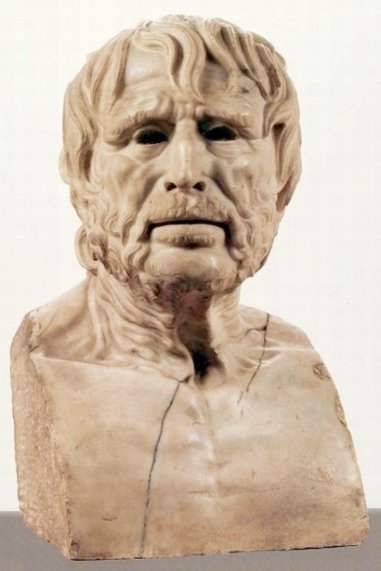
The Death of Seneca by Peter Paul Rubens, c.1615.
––––––––
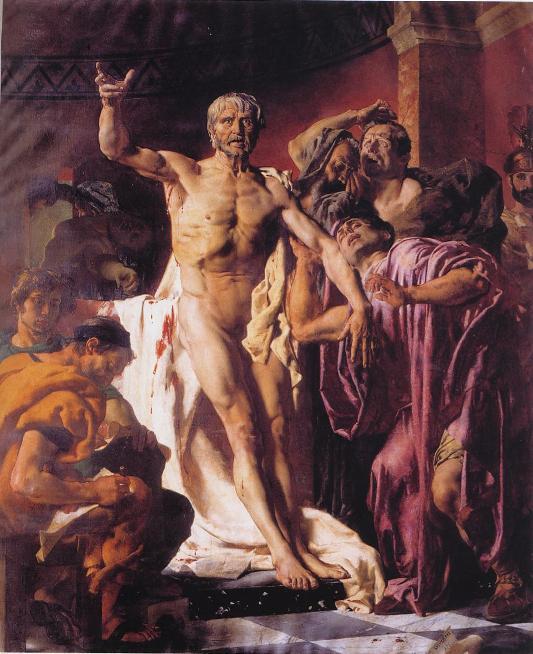
Statue of Seneca (Statua di Seneca) in Córdoba, Spain.
––––––––
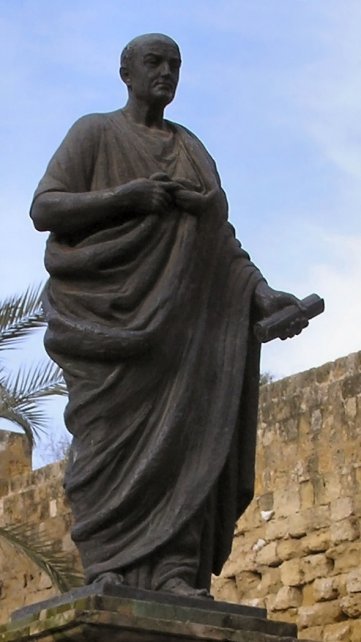
The Death of Seneca is a 1773 painting by Jacques-Louis David, now at the Petit Palais in Paris. It shows the suicide of Seneca the Younger.
––––––––
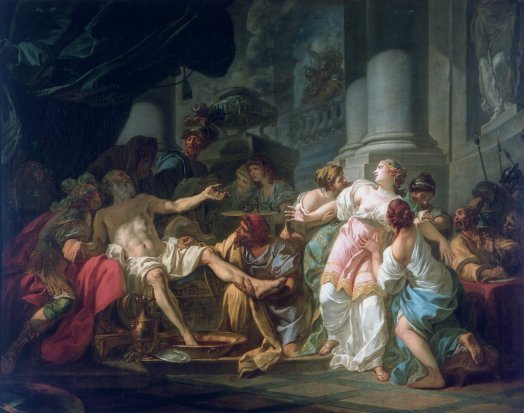
A Pseudo-Seneca from the British Museum.
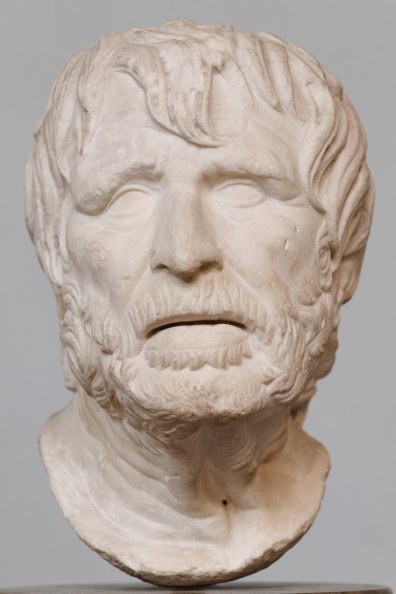
Bust of Gaius Caligula at the Getty Villa Museum in Malibu, California.
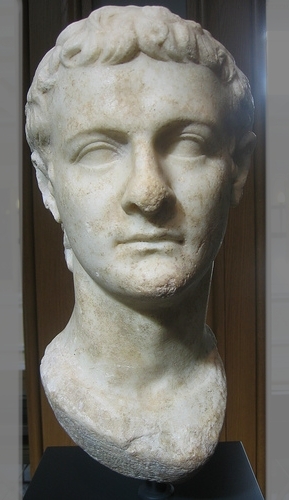
Photograph of a bust of Tiberius, housed in the Louvre.
––––––––
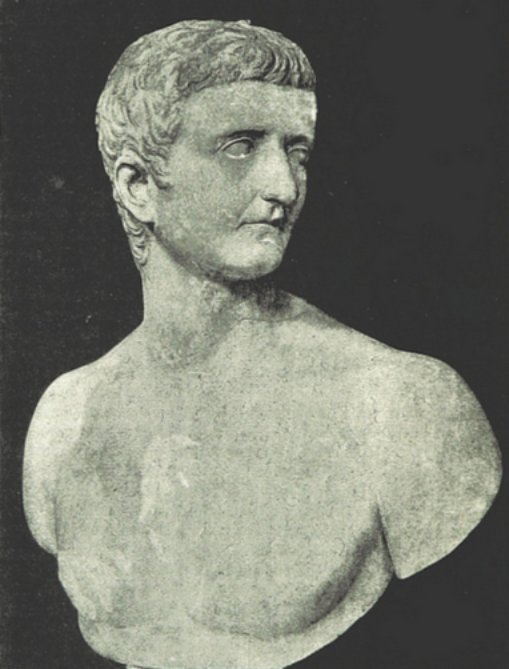
Remnants of Tiberius' villa at Sperlonga, on the coast midway between Rome and Naples.
––––––––
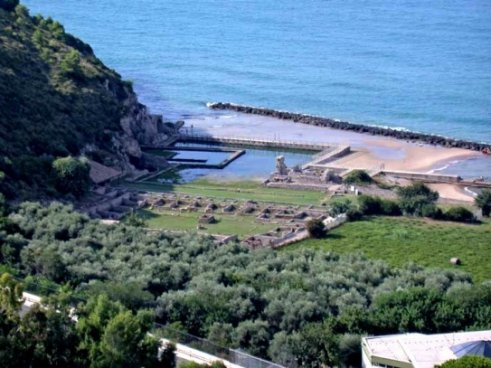
Ancient bust of Seneca, from the Antikensammlung in Berlin.
––––––––
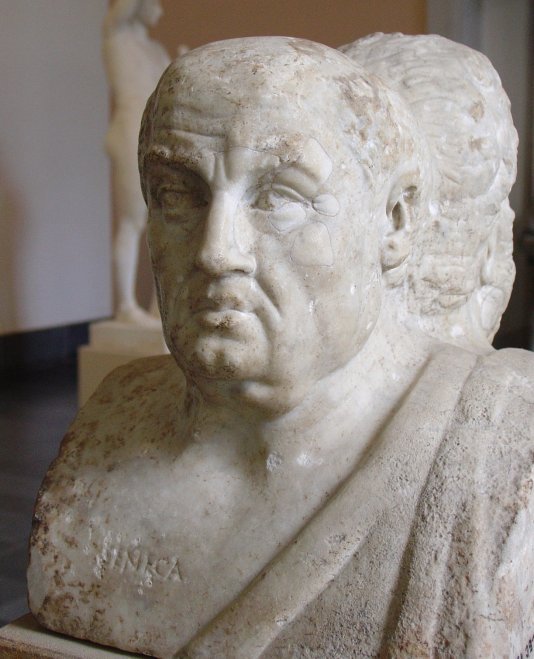
––––––––
Zeno of Citium. The founder of Stoic Philosophy, seen in a bronze bust here, a copy of the original marble.
––––––––
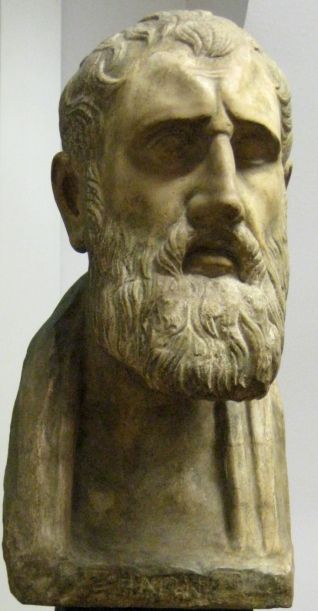
Antisthenes. Antisthenes is considered the founder of the Cynic school of philosophy. He was certainly the first to outline its tenets which contrast sharply with the more positive and humanistic ideals of Stoicism.
––––––––
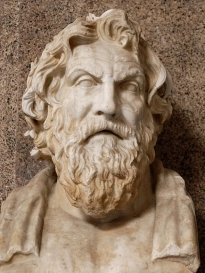
Bust of Emperor Nero. Seneca was tutor to the young Nero and later a close advisor making the Stoic philosopher one of the most influential men in Rome.
––––––––
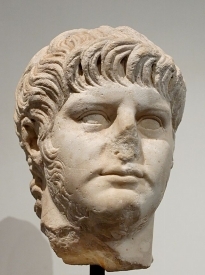
“True happiness is... to enjoy the present, without anxious dependence upon the future.” - Lucius Annaeus Seneca.
De Vita Beata or On the Happy Life is a dialogue written by Seneca the Younger around the year 58 AD. It was intended for his older brother Gallio, to whom Seneca also dedicated his dialogue entitled De Ira (On Anger). It is divided into 28 chapters that present the moral thoughts of Seneca at their most mature. Seneca explains that the pursuit of happiness is the pursuit of reason – reason meant not only using logic, but also understanding the processes of nature.
This new edition of De Vita Beata from Enhanced Media includes an introduction by William Smith and a Seneca image gallery.