My Life’s Review

Press of
Zion’s Printing & Publishing Co.
Independence, Mi
© Copyright 1947
by WILBERN S. JOHNSON
Printed in United States of America
My Life’s Review
Press of
Zion’s Printing & Publishing Co.
Independence, Mi
© Copyright 1947
by WILBERN S. JOHNSON
Printed in United States of America
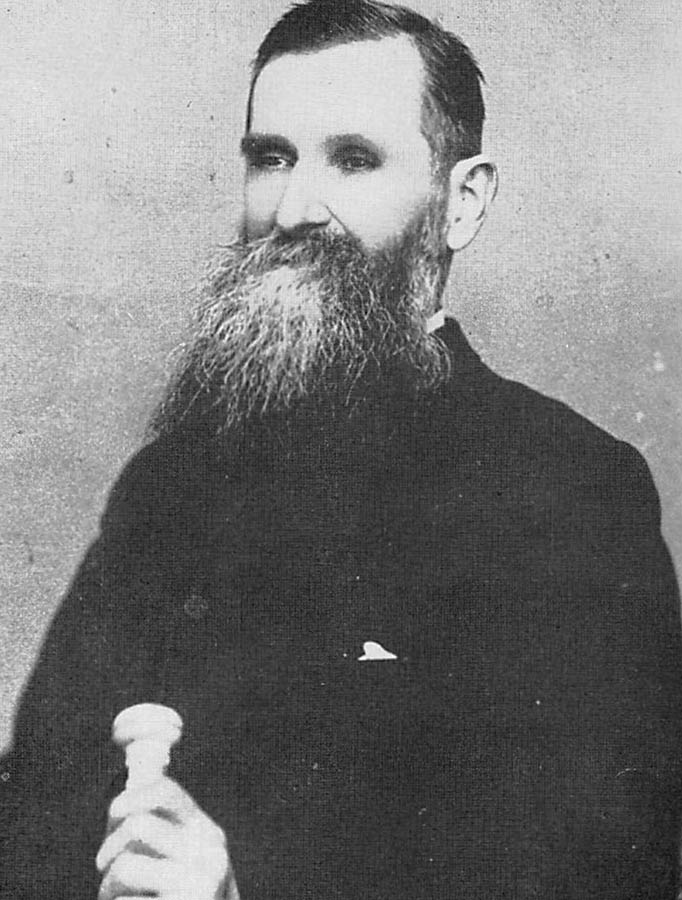
BENJAMIN FRANKLIN JOHNSON
28 July 1818—18 November 1905
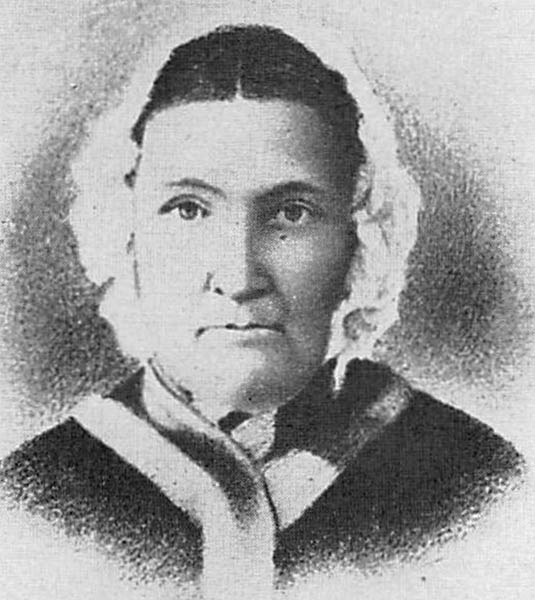
JULIA HILLS JOHNSON
Mother of Benjamin Franklin Johnson
1783-1856
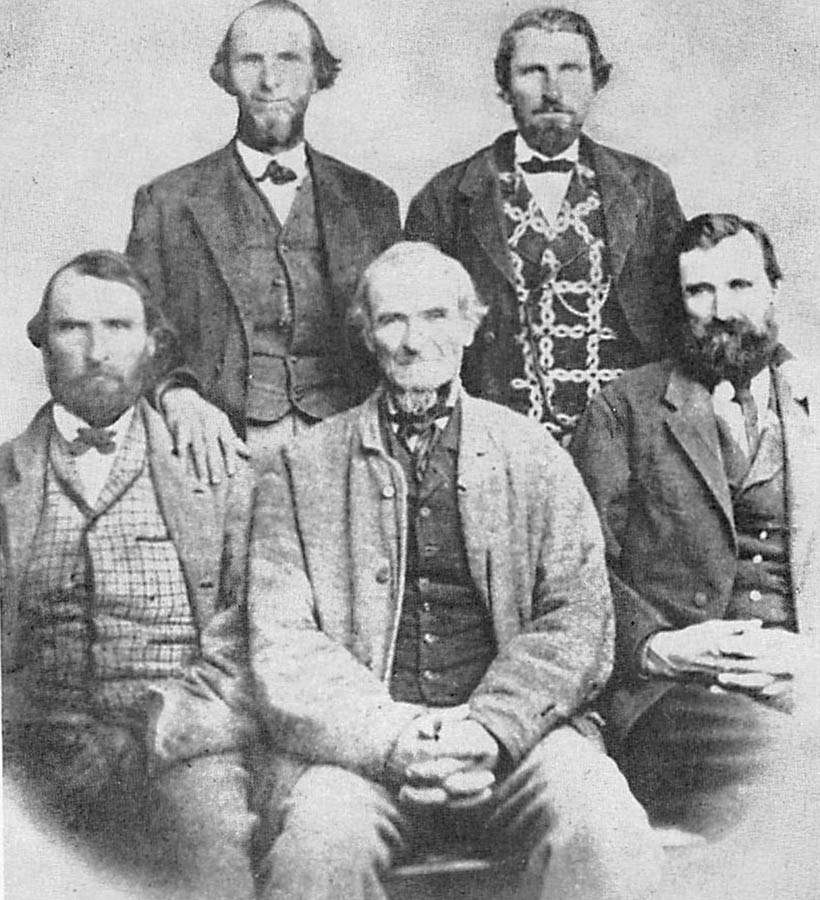
FIVE SONS OF JULIA HILLS JOHNSON
Seated, left to right: George Washington Johnson, Joel Hills Johnson and Benjamin Franklin Johnson. Standing, left to right: Joseph Ellis Johnson and William Derby Johnson.
By publishing the Life Review of Benjamin F. Johnson it will give his descendants an opportunity to know him and be influenced by his strong personality and his rich experiences. To those who knew him this book will be a source of comfort, consolation and new hope. To those who did not know him it will be a source of inspiration.
This life story will be evidence, to all who are privileged to read it, that hardships are not insurmountable obstacles before a worthy goal, for in it is depicted an outstanding characteristic of this great family-tenacious persistence toward truth and purpose.
The original "My Life’s Review" is safely stored in the fireproof vaults of the Church Office Building in Salt Lake City.
CHAPTER ONE
I was born July 28, 1818, in. the town of Pomfret, Chatauqua County, New York. My father, Ezekiel Johnson, was born in Uxbridge, Massachusetts, January 12, 1776, and my mother, Julia Hills, was born in Upton, Massachusetts, September 26, 1783.
To my parents were born sixteen children, namely: Joel Hills, Nancy Maria, Seth Gurnsey, Delcina Diadamia, Julia Ann, David, Almera Woodard, Susan Ellen, Joseph Ellis, Benjamin Franklin, Mary Maria, Elmer Wood, George Washington, William Derby, Esther Meleta and Amos Partridge. Excepting Elmer W., who died in infancy, all arrived at maturity, and all were among the first to embrace the fullness of the gospel.
In 1806 my parents moved from Royalton, Massachusetts, to Westford, Crittenden County, Vermont, from which place, in 1814, they moved to the place of my birth, in western New York.
My earliest recollections are of pioneer life, clearing deep forests with great labor for my parents, to obtain but scanty living comforts. While gathering forest nuts, wild fruits and flowers, with the tender care of (to me) a beloved and beautiful mother, loving elder sisters, and companionship of my almost twin brother; these were to me the happy features of my childhood and early youth.
At about 4 years of age, the death of my 18-month-old brother, Elmer Wood, brought to me a deep and lasting sorrow and grief, that through childhood often wet my pillow with tears and saddened my lonely hours. My mother possessed high religious veneration, and early taught me faith in God and the necessity of prayer. At this early period, so soon after the war of 1812, and in what was then a wild and almost frontier region, with heavy primeval forests to clear away before a meager crop of anything could be raised from the virgin soil for food, it seemed to require a giant fortitude and great patience on the part of all, to wait for results. My father for a series of years wrestled with the herculean task of clearing off the forests, but worn with incessant labors and the care of so large a family, he sought for a stimulus, and in my earliest childhood became addicted to the use of ardent spirits. Neither his labors nor his love for his family seemed to diminish, yet the fiend of unhappiness had entered our home to break the bonds of union between our parents and to destroy the happiness of their children. In looking back over my childhood it almost seems that I was born to be a child of sorrow, for such was my love for both of my parents that because of the troubles and unhappiness my heart at times would seem almost ready to burst with sorrow and grief, and a feeling always seemed with me to wish that I had died at my birth, or that I never had been born.
With the deepest sympathies for our father’s hard labors all his boys early learned to be helpful, and even at six years of age I was accustomed to follow him in the summertime to the forests and fields, to pile and burn the brush, or in planting time, to drop the seeds, or in haying, open the swaths for drying the hay, and no one then old enough to become in any way a help was left to be idle. All our support and home comforts were produced by our home industry; from the wool all our winter clothing was made for the men and boys, and from the flax all the summer clothing both for women and men; also all the bed and table linen and toweling. At this period young women were not thought qualified for marriage, who could not, through their own industry provide all these things. Our cheese, butter and honey were home products, as also sugar, thousands of pounds of which we made from maple forests; while soap and candle making, with beer brewing were common, homelike events.
While yet in childhood I was accompanied by my mother or those older than myself each Sabbath to the Sunday School and Presbyterian meeting. Here I learned to read and write from the Bible and to begin to be afflicted with the idea of a future punishment, with literal fire and brimstone to those who did not "get religion" or a "change of heart." Before I was ten years of age I was greatly exercised with anxiety and fear upon this subject, and until I was past 13 years of age, and had received the gospel, I did not cease to attend all their religious meetings and revivals, hoping I might obtain that forgiveness of sins that would release me from the fears of that awful burning pit so powerfully portrayed.
In my earlier years, although but a child, I was often led to wonder at the difference between the present and former religions, and especially in the life and character of their advocates. And in reading of the persecution of our Savior, His apostles, and the prophets, my very soul would become enthused with the wish that I had lived in their day, or that the day of prophets and revelation might come again while I yet lived.
In the year 1829, in our village paper, was published an account of some young man professing to have seen an angel, who had shown and delivered to him golden plates, engraved in a strange language and hid up in the earth, from which he had translated a new Bible, and I could hardly refrain from wishing or hoping it might be so. I think it was the year previous that there was seen at night in the heavens a large ball of light, like fire, which passed from the east to the western horizon. My older brothers who were out hunting coons, saw it and came home to tell of the wonder they had seen. When I asked my mother what its cause or meaning was, she said it was one of the signs of the near approach of the coming of Christ, or the day of judgment. This remained upon my mind a subject of deep thought, and I afterwards learned from those who should know, that this sign was given the night following the day on which the plates were taken from the earth by the Prophet Joseph.
In childhood my advantages for parental instruction and discipline were not great, owing to my mother’s large family and my father’s intemperate habits, but no influence was so potent as the love of my parents and my home, to restrain me to obedience and to the love of truth. Yet in no degree was my mother or my elder sisters remiss in their Sunday readings, and teaching us from the Bible, or at other times when opportunity would permit. My school education was less than it would have been, had I loved school more, and possessed a greater aptitude for learning. My bashfulness and great susceptibility to slight or ridicule made me jealous and fearful, and did much to suppress my capability to learn. When about nine years of age my brother Seth, then about 21, commenced to teach our district winter school, and in summer it was taught by Nancy, my eldest sister, but from this period I was permitted to attend only the winter terms. My brother, Joseph E., who was just fifteen months older than myself, possessed all the facilities for acquiring education that I lacked. We were constant companions, and he, being capable of taking the first prizes in our school, my pride and anxiety all followed with him, so that if duties at home were likely to interfere with his success, I assumed them, even in staying from school, through fear that he would not obtain the highest prize or honors of our school and class. Thus things continued with me, and I made slow progress in my schooling.
About 1830 my oldest brother, Joel H., sold his farm and mill and moved out to Amherst, in Loraine County, Ohio, soon after my oldest sister, Nancy, was thrown from a horse and her thigh bone was broken close to its hip socket. This to me seemed a terrible calamity, especially as the doctors told us she would remain a cripple for life.
About this time we began to hear more about the "Golden Bible" that had been found by "Joe Smith" the "money digger," etc., etc. My elder brother, David, having gone to visit Joel H. in Amherst, Ohio, had remained there until the next season, in the spring of which the first elders, going from Kirtland to Missouri, stopped and raised up a large branch of the Church into which both of my brothers were baptized. Previous to this, rumors had come from Ohio of the spread of what was called "Campbellism," a new sect, of which Sidney Rigdon was then the chief apostle, and through fear that my brothers would become deluded by the new doctrines, my mother had written a letter of caution to them, which was soon answered to say that they had both joined the "Mormonites" (then so called), believers in the Prophet Joseph Smith and the Book of Mormon or "Golden Bible." This news came upon us almost as a horror and a disgrace. The first news was soon followed by the Book of Mormon, accompanied by a lengthy explanation, on the receipt of which my mother, brother Seth, sister Nancy, a d Lyman R. Sherman, with some of the neighbors, all devoted to religion, would meet together secretly to read the Book of Mormon and accompanying letter, or perhaps to deplore the delusion into which my brothers had fallen. But their reading soon led to marveling at the simplicity and purity of what they read, and at the spirit which accompanied it, bearing witness to its truth. After a few days of secrecy I was permitted to meet with them, to hear it read, being then 13 years of age; and in listening, a feeling of the most intense anxiety came over me to learn more. It seemed as if I must hear it all before I could be satisfied; and the principle of faith began to spring up in my heart to believe it. This was in the early fall of 1831. Now a bright hope began to arise in my heart that there really was a living prophet on the earth, and my greatest fear was that it would not prove true.
Later in the fall my brothers came from Ohio to see us and bear their testimony, and were accompanied by Almon W. Babbitt, then not seventeen years of age. They bore a faithful testimony, but neither of them seemed capable of teaching in a public capacity. As a family we were being converted to the truth, when unexpectedly there came to us Elders James Brackinbury and Jabez Durfee. Elder Brackinbury was a capable man and a great reasoner, and the Spirit of the Lord rested mightily upon him, confirming the words we had already received. My mother, and Lyman R. Sherman, my brother-in-law, were soon baptized, shortly followed by the baptism of all my brothers and sisters who had attained their majority. At this time my father was employed upon job work as a carpenter in Fredonia and not being inclined to accept the gospel, would not permit us minor children to receive our baptism. My mother, brothers, sisters, brother-in-law and neighbors who were now in the church had always been esteemed among the most eminent in religious society, and the news spreading around, the priests began to howl about Faith, Prophets, and Delusion, and to do all possible to turn us away from the truth, calling publicly for "signs," etc., asking why my sister Nancy, who then walked upon crutches, was not healed? But upon the subject of her being healed I have written more fully in "Faith Promoting Series."
CHAPTER TWO
All my father’s family, except himself, now believed, and with many of our neighbors had obeyed the gospel, except those under age. And now it seemed as though Satan was permitted to try both our faith and our fortitude, for after a few weeks of the most powerful and successful preaching, in the midst of ridicule, scoffing and persecution, Elder Brackinbury was taken sick and within a few days died. Our enemies now felt they had a great triumph; for where now were the gifts of the gospel when our strongest man could die, and my sister, though she had embraced the gospel, was yet upon her crutches? These things seemed at the time a great trial, yet in no degree did it dampen the faith of any, and while listening to the ravings of our enemies, the truth, with the love of it, became the more deeply planted in my heart.
The evening after the funeral and burial of Elder Brackinbury all were gathered at my mother’s with the feeling of mourning, and praying together. Late in the evening my brother David felt troubled in mind, and when interrogated, said our enemies were then digging up the body of Elder Brackinbury. They soon started to the graveyard, which was about one mile distant, and on their approach found a party of men around, and one in the grave just ready to remove the body. They instantly fled and were pursued by my brothers and friends. My brother David captured a large and powerful young man, older than himself, and nearly double his size, who was brought before a magistrate, and bound over to appear at the next term of court. My brother Joel on his return in early spring to Ohio, wished me to accompany him, which I did, and although only past thirteen years old, traveled on foot over 200 miles in one week, carrying my bundle of clothing. The year previous I had cut my ankle with an axe, took cold in it, and for a time it was feared I would lose my leg. The ankle was still weak, and the misery of that journey can only be known by my good angel and myself.
In the course of the summer, my father, Seth, Susan, and others came from our home in New York to Kirtland, Ohio, saw the Prophet Joseph, and later came to us in Amherst. My father then appeared favorably impressed, and to all appearance was becoming confirmed in the faith and truth of the gospel.
While in Amherst, at my brother Joel’s a mania seemed to come over Seth, whom we all so dearly loved; and who was regarded by all as a gentleman and a scholar-a pattern for all young men. Apparently this was because of his extreme anxiety to see our father converted to the truth and redeemed from intemperance. Our first intimation of this mania was the discovery that he had left the house in the night, and when, after anxious searching and waiting for him, he came back about 10 o’clock A.M. next day, his mind in a wild and deranged condition. We found he had traveled near 100 miles in that short period of time. He returned home with my father, and remained weakened in mind for a few months, but was the same fall able to come to Ohio, from which place, after a short stay, I accompanied him home, after which he became to all appearance perfectly sound in mind.
Our hopes that our father would embrace the gospel were blighted, for all the light that had been reflected upon his understanding seemed turned to darkness, and so great was his darkness that at times it appeared like the buffetings of the Evil One.
Thus things remained until my father concluded to sell our home in New York and move to Chicago, which then was but a small frontier town. With this view he sold his two farms in the fall of 1832, and in the early spring of 1833 sailed up the lakes with the understanding that we were to give possession before the first of June and he would send us instructions as to when we were to come to him. But time passed, and no letter of instruction came; and being compelled to give possession of our home, we started for Ohio, and arrived at Kirtland early in June 1833. Some of our wagons and teams were traded for a home on what was then called "Kirtland Flat," close by the schoolhouse. My father at Chicago had bought a quarter section of land, and had written, but through some overruling providence his letters miscarried, and after waiting a length of time he disposed of his land and returned, to find us all at Kirtland. My mother being unwilling to leave Kirtland, my father concluded to remain, though apparently under protest, for his feelings had now become bitter through his disappointment. And here I will say, that although my father was apparently opposed to the truth, and had developed habits, yet he was a man of the highest organization. As a husband and parent, he was by nature the most tender and affectionate. As a neighbor and friend, most obliging and true, and was a man of truth and honor among men. Never-was a question known to be raised as to his integrity, for his word was his bond; and in all things he was a gentleman in the fullest sense, except only in the habit of intemperance, which at times would seem to change his whole nature. He was a man of full middle stature, about 5 ft. 10in. in height; of solid build, fine light brown hair, a mild but piercing blue eye, with light smooth skin, and of natural personal attractions. He was beloved and sought after by his friends, and for his words only he was feared and avoided, for with no other blow than words was he ever known to strike anything living.
In the fall of 1833, while yet there were but few saints in Kirtland, and those all of the poorer class, it was required .by the Lord that a temple should be built at that place. As at first it was designed to build it of brick, my brother Joel H. was called upon to burn them. After obtaining a brickyard belonging to Brothers Joseph and Thomas Hancock, I went to work to assist in making them. Here my brother David, a young man of twenty-three years of age, 6 ft. 3 in. in height, straight, and of the finest build and deportment, through his ambition in labors upon the yard, and in procuring wood with which to burn the brick, overtaxed his strength, took severe cold, and commenced bleeding at the lungs. He lingered for a few weeks in quick consumption, and died as he had lived, a true Latter-day Saint. His last testimony was given through the gift of tongues, which was interpreted by Brother Don Carlos Smith, who as his friend and companion, was present at his death, which occurred October 30, 1833.
Previous to this, the purpose of building the temple of brick was abandoned, as a stone quarry at easy distance was opened to obtain the rock for its construction. But such was the poverty of the people at the time of breaking ground for its foundation, that there was not a scraper and hardly a plow that could be obtained among the Saints.
At the laying of the cornerstones of the temple, in the spring of 1834 my brothers, Joel H. and Seth, and brother-in-law, L. R. Sherman, assisted.
On the night of the 14th of November of that year was seen a fulfillment of one of the noted predictions of our Savior pertaining to the last days, that we had so often heard quoted by the elders, that "the stars should fall from heaven a a fig tree casteth her untimely figs." But my pen is inadequate to give a description of the scene then presented, for the heavens were full of a blazing storm, from zenith to horizon, and a view more sublime and terrible the eyes of man may never have seen. To the fearful it struck terror, and even some of the Saints seemed almost paralyzed with fear, for it appeared for a time that both the heavens and the earth were on fire. I gazed upon the scene with wondering awe, but with a full realization of its purport as a sign of the last days. I afterwards learned that it occurred on the night following the driving of the Saints from Jackson County, Missouri.
The winter of 1833-34 I attended district school in Kirtland. Brother Joel H. bad bought some wild land in the township, and also built a sawmill. So in clearing land, making maple sugar, hauling sawlogs, running sawmills, and sometimes working for our neighbors, my brother Joseph E. and myself spent our first year, including the brickmaking.
As we bad no permanent business at home to occupy both Joseph and myself, and there being at home three brothers still younger, I deemed it better to look for some permanent employment, and engaged to Brother Uriah B. Powell to learn the saddlery business at $24 a year with board. Previous to this, however, the mob had driven the Saints from Jackson County, and Zion’s Camp was preparing to start, in which I desired to accompany my brother Seth, and brother-in-law E. R. Sherman, with A. W. Babbitt, who was to marry my sister, Julia. But the Prophet deemed it not best for me to go, owing to the opposition of my father, and as I bad not yet received my baptism. I was assured by the Prophet Joseph that no loss should come to me for waiting, for although not fully a member I had partaken of every hope, desire, and spiritual influence with which those around me were animated. It was with a joy almost unspeakable that I realized that I was living in a day when God had a prophet upon the earth.
In the summer of 1834 Father Joseph Smith, Sr., commenced to visit the families of the Saints and give patriarchal blessings, and greatly was the Spirit of the Lord manifested among the Saints in the gift of tongues, with interpretation, prophecy, and the gift of healing. In the course of the summer Elder Jared Carter, a man then of mighty faith, came with other elders to our house, and seeing sister Nancy upon her crutches commanded her in the name of Jesus Christ of Nazareth to leave her crutches and walk, which she at once did, and never again did she use them, although for years she had borne no weight upon her broken joint. We all knew it to be the power of God, and almost felt to shout Hosanna! to think pure beloved sister was again sound in limb and able to walk But in the midst of our joys then, oh, how many sorrows to us the future had yet to disclose. I now thought of what was so often said by both enemies and friends, in my native town, and felt that now my sister was healed all that would be needed for their conversion was for me to go and tell it to them. But all this proved a great mistake, as I may farther on relate.
After working with Brother Powell a few months as apprentice, he broke up business, and I sought employment in running a sawmill, carpentering, etc., until winter. Meanwhile many of the members of Zion’s Camp were returning home, among whom was my brother, Seth, Lyman R. and A. W. Babbitt. My brother, Seth, returned quite feeble in health, having nearly died of cholera, of which a number of the brethren had died in Missouri. Yet he felt as he always did that he must be useful, and although weak in body he engaged to teach a large school in the town of Willoughby, a few miles from Kirtland. Here he taught while I attended school in Kirtland until February when failing health compelled him to return home. Here all was solicitude-our beloved brother had come home, perhaps to die-a brother beloved by all who knew him, of whom no unkind word was ever known to be spoken; by me more than beloved, almost worshipped! Must he-could he die and leave us? Oh the cruel agony of such bereavement to the young, to whom in such sorrows, life appears so long and lonesome. But after all our anxieties, prayers and tears, in the midst of his testimonies to us and blessings upon us he died February 19, 1835. And even now, that I am growing old, and the time is hastening when I may, if faithful, meet and greet the departed, yet in calling back this and other bereavements of my youth, my heart again swells with emotion and my eyes become blind with tears. Yet there was one consolation that the Lord had reserved for me, relating to this brother that I will relate:
During his sickness a personage appeared to him and told him that had he retained his faith and his desire to live, there was a work for him to do on earth, but that it was all well, for a greater work was now awaiting him, and that the Lord would raise up another to do his earthly work. But the idea, that another was to do his work, and perhaps take his blessings, was not consoling to me. And it grieved me much when the members of Zion’s Camp came forward for their blessings, to think that another might step in and take the blessing of one who had gone forth in feeble health and had shortened his days by his self sacrifice. But I had I not long to wait for comfort.
In the spring of 1835 before I was baptized, my mother and all her children met at the house of my sister, Delcena Sherman, to receive from Patriarch Joseph Smith, Sr., our patriarchal blessings. He blessed all according to age until he came to Joseph E. and myself, when he placed his hands first upon my head. My mother told him I was the youngest, but he said that mattered not-to me was the first blessing; and in blessing me, among other great and glorious things, he told me the Lord would call me to do the work of brother Seth, who had been called away by death; In this promise there was to me more joy than ever: before I had known; my dear brother was not to be robbed of his blessings, and if I could only live faithfully his work would be done, and I should do it for him. I felt this was the greatest boon the Lord could bestow upon me.
Soon after this, I overstepped my father’s objections, and was baptized by Elder Lyman Johnson. My sister Julia was now married to Elder A. W. Babbitt, and I will relate here one item pertaining to him. The Prophet Joseph, in blessing him as one of Zion’s Camp, told him of much good he would do in preaching the gospel, and how the hearts of people would be drawn towards him, and the greatness to which he would attain, etc., but that he would at last be overpowered and fall by the hand of an enemy. This Brother Babbitt also saw in a dream, which he related some years previous to his death.
My blessing from Father Smith was to be realized in spiritual ministrations and labors, while Joseph E.’s blessing related to the greatness of his work in temporal things.
Owing to my father’s continued unbelief, opposition to the truth, and intemperance, it was deemed better that he should live apart from the family, to which he consented. He bought him a place in the adjoining town of Mentor, where one of my sisters would keep house for him, and where the younger children often went for a time to stay, and where I spent a part of my time.
At this period, upon my mother rested the responsibility of providing for the family, consisting of three boys and two girls younger than me, and my sisters, Nancy, Almera and Susan, who were older. With their assistance she commenced the manufacture of stocks, a fine article of men’s neckwear, and of palmleaf hats, then just coming into use, both of which they supplied to the merchants, and thereby obtained a comfortable livelihood.
At this particular period the Temple was progressing, the Quorums of the Twelve and Seventies were organized, and the first elders were being sent out. Brother A. W. Babbitt had already returned from a very successful mission in New York. Returning to his field of labor he invited me to accompany him to my native town in the same state, which I was very anxious to do, as I had not forgotten how all our neighbors had promised to believe and obey the Gospel if my sister Nancy should ever again be able to walk. I knew she had been heal ed by the power of God, and I thought it only necessary that I should go and tell them so, and all would at once be converted. But it would require money to go with, which it was almost impossible to obtain in Kirtland. About all the circulating medium among the Saints was the "Kirtland Scrip," signed by the Prophet Joseph and others, which originated in the "Kirtland Bank." Of this "scrip" I had procured as much as would be needed for my expenses for the journey, but no one would think of giving coin in exchange except at a great discount, and that would leave my amount too small. So after pondering the matter for a time in great anxiety, I took my scrip to the Prophet Joseph, told him where I wanted to go, and asked if he would give me money in place of it. He said, "Yes, Bennie, I will. It is right for you to go." And he comforted and blessed me, and his words made me more joyful than did the money, which I so much desired, and in other ways I now began to be better acquainted and more familiar with him.
The forepart of October I started with Brother Babbitt to visit my native place, designing to take steamboat at Fariport for Dunkirk, but storms were rising, and fearful of the waters we traveled through mud and storm on foot over 150 miles to the place of my birth. I had been absent about two years and a half, and although my old companions and neighbors seemed glad to see me, I soon learned that they were not so anxious to see me as I had been to visit them. When I told them my sister was healed, and that it was by the power of God, all interest seemed dead, and they felt no desire to talk upon the subject. After a few days of disappointment and chagrin, disgusted at my overanxiety to visit them and my misplaced confidence in their sincerity, I took steamboat at Dunkirk and gladly returned home.
In the following winter I attended the "School of the Prophets" with the Prophet and most of the first elders of the Church, where was first taught the Lectures on Faith, as contained in the Doctrine and Covenants, and grammar was taught by Elder Wm. E. McLellin. I also attended an evening class in geography in which I rapidly acquired the elements of that study, which inspired in me a thirst for history and other reading.)
But about the 1st of March of this year, my sister Susan, about twenty-two years of age, was taken suddenly ill, vomiting blood. All possible was done for her, that the loving sympathy of kindred, friends and physicians could suggest, but without avail. She lingered but a few days and died as she had lived, faithful to her religion. Just before death she called each of us to her bed, bore to us her testimony of the truth of the gospel, told us to be faithful to its trusts, bade us farewell, and fell asleep March 16, 1836. Such bereavements come with crushing weight. So much sickness and death tended not only to keep us as a family limited in means, but no doubt the more prompted us in humility to seek the Lord.
Previous to the dedication of the Temple on the 27th of March, 1836, all who had labored upon it were called together, and in the public congregation received their blessings under the hands of the First Presidency. I had attended all the meetings, listened to the blessings given, and felt a great joy in these prophetic words that filled and thrilled me. Yet all the time I was thinking that these blessings would only be for those who had labored with their hands upon the Temple, and all had not myself worked upon it not being strong enough for such labor I would not receive any blessing, and it grieved me exceedingly to think that perhaps through my neglect I was to be deprived of that which to me appeared of more worth than all earthly things. en on the last. day of blessings, I was standing by the door in the crowded congregation, and oh! how I did yearn for a blessing! And as the last blessing, apparently, was given, the Prophet earnestly looked towards the door where I was standing, and said to his brother Hyrum, "Go and see if there is not one more yet to be blessed." Brother Hyrum came to the door, and seeing me, put his hand upon my shoulder and ask me if I had not worked upon the Temple. I said, No sir, " but it seemed like passing a sentence upon my fondest hopes. He then asked if I had done nothing towards it. I then thought of a new gun I had earned and given as a donation, and of the brick I had helped to make. I said, "I did give often." "I thought," he said, " there was a blessing for you," and he almost carried me to the stand. The Prophet blessed me, with a confirmation of all his father had sealed upon me, and many more also. I felt then that the Lord had respect for my great desire. Even to be the youngest and last to be blessed seemed to me a high privilege. When the Prophet had looked towards the door, I felt as though he would call for me, though I could not see how I had merited so high a privilege. But so it was, and my joy was full.
I attended the dedication of the Temple and all subsequent public meetings. I knew of the endowments received by the elders, and learned of the ministering of the angels at the time of their appearance in the Temple; but as I had not yet received the priesthood I did not receive the higher blessings. Greatly now was the power of God manifest ed in the gifts of the gospel, and a general joy pervaded the hearts of the Saints.
About this time measles and whooping cough spread through the town, with which my brother, then eight years of age, came nigh unto death, his condition appearing hopeless. My father brought to see him two professors from Willoughby Medical College. They examined him, and in great gravity whispered together, and without one word of encouragement left a vial containing some powerful drug to be given as an experiment. My mother had sent for the Elders and as soon as the doctors left, Brother Bosley and others came in. My mother said the doctors had given no hope but had left the vial of medicine, which she handed to Father Bosley, who threw it out of the window. He then administered to my brother, commanding him to be made whole, which he was, from that hour. When the physicians returned they looked with surprise to see so great a change, and were taking great credit to themselves, but when told their medicine was thrown out of the window, and that my brother had been healed by the power of ,God they were greatly chagrined, but made no attempt to deny it. I mention the above as one instance among many that were so common among the Saints in the early history of the Church.
In the course of that year, the Egyptian mummies were bought from Mr. Chandler, by whom they were received from Egypt. Great was our wonder in looking upon the bodies of those who, 4,000 years ago, were living princes and queens. And when the writings of Abraham upon papyrus, which accompanied them were taken from its ancient casket, it seemed marvelous indeed. And all rejoiced when the Prophet told us these writings would be translated, which are now, in part, in the Pearl of Great Price.
It is proper here to say that up to this period from our commencement to settle at Kirtland, there had been by our enemies one continual persecution of the Prophet and contempt for the Saints and their religion. And such was their opposition and hatred towards the Temple during its construction, that it had to be guarded, not only by night but also by day; and the laborers upon its walls, while with one hand they held the hammer or trowel were always ready with the other to grasp the sword. Much of my time in boyhood was spent in assisting to prepare arms for the protection of the Saints. The lower story of my mother’s house in Kirtland was at that time used by Brother M. C. Davis as a gunsmith shop, for the manufacture of defensive weapons for the use of the people.
Previous to this period occurred the great exploit of Dr. P. Hurlburt of Spaulding Manuscript notoriety. He was called "doctor" from his being the seventh son of his mother. He was of a conceited, ambitious and ostentatious turn with a degree of education, but of a low moral status. He had been baptized, ordained, and sent eastward with others, to preach the gospel. He labored for a time near Jacksonville, Erie County, Pennsylvania, but was soon for illicit association called back to Kirtland, where he was excommunicated, but afterwards rebaptized. He soon became enamored or greatly in love with Electra, sister of E. R. Sherman, and because she despised him for his immorality and rejected his suit he swore revenge upon the whole community and boastfully declared he would destroy the church. While preaching about Jacksonville he had learned of Solomon Spaulding, who once lived in that vicinity, and had written a romance called "Manuscript Found," and out of this he hoped to gain notoriety, obtain money, and work his spite upon the Mormons. So he gave notice to our enemies that he had struck a lead to destroy Mormonism, and if they would come together he would tell them where "Joe Smith" got his "Mormon Bible." He soon collected around him the congregations of our enemies, .and in pert and pompous style told them the tale he had concocted of the "Manuscript Found," which of course was good enough when they could get nothing better. And so they readily advanced him means to hunt up the manuscript, and were greatly in hopes that now Mormonism would be at an end. But to all of them it was a failure, but not to Hurlburt, for he had their money.
Soon afterward by them all he was most cordially despised. One circumstance I relate to more fully show his character. In the township of Mentor near where my father then was, lived an aged man named Randall. He was one of the wealthiest citizens and a great enemy of the Mormons. Soon after starting his anti-Mormon crusade, Hurlburt had married, and Randall had not only donated liberally but had taken Hurlburt and wife to his own house for a home. But when their disgust at his doings became so evident to him, he saw no more money would come from his dupes, and so he in connection with his wife, put up a job on the old man, and drew him into a woman snare, from which they would not release him until after payment of $500. With this money, despised and hated by all parties, he left that vicinity. I then occupied a position through which I could obtain accurate knowledge of all that transpired on both sides; my father being regarded as an opposer, knew all their secrets, none of which did he withhold from me; and as Hurlburt had boarded at my mother’s, I had good opportunity as well as reason for watching his course.
In the early fall of 1836 another wave of sorrow and bereavement was gathering to burst upon us. Nancy, my eldest sister, who had ministered to us in infancy and childhood, who had taught us our first lessons both in the Sabbath and day schools, who had ever been as both mother and sister, always self-sacrificing, and uncomplaining through all the period of her lameness and feeble health, seemed now fading away in consumption. After all our previous bereavements, could we again endure this, another severe and crushing blow? And now just as I was approaching manhood, I seemed to come face to face with the great problem, whether as a family we were not all to die of the same disease consumption, by which three had already gone, and another fast sinking! She continued to sink until the 30th of October, when, like others, she bade us all adieu, leaving us her life’s example as a testimony to the truth of the gospel.
Everything now seemed to confirm the idea of a short life for myself, if not for all my father’s children. My muscular powers were small, and though large in vitality I had but small physical endurance. Through close application to my shopwork and long readings at night, I became effeminate and weak, and some influence like the whisper of the Evil One was always saying in my ear, "You are doomed to die young." At times I would remember the promise made by Father Smith in my patriarchal blessing, and the. blessing of the Prophet upon my head, and a desire to live and fulfill them, and to preach the Gospel would enthuse my whole being. Then the Evil Power would tell me all, these blessings were forfeited, for through wild shopmate I associates while away from home, I had been led into temptation, which brought me sorrow and repentance before the Lord. But under no circumstances had I ever failed to stand firm in the defense of our religion.
After the death of my two sisters, my mother was unable to continue her business in town, and concluded, with my brother Joseph in charge, to move out about a mile upon a farm. In November, 1836, the Kirtland Bank began to develop; the Temple was completed, and a large town was being built, by the gathering Saints. A wave of speculation was spreading over the nation, and it seemed the spirit of it was caught by the Saints. The revelation in which God had given but five years of safety in Kirtland for the Saints, in which to build the Temple and obtain their blessings had been forgotten, and all appeared to feel that Kirtland was to become and remain a great center of business and religious interest for the future. But the Lord had other and greater purposes in view, one of which seemed to be to show us the weakness of human wisdom, and the folly of our idolatry, by bringing us to see our idols crumble in our hands. At this time, town property and real estate went up to almost fabulous prices, and a general rush was made into business of all kinds. Members of the Quorum of the Twelve and Elders on missions hastened home, bringing merchandise and means for general trade, while the Kirtland Bank issued its paper apparently with full confidence in the future. Goods were sold upon credit with great hope of better times; and "Why be deprived of luxury and fashion today," seemed to be the spirit of the hour. But when goods bought on credit were to be paid for, and notes became due for lands bought at great prices, then began a reaction. Disappointment engendered feelings which reacted upon fellowship, and men in high places began to complain of and reproach each other, and brotherly love was found smothered by the love of the world. The Bank having issued its currency in the same confidence now began to comprehend that its specie vaults were empty, with no possibility to realize upon collateral to replenish them. The spirit of charity was not invoked, and brethren who had borne the highest priesthood and who had for years labored, traveled, ministered and suffered together, and even placed their lives upon the same altar, now were governed by a feeling of hate and a spirit to accuse each other, and all for the love of Accursed Mammon. All their former companionship in the holy anointing in the Temple of the Lord, where filled with the Holy Ghost, the heavens were opened, and in view of the glories before them they had together shouted "Hosanna to God and the Lamb," all was now forgotten by many, who were like Judas, ready to sell or destroy the Prophet Joseph and his followers. And it almost seemed to me that the brightest stars in our firmament had fallen. Many to whom I had in the past most loved to listen, their voices seemed now the most discordant and hateful to me. From the Quorum of the Twelve fell four of the brightest: Wm. E. McLellin, Luke and Lyman Johnson and John Boyington; of the First Presidency, F. G. Williams; the three Witnesses to the Book of Mormon, Oliver Cowdery, David Whitmer and Martin Harris. Of other very prominent elders were Sylvester Smith, Warren Cowdery, Warren Parrish, Joseph Coe and many others who apostatized or became enemies to the Prophet. I was then nineteen years of age, and as I now look back through more than fifty years of subsequent experience, to that first great Apostasy, I regard it as the greatest sorrow, disappointment and test through which I have ever passed; the first real experience among false brethren, the greatest sorrow and test for the faithful. But with all my faults I did not forget the Lord nor His chosen servants. And in this, day of great affliction and separation by apostasy, I felt to call mightily upon His name, that He would never leave me to follow these examples, but that He would keep me humble, even though in poverty and affliction, so only that I fail not. This prayer of my youth I nave never forgotten, neither do I feel that it is forgotten by Him to whom it was made.
In the summer of 1837 through failing health, I had left my employment and returned to my mother’s and there was a season of great scarcity for the poor in Kirtland. A great financial crisis had come, and money could not be obtained. The Kirtland Bank, with all the "Wildcat" banks of the country went down. To make our Mormon bank odious to our enemies and entail disgrace on the Prophet, as he was the president of the institution, the cashier, and secretary, Williams and Parrish signed and issued a large amount of bank notes to runners, with which to swindle the more ignorant people of the country, the disgrace of which did not follow its perpetrators (who had apostatized) but the Prophet and those who remained with him, true to the great cause.
The split in the Church was now so great, with the principal wealth on the side of our enemies, that they claimed the Temple, printing office, and everything regarded as church property. Writs were out for the Prophet and others for all public debts. So in midwinter with his father, Hyrum, and a few others he started as best he could for the far west. The printing office and material which our enemies thought to us. e to bolster up a church organization opposed to the Prophet was set on fire by Brother Lyman R. Sherman and destroyed. Those faithful to Joseph made all possible baste to follow him to the west. My mother and all of her children were of that number. But the same feeling still followed me that I was fated to die young, and should I start would not live to perform the journey. My anxieties at that time were not from a fear to die nor from a great desire to live, but there was a feeling almost akin to horror in the thought that my name would be blotted out from the living. And like Jeptha’s daughter I felt to "bewail" an early death. Often I have felt to tell the Lord that if He would spare my life to see one son who would bear my name after me in honor to him, I would promise. to die without regret; and it seemed that every ambition, hope or inspiration for life was swallowed up in that one desire.
In the early spring of 1838 an effort was made by the local authorities to draw the line of fellowship on practices which then seemed tending to demoralize, among which was dancing and late night associations, to which little heed was paid; and soon a long list of names was left with the High Council to be dealt with, and notice was given to each by its clerk. I had never danced, and rarely attended a party, but from some cause my name was in the list, and I received notice to appear and answer. I answered by letter in a spirit of meekness, and said I wished to live a L. D. Saint but was not satisfied with my present baptism, and if they felt it right to drop my name it would be satisfactory to me, for I would take an early opportunity to come in again by baptism. Feeling truly humble this spirit was conveyed to the hearts of the council, and they said Brother Benjamin’s letter was satisfactory and carried with it a purpose to be a true L. D. Saint.
I now felt great anxiety that the way would open that my mother and the children (three brothers and two sisters younger than myself, with my brother Joseph who was past fifteen months older, and about twenty years of age) might obtain an outfit, for the journey was now my greatest desire. My brother Joel owned a sawmill with land and other property, and my mother owned quite a good farm, but now all real estate was as worthless as it had the year before been valuable, but with hope and increasing faith we all worked with our mights to prepare for a start the coming season to the west. By the 4th of July we had obtained just teams and wagons enough to carry the families of my mother and oldest brother with their beds and company outfit. To facilitate the matter all their most valuable furniture and goods had been shipped by water, to go by St. Louis up the Missouri River to Richmond, Ray County, Missouri.
CHAPTER THREE
Up to this time I had not concluded to go with them, fearing my poor health might make me a burden on the way. I felt it would be better to stay with my father and my sister Almera, who was married and living near my father in Mentor, and was likely to remain for a year or more. So, while lending all aid possible and assisting in their starting with the company I was not expecting to go with them; and not until they had started, and some refractory stock to be driven made it necessary for me to go with them for a distance, did I resolve to go.
As soon as this resolution was formed, a new faith and feeling sprang up in my heart, and I felt that the Lord had heard my prayers. I felt sure I was not soon to die, a dark cloud rolled from over me and a great weight from my heart; and to all in camp it was surprising to see how fast I increased in health and ability to assist in our camp life. But to none was it so great a surprise as to me, and I felt in my heart to thank God and to devote myself to doing all the good in my power. In starting we had joined what has since been known as the "Kirtland Poor Camp," called so from the fact that the wealthy had apostatized, and those who had means enough got an early start; while the poor, by all journeying together could make an outfit and travel with much less expense.
Our start was on the 4th of July, 1838. The company consisted of over 60 wagons and near 400 souls, organized under the direction and leadership of President Joseph Young, Elias Smith, Jonathan Dunham and others. All means for defraying expenses were put together, and so all were to fare alike, and did so long as they remained in camp together.
So large a company, poor in appearance, and known to be Mormons, passing through the country where runners with Kirtland money had swindled the people, caused us to be more or less objects of contempt and persecution, and in a number of towns writs were served upon our leaders to compel a redemption of Kirtland bank notes. But the blessing of the Lord was with us, and there was always a way open for escape, and friends always at hand just in time of need. So in a good degree of comfort we arrived at Dayton, Ohio, where, as means to defray expenses began to be short, it was deemed better to obtain work on a public road then being constructed. So we remained there one month, in which time I went twice to Cincinnati to visit my kindred and do business for the company. On returning from my last visit I found much sickness in camp, and some deaths had already occurred. The wife of Benjamin Willey had died and Brother Willey was very sick, also some children. So much sickness in my mother’s family, and so much ill health myself, had made me acquainted with nursing the sick, and in some degree the use of medicine, with which I had commenced in a small way to deal, and to read medical works. And as I had now become well and strong physically I adopted the sick as my especial charge. Brother Willis appeared nigh unto death with typhoid malarial fever, and on traveling through the day but little could be done for him, but at night I gave him my undivided and sleepless attention. For three weeks in this manner I did care for and nurse the sick by night and travel on foot-by day, only obtaining sleep by the roadside as I got in advance of the company, or while feeding the teams at noon. Often did I carry my little chest of family medicines and other small articles of trade to exchange for butter, eggs, chickens and fruit, and anything suited to the appetites of the sick and feeble. Such was the increase of my health and hopes that I felt that I could do or endure anything to prove my gratitude to the Lord, for His blessings. In our traveling I was often ahead or behind the company, and so was liable to be interrogated as to who we were and where we were going, etc., and this afforded me just the experience I needed, and my answers and testimonies were never wanting. I often found myself surrounded by large numbers of both priests and people, but never was I insulted nor abused.
On one occasion while passing through a town of considerable size in western Ohio, I stopped before a large tavern to answer a question. I was covered with dust, without a coat, and barefoot, and feeling mortified at my appearance wished to hurry on, but other questions were asked and I could not leave them unanswered, until I forgot to answer one question at a time and commenced to talk, and as I proceeded the people gathered, and when I ceased and looked around there were hundreds before me and all windows were open on both sides of the street, and crowded with listening women; and all appeared to wonder at the dirty, barefooted boy. But no one marveled more than myself, and it was near night when I left them and had eleven miles to walk to camp.
The next day being Sunday, a number of carriage loads of people came from town to our meeting in camp, stayed for a time and inquired for the young man who had preached to them in town the day before, of which no one knew anything. I saw them come and go again but was too bashful to attract their notice or speak to them. Such evidences of the favor of the Lord, through which, by the power of His spirit I could bear a faithful testimony to the world was of great worth and comfort to me. In this manner we journeyed, and about the first of October arrived near Springfield, Illinois, where Samuel Hale and wife (parents of Mary Ann, who afterwards became my second wife) were taken sick, and Brother Hale soon died. It was deemed best that my elder brothers, Joel and Joseph, my mother and their families should remain there until the following season. Here Sister Hale also died, leaving Mary Ann, their only child, then some 10 years old, with my mother.
But I felt like going to the front, where I could again see and hear the Prophet. On the 13th of October we crossed the Mississippi at Louisiana, and began to hear of great troubles among the Mormons at Far West, and we were warned of the great danger of proceeding, but our camp was only stirred to greater desire to go on. Here I remembered my former purpose to renew my covenant by baptism, and as one of my associates, D. D. McArthur, was to be baptized, I went with him and was baptized by Henry Hariman.
About the 20th of October we camped at Haun’s Mill, where President Joseph Young remained with his family and where the terrible massacre took place a few days later. Here was massacred in cold blood, and in the most fiendish manner about twenty persons, from eight to eighty years of age, besides many men and women wounded, most of them my acquaintances and friends. One, McBride, a Revolutionary soldier of eighty years, was shot down with his own gun, and while begging for life was chopped to pieces with a corn cutter, or large front portion of a scythe, used by one Rogers as a sword. To this particular I may again allude.
On approaching Far West we were met by the Prophet, who came out to meet us, and I felt joy in seeing him again.
As my sisters, Delcena and Julia, wives of L. R. Sherman and A. W. Babbitt, were both living in Far West, I had expected to remain there also, but I was counseled by the Prophet to proceed to Diahman to assist with others in strengthening that place against mobs gathering there from the adjoining counties.
On our arrival at Diahman, our camp was pitched upon the town plat which had just been surveyed by direction of the Prophet, and of course each one was anxious to obtain the most eligible, or first choice of lots. As I was young and unmarried my choice would come near the last under the rule of "oldest served first." So when it was my choice I found I must take the top lot on the promontory overlooking the Grand River valley, or go farther away and lower down than I wished to. So I chose the upper, which at first appeared rocky, but which made the other lots appear almost enviable. When, after a few days, the Prophet accompanied us to this spot, and pointed out those rocks as the ones of which Adam built an altar and offered sacrifice upon this spot, where he stood and blessed the multitude of his children, when they called him Michael, and where he will again sit as the Ancient of Days, then I was not envious of anyone’s choice for a city lot in Adam-ondi-Ahman. Yet I would not have it inferred that my inheritance there, or those given me elsewhere are to be especially guaranteed to have in future.
At Diahmon I was now without money, kindred or home. All means I could procure had been spent in comforts for the sick; I had not even a blanket and only a small supply of warm clothing for approaching cold weather.
On my arrival I was at once introduced into active duties, on guard at night, and in scouting by day or raiding upon the enemy, as the case might require. I was now nineteen years of age and in. the flush of manhood. Too proud and bashful to make my wants known, or to accept gratuitous favors offered me, many nights I laid in freezing weather with nothing under or over me but the hay in the loft on which I slept. Many nights did I remain by the guard fire alternating between a roasting and freezing condition, as I changed sides to or from the fire, until the mother of President George A. Smith, who was always kind to me, learning my condition, came to the log barn in which I slept and gave me a nice warm quilt, which owing to the circumstances I shall never forget.
Soon the Prophet came to Diahmon and called for me to come and board at Brother Sloan’s, the place at which he stayed.
But times began fast to change; the people who lived around within miles of town had all fled; and all the Saints who had bought farms through the more northern portion of the country or elsewhere were now flocking into town, some of them bringing little more than their live It being now November and very cold for the season, heavy snowstorm came upon many families with nothing but brush as a shelter, for the aged, or the sick or the mother with her babes. In this terrible condition some children were born. This to me was an appalling condition, but a condition still worse was upon us, for we were being hemmed in on all sides by our enemies and were without food. All the grain, cattle, hogs, and supplies of every kind were left in the country, or so far from home they could not be obtained except with a strong guard. So our only possible chance was to go out in foraging companies and bring in whatever we could find, without regard to ownership; and in this way corn, beef, cattle, hogs, bee stands, chickens, etc., with anything and everything left in the country that would sustain a thousand people, we took wherever it was found. Thus we did our best to obtain food, dividing it as was needed.}
At one time when away on horseback, stopping to arrange saddle and pack, I was left behind by my party, and in my haste I made more delay; and when my company was about half a mile ahead, two shots were fired at me from the edge of the woods not far from where I stood, but I got safely away with all that I had proposed to carry from the deserted house of one of our enemies.
At this time the Saints seemed sanguine of our success in standing off all mobs and of ultimate triumph over our enemies in Missouri. But with me it was different, for although I took hold earnestly to fill every calling and to brave danger, yet it was with a constant assurance in my own mind, seemingly prophetic, that we would be overcome by our enemies.
Coming one morning just at daylight from off picket duty I saw a squad of brethren, among whom was my then intimate friend and bosom companion, W. D. Huntington, brother of Sister Zina D., and I asked where they were going, but he only took time to say, "Come and see." So without food other than a piece of corn cake or "dodger" as it was then termed, and after an all-night guard and fast, I started upon a two-year old colt which by some circumstance I had got astride of, and fell into rank with a company of near twenty mounted men, with Cornelius P. Lot as our Captain. I soon learned our destination was to Taylor’s on Grand River, about nine miles above, where it was said arms and ammunition were held for the use of the mob. On arriving opposite the houses, which were on the river bank, we saw a commotion, and persons step back into the cornfield which was close by. We hastily crossed the river, surrounded the house, and myself with others, went for those who had fled. One man I saw and followed, and as he dodged behind a large oak stub, Alex. Williams came on one side as I came on the other. Thus we caught him. It was the first prisoner I had ever assisted to take, and I learned something of the influence of fear upon the human heart; for as we put our hands upon his shoulders there was such a look of expectant death, and such begging for his life, and then to see a fine looking married man so filled with fear that he sank upon the ground. This was one of the Taylors to whom again I may refer. But we calmed his fears, told him for what purpose we had come, and that if there really were no arms or ammunition stored there to be used against us, we should leave them as we found them; but if we found they had those things we would burn them out. There were two men with a number of women and children, and all affirmed that there was nothing of the kind there. After a thorough search of houses, barns, etc., our captain ordered a search in the cornfields to hunt the cornshocks, which soon resulted in the discovery of arms and ammunition and of their falsehoods. The females hastily took from the houses what they could carry, and here I might say there was almost a trial of my faith in my pity for our enemies, even those who were plotting our destruction. Among the women was one, young married and apparently near her confinement, and another with small children and not a wagon, and many miles away from any of their friends, and snow had begun already (in November) to fall. My sympathies were drawn toward the women and children, but I would in no degree let them deter me from duty. So while others were pillaging for something to carry away, I was doing my best to protect, as far as possible, the lives and comfort of the families who were dependent on getting away upon horseback. When the horses were brought up for their use, there was one animal with a side saddle, on which the young woman was to get away; but it was taken away by one Sloan, who had kept the boarding house where I stayed, a man of education and apparently a gentleman. It was too much for me, so I took the animal away from him by force, and put her upon it, and then got from another a roll of homemade cloth and fastened it on behind her. While others were doing the burning and plunder, my mission was of mercy so far as duty would permit. But of course I made enemies at home, and became more known by those who were our avowed enemies. Before noon we had set all on fire and left upon a circuitous route towards home. As yet I had had nothing to eat and was much in need of food, and before starting went to a beehive and took in the hollow of a half pumpkin some beautiful white comb honey, ate a little as I went, looked at it and wished I might eat more, but as I could not, I set it upon a stump, where I have many times thought of it through the 56 years that have since passed.
On our way home our company divided to scout in different directions, and we soon came upon a fine looking band of horses following a brood mare with a bell. As I was upon this two-year-old colt and wished one for heavier service I thought it a good time to make trial to get one. So as a comrade offered to take my gun and lead my animal by the halter, I took the bridle and started with two others who volunteered to go with me for the same purpose. It was now in the afternoon, and clouds were rising as though it would rain, but we pushed with hope and earnestness for our animals, who, like the ignis fatuus (will-o’-the-wisp) were always just ahead but never to be overtaken and caught. Yet we followed until it began to rain, and then we lost the track of our party and were lost. As it grew dusk we hastened, but failed to find our way or trail. After dark we struck a trail which we followed for miles, nearing a large body of timber, and knowing that there was a mob gathering on what was called the grindstone, and fearing we were going in that direction, we halted. As one of our party had a flintlock musket we managed by care to get a light started with it, in the trail we were following, and soon discovered that our party had not passed that way. I felt sure we were going in the wrong direction and said we must take another direction. I extinguished the fire, and as I did so and we turned our course we heard but a few rods behind us a party of horsemen who galloped off in another direction, which proved we were near the mob encampment. We found and followed another trail until near midnight, and I became so weary and faint through want of sleep and food, I felt I should soon be compelled to stop. We were in some creek bottom among the timber, and soon came to a clearing with a number of houses. There being no moon and cloudy it was very dark and their outlines could barely be discerned. We drew near with great caution, and seeing no evidence of life, I determined to ascertain if anyone was there, and if so, to learn if we could get food and chance to rest. I told my companions if anything befell me to come to the rescue, or go and report. I knocked at the first house but no answer; went to the next with same result, and finding the third to be a barn I returned to the first and called my companions. We found doors and windows barred, but forced an entrance through a window. The first step after reaching the floor, I fell headlong into a cellar under the floor, where a part of what were called "puncheons," had been pulled up, with which to brace windows and door. I got out of the cellar, called my companions to bring their guns, by means of which we soon succeeded in making a fire. On lighting up we found some family had apparently just left, as nearly everything but beds, clothing and food, was present. I soon had a fire and on a pile of deer skins made me a bed, telling my companions that I could not watch, and that we should perhaps be discovered before morning. And so, wet, hungry and tired, and more dead than alive, I fell asleep. I had slept perhaps a couple of hours when I was disturbed by some call that broke upon my dead asleep but waking senses. "Who is there?" was repeated again and again. More asleep than awake I answered, "Me!" "What’s your name?" came next, and I said, "Benjamin F. Johnson." My name was passed around the house and I knew we were surrounded. Directly I heard one of the party say, "I know him," and he at once dismounted and came in. I saw it was Brother John Butler, whose acquaintance I had made in a snowstorm a few days before. When finding him one of our most valiant men with nothing but some green cowhide on his feet as moccasins, I gave him my only shoes that were of any value, and now as by special providence had upon my feet a most excellent pair of new calfskin boots, by which I felt I had been the greatest gainer.
We told Brother Butler how we came there and he said we were then on the right road, but near nine miles from home. He had been out on special commission and was riding the Prophet’s black horse, "Charley." He told his companions to return to Diahman, and that he would remain with us, which he did. In the early morning he led the way some mile and a half towards our enemies’ camp, to the smouldering ruins of a house apparently burned the day before to find something to eat. The only things to be found were a pile of onions and a flock of chickens, one of which we soon had boiling with onions in a stray dinner pot. But we did not then, so near our enemies, feel great delicacy as to our cooking, for we were governed by the idea of "eat to live" and we felt that the quicker we could eat our chicken and onions and get from there the greater was our chance to live; thus the onions were but half done and the chicken none too tender. Close by was an old bell cow, and cattle scattered about on the prairie; so while we were getting our breakfast, which was not long, Brother Butler had taken a gourd shell with salt and commenced calling, "Sook bos! sook bos!" The bell cow at once started for salt, with all the cattle after her, and soon he was ahead on old Charley with a herd of cattle following. As it went by us we fell in behind and followed to Diahman. When within a mile or two we heard a firing of the cannon which had that night arrived, having been taken from the mob and rooted up by the old sow as related in history. Our animals, near y forty head of good beef cattle for our famishing people, was a godsend indeed, and so regarded by all.
Here let me say that it should not be supposed, though we sought to repel mob violence and were compelled to forage for food when hemmed in on all sides by a mob who had driven us from homes they had sold to us and been paid for, robbing us of everything but our lives and the little we could carry away leaving our crops, stock and household goods to our enemies, that we were common robbers because we took by reprisal that with which to keep from starvation our women and children. Ours was a struggle for our lives and homes, and a more conscientious, noble, and patriotic spirit never enthused man than that which animated our leaders in this just defense of our rights.
Word had come from Far West that all were now wanted t ere except a home guard for Diahman, but being absent at the time I was not enrolled with those to go. A few days later, now without a horse, I was alone at night upon picket guard when word came of the surrender in Far West.
My last night on guard at Diahman I have ever remembered as one of the most lonesome and fearful of my whole life. I was down the Diahman valley nearly two miles. The heavy dry grass which was up to my shoulders was on fire on the side of the road opposite to the wind, which was high and the flames reached apparently to the clouds. It required great care to protect myself and to do my duty. About 2 o’clock I heard the sound of coming wagons and felt almost certain that a division of the mob was approaching. In order to be more safe I went from the open toward the wood and brush-covered ground to meet them, and on hailing, found to my great joy it was some families of our own people just coming in.
General Wilson soon arrived with his 700 mob militia and every man in Diahman was marshaled into rank and marched with all arms into Wilson’s camp, where. his soldiers were formed into an open square into which we were marched, and at the word of command laid our arms inversely upon the ground. We were then, under guard, marched out upon the street to be insulted, abused and taunted by our enemies. As I was marching with others, one of the Taylors, whose place I had seen burned, came up to me in company with Col. Sashed Woods, of Dewitt fame, and said while pointing to me, "This is one of the men who burnt my father’s place." Colonel Wood looked at me and asked if it was so. I answered, "Yes, sir." He drew his sword and pointing in the direction of Wilson’s camp bade me march with quick step, which I did at the sword’s point, to the General’s marquee. Here I was at once put under strong guard, a prisoner in General Wilson’s camp.
I was now twenty years of age, over six feet in height, reticent and somewhat genteel in dress and deportment, and although not robust in habit or appearance, I could feel that where there was culture and refinement, my appearance commanded respect and pity. With the ignorant Missouri barbarians, however, I was a hated Yankee, and the subject for every insult. With few exceptions my guard was of the latter class.
The next afternoon I was to be brought before Adam Black, justice of the peace, a pronounced and bitter mobocrat of that precinct. Previous to this the State’s Attorney (his name forgotten) from St. Louis, who had accompanied General Wilson, came to see and question me. He was accompanied by Dr. Carr of Gallatin, who made the first speech in that county to drive out the Mormons. Both questioned me closely over and over again to learn if possible who were our leaders in Diahman, and who led the party at the burning of Taylor’s place. I had been trained to revere and tell the truth, and in my heart I felt earnestly to pray that my answers might not implicate any of my brethren. It seems that wisdom was given me, and a great strength of memory, so that in answering a question once I did not forget the answer or explanation I had given; and when I was pressed to tell who was the man who led us ’to Taylor’s. I told them I had but just come to the place, and had made few acquaintances, but had heard the man called Captain Cornelius, it being Cornelius P. Lot. They had also questioned the Taylors, and learned how I had treated them as prisoners, and had assisted the women, and even quarreled with my own companions for their sake.
All these things this attorney and Dr. Carr drew out privately. About the third time they called to cross question me, their feelings appeared to change greatly, and they said to me in a kindly spirit, "Now young man, we have questioned you over and again, and you have given us always the same answer, and in no way have you contradicted your statement. We believe you tell the truth, and have been raised an honorable man. We know you are in a very bad fix here, and apparently but little hope for escape from conviction. You are the only prisoner here, and the chances for you are the worse, as there is much expectation in the army here as at Far West of bloody revenge. If you are the only one to answer for all the burnings and raids upon the old settlers then your case is bad indeed. But we are your friends, and unasked will do all in our power to save you."
In the picture they drew there was a terror, in the hatred of our enemies. The army there supposed all our leaders at Far West had been shot according to military decree, and they had come to Diahman full of the idea of vengeance in Mormon blood. This I was made plainly to feel through the guard placed over me at night, of four men who were relieved every two hours. One relief was composed of Haun’s Mill murderers, including the fiend, Rogers, who killed Father McBride with the corn cutter, by cutting off his fingers, hands, arms, and then splitting his head. That same corn cutter, still crimson with blood, hardly dry, was swung over my head once and again, with boasting of what it had done and what it would yet do, and with oaths and cursings picturing the fate that awaited me. No fancied horror could equal the real horror of the presence and words of those fiends; and I have ever felt that their presence and their words, with the corn cutter covered with blood, was the most terrible ordeal through which I have passed. Yet it was not the fear of their killing me, for I could think upon death calmly; but it was a something that grew out of being with and subject to those monsters: so much worse than the vulture to the giant pinioned to the rock, that there are no words to express it.
The snow was now nearly a foot deep, and it stormed almost constantly for days in succession, through all of which, during a period of eight days, I was a prisoner. I had no overcoat or blanket, and not even a stool upon which to sit. There was hazel and other brush around the camp fire, which one relief of the guard, more humane, gave me the privilege to cut and make a pile upon which I sat or lay down. Of food I have no remembrance of any ever being offered me, but there was one of the camp messes near the guard fire with a negro cook, and he never refused me the fragments he could pick up.
The second day after my arrest I was taken before Adam Black’s court in a log cabin near the camp. Here I found my two friends. At first I was fearful of their purpose, but was soon convinced that the Lord had touched their hearts with a feeling of friendship and pity. And here a new feature inspired more fear or dread than the thought of death. I being the only prisoner, and Daviess County not being in the same judicial district with Far West, if committed by the magistrate I would be sent more than 100 miles in an opposite direction, to that of Richmond, where our leaders were imprisoned. The mere thought of being taken so far away alone to prison was indeed terrible, and even now after so many years, I realize that such was the dread associated with the idea of being among strangers, to await trial alone in prison, that I would have chosen to go with the Prophet, were it even to certain death, rather than go elsewhere to be alone. The thought was a nightmare to me. I did not comprehend the object of my two friends, but could see they desired to prevent Judge Black from making a decree in my case. The court met again next day. Justice Black being an ignorant Missourian, they had him so completely entangled and befogged in matters of law, that seeing he could not proceed as he wished he jumped up in anger and declared he would have nothing more to do with the matter, and the military might do whatever they pleased with me. He left the court, ordering the officers to take me to the general’s marquee, so I was soon returned to my guard. Now my great fear was gone, but it was common talk that I was to be shot.
Often it was said to me, "Now if you would only give names of some others and help to convict them you might go free." Feeling that I was a great coward I sometimes pondered the matter and asked myself, "Which would require the greatest bravery-to stand up like a man and be shot, or like a dog live to be despised by all who loved me; to make my parents who now loved me ashamed to own me, and my brothers and darling sisters, to think how they would weep for my shame, also those who had died and begged me to be faithful could I endure such a living death?" Every feeling within me responded, "No! I am too great a coward ever to meet those I love, who are good and pure, and feel myself a traitor." My whole soul gave the verdict that I would not save my life at such a price. Many an hour while sitting upon my brush pile in the snow, did I picture myself standing by some large trees or in some open space with the weapons of death raised against me; and although my heart yearned for its young and beautiful life, not once did it shrink, or in any way consent to live in dishonor.
It was now understood that I was to be tried by court-martial. I saw but little of my two friends, but in some way learned they had repeated interviews with the general. I here relate one occurrence to give in a degree a picture of myself and condition while a prisoner. I always sought to keep a cheerful face, and would, when possible, draw my guard into conversation. Generally they were young men. I sometimes got them to sing, and often sang a song myself; and sometimes a guard would seem to forget that I was a doomed Mormon, and would not say or do anything to insult me. With others it would be the reverse, and no indignity was too great, or insult too gross, to offer me.
The snow was now deep and the nights cold, and as it took much wood to keep up a constant guard fire, the wood must be piled up by day for the coming night. Soldiers were ordered out to cut the large maple and other trees, and at times I had volunteered to help the guard carry up the wood; and finally I began to be ordered to do so. To all this I complied cheerfully, until one time I was ordered to march for wood, which I did-took a heavy load upon my shoulders, and started for the guard fire. I was walking slowly, for my load was heavy and the snow deep, when the guard behind me ordered me with an oath to "step faster, or he would stick the bayonet into me." Upon this a terrible revulsion of feeling came over me, and had I been Samson, I should have felt no stronger. I threw down the load as if it had been a straw, and raised my hand as I turned and confronted him. I shook my fist, and told him I would not carry so much as another chip; that if I had a sword I would split him from end to end. My voice was earnest, and the Colonel just passing came quickly and asked me what they were doing to me. I told him I was packing wood for the guard fire, and the guard had threatened to bayonet me if I did not move faster, and that I would pack no more wood. He turned to the guard, and with an oath told him that if I was not from that time treated as a prisoner should be that they should all be put under guard.
I had now been a prisoner six or seven days and the brethren had returned from Far West. Our enemies were still very anxious to know who were the raiders, and especially to arrest others who were with me at Taylor’s. There was also fear arising in the hearts of some of the brethren, especially Brother Sloan, with whom I had differed when at Taylor’s. The brethren were now fearful that I would betray them to save myself. At last they sent my companion and friend, W. D. Huntington, to the camp to get an interview with me, and learn what my real purpose was in relation to the matter. Brother William came near the camp :fire and having then a humane guard, I asked the privilege of speaking to him, which they gave, by my talking in their presence. In ambiguous words he conveyed to me the fears of the people that I would prove a traitor. At this a sense of injustice came over me not easy to describe. I had stood there alone in prospect of death, or worse, and I had been true, and now instead of praying for me and giving me their faith they were prophesying evil, or exercising a faith against me. A flood of grief gushed out of my eyes before I could hinder it. I told him to tell the people to have no fears, for with God’s help I would stand true, even though they, instead of praying for me and exercising their faith for me, continued to prophesy evil against me. My very soul felt thrust to the center with their suspicions, and the feeling went to Brother William’s heart, and on his return he recounted my words to his sister, Zina, and all who heard felt there had been neglect on this matter. Sister Zina asked all who felt like it, to come that night to her father’s house and pray for my release. That night I felt as though I knew the people were praying for me, and all grief, sorrow, fear and hardness left me. When Brother William came the next morning to bring comforting words I almost felt I had words of comfort for him.
The mob and militia were waiting for Mormon blood, and it would not do to at once disappoint all their hopes, so I was kept from day to day, even after the General had himself come to see and question me, and once sent for me to go to him for the same purpose, and determined that at the proper time he would provide my release or escape; to which conclusion I have no doubt he was persuaded by my two friends whom the Lord raised up to me in the midst of my enemies. The day after the prayer meeting about the middle of the afternoon, I was taken from the guard by the aide-de-camp and brought to the General’s marquee and alone into his presence. He said he believed I had been well raised and had good parents, and from all he could learn had in every respect been truthful and honest, and that which had been proved of me at Taylor’s burning stood much to my credit. He said that he liked my appearance very much, and would have liked me to go and live with him. If I would leave the Mormon faith and go with him, and make my home with him he had every advantage to give me to become rich, and he would see that I would be one of the richest young men of the state. If I would do so, he would give me a pass and furnish me a horse to go direct to his home. I thanked him from my ;heart, for his words were tender and kind, softened by a power he did not comprehend; but I told him I had parents back in the east, from whom I had till now never been separated, and that if I was ever free again I must go to them, for I knew my kindred were in great anxiety for my safety, and would fear I was dead until they saw me again. He said he did not blame me, and he would take the responsibility to give me a pass, but I must avail myself of the night time to get away, for old citizens around Diahman would certainly kill me if they found I was set at liberty.
About an hour before sunset he gave the pass, and a guard to go with me, to get some items and say goodbye, and especially to inquire where I could find shelter for the night-a few miles from town. He was told of a house four or five miles distant, where I could build a fire and keep from freezing. It was still cold, with deep snow, and I started alone just at sunset, without blanket, overcoat, mittens, or any clothing more than a respectable suit of common thickness and warmth. I had a few matches with which I hoped to kindle a fire in the cabin to which I was directed, but when there found someone had been before me, and had not only burned the wood, but had burned the chinking of the house. I sought in the snow for wood to start a fire but could not find any, and for a time did not know what to do, but :finally concluded to strike across the prairie ten miles farther, to the houses of some brethren living in a skirt of timber between Diahman and Far West, who had not been disturbed by the mob. To this timber I started, still wading in snow without a path. Late in the night I came to a house, and knocking at the door a man came out, and I asked for a place to stay. He told me I could not get into the house, and showed me the whole floor, to the door, covered with sleeping people. He said there was another house only a mile away, where I could stay, and gave me directions through the timber to find it. I lost my way and wandered for miles through the timber, and returned to the same house. The man then went with me until the path was plain, and towards morning I arrived at the residence of Elisha H. Groves by whom I was kindly received. The house was cold and the floor open, and lying upon only a rug I could not sleep for the cold, which was now fast increasing. Food was exceedingly scarce, and after all the fatigue of the night before, I had but a small breakfast.
There was nearly twenty miles of bleak rolling prairie to go over, with deep snow before reaching Far West, the place of my destination. The air was full of frost, and the sun through the mist looked blue and cold, and the wind was terrible and would be full in my face. Under the circumstances it looked like a fearful undertaking, but no alternative appeared. Go I must, so I started with some miles of unbroken snow before reaching the traveled road. The wind blew so strong and steady that much of the distance I had to walk backwards to keep my breath. Thus I traveled until I had got about half way when I became so benumbed with cold and exhausted by fatigue that it seemed I could proceed no farther, without warmth and rest. I was upon a high, bleak prairie, and not a house, tree or shrub could be seen. It seemed that the angel of death stood before me, for my heart and hope began to fail me. Yet I did not forget to pray in my heart, and as I looked around upon the snowy expanse I saw just at my left, a little from the road a small deep swale, where the grass stood high and thick above the snow. I thought, "Oh that I had saved just one match last night!" At the thought I felt in my vest pocket and found just one match. With it, through the blessing of the Lord I fired the grass. I inhaled the heated air, and soon recovered warmth, and after a rest the wind was somewhat abated.
I made the remaining distance to the home of my sisters before it was dark. The little swale of tall grass and the one match when I supposed all were gone, did then and have ever since appeared as special providences to preserve my life; and in fact all the providences attending my imprisonment and liberation are ever remembered as the direct hand of the Lord for my preservation, to His own purpose and glory.
I found my sisters, Delcena and Julia, well and glad to see me again, but here I dare not remain. I must go from here by night, for the mobocrats of Diahman had learned of what they understood as my escape, and were now hunting me. Here I found an old associate and fellow apprentice-Arthur Millican-who was wounded in the Crooked River battle, where Apostle Patten and others lost their lives. He was now the husband of Lucy Smith, the Prophet Joseph’s sister. He had been in hiding, but was now able to travel, and wished to go with me. Food at this time in Far West was very scarce, a little corn meal, ground by horse mill or by hand. We were obliged to wait one day to get meal to make bread for our journey, as we could not safely approach a settlement. At this time Brother Sherman had gone to Richmond to see the Prophet Joseph, on which mission he took cold, and died in my absence, soon after his return home. He was a man of great integrity, a powerful preacher and by revelation was called to the Apostleship but died before receiving his ordination into that Quorum
On the third night after my arrival at my sister’s we started, each provided with a quilt, a package of corn bread, with a little boiled beef; and my sister Julia had procured a pint can of honey, which with my young appetite I thought would be so good with our hard corn bread. I often thought of it as we plodded our way over a trackless prairie over which the sun was high and warm, until we came to timber upon the bank of a small creek. There we sat down to rest and eat such as loving hands had provided for us. I thought of my can of honey, and of the pleasure of sharing it with my comrade, but when I opened my pack it was not there-it had been left behind. As I realized its absence, a sense of disappointment and forlornness came over me, and as I sat upon the log I wept and sobbed, just like the big boy that I really was then.
Our destination was Fort Leavenworth, but our course was far around to avoid settlements. On the third or fourth day we arrived at the ferry and crossed into what was then the principal frontier garrison in the Indian territory. We at once went to the chief in command, which I think was General Kearney, and told him who we were, and why we had come, and asked for protection i told him we feared our enemies would come for us. He said if we wished to work for the Government we should have employment, and have his protection. Great was this chance for us; whereas we had been so long hungry, cold, weary and persecuted, here we found every real comfort of living with safety, and good wages, and it seemed in the kindly spirit of the offices, and the advantages offered, that the Lord had opened our way and led us there.
Our work in general was the care and driving of six yoke of oxen, hauling supplies from place to place about the fort and reservation. Our food was good, and our mess room contained about seventy-five persons, all sitting at,the same table and sleeping in the same spacious room at night. Here I began to comprehend more fully thy vices of the world: gambling, drunkenness and prostitution were ah bare and open-faced, and the Indian women and the negroes were just as common as was the money that would pay them. Yet while we in no way joined in with them in their gambling and carousing, they treated us with respect and often with kindness. Soon after our arrival others came-some for protection, and all to earn means whereby to be better prepared to leave the state of Missouri, which must be done by the first of April.
Among others came my brother-in-law, A. W. Babbitt, and his brother, John. Up to this time since leaving Kirtland I had been passing through continued scenes of exposure and hardship, all of which seemed to develop and increase my physical capacity, and,! now stood 6 feet 1½ inches, and weighed 175 pounds. I was not muscular but somewhat nervous and sanguine. I was no bully, in fact, I lived in a degree of fear lest some of my jokes or outspoken remarks might draw me into trouble with some of the hot heads of our mess room, and would try to guard my words and action on that account. After a few weeks there was a discharge of soldiers whose term of enlistment had terminated, among whom was one Orkey, a large, powerful, good-natured German, who was regarded as the bully of the garrison. On his discharge he came directly to the mess room. As soon as I saw him I felt to like him, which, as we became acquainted became mutual. He, like me, was cheerful and jocular, and in that spirit we often played upon each other by words. One evening as we sat some ten feet apart, in bragadocio boasting of what we could do to each other, I felt unusually full of fun. As he dared to "try me on" in any manner, I paused to consider. In a moment, a feeling I cannot explain enthused my whole being. I sprang to him, grasped one arm under his legs with the other around his shoulder, and lifted him as though but a child. I carried him across the room to his bunk, and raising him high up I let him down with his full weight upon it, when altogether it crushed flat to the floor. He got up, looked at me and then at his bunk and asked, "How could you do that?" But there was no answer I could make to his question. I spoke as pleasantly as I could under the excitement. I said, "We must reconstruct the bunk," after which we got tools and I helped him to do it. But he never challenged me again, and the next morning, as I came in from attending to my team I overheard him telling my messmates that they "had better let that young Johnson have his own way for he was a d-d good fellow anyhow, and no one in that room had any business with him." But I looked at the matter very differently, for in my normal strength I hardly felt equal to a boy, and if it was not from the Lord that the power came to me, I knew not whence it was. I at least had no further fears while at the garrison, of assault from anyone.
About the first of March, after learning of the death of Brother Sherman, my sister’s husband, I arranged to return to Far West. On the opposite side of the river, which was over half a mile wide, was a horse I had engaged for the journey, and I must be there to get him and be ready for a start in the morning. When I came to the river it was near sundown and the mush ice was running fearfully. There was but one canoe, and that would cross but the once. As I had the promise of being carried over I stepped in the canoe, when six others came in also, which with the baggage was likely to sink the canoe. The ferryman told us it was dangerous, and some had better get out, but no one woud do so. When the canoe was still her rim was not more than one inch above the water. It was a fearful and almost hair-breadth escape, skulling through the masses of floating ice. But we landed safely, and ever since I have felt like holding my breath when the thought of that danger has occurred to me.
The second day after I arrived at Far West and found my sister Delcena a widow, with six small children for whom I must do my best to provide for their removal from the state, as well as for their support, Brother Babbitt and I made a trip to Richmond to learn what we could of the welfare of the Prophet and company, and also to obtain our arms that we had surrendered. Also, to look after the goods shipped before leaving Kirtland as before noted. It was then the time of the sitting of court, and we could not see the Prophet or learn anything satisfactory about the prisoners; and when we went to look for the goods shipped, we found the last of them just being sold under the hammer to pay freight charges. It was a great sacrifice, but the people had no possible means of redeeming them. Some had not come to Missouri, and all were now soon to leave the state, as agreed by treaty with the mob. We went for our arms as directed by the quartermaster, and all were found except the one laid down by myself, which was not my own, said to be the most valuable rifle in all upper Missouri. A common gun was given me in its place which I would not receive. I gave description of the one I had surrendered at Diahman. I saw he did not intend I should get it, and went to his superior and told him I wanted my own gun and would take no other guns. He said, "No," but opened a door into another room into which I followed, and among others I saw my own gun. I picked it up and at once brought it out. He was angry at first, and said it was not mine, then said there had been a mistake made. But I had made no mistake and so kept my gun.
On arriving at Far West, I found my old associate and friend, William D. Huntington, then a bosom friend of the Prophet. We were much together and consequently I was often at his father’s house and in the company of his sister, Zina, and both Zina and her mother were much devoted to their religion. And often at Mother Huntington’s did we have the most spirited and enjoyable testimony or prayer meetings. There the gift of tongues came to me in power, and never has it left me. To Sister Zina was both the gift of tongues and interpretation given, and under the influence of our spiritual enjoyment it seemed we formed a mutual attachment, which before I left Far West grew into feelings of reciprocal love, with hopes, which although not realized in full, did not hinder our being ever the warmest and truest of friends.
On the 10th of March, 1830, I was ordained an Elder under the hands of Apostle Heber C. Kimball, who then gave me notice that I would be called to go with him the coming season on a mission to England. Brother Babbitt and myself with all others in Far West were now busy in gathering up outfits to get away from the state, and some had already started. About the last of March, we left Far West to recross the Mississippi and find a home elsewhere as best we might. Roads were bad, with storms and cold weather, but we safely crossed the river at Quincy to meet many of our people, and to find that citizens of Quincy and of Illinois were showing great kindness to the persecuted Saints. Here my sister Delcena with her children concluded to remain until it should be known where the next gathering place would be. Seeing her provided with comforts and home, we continued our journey to Springfield, where my mother and younger children with my two elder brothers, and others who had started for Missouri still remained. We arrived there in the forepart of April, when there was a meeting and greeting, with gratitude to the Lord for having so preserved and brought us together again. I was now twenty-one, with increased health, energy, endurance, and animated with brighter hope than before had ever inspired me, all begotten within me through a travail of tribulation and sacrifice since leaving Kirtland not more than nine months ago.
In looking back over the vicissitudes through which I had passed in that short period it seemed more like a dream than a reality; and when I think of it all as real, I feel a weight of gratitude to God that I find no words to express.
CHAPTER FOUR
I soon took employment with Charles Lamb, wholesale merchant and banker at Springfield. Mr. Lamb, almost from the first, treated me with the greatest degree of confidence, and during the first week in his employ sent me alone on business to Beardstown, a distance of forty miles with a valuable outfit and near $1,000 in bank notes to disburse. I marveled at his confidence, and was careful not to betray it. I soon received a letter from H. C. Kimball saying that I was called by the June conference at Quincy to accompany the apostles on their mission to Europe, and so I applied myself earnestly to save money to be prepared to accompany them.
While in Mr. Lamb’s employ, associated with his family, my vanity was at least a little flattered even if I was not tempted by the partiality of a rich young widow who lived with and was a sister of Mrs. Lamb. She was married very young, had but one child, and was the relict of Secretary of State Falguar, who had died the year previous. I had often to attend them in their carriage, the finest equipment in the city, and I could feel I was not indifferent to her. Her little boy just commencing to talk, almost stole my heart whether his mother did or not. She was reputed very rich-a millionaire, and I felt very sure I could win her hand if I would, especially after I had overheard a conversation between her and her sister, who did not appear to favor her partiality for me.
I pondered the matter prayerfully, and I could not but feel that to marry a woman with wealth would be to bring myself to the world, and would keep me from my mission, and if allured away from my calling in the Gospel, then all the new and bright hopes that had wakened within me would become a failure. I felt it would be a sacrifice too great even for a lovely wife with inheritance of wealth.
It was now drawing near my twenty-first natal day, July 28, and I learned that Commerce, in Hancock County, had been purchased as a place of gathering, and that the Prophet had escaped from Missouri and was then there with many others of the Saints. I knew that the time might be drawing near to leave for Europe, and as I wished to see the Prophet and other old friends at the new gathering place, I left Mr. Lamb’s employ and arranged to make the visit. On my natal day, the 28th of July, I started on horseback for what then began to be called Nauvoo, of "beautiful rest," from Hebrew. On my arrival, August 1, I found nearly every one sick and quite a number had died, among whom was Mother Huntington, and both Zina and her father were still very sick. Of the Fisk brothers, three had died and our old neighbor, Capt. B. Brown, had lost his only daughter. Nearly all were down with typhoid or malarial fever which it almost seemed would sweep the place with death, for among all the families of the Saints it was rare to find one who was able to wait upon and care for another.
At this period there were in Nauvoo two young men, physicians from the East, graduates in medicine, Brothers Wiley and Pendleton. They went from house to house prescribing for the sick, and on my arrival, I was drawn in at once to follow them as nurse and care-taker, to administer the medicines, prepare gruel and other food, bring water, make beds, etc. Having arrived on horseback, and the sick being so scattered, I kept my horse constantly under saddle, and when persons were too sick to be left through the night without watchers, I often rode for miles into the country to bring young women. Often did I go for those called the Robison girls, sisters of General Robison and Brother D. H. Wells’ first wife. Those people were very kind, and the young women would come alternately as they were needed. In this way I had spent four or more weeks and had not yet pulled off coat or boots for a night’s rest. But I was getting worn out, when on one occasion, in going for one of the Robison girls to come to Bishop Granger’s, it being warm, I rode away without coat or vest, and on my return the wind blew, and we were drenched with chilling rain. I felt then that I was "done for," and sure enough that night I took a terrible chill with fever, and lay for a day and a half, most of the time delirious, until Sister Sarah M. Granger, herself sick, got word to Brother Hyrum Smith, who the second day sent me some gruel. In this condition I lay for days, until I procured Sapinton’s pills, a compound of quinine, which was now the common remedy. They broke my chill for a time, and I was soon able to walk about, when I was called by the Prophet to his house and requested by him to remain there and take care of myself. Overexertion brought on a relapse, but I was soon up again, and waiting upon the sick. At this time there was living in one of the Prophet’s homes, Father G. W. Harris, then, I think, President of the High Council, who had married the widow of Wm. Morgan of Free Mason fame, and who left two children, Lucinda and Thomas. Lucinda, then 16 years of age, appeared to be very lovable, both in purity and beauty, and being often companions naturally drew us together in feeling. The Prophet, seeing our partiality for each other told me to make her my wife, seeming to enjoin it upon me. I at once moved to that object, and found there was a mutuality of feeling between us, and we soon pledged our vows to each other.
The Prophet at this time sick with the fever, chose me as his constant nurse and companion, and I will here say, as a valuable hint to the wise, that the sanitary treatment of copiously flushing the colon with water, much upon the present "Hall System," was about his only remedy.)
At this time, with so much sickness and death, a great fear began to prevail, with a desire in some to abandon Nauvoo, and with this feeling President Rigdon was greatly exercised, making grave complaints. The Prophet now arose in great power, shook off his own sickness, went to Brother Rigdon, rebuked his fearful and complaining spirit, and told him to repent or a scourge from the Lord awaited him. Those being sick he commanded to be healed, which they were. He then called for a skiff and crossed the river to Montrose, where he found Elijah Fordham, drawing apparently his last breath. By his command life returned and he arose and was at once made whole. The Prophet then visited Brother Noble and other places, full of the power of God, healing the sick, as has been heretofore written in his life, all of which with many other things I know to be true, for I was with him as a younger brother and companion much of the time.
It was now about the first of October. The Prophet was again well. I was at his house again, sick, and it seemed to me nigh unto death, when a letter came from Springfield, to say my mother and sister, Mary, were very sick, and anxious for my return. I obtained more quinine pills, took double doses, and found my fever again broken. I had now been in Nauvoo over two months, had spent nearly all my money, so carefully saved for my mission, had ruined all my best clothing, and of over a hundred dollars, had but ten left. I got my horses, gathered up my things, and in haste, prepared to start. I felt worn, sick, poor, and sad at thought of leaving so many with whom I had so long been in affection. I handed my last bank note to Joseph, and asked him to take out the tithing. He gave me the nine dollars left and as the coin came into my hand he hit it from underneath, and scattered it upon the floor, at which I took hold of him and a shuffle ensued, in which in my weak condition, I came near falling in a faint. He held me up, picked up the money, and kept his arm around me until I was going through the gate a few rods from the door. Then he put his hands upon my head, and blessed me in the name of the Lord and told me an Angel should go with me and protect me. This greatly comforted me, for I was very weak and my heart was full. The first night I reached my Brother Joel’s near Carthage, where he had been preaching and had raised up a branch of the church. The next morning I started again, hoping my chills and fever would leave me, so I could get home before they should return, but they did not, for I had not gone far before I was taken by a severe chill, followed by a high fever. This so prostrated me that about 4 P.M. I was found unconscious by the roadside by the Prophet’s brother, William, and his wife, who were going for wild plums. They took me to their home at Plymouth, and his sister, Lucy, cared for me tenderly, and grieved much to see me, so very sick, start as I did the next day about 10 o’clock. That day I missed my chill, but the next was as the previous, or worse. That evening I found myself in the house of a stranger, who told me that unconscious I was picked up by the roadside.
In this way I got home, and found my mother and sister not so sick as myself, and the kind ministrations of friends was then indeed timely. I was very sick, money gone, clothing worn and spoiled. My mother and brothers after so much sickness, were in poor circumstances and resources limited. Now as to the prospect of filling a mission to England, or of marrying, all bottom seemed falling out, for in my sickness and poverty, I felt myself almost a burden to my friends. While staying for a time at Brother John Snyder’s, I was treated with great kindness, but grew much worse. While in the chill that now came every day, spasms in my stomach became terrible, resulting in a fearful hemorrhage of the bowels in which I voided apparently a great quantity of blood. The doctor said if the chills came again I would die, and prescribed India cholagogue in double doses, in half the time named in the directions. I pondered the matter, felt it was better for me to die as I was a burden to my friends, had no money to go to England, and I had been sick so long I almost felt a desire to die. But the medicine was got and administered to me by careful hands and loving hearts. Two days passed and the chill and paroxysm did not return, and the hemorrhage ceased. I was soon able to walk and life began to look hopeful again, and soon came Apostles Brigham Young and H. C. Kimball on their way to England. Both had left homesick, were still unfit to travel, and had left their families in great poverty at Nauvoo, but when they saw how sick I was, and without money or suitable clothing they did not urge me to go but left it to my own faith and desire. I much wished to go but was so diffident, had no missionary experience, and fearing they would feel me a burden I had not faith enough to start. They told me to take a mission east as soon as I was able and this I felt determined to do.
CHAPTER FIVE
It was now February in 1840. I was just able to be at a Sunday evening prayer meeting at the place of my residence, where I said I very much wished to get a conveyance out of Springfield, and that I would start if anyone knew how I could get one day’s ride. James Standing, father of Joseph Standing, the martyr, said he would take me in a sleigh as far as the snow would last, and that he would be ready to start on the next Tuesday. I was yet too sick to sit up long at a time, and unable to walk more than a few rods at most, and had hardly yet attempted to speak in a prayer meeting. The devil said, "You cannot go, it will be suicide, you cannot" preach and you will die in the street."
But courage was given me, and Tuesday found my few articles of clothing packed with a few books, in a valise, and some kind friends made me a bed in the back of the sleigh, and as I started my brother, Joseph, and some others made up a purse for me, of I think, $12.50, which was all that I had. I have often thought of the strong feelings that at that time came over me. I felt I had been dependent on my friends, and that they had enough to bear without being burdened by me, and that if the Lord did not care for me now I would care nothing for myself. While my hopes were small, I would not be governed by fears; and my mother, living a little out of town, was hardly aware of my real purpose until I was gone. On the following Friday we arrived at Paris, one hundred and ten miles, and my health and spirits had in some degree improved. The snow was now gone, but the mud was deep in its place. Here I was left, and here now was a test of fortitude and perseverance that may find few equals. Only twenty-one years of age, I was alone, sick, and among strangers without money, the mud deep, weather stormy, without education or mission experience and bashful beyond the power of words to tell. Yet I did not wish myself back. The Lord had brought me carefully through an experience calculated to teach me that it would not do to depend upon my own wisdom and strength, and as for my own capability, it was really as nothing, and if the Lord had ceased to care for me I was of little worth. I told the Lord I had taken that mission because I was told to by His servants, and if there was anything a poor ignorant boy could do to please Him I was willing to try and do my best, but if He left me alone I was certain I could accomplish nothing. These were my feelings as Brother Standing turned his sleigh homeward through the mud in one direction, while I with my valise and a stick in hand slowly moved in the other pouring out my secret feelings to the Lord as I went.
I had forgotten to say that the fall previous, while I was in Nauvoo, Brother A. W. Babbitt with my sister had left Springfield for the Eastern states on a mission, and on passing through Indiana had stopped for a season at Pleasant Garden, I think in Putnam County, and had raised up a small branch there, of which I had learned, and I now had it in mind to reach that place.
My first day’s travel after my adieu to Brother Standing I cannot quite remember, but I think it was seven miles, but remember distinctly my surprise, almost amazement, at its number. The kindness of Brother Standing and his self-sacrifice in bearing all expenses of that trip I can never forget. Just the distance from Paris to Pleasant Garden, the number of days it took to make it, I cannot now clearly remember, but I do not forget that through its whole distance it always seemed that the Angel promised by the Prophet was with me to open my way to make for me kind friends whenever I needed them.’ At Pleasant Gardens I found a Kirtland acquaintance in Brother Jonathan Crosby and family, who, together with Brother Ross R. Rogers, his business partner, were in the cabinet-making business. They gave me a pleasant welcome, but soon after my arrival I again took the chills and fever. I was kindly cared for and nursed by Sister Crosby,.whose kindness, with that of her sister, wife of Addison Pratt, I will never forget. I was soon again able to be out, and as it went abroad that another Mormon Missionary had come, I was invited to many places to visit and to preach, which, as yet, I had never attempted in public. So long sick, I was still feeble, and the chills still following me, my body was weak indeed, but my visits among the people had made them anxious to hear me, so I forced myself to the issue and when the congregation came I opened the meeting as best I knew how and arose with my eyes shut and commenced to talk. The spirit to talk came upon me and I preached one hour and a half as I was told afterwards, with my eyes tight shut, and this habit tried hard to follow me, and it was after many attempts before I could look upon a congregation when preaching. A number now came forward for baptism, and here I baptized my first convert. I now had calls to preach from many directions, and I was gaining in confidence and felt blessed in my labors, with the spirit of my mission. But unexpected events drew me from this field of labor. In the Church here was Dr. Knights, an old resident, an eminent physician, a man in the highest esteem through this whole region. In early life he had come as a pioneer to the country. He had an extensive medical practice, and owned a large body of choice lands on Eel River, and had returned to Virginia and married a young and beautiful lady. Previous to this he had taken a poor young man named Shepherd as a protegee, gave him a thorough medical tuition, and after his marriage made him an equal partner in business. The old doctor was very devoted to his young wife and his two little sons, and to give himself more fully to their society he gave up principally his medical practice to the young Doctor Shepherd who rapidly grew in prestige and medical skill, and was soon upon the top wave of popular favor. From this eminence, to which his more than friend had elevated him, he descended with a treachery most ungrateful, and more deadly than the serpents face. Dr. Knights now found his idol was broken, for upon her death bed his wife had acknowledged that by the young doctor she had been seduced and he dishonored. He waited until his wife was in her grave and then with a short club in his hand he went into the office where sat the young doctor by the table. He closed the door, turned and took the key, stepped to the table saying he had come to kill or be killed, and told him the reason why. The young doctor grasped a pistol which was knocked from his hand, and he was beaten upon the head until he lay apparently dead. The old doctor then went out, locked the door and threw away the key. After a time he returned, looked through the window and saw his victim crawling around as if seeking to get out. He then procured a double-barreled shotgun and through the window fired two loads of buckshot into his neck and shoulders. All this did not kill him, but he got up and crawled out of the window, and dragged himself into the hotel across the street, where I slept. In the early morning I was awakened by the great excitement caused by the assault. All the physicians of the vicinity were called, and found his skull badly broken, but his brain not badly injured. They took out many pieces of bone, in my presence, put in a large silver plate, put back the pieces, sewed up the scalp, and within a few days he appeared convalescent. But the case was wonderful to all, and that Dr. Knights did not attend the young doctor in his terrible condition was a wonder greater still, and when asked why he did not at tend Doctor Shepherd, he simply told them to ask Shepherd for he could tell them who was his enemy, and the reason why. Considering the doctor’s great bereavement in the loss of his wife, I called at times to console him.
I felt small in view of his age and profession, but I regarded it as a duty of my calling, as he was a member of the church. He was greatly bowed in spirit, and my words impressed him to turn his heart towards me. At one time he asked if I walked to my appointments. I said I did, and he told me to meet him next day at his plantation a few miles distant and he would furnish me a horse to ride. I went, he sent for his band of horses and told me to take my choice. I chose a fine young horse just broke to ride, and he gave me money to buy me a saddle and bridle. So here I was raised almost as rich in feeling as a Lord. But I did not forget whence blessings come nor forget to show my gratitude to the hand that gave. And now in visiting him I saw there was something I did not comprehend. But the Lord gave me wisdom and discernment and I was so led in conversation with him that he soon unbosomed his whole soul to me, and told me he had yet to finish the job and kill his enemy. Here came a test of my influence to restrain him, and I confronted him at once upon the subject. I told him the Lord had delivered his enemy into his hand, he had had every chance to kill him that the Lord was willing to give, and that as his enemy was by a miracle saved from death he must now leave it in the hands of the Lord.
He was of the hot southern blood, and would seem to agree when talking with me, but by the next visit would have returned to the same feeling and determination as before. It was now said the young doctor would recover. This so wrought upon the old doctor, that I saw something must be done to deter him; otherwise he would walk into the sick room, and kill him, even should a multitude be present, for he cared apparently nothing for his own life. Only one idea enthused him-to kill the young doctoral! else was swallowed up in that one desire. What now should I do? I must save him from himself. To me there was a horror in the thought of his killing the miserable creature. I felt he would not again be justified and as he had become a dear friend, and was kind to me, I must not lose my hold upon him. I must save him by saving the young doctor. I prayed, and a thought came to me, which I quickly acted upon. With pencil I wrote in letters like print to Dr. Shepherd telling him he must leave there without delay or die. I slipped the letter under his door at night. He found it in the morning, and the whole country round about became a ferment. A strong guard was placed around the young doctor, and every man in the vicinity was required by a public vote to come to the justice of the peace and make oath as to whether he had any knowledge of the writing or its writer. Every name was taken and every man was sworn but myself, the one who wrote it. I was not suspected of having anything to do in the matter. Dr. Knights saw himself foiled; he could not approach his enemy, being now suspected by the friends of Dr. Shepherd, and at the time it seemed as if Dr. Knights would go wild.
About this time I learned that Brother Babbitt and my sister had returned from Philadelphia, where he had been laboring with much success, and were for the present in Kirtland. Dr. Knights’ conversion being the fruits of his labor, of course he was held in high esteem. The thought came to me to urge Dr. Knights to go at once to Kirtland and find Brother Babbitt. At first he could not consent to abandon the great and only object of his life. While holding up to him the higher obligations of duty to his little sons, he would seem nearly convinced, and turned from his object, but on my next visit, he said if I would accompany him he would go, but not by public conveyance. He would provide a horse and buggy, and we could go where and when we pleased. If I should consent to go, my air castles would fall to the ground, for in the vicinity there appeared to be a broad field for labor, and I had now a fine horse and outfit, and could perform a mission here, and do a good work, and return to my mother and kindred; and to her that the Prophet had given me, who when I left appeared to love me. It seemed the Lord ha,d another purpose, for just at this period I received a letter from her, saying, that as I was now gone and not knowing when I would return, her mother wished her to marry another man. Following it came a letter from my friend, D. Huntington, saying my Lucinda had through her mother’s influence married a licentiate by the name of David Smith. Those who in early life have been too roughly awakened from a dream of happiness need not be told of the influence of such a disappointment upon an organization like mine. I concluded to go with the doctor, and felt that in leaving, my way might open into a broader and more distant mission field. I filled my appointments while the doctor was arranging his affairs, turned my horse back into the band from which I took him, and was, with all my idols broken, ready for a start.
I think it was now about the middle of July 1840, and the doctor not wishing his leaving to be public, met me in a neighboring town. I found he had an outfit fit for princes, and we started on our journey eastward. The distance to Kirtland I think was over 400 miles and it took some two weeks to make the trip. Where the doctor was known I was at times asked to preach, which I did.
I had always to watch as well as pray, for at times the old influences would be strong upon him that I was compelled to dog his very steps. Once he slipped from bed before I awoke, and I found him getting into the stage as it was starting. I pulled him from the steps of the coach and after his anger was appeased I asked him what was his idea in leaving me with his outfit and trunk, in which I knew was much money, what he would expect me to do with it or with myself. He said if he left me by no means to turn back, that all he left was mine. But had it been a thousandfold, the influence of money could not tempt me to loosen my hold upon him to keep him with me.
On our arrival in Kirtland, and in company with Brother and Sister Babbitt he began to greatly improve in spirit and feeling, and had no desire to return to the west but rather to go farther east. He said he would like to visit Canada, and asked if I would go with him. He also invited Brother Babbitt and my sister to go. In this I felt there was a purpose, and that if I went to Canada I would remain there to continue my mission. As Elder Babbitt had labored in Toronto, raised up a branch, and still had friends there, he was quite ready to go there. And so, after visiting my father and my sister, Almera, who had married a man in no way worthy of her, we enjoyed ourselves here a season, and then started as the doctor’s party, he bearing all expenses, went down the lake to Buffalo, visited Niagara Falls, then went to Toronto and visited, where I found an apparent opening for preaching. When the doctor had tarried long enough in Her Majesty’s Dominions, and was ready to return, I had concluded to remain and see if a field of labor would open for me in that land.
They returned and left me alone among entire strangers, over a thousand miles from home, on foot and penniless. It was then the rule to travel without purse or scrip and if the doctor offered me any money I had refused it, for I felt I had been a great expense to him. I was too simple-hearted to think of what, by the blessing of the Lord, I had done for him. They returned to Kirtland, took with them my sister, Almera, and started for Ramus, twenty miles east of Nauvoo, where my mother and kindred then lived. The doctor went with them, seemingly cured of his mania for the young doctor’s life. But what a reverse to my fond hopes! I must not reflect upon it, but move towards an opening for usefulness, and make friends by preaching the gospel, for I now felt friendless and desolate. My anxiety for the doctor had filled me with care, and had so completely absorbed my thoughts that they must now be whipped back to the spirit of my mission. I soon realized that instead of being in a new and fresh field of labor I was in the stubble field, already harvested by older and more experienced elders, such as Parley P. Pratt, J. E. Page, A. W. Babbitt and others, and at most I could be but a gleaner. A few at Toronto, who had friends at Nauvoo, invited me to call upon them, and others, from a desire to learn particulars of our persecutions, etc., but no opening appeared for preaching. In a few country places I found openings to preach for a season and in Union District, some miles north of Toronto I preached for quite a season and was kindly treated bl,: the people, especially those at a large farm home near by. Here I preached twice a week to large congregations, with good liberty, and perhaps began to feel a degree of self importance not approved of by the Lord.
At this time the prophecy of Daniel would be the subject of my next discourse. I had not yet learned the admonition of Paul "Let him that thinketh he stands take heed lest he fall." It had never yet been forced upon me, but it came, nevertheless, and left a lifetime impression upon my mind, for at the time appointed a large and expectant congregation filled the house. With a degree of self-confidence I went to the stand with a feeling akin to exultation in the large congregation, and in what I felt so sure I should be able to say to them. I opened the meeting as usual, took my Bible and began to read from Daniel, but the scripture that had before seemed so full of light was now dark. I turned to others, but all were dark. The light of the Lord had left me, and I stood there alone before that large congregation, alone in my own strength, and in my nakedness I almost felt a horror of myself. I stood there speechless, and mortified. And oh! the sense of ingratitude to the Lord that came over me. To think how He had helped me, and that all I was He had made me, and now I stood there in my own strength, and was humbled in the dust, with a feeling that the ground under me ought to open out and let me down out of the sight of all. The flood gates of my heart broke, and I wept. The congregation sat silent, and I could feel their pity. The thought came over me to be honest before God, the people and myself, and confess all before them, and as I opened my mouth, my speech came to me and I asked them if they had not often heard me speak to their understanding and edification, and if I had not always told them I was but a plow boy sent out like the apostles of old, to preach by the inspiration of the Holy Ghost, and that without it, I was nothing, as was now proved there before them; that for some cause known to the Lord, His Spirit had left me, and they now saw me in my own strength, in, which I could do nothing. I said, "As you have come out today only to be disappointed, perhaps you would not be willing to come again." But I saw they believed me honest, and I said, "If you will allow me to have another appointment, rise to your feet." When all the congregation rose, I said I would preach again if the Lord would help me, at the usual time, and dismissed the meeting. A feeling of kindness pervaded all, but oh, how small I felt. I prayed the Lord to forgive my great ingratitude, and I would try forever more not to forget how dependent I was upon Him. To this day I have retained a lively remembrance of the experience.
At the next meeting, when the Lord had forgiven my sin and loosened my tongue, the people felt that the "Boy Preacher," as I was called, no longer needed their sympathies, for there was a power greater than theirs that accompanied him."’
In this place it seemed there were those who believed, but none came forward for baptism, and I often caught the idea that I looked too young and feeble to baptize anybody. I was very thin, much afflicted with pain in my side, and at times I seemed to lose all care for my health and life, and would sometimes stand three hours in vehement speaking to a congregation. I wished to bear my testimony, and felt that I could not die in a better cause, and that it was the Lord’s business to keep me if I was of any worth to Him. But some of these ideas were the fruits of my sorrows and of my youth, instead of the wisdom that age and experience bring.
From this place I proceeded north to South Gilensburgh, where I was invited to preach. Here I found Brother Joseph Pegg and his wife who had for a long time been members of the Church. He was a well-to-do farmer, somewhat married to the world, while his wife was a younger woman of high spirit and talent, who wished to gather with the church. Her warmth of feeling for her religion made her very kind towards me, which appeared to offend her husband. After remaining there a few days in poor health I went into North Gilensburgh, upon the shore of Lake Simcoe, at the house of Father Draper, who soon believed, with all his house, but like those of Union District, they seemed to feel that I was too young and feeble to be trusted with their baptism. My constitution seemed terribly broken and I was often told I would not live to return home for I seemed to be declining with consumption, which in no wise deterred me from filling every appointment to preach, and striving to fill my mission.
At one time on my way from Brother Peggs to Lake Simcoe, feeling a little weary, I called at a nice log cabin, and told the lady of the house I was a preacher of the Gospel, and was going to an appointment and had called to ask for a lunch and a few moments’ rest. She seemed pleased, and at once set upon the table in nicest order and delicacy, the simple fare of the country, and said, "I gladly give you the best I have. If you are a servant of God you will think it good enough, and if you are not, it is too good." I said her food was excellent, but her sentiment was better, and I thanked and blessed her for both. And this was the only time through all my mission labors that when alone I asked for food.
I will relate here an incident which occurred in relation to t e gift of tongues which came to me. In this vicinity there were many Indians on an island in Lake Simcoe. The government had colonized a large tribe and they were scattered upon the borders of the lake. Upon the lake shore near Father Draper’s grew beautiful broad-spreading cedar trees, with branches so low and broad that they appeared almost like a canopy or tent, and the Indians often occupied this as a summer resort for fishing, etc. One morning while taking my walk among these trees I came upon a number of Indian families encamped. I found one Indian who could talk very good English and was quite intelligent. I questioned him in relation to their traditions of the past, and of their hopes of the future. At first he did not seem disposed to talk, but seemed willing to listen. I commenced talking to him of their forefathers, when the Spirit came upon me, and I spoke in their own tongue. All the Indians came running to me, to listen with glistening eyes and great attention through all my talk to them. When I ceased, the Indian with whom I had been talking said, "You talk good Mohawk, and we all understand." This was manifest to me, the Spirit of the Lord rested upon them, and they would now tell me anything I wished to know pertaining to their religion / I learned that their hopes of the future were almost identical with our own, and they realized that because of wars and wickedness they had been cursed, but that through the ancient fathers it was promised that the power of their enemies should be broken, and a great prophet or prince would be sent to them by the Great Spirit. All of this was in the highest degree joyful to me, for I felt that I had been led to them to bear a great testimony to these Lamanites, that would not by them be forgotten, and that it would live in the hearts of their children. The summer season was now closing, and I felt impressed to leave this cold climate, and return homeward as my way might open before me. I had preached much and borne a faithful testimony, but not one had I baptized; and now, over a thousand miles from home, I must perhaps go all the way on foot, if I lived to return, with health so poor. People had treated me kindly but I had only enough money to buy a few needed things for comfort, and to pay my passage across the lake.
Near the last of October I left Lake Simcoe and at Brother Pegg’s found domestic trouble. Sister Pegg had learned of my starting homeward, and greatly wished to accompany me to Nauvoo, and would if I had permitted. I sought to console her with the hope that her husband would go in due time. But in that I was mistaken, and I have since felt a doubt as to the wisdom of my advice in a matter of that kind. She was his second wife, with two small children, while he had a grown daughter and children older, and he no doubt apostatized.
She with her children might have filled a useful career, and at that time having means in her own right would have opened a way for my direct return home. But the Lord had another path in which to lead me. While here a brother named Archibald Hill came to me with some others, from about sixty miles distant near Lake Huron to get counsel in relation to delusive spirits then manifest among them. In these matters I had been taught and gave them keys by which to know them, and they returned, profited by their visit. I felt sad to leave Sister Pegg, who had been so kind to me, and I have always wished to see her gathered with the Saints.
I left Canada about the middle of November and made my way as best I could on foot in the direction of home, when I arrived in Buffalo, oh! how I wished for means to pay my passage direct to Kirtland, but such was not the lead by the unseen hand, there was another path marked out for me. I was now less than fifty miles from my native place, and although I had visited it once since leaving, I was then but a lad, and now I might bear a testimony of greater weight, and perhaps one would embrace the truth. In this hope I made my way to Fredonia, found many glad to see me; and the people, from a feeling .of old-time friendship were willing to hear me preach, but could not be awakened to any love for the gospel. When told again that my sister, Nancy, was healed, they thought some natural cause had produced the effect. As she had since died, if it was a miracle, why then had she died? Why was she not again healed? I bore to them my last testimony and left them, some of my old friends giving me a pittance to help me on the way, which was now cold, snowy and weary. I went back first to Kirtland, and then on to Nauvoo, the home of my kindred.
But the Lord had his own way, for when I came to Erie County, Pennsylvania, I put up at a tavern, and as I had traveled all day in the snow, and was very tired, I was just going to bed when it occurred to me that before I left home Colonel Harmon had asked me to call upon his friends in Erie County, Pennsylvania, if I ever went there. I had my slippers on, my candlestick in hand to go to my room, when the door opened and a man covered with snow came in and stood by the fire. Almost before I thought, I asked him if he knew any people named Barnes in that region. He said, "Yes, and you can go there right now if you wish to see any of them." I told him no, but their friends in the west wished me to inquire after them, and when I told him the names of their friends he was still more solicitous, insisting that I should go with him, and something said, "Go." I put on my boots, got my valise and rode eleven miles through the storm to the house of my companion, who was himself one of the Barnes. One of his sisters then living with him was a member of the Church (Huldah Barnes) and afterwards was sealed to President H. C. Kimball. When we arrived about 11 P.M., he told her he had a Mormon elder, cold and hungry, and although a large corpulent woman, her steps were nimble until all my wants were supplied.
The word at once went out that a Mormon elder had come, and all appeared anxious that I should preach. I did so the next day, and the day after I was taken by others of the kindred to Union district, where I commenced to preach to a large congregation, and from there to a larger still. Here now a wide door for preaching was opening to me, but the enemy was not asleep. Soon the priests were out, came and filled the stand without invitation, with full expectation to overawe and squelch the Mormon boy. I opened the meeting, and arose with very bashful and boy-like feelings, and commenced to apologize for my youth, want of learning, etc. Just then at a point farthest from me in the congregation, an old man arose and said, "Young man, he that is good for excuses is good for but little else." Instantly the words of Paul to Timothy came to me, "Let no man despise thy youth." And those admonitions to me were never needed again. I spoke upon the Book of Mormon and the second coming of Christ with good liberty, after which Rev. Jesse E. Church, a great and noted preacher, arose and gave out an appointment to preach the next evening; said he would down all this Mormonism; that he had once challenged Sidney Rigdon, who would not meet him in debate. The next evening I attended his meeting, and made appointment for the next night, which was again crowded. He then appointed his meeting in bis own neighborhood and I heard him again, gave an appointment for the next Sabbath at the same place, at which I invited any present who wished baptism to arise. Seven of his own members arose, and repairing to the creek and cutting through fifteen inches of ice, were baptized by the boy for whom he had shown such contempt. Among those baptized were some of the family of John Spaulding, brother of Solomon Spaulding of the Spaulding Manuscript story. This story, with every other previously invented, was paraded to defeat the Book of Mormon, and it should be remembered that in this vicinity lived Solomon Spaulding, and here he wrote "The Manuscript Found," which his brother, John Spaulding, publicly denied as being in no way possible connected with the Book of Mormon. After this, the great Jesse E. Church, as he was termed by his admirers, was silent. Instead of squelching Mormonism, and the Mormon boy, he had squelched himself, and few were left to follow or honor him. Here lived Washington Walker, a Universalist, who took me to his house and made it my home while I remained in that country, often taking me in his sleigh or carriage to my appointments.
He was a gentleman of culture, but of few words. At this time his sister, an eminent Presbyterian, came from Erie City to visit them. They took her to my appointments to hear Mormonism in which she seemed to take a lively interest, and on one occasion said there was one subject that greatly interested her, on which she wanted light, and wished I would make it the subject of my next discourse. This was "Foreordination" or "Election and Reprobation." If she had struck me with a club I could not have felt more stunned, dazed and foolish. I felt that I must comply with her request, but how? In preaching the first principles of the Gospel, the Second Coming of Christ, the gathering of Israel, Book of Mormon, etc., I was perfect, both in the letter and in the Spirit, but what did I know about Predestination? I did not know its definition, or meaning, nor of Election and Reprobation. And I was expected to preach upon that subject. How could I without one gleam of light or some key of knowledge to inspire me? I searched the scriptures and prayed, but no light came to me. The subject occupied my thoughts, and "foreordination" rang in my ear like a funeral knell. I wished to make excuse to the lady, but how dare I shrink from my calling? Had I not professed that my capability to teach was from the Lord, and could I say I was not prepared? But oh, how dark it all was to me!
The day of meeting came, the hour was fast approaching, and the thought almost took my breath. I had not eaten, I had not slept, for Predestination had occupied my thoughts night and day. I did not fear for myself, but for the great cause to be dishonored, perhaps by me. But the hours would not wait, the congregation had assembled, the house was full, and my feelings almost as dark as suicide. I opened the meeting, arose, and mechanically, without a thought as to what I would read, opened the Bible and saw the first chapter to the Ephesians and read, "We were chosen from before the foundation of the world, to the adoption of children by Jesus Christ to the praise and glory of God." Here now was the key of knowledge, and with it came the light of the Lord to fill my whole being. The visions of heaven were opened before me. I saw that all intelligence moved to the accomplishment of objects for their own greatness and glory, and to that end the earth was made, not upon the principle that nothing had put forth to beget something, but from matter as coexistent with spirit. I saw that the spirits of all men had been begotten and that they were the morning stars that sang together and shouted for joy when the foundations of the earth were laid, for they saw that upon the earth they would receive tabernacles, through which they, like the Elder Brother would "descend below all things to arise above all things." And that as He was foreordained a Lamb slain for sin, also was it foreordained that man should sin; for if sin had not come there would have been no death, and without death no pain, sorrow and suffering; and without these there could be no joy and happiness; for as light is comprehended through darkness, so pleasure is bought by pain, its opposite. I saw that there is opposition to all things, and had there been no element of death there could have been no increase of life, "that man sinned that man might be, and that men might have joy," after tribulation.
All these ideas, and many others I presented and elucidated in a discourse delivered in a vehement and powerful manner, of over three hours’ length, while the congregation sat as if riveted to their seats, and not a move did I notice from the time I arose, until I took my seat, and even yet all sat still as if in a maze.
But though all seemed to wonder, the marvel of no one could equal my own. To me it was as though from Egyptian darkness I had been suddenly brought into the light of the sun. The heavens had seemed opened to me, and of all I was the one most instructed. I knew it was all of the Lord because I had not desired the light for my own praise and glory.
An old Methodist preacher came to me at the close and said, ’’My young friend, you have taken us beyond all of my comprehension but I cannot gainsay one word." The lady left the next day, seemed very thoughtful, and treated me with the greatest respect, but she was of wealth and position, and I thought was sorrowful that all the great things she had learned were through so low and poor a people as the Mormons’.
About this time Mr. Walker asked me to go with him to the city of Erie for a sleigh ride, which I did, and found a Methodist revival going on. His business was at the publishing house of the Universalist Champion Spafford, noted for great learning, and as we came into his large store, we found him and a Methodist priest in earnest debate on Bible doctrines. The room was full of people, and all were eager to see how it would end, or who would first "back down," as they termed it. And it was proposed by spectators that the first one to draw out from the discussion should "forfeit a shilling." The Methodist had already become restive, and wished to get away, and drawing nearer and nearer the door, finally took his hat from the counter and slipped out. I sat in the corner with cap pulled low over my face and listened to Spafford’s remarks of self flattery as to the ease with which all advocates of future reward and punishment could be defeated, until at length I asked if I might ask him a few questions, saying, "You might ask me afterwards as many as you please." He said, "Certainly, ask as many as you like."
"I wish," I said, "to know if your religion is all reward in future life, and no punishment." He said, "Yes, all is reward in the after life." I continued, "You believe the last fixed state of man is better than this earthly state can be?"
"Yes," said he, "the last state of all mankind will be better than this state can be." I then quoted to him the words of Jesus, ’’When the unclean spirit is gone out of a man," etc. and its return, "the last state of that man is worse than the first," and also II Peter, 2nd to 20th verses. He stopped as though he had struck a sawyer, waited a moment, and all saw he was beaten, and raised the same shout to him, to pay the shilling. He then came to me pleasantly, asked my name, who I was, what was my religion, etc., wanted me to stop for a week with him, found I was a Mormon, and insisted on my staying to preach. But I had appointments, and the city of Erie had been harvested by greater minds long ago, and I must return. When I left he forced upon me books to peruse, which I returned without reading, and I have never seen him since.
For some weeks after my arrival in Erie County as a rule I held meetings somewhere each day, often preaching two and at times three sermons in one day, which in general were from two to three hours in length, and the time I occupied at that period in vehement speaking seems now almost incredible. Besides this, where I stayed people would keep me talking often long past midnight. Often I was admonished by those who listened to me that I was killing myself, for the great exercise of mind so impaired my digestion that I could not eat. One cooky crumbed into my coffee in the morning was my breakfast, and the same, or a fried cake with tea was my supper for weeks. I was very thin and pale, but full of spiritual life and abundant energy.
With the most of the people it was the excitement of novelty. Their preachers had killed their own influence, and now they wanted someone to follow. It was not really the truth they were after, it was the sensation of something new, and as it drew towards springtime the calls for preaching began to die away. There was a general desire for me to settle there, and preach for a good salary, which all parties would contribute to pay, and give me a good support; and like the devil upon the mount I could have all the world if I would turn away from God and duty. But I knew it was a trick to flatter my pride and to lead me away.
My time now was not so occupied in preaching and my strength and appetite began to return, and being now much at home, I assisted Mr. Walker in his store, and also obtained material and made through the summer a few sets of harness, with trunks, saddlery, etc., but I could not resist the feeling that such occupation here was beneath my calling. Learning that Brother and Sister Babbitt with my youngest sister had returned to Kirtland, Mr. Walker kindly offered to take me in his carriage to Kirtland on a visit, which he did. Soon after our return they came to Pennsylvania to see me, to induce me, if possible, to return with them which I soon arranged to do, and left for Kirtland, where Brother Babbitt was then residing. I soon obtained means to start a small business in saddlery in Kirtland.
CHAPTER SIX
At this time my home was with Mr. Babbitt, with my two sisters. Closely associated with my younger sister, as a student in the Academy at Kirtland was a young lady, Melissa B. LeBaron. She was an orphan, and in appearance, education and ease of manner, had no equal in the vicinity, and it was said there was a money legacy due and waiting her claim in a Rochester, New York, city bank. After making her acquaintance I perceived my society was not unpleasant, and as I was then highly respected as a successful missionary, and she, a young heiress, beloved by all who knew her, my friends hoped we would make a wedding to please them as well as ourselves.
It had been constantly before me that I should return home to the Church and my home in the West. I now applied myself earnestly to obtain means for my intended journey. Quite a large Branch had again been organized in Kirtland, and Bishop G— had been sent East by the Prophet to raise means to pay for lands that had been bought at Nauvoo, and so brought his family back to Kirtland. He was a man of eminent capability, but had suffered greatly by intemperance, which habit, after obtaining money, overcame him again, and so the money was squandered. He took dropsy and soon died.
Brother Babbitt had star ted quite extensively in merchandising, and Brother W. W. Phelps being there, it was designed to publish a paper. In fact, quite a feeling began to arise for again settling at, and building up of Kirtland, and for a time all appeared hopeful for a home and a business future to those whose duty, privilege or choice it was to stay there. But to me it did not seem like a home for the faithful and true Latter-day Saints.
I was now often in the society of the friend and associate of my sister Melissa LeBaron, "the heiress," as she was called, and I saw she was not averse to me, and I could look upon her with a feeling of pride. I felt attracted toward Melissa LeBaron, and as this feeling grew, it drew us naturally more together, to become better acquainted. Here was one the Lord had placed right before me, a young lady of culture and refinement, and a good L. D. Saint, who was ready in the coming season to go with me to the gathering place of the Saints. I knew the Lord had proved me in virtue and honesty towards those whom I had loved, and I could feel that He had brought her there for me, and I was just as certain what her answer would be before, as I was after I asked her to be my wife. It seemed to me the Lord had remembered that whatever I had earned I had cheerfully contributed, in assisting his Saints from Missouri, and in caring for and supplying the sick at Nauvoo, as also those of the Kirtland Camp.
I had now been two years on a mission and was returning home poor, and now the Lord had brought to me one that had enough to pay for all these sacrifices, one who seemed pleased to lay all down at my feet.
On Christmas day we were to be married, and so many were our friends, and such the interest taken in preparations that one might have thought it was everybody’s wedding, instead of that of an unpretending and humble couple.
We were married by Brother Babbitt in the house in which the Prophet lived in Kirtland, and all its rooms were crowded. The only thing worthy of note, besides festivity and general mirth was the division of the company into separate rooms. The married people claimed us now, which was disputed by the unmarried, who insisted, that as bride and groom we still belonged to them. Each party laid hold of me to make good their claim, and before they knew it they had pulled me speechless, and really came near killing me with their kindness. So we were at liberty to enjoy, and be enjoyed by both as suited us best.
About this time it began to be understood that the policy of again building up Kirtland was not approved by the authorities at Nauvoo, and soon came the revelation in which the Lord speaks of his servant, Almon W. Babbitt, as "making a golden calf" at Kirtland. So came to an end the hope of remaining there, and business of course must go down, as those who were true Saints would soon gather to the West. Brother Babbitt now saw that he would be broken up in business. He felt hurt by the rebuke in the revelation, and he was in great temptation to complain, and to turn his heel upon the Prophet. I now saw it wisdom by every influence to keep him from an unwise step and induce him to return to Nauvoo. He had bought many notes and claims against the Prophet or the church, and with these he might be tempted to do a great wrong to himself; and such was my love for him that I felt to make any sacrifice to promote his love for the gospel and bis fellowship in the Church. He now began to study law, wishing me to do the same, and proposed that we buy together a small law library. I consented, that I might be the nearer to him and better able to hold an influence over him for his own good. As myself and wife had to make a visit to her native place, Leroy, and go to Rochester to obtain the money due her, we invited Brother and Sister Babbitt to go with us. Obtaining a carriage and outfit we left for the east about the last of January to visit our friends and preach, as opportunity might open on the way.
On application for the legacy due my wife, it was found that through an order from Brother J. L. Holman, her guardian, her interest money to the amount of some four hundred dollars had been drawn by Bishop G., besides household goods of much value, left her by her mother, all squandered by him in dissipation, leaving only the principal, which we obtained. But while Brother G. possessed eminent abilities and was beloved and trusted by the Prophet, yet the way of the transgressor is hard, and today there is not a lineal representative of his in the Church.
About the time of his sickness and death a spirit of fanaticism arose and formed a party, who adopted him as its oracle, and almost as their God; claimed he had revealed to them the celestial law of marriage. Some of them being of the respectable and more wealthy class, I was induced on one occasion to attend their meeting, and being astonished at their doctrines I rebuked the spirit they were of, and by prophecy told them that without speedily turning from it, they would become disgraceful maniacs upon the streets, which proved more than true, as the same week men and women of previous respectability were now in free love, disgracefully and insanely mixed up in the public streets-apparently a trick of the devil to forestall with disgrace and bring contempt upon a sacred and holy law that the Lord was about to reveal through His Prophet in Nauvoo.
Brother Babbitt had now concluded to close up business in Kirtland and return west as soon as he could do so, to facilitate which I advanced money to pay his pressing liabilities, and while he would go east we would start west with suitable outfit, accompanied by his wife, my father and younger sister, an-d he, coming by water, would meet us at Nauvoo, bringing from Cincinnati and St. Louis goods to start business in merchandise.
We left Kirtland the first of June 1842 and with the beautiful weather and good roads, we had hopes of a safe and pleasant journey. But our animals were young and spirited and we had need both to watch and pray, for we were often in great danger. An incident or two I will relate to show that the Angel promised was always near. Soon after our start, our horses still fresh and mettlesome, descended a long, steep and dangerous dugway, with my wife and sister in the wagon. Just at the bottom as I drew rein upon the level, the ring from the neck-yoke with the wagon tongue dropped to the ground. The thought of the certainty of deaths had it dropped a minute before, almost dazed me—but the Angel was there. Another day, on appearance of a storm we put up at a tavern. I drove the covered wagon in which my wife and self slept, under a large swinging signboard hung between heavy posts, my father and sisters finding rooms in the tavern while we occupied the wagon. In the terrible night storm lightning shattered posts and signboard, piling the debris upon the front of the wagon. Although for a time we felt ourselves killed, we were out all right in the morning, with the footprints of the same Angel clearly in view.
But with all past experience I had a lesson yet to learn. We were just over the Illinois line in the prairie country and it was the Sabbath. We had driven hard all the week and needed rest, yet our anxiety was so great to get to our friends that although we knew the Lord had said, "Thou shalt rest on the Sabbath,"’ yet in our haste we did not do so, and driving until noon we crossed a deep creek, on the opposite bank of which was an open space of beautiful grass, surrounded by timber and high brush. Our teams were tired, and heretofore on the road had given no evidence that they were easily frightened or disposed to run away. So driving into the tall grass I slipped off their bridles, as I had often done before. But no sooner had I done so than they began to show signs of fright, and commenced to plunge and start to run. My father was just doing the same with his buggy horse, and my sisters stood holding the span attached to the family carriage. I did all possible to quiet my team but they broke away. My father’s did the same; the others broke from the women, and all went tearing through the timber and brush until every vehicle was smashed and with goods and harness strung piece-meal for three-fourths of a mile around. A greater smash up it was never my bad luck to see. At first I looked upon the wreck as impossible to reconstruct, but we gathered up and put the parts together and got all mechanical help possible, labored hard, and by the next Sabbath day we had so far reconstructed our vehicles that by noon we hitched up, and feeling again tempted through anxiety we drove fifteen miles to early camp, but when unhitching our horses they again-all but one-took fright, took the back track, and as though spurred by the Evil One ran the whole distance to our former camp. Upon the horse left I followed with utmost speed and found them with legs terribly lacerated by the tug chains, and streaming with blood and sweat. I made no stop, but hurried them back as fast as I could ride, arriving in camp just before sunset, and was up much of the night bathing the bruised legs of the animals, and telling the Lord if He would now forgive me and give us His blessing for the rest of our journey I would promise never to forget the experience of those two Sabbath days.
We started early the next morning, and with all the fatigue and bruises, our animals seemed all right, and made us no trouble afterwards. I knew then and I know now that this experience was given to me of the Lord for my profit, and to record as a testimony to my children, that the Lord will not hold in favor those who do not rest upon and hallow the Sabbath day.
We arrived at Ram s, afterwards Macedonia, twenty miles east of Nauvoo, first 6f July, where lived my mother with younger children, my brother, Joel H., and family, and and brother, Joseph E., who had married in my absence, and my younger sister, Mary E., who had married George Wilson.
There had come another bereavement, another wave of sorrow for us all as a family. Our youngest brother, Amos P., who had always been delicate and had suffered from sciatic rheumatism through nearly the whole period of my absence, had died but a few weeks previous to my return. He was bright and most lovable, and being the youngest was the darling of my poor mother whose loving heart had so often been made to bow to the sorrows of bereavement. He was born January 15, 1829, and died May 9, 184, in his fourteenth year.
My return after an absence of two and a half years of such varied experience, was a time of glad greeting for all. I had left home when but a boy in experience, the uneducated one-star ting while sick and without money; and truly, that promised Angel had been with me, to preserve my life and to open the way for my return in health, not now alone, for a loved and loving wife accompanied me. I was not now so poor, and I felt truly the Lord had given me more than I had earned and repaid all my sacrifices.’)
I soon visited Nauvoo, and I saw the Prophet, who cordially welcomed my return with renewed blessing. I conversed with him upon the business matters between him and Brother Babbitt, told him it had been a time of test to Brother Babbitt’s integrity, but with his arm around him I felt he would remain true to the cause. He said he loved Brother Babbitt, that he was capable of great good, and that the troubles should all be bridged over, and Brother Babbitt should have no reason to complain. It was the first time I had ever spoken to the Prophet with feelings and opinions of my own, and he seemed to love me more, because of my love for Brother Babbitt, and told me, that as Brother Babbitt arrived we should come together and see him, which we were able to do in a few days. We found Brother Joseph in a happy mood and glad to see Brother Babbitt. When business matters were brought forward relating to notes bought from outsiders against him or the Church, Brother Joseph said to him, "Now, Brother Almon, we will not disagree, for here is Brother Benjamin; you have all confidence in him and so have I; and now let us leave all our differences to him and stand by it, and be good friends forevermore," to which Brother Babbitt agreed.)
All was settled at once, and all papers between them were placed in my hands, which then included the Church property in Kirtland, and the Prophet said then that he wished me to remain in Ramus, as it was then called, and act as trustee or agent for the Church property at that place, consisting of the then surveyed town plat and all the lands around the town site. He then made and executed to me a power of attorney to use his name in buying, selling, and deeding property, which power I held and acted upon fully until the day of his martyrdom. Brother Babbitt had bought a fine stock of merchandise with which to start business, and as the troubles at Kirtland had complicated him financially, and wishing to associate our business, by power of attorney all transactions were in my name. At this time Brigham Young, then President of the Twelve, wished to send me to Pittsburgh, to preside over and take charge of the branches of the Church in that region. But my business outlook at home was flattering, and I felt I should carefully look after the means that had come to me. So like the "young man" with the Savior, I was a little sorrowful, but secretly felt it was the road to real usefulness. But when I told Brother Joseph, he said, "Tell Brother Brigham that Brother Joseph says, ’send someone else.’" But I always felt that he discerned my choice and decided accordingly.
I was now selling goods, keeping a tavern, and doing all the Church business for that town, which was second only to Nauvoo, and I was growing not a little into the idea of getting rich. Yet I did not forget that I was an elder, and not only took part in our meetings at home, but as often as I found opportunity I would preach in the surrounding country to the outside community. The Prophet often came to our town, but after my arrival, he lodged in no house but mine, and I was proud of his partiality and took great delight in his society and friendship. When with us, there was no lack of amusement; for with jokes, games, etc., he was always ready to provoke merriment, one phase of which was matching couplets in rhyme, by which we were at times in rivalry; and his fraternal feeling, in great degree did away with the disparity of age or greatness of his calling.
I can now see, as President George A. Smith afterwards said, that I was then really "the bosom friend and companion of the Prophet Joseph." I was as welcome at the Mansion as at my own house, and on one occasion when at a full table of his family and chosen friends, he placed me at his right hand and introduced me as his "friend, Brother
B. F. Johnson, at whose house he sat at a better table than his own." Sometimes when at my house I asked him questions relating to past, present and future; some of his answers were taken by Brother William Clayton, who was then present with him, and are now recorded in the Doctrine and Covenants; the one as to what the Lord told him in relation to seeing his face at 85 years of age; also the one as to the earth becoming as a sea of glass, molten with fire. Other questions were asked when Brother Clayton was not present, one of which I will relate: I asked where the nine and a half tribes of Israel were. "Well," said h, "you remember the old caldron or potash kettle you used to boil maple sap in for sugar, don’t you?" I said yes. "Well," said he, "they are in the north pole in a concave just the shape of that kettle. And John the Revelator is with them, preparing them for their return." Many other things of a public or private nature I might ’here record, but will only note one or two, those pertaining to our own family.
In Macedonia the Johnsons were quite numerous and influential and the envious dubbed us the "Royal Family." When Joseph heard of this honor conferred upon us by our neighbors, he said the name was and should be a reality; that we were a royal family; and he knowing the intemperance of my father, said that he should yet be a great man and stand at the head of a kingdom. On one occasion he blessed my mother and told her that not one of all her children should ever leave the Church; which, up to this, the year 1894, has been the case; and now as a family we number not less than one thousand, not one of the kindred by blood has ever yet apostatized that I know of. In talking with my mother after the revelation on plural marriage was given, he told her that when the Lord required him to move in plural marriage, that his first thought was to come and ask her for some of her daughters; and I can now understand that the period alluded to was at Kirtland, where she had three unmarried daughters at home, two of whom died there, and Almira, the other, was sealed to him in Nauvoo; the other two, Nancy M. and Susan E., being sealed to him by proxy since his death.
As I have alluded to the law of plural marriage I will relate the time and manner in which it was taught to me.
About the first of April, 1843, the Prophet with some of the Twelve and others came to Macedonia to hold a meeting, which was to convene in a large cabinet shop owned by Brother Joseph E. and myself, and as usual he put up at my house. Early on Sunday morning he said, "Come Brother Bennie, let us have a walk." I took his arm and he led the way into a by-place in the edge of the woods surrounded by tall brush and trees. Here, as we sat down upon a log he began to tell me that the Lord had revealed to him that plural or patriarchal marriage was according to His law; and that the Lord had not only revealed it to him but had commanded him to obey it; that he was required to take other wives; and that he wanted my Sister Almira for one of them, and wished me to see and talk to her upon the subject. If a thunderbolt had fallen at my feet I could hardly have been more shocked or amazed. He saw the struggle in my mind and went on to explain. But the shock was too great for me to comprehend anything, and in almost an agony of feeling I looked him squarely in the eye, and said, while my heart gushed up before him, "Brother Joseph, this is all new to me; it may all be true you know, but I do not. To my education it is all wrong, but I am going, with the help of the Lord to do just what you say, with this promise to you-that if ever I know you do this to degrade my sister I will kill you, as the Lord lives." He looked at me, oh, so calmly, and said, "Brother Benjamin, you will never see that day, but you shall see the day you will know it is true, and you will fulfill the law and greatly rejoice in it." And he said, "At this morning’s meeting, I will preach you a sermon that no one but you will understand. And furthermore, I will promise you that when you open your mouth to your sister, it shall be filled." At the meeting he read the parable of the Talents, and showed plainly that to him that hath shall be given more, and from him that had but one should be taken that he seemed to have, and given to him who had ten. This, so far as I could understand, might relate to families, but to me there was a horror in the idea of speaking to my sister upon such a subject, the thought of which made me sick.
But I had promised, and it must be done. I did not remember his words, and have faith that light would come, I only thought, "How dark it all looks to me.’ But I must do it, and so told my sister I wished to see her in a room by herself, where I soon found her seated. I stood before her trembling, my knees shaking, but I opened my mouth and my heart opened to the light of the Lord, my tongue was loosened and I was filled with the Holy Ghost. I preached a sermon that forever converted me and her also to the principle; even though her heart was not yet won by the Prophet. And so I had great joy after my tribulation.
He had asked me to bring my sister to the city, which I soon did, where he saw her at my sister’s, the Widow, Sherman, who had already been sealed to him by proxy. His brother, Hyrum, said to me, "Now, Brother Benjamin, you know that Brother Joseph would not sanction this if it was not from the Lord. The Lord revealed this to Brother Joseph long ago, and he put it off until the Angel of the Lord came to him with a drawn sword and told him that he would be slain if he did not go forth and fulfill the law." He told my sister to have no fears, and he there and then sealed my sister, Almira, to the Prophet.
Soon after this he was at my house again7 where he occupied my Sister Almira’s room and bed, and also asked me for my youngest sister, Esther M. I told him she was promised in marriage to my wife’s brother. He said, "Well, let them marry, for it will all come right ."
The orphan girl-Mary Ann Hale-that my mother had raised from a child, was now living with us, of nearly the same age as my sister, and I asked him if he would not like her, as well as Almira. He said, "No, but she is for you. You keep her and take her for your wife and you will be blessed." This seemed like hurrying up my blessings pretty fast, but the spirit of it came upon me, and from that hour I thought of her as a wife that the Lord had given me.
In lighting him to, be d one night he showed me his garments and explained that they were such as the Lord made for Adam from skins, and gave me such ideas pertaining to endowments as he thought proper. He told me Freemasonry, as at present, was the apostate endowments, as sectarian religion was the apostate religion.
In the evening he called me and my wife to come and sit down, for he wished to marry us according to the Law of the Lord. I thought it a joke, and said I should not marry my wife again, unless she courted me, for I did it all the first time. He chided my levity, told me he was in earnest, and so it proved, for we stood up and were sealed by the Holy Spirit of Promise.
This occurrence is referred to in the life of Joseph Smith as "Spending the evening in giving counsel to Brother Johnson and wife." At this time I knew that the Prophet had as his wives, Louisa Beeman, Eliza R. Snow, Maria and Sarah Lawrence,Sisters Lyon and Dibble, one or two of Bishop Partridge’s daughters, and some of C. P. Lott’s daughters, together with my own two sisters. And I also knew that Brother J. Bates Nobles and others had plural wives, and that the Prophet .had sealed to me my first and had given to me a second to be my wife. And I knew of other things in the Prophet’s life and teachings that I will not now write, but I do so well remember his declarations in the meetings of the Saints, that the Lord had revealed to him principles, that should he teach and practice them, those who were now his best friends would become his bitterest enemies.
This was already becoming apparent, and the end of his labors in this life, with the hope of the rest prepared for the faithful was now beginning to fill his weary soul. On one occasion, at Macedonia, after he had preached to a large congregation through the day, and at evening meeting had blessed nineteen children, he said to me, "Let us go home." We went home, and I found my wife sitting with our first born still unblessed and said, "See now what we have lost by our babe not being at meeting. Brother Joseph replied, "You shall lose nothing, for I will bless him too," which he did, and then sitting back heavily in a big chair before the fire, and with a deep-drawn breath said, "Oh! I am so tired-so tired that I often feel to long for my day of rest. For what has there been in this life but tribulation for me? From a boy I have been persecuted by my enemies, and now even my friends are beginning to join with them, to hate and persecute me! Why should I not wish for my time of rest?"
His words to me were ominous, and they brought a shadow as of death over my spirit, and I said, "Oh, Joseph! how could you think of leaving us? How as a people could we do without you?" He saw my feelings were sorrowful and said kindly, "Bennie, if I was on the other side of the veil I could do many times more for my friends than I can do while I am with them here." But the iron had gone into my soul, and I felt that in his words there was a meaning that boded sorrow, and I could not forget them.
In the spring of 1843 I had commenced to erect a large brick residence, and when my sister came to be his wife, since she lived with us, he wished to become part owner for her, and so it was arranged, that I should draw on him for his share, or use proceeds of sales of Church property, all of which, though only verbal, was mutual between us.
Apostate spirits within were now joining with our enemies outside for the destruction of the priesthood, for the Temple was progressing, and the devil, striving for empire began to stir up, in them as in Judas, desire for the Prophet’s blood. The keys of endowments and plural marriage had been given, and some had received their Second Anointing. Baptism for the dead had been taught and the keys committed. All of these things I then comprehended, though in some I had not fully participated. These sacred principles were then committed to but a few, but not only were they committed to me from the first, but from the first I was authorized by the Prophet to teach them to others, when I was led to do so.
I was now progressing with my building, and had over 100,000 bricks in its walls, besides cut stone. I was still selling goods, with a cabinet shop, was burning brick and lime, and attending to my calling as trustee, when traitors inside joined with outside enemies to destroy the Prophet. All of this is written in church history, so I need not repeat.
At this time Father John Smith lived at and was President at Macedonia, and by him I was ordained to the high priesthood. When he was sent for by the Prophet to receive the Patriarchal Priesthood, I accompanied him to Nauvoo for that purpose, and obtained indirectly his first blessing. My mother having finally separated from my father, by the suggestion or counsel of the Prophet, she accepted of and was sealed by him to Father John Smith. In this I felt not a little sorrow, for I loved my father and knew him to be naturally a kind and loving parent, a just and noble spirited man. But he had not obeyed the Gospel, had fought it with his words; and as I knew a stream must have a fountain and does not rise above it, so I consoled myself, assured by the Prophet’s words that a better day would come to my father.
The days of tribulation were now fast approaching, for just as the Prophet so often told us, so it came to pass; and those he had called around him as a cordon of safety and strength were worse than a rope of sand, and were now forging his fetters. William Law was his first counselor; Wilson Law, Major General of the Legion; Wm. Marks, President of the Stake; the Higbies, his confidential attorneys, and Dr. Foster, his financial business agent. All of these and many others entered into secret covenant so much worse than Judas, that they would have the Prophet’s life, just in fulfillment of what he had said so often publicly. With all their power, they began to make a party strong enough to destroy the Prophet.
At one of the meetings in the presence of the Quorum of the Twelve and others who were encircled around him, he arose, gave a review of his life and sufferings, and of the testimonies he had borne, and said that the Lord had now accepted his labors and sacrifices, and did not require him longer to carry the responsibilities and burden and bearing of this kingdom. Turning to those around him, including the twelve, he said, "And in the name of the Lord Jesus Christ I now place it upon my brethren of this council, and I shake my skirts clear of all responsibility from this time forth," springing from the floor and shaking his skirt at the same time. At this same meeting e related a dream of a night or two previous. He said he thought the Laws, the Higbies, Fosters and others had bound him and cast him into a deep well, and while there he heard terrible cries of anguish and loud calls for him. With his arms pinioned he worked his way by his elbows so he could look over the top, and saw all who had bound him with a terrible serpent just ready to devour them. He told them in his dream he gladly would help them, but they had bound him and he was powerless now to help them; and in his presence they were devoured by the serpent.
These things with those previous, impressed me strongly with a feeling that some great change was near. In fact, the Prophet was often heard to speak of his being made a sacrifice by those who had been his friends. But this is my own life in review and not the Prophet’s, yet at this time I was so fully occupied by and with him, and my business and feelings so joined to his, that I have little more than his history to write while he lived, to fully chronicle my own.
CHAPTER SEVEN
The full break had now come in Nauvoo. The apostates had started to publish the "Nauvoo Expositor" which was destroyed by the police, and Joseph, being Mayor of the city, was held responsible for the act. Writs were issued from Carthage for the arrest of the Prophet and others at Nauvoo, from which he was released by habeas corpus by local legal authority. All hell now seemed in commotion. Mobs were rising in all the adjacent counties, with Missouri and Iowa in sympathy with our enemies. All conspired for the destruction of the Prophet, with his beautiful city and massive temple so fast nearing completion.
Before this, the Prophet had foreshadowed the close of his own earthly mission, and the near approach of the time when the Saints in tribulation would find a place of refuge in the far-off vales of the Rocky Mountains, which has already taken place; and also relating still to the future, when a path will be opened for the Saints through Mexico, South America, and to the center Stake of Zion.
These, and many more great things were given by him, some of which, as with the ancient disciples, we could not comprehend until fulfilled.
It was now June 1844, and mobs were destroying property, burning homes of the Saints outside of Nauvoo, and threatening the city. Governor Ford ordered out troops to enforce the law, but they were not reliable, and all was excitement. On the 15th an order came for the able-bodied men at Macedonia to hasten to Nauvoo. On the 16th we started, and to avoid attack travelled all night across the prairie through mud, rain and darkness, terrible to those who were there. The Prophet came out to greet us. Here I remained a few days on duty, when I was sent by General Dunham, then in command, back to Macedonia to look after and keep up a home guard.
It was now revealed to the Prophet that his only safety was in flight to the Rocky Mountains, and he crossed the river with a few faithful friends with a full purpose not to return. But through the persuasion and reproaches of his wife, Emma, and others, he was induced to return and give himself up to the slaughter. With all the persons who induced him to return I was well acquainted, and I know that fearful has been the hand of the Lord to follow them from the day they sought to steady the Ark of God, which resulted in the martyrdom of his servants.
After returning to Macedonia I saw no more of Brothers Joseph and Hyrum, but learned early on June 28th of their assassination. To attempt to delineate the feelings of woe and unutterable sorrow that swelled every heart too full for tears, I need not attempt. I stood up, dazed with grief, could groan but could not weep. The fountain of tears was dry! "Oh God! what will thy orphan church and people now do!" was the only feeling or thought, that now burst out in groans.
I did not go to see their mutilated bodies. I had no wish to look into their grave; I knew they were not there, and the words of Brother Joseph began to come back to me, "I could do so much more for my friends if I were on the other side of the veil." These words, "my friends"-oh, how glad that he was my friend. These thoughts gradually gained the empire in my heart, and I began to realize that in his martyrdom there was a great eternal purpose in the heaven’s. But we were not able, as yet, to comprehend such a necessity. I could begin now to feel just what he meant, and his words, "do for his friends," to me, were like the promise of Jesus to provide mansions for his disciples that they might be with him always. These things now were my consolation, and when I could begin to rejoice in them, the fountains of my tears began to flow, and I grew in consolation from day to day.
Our enemies, who, on accomplishing the murder fled in fear of Mormon vengeance, now began to return in boldness, and a mob came and searched my new building for arms, and to take me on a writ, as they had obtained evidence that I was a refugee from Missouri justice and was one of the incendiaries in Daviess County. For days I was hidden in the woods, where trusted friends brought me food and at times bore me company. By degrees the excitement and feeling for persecution seemed allayed, and we again had hope for a brief period of peace. But I had no confidence now in anything here as a future home, and there was a great financial depression in all kinds of business. I was broken up in Macedonia, and my home, though enclosed, was unfinished, although material was ready for its completion; but I had neither energy nor faith enough to invest in it another dollar.
On November 14th Mary Ann Hale, given to me by the Prophet, was sealed to me as a plural wife by Father John Smith, as directed by President Brigham Young. But previous to this had transpired things I should not omit to relate.
At the time of the martyrdom all the Quorum of the Twelve were absent except John Taylor and Dr. Richards, both of whom were with the Prophet in the Carthage jail, and Sidney Rigdon having retained a partial fellowship as one of Joseph’s counselors, came forward claiming the right of Guardian of the Church. James J. Strang also claimed through a spurious revelation purporting to be through the Prophet that he should lead the Church. And so matters stood until the return of the Twelve, when a conference was assembled, and President Rigdon was called upon to put forth his claim before the people, which he did, and after closing his remarks, which were void of all power or influence, President Brigham Young arose and spoke. I saw him arise, but as soon as he spoke I jumped upon my feet, for in every possible degree it was Joseph’s voice, and his person, in look, attitude, dress and appearance was Joseph himself, personified; and I knew in a moment the spirit and mantle of Joseph was upon him. Then I remembered his saying to the Council of which Sidney Rigdon was never a member, and I knew for myself who was now the leader of Israel. New confidence and joy continued to spring up within me, and the subject of our finding a new home in the wilderness of the great West was one that occupied much of my thoughts.
The cruel death of the Prophet now brought a new feeling and spirit over my father. Instead of joy in his death, he greatly sorrowed that he had ever been his enemy; he deplored his death and cursed bitterly his murderers, and would gladly have assisted in bringing them to justice, and this feeling never again left him.
Now came upon us another family bereavement, June 11, 1845. My sister, Mary, just younger than myself, and my companion (married to Brother George Wilson while on my mission), had died at childbirth with her second infant. She dropped away before we could reach her, to receive her last adieus. But she, like the others, died in full assurance of the reward for the pure in heart of womankind. None could approach nearer to angelic character, in childhood, girlhood or womanhood, nor was there ever known from her associates one unkind word or feeling towards her, and she died as she had lived, beloved by all who knew her.
The great idea now was to finish the Temple to the acceptance of the Lord, and prepare for the great move that the Saints now contemplated.
I was now called by the Council to rent and keep open the Nauvoo Mansion, late home of the Prophet, and commenced arrangements to leave Macedonia, feeling I should never return there for a home. I was still indebted in St. Louis for goods to the amount of $250 for which I was now being pressed, and to settle which, I gave a deed for my new brick building, with all needed material for completion that had cost me even thousands, together with seven city lots lying together on which it stood-all for that paltry sum, and then turned everything available in to pay rent and furnishings for the Mansion, to keep the Prophet’s hotel to the credit of his name and his people.
From a broad and prosperous business and good circumstances, I was now only a renter, with everything available invested in the furnishing and supplying of a public house, while trouble was again beginning to rise. The Temple was drawing near to completion. The devil was mad, and his servants had already begun driving the Saints in from the adjacent sections. I was now appointed one of the Captains of Fifty to organize a company to prepare cooperatively for a journey to the west, by constructing wagons, procuring teams, tents and general outfit. Public travel was now cut off and all business profits with it; yet our expenses were nearly the same, as the place must be kept open to receive county and state officials; as also people who came to inquire into the causes of our troubles.
Among these were Judge Stephen A. Douglas, James Arlington Bennett of New York, and others, together with military officers sent by the Governor from time to time. So, instead of being profitable we were at great expense with small returns.
I organized an emigration company and started wagon making in the basement story of the large brick stable belonging to the Mansion, and our hands were at work, but some of them had an eye more to their own than to the company’s profit, which brought trouble and loss to me. The Temple was now open for endowments and sealings, and about December 1, 1845, a third wife, Miss Clarinda Gleason, was sealed to me.
Here my real family troubles commenced. The third wife was much older than the second, and was of broad experience and capability. She was unwilling to be second to the younger, and was not satisfied with her proper place, and there was now discord in the family circle.
Rumors of murders were rife. Jacob Backenstoos, a man of sterling integrity for law and order, was sheriff, and boarded at the Mansion. By him or some of his posse, Frank Worrel, one of the mob leaders, was killed, and it was said others were found dead and it was reported that murders were committed at the Mansion stables-a suspicion prompted no doubt by our cooperative mechanics and laborers at work in and around its basement, then occupied as a wagon ship.
The mob spirit still prevailing, a posse was ordered from Carthage under military escort to explore the Mansion barn and stables for bodies of the dead, said to have been buried by the Mormons. They were soon convinced of the folly of their mission.
I now have three wives and three children, and all means left from the Macedonia sacrifice had been expended in rent, furnishings, supplies and needed helps to keep the Mansion to its status of respect ability. The time was drawing near when the Presidency would cross the river, and for me there would be no safety should I remain. President Young asked my condition and I told him all. He said I must go, and told Brother Hyrum Bostwick, one of my company, a man of means, to help me to an outfit. But his means were his own, and the outfit came too slow to get in sight. We were now invited to come to the Temple for our second anointing, but having the historic Gen. Arlington Bennett as the city’s guest, with his associates to entertain, we were obliged to forego at that time the great privilege and blessing.
I was appointed with Bishop N. K. Whitney to visit Sister Emma for the last time, and if possible persuade her to remain with the Church. Nearly all night we labored with her, and all we could learn was that she was willing to go with the Church on condition she could be the leading Spirit. So we left her, and she did lead all who would follow her so long as she lived.
CHAPTER EIGHT
I was now in great wonder how the way would open for my exodus from Nauvoo, but I managed, by the sale of beds, furniture, etc., at prices one-tenth, perhaps, their true cost, and with a little help from some of my friends, to buy three mules, and Brother Bostwick gave me property to exchange for another. I had one light wagon of my own, and Brother Ovid let me have a spring wagon or carriage, and Brother William Weatherby, a volunteer to take a load for the church, was sent to assist me so far as he would go. We had obtained flour, crackers, hard bread, parched corn, beans, etc., sufficient, with the feed, to load Brother Weatherby’s wagon. Besides this we had a light spring wagon and a family carriage for the seven of us, with beds, clothing and camp outfit, ready to cross the river. But one afternoon, I think the 6th of February, 1846, I learned of a posse being sent from Carthage to search the manure piles around the Mansion stables for dead bodies, with a warrant for my arrest and others employed about the premises. Tales of great horror had gone about the country, of murders committed at the Mansion. But I left before the arrival of the posse, and with Mary Ann and Clarinda, went to a friend’s house near the river and crossed about midnight in a bitter-cold storm. The next day the river was closed with ice from bank to bank. The camp of the Presidency and many others was on Sugar Creek, and on our arrival there we were without even a bit of canvas to cover our heads, but were kindly received by those who had shelter, one of the kindest of whom was the fated John D. Lee, whose generosity there I do not forget. But soon President Young ordered for us canvas for a tent, by which we were made comfortable.
But my first wife and children were at Nauvoo, with the wagons, which our friends loaded, and upon the ice brought all over to camp.
Now here we were, started in midwinter without a dollar, on a journey without any knowledge of its length or the time it would occupy, with three wives, the youngest in a delicate condition, three small children, and two spans of animals to care for, with only provisions enough to sustain us for a few weeks at most, and with poor health which for the last year or more had been exceedingly precarious. I often suffered with acute, cutting pain in my stomach, which at times would cause the sweat to start from every pore. This, with constant piles and tendency to dyspepsia, made me very unfit for such arduous labors. The duties alone of caring for the teams and other camp duties looked great indeed to me, and coming from one of the best tables in Nauvoo, with my delicate appetite-now how was I to live! After being a few days in camp, some commenced to complain of hardship and poor fare, but President Young roared upon them like a lion, and told them, and all who could not then commence to live upon "boiled beans and corn," trust in God, and be grateful for what they did get, should start back at once, for the camp of t he Saints would be a poor place for them. This ca e to me as the word of the Lord, but what was I to do? For a long time I had been unable to eat cornbread or beans, as they gave me those unbearable stomach pains. How could I then go, for the most we had now for food was corn and beans. I felt it was a subject of life or death to me, and I asked myself what show there would be for me in turning back with my three wives; and whether it were not better to die, trusting in the Lord and being faithful than to feel that I could not conform to the necessities of the journey and go forward. This was on Sunday, and in the evening we talked the matter over. I told my wives I was there to trust in the Lord, and if He was not with us He certainly was not behind us, and I should not go back. I was willing to eat such food as we had and be grateful for it. And if the Lord did not take care of us now, the sooner we were all dead, the better, for we would not be able to care for ourselves or protect our lives upon this journey:
In the organization of the Camp I retained my office as Captain of one Division, and was appointed Custodian of all property found upon the road.
I was again alone, so far as any of my kindred were concerned. Brother Babbitt, devoted to the Law, had attended law college in Cincinnati and graduated, and was now left to attend to all church business and direct affairs in Nauvoo. Brother Joseph E., with my mother and others of the family had also removed to Nauvoo, my father being there with my sister, Esther M. LeBaron, most of whom with others, came over upon the ice to visit us in camp. Here I often met in council with our chiefs, and many things occurred worthy of note; but all the principal events are written by others more capable.
From near the first of February to the first of March we were camped on Sugar Creek amid storms, the mercury at one time recording 20 degrees below zero. Yet there was a warm feeling in our hearts for we felt to trust in God. Even in the midst of tribulation, in a stormy winter’s encampment, merry songs and happy voices were heard at every camp fire, and when the weather permitted all ages would join, inspired by sweet music, in the dance. At the signal for prayer, every occupation was suspended, and around the campfire, in wagons and tents, every knee was bowed, and a voice from every circle was raised in gratitude for past and in petition for continued protection.
And here I will say that before breaking camp at Sugar Creek, the beans and corn, formerly uneatable by me, I could eat with relish, and from that time the old effect did not return to me on the journey. I had told the Lord what His servant had said, that by His help I would fulfill every requirement, and if it was His will that I should live to be His servant, He must cause my food to assimilate to the condition of my stomach, which I know He did.
We left Sugar Creek about the first of March, with snow, sleet, rain and mud, often pitching tents on ground swimming with water and deep with mud. To picture the realities of our journey to Garden Grove, about two hundred miles, is beyond my capacity. One day, in the open prairie, without a road, and ground full of water, our mules’ feet, like pegs, could find no bottom and could go no farther. So in the open, treeless prairie we were compelled to stay. The companies had all passed, and we were alone. In the carriage was a small sheet iron stove, but not a stick of wood. The evening was growing cold and snow began to fall. Here was a dilemma. Without fire, and something warm to eat, all would suffer through the night. Seeing no other way I emptied a large, valuable chest, highly prized, split it up with the hatchet, and soon had a warm supper; then in the freezing storm, we crowded into our wagon and remained through the night. The next morning Brother Weatherby went 1½ miles for a green elm pole, which, with a little of the chest, gave us fire for our breakfast. Soon some of the brethren returned to look after and help us, but the ground was now frozen hard enough to bear both wagon and mules. We only needed help to get our wagon wheels out of the deep, frozen mud, in which they had been sunk.
Measles was now in camp, and when its fever was upon our two eldest, the water came so deep into the tent that our beds were soaked. A number of children died, among whom was one of Brother Bostwick’s, a little girl about six years of age. Oh! how sorrowful to put her little form, as we did, in a grave half full of water, as no drier place could be found. Yet, with all this, there was hope and cheerfulness in the camp, and perhaps no company of equal size ever journeyed together with less faultfinding or murmuring.
On the headwaters of Chariton River we stayed some days waiting for the floods to subside; and here, I think it was, we learned of the burning of our Temple at Nauvoo, which had cost so many years of labor by the poor Saints who had in poverty, sickness and terrible persecution toiled on; and even in hunger and destitution they had still labored upon their beloved Temple which had cost perhaps a million or more dollars, now left ,a ruin by the torch of our enemies. Still worse, we had learned our enemies had combined in force to drive from Nauvoo the last of the Saints, including the sick, aged and infirm, the widow and the orphan, still left behind.
Near the last of April we arrived at Garden Grove, on the headwaters of Grand River, and here it was proposed to leave a portion of the camp to remain, make a crop, recruit teams, and be ready for an onward march in the coming spring. And here President Young asked me to remain and let my span of large, valuable mules go forward under saddle, for the pioneers, to which I consented. But this was not the full purpose of the Divine Mind, for I yet had something to learn.
I had heretofore been guided directly by the Prophet and after him by President Young. To others I had not learned to be obedient. When Brother David Fullmer was appointed to preside at Garden Grove, I did not fully realize that I should be governed by him. And after we were counseled by President Young to remain and work together, and strictly charged not to turn back towards Nauvoo, I disobeyed both of these counsels through ignorance and self-importance, for no sooner had the President and company left than Dr. Bostwick and I concluded we would not be dictated to by anyone there, and finding a beautiful point about a mile from the main camp we moved to it and began clearing land, each by himself. Commencing the first of May I cleared and fenced and planted over seven acres, and made two trips into Missouri for seed and supplies before it was :finished. For three weeks of the time there was not one day that it did not rain. On stopping at Garden Grove we had no bread, no seed to plant, no cow or chickens; in fact we had everything to procure from Missouri, and not one dollar in money.
My wife, Clarinda, had become dissatisfied and had gone on with an advancing company. The other two, Melissa and Mary Ann, gave up their feather beds, only reserving one pillow for each, gave me all their china, glassware, fine table cutlery, etc., and with it I went to Missouri, a three-days’ travel, and returned with plenty of corn, bacon, beans, three young cows, garden seeds, chickens, etc., On going to Missouri I took the name of Franklin Hills, through fear of meeting old Missouri acquaintances. On my second trip for further trade and to get what I had before left, I got into conversation with a man with whom I dealt. I learned he was a Campbellite preacher, and he told me he had at the time of the Mormon troubles lived in Daviess County and was burned out by the Mormons, and that his name was Taylor. Before he gave his name I recognized him as the man we had taken prisoner in the cornfield, and I was thankful I was not recognized, for I should certainly have been at great disadvantage. So just as fast as it would do, I hastened to get away, and was glad to remain incognito.
I had not for many years done any hard work, and it was a marvel to me and others, to see the amount of clearing and fencing I did-the plowing and planting. In all this I was prospered, also in putting up the walls of a house, on which I pitched and nailed our tent for a roof.
One especial teaching by President Young was to take the life of nothing, unless from necessity, and to leave all the snakes alive; that if we did so in faith we would not be bitten by them. I believed this and practiced it, although the ridge on which we lived was infested by them. In going for strawberries we would hear them rattle, almost wherever we would move. Entering the house one day I saw our little girl, Lizzie, looking behind a trunk, greatly animated, and reaching for something that in her baby tone she called, "Pitty! pitty!" I saw it was a huge rattlesnake coiled behind a trunk. Examining under the barks, peeled from the trees for a floor, we found a number more, all of which I carried away and left alive. Once hurriedly grasping up a handful of green herbs, I held up with them a rattlesnake by the tail, and chopping down trees for hickory nuts, as I reached under the leafy boughs to claw out the nuts I brought out a large rattlesnake with my naked hand. At another time I was in more danger with snakes than either described. Yet not one of us was bitten, which has confirmed my faith in letting all things live which the Lord has created, unless they prove dangerously aggressive, or are needed for food.
July 25, 1847, Mary Ann, my second wife, after lingering in travail, presented me her first born, a daughter, Emma Jane. About this time my mules were sent back to me; but oh! such mules! They were the finest mules in the company, now they were skelton poor, and the best one like a rotten mass from her wethers to her flanks. I felt that to me they were about worthless. But as I did not complain, ’ the Lord blessed them to me; for after cutting open the side of one, and running some two gallons of matter, she began to thrive, and they were soon mules again. A man buying mules for the Government offered me all I thought them worth, and tempted with the idea of money, I sold them.
I had transgressed, and the way was opening for further departure from counsel, and for the rod of the Almighty to come upon me. I had now about $300 with which I designed to buy oxen for our further journey. Through all the spring and planting season I had worked incessantly. No matter how hard it rained, my axe was going or my hands clearing and planting; and through this exposure I inhaled maleria, and all at once I was down with severest chills and fever. There was no one now to care for the crop, or attend to the wants of the family, and sickness caused the money to waste away.
Previous to this, the final struggle in Nauvoo had ended in victory for the mob, and the driving of all the Saints the aged, sick and poor-across the Mississippi River, left by hundreds in the hot midsummer sun upon the opposite bank, without shelter or food. Among others, my brother, Joseph E., who then had a good business, being obliged to leave Nauvoo, came to Bonaparte, in Lee County, Iowa, on the Des Moines River, and being earnestly invited to come back and wait for him, I began to yearn for his company. Feeling sure he would go with me when I should start again, I consented to turn back, Brother-in-law D. T. LeBaron coming to assist us back to Bonaparte. In doing so I left all-my field, my crop, my house-all that I had accomplished in poverty, rain and storm; and which all availed me nothing. It was not done in the pattern given, and from this disobedience I was led to the going back, which was the greatest mistake that I ever made. Whereas, previously I had the favor of both God and man, this act of disobedience to direct counsel not only let me down but left me behind those who previously were my inferiors.
At Bonaparte, I must now do something, but still subject to chills and fever, could do no hard work, and having most of my money left, concluded to start a small business in saddlery. I bought a small stock of material, started business, and took as apprentice Wm. P. Goddard, being too sick to properly conduct the business. I took as a partner one Beck, which soon proved a great mistake. So I drew out what I could get, and continued business by myself.
The chills had now left me, but commencing again to work, the old stomach misery from which I had been delivered, returned, increased in violence.
I knew this was my punishment, but I stuck to my bench and worked hard. There were days of suffering, both of body and mind. I knew I had transgressed, and I knew, too, that if the Lord car ed for me, He would afflict me for my own good. I prayed that the Lord would just once more deliver me, for I saw plainly that I had voluntarily come back into the Devil’s dominion after the Lord had delivered me from it.
In the spring of 1847 I had received a letter from the Presidency, requesting me to be at Winters Quarters, ready to start with them as a pioneer. How small I then felt I shall never forget. Here my oldest son, Benjamin F., Jr., was first attacked with rheumatism, which followed him all his life, settling upon his heart. What hurt me much the example of my coming back caused a reaction in the feelings of my brother-and I saw that he would not go with me, even if I was again to start. Oh! how dearly I had paid for a brief independence.
At Nauvoo there had been a nest of thieves and counterfeiters, as vultures, to prey upon the property and character of the Saints. These, too, were driven from Nauvoo, and were now plundering the people, creating a bitterness towards all who were from Nauvoo. One Gibbs, a near neighbor whom I regarded as honest, was found with stolen property, affirming it was left at his house by an absent party. He, being under arrest, I was induced to go with him to Farmington, six miles distant, to help him out of trouble; but I was soon convinced of his guilt, which left me in bad odor with the people. When they learned that I was the Johnson that kept the Nauvoo Mansion, a large crowd gathered around me, inspired by the old rumors to which I have alluded. It was but a few days previous to this, they had hanged Brother Folsom, our temple architect, until he was nearly dead; and apparently they would serve me worse, judging from their savage looks. There seemed little hope for me, but I realized that cowardice would be fatal. So, standing in the center of the mob, I placed my thumbs in the armholes of my vest, swelled myself out full size and height, and with hat on the back of my head I looked at them boldly, and asked what kind of a man they wanted, or were hunting for? I said, "If it is an upright, honest, law-abiding man who never in his life willfully or knowingly wronged a fellowman or woman, then they had got just the man they wanted, for I was just that man, and dared all proof to the contrary. I said, "If you gentlemen are looking through honest men’s eyes, you can see and feel that I am telling you the truth.’’ A lawyer present asked me some questions, and as I gave him my answers, the crowd grew less, and soon I found myself free. I remained no longer there than I could help. Brother Babbitt and family still remained in Nauvoo, as agent for the Church, and my mother and sisters were also there, my first wife also, who had accompanied my brother to visit them.
In February 1847 the mill dam across the Des Moines River was still frozen solid, and the people turned out with sleighs and wagons for a frolic in fishing, by cutting holes in the ice, and then running teams back and forth to drive the fish to these air holes. I had worked all day in the shop, hearing their shouts and the jingle of the sleigh bells, but felt too poor to spend time with them. Learning they had caught nothing, and desiring a walk, I went to the mill dam to see the holes they had watched all day in disappointment. The first hole I approached was black with catfish of large size. I found a spear and commenced piling them upon the ice. Clearing that of fish, I went to the next hole with similar success, until before it was dark, I had a full wagon load of fish, many of which I caught after breaking my spear handle to less than two feet in length.
Now it seemed a good time for my visit to Nauvoo, so, selling some of my fish and taking the rest to sell on the way and for our friends, I started for Nauvoo, to see my parents and bring back my wife. In the hotel where I stayed one night on my way, a gentleman took my hand and asked if I remembered him. I said I did not. "Well," said he, "I happened to be in Farmington on business when they had you there in a tight place. I heard what you said and believed you, and told them so, and that it was best for them to let you alone, for if they commenced on you they would not all get out alive. I believed it, and so did they. And now, Mr. Johnson, I wish you well; I am an attorney, and if in trouble, and I can help you, send to me and let me prove it to you." And again I knew that the Angel the Prophet sent with me had again delivered me, even when I thought not of his presence.
The Mississippi was frozen yet, and I crossed safely, but realized that it might not remain so, as the weather was moderating. We were all glad together, and the one day passed so quickly it seemed hard to part so soon, so one day more we would risk to cross upon the ice. I did not take into consideration that I drove a very large and heavy span of English draft horses, nearly twice the weight of common animals. In the morning of the third day we started to cross the river; but no sooner was the weight upon the ice than it began to bend and crack for a long distance around. It looked fearful terrible, but we must not stay for the river to break up; for that would detain us weeks, and we must risk it. I got out of the carriage with my little five-year-old boy and went ahead, while my wife with the two small children drove the team close behind. It was a terrible ordeal. The bending, cracking ice at every step sounded to me like a death-knell of my loved ones. And why were we there? Only through my disobedience to the Word of the Lord. My remorse was great and my repentance full. The promised Angel was there still, and all was safe until passing a large steamboat moored at Montrose, the ice broke under their feet. The whip was applied, the horses sprang, and as the carriage sank deeply into the water, the forefeet of the horses struck the bank. They bounded forward, and all came safely on shore. But oh! how small I felt; and how merciful was the Lord! I would never be forgetful and disobedient again!
I was still determined to go West, but my health was poor, and I could hardly make more than a living. So when warm weather returned, to save rent, we moved into a tent, in a beautiful grove near the river, with my brother, and Brother Hodge and others, who were camped near us. I still had, chills and fever, with my terrible stomach affliction.
One day in July while I was unable to leave my bed, a fearful tornado arose. I listened and knew a terror was upon us, for our tent was pitched in a thick grove of heavy timber. I told my wives to run with their children to the nearest ground; they hesitated, waiting for me, until I commanded them to go. My only care was for them, almost wishing for my own end to come. The tempest struck with a crash. The largest trees fell with a stunning noise all around me, in the midst of which arose the screams of horror and pain from the neighboring tents. Excitement, and fear for others aroused me and I arose, amazed that I was alive. The trees had fallen thickly all around me, but the Angel had been there and leaned them all away from my tent.
I hastened to my brothers’, and Brother Hodge’s tents, and saw the trees under which they had lived fallen across one tent, crushing Brother Hodge’s wife into a shapeless mass, and breaking the leg and otherwise severely injuring a grown daughter. This was an experience long to be remembered, and by it I was again admonished to hasten preparations to join the camp of the Church.
On the 26th of September, 1847, our daughter, Esther, was born in a tent by the roadside. Ten days after, October 6, I found an opportunity to send my family on to Winter Quarters with my team, while I remained into the winter to close up my business.
My first wife now had four children and the second wife one, a little daughter, who had been declining, and we hoped for her improvement by the journey; but on arrival at Pisgah, she died among strangers, and the place of her burial I had no opportunity to see.
I remained in Bonaparte, very unwell, seeking to close up business and obtain whatever I could to take with me in our move across the plains. I was much oppressed in my spirits and cared little for my own life. I was sick, ashamed that I had turned back, discouraged and almost hopeless, and under these influences dreamed I was alone in a strange place in a great concourse of strangers and enemies. I felt friendless and desolate, and sought to avoid notice by sitting down; and looking up, I saw a man come in with a broad-brimmed, white hat which partly covered his face. He sat down near me. I looked under his hat and saw it was the Prophet Joseph. I clasped him around the legs and wept for joy. He placed his mouth to my ear and told me to be comforted, that he was still my friend and would not forget me. My tears had not ceased, and when I awoke I was still crying from joy; and I felt from that hour a new inspiration that nothing else could have given me. It was to me, light in the midst of darkness, or like a lost happiness returned.
It was now the first of January, 1848, and Brother Babbitt and some others were going to visit Winter Quarters, so I arranged to go with them. On his arrival, which was about January 20, he brought the sad news of the death of my father. But with this great grief there was much consolation, for during the last year of his life he had ceased to use ardent spirits, and had realized the great wrong he had done himself and family by his opposition. He knew the Gospel was true and had asked for baptism, of which his sudden death deprived him, leaving all his work for his children.
At Winter Quarters I was welcomed by the Presidency and old associates, but I had lost blessings and caste, and could not but feel it. The pioneers had gone without me, found the land of our inheritance, and returned; and even now I was not ready to follow, and where was I to obtain the necessary outfit? I felt a joy in being again with the Church, but the lessons of the past I must not forget.
I found my wife, Clarinda, doing well, with a nice daughter over a year old, named Huetta. She was in a degree reconciled, and returned to us. I now went with various articles of trade into Missouri to obtain supplies for our journey west. Of this trip I only remember that I was greatly blessed in obtaining whatever I desired, in flour, bacon, beans, seed, grain, etc., but on return, it being yet early spring, and stormy, I took a severe cold and at night camped out and found myself with a violent attack of pleurisy. For a time I feared I would die, but my resolution was good and I sat by the campfire all night bathing my side, taking medicine and exerting my will and faith to live and yet go to the valleys. My faith and determination prevailed, but it was a fearful attack.
We now all sought to get ready, and trust in the Lord for what we could not obtain. We soon learned my brother, Joel H., was on the road bringing us a good wagon and yoke of oxen from Brother Babbitt and my brother, Joseph E., also some groceries and other comforts for the family sent by my mother and sisters. So the way continued to open until the organization of President Willard Richards’ company, which started July 4, 1848.
I now had two wagons, a yoke of large oxen for one, and two yoke of steers for the other; and as I could not manage both teams alone was obliged to take with us Brother Benjamin Baker and his daughter, which made eleven persons in the two wagons. Brother Baker had two cows and I had five others, to be put in the yoke if necessary.
On the first day we broke an axletree, and the delay, trouble, expense, etc., to get it repaired seemed a prelude to the weary, toilsome four months’ journey that was before us, of which there were but few prominent incidents pertaining to my own history. I suffered much with chills and fever and stomach complaint, and although I was never required to do guard duty, I had more cares and labors upon the way than I was well able to endure. Among other things to annoy me, my wife, Clarinda, rebelled at my government of her child and left us upon the road, and associated with a family named Washburn, into which she afterwards married. Yet, the blessing of the Lord and His angel was ever with us. On one occasion, I think it was on Strawberry Creek, we had yoked some cows on the family wagon, which Brother Baker was driving. The wagons were stopped, on the bank of the crossing and he was talking, when the team started, turned and tipped the wagon bottom side up in a gully, with our three youngest children underneath. The wagonbox was filled with large flat trunks made just to fill the wagonbed crosswise and were filled with all family goods and our beds were spread upon the trunks. As the wagon turn ed over the trunks would naturally fall with their whole weight upon the children. Appearances were frightful and left us hardly a hope of escape for the children. Haste was made to rescue them, which seemed an age, when the two eldest were found between instead of under the trunks. Of the youngest we despaired, but at last removing the weight and unrolling the bed the little one was found nearly smothered, but otherwise uninjured. Again I could see plainly the Angel was there.
I started with five cows, and although we were greatly blessed in our teams, yet others had lost oxen and our cows were taken to replace them, until all but one heifer was dead.
CHAPTER NINE
We arrived in Salt Lake Valley October 22, 1848, feeling that the mercy and blessing of the Lord had been with us. I felt, on arriving in the valleys of the mountains to dedicate myself renewedly unto the Lord, to become more fully His servant. The last attack of chills and fever, which had stuck to me over a year and a half, I felt on the Little Mountain, in sight of Salt Lake Valley, since which it has never again afflicted me.
We had no sooner got into the valley, than Clarinda, my third wife, claimed a divorce, which owing to my love for the child, I refused to give her, but President Kimball, in advising me to do so, said that not only the child but its mother should yet return to me; a part of which was fulfilled, and for the other I will wait the resurrection of the just.
Our provisions were nearly gone, mostly cornmeal being left, which had gathered dampness on the way, and was not nice, of which we had not four ounces each per day until a coming harvest, and when, to us, might that harvest come? Those who came the year before had fought myriads of crickets and saved from them but a pittance after all of their toil. And what could I expect, with not one pound of bread to be bought even had I money with which to buy. And now, late in the season, winter would be upon us, and no house to shelter women and children.
The weather was yet beautiful, and it might be long before snow would come; so I at once bought adobies to build us a house while weather would permit. To this end I sold all the clothing we could spare, nearly all the groceries, and everything that could be scraped together for that purpose. I hauled the adobies upon the ground, while Brother Baker went with a team to the canyon to get lumber for floors, doors, etc. For about one month the weather was beautiful, the walls were up to the square, when suddenly the winter storms set in and deep snows almost overwhelmed us in our two wagon beds, they being all we had for shelter. Brother Baker now came from the canyon with his feet frozen; and so, with little or no wood, we were indeed in a bad fix. But Father John Smith invited us to move into the Fort by him, which we did; the room being ten by thirteen feet, built of large poles, covered with corn fodder and chinked with straw. In this a fireplace was made and into it we moved-Brother Baker with his frozen feet, and his daughter, as well as the two women and four children.
The Colonial Council or Legislature of Deseret, I think was organized in December, 1848, to which I was elected and held membership through the colonial period.
The Mormon Battalion had been raised and sent, had arrived at the Pacific, were discharged, had found the gold mines, gathered much gold, and many were now at home in the valley. All had brought California horses, and some had brought small bands; and they being without food or other supplies, gold dust became plentiful and horses very cheap, in exchange for anything they needed. The great, leading idea now, was to prepare for raising food, and as all teams that had crossed the plains were turned upon the range poor, to live if they could, many were anxious to procure harness to work these horses, now so cheap.
I was a harness maker, but there was no leather or harness material in the country, and I lent my thoughts to improvise material and method for making harness. I obtained a small quantity of powder, lead, paint, etc., as Indian trade, and bought deer, elk and other skins, and also beef hides, which, after soaking I stretched and salted Mexican fashion. These I cut lengthwise into strips about five inches wide, and doubled to three thicknesses for tugs, and hammered them upon a large rock until they were softened, with the hair side out. Then with buckskin strips of suitable width I nicely covered my tugs, making them solid with two rows of thong-stitching.
I soon found I could make from a heavy buckskin a good reliable collar, and for hames I found oak, the butt of which, splitting into the wood made a perfect shape, and with proper ironing all that was needed. In bridles and lines especially, I found my greatest difficulty; but by careful selection, I found by stretching the skin before it was cut into lines, that the heaviest buck would do. And so I went to work with energy and determination to succeed, which I did, and made many sets for the farmers, and got gold dust, all I had conscience to ask. But gold would not buy one pound of bread. We could buy poor beef when it was killed, and when scarce, we cooked the heads and feet, hides, etc. The cow I brought with me I traded for a heifer to kill, and I bought a very fine cow with a calf, in hope of milk. But the same night her teats froze solid, so the calf starved and she was killed.
The winter of 1848-49 was very severe, with deep snows, and the question may be justly asked how I was able, in so small a place, and with so large a family to do so much work? The main part of the harness work I did not do until towards spring, when I obtained a larger and better place. But through the winter I made a large number of collars and other small work. Under the window I put up a wide plank table, one end of which was occupied by our bed, underneath of which slept our oldest children. The other end was table and work bench. My second wife slept in our wagon bed, by the door, and Brother Baker and daughter in the other. My best time for work was after all were in bed, to make collars, to be finished the following day, but not in the cabin. Many a day I did work in the open air when it was so cold that straw, taken from hot water froze before it could be properly set in its place. Yet my heart was warm with hope of better days. I bought of my brother, Joel H., ten fine sheep to be kept through the winter regardless of cost, for as I now could earn money I wished to invest with an eye to future wants.
Towards spring Brother Baker and daughter left us which was a relief, as he had not been able to help through the winter, and Brother Jacob Burnham came to live with us. He was about thirty years of age, had lost his wife and had no children.
As the weather moderated toward spring, many were able to move upon their city lots and we were enabled to get better quarters for both workshop and family, and I used the time in making harness to fill orders received. But bread we could not get, and having no cow I arranged with Samuel Baker for ten quarts of milk per day, and with a little corn meal we made this into porridge. Sometimes we dug thistles, bought all the beef we could, sometimes cooked beef hide, and never missed cooking the feet of beeves whenever we could get them.
One incident about this time may interest my children to record. Mary Ann, my youngest wife, now about eighteen years of age, had lost her only child, and like Rachel would not be comforted. It seemed that she might bear no more children, being troubled with increasing feminine weakness. Feeling deep sympathy in her sorrows, I prophesied to her in the name of the Lord, that if she would cease her mourning, rise up and be cheerful, that joy should daily increase with her, and she should have a son, to bring her far more gladness than she had ever known of sorrow; and in the common period of time was born Joseph Ezekiel, now my oldest living son.
While Brother Burnham and I were so busy in the shop, often working most of the night, we did not forget seed time. Just outside of the old Fort we found a few acres of black, mellow soil that somebody had commenced to fence and till, but we were credibly told it was now abandoned. So at fencing and plowing we went, on days that were fair, while nights and stormy weather we stuck to the shop. I had bought garden seeds, and wheat enough to sow about one and a half acres, which I had planted the previous fall. But it was now April and no wheat had come up. We had sown our wheat almost in starvation and by advice had plowed it in, and it had rotted in the ground. Still we hoped to have the earliest and finest garden, for we had the most beautiful spot to be found, so we planted our choice seeds with the greatest care.
No sooner had we finished fencing and plowing, and began planting, than a claimant came demanding the land or pay for his improvements, at a large price, he knowing it worthless. We paid him in full hope of an early, fruitful garden, but as time passed and the sun grew warmer we looked for plants to appear. Here and there a sickly looking pea, bean or spear of corn could be seen, with other plants, all struggling through a white, deadly looking substance forming on the surface. Yet we could not comprehend the possibility of a disappointment, for what could we do if the garden failed, on which we had staked our labor and planted all our seeds. No possibility for another garden in a new place. So we worked, still in hope, fear and desperation to care for the few sickly plants. They did grow, but it was less every day, until at June all hope was gone and our garden abandoned.
Our food was now all gone, our clothes worn out. All this time we had worked day and night, almost on starvation rations, and not so much as a radish or a pinch of lettuce to reward our toil; and the wise could now tell us it was saleratus ground. But we had learn ed it by bitter experience, and it was too late for our benefit or gratitude.
Sunday, the 15th of June, came. It was a beautiful day, but nothing looked beautiful to me. The very heavens seemed brass over our heads. I did not wish to go to meeting; if I did, I was barefoot, and so I wandered out from a home of prospective starvation and nakedness. I stood pondering, but my pen is inadequate to portray my emotions. Brother Burnham came to me and I said to him, "Jacob, there is one consolation to us left—if we starve, the Lord certainly will give us credit for industry, if nothing else. We have worked hard in hunger and weariness, but it does almost seem now that he has forgotten us." As we were talking we saw some boys coming upon the run, who said a company of emigrants had just come in from the States. I said it could not be so, for it seemed impossible for a company to get through by the 15th of June. But they said it was so, and told me to go and see that they were camped near the Warm Springs. I started, faithless, but soon found it true, for a company was there; and almost their first inquiry was for pack saddles, and fresh animals in place of their jaded ones. They appeared almost crazy with excitement about California and gold. I traded them a jack and jenny and began the making of pack saddles, rigging them with rawhide. Oh! what a change. I now could get flour, bacon, sugar, rice, soap, tea, powder, lead, tobacco, the finest clothing, with wagons, harness, etc., in exchange for packing outfits, which I could supply in quantity.
Now I remembered the public prophecy of President Kimball, that within six months clothing should sell cheaper in Great Salt Lake City than in New York or Boston-a prophecy now more than fulfilled. And now, instead of being forgotten, oh, how ashamed I was that I had been so faithless, for everything desirable to eat or wear, was in piles around us, as a miracle by the hand of the Lord.
Previous to this, by the Colonial Council I was appointed to raise and take command of a company of mounted Guards, the first military appointment or commission given in Utah.
In August, 1849, among the many companies that passed through Utah was the one in which Albert K. Thurber came. He was a young man from Boston, a combmaker. While fitting out his company, I had some kindly talks with him, and being tired, and not quite satisfied with his associates, he asked if he might stay and work for me. I took him into my family, taught him the Gospel and he was baptized, and in his confirmation, I prophesied upon his head that which he lived to fulfill.
In the fall President Young proposed that some members have the privilege of sending two or more persons to the gold mines for their own advantage, he feeling it to be due owing to the large amount of time spent by them in counseling for the public, for which they received no remuneration. Brothers Burnham and Thurber offered to go and appeared anxious to obtain means for me; and as my brother, Joseph E., had sent his wife’ brother, Wm. P. Goddard, with a team that he wished to send, we made the outfit together, and started them in November with four yoke of oxen and wagon on the southern route to California. Through bad luck or mismanagement three oxen died or were killed by the Indians, and they got through in poverty. Brother Thurber worked a year, made nothing, and came home, glad for the clothes he had left with us. Poor Jacob Burnham had just opened a rich prospect which gave him high hopes, but he sickened and died in a few days among strangers. I got not a cent for all the outfit furnished. But the loss of Brother Burnham, as a friend and companion, the gold mines could not have repaid.
I now finished and moved into my new house, which I did in the fall of 1849, after their leaving for the gold mines.
On November 11, 1849, was born Delcena Alvira, daughter of Melissa B., and on January 12, 1850, was born to Mary Ann, Joseph Ezekiel, son of promise.
About this time I courted and had sealed to me on the 17th of March, 1850, Harriet Naomi, daughter of James S. and Naomi Holman, a niece of my first wife, her mother being my first wife’s half sister. She was sixteen years of age. At this time Brother Holman commenced to join his interests and labors with mine, and built a house and lived upon my city lot in the 16th ward.
Through the summer and fall of 1849 I had traded for so many wagons that I knocked down many of value, for the iron, and burned the wood for fuel. I also cut up good harness to rig pack saddles, until I had so many hames that they were burnt for firewood. To show the slight cost in labor or material to buy a wagon and outfit, I will just state that one Saturday night a man came for pack saddles. He said he could not wait till Monday; he must leave with his company on Sunday. So I got up early Sunday morning, and when I had worked until meeting time, he went away happy, leaving a new iron-axle wagon, three sets of harness; with more camp outfits, clothing and goods in the wagon than a fair price to pay fourfold for my work. When they got what they wanted, they cared for nothing they had to leave. In this way I bought out many physicians’ libraries, instruments and stocks of drugs, until I had a complete drug store, together with a saddlery. In the latter part of the season many came driving cows, and I traded for a number. And now the tithing of all we owned was called for; but I was getting along so nicely, I felt too poor and stingy to pay my tithing. Every time I went to the corral my heart said, "Turn out a certain young cow’’ for tithing; but selfishness said, "No, she would do no one so much good as you." And so I delayed from day to day. One evening the girl who milked this cow said she gave no milk. The next morning I saw she was nearly dead with poison, and told the boys to hasten and take her away before she died, which they did, but she died just outside the corral. I knew it was just, and felt angry with myself. I then told the boys to take a certain ox to the tithing corral for tithing. I asked Bishop Whitney the value of the ox. He made some disparaging remark that annoyed me, and said, "Thirty dollars." I took that amount in gold, gave it to him, and asked if the ox could go that day with the tithing herd, to which he consented, and as the herd passed out I heard the herdsman say, "That ox is sick." Yet he was fat. I never saw him again but heard he lay dead upon the "Bench," and I knew it was of the Lord to give me a lesson I needed. Often in public and private I have referred to it as an experience for others to shun.
One other example in my experience, I write for the good of others : It was in the summer of 1850 when many emigrants came, wishing to trade their horses for oxen, and among others an honest old Dutchman, who had a span of mares, very valuable for raising stock. I coveted them, but did not have the two yoke of oxen that I felt would be an honest equivalent; but I had two yoke of young oxen that had crossed the plains late the year before, and had been turned upon the island. I sent for them; they looked well, but I did not tell him they had crossed the plains the fall before, but I let him judge for himself. I did not tell him a falsehood, but I did not tell him the whole truth, and while I permitted him to take his choice, my conscience reproached me. When I saw him take the two yoke of oxen and leave animals worth four times their value I felt guilty. I offered anything I had he wished in addition, and when he wanted nothing more, I gave him the last dollar in money I had. Yet it all did not make me feel honest, and I felt from the first that the mares would do me no good. Yet as I look upon it now, with a broader experience I know of no reason why my oxen were not even better by their previous year’s use, as they had fully recuperated and their feet were perfectly sound. But I had not kept a clear conscience before God. One of the mares I kept at home until she was in good condition, the other being turned into a herd. At the approach of cold weather I sent the one at home with another for a load of wood staking them upon the grass at night. In the night my hired man reported that this best mare was very sick, and wished me to get up. I said, "No, for she will be dead before I get there." He went back, and sure enough she was dead. The other one was left in the herd until the following summer, when my brother, Joseph, came from Kanesville on a visit; and being in his debt I wished him to have her, and got her for that purpose. She was tied to a wagon of feed near the house, and soon appeared to act sick. The boys doctored her but I knew she would die, which she did within an hour, and I felt it was a justice upon me for not doing just as I would be done by. And this testimony I have now to bear, that nothing I have ever obtained with compunction of conscience ever proved to me a blessing. As my mother taught me in childhood, so it has proved through my life, that what I could not obtain with a clear conscience was not worth having.
In the winter of 1849-50, I was called by President George A. Smith to go with him to make a settlement at what was then called Little Salt Lake; and while preparing to go, I unwittingly took a couple of sticks of phosphorus from the bottle of water which contained them, wrapped them up wet in paper, and put them in the left pocket of my pantaloons, just for a moment They soon exploded; water was hastily applied, but without effect. My clothes being stripped off, my hip was badly burned, which became inflamed and resulted in the worst sore with which I was ever afflicted. It stood out upon my hip looking like a honeycomb, exceedingly’ acute to the touch or to motion; and I feared I would never cure it, for I had tried every known remedy without effect. While pondering with prayerful heart I thought of a bottle of white powder got from a specialist for curing old sores, and remembered he told me it would certainly dry up any sore. I found it labeled, "flour of zinc," sifted it over the sore, and in two hours the acute sensibility was gone, and it was soon well.
I was now called by the Presidency, to be ordained Bishop of the 16th Ward but as I suggested Brother Shadrach Roundy as an older and better man, he was ordained.
This summer Brother Holman and I farmed, with but poor success, yet I still kept up a trade with emigrants.
I now again had three wives, and felt the Lord had brought me to a land of freedom, and was fulfilling His promise to take care of His saints. The old pain in my stomach had left me, and I looked forward with faith to the future. This summer, my brother, Joseph E., had come from Council Bluffs to make us a visit, and it was a time of great pleasure to me. We were together through all the holidays and reunions and dances, and accompanied the Presidency in selecting and surveying the Ogden city plot. I was elected to the Utah legislative council, and served in its first session after organization of the Territory.
My brother, Joseph E., came to the Territory with a mania for a bear hunt, and could not be satisfied without. So I took my family carriage, two of my wives, one of my brother Joel’s, six of us in the carriage, with baggage wagon for the arms, provisions, blankets, etc., with some on horseback, and went south some miles to get Brother Hakes, who was to be our pilot and champion bear hunter. From his house we went west, to cross the Jordan and go to the west canyons. In coming to the river no one felt real brave about crossing, but all felt ashamed to go back. The river looked forbidding and the spirit whispered "turn back." But pride was in the way, and so I went in with the carriage, as being the safest; but no sooner in than the horses stopped and the carriage began slowly to go down. I sprang for a horse, while my nephew, Nephi, hitched a rope to a hind wheel, to which all held fast, while I rode to the carriage and took the women, one by one, behind me to the bank. By working long in the water we got all safely back to the home side bank, with all the bear hunt fever soaked and scared out of us, and glad we were that we had lost no bears.
CHAPTER TEN
In the spring of 1851, President Young invited me to accompany him with an exploring party up the Sevier, and over the mountains into Iron County, to explore the iron and coal mines, etc., which I did. Brother Joseph L. Heywood assisted in providing a team, and was a very pleasant traveling companion. The second night out from Salt Lake City we camped at Summit Creek (Santaquin) in Utah County. It was the 1st of May, trees in full foliage, and the grass was like a carpet studded with flowers; the broad smooth lands sloped delightfully away to the west mountain, while here and there were rose and willow patches. The morning sun upon a clear sky, the air fragrant with spring odors, and trees, alive with singing birds. It appeared to me as enchanted ground, and I spoke of it as a place of beauty akin to Paradise. President Young heard me and asked if I would like to settle a colony there, and I said, "Yes," if he wished me to. He said he did, and that I might commence my arrangements as soon as I returned. I felt a little taken back, for I had never thought of leaving the city. I was getting a good run in the saddlery business, had the best drug store in the Territory and was doing well. I owned the half block on which the Utah central depot now stands, besides many other valuable lots in the city and a number of 5- and 10-acre lots in the fields adjoining the city. Yet the call had come, and I could see a providence in it. The more I thought upon the subject the more I became enthused with joy and pride, that I had been deemed worthy of so important a call. We moved on through San Pete Valley to Manti; and here I met her that was my wife Clarinda with my little daughter, Huetta. The thought of leaving her there to forget that I was her father, perhaps tempted to fear and not love me, robbed my visit with friends there of much of its pleasure. On kissing my child adieu I dropped into her lap my purse with all the money I had, leaving her with tears in my eyes and heart, to see her no more for years.
We traveled up the Sevier, crossing the mountains near Parowan, on the summit of which, a storm struck us so sudden and severe that I feared we would perish. A fire had been made by the roadside, and being so cold and in great hurry to warm, I burned and ruined a pair of very expensive new boots. Rolling down the mountain, we soon got below the storm. At Parowan I found my brother, Joel H., and his sons, Sixtus and Nephi, hard at work preparing new homes. We went to the Magnetic iron hills, where almost pure iron lies in millions of tons, and so strongly magnetic as to hold suspended a pocketknife. I had a pleasant journey, an agreeable visit with many old friends, and returned filled with enthusiasm with the idea of making a paradise at Summit Creek, or at least fulfilling my mission in colonizing that place. I arrived at home about the middle of June and found all well except my youngest wife, who it was feared, had heart disease, which proved due to overwork and anxiety. With proper care she was soon well again.
I gathered a few of my friends, who were disposed to join me in the new Colony, and made a visit to further explore and examine as to its promise for a settlement. The whole country was one vast meadow and the situation delightful, overlooking the lake and every settlement in Utah valley. The air was pure, with plenty of firewood near at hand, but the canyon appeared rugged and almost inaccessible, and the soil was not of high fertility. Some were pleased with the prospect, others discouraged, and I returned in a degree disenchanted, but determined to fulfill my mission. The President told me to pick out such as I wanted to go with me, and that I need not have any I did not want. But there was something I had yet to learn; I could pick out the ones I wanted, and they might promise to go, and yet not feeling themselves under direct call of the priesthood, there would be delays. And so it proved, and none were really ready to go in sufficient numbers to settle in safety the first season, and so I kept up trade in the city.
Brother Babbitt and wife came the same summer, and my brother, George, the same fall. I had the principal harness shop and quite a stock of saddlery, the only drug store in the city, with plenty of farm land adjacent, besides much other valuable property, all to be left, to start a new place and take hold of hard work again. My enthusiasm for the country went down very low; but a sense of duty held me to a higher purpose. I sold my home for $700 to A. W. Babbitt, in wagons, oxen and goods; with a reserve of house except one room to be occupied by Mrs. Carter, and part of garden for one year. She was to use such a portion of the garden as I should designate. The season before I had planted a large portion of my garden to apple seed; and this failing to germinate that year I supposed they were dead, and set off the land on which they were planted. Being in the garden when she was hoeing, I saw the ground full of young apple trees just coming up. I showed them to her and begged her not to destroy them, but she said the ground was hers, continued to hoe them up and defied me to help myself. I attempted to take the hoe from her, and she struck me on the head, breaking the handle. I grasped and twisted her nose and left the garden, but she had destroyed a thousand dollars worth of apple trees, they being the first apple seeds planted west of the Missouri River. But I had given one half of my apple seed to my brother, Joel H., which he took to Iron County, and so gave the South the first start of fruit; and they were brought from there to the north, even to Salt Lake City. She was a miserable specimen of a woman, and went to California and apostatized.
This summer my brother, Joseph E., obtained the contract for carrying the U. S. mail from Salt Lake to Ogden, and from Salt Lake City to Manti. The Ogden route he sublet to Brother Phineas Young, while I at $1600 took the latter. It was necessary to have stations along the road, one at Summit and one at Salt Creek (which place Brother Jos. L. Heywood was called to colonize) and I hurried to get upon the ground before cold weather, to cut hay, get grain, etc., preparatory to the wants of winter. I reached Summit Creek with my wife, Harriet, in time to make the adobes and construct a comfortable two-roomed house before winter; and sent hands to Salt Creek to build a house, put up hay, etc. Brother Holman, my brother, George W., Brother Butterfield and others were with me. It proved an open winter, and we did much through its season in preparing for spring crops; and as soon as a house was built at Salt Creek I moved my wife, Mary Ann, to that place for a home.
I yet had quite a business in the city, where my first wife, Melissa B., still lived; and while I employed mail carriers and men at the stations, I was engaged mostly on horseback, a number of times riding the same horse to the city, 75 miles distant, and back the following day.
With my own and hired labor I had put in about sixty acres of wheat at Summit Creek in the spring of 1852, and some twenty acres at Salt Creek; had men, teams, cows, pigs, and every resource for prosperity and plenty, at both places and felt I was doing well. My hopes were bright for the future before me.
At Salt Lake City July 10, 1852, Melissa B. gave birth to our daughter, Frances Bell, and I had taken a boy, Orson Murray, to raise. His father was dead, and his mother and grandfather gave me a writing to ensure my keeping him until 21 years of age. He was a good boy, and we adopted him in our hearts as well as in our home; and business so increased that at the time for October semi-annual conference I had so much to do and look after that I could not go, and attend conference.
CHAPTER ELEVEN
But the Lord’s ways are not as man’s ways; and things appearing of so much consequence to man is of no worth to Him. And so it proved; for about October 10 I received notice that I was called by the vote of General Conference to a Sandwich Island mission, and that I had until the 20th to prepare for the start. At first I could not believe it, but when I found it a reality I was dazed. How possibly could I be prepared in ten days-or even in ten months to leave my families, now separated 100 miles; with a U. S. mail contract, and unsettled business almost everywhere, from north of the city to Manti. Then my saddlery; with large bill of merchandise just imported, and drug store-all to be disposed of or thrown away! All this, and only ten days to rent out my farms, gather up my family, dispose of my mail contract, settle all business, and get ready for a start. Reason said, "No, you cannot go; it is not just to require it under such circumstances." Three wives with eight small children-to be increased by two in my absence; and what a loss in means! Such a needless sacrifice! And then to go away among barbarians in a land of license! It was terrible for one so weak as I. "But what shall I do?" I asked myself; and Faith answered by asking, "From whom did you receive wives and children, farms and houses, goods and cattle? Who redeemed you when you were hopeless of life and name upon the earth? To whom do you owe all you are, all you possess, and all you hope for, but to God? Then why hesitate when you have professed to be willing even to die for the truth of the Gospel?" I could see but little choice between the grave and my mission. But in gratitude to God I said, "With the Lord’s help I will go; and the cord that holds me from my duty I will cut loose from; for go I will with the Lord’s help." I told the Lord I would now commence, and wanted His help.
I started to the city to settle business, and find someone to take my farm at Salt Creek, to dispose of mail contract, saddlery, drug store, etc. Faith and hope grew in my heart. In Salt Lake City those I wished to see on business were the first I met, all dues to me seemed ready, and men I owed and not ready to pay were not pressing; men living in the north I had no time to visit, I met on the street; and the first men I met when looking for renters for my Salt Creek farm, were Brothers Vickers and Udell, with whom I at once closed an arrangement to take my farm for the term of my absence.
I got my blessing under the hands of Brother J. M. Grant, with private counsel and instruction from Presidents Kimball and Richards; and when I left the city for home I did not think of one item of business left undone. And I knew the Angel had been right before me all the way.
But the idea of leaving my wives and children, more dear to me than life, and for so long a time-would I ever see them again? A long, tedious and dangerous journey of twelve hundred miles to the coast; then up the coast by sea some 800 miles, and then near 3000 more across the ocean to the Islands!
President Grant, in setting me apart said, "Through you, succor and sustenance shall come to the mission to which you are called, and your brethren shall be fed, clothed and sustained by the blessings of the Lord through your ministrations; and the Lord shall greatly multiply both temporal and spiritual blessings upon the mission to which you are sent; and the brethren shall greatly rejoice in thy ministrations and councils; and the Angel of the Lord shall go before you to prepare your way."
In private counsel with President Richards, referring to my inability to learn the native language, he said I should have all I could do upon that mission in my own language. All these predictions proved a reality.
In conversation with President Kimball in regard to immoralities of those lands, he gave me a key that I would not forget. I spoke of those who had fallen upon their missions, and expressed a fear for myself. He asked how many wives I had. I said, "Three." He asked if they were good, praying women. I said yes. "Well," said he, "no man ever did nor ever will fall that has three good, praying women to hold him." This, as a key of knowledge, I wish to record for the benefit of my children.
Our mission was to carry to the world the revelation on plural marriage, to advocate and defend it. We were told to go without purse or scrip, and on arrival in California to sell our teams and send the money home.
I now started teams to move Melissa B. to Summit and to bring Brothers Vickers and Udell to Salt Creek, and by my suggestion Brother Holman was ordained Bishop at Summit. He was also to see to my family and property. Melissa B. and Mary Ann were now moved to Summit and all were to remain together there during my absence. I now took an inventory of the improvements on land, grain on hand, houses, horses, oxen, cows, sheep, wagons, stock in trade, farm tools and implements that I left at Summit and Salt Creek to the amount of over $7000 after all debts were paid, taking one light spring wagon and a valuable span of horses with me.
On October 22, I was ready and waiting for company, who came and passed, as all were to meet at Salt Creek and start from there on the 24th.
Previous to my call to the Mission, I had asked Brother Holman for a young daughter (the sister of my wife, Harriet), who gave his consent, sanctioned by President Young; and to which union I had obtained her cheerful consent, but she was young-I might be gone many years and so she had changed her mind. She was beautiful and witty, and I had perhaps loved her too much, and must see my idol broken! But strong in the courage of duty I turned my back upon home and loved ones, toward the far away land of strangers.
Brother Alexander Badlam, who by President Young’s arrangement, was to accompany me to San Bernardino, was with me, and the evening of October 23 we arrived at Brother John Vickers at Nephi (Salt Creek) and as the company had been already organized, came in as the last wagon of the train, but I felt to be satisfied, confident that through the providence of God I would occupy the place that would be according to His will.
We held meetings on our way through the southern settlements, we being over forty in number, appointed to China, Australia, Ceylon, Hindustan, Africa, and perhaps other points within the Indies. To the Sandwich Islands, there were nine, namely, William McBride, Nathan Tanner, Thomas Karrne, Ephraim Green, James Lawson, Redick and Reddin Allred, Egerton Snyder and B. F. Johnson.
As we journeyed through the settlements, we saw many old friends, and had generally a pleasant journey. At Fort Johnson, I found my brother, Joel H., with his family. He had built the fort, and had an excellent farm and a pleasant home. Here I was glad to see the apple nursery, for which I had furnished the seed, and had a pleasant visit with my friends. It being Sunday, I went to meeting at Parowan, where I first met Brother James H. Martineau, who had married my brother, Joel H.’s daughter, Susan E. At the meeting was manifest much of the good spirit, and many spoke, of whom I was the last. Among other things, I prophesied that to some of the missionaries present Princes should come, seeking for counsel and wisdom in government, before their return. But after meeting this prediction troubled me, for the devil said it would not be fulfilled. But upon this subject I have written in the "Faith Promoting Series" published in "Fragments of Experience." From Parowan we proceeded pleasantly down the Santa Clara and before reaching Beaver Dams we passed an aged Austrian gentleman with a broken wagon, and two younger Germans. They were in a hostile Indian district, where no white man would be left alive who fell into their power. They could not talk English, and to me it appeared heartless to pass them by. Yet this was the feeling of the others, and I could not change their minds. An uncompassionate feeling seemed to actuate our leaders that did not please me. The next night we camped at Beaver Dam, and it was talked of and believed by our party that the three men would be killed that night by the Indians, and I felt sorrowful, for I could not see in it a spirit of the Good Samaritan. I knew I would feel it barbarous to be so left to Indian cruelty, and thoughts of it troubled me through the night. But at daybreak here came the two younger men each with a blanket and small sack of cornmeal, and in the best way they could, entreated us not to desert them. One could talk a little broken English and we learned that the old man had got into a cave near his wagon, picketing his horses and was defending himself that way. They besought him to come with them, but he would not. I at once proposed that we take these men with us and let them live, but was earnestly opposed by many of our number. A few said they would assist in helping them through. A meeting was called and I took the side of mercy, and Samuel Wooley advocated leaving them to take care of themselves. The camp was divided, and I said, "You brethren who are willing may help me to take these men, or with the help of the Lord I will do it alone."
I told them to put their things in my wagon, and from Beaver Dam the men remained with me through the whole journey. They traveled mostly on foot, did all my night guarding, brought firewood, and showed great gratitude to me; and I believe the Lord was pleased, and gave me especial blessing; On our way many animals were poisoned, mine among the rest. One became so bad we thought he would die, and with great difficulty got him to camp at night. He soon got better, while all at once the other proved to be still worse poisoned, and working with him one night until discouraged, we left him as dead, with no hope of finding him alive next morning. I lay in my wagon, and could see no hope but to leave the wagon and go on foot. I thought of the promises of the Lord to us and said to myself that I would go and ask the Lord. I had not strength to travel that journey on foot; I had been merciful to two of His unfortunate children, and I asked Him now to have mercy upon me and heal my horse. And I commanded the disease to depart. I wept before the Lord and asked Him how I could go on without my horse? I got up feeling that I had done all I could, and would now leave it in the hands of the Lord. I left the horse lying upon his side, as I supposed to die; but early the next morning I found him standing up, eating and apparently well, put him in the harness, and he was sick no more. To me it was like raising a horse from the dead, and I know the Lord is just as able to heal a horse, ox, cow, or any other animal as he is to heal us, his children, and will do it if we do our duty:
We were a little short of food, but did not suffer much, and arrived all well, in San Bernardino, where we found homes for a time among friends. The two Germans on taking leave of me, evinced the liveliest and most earnest gratitude. Each had a blanket, pistol and bowie knife, which they laid down at my feet and asked me to take, and they embraced me in tears, especially the younger, who was a man of excellent mould of mind as he was in person. The remembrance that I saved their lives has ever been a satisfaction to me, and an assurance that in trouble I shall find friends as I may need. The old man, after remaining three days in his cave, was found by an ox train, who fixed him up and took him in company to San Bernardino.
At San Bernardino we remained nearly three weeks to recruit our teams and dispose of them, and I made my home at Brother Norman Taylor’s, by whose two wives, Lorana and Lydia, I was treated with great kindness, they making all needed clothing for my further journey. I sold my outfit for over $300, lent $100 to Brother Badlam, and arranged to send to my family by one of the brethren soon to return to Salt Lake whatever I might have left after paying expenses to San Francisco.
I will here note that although Brother Badlam showed me letters from bis wife, who was a sister of Samuel Brannon, the millionaire, and from his sons, promising they would pay all his expenses, yet I was never repaid one dollar. Had he and his kindred been poor, I have no doubt they would have fulfilled their promise.
And now, in looking over my Life Review in 1894 I will state that seeing the name of Alexander Badlam, Jr., associated with the California Midwinter Fair as secretary, I wrote him a kindly and plain statement of this family indebtedness, and being myself poor, I asked him to pay me the one tenth of what the compound interest would be for the forty-two years indebtedness, which should be in full for the account. In reply he stated that his father was still living and he himself was not a party in the matter. In reply I said if he was not a party in the honor of father and family, I knew him to be by written promise to his father, by which I was deceived, and set him down as the son of his own Father.
From San Bernardino it is about 80 miles to San Pedro on the coast, to which place the brethren of San Bernardino shipped us in open wagons, and the first night-oh, how it did rain, and having no shelter but our blankets, and the last of December, we were soaking wet and miserably cold. The next night we suffered nearly as much, but on the following night, within six miles of San Pedro we stopped at a Spanish Ranch. The proprietor was one of the party of whom the San Bernardino ranch was purchased by Apostles Lyman and Rich. Here we hired a large room, at ten dollars per day, in which to stay until we could negotiate for our passage up the coast. Here I was appointed with Brother Nathaniel V. Jones as agent to negotiate and transact business for the company, and here I began to get an insight into Mexican social and moral life, in a manner I may never forget.
I think that the Lord, as well as the devil had an object in my experience the night after our arrival there. It was a family of great wealth, and appeared a good Spanish education. The man could converse well in English. Seeing quite a number of .young children, I sought in my natural way to make myself pleasant, both to parents and children. I saw one little boy some three or four years old was of much lighter complexion, and very smart, and as I gave him some notice the mother said in English, "My American boy." Knowing her to be the landlady, and I supposed respectable, as all their style indicated wealth, I felt not a little nonplussed and said nothing. But her husband soon came in and told me the boy’s father was an American lieutenant and he was going to send him to the States to be educated, and make a great man of him, seeming much more proud of him than of his own children. There were also three daughters, the most perfect type of Spanish beauty, the eldest married, and the two younger not over fourteen and sixteen years of age, who were dressed in silks and canton crepe shawls. It seemed to me that one could hardly imagine a more perfect brunette beauty. I went to bed but was soon told the landlord wished to see me. I dressed and went below to his room in which was spread a table with wine and dainties. He greeted me cordially and bade me help myself, and turning to his daughters smilingly, told me they were to await my pleasure and bidding. Of all the sly tricks of the devil I felt this to be his arch attempt to destroy me. I thought of Joseph, in Potiphar’s house, I looked upon them with love and pity and my very heart wept for such fallen loviness. I made my excuse and adieus as gracefully as I could, and went to my own couch, carrying almost an anguish of sorrow, pity and regret that such lovely daughters of Eve could be to virtue and purity so insensible and ignorant.
The result of such tests had been the source of my greatest fears, and I felt grateful to the Lord that my good Angel had not left me.
After a short stay here we moved to San Pedro, a small harbor on the coast, on December 22nd, and here we remained over a week, waiting the arrival of a vessel on which to get passage up the coast. Here we found, also waiting passage, two gentlemen from Boston, physicians named Williams. The younger was nephew to the other, and he was one of the first known writing mediums in spiritualism. They seemed refined and cultured, and eminent in their profession. Religion and spiritualism were soon in discussion, and with much assurance they offered to give us demonstrations of power greater than could be found in any religion. They asked me if I would preside at a meeting if our company would agree to attend, and witness the manifestations of their power. This I agreed to do on condition that our company wished it, and the dining hall could be obtained. Being agreeable to the brethren, the room was engaged for the coming evening, and so at the time appointed all were present. There were no opening ceremonies, and as I announced the meeting opened, a feeling came upon me that gave me faith, and full assurance that while I exercised my will, they could do nothing. I sat while they called for spirits, one after another, until they seemed to exhaust their vocabulary of spirit names, without answer or demonstration of any kind. At last chagrined and mortified, they said there was a stronger power present than theirs, whose will had been exercised against theirs, and that under such circumstances they could do nothing; but that they did not regard the man who had placed himself in opposition as a gentleman. I remembered that the Lord had rarely on the earth been regarded as a gentleman. They left the hall mortified and disgusted, and the young man was so chagrined that he rarely spoke through all the time we were together. But at San Francisco, on their arrival, the public journals were soon full of the mighty things manifest through these men; converts came to the Islands the following year and made many converts to spiritualism. Some brethren at Honolulu were captivated by it.
But to return. I spent much time upon the shore in admiration of beautiful shells, or from some higher point watching the sportive seal or sea lion, or the spouting whale in its majesty slowly passing in view; with the wonderful sea weed, like forests and gardens, with fruit and foliage of great variety in shape; these, with the thousand wonders of the deep, gave one pleasant occupation until the arrival of the brig, "Fremont," and Captain Erskine, commander, bound for San Francisco, our final point of departure.
Brother Jones and I soon arranged terms of passage for all our party, now numbering forty; and the vessel being limited in accommodations, the Captain guaranteed us every facility for comfort in the cabin, except the sofa, on which he would sleep. Upon these conditions we paid passage money and went on board, while he went to Los Angeles for supplies. I was just now afflict ed with neuralgia, which tended to greatly weaken and unnerve me.
There were not enough state rooms for all, and as I was unwell, one was cheerfully left for me, to which I had retired for rest. The captain came towards evening, partly intoxicated, with a man of great pretension, apparently a gambler; and as he came into the cabin wit h this man he began to swear about the d—d Mormons taking possession of his whole cabin. As no one answered him I sprang out of my room and told him we had paid him for the use of every state room, and for every facility for comfort in his vessel, except the sofa, and if he attempted to give that which belonged to us to others we wanted our money back at once, and with nothing short should he weigh anchor, and should he attempt it he should go overboard. I told him his best accommodations were too poor for the meanest man in our company; we wanted nothing but our rights, and them we should have. Brothers A. M. Musser and Wm. Fartheringham and others gathered around me, and whispered to me, "Hold on, Brother Johnson, you have given him just enough." What I had said checked and seemed to sober him; he gave his friend the sofa, and went upon the deck, answering not a word. So I took my blankets and satchel, and with others went below, spread my blankets and lay down, not knowing just how the matter would end. I had not long to wait before Brother Jones came down and said, "The Captain wishes you to come up."
I said, "Tell the captain that if I do not have this brig I shall stay below." He returned to the Captain but was soon back again, saying that the Captain entreated me to come above, and that I should have nothing more to complain of. I said, "Tell Captain Erskine if he wishes to see me, to come where I am, and send no more messages." In less than five minutes, the Captain came, and kneeling upon the blankets entreated me to forgive the past and come above, that I should want for nothing within his power to give. I shook his hand, went with him back to my state room, and enjoyed especial favor through a tedious trip of head winds up the coast.
After ten disagreeable days we landed safely at San Francisco, where we were to raise money to defray expenses to our different fields of labor. But how was it to be done? We rented a house large enough to accommodate all, then, in general council agreed that a Circular Memorial to the people of San Francisco should be written, showing the object of our mission and asking for donations in money, to assist in defraying our expenses. Brothers James T. Lewis, A. M. Musser and Wm. Hyde were appointed to draw up this statement Memorial, which they zealously strove to do, but did not succeed in a manner satisfactory to themselves, and appeared discouraged. Acting then as chairman and sitting by the table, I picked up a pencil and proceeded casually to write as thoughts came to me. One of the committee read the following:
To all to whom this may come, greeting: We the undersigned, missionaries of the Church of Jesus Christ of Latter-day Saints from Salt Lake City, Utah, to the different nations of the earth, respectfully represent to the honorable people of San Francisco, that we, like the Apostles of old have left our homes "without purse or scrip," and are now in your midst awaiting passage to our respective fields of labor. We therefore humbly ask you, in the name of our Master, to assist us with means to defray expenses incidental to our journey, and the God whom we serve shall reward you a hundred fold. He said, "This is just what we want," and read it aloud, and all agreed that was just what was wanted. I begged the committee to revise it which they ought to do, but they said they could not better it, and asked me to write it over, which I did, carefully. It was given to the brethren, who, two by two, went through the city visiting stores, public houses and business places, to present this memorial and ask for donations. Many responded in small sums of one, two and five dollars, but the amount we must have was not less than six thousand dollars. This was continued for a few days, and having been a member of the Utah legislature I was asked to visit the State legislature, then in session in Sacramento, and present our Memorial, and ask for help. I was about to start when Brother John M. Hornor, a wealthy L. D. Saint of San Francisco, came and wished us to cease all further efforts to raise money, and said he would furnish us five or six thousand dollars when we were ready to sail. It is but just to say that Thomas S. Williams, who was a member of the Church, gave $500, as also Brother Sparks and others, all of whom later turned away, gave sums from $10 to $50. We almost felt to shout "Hosanna" to the Most High.
After two weeks’ pleasant stay in San Francisco associating with old friends, holding meetings, and conversing with many upon the revelation on plural marriage, we heard the ship "Huntress" would sail for Honolulu February 2, with James Lambert, Master, with whom we arranged for our passage and went aboard, February, 1853.
Our passage to Honolulu occupied sixteen days with weather just rough enough to give us the full benefit of seasickness. Otherwise it was exceedingly pleasant, and rendered so by the Captain’s extreme kindness to us, of which the lion’s share, through his partiality, fell to me. We had no sooner shipped on board, than he came to me with the freedom of an old acquaintance or companion, no degree of reticence on my part could deter him-his companion I must be; and although there were quite a number who paid higher for passage than we, they were ignored and we were his favorites. The "Huntress" was a new ship, and this almost her first voyage. As soon as we passed the Golden Gate, the Captain asked me to accompany him on a tour of inspection through his vessel. He led the way into private apartments in which were many secret deposits, and private stores, and opening a vault, containing, as he said, $20,000 in specie. Then we went to the armory and magazine, and after apparently opening to me every secret of his ship, he then opened his heart to me, and told me why he had done so, and said, "No, Mr. Johnson, I have made you, although a stranger, my special confidant, and I have an object in doing so. At San Francisco most of my ship’s crew deserted me, and my new sailors are strangers, and may not be reliable. But when I saw you I knew I could depend upon you and trust to you for my ship’s safety into port." He gave our company all the honors, while he treated others apparently more wealthy and genteel at times almost shabby, to accommodate or show favor to us. As for myself, I had the place of honor at table, and he almost burdened me with his solicitude for my comfort and for my society; for he seemed unwilling to sleep nights so long as we would sing, converse, or in any way entertain him. At one time, he, being something of a poet, got us started in rhyming our thoughts. The first of mine was "Our Mission Prayer." The others were sentiments in verse to each of my wives as subjects of my thoughts, the original of which I may append to this manuscript.
On our arrival in Honolulu the Captain’s friendship did in no degree abate, and as he had friends of long standing among the merchants and business men of the city, he took great pleasure in introducing me to them, and in commending us to the public as missionary gentlemen; and so continued until the day before setting sail, when he invited us and insisted on our coming on board with all our friends, to a turtle soup dinner. After a time of enjoyment, before our farewell he asked us to sing, "When Shall We All Meet Again," which caused a moisture in his eyes, and made us to feel, "God bless our dear friend, Captain Lambert."
On our arrival in Honolulu, which was February 17, 1853, we found Brother Philip B. Lewis, who was set apart as President of the Island mission, occupying rooms with Brother Dennis and his wife, a sickly woman, who died on her way home from the mission, plying her needle for their support, while he with all his soul was studying to acquire the native language. The mission was financially in a scanty and humble condition, as was in many ways manifested by the elders who came from their fields of labor to welcome us.
The blessings, predictions and counsels to me by the Presidency, relating to this mission, all tended to inspire a faith that the results or fruits of my labors would be in temporal as well as spiritual good to the people, and to the mission. But in speaking in relation to an improved temporal condition of the mission it seemed to inspire jealousy among the brethren, especally in one brother, whose experience and standing should have inspired greater wisdom and discernment.
Our island conference was appointed for April 9, but the night previous I was taken very sick with a fever to which foreigners are most subject, which is often severe and protracted and not infrequently fatal. I asked that my cot be taken to the conference room, which it was, and while lying sick the things I had said growing out of my faith in the future of the mission were unsparingly criticized and inflated by some of the brethren. To all appearance I was in disgrace for having faith in the words of the Prophets to me. Prejudice against me resulted in Brother Tanner being chosen first counselor to President Lewis, and in assigning me to take alone, as my field of labor the poorest and most helpless. I listened to it all and wept and prayed for humility, and power to trust in God, that I was there to do His will, and that all might be overruled for His glory and my good. I was too sick for some weeks to leave, and before I was able to start to my field of labor there came a great change in the influences and conditions around me. I would not willingly bring the name of any of my brethren unkindly into my journal, for I too, have grave faults; yet I would write even my own history as it is, that my children may profit by the example and fruits of evil as well as good, to see that the Lord will overrule the designs of the selfish and arrogant to their own humiliation, and to the honor of the meek, the humble and the contrite of heart; for the ways of the Lord are not the ways of man. Although some of the brethren had agreed in their unkindness towards me, now they began to disagree. A difference commenced between them which increased to dispute, or quarrel, and even to threatening words. I occupied an adjacent room and heard all. Heretofore I had said nothing, but now confronted them. I told them that being a High Priest it became my duty to rebuke this language and spirit; and although not interested in their quarrel, I was interested in seeing that the President of the mission was not dishonored or outraged in his calling, President Lewis was my president and must be sustained. My words seemed to inspire in President Lewis new thoughts and feelings towards me, and a reaction from prejudice to confidence began to inspire all.
All past jealousies and unkindness towards me had reacted, but I did not wish to shirk my field of labor, or learning the native language, or laboring among the natives. While acquiring the language I thought much upon the secular or financial interests of the mission, with faith that its condition, through a unity of effort, should soon be elevated from poverty to prosperity, and to greater progress in our missionary labors; and it had been the expression of this feeling which offended some of my brethren, who had no faith or hope.
But as had been predicted upon my head, so the Lord brought it to pass, for instead of my going from Honolulu to labor among the natives, it was overruled so that I did not leave. With the approbation of President Lewis, I wrote a letter to King Kamahamaha ill, of the Hawaiian kingdom, in which was explained briefly, the object of our mission to his realm, with the principles of the Gospel in their purity, which we were there to teach; also of the record of their forefathers, all of which was set forth in plainness, in contrast with the various man-made systems heretofore taught them. The letter was translated into Hawaiian by Elder William Farrar, assisted by an eminently learned native, and was presented to the King by Halalia, a member of his cabinet, and our friend. After reading it, the King gave it to his Privy Council, which included some of the old mission board, requiring them to read and explain it to him, which they were unable to do to his satisfaction. He then sent copies of the letter to the two court journals, printed both in Hawaiian and English for publication, which especially aroused the native population with a feeling that the doctrines taught by the missionaries in all the time past, were not according to the Bible. For they, having few other books to read in their own tongue, were great readers of the Bible, and therefore could compare doctrines and understand for themselves. As Brother Wm. Farrar, who had been for years upon the islands, was then preaching, natives were coming forward for baptism, and on the 28th of April a branch of 100 members had been organized. Quite a number of the foreign population was now baptized, which with those here when we arrived, made quite a branch of foreign saints. It was now deemed wise that I remain and take charge of it and to look after the many foreign interests of the mission.
About this time I felt an inspiration to urge the ordination of natives to the priesthood, to assist the foreign elders in preaching the gospel. In this, President Lewis and Brother Cannon and others were with me, while others opposed; but no sooner were a few ordained and sent than all objections vanished, for they proved far more efficient than we had hoped. Through them the work spread mightily, and many of the best educated were baptized and soon became efficient auxiliaries.
About the first of May at Honolulu, after a Sabbath meeting, invitation was given to all who wished baptism, and a hundred or more came forward, followed by a multitude to see the ordinance administered. And now the native saints, as in the days of Jesus, brought out their sick or sent for the Elders to administer to them, and the power of God was greatly manifest in our administrations. To more show the influences then upon the island Saints, I quote from my daily journal kept at that time: "Thursday, May 12th. This morning as usual I administered to many sick who throng the house, and we witness the power of God greatly manifest, some are healed who for months had been afflicted. Some even for years, and they go forth joyfully into the waters of baptism. Attend with the native saints a meeting to arrange for the construction of a house of worship.
"Friday, 13th. This morning as usual, through with the sick. Administer to thirteen before breakfast, and the healing power of God through their faith made all greatly rejoice."
Native elders now in the field were exerting a powerful influence, and it almost seemed as though all the Hawaiian people would become members of the Church; but at this time the smallpox was getting its start among them. I had never before seen a case of it, and I had no apparent protection by vaccination; and as they continued to flock to us for ministration, there came those in the fever, soon developing the disease, to all of whom we ministered. But as soon as it was really known to be smallpox, the old missionaries left their flocks and fled. Many of the physicians were too frightened to remain and some left us for Hawaii. The health officers began to gather the sick to hospitals and pest houses, to which the natives looked with terror.
Brother Lewis, Brother Farrar and I were still together in the city, and we agreed that by the help of the Lord we would stand by each other, and stay with the native saints. Unlike the others, I had no apparent protection, but I felt I was in the line of duty, and in the hands of the Lord, and that I could not afford to desert my post and leave the native brethren alone in their affliction.
But there were trials before us. As soon as some of the natives began to die with smallpox, it struck the people as a panic; and being nearly amphibious in their habits, at the appearance of fever they fled to the sea to plunge into the surf almost to certain death. This from the first we counseled them not to do, but they would not listen; and before we were aware of it almost the whole native population was sick, dying, or lying dead. Such was the terrible condition of the city that State’s Prisoners were pardoned on condition they would assist in burying the dead. At first the health officers took them to hospitals or pest houses, and to escape this many fled to the mountains and died in some by-place. Accompanying Brother Lewis to the hospital at one time to look after some of our brethren, the stench from the dead and dying so overcame me that I was helped from the room to the open air. And going from house to house among the sick we found in yards where perhaps twenty had lived, now not a soul alive, while some of the dead were still unburied. Often in one day we used two quart bottles of oil in anointing the sick, for we ministered to all who asked us, feeling they were all our Father’s covenant children.
I cannot describe the piteous sights we often witnessed. On one occasion coming to a house where lay upon the mats a man and boy too swollen to be recognized, as we ministered to the man he seemed to revive and tried to talk, and I felt sure it was one of our brethren. I looked around and saw a coat which I knew belonged to one of our dearest friends, a most devoted member of the Church. All the rest of his family were dead and he was nearly gone. So went most of our dearest and most zealous brethren and friends-our most active help in the ministry-and my heart wept, and my whole soul cried out to the Lord for that poor people. I was in great affliction, and marveled that the Lord would permit all his most faithful servants to die, so dear to us, and whose help we so much needed. I pondered the subject prayerfully until the light of the Lord shone upon my understanding, and I saw multitudes of their race in the spirit world who had lived before them, and there was not one there with the priesthood to teach them the gospel. The voice of the Spirit said to me, "Sorrow not, for they are now doing that greater work for which they were ordained, and it is all of the Lord." So I was comforted, knowing that through the Spirit of Elijah, the hearts of the children were now being turned to the fathers in the Spirit land. Of the 4000 who died in the vicinity of Honolulu, some 400 had received the gospel, including the most efficient and the very best of the native saints.
Our remaining in Honolulu like true shepherds to care for the natives in their great distress aroused those who had deserted them to jealously and hatred, and they wrought with the authorities of the city to prevent our visiting them, with the pretense that we were breaking quarantine regulations, and that we were ministering as physicians, contrary to law. They so influenced the city marshal so that he sent a noted pugilist or bully to follow Brothers Lewis and Farrar, and order them out of the native houses, with threats of violence if they did not desist in their visits. Being unwell I had remained at home, where they soon came to make their report and ask my advice. I knew we had broken no law, and told them that if they were afraid to proceed in their line of duty that I would get up and go with them, which they would not permit, and so returned to their visits among the native saints.
But soon the same man met and fell upon them like a fiend, beat and bruised them and tore their coats from their backs. They quickly returned, and I went with them to the American Commissioner who advised us to prosecute the assailant, which was done, Brothers Lewis and Farrar making the complaint. Previous to this, however, I had met the city marshal and learned that he had authorized the man Turner to make the assault. I read the law to him, and told him we were there only to do good, and nothing less than being murdered should hinder us. The writ was served, Turner arrested, and trial set for next morning, July 5. In the evening Brother Albion Burnham and I, while together upon the street, met this man Turner, who gave me insolent abuse as the cause of his arrest, to which I paid no attention. Brother Burnham, a brave and fearless man, who never took an insult, turned upon him, when Turner drew a knife and swore to kill Brother Burnham, but finding more than his match he left us. On our return to Brother Dennis’ tin shop, where were a number of our brethren, Turner came in and challenged Brother Burnham to meet him at the "White Swan," the principal hotel, and he would "take it out of him." Brother Burnham started at once. I waited in hope some of the foreign brethren would go with him, but as no one started, I felt that he should not die nor suffer alone, and hurried to the hotel bar room, where I saw Brother Burnham in a corner, with a crowd of bullying ruffians in front of him. I had on a broad blue official service suit, with stove pipe hat, and as I approached, I set my hat upon the table, spread myself into an attitude, and with both eyes wide open I looked at them. As soon as they took me in they began to whisper one to another, and one started to the door. In less than the time to write it, the police came in with a "Break up this row!" and one, at least, was glad to decamp so safely from such a fearful looking lot, all, like Turner their leader, Australian convicts, and just out of Hawaii prison for burying the native dead. Such was the impression made upon these desperadoes by my appearance at that time that by the roughs of the city, I was always afterwards known as the "New Orleans fighting man."
Next morning I went to the court to witness its force. There being no prosecuting attorney, and Brothers Lewis and Farrar being ignorant of law proceedings, they were so bamboozled by the attorney for the defense, that as the case progressed they appeared to be on the defense, for malpractice in medicine and breach of quarantine laws. The court adjourned until next day, when I was to be called as witness.
On taking the stand I told what I knew of the assault, and then asked His Honor the privilege of acting as attorney for the prosecution to review the proceedings of the previous day to see that the case was kept properly before the court; for it now appeared reversed from served process, and being somewhat familiar with law terms and proceedings, the court seemed convinced at once as to my qualifications as an attorney-at-law, and permitted me any privileges I asked. I then said I stood before the court as a practical physician, and that as such the plaintiffs in this case had been my assistants, carrying out my instructions in nursing and ministering to the sick; and if the court had doubts as to my capacity and qualifications, I wished him to summon before his court, Doctors Rook and Lathrop, physicians of the Board of Health and Quarantine of the city. Medical phrases as well as law terms were familiar to me, and a few only were necessary to convince the judge of my eminence in medicine as well as law.
I now had the case all in my own hands, and my evidence being last, the case rested Lawyer Blair, the leading attorney in the kingdom, made a short plea for the defense, yet honoring me in all the professional eminence claimed, after which I reviewed the case, showing how we had left our homes, coming to these lands without fee or revenue, even without purse or scrip; and as good Samaritans, when their shepherds had deserted them and fled in fear, we had, at the risk of our lives, remained with them to minister comfort and blessing in their hour of suffering and death, and that the assault made upon us was the fruit of jealousy and hate of those by whom they had been deserted and left to die uncared for and alone. I said I did not blame the-poor ignorant man employed to do this dirty work, and asked leniency for him. We had left our homes thousands of miles away, and were here to bless the poor and ignorant; and although the court had so kindly admitted my qualifications as attorney-at-law and as a practical physician, yet these were not the callings that I desired to honor before the court and the world; it was as an Elder of the Church of Jesus Christ of Latter-day Saints a higher and holier calling, to honor which was my highest aspiration.
My plea was of considerable length-the Spirit of the Lord was with me. The courthouse was full and the yard thronged. The eyes even of our enemies were wet, and Turner, the assailant, wept like a boy, for he felt that I had plead his case to better effect than his attorney had. He was fined the small sum of $12. We left the courthouse, the natives following us, feeling that we were not forgotten of the Lord. The same evening Turner came, confessed he had done great wrong-said he thought we were bad men, but found he was mistaken-was sorry for what he had done, and in tears, asked us to forgive him.
At this time strong feeling became manifest among the foreign population relative to the Government, some of the officers of which had become obnoxious to them, especially Dr. Judd, formerly a missionary among them, but now Prime Minister, and very wealthy, in fact, the real power behind the throne. He even held a mortgage upon the royal palace. Hated by all the merchants and business men in the kingdom, and by as many natives as they could control, they began to clamor for his removal. Mass meetings were held to express public indignation and contempt for Dr. Judd. Inflammatory speeches were made and strong resolutions passed, and a committee of thirteen appointed to see that the public will was respected. A petition to the King, asking and demanding the removal of Dr. Judd was signed by most of the business men in the realm, and they fully expected within a few days at farthest, a full compliance with their demand. But such was not the case, for in opposition stood the old Mission Board, which had spent nearly $1,000,000 in the conversion and education of the natives; and many of the ministerial and cabinet offices, like that of Finance, were filled from the staff of foreign missions. Under these circumstances the King received the resolutions, petition, and demand for the removal of the Minister of Finance, and held them in silence, without reply, and without showing himself to the people. Days passed, and weeks, leaving them in disappointment and chagrin; a month passed, and the people became sullen and angry. The Committee of Thirteen had sought to elicit from the King something of his proposed policy, but he would not be approached.
And thus it was, when one night about the 1st of September, 1853, I dreamed that I stood upon the side of a mountain and near it ran a large river of beautiful water. As I looked down upon the river I saw a large building apparently designed for a mill, of plain and rude workmanship, built of coarse and unseasoned timber. As I looked I saw a smoke arise from the building, heard the cry of "fire" and saw people running and shouting "fire." And while they seemed coming from the valley the wind was blowing from the mountain, and as they approached the building, dense smoke came into their faces, and blinded them. Wondering at their folly in remaining in the smoke, I thought I ran, jumped up on the flume which led the water into the mill, snatched a bucket and dashed water upon the fire, and it was at once extinguished. As I looked at the partially burned machinery others came in, as now the smoke had cleared away, and all were wondering by whose agency the fire was put out. I being apparently unobserved, they proceeded to examine the mill and appraise the damage done, which was said to be $50,000.
I awoke, strongly impressed by my dream, told it to Brother Farrar, and said I believed its interpretation was near. Before breakfast, Broth er Farrar called upon Halalia the Chief, and member of the Privy Council, who asked him to tell me that by the King’s request he and Prince Leholeho would come the following night to lay before me the King’s great trouble and ask my advice. The interpretation of my dream flashed through me, and I earnestly prayed for wisdom, that anything I might say or do might tend to the honor and glory of God.
And as Nicodemus came by night, so did Halalia and the Prince come to obtain counsel from a humble Mormon, Elder, to guide the King out of great State difficulties. Halalia said the King was now in great trouble; that nearly all of his foreign subjects had become enemies to Dr. Judd and had demanded his removal. While he, and most of his native subjects, felt that he had been a friend and benefactor to the Hawaiian people, the King himself was under great personal obligation to him for money loaned, and he had been for some time considering to whom he should apply for advice. He had thought of the American Minister, but the Americans wished to obtain his kingdom by annexation, and the English, French, and all other governments had some selfish end in view, relating to his government so that he had no confidence in their friendship; but he felt that the counsel we would give him would be disinterested and wise; that he had read our words and seen our acts, and knew of our faithful friendship to his people in their distress. And now he wished to learn our thoughts in regard to his present political trouble.
I answered that we were not here to interfere with the political government. We had come to teach the pure gospel, as now revealed from Heaven, and as taught in the Bible; but the Bible taught that "when the wicked rule, the people mourn," and it appeared that in the past the King had, in a great measure, entrusted his government to Dr. Judd, who had become like a power behind the throne; and because of this, the King was now in trouble. This being the case, if Dr. Judd was truly the king’s friend he would resign for the King’s sake, and put an end to the trouble. For there were others in the kingdom equally qualified for the office, in whom both the king and his people had the fullest confidence. And if Dr. Judd would not do this for the King’s sake, it should prove to the king that his friendship was selfish, and he should therefore be removed.
When I ceased, Halalia grasped my hand warmly and said, "What you have said is true, but the King has not thought of it that way, and I know he will be glad when I tell him your words. And he will do just as you say, and by the day after tomorrow at 10 o’clock you will hear the King’s herald proclaim the appointment of Mr. Allin as the Prince Minister."
And sure enough, at the time mentioned, the Herald proclaimed the removal of Dr. Judd and the appointment of Mr. Allin in his stead. The people heard the news with great surprise. They left their places of business to congratulate each other, wondering by whose influence it had been brought about. And so gr eat was their joy that at night the whole city was illuminated, with apparently a candle to each pane of glass.
When the Committee of Thirteen called a meeting for mutual congratulation, I sat in their midst, full of contemplation as to the small and unperceived means by which the Lord brings to pass his purposes. Just as I dreamed, so it all came to pass, and no one but myself could realize that the Lord had used the humble effort of His elders to accomplish what the wisdom and wealth of the multitude could not accomplish. When the auditing committee examined Dr. Judd’s ministerial records and accounts it was said he had swindled the government to the amount of $50,000, as I had dreamed.
At our conference, October 6, 1853, a move was made to procure a printing press for publishing the Book of Mormon and other works in the Hawaiian tongue, and President Lewis, Brother Cannon and I were appointed a committee to devise ways and means for that purpose. At the same time I was called upon, with others, to select and negotiate for a suitable tract of land for the gathering of the Saints. Heretofore the mission had been very poor, and it appeared a great undertaking, especially to raise the money necessary to buy a press and material sufficient for the work before us. But with me it was a principle of faith, and according to prediction that means should come into my hands through the blessing of the Lord, to sustain and comfort my brethren, and to accomplish every purpose pertaining to my mission. Thus far the way had been marvelously opened, and I felt strong faith that we would succeed.
Our general conference was held at Waialuku on East Manii, at which nearly two thousand native members were present, there being six or seven thousand native saints in the Mission. East Manii embraces about one-third of the island, and is one vast mountain rising abruptly from the sea on all sides except landward, and attaining the height of 14,000 feet. On the summit is an abrupt chasm about ten miles in diameter and some thousands of feet in depth. To visit this a party was formed, consisting of President Lewis, Brothers Cannon, Hammond, Bilger, myself and others, with horses, mules, asses and jennies, the provisions being furnished by the natives. With some natives for guides we set out, the summit being fifteen or twenty miles distant. The ascent occupied nearly two days, and for some miles was gradual, over land which was the richest and most beautiful of any I had then seen upon the islands. Here grew many acres of beautiful potatoes, thousands of bushels of which had in the past been shipped to California, and other markets. They were a flesh color, smooth, good size, and much like our present "early rose." I tried to learn if they were indigenous or from foreign lands, but the oldest inhabitants could not tell. Thousands of acres were covered with tomatoes, ground cherries, strawberries and whortle berries; and here was the only place I saw where was growing the famed sandalwood, burnt as incense in eastern worship. And here was a branch of the Church with its flocks of goats, pigs, fowls, etc., who feasted us on our way up and invited us to stay with them on our return, with promise to cook for us a fat goat. The first night brought us up to the first line, and into the region of rocks, brush, and steep ascent, and to a commodious cave, where we camped for the night. The natives had broiled goat meat and roasted potatoes, etc., which gave us supper and breakfast which last was served at break of day. Again we scrambled upward over the few remaining miles before us, which grew steeper and more steep until we were compelled to dismount, lead our mules and pull up by the brush. There was no intimation to our near approach to the top until we stood upon the very rim of this most awful abyss, almost just beneath us. Here opened to our view a scene sublime, grand and wonderful. Before us was a chasm some thousands of feet deep and 30 miles in circumference; once, to all appearance, the mightiest volcano that ever shook the earth, where had rolled in majesty not a volcanic caldron, but a ten-mile sea of molten fire, which, as we gazed, appeared from our elevation a moving mass and still flowing through a gorge into the sea. My pen is inadequate to describe the awful majesty of this unparalleled, though now quiesent volcanic crater. And while standing at this great altitude the view stretches away over the mighty deep, taking in all the surrounding islands, which appear but as dots in the vast expanse. And never has any view so impressed me with the majestic greatness of Nature’s God and the smallness of finite man.
Of our descent into and exploration of this awful chasm and the dangers encountered in our exit, as also the many interesting incidents attending our visit and return I must not pause to write. We returned to Makawon on the night of the 16th and stayed with Mr. John Winchester in company with Brothers Lewis, Cannon, and others. We started in early morning for Wialuku, 15 miles, and on leaving the road and crossing a broad sand plain we saw large quantities of human bones, apparently spread broadcast far and near in every direction-a grim and hideous sight. We learned that here was fought the great battle by Kamahamaha I through which the Manii King became his vassel, as also all the other island Chiefs or Kings who were conquered by him about the beginning of this century, since which a constitutional kingdom has been created, and recognized by the governments of Europe and America.
From Wailuku we went to Palla, where the natives took us by whale boat 20 miles to Lahaini, from which point the commit tee appointed to obtain a location on which to gather the native saints were to cross the channel and explore the island of Lani, much of which belonged to our friend Halalia, who, I forgot to say, had offered it to us on easy terms, either for occupation or purchase.
We arrived on the 18th and on the 19th the committee consisting of Brothers Hammond, Dennis, McBride, Tanner and myself, with Brothers Cannon and Napela, started in a whale boat 20 miles across the channel. After a tedious passage without wind, we arrived about 4 o’clock at Mannetta where were a few native houses and the people had collected upon the beach to receive us. We held meeting, baptized a few, and after an early breakfast the following morning upon fish caught by native brethren through fishing all night in a heavy storm lest we should go hungry, we started to explore this island, which very few foreigners had ever visited. It is nearly circular in shape, and about 20 miles in diameter, and has been upheaved, a melted, dripping mass of rock. On all sides, except at the place of our landing, the once melted rock stands vertical for some thousands of feet, and its honey-combed sides are inhabited by flocks of domestic pigeons in their wild state, with swallows and sea birds as associates. In ascending this island mountain about one mile was rugged and rocky, but another mile of smooth and beautiful grass-covered lands brought us to the summit or rim of a basin or valley, which as a concave occupied its whole top; and as we gazed down upon it we were charmed with its beauty. Never had we seen a valley of such symmetry and beauty, and as we proceeded, we found the soil very rich, the only question of importance being the needed supply of water to sustain the population through the dry season. To stay both hunger and thirst, we ate the Pabisus, or fruit of a cactus, which is delicious and is much used by the natives. In color it is of a bright yellow, and about the size of a turkey’s egg. The plant, with its mammoth leaves growing one upon another attains to 20 feet, and its fruit is reached with a forked pole or bamboo.
We were told of springs over a high ridge, from the top of which our descent was over a mile into a deep gorge, so steep that much of the way was by steps cut out in the hard clay. At the bottom we found a number of small basins dry in the clay banks, filled by the seeping waters. While there two native women came with calabashes, taking water away upon their heads. On our return we found that those two women upon the beach had washed more clothes and made their linen whiter than foreigners would have done with ten times the amount of water, and this trait I often noticed among them.
Exploring the interior portion of the valley we found beautiful fields of sweet potatoes, with melon vines and beans that had grown year after year, and one bean vine, as it spread over trees and brush, covered, I think, nearly half an acre. It was constantly in bloom, with pods in all stages and bushels of ripe beans loading its branches; near the ground it was 5 inches in diameter. It is said this bean was brought by Captain Cook. The natives make little use of it, but early ship masters gathered them for ship supplies.
We could not see how to procure water for a settlement, as to construct tanks would be expensive and take time, and one member of the committee was opposed to any move that interfered with his plan of procuring a ship and emigrating the native saints to the coast, the outcome of which may be seen further along.
A storm the night before our leaving for Lahaini left the channel very rough, and on setting sail in the morning we were at once on a choppy sea and then in a dead and sultry calm of tropical heat. The natives plied their oars until exhausted, with little progress. The choppy sea and sultry calm was a terrible ordeal, and all became seasick so very sick, and like some others I became unconscious. When aroused from stupor I heard Brother Cannon tell Brother Napela to pray. He stood up in the bow, and in his native tongue and simple faith asked the Lord to have mercy upon His servants there so sick, and send the wind quickly or they might die. I knew the wind would come, and it did, in less time than I take to write it, and we soon gladly landed at Lahaini.
At Lahaini the committee met to consider the results of our mission to Lani. From a spirit of opposition and other causes, the committee deferred for the present, efforts relating to a place of gathering for the native saints. It is now one year since I left my home, in which period my mother died-such a God-fearing, patient and loving mother few others ever could have known. And one of my dear children has been buried from my sight; while my sister, Delcena, who in feeble health, struggled through to the valleys in hope we would meet again, also died soon after her arrival in Salt Lake City. And yet another still, the boy Orson Murray, given us by his mother and grandfather, after living with us for years and gaining our love as one of our own children-he, too, has died-all in one short year of my absence. These sorrows are followed by others, for it has also come to me by letters from home, that the Indians have broken out at Summit Creek where I left my family, killed some of the brethren, wounded others, and that all my dearest ones were compelled to flee at night to find shelter where best they could; their homes and goods destroyed, their horses, oxen and cattle driven off or shot down while in use, and my family in tents, or such shelter as they could find, and from a property valued at nearly $7000,I am again reduced to poverty. But there also came tidings of one great happiness to balance against these disasters: there had been born to me two sons-a great gain-for the others are not lost, only gone before, to meet again. And so while I am sorrowful I am yet glad grateful to the Lord in my heart. My health upon the islands has always been poor, with little appetite. Much of the time a little fruit, a teacup full of poi, with a taste of fish would suffice me the full day.
Halalia has again come to see us, and he not only offers us any of his lands but says he thinks he will advance $500 as a loan towards buying the press, and he wishes Brother Cannon to assure me that he regards me as his hai carne-meaning a friendship greater than that. for a brother, a friendship of perfect reciprocity in everything, not excepting money, wardrobe, grown daughters, young children, and not even his bed and wife. Such was their ancient and still is their present custom. For instance: There was one of the native brethren whom I often visited. Children among them are scarce, and as they had one bright little girl about three years old, it was a pleasure to me to pet the child. One day I called, and not seeing the child, I asked for her, and was told their hai carne from another island had taken the child away. I felt grieved,for I loved the child, and reproved them sharply, but they said such was common among them, and they could get another by asking for it.
President Lewis and others today sail for Kaui, and all take distant fields of labor except Brother Cannon and myself, who remain together in Honolulu, Brother Cannon preaching to the natives while I look after the foreign branch, and attend to all foreign interests of the mission as relates to our rights in the government; to receive and distribute the mail to the brethren in their different fields of labor, and together do what we can to get means to buy a press. Halalia’s $500 now is awaiting us and Brother Dennis has promised us a loan of $1000 as soon as he can sell some property.
Brother Dennis has been very kind to me, giving me shelter, money for clothing and traveling expenses and in other ways, and now desires to emigrate to San Bernardino, California. I take great pleasure in the business relations and companionship of Brother Cannon. From want of appetite or other cause I am becoming like one of "Pharaoh’s lean kine," and have taken to the practice of going each morning to the "King’s Falls," a distance of two miles, for a bath, which I greatly enjoy even in the rainy or winter season. The falling stream is of large mill-creek size, and comes leaping down the high mountain in almost continuous cataracts, its last leap being about 15 feet into a circular basin of about 300 yards circumference and of unknown depth. On one side of this deep basin was an overhanging rock 75 feet or more in height. On the side approached by foreigners one could leap or dive from the rock at any distance up to 15 feet; while from the other side, the natives, with women and girls like a flock, would be gathered upon the rock from 65 to 100 feet above, and like so many arrows come shooting down, all around us. Their almost amphibious character seems marvelous, and wonderful things could be told of their exploits in buffeting the sea. They are semi-barbarous, and although they appear to be of the same stock as the tribes on the mainland, yet they are unlike them, caused doubtless by their different surroundings.
Instead of flesh as food, they use Calla, fish, sweet potatoes, bananas, breadfruit, cocoanuts, with a few other fruits; also pigs, chickens and dogs. This food inspires domestic and social qualities rather than those of war and bloodshed. They are more industrious, intellectual and civilized than the warlike American tribes. Their houses are built of poles tied together firmly by Ahoes, a tough native vine. The frame being ready, it is smoothly thatched with grass, which is often braided and beautiful in appearance. Those of the better class are usually surrounded by a veranda. The floor is covered with mats, in texture from the fine wire grass to the bull-rush, in size to fit the floor, which is covered from five to ten deep with these mats. The finest and greatest number occupy the part we might call the bedroom, as the soft, springy mats are both carpet and bed, on which they sleep with a small pillow of "pula," gathered from a fern, that here attains a height of ten feet or more. Their covering at night is their Kappa, a fabric like tough paper, made of the bark of the mulberry, ground into a pulp and with a mallet upon a smooth pole spread to a breadth and thinness that is surprising. This kappa or paper sheet was worn as their only clothing, as protection from both cold and heat.
The Hawaiian mode of cooking is wholly by baking or roasting in the ground. The oven is two or more feet deep, and in size according to what is to be roasted. In this is placed dry wood, a few rocks and fire underneath. When the fire and rocks are removed, whatever is to be cooked goes into the pit, thickly wrapped in banana or other broad leaves. When the hot rocks and everything are in, with leaves over the whole, and folded kappa on the top it is complete. To give a plainer view of their domestic and social life, I copy a page from a daily journal kept at that time:
"January 1, 1854. Sister Dennis, a native woman, has invited me with Brother Dennis to take dinner at her father’s, about 1½ miles from the city. We start at 10 o’clock, somewhat rainy; find the house nicely prepared for the occasion. Our shoes are left at the door, and we throw ourselves lazily upon the mats in anticipation of the coming repast, to ponder the past year and think of the new one. The first part of our repast was a lot of beautiful fish wrapped in broad leaves, and looking as fresh as if but just caught, which were placed upon the matted floor. Then came fowls in the same manner stuffed with choice greens, which are a great delicacy with me. Then came sweet potatoes, calabashes of poi followed by a wooden tray about five feet long whereon was a good sized porker, , steaming hot; after which pie, cakes and other foreign delicacies were spread in profusion. I was given the place of honor, and by the native women was crowned with garlands of beautiful flowers of most delicious odor.
"The blessing being asked, all fell to with good will, without knife, fork or spoon. I accepted the saying, ’In Rome do as the Romans do,'" and fingers being the medium, I found no difficulty in dissecting with them my food, or in sucking from them my poi like the natives. The day passed exceedingly pleasant, the natives regarding the visit as an honor done them." But I must cease these digressions.
Previous to this, about the 1st of December, 1853, Brother Dennis sold his property, obtaining as first payment $7000 in gold, $1000 of which he had promised as a loan towards the buying of the printing press and materials, and besides the $500 promised by Halalia, we have obtained quite an additional sum, and we feel it is time to move in the matter.
President Lewis, with Brother McBride and others being on the island Kauai, we wrote him upon the subject with the suggestion that the money be at once remitted to Brother John M. Homer of San Francisco, and through his agency obtain from Boston the press and material at an early day.
In answer to our letter Brother McBride came with instructions or suggestions from President Lewis, that Brother McBride proceed with the means to San Francisco, and with Brother Homer’s assistance, make the necessary arrangements. Also, that as Brothers Cannon, Bigler, Farrar, Hawkins and others had been for years upon the islands, and it being their privilege now to return home, it was suggested that Brother McBride labor through conference for the means necessary for their return.
In the fore part of January, 1854, had been paid into my hands by Brother Dennis, $1000 in gold, and from Chief Halalia $500, as loans for procuring the press, and Brother Cannon held a considerable sum, received as donations from the natives for the same purpose. It is yet scarcely a year since our arrival, at which time the mission appeared in such poverty that the bare suggestion from me that a press could be obtained for the mission, brought upon me almost a persecution. But the Lord had verified the prediction of His servants, and I rejoiced greatly.
And another opening still, through the Lord’s blessing, was made manifest to our advantage. Brother Dennis having sold his home property in Honolulu now wished to emigrate to San Bernardino, California, and owning a tin and copper smith business which he had conducted many years, he now proposed that I should, on credit, take the business with the shop, tools, and stock in trade off his hands. President Lewis being a thorough master of the business I felt sure it was of the Lord. As he was yet upon the island of Kanui, I wrote him at once, advising a purchase, to which he acceded, and at once returned to Honolulu. The arrangement was soon made, and Brother McBride started the same evening.
With Brother McBride, my association upon the mission has been in the fullest confidence and fellowship, and I greatly felt my loss at his departure.
We now take possession of the shop, and Brother Lewis now sees that he must devote himself to the business to make it a success. He requests to me to more fully take upon myself the spiritual care and duties of the mission, to which I cheerfully consent, conditioned that he will, with his hands upon my head set me apart and bless me with the spirit of his calling, which he did, in feeling and faith.
Brother Dennis is about to sail with his family for California, and I feel their departure will leave a broad vacancy in any present social life. To me Brother Dennis has been as a brother and a true friend from the first; at his house I found a home, and his kindness and generosity have been without stint or limit.
As an example of his confidence and generosity: After having, during the previous year provided me a home, defrayed my expenses in traveling among the island channels, and giving me money for clothing and other comforts, on receiving payment for the property he had sold, he came to my room with a sack containing $7000 in gold, and laying it upon my table said he wished to leave it in my charge and that I might use any amount of it that I needed, just as though it were my own; and to give to my friends if they were in need. After he left me, I reflected that I had no safe place of deposit, and what was I to do with it? The thought came to go into my sleeping room, crawl under my cot and slip it under the floor mats, which I at once did; and returning to the business that had occupied me, the money matter soon was forgotten.
After a week or two, Brother Dennis came and said that as he had use for some money, I might give him what I had left. His request struck me strongly-I knew there was something I had forgotten, and professing to be deeply engaged to gain time, I asked if it would discommode him to call at his dinner hour. He said, "All right," and went, but left a load on me that soon started the sweat. Of His coming to me with the $7000 I remembered, but what had I done with it, or where put it? Had it been stolen? My feelings are not easy to describe, but I prayed to the Lord for light upon the subject. The voice of the spirit asked, "Where would you put it for safety if it were just now put into your care?" and my thoughts took the same circuit through the rooms as before, to the cot and under the mats, when it all flashed upon my recollection. The money was safe, which gave me more joy than the ownership of it would have inspired, and I gladly returned it. But Brother Dennis never knew the anguish of mind I had suffered.
Sister Dennis, too, had been extremely kind to me. At one time in her house I was confined upon my back for many days with severe inflammation in my leg caused by a cut with a sharp stone in the water, through which, as also in my other times of sickness, she was in kindness all that an own sister could have been, and their daughter of eleven years was ever ready to wait upon me, or teach me the Hawaiian tongue. I wrote for them letters of commendation and introduction to my friends; and felt that they will never be forgotten by me in this life or hereafter. And there are others too who will be long remembered, especially Brother and Sister Albion Burnham, as a man of noble and generous heart. He had few equals, was brave and generous. He had embraced the gospel, and was an unshaken lover of the truth before my arrival, and in first acquaintance I felt that he was a man after my own heart. And while upon the islands he had made me welcome to his home and purse.
President Lewis was now employed with men in the tin shop and I devoted all spare time to assist him. Brother Tanner, who had been appointed First Councilor to President Lewis, now arrived from the island of Hawaii.
At this time there had appeared in the Polynesian, an attack upon our religion, portraying Brigham Young as a seducer, adulterer, a fiend of lust, a man of all wickedness and corruption; and through Bible quotations, seeking to prove all ancient polygamy reprobate to virtue, and to the glory or favor of God, with the signature, "A Mormon Book Reader."
This came upon us unexpectedly, and we read it with feelings almost akin to terror. Although I feared we would find no medium through the same press for our vindication, or through other local journals, I felt we should endeavor to vindicate the truth and repel this attack. As President Lewis was a man of education, I begged him to write a reply, which he declined to attempt. Brother Cannon said he did not feel adequate to the task and could not attempt it. But to me this attack upon our religion and beloved President was more than I could bear, and a desire to repel it was like a smouldering fire within me. Without regard for weakness of body I must attempt what to others stronger, seemed too great an undertaking. I realized that if I was able to do anything according to my desire it must be through the inspiration of the spirit of God. I closed my door, and bowed weeping before the Lord, told Him our enemies were exulting over us through the falsehoods published against His servants and the Gospel we were sent to preach, and asked Him to make me able to vindicate the truth to His own glory. In this feeling, I poured out my soul in earnest prayer, dedicating myself to the guidance of His spirit. I then sat down with my pen, trembling under the great and new duty of writing for publication our defense; and so I wrote. If fear, doubt, or self-glory brought darkness I at once prayed for the light; and thus I continued for two days and nights to write and search the scriptures for the proofs needed in the reply. When J had finished the manuscript and read it to Brother Lewis he was full of joy, and said the Lord had been with me. Brother Cannon and all the brethren were called in to hear it, and all appeared to feel as President Lewis had expressed. The next morning, we went to the editor of the Polynesian and asked him to insert it, as a reply to what he had published. After a perusal, he refused to do this, and I took great liberty in criticizing the honesty of such a refusal,.and left him crest fallen, to visit the Argus office-a paper more liberal, but too small for so long an article. And so our way seemed closed against a home published defense.
But in the evening, as the rumor was out that a reply had been written, a number of liberal-minded outside friends came and asked to hear it read, one of whom after listening to it, jumped up and with strong emphasis upon his words said, "Here is $50 towards publishing that in pamphlet form." Others volunteered smaller sums and it was at once agreed to send it to San Francisco by Brother Tanner who had not yet left, to be returned as soon as published. Brother Tanner started the last of April, 1854, and our labors continued with little change.
Our financial credit gradually rising and mission labors steadily progressing, when not otherwise occupied, I assisted in the shop, and became quite expert in making solder, also to some degree in handling the irons, and helpful in many ways pertaining to the business. I can see that the status and respectability of our mission is growing; our press is on its way from Boston and we have a good increasing business in the tin and copper work and it has become an accepted idea, that work that no others could do, could be done at the Mormon shop, which perhaps grew from the engineer of the fire department, who came for repairs on his hose, which every other shop had refused to attempt. I succeeded perfectly in the repair needed, which was much to our credit. I have always believed the Lord was as able to give one kind of intelligence as another, and will do so according to the faith of those who desire it. I have many times prayed on similar occasions, with similar results. But to show we had reverses and trials, I quote from my diary of that date:
"Saturday evening, June 10, 1854: Today I remain at home quite unwell from a cold taken in getting too warm at the forge making solder. About 11 o’clock, President Lewis comes to my room and asks if I have been to the shop, and asks if I have not been to take the money from the shop drawer. ’Then we are robbed,’ which of course I have not done. We found nearly $200 was stolen while he was but a moment absent across the street. This was a great loss, but the Lord has permitted it, and He best knows what would be for our good and for His glory."
We received 400 pamphlets by ship, "Restless," sent by Brother Tanner, and we at once sent copies to the King, and to each member of his cabinet, his Privy Council, and to each foreign minister; also to the Board of Foreign Missions and to every prominent officer in the government. For many days there was general excitement throughout the city, and had a thunderbolt fallen at the feet of our enemies, it would not have made a greater sensation. To me it was instructive and amusing to hear the comments and remarks by the people: "It’s author was so conversant with Bible history"; "So learned in psychology and philosophy"; "So profound a reasoner, and in language unequaled by only best writers," etc., while men who thought for themselves seemed anxious to make my acquaintance. Even General Miller, the pompous British Minister, made repeated calls and brought the French Minister and others, taking copies to send to his friends, assuring us that one copy should go in a report to his Government. In all of this, I saw how honorable the Lord could make His unlearned servants, if bumble, when at heart they desire to honor Him in a defense of the truth.
On May 24, conference of the foreign elders was held, and coming now to a home of comfort provided for them and in view of the increased prosperity of this mission, all rejoiced.
And now that Brother Tanner bad gone, and after my occupying through the providence of God, the position of Councilor to President Lewis, it was moved that I should now occupy legally the calling of First Councilor to the President"of the mission which had so long been thrust upon me, which was heartily sustained.
In this conference the spirit of the Lord was greatly manifest, and after the conference business was transacted, all came together for mutual confession; and in general humility we prayed for, and blessed one another, with hands upon each others’ heads, predicting such things as we were given by the spirit. President Lewis and Brother Cannon, with their hands upon my head, prophesied of labors that after forty years I am performing in the holy temples. The gift of tongues with interpretation and prophecy was poured out upon all.
And now, July 29, Brothers Cannon, Bigler, Farrar and some others, are about to sail for California, en route for home and as I have looked upon Brother Cannon as the only one qualified to take charge of the press when it shall arrive, I can see no one to fill his place. With him, I have been closely and pleasantly associated, especially as members of the Finance Committee for procuring the press.
We have always labored together in the most perfect confidence and union, and he has proved the most scrupulously honest, virtuous, modest, social and exemplary man I ever knew-I could not love a brother more.
But Brother Cannon has gone and my great hopes for immediate use of the press have gone with him. And there are still the great labors now to be performed in this mission.
Previous to this, in view of the prospective release of some of the elders, it was deemed necessary to write to the Presidency, and not only ask for more immediate help but to represent the necessity for a separation of the native saints from their corrupt surroundings; and the duty devolving upon me, as also that of suggesting the number of elders to be sent, I asked President Lewis if it should be nine to which he assented. In due time the reply came that "Before you had called we had answered," and that nine elders were already on their way to the islands. President Young again suggested that a place of gathering be obtained upon one of the islands, and as soon as the way opened to commence to gather the saints. Halalia still offers us his choice lands upon the island of Lanai, either to sell at a small price, or to give us to occupy free for a number of years, and this question, by vote of the conference, was left to be settled by the Mission Presidency. As President Lewis feels compelled to remain with our business in Honolulu, he lays it upon me, with Brother Karren, and with Brother Hammond to go to Lanai, select a place, and organize a commencement for the gathering of our native brethren, at once, with Brother E. Green to go with us, and open up and superintend farming works. For this purpose we obtained farm implements, seeds, and necessary outfit, and on the 22nd of August, 1854, sailed to Lanai, arriving after a three days’ voyage, and remained with Brother
F. A. Hammond until Monday, the 28th, when in a whale boat we crossed the channel, 20 miles, to Lanai. As I am again sea sick and not strong at best, I feel poorly qualified for climbing up again to the valley. The whole island is but one mountain, the top of which is a beautiful concave or basin, in shape like a saucer, some ten or more miles in diameter, of which I have written previously.
Wherever we go we are feasted upon melons, sweet potatoes, chickens, fish, etc. The next day we visited the Great Haiow or ancient Hawaiian Temple. At present it is only an inclosure, of one hundred or more feet, walled high with stone, and according to tradition was used in idolatrous worship, including human sacrifice.
Although we had spent several days, examining the valley and holding meetings among the natives, looking for a place to start our settlement, as yet we could not decide, even upon the day of our departure for Lanai. On this morning, I started alone for a walk, without thought as to where or how far I would go, and was glad to see Brother Green coming with me. In him I always had perfect confidence with warmest friendship, and was glad for his coming. We talked of not having yet agreed upon the place for a town to be established, and wondering how the point would be settled, and were oblivious as to the distance we had come, or the features of that part of the valley over which we were walking, until we came to a tree, and stopped to look around. But when we did, it was with an admiration and an inspiration that filled us both, and I exclaimed, "This is the spot we have been looking for!" to which he bore testimony. It was a plot of some hundreds of acres of excellent mesa or table land, sufficiently elevated to overlook the whole beautiful valley. We had walked about one and a half miles which we soon retraced, and made our report to the brethren, who were eager to visit the spot. In eating my breakfast I found myself for the first time eating locusts, a large green grasshopper, which I had not noticed until finding them too dry to relish I looked for something more juicy though perhaps equally as nasty, but braced by a sense of our duties the nasty did not trouble so much.
We soon returned to the spot with the other brethren and all with one voice said, "This is the place," and joy seemed to fill all. After a short period of congratulation, it was moved that Brother Johnson name and dedicate this spot of ground for the gathering of the native saints; and this being expressed by unanimous vote I named the plot "Joseph" and the valley "Ephraim." We knelt together in the dedication prayer, and on arising all were full of prophecy of good upon this spot, and I well remember the words of my prediction, "That through the faithfulness of the elders from this spot salvation should begin to go forth to the children of Joseph upon these lands." We left Brother Green with seed and implements to commence gathering around him the native saints, to build houses and start agriculture, designing that as soon as the elders now on their way should arrive, one or :m,ore should be associated with him, and that Brother Karren also should return to his assistance.
On the 27th of September, 1854, most of the elders en route from Utah arrived, and we were more than glad to see them. My nephew, Sixtus E. Johnson, and others, were destined to again earn their passage money, owing to the fact while others had been successfully employed elsewhere, they had been employed by Brother Tanner, who had bought an old vessel for $6000, had it refitted at large expense, under the superintendence of its former owner, who stole the vessel as soon as completely repaired, sailing in the night, and leaving bankrupt those whose money or labor was invested, and making a terrible loss for Brother P. P. Pratt and other brethren living in California.
And so Brother Tanner’s long cherished hobby of a vessel to emigrate the native saints-like all other air castles built outside the legitimate channel fell to pieces, involving loss to others and no honor to himself.
My health was now so very poor that President Lewis suggested that I return home, but how can I shirk the fast increasing responsibilities now upon me?
The ship "Living Age," from Boston arrived with the press and material and the great question now is-what can be done with it? And who can put it into use? Money must now be raised through our business to pay nearly $500 to Halalia, besides a heavy freight bill, which compelled President Lewis’ close attention to the shop. I gave up the thought of release, or of ill health, and applied myself to procure a place, and in getting the press safely discharged and stored away.
The Mission now being so deeply in debt, I applied myself to assist President Lewis in the shop upon a contract for 500 large tin boxes for packing flour; and Brother Wm.
W. Cluff, one of the new missionaries, was my assistant. We set apart Elders Rogers, Thurston, and Joseph F. Smith to the island of Mani, Elders Richards and Peck to Rani and C. West to Hawaii, who sailed on the 20th of November to their fields of labor.
We now labored diligently in the shop to raise means
to pay off debts contracted for the tin shop. Press, freight, books from Liverpool, Deseret News, etc., all amounting to nearly $1500, most of which I must see paid before I can leave, or before we can put the press into use, which would also entail expense. A letter from P. P. Pratt informed me that he expected me and others to meet him in California for a start home by the first of May.
Elders John T. Caine, E. Partridge and my nephew, S. E. Johnson, arrived. A few nights before this I dream ed President Kimball told me that my nephew was on his way, coming to me, and that they had sent him to his "Uncle Ben" to be set apart and blessed to his mission; and that Apostle Pratt was to bless me, which I thought he did in great liberty, and prophesied great and good things upon me. Immediately on his arrival, my nephew told me he did not get his setting apart, but was told "Uncle Ben" was to do it on his arrival, which I did at once, gladly.
On December 15, 1854, King Kamehamaha ill died. All flags and signals on shipboard are at half mast, minute guns were fired, and Leholeho Kamehamaha IV was by the herald proclaimed King. Brother Karren returned from our gathering place in Lanai, and President Lewis felt that he should be at liberty to return home with me as soon as the way should open, and on account of my increasing ill health he seemed anxious for me. My nephew was appointed in his place (Karren’s) to labor with Brother Green to prepare a place of gathering of the native saints.
We have just paid $600 to Halalia on the press with its freight charge, with means still in hand to meet other debts, with hope of a surplus sufficient to pay my passage to the coast.
On the 30th of December a letter came from Apostle Pratt counseling us to ship the press and material to San Francisco in view of greatly reducing expense of publication. By this I feel a full and honorable release, as our mission liabilities are being paid; but to get money for passage home is now the great question. Brother Karren had no faith for himself, but prophesied good for me, that I would soon obtain all needed help and be upon my way home. I told him in prophecy that if he would accept it as a promise of the Lord, that his way should be opened, even before mine, and that he should speedily return home, and lack for no good thing. But my prediction almost staggered my own faith, for being so reticent, modest and slow. I could not see where the means could be raised for either of us,. especially for him. Soon after this as I sat pondering the subject, a brother came in, an erratic sort of man, whom Brother Karren had baptized on the island of Hawaii. Professing great regard for Brother Karren as his father, he came to ask council, as to the idea of his immediate emigration to Utah; said he would have $150, which he left with me, to be given Brother Karren, with the privilege to use $50 myself, if I desired. It was a marvel to me and amazing to him when I gave him the money. While I had no apparent prospect for myself, President Lewis proposed to estimate our liabilities and assets, and if there be any surplus, to apply it to my outfit-on passage which would be $50-a vessel to sail January 16, 1855.
I said in my heart, "If there is the necessary money it shall be a sign it is right that I return home; otherwise, I will remain until the Lord shall open the way." President Lewis, a good accountant, struck a balance sheet, and found no surplus. So I was to remain, and I at once threw off the idea of leaving, at least for a few months, and returned to my work in the shop, to remain, as I thought, about six months.
But a voice within said, "Ask President Lewis to count that money again." But I had seen it counted, and felt it would be foolish to do so; and I tried to forget the matter, bu could not and at evening I told him I was all the time prompted to ask him to count the money again. He seemed almost offended; said he knew it was counted right, but would do so if I wished. He counted it again as before, and when every claim was balanced there was just $50 lying on the table-surplus.
President Lewis was astonished and my heart was full for I then remembered a prophecy to my mother, when in my youth, that while some of her sons were in foreign lands the Angel of the Lord should provide for them and with their own hands should minister to their wants. This, I knew, they had done, and I was filled with more joy than I could express. So, my way being opened, it was plainly the will of the Lord that I should now return home.
The King had lain in state for some weeks, which were spent in preparing for a funeral of great display. Such pomp and magnificence I had never beheld. The streets were carpeted with grass or leaves by the natives, who swarmed from all the islands in multitudes, and thronged the city, together with the chiefs, who each wore the insignia of his ancient greatness, the principal of which was the garment of Golden Feathers, in size from a small cape, to a full flowing mantle or cloak, according to the importance of his position, and his right as a chief by birth. I will not attempt to describe the pageantry of this greatest of state occasions, but will say, as it pertained to royalty, the Ministers from foreign courts and the Consulates of all nations, officers in every department, and the wealthy of every class-all added greatness and splendor to the occasion. I cannot here describe the miles of the procession, but speak only of the insignia of ancient royalty or cloak of golden feathers that hung over the casket containing the body of the king. This gorgeous cloak, descended from the great Kamehamaha. I, had perhaps cost a sum, if we reckon time as money greater than the robe of state of any other potentate on earth; as owing to the scarcity of material, ages had been employed in gathering enough for its manufacture; and these feathers were the tribute of fealty from the chiefs of the various islands. AB the birds that produce them were rare and had but two feathers of this kind, it was a criminal act to kill them; so they were caught, plucked and liberated. So these feathers became a circulating medium of the greatest value in the whole group of islands. The chiefs made of them cloaks or capes in size according to the position or importance.
The coronation of Prince Leholeho, as Kamehamaha IV, took place the next day, the 11th of January, 1855, with the same great display. I had often met the young king, had corresponded with him as Prince and Commander of the troops, and it seemed a little strange to see him now with the royal crown upon his head. But as I have few notes of this episode I will not try to describe it.
I must not forget to notice my servants, Kemo Palulia and his wife, who by law were exempt from taxes for becoming servants to missionaries. They had, for a long time, done my washing and all they could for my comfort as fully as if they had been hired to do so, and had great desire to go with me to Utah. But as the time drew near I saw it would be next to impossible, on account of the difficulty of obtaining for them a passport and money for passage. In view of their great grief and disappointment should I go away and leave them, I induced a friend to get them away to another island by stratagem, so I might be spared, with them, the grief of parting, and they could hardly be consoled when they found I had left them.
The native saints, learning I was soon to leave them, came with their small offerings in money-large, considering their poverty-and with tears and sobs said, "Goodbye." I found about $20 in these small sums. I was glad in the hope of again seeing my family, but had not realized how my heart was entwined with these poor people, and it required an effort to subdue my own grief at parting with them.
Monday, 15th, we shipped our baggage, paid our passage, and in the evening met with the brethren for the last time. I asked President Lewis for his blessing, when all the Elders present laid their hands upon my head, and Brother Lewis prophesied many joyful things, and said that although our voyage would be protracted, yet the Angel of the Lord would be with us, and we should arrive in safety, to our families in health and peace; I should labor in the Holy Temples of the Lord, and become a savior upon Mt. Zion, all of which was, or is being fulfilled.
Tuesday, 16th, we set sail-so joyful and so sad. But the last "Aloha nui" must be said, and at 4 P.M., we must be on board, ready to sail; but the time passed so quickly, and we heard a rumor that the vessel would not start until 5:30, so we lingered on shore. But at 4 o’clock, we saw the sails were set, and our vessel moving out of the bay. We made a rush, for our all was on board, and hired two natives with a light skiff, shouted one last "aloha nui mukai" and with all our might pulled for the ship, which seemed beyond our hope to reach. The boatmen did their best, but we were at least two miles in the rear, and our hopes were fast sinking, and my only hope now was in the help of the Lord. I prayed that if it was His will for us to return home now, we might be discovered by some on board. The sun was just setting, when, standing up with my hat raised upon my cane, I waved it to attract attention. It was seen just as the ship had passed the reef into the open sea. The Captain saw us, the vessel was hove to, and at dark we were on board, feeling that again the Lord had heard our prayers] It was the season for typhoons—great storms-upon the Pacific; our vessel was frail, and we felt that without the good Angel promised to us, our risk was great.
Our cabin was nicely fitted upon the after deck, containing about twenty persons; and with good weather and agreeable social relations, we might reasonably hope for a pleasant and cheerful voyage, neither of which were in store for us. No sooner had we taken possession of our berths, with hopes of rest and pleasant converse, than we found we were associated with libertines, gamblers and renegades of the most profane and vulgar character. On the third day a robbery was committed; someone had entered the Captain’s cabin, cut open his carpet bag and stolen a gold watch chain and jewelry to the value of $300. While we were known as Mormon Missionaries, we had hardly spoken to the Captain to make his acquaintance; and we could but feel anxious in relation to the matter. Both sailors and passengers were called on deck, the hatchways closed, while the captain and his officers searched all on board. When our turn came, with our baggage on deck we expected a rigid scrutiny and felt a tremor of anxiety as the Captain stepped to my side and in a low voice said, "Mr. Johnson, we shall only look a little at your things for form’s sake. We know you have not the property." When we proceeded to open out everything he would not permit it, and to our surprise, moved away with apparent confidence and respect, which was marvelous to us.
On the 19th the storm which had been gathering was now beginning to burst upon us and with constant head winds we proceeded but slowly upon our voyage and were drifting to the northwest. Now the terms of a tedious voyage began to appear; our vessel shipped a monster wave which filled our cabin until all within was afloat, our bedding as wet as if dipped in the sea. The storm increased and soon all but the ship’s main masts came crashing down upon deck, and all was excitement and fear, and oh! we were so sick, so cold, wet and miserable all night in fear our cabin would be swept into the sea. Day after day this dreadful storm raged, and we drifted into sleet and snow in the latitude of Oregon. And now to cap the climax of horrors, at midnight came the cry of "Ship on fire!" In darkness I crept from my berth and feeling my way carefully to the stairway of the lower cabin I found the smoke pouring up through the transom in smothering volume.
At such a moment a man of strong nerve and physical endowment might become shaky. Afar at sea-in midnight darkness-a terrible storm-our vessel at the mercy of the angry billows-and our ship on fire! Whose pulse would not quicken-whose fears not be aroused? While the Captain was trying to get a light, the first mate and I went from the lower cabin into the hold of the ship. All was now excitement and terror. We crawled forward through stifling smoke and as we passed midship the fire could plainly be seen under the forecastle, approaching which, we shouted to those above, "Thank God, it’s in the pulu! The ship is safe." This being a fine wool or silky fiber gathered from around the trunk of a colorful fern, indigenous to the islands, growing to the height of 10 or 15 feet, it was not easy to flame, but in smouldering would emit dense smoke. The fire originated from a sailor’s pipe lying upon the bales, in a jacket.
This was an experience to cause reflection, and for us to see how far our trust was in God, and how far we could be resigned to His will; for even if one would give his life for the gospel’s sake, there might be great choice as to place or manner of yielding it up. If by accident, violence, privation, sickness or worn-out life-then the time and place of his death might be known; but upon the sea, if the ship by fire or wreck is sunk, who could point out the place where the loved one died, on earth to be seen no more? In that terrible moment my heart cried to the Lord, that rather than in unknown latitude to be buried in the sea, let the desert wolves howl over my bones; so that some mountain, river or valley could be pointed as the place where I last struggled in life.
The storm continued, and coming next morning on deck, being very weak, the ship made a sudden lurch and I was sent almost like a bolt through the gangway of the bulwarks, and would have shot away into the sea had not my left arm, as by miracle, caught around an iron rod as I was going through. Again I knew my guardian angel was with me.
Cold, seasick and in peril, we endured these profane and vile fellow passengers, and wore out the twenty-two long days of our passage. But to such a degree did they carry their blasphemous and beastly vulgarity, that I rebuked them sharply. They seemed to feel the rebuke and did not again annoy us with their extreme foulness. They were men who had roamed over the world gathering in the vices of all nations, Christian or pagan.
On coming to anchor in the bay, the captain of police was soon on board to search again for the stolen property, but without finding trace of it. Leaving us, who had more baggage than others until the last, the captain said there was no need for further search. I insisted that we should be searched, for should he not find the lost property, he could never know that we had robbed him. But he assured us he should always be perfectly satisfied upon that point, and seemed to take pleasure in giving us information, and in doing all within his power for our accommodation.
I left the ship before the arrival of the custom house officer, and forgot to leave with Brother Karren the key to a large trunk containing many European Books and other goods on which duties were due; and as he came in my absence, and the trunk not opened, the Captain pledged his honor that is contained nothing contraband; and so all was released free. Meeting the Captain in the street the next day, he hailed us with the warmest friendship, inviting us to any enjoyment that we would accept. I alluded to his loss, and to his remarkable confidence in us as strangers. He said that when we came on board, we did not seem to him like strangers; and parting now, was like the separation of old friends. Until the la t moment he did all he could for our welfare and comfort.
We soon found temporary homes with some of the saints, I being invited and kindly cared for by Mother Moury, whose husband was not in the Church, yet I was welcome. In flesh I was thin, and weak in body, but felt I would improve, and did at once. My stay in San Francisco was very pleasant. Apostle Pratt was there and some of the brethren from the islands were waiting to return with him in May. By Brother Pratt, I found our labors upon the islands had been appreciated. He spoke of my pamphlet in reply to the Polynesian, and said that nothing better had yet been published upon plural marriage; and said the press and material we had procured belonged to us according as we had contributed to its purchase. I said I was sent out to work for God and his kingdom; and if I had been faithful I wanted the credit of having well done, but I could not be paid for leaving a dear family, in dollars and cents. I had left the islands, I said, with just money enough to pay my passage at half fare; and as I had money with me due to the News, Seer, and tithing office at home, I might use it for my outfit, but would repay every dollar before visiting the city, after meeting with my family, then at Payson.
I met here my friend, Captain Hooper, on his way east. He had come from Salt Lake by San Bernardino; had left his light wagon there to be taken back by young Knowlton, and advised our return home that way, kindly offering to instruct his teamster to assist me through by carrying me or my baggage as circumstances made it needful.
As a steamer that would touch at San Pedro on her way to Panama was soon to leave port, we arranged for our passage, and Brother James Lawson, who had just arrived from the islands, arranged for passage with us. On our way down the coast we encountered the heaviest storm experienced upon that coast, and in a dense fog came near stranding us upon the rocks. Such was the storm that when standing on the upper deck 30 feet above the waters, the waves seemed like mountains above us.
After a cold and perilous passage both by sea and land, we arrived at San Bernardino, and found that Captain Hooper’s team, with Captain Conger’s mail party would start for Utah in one week; which, for a long period, might be the only safe conduct through the hostile Indian country. From Captain Conger I learn ed that two horses, with pack and riding outfit for each man, with blankets and provisions would be necessary; and with the money due President Young and others I bought my horses and outfit. But one of my animals was pronounced unfit for the journey on the evening previous to our start; and this indeed seemed too much. I had already more than I was able to do to get ready, and I felt I must wait another opportunity. But as usual I prayed that if now was the time for my return, that the way would open through some of those who came to visit our camp. I said to those present who wondered what I would do, that I was in a degree upon their mercy or charity; that I was on my way home from a mission of years, and unless someone would exchange horses, and give me one that would do, for a reasonable difference, I must remain, for I could not go around to hunt up a trade; and I must leave the matter with them and the Lord. Brother Thomas Holladay said he had a colt that would carry me if I could ride him, and brought him to me. I liked his appearance, and a Dr. Peterson, of our part, promised to exchange a gentle animal for him if I could not ride him. I gave Holladay the $20 he asked as boot and took his colt. But Holladay afterwards came and said, "I tell you, as an honest man, I would not ride that colt; he has thrown everyone who has tried to ride him. So if you take him it is at your own risk."
The colt pleased me, and a voice within said, "Take the colt and trust in the Lord," which I concluded to do. But no one offered to assist me in my preparations for departure, nor did Dr. Peterson exchange horses with me as he promised. Captain Hooper had written his teamster at San Bernardino to give me any needed assistance, and so, the first two days my pack was carried in his wagon, and I rode my pack animal and led my colt, talking kindly to him, as with a prayerful heart I sought to gain his confidence and friendship, for I felt that in the company there was for me no sympathy or help. On the third morning, as we near ed the desert and the wagon load was to be lightened, I loaded my pack animal and waited to see if anyone would offer me a gentle horse in exchange. I expected nothing of Brother Karren, he being a missionary and not a bronco rider, as were the rest of the company, who had encouraged me to take the colt. But no one exchanging with me, "and the company about to leave me alone, I saddled my colt, thinking of what Holladay had told me. The feeling I can never forget as I raised my foot to the stirrup, and my heart to the Lord, for I had no hope but in Him. I left the colt to himself; he stood for a moment as if surprised, then awkwardly followed. I patted him and talked to him as if he were a child, and soon saw that my talk and fondling pleased him. I will only say that through the blessing of the Lord in answer to prayer, one of the most vicious colts in Southern California became a faithful servant, friend and companion, gentle, obedient, and true; and proved the hardiest and most desirable saddle horse in the whole company; and on our last day’s journey I rode him from the Sevier Bridge to Payson, a distance of fifty miles, in almost as good condition as on leaving California. I made a vow to the Lord that so long as "Ranger" could be ridden by others in safety, he should be like me, a public servant, and from 1855 to 1875, through all the Indian raids and the Buchanan invasion, he was always in the front, and was finally buried in our garden at Spring Lake.
To return to our journey home. In all the company of nine preferred brethren I had no friend except Brother Karren. Riding one day in front with Dr. Peterson to drive the loose animals we came into the thick timber and brush of the Beaver Dams, and stopped for the teams to come up. As I dismounted, an Indian jumped up with a whoop before me, at once repeated by Indians all around us. We sprang upon our horses and hurriedly sought to drive the loose animals to the open plain, but the Indians gathered, and with bows and arrows in hand formed in single file on each side of us, apparently about a hundred in number. As they both followed and kept in our front with bows ready, the situation was grave and fearful. Peterson drew his revolver shouting, "Stay back, or I will shoot." I begged him to hold on, but with a blanched face and pistol cocked, he seemed about to fire, when I commanded him, my hands upon my pistols, to hold on, which restrained him, and in a few moments those behind came up.
As there was no possibility to escape them by fast driving, we halted for a parley, and so, drawing close together we sought to learn their purpose, which was difficult, as none could talk with them except a smattering by Pope. I remembered that Nephi, my nephew-had been among Piutes and spoke his name to them. They at once turned to me, and we made them understand that he was my brother’s son; and so they knew we were Mormons, which was what they were trying to find out. Had they learned otherwise we would have been doomed. We gave them biscuits and tobacco and told them of a horse we had left behind they might have, so they hurried away to find it. We hastened forward, feeling that we had been delivered from the jaws of death.
We were no sooner safe than Peterson turned upon me with threats and insults for having laid my command upon him, and I felt he had murder in his heart towards me. I had to endure great abuse and threats from him on our journey, while I knew the course I had taken had saved his life as well as mine. I have learned as a principle, that when a man has once shed human blood t here is a spirit in him to shed more; and so I kept out of his company as much as possible.
The night before we arrived at Cedar, the first settlement, we camped on Pinto Creek, and in mounting my horse next morning, I badly sprained my ankle, which caused great pain all day, and at night I could not dismount without help. On examination I found the knuckle bone in the side of my foot projecting an inch beyond its normal condition, which never fully returned to its place. At Cedar City I found my brother, George, and many other warm-hearted friends, and from Johnson’s Fort my brother accompanied me home, where I arrived March 26, 1855.
I am again at home with my family in Payson, though worn, weary, weak and thin in flesh. But I knew the Angel sent with me by the Prophet and the one promised me on my leaving the islands has been with me to open my way, and I look back with wonder to the many providences that have sustained me upon my mission and upon my return. But I returned in debt, having used the money of others in the purchase of my outfit, to the amount of $150, and I had promised myself I would not go to Salt Lake City to see the Presidency until I could take the money with me and repay it. In the depleted condition of our means this might be difficult to do at once, and it caused some weight upon my mind, until speaking of it to my wives they told me they had just $150 which had recently been paid for a mule. So I was in no way embarrassed, for the Angel had been before me.
CHAPTER TWELVE
After a few days’ rest I went to General Conference with two of my wives and Brother J. H. Martineau, and received a cordial welcome from the Presidency and much commendation for my labors. Brother Kimball, taking me by the arm to his home, said, "Bennie, I always knew the lion was in you, and when I read your defense of polygamy, I could see they had waked him up." But I knew as he did, that the lion was a love for God and His kingdom and the lion’s power is that which comes through prayer and humility before the Lord. President Young gave me his approbation and blessing and wished me to again colonize Summit Creek-which we afterward called Santaquin, the Indian name of the brook.
In this I felt satisfaction and pride, and hoped to proceed to again colonize the place, but another disappointment awaited me. My family had sown 40 acres of land to wheat the fall before, but clouds of locusts or grasshoppers came, leaving the ground as bare as if burned over with fire. We had no grain in store, and now it was almost impossible to procure it anywhere, except in distant places and at high price. The prospect was dark indeed-thirty in family, including Brother Holman, George Wilson and females, who were engaged with me. As we had no money, I tried to get it by loan or sale of property, which I could not do, for there was a scarcity in money as well as in wheat. As a last resort I sent to Brother-in-law A. W. Babbitt, asking him to take one of my city lots now occupied as the Union Depot in Salt Lake City, and send me in cash whatever he would give. He sent me $100 and my sister Julia, his wife, feeling it was too little, privately added $20 which was characteristic of her unselfish goodness of heart. This amount would procure bread for a time.
In June, we again planted wheat, corn, and potatoes, most of which was eaten by locusts or killed by early frosts. After our last planting I returned to Summit-now Santaquin-with Brothers Holman, Wilson, LeBaron and others where we built corrals, put up hay and erected one cabin, with the hope of moving there that fall. But owing to the general loss of crops and other reverses, this was impossible. President Young had given us a plan or draft for a stone fort, and we did what we could in hauling rock for that purpose.
In this season I was again elected a member of the Legislative Council, which convened this winter in the State house at Fillmore. I remained during the session, with my brother, Joel, who was chaplain of the House, and to me the time passed unusually pleasant, President Young being Governor, and A. W. Babbitt, Secretary of State.
As our colony rights in hay, wood and stock range at Santaquin were being invaded by older settlements, a grant of control was given me by act of Legislature, of all the range and timber, from Spring Creek, north, including a strip of Juab County on the South, and extending west to Salt Creek or Goshen, and east to the summit of the mountains : in which to establish herd grounds, build mills, open canyon roads into the timber and to control the same;, and by my request Father Isaac Morley was associated with me in the grant. At a meeting of the supreme court the same winter at Fillmore, my name was presented for admission as Attorney to practice, and as a member of the Utah Bar. I passed my examination and was admitted, and received from the clerk of the Supreme Court, the great "Sheep Skin," to establish my legal qualifications.
I arrived home about the 20th of December, and on the 29th was at the social hall to attend our Legislative ball. For a partner I took Sarah Melissa, my wife, Harriet’s younger sister. She had been with us much from her childhood, was a favorite with all, and before my leaving for the islands had promised herself to me, but had turned away. Finding her still unmarried on my return, I renewed my proposal, and she was married to me by President Brigham Young at Salt Lake City on February 3, 1856.
I was soon again called to the city as Delegate to the Convention to form a constitution for the State of Deseret, preparatory to asking admission as a state.
Soon after this I went to Santaquin where Bishop Holman and others had already commenced the construction of cabins, built around a square. I at once saw it was too small, and to enlarge it, was compelled to destroy a small apple orchard which I had planted in 1852; and as it became necessary to enlarge it from time to time, our Fort became to me a deformity, with which I was never pleased.
This season we planted crops upon land near the mountains, nearly all of which were destroyed by the crickets; and the year was a season of-terrible scarcity. My wives Melissa B., Mary Ann, and Harriet, had remained in their homes in Payson; and taking Sarah Melissa with me to assist in developing our new home, I was made glad by her easy and cheerful turn from the frivolities of flattered girlhood to a thoughtful, prayerful, noble woman and wife. And with this happiness to encourage me, together with my other loved wives, my joy seemed full. Three children had been born since my return: of Melissa B., David Albion, born February 21, 1856; of Harriet N., James Francis, born April 20, 1856; and of Mary Ann, Mary Ann, June 26, 1856.
As before stated, this was a season of great scarcity for bread-a year of famine and hard toil; but we did not forget to put our trust in the Lord. In dividing breadstuff to my families, there was about 100 pounds each of corn meal and flour to each. Besides this we had milk, and might gather greens, and dig roots, etc. What bread we had we dedicated to the Lord, and we, Sarah Melissa and I, agreed together and told the Lord that so long as anything remained in those two sacks no one should go from us hungry; and I felt that the Lord heard our words. As President of the settlement we had many calls from friends and travelers, and all were supplied; and whenever we heard that any of our neighbors were without bread a share was taken to them. And there stood our two sacks of breadstuff side by side in the one and only room we then occupied. How often did our eyes turn, wondering, to see that they were not yet nearly empty, until a conviction, strong as knowledge itself, assured us that the Lord had accepted our offerings, and that our bread was like the widow’s meal and cruse of oil. Realizing that so many were in scarcity while we had felt no lack, I did not wish to pass through to the approaching harvest without realizing a little of that scarcity of which others had felt so much. I said to my wife in a partly thoughtless way, that as we have as yet seen no scarcity I hoped our bread would be out a week or two, that we might more fully realize what others had suffered. Our assurance of bread had become to us a principle of faith without fear, so we kept on doing as we had and took no further thought even, to look at the sacks, until about 10 days before a new supply would come, my wife said, "Benjamin, our bread is all gone." At first I felt a little surprise and chagrin, but in a moment I remembered what I had said, and I knew the Lord had taken me at my word; and so I felt joy in our scantiness for it brought an assurance that the Lord hears our words, as well as knows our condition and desires; and that He is near us when we are humble and meek.
This season brought a small harvest, but not enough for our bread; our wheat, through a scarcity of water had to be pulled up by the roots, or cut with a knife.
A spirit of jealousy and prejudice about this time began to manifest itself towards me. Some of my old friends became my enemies; and while yet in my confidence sought to destroy my influence at home and abroad. But I cannot enter into details, as it would of itself fill a volume.
But in that great experience and trouble I was strong in the love and sympathy of an undivided family: and although I then thought I had all I could bear of injustice and sorrow, yet now as I look back upon the experience of intervening years, I regard that as one of the happiest periods of my life; even though in comparative poverty, with a large and increasing family, poor health, and no help then but the cheerful assistance of the more than loved mothers of my children.
This was the period in Utah’s early history when wives and daughters were glad to have wool, which they could manufacture into clothing for themselves and families, in which we were all so comfortable and so proud. But these days passed with those, when through want of food in early springtime the sego, the thistle top, and the famine root, were sought as food and more relished and enjoyed than now, in all that wealth can produce. And while it was with nimble feet, and in such cheerful and loving companionship that we, of all ages, could trip away to the canyon or mountainsides for the service-berry, the wild raspberry, currant and choke cherry. All of these we then considered luscious, but now they were forgotten, while the apple, pear, peach and plum, and other choice fruits are in such wasteful abundance. But in this surfeit of blessings, have our hearts continued to feel the same gratitude to God and the same love for each other?
This fall I was again elected to the Legislature, and accompanied by my wife, Sarah Melissa, started for Fillmore, but at Nephi learned that the Legislature would adjourn to Salt Lake City. So leaving my wife to return home, with others I went on to Fillmore, where an adjournment to Salt Lake City was legally effected; soon after which with my wife, Harriet, and two children, I started for Salt Lake City with Brother Wm. Head, but traveled slowly through the deep December mud, though we had a light vehicle and good horses.
Between American Fork and Lehi on the second afternoon a mountain storm of wind, snow and hail burst upon us in all its fury, the snow blotting out the road and filling the air with such a fearful whirling mass that the horses’ heads could not be seen. The snow had fallen over a foot in depth, and turning to retrace our way we found ourselves lost. Night would soon be upon us and the children, and we had no wraps to protect us from soon perishing, and our condition, to me, seemed terrible in the extreme. For a few moments only we hesitated. I thought of the promised Angel, and told Brother Head to let the horses take their own course. As they started I could just see my little dog "Ring" forward under the neck yoke in the lead. The horses kept their pace and the dog kept his place through that blinding, terrific storm, in which we could know nothing of our course or whereabouts, until we found ourselves going through the Lehi city gate. I have encountered many fearful mountain storms, but none equal to this in its terror or in the marked providence by which we were delivered. And as for our little "Ring" who like a guiding angel led us to safety, he remained always with me until he died of old age and was buried in the garden near one of our children; to the end of his life faithful and true.
On arrival in Salt Lake City, we spent the period of the Legislative session with my sister, Julia, whose husband, A. W. Babbitt, had the previous fall been killed by the Cheyenne Indians while on his return from Washington, of whose estate, Capt. W. H. Hooper, my sister, Julia, and I were appointed administrators.
Brother Babbitt was associated with my earliest experience in the church. When but 17 years of age he came with my brother, Joel H., to the state of New York and brought to us the Gospel. He labored with us in making brick for the Kirtland temple in 1833; traveled as companion with my brother, Seth, going and returning in Zion’s Camp. He married my sister, Julia, in 1834. In the missionary field he soon became one of the mightiest in gathering to the fold, and in defense of the truth. In Canada, the eastern states, Philadelphia and many other places, his converts were numbered by hundreds. His friends were numbered by thousands, while his enemies were but few. A company emigrated with him to Far West, Missouri, where he proved true to every test, and came to Fort Leavenworth, to which place I had escaped from General Wilson’s army, and when hostilities ceased, together we fitted out and came to Illinois. Being three years older than I, and more precocious in mind, to me he was patronizing and kind. In youth I was much associated with him, both in travels and in labors; and when, on returning from a two-year mission towards Nauvoo, I came to Kirtland, where he was presiding, I found and married my first wife, Melissa Bloomfield LeBaron. Here, after his days of great usefulness he seemed disposed to settle down and make a home, with assurance that Kirtland would be rebuilt. Starting merchandising, a spirit of self-importance came upon him, until the Lord, through a revelation dealt him a rebuke, which, at first, seemed would kill his love and faith in the Gospel, which he had so successfully preached. But of his return to Nauvoo, and his settlement with the Prophet I have before written, and also of our mercantile partnership in Macedonia; of his course of law studies, at Cincinnati; and at our expulsion from Nauvoo of his appointment to remain as Church Agent in charge of both public and private property, and to look after the Church interests in general, together with Joseph L. Huywood and John S. Fullmer. He came to the valley in the fall of 1849, and was sent to Washington, D. C., to offer himself as a Representative of the people of the state of Deseret, where he took the initiative in having passed the Organic Act creating a government for Utah, of which he was accredited its representative.
This office he occupied in Congress until succeeded by Dr. John M. Bernhisel, when he became secretary for Utah, in which capacity he was acting, when returning from Washington he was murdered on the Plains, in direct fulfillment of a prediction by the Prophet Joseph, while pronouncing a blessing upon him as a member of Zion’s Camp. Although he had faults, he had a noble and a brilliant mind. The Prophet Joseph seemed always to love him, and he died mourned by thousands of friends.
At this session and through the winter was inaugurated the great general reformation in the Church, in which every feeling in the hearts of the saints was stirred to seek out and put away iniquity and sin. In my own heart, when lit by the candle of the Lord, I found more of evil than I wished to carry, and I laid all down at the feet of t he Lord and His servants, and in the waters of baptism and repentance sought to live a higher and more perfect life. But the evil one did not slumber nor the warfare cease, as the future may disclose.
At this time, the Elders were strongly reminded of their duty in the increase of their families according to the revelation on marriage, and I was again counseled to take another wife. At this session Brother James H. Martineau was Clerk of the House, and boarded with me with my sister, Julia Babbitt, and under the instructions given we were both exercised upon the subject of obeying this counsel, and made it a matter of fasting and prayer, that we might know the will of the Lord. Brother Martineau had already married Susan E., the daughter of my brother, Joel H. My niece, Susan J. Sherman, daughter of my sister, Delcena, was then living with my family; and Susan Holman, my wife Harriet’s sister, just grown to womanhood, was living with her two sisters as one of the family. Neither of them had ever been thought of by us in relation to marriage, until conversing with Brother Martineau one morning, he told me a dream he had had the night previous; and while telling me his dream, I remembered my own, of the previous night, relating to Susan Holman. Both dreams were alike in general, and clearly indicated that he should take Susan Sherman, and I Susan Holman; that both would bring sorrows, but also far greater joys and reward; all of which has been fully verified to this time (1894). Brother Martineau married Susan J. Sherman on January 19, 1857, being sealed by President Heber C. Kimball. When President Kimball was told Susan’s name he said, "Are you the daughter of Lyman Sherman?" She said, "Yes sir." Said he, "The daughter of Lyman Sherman who died at Far West?" She said, "Yes sir." Said President Kimball, "Lyman Sherman was a good man-a noble man and was Joseph’s right hand man." He said much more in his praise, showing the good a man has in him will live after him, and never will be forgotten. There will always be someone to remember and testify of it.
After my return home from the Legislature, I soon won Susan Holman to be my wife, the third daughter of Bishop Holman, and soon returned to the city for our sealing. So, as we both dreamed in the same night, so it has and is being fulfilled.
Having not yet fulfilled all the counsel given me, I wondered if any other young woman would willingly take the risk of poverty and hard work with me, but felt that if the Lord required more of me, that he would open my way before me, not having assurance to try for myself. At the request of one of my counselors I tried to influence Sarah Jane Spooner in his behalf, as he wished another wife, but I soon found that if I did not wish to win her to myself, I need speak for no other one. The suggestion came as of the Lord, which I knew it was, to point the way of his own purpose; and so, she too, was wooed and won, and on the 5th of April, 1857, she became my wife. The following incident may be worth recording:
I was at the General Conference, and intending to take a young wife, felt a degree of pride as well as the want of many things-some of which were imperative; but I had only a little money for expenses and purchases. On the first day of conference, President Kimball said a certain sum of money was needed and must be raised at once—by donation-and he wanted all the elders that were present to empty their pockets of the last dollar for that purpose, before they left the house. If they would do so, trusting in the Lord, on his promise, they should have more instead of less; their way should be opened, and they should lack for nothing while in the city nor on their return. I felt of the few dollars in my pocket, and remembered that I had not bought even a small present for my new wife, had expenses to meet, and oh! so many things we needed to buy. But I hurriedly emptied my purse, to the last dime, and went out. I did not feel that I had done it in faith, but in obedience, and I wondered how I could get home, and how get money to pay my present expenses. I thought, too, how I must leave without getting a present for a wife or even for the little children at home. But when passing through the south gate a man from the north, with whom I had dealt years before, whom I never expected to see again, caught me by the arm and said, "Brother Johnson, I am glad I have found you for I want to pay what I owe you." And he paid me four times more than I had given. And I felt ashamed that I had been so unbelieving; and before I was ready to go home, so many ways had opened to me that I was able to meet every present need and to supply all the real wants of my family at home. All my experience admonishes me to trust in and claim all blessings promised by authority of the priesthood that I have learned by obedience.
During the year 1857 we fenced a new farm of about 400 acres and fought myriads of grasshoppers to obtain a little bread; and from those heretofore named I met great ingratitude, opposition and abuse. It mattered not what I attempted, even though to their own benefit-the object was misunderstood and I was misrepresented. But I still had great joy in the love and union of my family, and in the strength that such sustenance brings.
On May 10th, Sarah Melissa’s oldest Benjamin Julius-was born. This was the year of the attempted invasion of Utah by the United States army commanded by Gen Albert Sidney Johnston, sent by President James Buchanan to squelch or destroy the Mormons. For such a measure there had been no occasion, and the injustice of such a move upon an innocent people aroused every patriotic feeling and every arm to repel the invasion. From city, town and hamlet, citizens came forth armed for military service and were sent as scouts, pickets or as a standing army to defend the mountain passes against their approach. Our men stampeded their stock, burnt their supply trains, burned the grass upon the rang e and compelled the army to winter at Fort Bridger, near Bear River. A share of this great expense and labor devolved upon us, who for three successive years, through crickets and grasshoppers, had failed in our crops. To me, with a large family, weak in body, and no one old enough to carry responsibility, it was a giant’s load. But I called upon the Lord, who had promised to bless and sustain those who were faithful and obedient, and the Lord raised up to me a help in the time of my greatest need; for in the fall of 1856, after the arrival of a company by hand-carts, I was returning from the city with my sister, Julia Babbitt, and overtook a young man and his wife, Reece and Ann Llewellyn, each carrying a small bundle. From his broken English I found they were of the hand-cart company just come in, not long married, and just from Wales, had no acquaintance, and had no particular settlement in view, but were seeking a home. I asked them to ride and they went home with us, where we made them welcome to stay as long as they pleased. After a few days they desired to know upon what terms they could remain to live with and work for us. I told them I could not hire them by the month or by the year, but they could stay with us until fully rested and could look about to find a home that would suit them better; and as winter was coming on, if they should remain with us they would be provided for as though a portion of our family, but could leave at any time they desired. He had always been a coal miner, and a timekeeper, and had had some degree of charge in the coal mines of his native town.
They remained through the winter, mutually pleased, and when my enemies prompted them to draw away from us, they again asked for a stipulation as to what pay they should receive. I could promise them no more than that they should stay with us just as long as they pleased, as a part of the family, as though born in my house, to share equally in all labors, sacrifices and blessings; and when they should go from us would be regarded and treated as our own children. With this view t hey remained with us, and I felt that in Reece Llewellyn I had a son, a companion, and a fast-growing pillar of strength to lean upon; and his mind seemed inspired with the same feeling and same channel as mine. Being younger and more hardy he took the front in all expeditions to impede or repel the invading army. His influence and sympathies were with me from the first, and against those who sought to defame me and even to destroy me, as was evident upon one occasion, when on a division of fence material of a public corral, some portion belonging to me was claimed by one of my enemies. I took a heavy post upon my shoulder, and he in anger caught hold of it to take it from me as I was crossing a bridge, and gave me a heavy surge to send me and the post on to the rocks in the creek below, which might have killed me, had not Reece seen his intention and saved me. I knew he had no regard for my life, and so went at him with my fists, to stamp my brand upon his face. This was the first and only time I ever used my fist upon a human being.
With the assistance of Brother Holman I fitted out Reece Llewellyn upon Ranger and John Mathews upon another horse with food supplies, for Echo Canyon where our troops were fortified against the U. S. Army. Then, that there should be no lack in supplies for the seven men called from our ward, I ordered supplies in Salt Lake City, creating a personal debt which t he people pledged themselves to pay. This was in the winter of 1857, while the U. S. Army was at Fort Bridger and our men in Echo Canyon, or in various mountain passes for the defense of our homes.
But towards spring Colonel Kane arrived on a mission of peace from President Buchanan, and an armistice was effected and our men permitted sooner to return than we had expected.
As the way was now open for a hostile army to pour like a flood into our midst, the First Presidency deemed it best to evacuate Salt Lake City with every settlement north of Provo, and all commenced at once to prepare for the general move, which began in April and continued until every city, village and habitation north of Utah County was abandoned and prepared for burning. Every team and vehicle was called into use to assist the people to move: horses, cows, and even dogs were loaded to t heir capacity, and families marched without even these helps, carrying what they could in their hands. The people of Ogden as a Ward, with many from Salt Lake City and elsewhere came to our little town for shelter, and to await coming events. We divided with them our lands, which they accepted with no apparent expectation of ever again returning to the homes they had left. The entire people felt determined that if the U. S. troops should attempt to quarter themselves in our cities or to arrest our leading men, every city of the north should be reduced to ashes and the country again be made a desert. With this determination all of the cities and elegant houses of the north, with their beautiful furniture, etc., were abandoned, and their owners now lived in tents, dugouts and brush houses. Such was the condition and feeling of the people when Governor Cumming, the Governor of the Territory, arrived in advance of the army in Salt Lake City, to find it desolate. He was soon followed by the U. S. Army, which marched through Salt Lake City without halting, and established "Camp Floyd in Cedar Valley some forty or fifty miles from Salt Lake City. Other peace commissioners were sent by the Government with full pardon for a people who had broken no law.
So the way was opened before the first of July for the people to return to their homes. By Bishop James Brown of Ogden and by all the principal men of his ward or company, I was regarded with respect and kindness, and while they remained with us, gave me their fullest confidence, and sought to remove the enmity of those who had turned their heel against me. But it is said, "One never forgives those they have willingly injured," and so it seemed with them. They had become my enemies without cause; our troubles had been investigated by the Stake Presidency and the Presiding Bishop, and by them my accusers were rebuked and required speedily to repent, which at the time they professed to, which proved only a regret that they had done so little to injure me.
About this time there came to our town a young woman, a daughter of one of my enemies. She was coarse and profane, and very singular in her actions and subject to fits that seemed demoniac; in fact she was possessed of the devil. Living near us and being taken with terrible convulsions, the Elders were sent for, as also the neighbor women, among whom were my wives, Sarah Melissa, Susan and Sarah Jane, my daughter Esther and others.
The elders who administered were all strong men and my accusers, and when by the authority of the priesthood the devil was cast out, apparently by their consent, he turned upon all the members of my family present, and four were seized by this terrible power and were in convulsive spasms at the same time. And upon Sarah Melissa, who appeared the strongest, the evil power was so great that she sank to the very door of death, even to pass within the veil, and to converse with our kindred, and to gaze upon the beauties of that spiritual home which awaits the true and faithful. Through her whispered converse with my mother, brother, Seth, and sister, Mary, while lying before us apparently lifeless, were marvelously portrayed the beauteous landscapes with palaces, gardens and flowers awaiting us, if faithful. She vividly described the labors of our kindred there, who are preparing for our coming while we complete their work on earth-all seemed made plain; as also their teachings and earnest instruction relating to a family union in the law of obedience, and while expressing the greatest confidence and love for me of those behind the veil, it was most earnestly enjoined upon the family to accept my counsels as the word of the Lord to them; and in doing so none of their children should depart from the truth. Such was the influence of the heavenly views opened to her, and of the approbation and love of those behind the veil towards me, that on her recovery to consciousness, she appeared dissatisfied, and wished to return to the society of those who had ministered to her. Through their teachings she had become so deeply impressed that for a season, at least, her feeling of confidence and love towards me was a worship. My wife, Sarah Jane, in a large degree partook of the same experience, received the same admonitions, obtained the same views, and bore the same testimony as to the love towards me of those behind the veil, and of their joy in the works that I would do for them and our kindred dead, and with the same exhortation that all, as a family cleave to my counsel as the word of the Lord, and thereby cement a union which could not be broken by the evil one. For as light may turn to darkness, so by the craft of the adversary the richest treasures of knowledge with the choicest blessings of heaven, through ingratitude and want of appreciation, may turn to our condemnation. VI/hen we are softened by the spirit of truth, we are filled with love towards all-even our enemies; but when the spirit of the Lord is grieved, we become more hard than before. And so one extreme may follow another, to make the devil laugh at our stumbling in the dark, while in obedience we would have retained the light, to walk by it in safety.
When I told President Young of the spirit manifestations in my family, he expressed only the fear that they might not retain the same influence, but be led away by evil power to the opposite extreme to make a breach in my family union, to destroy my influence, and diminish my power for doing good, a design of the evil one which to a degree he has accomplished. As I now look back through the intervening years, I can so plainly see why such earnest and anxious exhortations were given to my wives to cleave to the iron rod of obedience; for where there is no danger there need be no fear. Warning, admonition and reproof are only for the rebellious, for those who would become a law unto themselves. But when are such profited other than in the school of experience, as a crucible which the Lord prepares in his own way for all whom He loves as His own?
This seeming flow of love, confidence and approbation as from the hearts of dear ones behind the veil, coming to me through the warm hearts and lips of those I so much loved, may have been a design of the evil one to fill me with vanity, and self love; but in looking back over my life’s pathway, strewn with so many weaknesses and follies, I saw nothing of which to be proud; and I felt with all my heart to call upon the Lord that I might be humble, and through faithfulness become more worthy of His confidence and of the love and confidence of my kindred, both the living and the dead.
To this period, though one of poverty and toil, surrounded by jealousy and hatred and ingratitude, I now look back upon as one of the happiest of my life. For then all the mothers of my children loved and honored me, and while assured of their confidence and sympathy, I cared little for poverty, toil or debt; and still less for those who hated one without a cause.
Enmity and opposition had now become so great towards me that Apostles Hyde and Richards were sent by President Young to investigate our troubles and effect a settlement. They came in the latter part of June, when general meeting of all the people was called, including Bishop Brown from Ogden, and all still remaining who came from the north. After remarks by the Apostles, a vote was called to sustain Brother Johnson as President of the branch or ward, which appeared almost unanimous in my favor, but when the contrary was called, fourteen hands were raised, and the persons were called upon to stand up. Their names were taken and each called upon to state their reasons for voting against me, which each in turn proceeded to do, which occupied the whole first day and much of the subsequent night, together with answering questions and explaining their grievances to the Apostles. The next day’s first meeting was occupied by the testimony of my friends, with the privilege to me of making my statement of the case, which I did in a brief and pointed manner. After this, Apostle Hyde called upon all my accusers to repent at once, and that they would give them but a few minutes in which to ask my forgiveness, otherwise they should all at once be cut off from the Church Father Morley had been deceived by their falsehoods, and when the facts became ventilated, and my real enemies exposed, he came to me before the whole congregation; said he had wronged me, and upon our knees we wept together-a mutual and eternal reunion of our hearts, while the expressions of others seemed only formal, and their words of contrition to come only from their lips.
In the afternoon, Elder Hyde summed up the merits of the investigation and said that it was always grievous to chastise or reprove presiding authorities but in this case it must be done, for they found Brother Johnson in one grave fault and one only, which is that he did not long before cut from the Church all you who have been his accusers; that Brother Johnson had carried their public burdens and was now deeply in debt thereby; he had tried to do them good and they had repaid him with injustice; and being a better man than they deserved, he should be released from his thankless calling, and another be appointed to preside over them. They asked me who should be appointed in my place, and I named Brother William McBride, who had come from Tooele County to Santaquin. On his being set apart to preside it was given to him as an especial charge that he see to it that this spirit to find fault with and accuse Brother Johnson have no further place among the people, and as I had right given me by Territorial statute for a herd ground, and for the construction of roads, mills, etc., he was charged to see that my rights were not infringed by the people.
Thus I was released, and told to accumulate means to pay my debts and for the comfort of my family; and I should be blessed in doing so. I owed $2000 in Utah, besides a large amount to my brother, Joseph E., incurred through having goods sent to the Valley and left upon my hands previous to my island mission, most of the proceeds of which were destroyed through the Indian war of Walker, during my absence. We had succeeded in raising but small crops as yet, owing to locusts and crickets, and so our bread was always to be bought. I had sixty head of stock, a flock of one hundred or more sheep, a number of Fort houses, quite a number of town and garden lots, with farm land in the field. I had bought a sawmill built near town by Brother Wilson, and to satisfy the public it was pulled down to be taken into the canyon, and was now lying on the way up, as far as the road had been made. To rebuild it would require more means than I could command; and being in debt I must make speedy and extra exertion to get money for my liberation and family sustenance. The U. S. Army was now stationed at Camp Floyd in Cedar Valley, about 35 miles distant. My herd ground encompassed the south end of Utah Lake in that direction, and as the army trains had a large number of government cattle I could see they might occupy my herd ground with their stock. To head off such a measure I hastily arranged to move my cattle and sheep upon the ground and also a part of my family. Having no houses, we lived in tents and booths made with poles and the tall cane that grew as a broad dense field for miles upon the lake shore.
It was now July and the cane was just in proper condition to cut for feed, and as there was no other hay to cut, I began at once to cut and stack all the cane possible. I had faith that the Lord would bless our labors, and we did not cease to call upon His name. One large stack after another arose, as the result of our toil, and my wives, too, who shared this labor with me, were patient, faithful and true; and their cheerful and loving help made the time of our isolation and labors appear quickly to pass. For over three months, we had continued our labors, not knowing what might be the result, yet hoping the army commissary would buy, at some figure, the cane we had stacked.
About the middle of September, I found that a large number of oxen had been driven upon my ranges, and learned they were sent by the army quartermaster. If they were to remain, we would be obliged to move our stock and ourselves, and all our stacks would soon be destroyed. But I arose equal to the occasion, and wrote Gen Albert Sidney Johnston, the commander of the army, a letter both dignified and persuasive; told him we were overwhelmed by the government cattle, and would be compelled to move my herd and my family, and that it would be impossible to save my stacks of cane from destruction if the government stock was to remain there; and asked him to consider the matter in equity, and inform me what I should do. The quartermaster sergeant was sent to say the general wished to see me; and accompanying him on his return, the general in a very urbane and kindly manner, told me if I would sell my stacks to the army he would make the price large enough to cover all my sacrifices in moving my stock, etc., from the range. To this I agreed, and was accompanied back by the quartermaster sergeant, to measure the stacks and agree upon the price. When asked what price per ton I required, I strained my conscientiousness to its full limit and said $13, which he said was less than the general wished me to have; and so he by measurement increased the number of tons 33 1/3 per cent of the three stacks I sold him, I keeping the best stack for my own use. I got for what I sold over $2000, with a contract for delivering it, which amounted to as much more. Had I sold the other stack also, which was nearly all stolen by freighters, I would have cleared three thousand dollars for our three months’ work.
Reece Llewellyn had remained to take charge of the farm and affairs at home, while Frank, Sarah Melissa, and Sarah Jane were the only ones from home who were with me, all other help being hired. I now had money, and after paying $200 cash tithing, I was able to square all cash obligations, with $1000 left with which to employ men to open the Canyon and rebuild my mill. Lumber was in great demand, and I took contracts to deliver lumber at Camp Floyd at $70 per thousand feet, which I sub-contracted to others at a good profit, and in all I undertook I prospered greatly.
But another vexatious trouble was upon me relating to my mill and canyon interests; for Brother McBride, who had received especial charge to watch over and defend my rights, during my absence and had been drawn in or captured by my enemies; he had joined with them in the hurried construction of a sawmill almost upon the foundation prepared for my own. This I had, through my friends, forbidden them to do, and protested against their infringing upon upon my canyon rights. To this they gave no heed, but hastily constructed a weak and almost worthless mill to gain the advantage of the nearest timber and the present high price of lumber. While still protesting against their trespass, I hired a strong force of men and proceeded to open a road still further up. But just above the mill being constructed, the steep rugged canyon, with its almost vertical walls, became only a narrow defile piled full of towering rocks, to forbid our progress. But our energy rose equal to the occasion, and through the heavy sledge an repeated blast, their frowning crests soon began to crumble; and after a winter of sturdy labor through its storms, our road was opened to the timber above. We built our mill in this almost impossible gorge, under a fall from which our millstream dropped some thirty feet.
But I must return to say, that as Brother McBridge had led out in trespass upon my canyon right, and being now the bishop, at the close of the October conference I went to Bishop Hunter and told him my charges against Bishop McBridge that he was still in the city, the matter was urgent, and I could not leave until it was settled. Bishop Hunter sent for him at once, called in Apostles Hyde and Richards, with Bishop Holman and Father Morley and others, besides his own councilors.
I made a brief statement of the trespass upon my rights and of Brother McBride’s joining in it, which was full of evidence; and at a late hour at night Apostle Hyde, in reviewing the subject, referred Bishop McBride to the charge given him to protect my rights. But the things he said to him, I will not write, as we are now friends, further than that, he told him to go home and see to it that he got my forgiveness, and to see that every other one in the ward, who had again reinbibed the old spirit, came to confess their sins and ask again to be forgiven; and that until I forgave them they should not be forgiven. And their will should be subject to any order or rule that I should prescribe. But they had so whipped themselves that I felt they were entitled to my pity, and I gave them more for their mill than it was ever worth to me. What was required of the people was but partly fulfilled, but I have forgiven them. The Lord had so blessed me that I was able to pay $1000 for twenty yoke of oxen that had crossed the plains the past summer. But this investment was disappointing, for the best were stolen on their way home, and as I was again in the Legislature the next winter, through want of proper care quite a number of them died.
Through the continued injustice toward me at Santaquin I was advised by Brother Hyde to pull up entirely and leave the place, which, though a great sacrifice, I thought I would do; and so for a start, moved Harriet and Susan into houses I had bought in Goshen Valley, about six miles away. But President Young, hearing of the matter, wrote me, "That unless I wished to go it might be better to remain at Santaquin, which I could do with his full approbation and blessing."
In the spring of 1859 lumber was still in demand and at $70 a thousand feet at Camp Floyd, and one mill we kept running while finishing the other. Through that year much lumber was made and sold for cash at good prices, and our means seemed fast increasing to raise us above every want. But the spirit of jealousy began its work to destroy the confidence, union and love in the hearts of my family, to give place to murmuring and disobedience, disunion and strife, which are the elements of poverty. For the Lord will not bless such with riches. The construction of our upper mill and canyon roads was still pushed forward, requiring all money earned by the lower mill to meet expenses. At this period I had great consolation and help in the continued devotion and faithful labors of my wife, Sarah Jane, who was a constant companion and help, patiently making her home in the mountain cave or under the shelter of forest trees, as conditions would require, while opening roads, cutting logs for stocking mills. Although it then seemed easy to obtain money, yet the price of labor and merchandise was exceedingly high. To furnish shoes for so many in the family, and needed repairs, being partly a shoemaker as well as a saddler, I got leather; and while overseeing the general business of mill building, lumbering, and opening roads, I made shoes for my whole family of six wives and their children, as also for others who were with us; and on one pair of lasts I made fourteen pairs of shoes to fit each of my wives and eight of the children. So high was the price of leather and so hard to obtain, that many pairs were made from military shoes and boots thrown away, gathered up and gladly utilized by the settlers in that early day. I feel to write of these things, that my children's children may better comprehend the struggles of those who in their poverty, obeyed the command of God in that early day, in the increase of their families.
Towards the fall of 1859, the upper mill was finished, and for a time all seemed financially prosperous, but the leaven of disunion was still working. While I knew the Lord was willing to entrust me with riches, I could see plainly that a want of gratitude to God, and a proper family union would necessitate a further experience in poverty; and while yet in comparative prosperity, I told my wives by prophecy, that a day of poverty and great want was again to be upon us.
Reece Llewellyn and Brother Holman who had long been with me, had now accompanied my brother, George W., in making the settlement of Fountain Green, in San Pete County. Reece Llewellyn had remained with me four years; had become fluent in English, and conversant with my methods of business; so much so, that he was equally capable in management; and I felt it my duty to counsel him to leave me, and provide for himself a separate home. This to me was a trial indeed, as I had learned to lean upon him for strength, and I loved him almost more than a son; for he was also companion and friend. When I told him the time had come for him to leave me and go to himself, he looked at me as though I had struck him and seemed grieved at the idea of going by himself, and asked if I really wished to get rid of him. I told him he was now able to do better for himself than I could hope to do for him. That he had but a small family; that mine was large and fast-increasing, and it would be unjust to him to stay and share but equally with us; that as a son he should now share equally, according to his number, in what we then possessed. I gave him two yoke of oxen, with wagon, cows, and general outfit; and in addition to the one child born with us, Sarah Jane gave them Viret, a small Pah-erd girl she had bought; which the Indians according to their custom were about to kill.
Previous to this period we had bought a small Indian, boy, under similar conditions, that we called Kemo; and besides those, we had with us three Indian children belonging to the Babbitt family, on whom my sister, Julia, had devoted much care and expense. Their names were Sam, Elva, and Dan. My sister left them with us while she, with her own children, in the spring of 1857, accompanied by my brother, Joel H., returned to Council Bluffs to make further inquiries relating to the death of her husband, and to institute search for his body, which as yet had not been recovered or identified among those who fell in that massacre. But failing to accomplish this object she sickened the following October and died at Cresent City, Iowa, where resided my brother, Joseph E., then engaged in large merchandise, land, and publishing business. He came to Council Bluffs in 1849, and became one of the leading factors in opening to settlement, the then almost unknown western Iowa and southern Nebraska. He published the Western Bugle, the Omaha Arrow, the first paper published in Nebraska, the 0resent Cit y Oracle, and the last before leaving for Utah, the Huntsman’s Echo, at Wood River, Nebraska. Having sustained great losses by fire and reverses in land speculations, he became financially reduced, and in 1862 wit h his family came to Utah. For a time he remained with me at Santaquin, then, buying land on Spring Creek he built there his "Spring Lake Villa" home, where he published the Farmer’s Oracle, until called to the Southern Mission, when he moved to St. George. There he published the Pomologist and became pioneer in introducing nearly all the choicest fruits and flowers of southern Utah. As Pomologist, Botanist, and Aperist he had no superiors and few equals among the Saints; and had his pen been tipped with fire from the altars of our sacrifices, and enthused wit h the spirit of love for the higher life he would have been a giant in defense of the truth. But, as was foretold by the first Patriarch, Joseph Smith, Sr., in boyhood, his gifts were to be great in temporalities; and so they were to the end of his days.
In the summer of 1859, I had, as stated, both mills running, with debts nearly paid, but at this time the secession element within the Union began to be rampant, most of t he a rm y with General Johnston in command was in sympathy with the South, and through orders by Secretary of War Floyd, arrangements were being made for the return of the army to United States, which at once shut off all sale of lumber to the government, and large supplies then on hand were sold to citizens at nominal price, or with other army supplies of arms, ammunition, etc., were destroyed. So now our lumber market was closed up and our reverses began. At this time I had nearly one hundred head of stock, a nice flock of over one hundred sheep, a large number of town and garden lots, with farm lands, besides my mills, teams and farming utensils.
Government stock, both for freight and military service was now broadly scattered through the country, and stock thieves had multiplied; and when in the summer of 1860 I began looking for and gathering up my stock, I found many were stolen, and continually grew less in number, as all fat cattle found their way as beef for the army or for home consumption.
But a greater loss than wealth could replace was now being prepared for me. On September 4, 1860, Melissa Bloomfield, the beloved wife of my youth, came to parturition with her ninth child, Leah, a daughter, when all for a time appeared well. For many years she had been subject to sinking spells from a nervous affection in her head, and overcome by such an attack she sank very low, appearing to suffer for a time and then reviving, seemed desirous to talk, but was too weak to articulate. I saw she was going soon, and called the family, but they had hardly assembled before she drew her last breath. She passed as one falling asleep while in my arms, her head upon my breast. The dear loving wife of my youth had left us; our home and our hearts were desolate and in mourning, with a more perfect knowledge of her value to us, now that she is gone. Her infant daughter was by Sarah Jane taken to the breast and cared for by my eldest daughters, but on the 11th of the following April (1861), arriving home from annual conference, I found she had sickened in my absence and died the day of my arrival at home. This is the third of my first wife’s children who have died and each in my absence. Our darling, Frances Bell, died while I was upon the Sandwich Islands, and little Erastus Elmer was born April 17, 1859, and died the 29th of same month, while his mother was residing in Salt Lake City, where I spent a portion of the previous winter as a member of the Legislature.
In the summer of 1861 my labors in the canyon told severely upon my health, together with aggravated bleeding piles, and an apparent growing tumor of a delicate nature was to me a great affliction, both in body and mind, rendering me weak, nervous and discouraged, until at times I cared little for life, while at the same time a tide of adversity was upon me. In the winter of 1861, both mills were nearly destroyed by floods, and our stock was stolen. Thieves multiplied, and when the government stock was gathered for the removing army, my whole stock, except a few cows, was gone. Our sheep, kept near home, were yet retained.
CHAPTER THIRTEEN
In 1862-63 I sold my farm lands, garden and town lots, with our homes at Santaquin at a small price and bought land with small improvements at Spring Lake, three miles from Santaquin, and as far from Payson. I also bought land at Fountain Green, with my father-in-law, J. S. Holman, and my wives, Harriet and Susan, went there to live for a time with their parents until I could make homes for them. My brother, George W., had planted that colony and was then acting as bishop.
Through the season of 1862, my labors in opening new fields at Spring Creek were excessive, with but little help as yet from my sons, with my painful infirmities increasing. Still losing our crops by locusts, and our stock by thieves, and by reverses in general we were as a family becoming scant indeed in all the comforts of life.
One of the first to raise and manufacture syrup from sorghum, I was fairly successful; and as our crops were by insects and crickets mostly destroyed each year, the sale of syrup, and its exchange for wheat, was for years our only resource for bread. In 1862 I sent my son, B. Franklin, Jr., for a cane mill, which proved a great benefit, and in 1863 we raised a fair crop of cane, both at Spring Lake and Santaquin, where, making syrup late in October, it required my care and labor day and night. I took severe cold, and after a six hours’ chill I became so prostrate with inflammation of the lungs that for six weeks it held me nigh to death. My wife, Sarah Melissa, still living at Santaquin, had a few days previously given birth to our twins Sariah Agnes and John Angus. My case for a time was regarded as nearly hopeless, but the loving care of family and friends, especially that of my eldest daughter, Melissa A., who so long and so devotedly cared for me both by night and day, was greatly instrumental in my recovery.
Presidents Young and Smith, Apostle Snow and other kind friends came and ministered to and strengthened me. There was now general war in the States, and U. S. currency or "Greenbacks" were worth but 40 cents on the dollar.
About the first of December, still sick, I returned to Spring Lake where then resided my wife, Sarah Jane. It now became known that there was not enough wheat in Utah for bread for the people, so much had been sold to the army, or to surrounding territories; and from $1 a bushel, the usual price for years past, it suddenly rose to $6 a bushel in U. S. currency;and having raised no grain I was now with my large family, without bread. My mills and canyon roads had exhausted all ready means, and to operate the cane mill, hire help, and meet current expenses left me in debt. Syrup did not now bear a relative price to wheat, which was scarce at any price. This was our condition while I was held at home by sickness, as well as by real poverty, for I had not clothing in which I could go in comfort to a neighbor; and my family was also destitute. Our prospects for food and common comforts were dark as death, and only a remembrance of the Angel, who so many times had opened the way for relief kept me from despair.
But I pause here to record that our trust in the Lord was not disappointed, for my old and true friends, Brothers Vickers and Udell, with whom I left my home and farms at Salt Creek-or Nephi-while absent upon the Pacific islands, learning of my sickness sent me word that if I needed bread, etc., to send to them, which I did, and received a wagon load of wheat and other provisions, which would of course sustain so large a family but for a period.
We had stacked 100 tons of hay, and having but little stock and our sheep to provide for, we took on shares about 200 others, which resulted in disaster, both to us and the owners. The winter was very wet; the sheep had the scab and took also the rot, and towards spring, after consuming most of the feed, died in great numbers. I did all I could to save both the sheep and lambs, even taking them into our poor home and using our scanty supply of milk to save them, but all in vain, and when spring came but few sheep were left; and valuable work oxen, and every cow but one had died. Both cattle and sheep at that time bore a much higher price than subsequently, as the country was as yet but sparsely stocked, while beef, mutton and milk were great staples as food supplies. Cloth from wool, homemade, was almost our only hope for clothing, and wool, at this time was 50 cents per pound.
The spring of 1864 found us in deep poverty, hardly to be realized as resulting in so short a time. With us at Spring Lake were my first wife’s children, four Indian children, some of the Babbitt children, and a man named, Harris, with a wife, who were in my employ. Since 1849, when at home, I had served in the Legislature, which had assisted in providing comforts for my family, but to the last session my brother, Joseph E., was elected. My sickness having prevented my obtaining anything, we were in want of clothing, food and common necessaries; and also for team, seed and implements for the farm. One incident may show how straitened was our condition: Near our dwelling gushed up large springs of the coolest and clearest waters, where many would stop to refresh. One day an acquaintance with strange ladies drove up in a carriage and asked for a cup with which to dip water. My daughter, Julia, then approaching womanhood, went to obtain one, but finding nothing she thought respectable, and ashamed of the best, a worn tin cup-she sent it by the Indian girl, Elva. But they chose to do without it, and in a few days there was sent to us by someone unknown, two new tin cups, an offering perhaps of pity or contempt—if pity, we may perhaps return it; if contempt, we will pity them the more.
By sale of Salt Lake property and some land at Spring Lake I obtained oxen and seed grains, with bread and increased comforts for the family; and succeeded in raising sorghum and making syrup, almost beyond our hopes; and as our wheat crop was again destroyed by locusts, we were able to exchange syrup for enough wheat for our bread.
A part of the winter of 1864-65 I spent as usual at Salt Lake in the Legislature. I had exchanged my two city lots in the 16th ward now occupied by the Union Pacific Depot, with President Young, for the Candland property, which I turned to my brother, Joseph E., on old indebtedness and for more teams and through the winter we jointly occupied the place with a portion of our families, with our children attending school.
Our interests in San Pete did not prosper. I had obtained claim with my brother, George W., and Brother Holman on some valuable land, with mill site and water power, and with Brother Holman had arranged to build mills, to commence moving one of mine from Summit Creek canyon. But through prejudice, the will of President Young was overruled, my brother was superseded, in the Bishopric, and our lands, with mill site and improvements, by stake and ward authorities were given to another; who after constructing mills upon our claim soon apostatized and became an enemy. In this we suffered much loss, and Brother Holman being dissatisfied with his treatment, sold his home and with my wives and what was left to them, moved back to Spring Lake. My brother, Joseph E., having been called to Southern Utah with most of his family, we occupied some of his house room-a great convenience to me.
During the summer and fall of 1865, the young Indian Blackhawk, who was born at Spring Lake, stirred up Indian hatred towards the Mormons, and committed depredations. He stole from me a fine mare, and shot down some of my stock upon the range, probably not knowing they were mine, as he, with the Indians in general, of our vicinity, had always professed great friendship toward me. They always came to me in their trouble or sickness, for counsel or ministrations, or for food if they were hungry. Guffick, with most of his band, had been baptized, and such was their faith, that when they were sick, if I would only as they would say-talk to the Lord for them, or give them a letter to recommend them as good Indians, they would become well at once. For years my counsel or requirements was a law to them, my influence growing out of honest, generous dealing with them. My demands upon them were incisive, and I reproved only for good cause. I give one incident as an example of my experience with Blackhawk: In early fall of 1865 he came on horseback one afternoon with his squaw, and with tomahawk in hand and in an imperious way, demanded melons, of which we had a nice patch near the house, where with Sarah Jane, I was alone. At his demand I stood in front of him, looked him in the eyes, and said I had no melons to give him, that he was a bad Indian; that he had stolen a mare from me and had shot some of my cattle on the range; that I did not like him, and that the good Indians as well as the Mormons knew him to be bad. He looked as though he would like to kill me, as we stood together with the melons all around us.
I turned from him and called his squaw, who stood a little way off in her blanket. I shook hands with her, told her she looked like a good squaw, that I had heard nothing bad of her, and she should have as many melons as she wanted. So I filled her blanket, and with the best, while he stood looking on in surprise and with an angry pleasure. Taking the melons, he turned as he went through the bars and said that I was big and wise captain, and that all the Indians like Johnson. He never after that made trouble in our immediate vicinity, but in early spring began his raiding in San Pete and in Thistle Valley, killed a whole family and murdered many others. Many settlements up the Sevier river were now being evacuated from Indian hostilities, and we now concluded that we, too, must leave our homes and build a stockade for safety, which we did by tearing down and using the logs of which four houses were built, for pickets, besides many more, to enclose the south side of the Spring Lake villa home.
About this time, a small party of overland emigrants on the Fort Hall road had been murdered by Indians and a few days after hearing it, Blackhawk, with a party of strange Indians painted as friends, came very early one morning wanting breakfast, which we hastened to get, the sooner to be rid of them, for they looked and acted like murderers. As soon as they had eaten, they produced a short pole or staff from which dangled a number of human scalps, among which was one of long, light, beautiful hair, of a woman or girl, and they boasted of the murders they had committed upon the American emigrants .
The war through the whole section was terrible in loss of life, and destruction of property, through the breaking up of settlements and the driving off of their stock. A portion of the Summit Creek band that had always been with us, joined Blackhawk; but Guffick and his family, who had grave occasion to be angry for the death of his son-in-law, who, while a prisoner, was vindictively murdered by lawless citizens, still remained true to us, and rather than join his tribe, hid himself away in the mountains near us.
Early one morning a young Indian came and said he had lain out all night and was hungry, and that he was hunting for Guffick. I fed him and told him to tell Guffick to come to see me. The next morning I saw someone moving in the brush at the foot of the mountains, and thinking it might be Guffick, I started in that direction. Seeing me, he hurriedly came, clasped me in his arms and wept. I asked him with his family and friends, to come and live with me through the war, and I would give my life for his did anyone kill him or his. He said he could not, for if the Mormons did not kill him the Indians would, should he do so. His grief for the war then going on appeared extreme, and at parting he again hugged me and wept as before. Such was his integrity to me, and our mutual confidence and love for each other that to but few would I have entrusted my life sooner than with him.
He returned to his hiding place and the war continued till fall, when Blackhawk surrendered, and the Indians began to return to their old places of residence, generally with contrite and friendly feelings, which, with one exception, was the case with our little band, that had so long been with or near us. This one—Ponsook-a large and self-important Indian, was sick the previous winter and came to me for a "Pokent" or letter, as medicine, to cure him, which he said it did; but he had joined Blackhawk, was foremost in murder of women and destruction of property, and was now, in his own estimation, a great warrior. He rode up to me on his return, with great pomp and impudence and said my "Pokent" or medicine was not good, and he had thrown it away; that he was now a great captain, and that the Mormons were not good. I said I had been his friend, and was still a friend to Guffick and all good Indians; but that now he was my enemy; he had killed my friends and I wished him to go away from me quick, and come to me no more. He went at once and I saw him no more for some weeks. He then came on foot, leaning upon a long staff in decrepitude; was very humble; said he had done wrong in throwing away my "Pokent," or letter, and that he should die if I did not give him another. I told him he bad killed the Mormons and that Loats (the Lord) would not now hear me talk for him, and I would give him no more "Pokent," or medicine, as I was no longer his friend. He said, "Then I shall die," went away, and within a short time his body was found in the Goshen Mill race, it being then too cold for Indians to dig a grave.
I could relate many examples of their great faith, but one more must now suffice. On return of the Indians after the war, with Guffick’s family came one Joe, the husband of Guffick’s widowed daughter. Joe, with Shwan, another fine young Indian raised by Guffick, came to me with a fine buckskin to trade for powder, lead, paint and tobacco. After paying Joe for his skin, Shwan asked me for the same that I had given Joe, saying he would soon bring me a skin of equal size and value. I gave him what he asked for in the fullest confidence, as though one of my own boys. I waited till late in summer, when he brought me a small skin of little value. I said I would not take a skin of less size and value than the one he had promised, for that would leave his word false, and I would not love anyone who was a liar. If he had had bad luck in hunting I would wait, but would take nothing less than he had promised. He left in anger, and I saw him no more until fall, when he came looking downcast. He said he was getting sick; that he had not done right, but did not want me to throw him away. He said he had not got the buckskin, but would give me the new blanket he then wore; that they were going up the Sevier river for deer, and would come back to winter. I said, "You must keep your blanket, you might get sick and die without it, but when you get a skin as you promised, bring it to me and all will be right."
He went away, feeling well, and in a few weeks brought me a skin fully equal to his promise. He was well and strong, and gave me the skin with pride, and asked if he had not done as he promised, and if we were now good friends again. I said, "Yes." Said he, "Well then, if I have made it all right, and you are my friend again, I want you to give me the same amount of things again that you gave me before to prove that you love me, now that I have not lied to you." He had it all fixed with true Indian "Clinch," and had I then had the things he asked for, I would have given them to him, but at that time I had nothing. I looked at him kindly and said, "I am poor now, and have nothing I can give you but the buckskin. I wanted you to bring it so I could still be your friend; but now you have brought it and we are still friends; and as my heart does not covet it, and as George Hancock has the things you want, take the buckskin to him and buy them of him." As I gave him the skin he looked as if he would sink in crest-fallen disappointment. He dragged the skin after him to his horse and rode away.
The same day, Joe came and told me I had killed Shwan-I had shot him with my words, and he had gone home to die; that he had told the Indians that Johnson was a great and good captain, that all his words were good, and his medicine was good, while he, himself, was small and mean; that he had not done right, and my words had killed him, and he would soon die; but that they should have ears to hear what Johnson told them. I did not think it possible that he could die, but soon learned he had disposed of all he possessed, had taken to his bed; and his squaw and friends were already in mourning for him. His home was nearly ten miles away in Goshen Valley, and although Sunday, and a stormy, cold time, I sent for Dr. Simonds, and taking everything for his comfort, we went to see and minister to him. We found him alive, but all our efforts to arouse him were vain, and he died the next day. We felt sorrow, for as an Indian he was an exception.
I was a little fearful the Indians would hold me responsible for his death, but it was the reverse, so much so, that they would willingly do nothing without my sanction or advice. So broad had this confidence extended, that when Arrapeen, the principal chief of all the Utes, was asked what should be done with certain Indians who had been doing wrong near us, he said, "Take them to Johnson, and let him handle them if he wants to, and all will be right, for he is a great captain and a friend of the Indians."
At one time he came to see me and said, "Your words to the Indians are all good, and all the Indians know you. I want them to hear and obey you, and when they don’t, you must whip them. If they steal, you must hang them, and it is all right." But only by Blackhawk did I ever lose anything worthy of note; and I never had occasion to punish them except by words. They were to me as my children and friends.
The years 1865 and 1866 to us seemed full of events. We had built a fort, and remained at Spring Lake while all our neighbors, and those living at Lower Spring Creek had moved for protection to Santaquin, and a feeling of envy that we alone had kept to our home, caused them to urge that we, too, should be required to move to Santaquin; and this, by proper authority we were counseled to do. This, to me, was a test of my obedience. I had colonized Santaquin, and through many years of famine by crickets and Indians had become poor and deeply in debt while living there; and to get away from there had almost given away my possessions, the most valuable in the place, now worth many times the price I had received for them. At Spring Lake we had good homes, excellent land and other great advantages; and to be forced to return to the place of my former experience of injustice and poverty, was to me very irksome and cruel.
But I could not afford to disobey counsel, for I desired to do my duty and be obedient, and I prayed that I might be humble. We had become members of the Payson ward, and many at Santaquin would gladly see us forced to return there. To their Bishop I had given free all he owned in land, yet he was not my friend. I went to him bending in humility, to ask his aid to obtain a foothold in the ward, but received no encouragement but the cold privilege to buy back at a large price, a small part of that which I had given away. Deeply stirred by feeling, I wept before him. But be was so insensible and deaf, that indignant at his unjust and cruel coldness, I left him with a feeling, as certain that I would not move to Santaquin, as though a voice from heaven bad told me, and from that hour no thoughts upon the subject troubled me. Within a short time President G. A. Smith came to my home, and incidentally asked me if I would not prefer moving to southern Utah than to Santaquin; and telling him I would, he told me I was relieved from moving to Santaquin—a release, the value of which no one but myself could know: the reward for my humility and obedience.
During the season of 1866 we had cleared and cultivated broad fields of rich lands west of the Villa; bad bought the Miller and other possessions and my elder sons, B. F., Jr,. Joseph E., B. Farland, David A., James F., and others were all good and faithful, and fast becoming a help to me; but a call to move to Southern Utah was still upon me. I could not sell; the family was large, and I had not teams sufficient to make a general move possible. I had written to President Young a statement of my circumstances, and he wrote me to remain another year, if I felt safe in doing so; to which I had no hesitation, as all Indian hostilities seemed wholly ended. Our crops were comparatively good, although the locusts came in myriad swarms to devour most of our wheat. My brother, before leaving Spring Lake, had started broom making, which I continued with fair success; also raising cane for syrup, a quantity of which we made each year to exchange for grain, pay for labor, etc.
With these industries another seemed to force itself upon me, and the writing of it may prompt reflection. We are taught charity, and to refrain from judging, as we may not know the motive of another. Looking back, I realize that in my "strait jacket" of prejudice, I may have been uncharitable towards others. As an example: I was so adverse to the use of ardent spirits that I could disfellowship or despise those who would make or sell it, without pity almost a fault in me. Father Miller, an old soldier of 1812, owned a place joining ours and ran a distillery. Buying his place, I would suffer loss unless we ran the distillery for a time. At first I felt repugnance at the thought, but a voice within said, "You have judged others, and the Lord would now prove you." And I felt confident the hand of the Lord was in it. So I laid off my strait jacket, and went into the distillery, but did not forget my prayers. My son, B. Farland, about sixteen, was my principal help and became expert. Many came to buy whiskey to whom I had none to sell. Elderly people got it, and perhaps a second glass, but no more, and I made it to myself a field of mission labor, especially to the young; and it was said my words and example had a lasting effect upon many. From the wild carrot, and from sorghum, we made spirits which we sold in quantity where it would do no harm to our people. But we did not continue it long, when winter approached we ceased it entirely.
Being in the city in the spring, President Young said he wished me to remain at Spring Lake; he knew I had had a hard struggle with my large family and so many reverses; that I was released from my call to Southern Utah; and that in staying at Spring Lake I should be blessed with increased prosperity. This was what I most desired, and I knew that my willingness to do as had been told had brought to me this great blessing. In the same fall season, my brother, Joseph E., came up from St. George to sell the home we then occupied and to move the rest of his family to St. George. His place was just suited to our wants, and although it seemed impossible to buy it, yet by faith and especial blessing I obtained for him $2500, whereas at the start I could hardly see how to get the fourth of it. But it left us without team or cows. But I trusted in the Lord, and next spring had again teams and cows.
During the Legislative session this winter (1866-67), I made my home with my brother, William D., and my sister, Esther M.-an enjoyable period with kindred and old friends, and was called by the presidency to bring my wives for our further blessings in the second anointing. But only two were prepared or willing then to accompany me. Real poverty was turned away, but gratitude and humility did not increase with earthly blessings, and the union and obedience due from our covenants did not characterize our homes.
Losing our sheep, I had bought a large quantity of baled wool from Idaho, and had sent to the States for improved looms and facilities for working it up. But we are rich only as we are grateful to the Lord; and too often measure our own blessings as compared with what others possess.
Excessive labors, to which I was not equal, with infirmities for years, and increasing disobedience, unhappiness, and disunion in my family did at times almost dethrone my better judgment, leaving me without the wisdom of "soft words to turn away wrath," as due to the high and holy calling of husband and father. Worn with cares and infirmities and disappointment in my life’s ideal of a happy home, I became somewhat austere, perhaps morose, even towards those without whom I couldn’t be happy. All this discouraged my ambition, mortified my pride, made me unsocial, and inspired a feeling to withdraw from public callings and positions of honor.
From the organization of the Colonial Council, when at home, I had been elected to the Council or the Legislative Assembly, but owing to these feelings of discouragement, I now refused re-election to office, and being asked to suggest my successor from Utah County, I gave the name of Albert K. Thurber, then bishop of Spanish Fork, who was annually elected, and proved a man of broad and noble mind.
In 1868-69 we prospered in our crops, in making brooms and syrup, with a small start in market gardening and nursery, and our orchard at Spring Lake was now beginning to fruit. At Santaquin we left one of the largest and finest orchards in Utah County, and nearly all the fruit trees in the place were of my raising, and in going to Spring Lake, I felt an ambition for the largest and most select orchard and garden, and my hopes were fast coming to realization. As my children were increasing, and outside influences increasing among us as a people, I felt anxious to draw them away from its contact, and to surround them with everything in fruits, flowers and amusements, that their homes might be to them attractive and pleasant, with capacity sufficient to draw others to us instead of t heir being drawn away to find society and amusement elsewhere. And to that end I planned to build larger houses than I then had.
Now that we could remain at Spring Lake, and being still members of the Payson Ward, the people began to envy me my franchise of canyon rights, and roads I had constructed; and they were preparing to abrogate my rights by building another mill. I wrote a statement to the county court relating to the matter, and my claim was again fully sustained, and their works were discontinued.
Although the locusts came in clouds that darkened the air from year to year, we were still blessed in our crops, and one season we were able to obtain more credit for tithing than all Santaquin Ward, which stirred the hearts of some with envy, and as most of our lands depended upon Summit Creek waters for irrigation of which they had the control, we suffered injustice and loss through the jealousies of otherwise good men.
In 1869 and 1870 the transcontinental railroad had become a reality, and large woolen and other factories were being established through the territory, tending to a great change in our condition as a people. Our earnest prayer for so many years that the Lord would "hide from our enemies the treasures of the earth, that they come not to defile our inheritance," was being forgotten, when all so suddenly, mines were discovered in every direction, causing strangers to flock into our midst. To me this was a fearful evil, to bring baneful consequences to us, and I loathed the thought of coming again in contact with the outside element. Although I knew that such would be the case, I was yet unprepared to see introduced among us their vices, or to again suffer their persecutions. But I had not understood the purpose of the Lord. Through love and fear for my children, I had drawn them even from common home association with our own people; had surrounded our home with fruit and ornamental trees like a forest, with shrubs and flowers to make it attractive and pleasant. And now I felt ready for their sake, to sacrifice all and move my family away to some secluded place, if only safe from such evils.
In the fall of 1869, associated with Brothers Holman, LeBaron, Openshaw, Wingate and others, I took a contract to furnish 10,000 railroad ties to the Utah Central Railroad. We made roads to the top of the mountain east from the Villa, employed men and bought ties; but the winter was severe, and snow deep, and we were not able to fill our contract, and thereby suffered great loss by deduction from contract price of those we did furnish.
In the spring of 1870 I was still oppressed by that infirmity which had troubled me now twelve years, a tumor, the real nature of which our most skillful surgeons had not been able to ascertain; and feeling I could not long endure such mental and physical strain, in February, 1870, I went to Salt Lake City and consulted the three most eminent surgeons: Doctors Bernhisel, Anderson and Richards, who suggested a surgical exploration under chloroform. I then consulted with Presidents Young and Smith who gave me words of sympathy with advice to submit to an operation; which I concluded to do, and the 2nd day of March was set as the time, at the residence of my son-in-law, A. W. Babbitt. Weak in body and to a degree hopeless of consequences, I wrote a statement of my wishes relating to family affairs in case of fatal result. The surgeons, in operating, found my supposed tumor was an unusual secretion of lymph or serum, so uncommon in appearance they had not understood it; and the fluid being drawn, greatly to my relief and to the happiness of all I was restored to the comfort of a normal condition, lifting an untold weight of anxiety, and inspiring new life and hope.
But this was not the end of this affliction, as the secretion would continue, and another surgical operation must be made, to dry up its source. Such was the anxiety at home and fears for my welfare, that although an inclement season, and 75 miles of heavy roads, my wives, Mary Ann and Sarah Melissa, my brother, George W., and son, B. Franklin, arrived the following day to be made glad with me in the hopeful results.
We arrived at home March 8th, and President Young being now in St. George on the 12th kindly telegraphed to learn of my welfare. Taking severe cold, I was very sick for a few days, but about the 1st of April was again in the city for treatment; when by the same surgeons and others, insertion was made. This was followed by great inflammation, and I was kept in my bed three weeks, and apparently might have died but for the loving care of my wife, Sarah Jane, my sister, Esther M., my daughter, Delcena, with other kind friends. My hope was now a reality, being made wholly cured of the infirmity of so many years. But I still suffered from piles and fistula, always painful and at times causing such anguish that I could find no attitude for ease or rest but in a recumbent position. For many years I was compelled while at work to stand erect, or perform labor upon my knees, under which conditions I had planted the largest orchard and forest in Utah, with broad market gardens and nurseries.
With the help of my industrious sons, we were fast making a comfortable home, and we had also successfully started a commercial canning of fruits, which by its excellence, commanded the home market. Yet with all these advantages, fearing the growing outside pressure upon us a people, I felt anxious to get from its contact, and as President Young and party had left Salt Lake City to spend the winter in St. George, I arranged with my brothers, George W. and William D., with my sister, Esther M. LeBaron, for a trip to the south to visit brothers, Joel H. and Joseph E., and to see our sister, Almera W., at Parowan, and to spend the winter in St. George.
On November 23, 1870, with my wife, Sarah Jane, and nephew, D. T. LeBaron, as driver, we left home and rapidly driving for fifteen days, we reached St. George December 7, and met our kindred and friends and were pleasantly greeted by President Young and the Council. On the arrival of my brothers, with Brother-in-law LeBaron, we all met the Presidency, and it was suggested that my eldest brother, Joel H., should receive the patriarchal priesthood, to which he was ordained soon after.
Feeling kindly towards me as a family, President Young suggested that we colonize the Scootempah or Rock Spring Valley, about 12 miles from Kanab. This just suited my wish to get my family to some secluded place, and I gladly accepted the offer, as did also my brothers. At Christmas there was a general gathering of the Johnson family and kin at the Social Hall, attended by the First Presidency and principal Elders; at which President George A. Smith alluded to historical family incidents; said he became acquainted with the Johnsons while journeying together from New York to Kirtland in 1833; since which he had known each member personally; that my brother, Seth, was with him in Zion’s Camp; that my brother, David, died from overexertion in work for the Kirtland Temple; that our mother was married to his father, and our family was now perhaps, the largest family in all Israel, and of all the members not one had yet apostatized or been convicted of crime; and of them all there was not one unwelcome to the name of Smith; and if we were not of the Smith family then he belonged to the Johnson family.
Much pleased with the idea of colonizing as suggested, we left St. George about the 25th of January to explore the Rock Spring Valley, our route being through Toker, Virgin City and Kanab, a distance of 112 miles. Our party consisted of my brothers, Joel H. and wife, Joseph E., George W. and wife, William D., David T. LeBaron, Nephew Sixtus E. Johnson, Nephi Johnson and Elmer Johnson, with myself and wife. We made pleasant calls upon many kindred and friends on our way, arriving at Rock Springs about the 29th.
We found Rock Springs Valley to be a narrow valley, or broad open canyon of fertile soil, and apparently well watered, with abundant grass on the adjacent low mountains, which were studded with pinon pine, cedar, oak and other scrub forest trees, and in the mountains a few miles distant was the long-leaf pine. We spent some days exploring and in council, relating to division of land and water to the different branches of the family, as the arable lands were not equal in quantity to our hopes. Side canyons and grottos seemed most desirable, but each could hardly expect just what they might choose, but all was pleasantly arranged. The water supply from numerous springs at the base of the mountains seemed abundant, covering many acres of land as a thin sheet of water suggested the name, "Johnsonia," for our settlement, but the plain name, "Johnson," seemed to best suit, to which all agreed, as also in recommending our nephew, Nephi Johnson, for bishop. We also arranged for a future joint stock company for stock growing, commerce and manufacturing. We remained at now Johnson about five days, and hastening our return to St. George I felt to hurry our departure north, as I was resolved speedily to return to Commerce arranging for our removal to this new colony. About the 6th of February we bade adieu to loving friends and relatives at St. George, and alone started towards our northern home-a journey more perilous than I had conceived possible. On leaving the sunny valley to the highlands above, we were in winter storms, with terrible roads; and on arriving at Wild Cat Canyon late one afternoon in deep snow, a wagon tire was broken. Without help or repairs we could go no farther, and we were many miles from settlements. This seemed perilous indeed, for I could not leave my wife alone, and I had no means by which to send the wheel away, and the condition looked grave and fearful. I was preparing for an indefinite stay without a thought that others would travel in such inclement weather, when Brother Joshua Sylvester drove up. He had a good team, small load, and at once offered his assistance. With hoop iron wire he :fixed the wheel and then took the principal part of our load, taking all care from me until he landed us safely at home with all our freight, and only 12 days en route from St. George, arriving home February 18. Brother Sylvester I regarded as one of a thousand, and shall cherish his remembrance to the last.
Glad indeed we were to get home and find all well, but my ardor for speedy return had not abated. On the night or morning succeeding my return, was born Lionel, child of my wife, Sarah Melissa.
Interest and value in our Spring Lake home, with all its advantages, was now fast decreasing, in view of another, more isolated and safe from outside pressure. I gave notice I would soon return south to make another home for my family, and would be glad of the company of any of the kindred who wished to go. My daughter Esther’s husband, Samuel Openshaw, D. J. Wilson, another son-in-law, and my eldest son, B. F., Jr., volunteered to go with me to see this new country.
With a zeal and hope born more of fear than of knowledge, I hurriedly arranged for speedy return to Johnson, the new place, filled only with a desire to get away from the present outside influences, with my eyes shut to all present advantages of home comforts, society and education for my children.
On the 7th of the inclement month of March, we started with those above named, and my young sons, Benjamin S., David Albion, James Frances, and my wife, Sarah Jane, and her two young daughters, Julia Ann and Sarah Jane. Our outfit for comfort, loaded as we were with seed grain, farm implements and food supplies, considering the season was but meager; and such was the determination to get early to our destination to be prepared for cropping that I was hardly considerate for the comfort of myself or family. At Holden, we were joined by my father-in-law, J. S. Holman, with his son, Lester, who accompanied us on this tiresome journey of four weeks, arriving at Johnson April 7, 1871. Those who came with us now looking around, not inspired by motives like my own, did not see through my eyes or become enthused, and after a short stay they returned home; and I felt I was indeed alone in this great endeavor; although portions of my brother, Joel H.’s family had preceded us, d were encamped a short distance from us on the opposite side of the canyon.
There seemed now nothing for us but hard work and rough fare. We moved our wagons into what was called "Uncle Ben’s Grotto"-a circular opening like an amphitheatre of two or more acres, surrounded by a precipitous wall with woodstudded cliffs far above. The overhanging rock around this enclosure gave us deep and ample shelter from storms, was a cool retreat from heat, and partial protection from Indian hostilities, to which all new settlements were more or less liable; while wood in abundance we could toss to our camp fire from cliffs above. A spring dug within our rock shelter afforded plenty of water. So, while our food supply would last we had nothing to do but work. Our best land was covered with willow and other brush, and rolling up our sleeves, with grub hoe and axe we began to clear it. We had brought a large number of fruit trees, rooted grapes, cuttings, and garden seeds in great variety, and our ambition was great for orchard, vineyard and early garden. We planted hundreds of orchard trees, thousands of grape vines and cuttings, with all desirable in a garden, purposing largely for a grain crop without a thought that water could become scarce for some 80 acres in field crops, besides our trees and garden.
About the last of May, I went to look after our water supply and locate our canal, as the weather was becoming hot and our crops dry, but was much surprised to find that the broad sheet of water, covering many acres, had all disappeared, and that the stream, of good size, running down the canyon when we came had all dried up. On more closely observing, we found that the principal waterflow of the past winter was from innumerable minute springs filtering through the porous sandstone cliffs on both sides of the canyon forming in winter, almost a millstream while speedily dried away by the hot summer sun. Determined to succeed, we built a ditch to catch water from many springs above, but to no avail-a supply could not be had.
We then planted more seed in places naturally damp, and to save our orchard trees, vines, etc., we dug wells with about eight steps from the surface of the ground to the water, from which we daily carried hundreds of gallons in hope to save choice trees, vines and seeds, which had cost us so much. My two little daughters, Ann and Jenny, in their anxiety to help, carried up from these wells to quite a distance over 10,000 gallons of water. But all our efforts were fruitless; the hot sun upon the sandy soil, dried up the water, or so scalded the roots that they withered, until not one of them was left alive. And now swarms of grasshoppers were fast destroying our last planting, and yet we were not wholly disheartened and about the 1st of July, with my nephew, W. D. Johnson, Jr., we went about three miles into the mountains to a small pond, accumulated from the seeping springs, and there we cleared, plowed and planted land, then dug a ditch and drawing the water from it we found it all would not water the land we had planted once.
And now, discouraged, we returned to our grotto camp, cured of the Johnson experiment and fever. A great change of feeling came over me, for I knew the Lord did not want me there, but had permitted me to come and learn a lesson for my own good. The Lord knew I had been willing to sacrifice for the good of my children, and he had accepted my offering. I could now look upon our labors and rejoice, even in our disappointment. I knew it was of the Lord, and our home was to be yet at Spring Lake. I could now see, as I had been told, that the Lord had a purpose in bringing us again in contact with the outside world, as another test to see if our children could be enticed away, to become like them. If this be the case, why should I try to avoid it by taking my family away from an experience needful to all?
This all came plain, as though spoken to m and I was now as anxious to return as I had been to come.)My brothers, Joel H. and Joseph E., had sent a portion of their families with their sons, and had turned their attention mostly to stock raising and building, and living in the south they had cattle and other sources of supply, while my brother, William, and all his family, stock and store goods were there, but neither had much experience in farming. So nearly all the real expenses thus far for experiment in farming had fallen upon me.
On the 20th of July we bid adieu to the place of so much toil, sacrifice and disappointment, and started for our home in the north, seven of us, toil worn, shabby, turning all we had to pay expenses, except one span of mules and light wagon. We started by way of Hillsdale, and Panguich, through Bear and Farmont Canyons, a route new to us. At Hillsdale we found my brother, Joel H., brother-in-law, George Wilson, who had built a sawmill and started a small colony there also. The weather was pleasant, the roads excellent and our trip would have been one of pleasure only for our crowded and shabby condition, I being nearly hatless. I was to reach home on the 27th, the next day being my birthday, and I knew all would be astir, and I was going home nearly hatless! One morning, as I lay in my wagon wondering how I could procure a new hat, and if I had done anything that the Lord could not afford me a hat, the Pioche stage went by, with a bareheaded man asleep, leaning out of the window. We had traveled but short distance when we found a fine new hat lying by the road. I wished the owner had it, but an inner voice said to me, "The Angel was present, heard you complain and procured for you this hat. It is of the Lord and you are justified." I write this to impress upon my children the great fact that the Angel of our presence is always near us, and that even our just complaints will be heard and honored of the Lord, for he is bound on his part to provide for those who do right and trust in him.
We arrived home on the 27th, and had great joy in finding all in health and comfort; and looking over the broad, green fields, the luxuriant garden, and orchard laden with ripening fruit, it seemed to me the loveliest spot I had seen upon earth, and I felt like one from banishment returning to Paradise, increased to me in value more than to pay all our sacrifices. We learn the value of blessings by their loss. I had rented much of the farm, and found it badly neglected in culture and irrigation, thereby suffering loss; but I felt my experience had paid for all.
The 28th, the anniversary of my fifty-third birthday, was enjoyed by all my family and kindred, with many friends from Payson with the Brass band and many evidences of a glad welcome for our return.
Early in the fall my brother, Joseph E., wrote, saying he was offered by a Colonel Furness in Nebraska, a flock of Cashmere goats he had imported from Tibet in Asia, who highly recommended them for Southern Utah, and desiring him if possible, to find a purchaser. About this time, much was being published relating to importing the true Cashmere goat and manufacturing those costly fabrics of shawls that are such expensive luxuries and now imported from Asia. Apostle Erastus Snow, then presiding in Southern Utah, looked upon it, like my brother, Joseph E., as an industry of great promise to Utah, and uniting to Apostle Taylor he also joined in approval of the enterprise, offering to invest largely in a joint stock company for their purchase and with a little encouragement to the owner, they were at once shipped by cars, arriving in Salt Lake City the last of November. My brother with Apostle Snow, having arrived in Salt Lake City, a meeting to organize a joint stock company for their purchase was held, and a company organized, with John Taylor, President; Erastus Snow, Vice President; Joseph E. Johnson, Secretary, and myself Superintendent; with a stock capital of $10,000 and shares at $50 each; nearly all to be paid up at. once, as present payment for the goats was $7000.
A great responsibility was now upon me in the safety of the goats, which cost so much, and in which great hopes were centered. It. was coming winter and I must hurry them into a warmer climate and abundant feed. A young man, Charles Townsend, who came with the flock, was still caring for them, and would accompany us as assistant in taking them to the South. While arranging outfit and company for another trip to Johnson, I sent Son-in-law D. C. Babbitt with others to the city to bring the goats to Spring Lake, and our start must be hastened or the kids would be dropped before reaching their destination. Arriving with the flock in Springville just at evening before corralling them, one of the most valuable of the female goats stepped aside and was not missed until morning. Parties found the goat, and thinking it a sheep killed it for a mutton-an imported cashmere, at least $300 in value. In the morning all was discovered, the two men arrested for grand larceny, and put under bonds. At Spring Lake, we hastened preparations, and on December 24, 1871, the goats, together with our flock of sheep and one baggage wagon started south in charge of my sons, B. Farland and B. Samuel, assisted by the man named Townsend who came with the flock. On the 26th, with a lighter conveyance and again accompanied by, my wife, Sarah Jane, and my son, B. Julius, I started to overtake them, which we did at Holden on the 28th. Taking with our sheep a small flock from Brother Holman we hurriedly pushed on while weather and feed were good. Our cashmere goats excited much curiosity and speculation among the people, many desiring to obtain stock in the company, others desiring to purchase a pair and start the great industry for themselves. A business man in Beaver wished to buy a pair of the goats, and wanted to know the price of a graded pair. To quiet him I said $350. He accepted the offer with condition of part pay down. I tried earnestly to deter him from purchasing but he would have them, and bought a pair of grade goats and I got for the company the full price named, and in good time, as we were in need of means for expenses.
At Cedar City we put up with Bishop Henry Lunt, a brother and friend with whom I had long been acquainted. In the morning some of the sheep took fright and started for the hills, but we gathered all but one, a valuable ewe, which we left without hope of seeing it again. We had traveled some 15 miles, when the Bishop’s wagon drove up with the sheep which had returned to his place, and he had sent it to us and would receive no pay; which has always appeared characteristic of Brother Lunt.
Encountering storms, we passed down the Black Ridge, stayed over night with my brother, Joel H., at Bellview, and took the road to Fort Pierce across the Virgin River where we arrived just at evening, and had great difficulty in getting our flock over. We succeeded by tying goats behind the wagons for others to follow. The stone fort was occupied by a man named Ketchin, with young stock. We found room, with plenty of feed for flock, and the next morning, with light wagon, accompanied by B. Farland and B. Julius, I started to St. George for a flock of some 200 common female goats, that had been bought by the company, with which to raise graded stock by the cashmeres. These we obtained, and the next day were back to our camp at Fort Pierce.
We were now in the sunny valley of the Rio Virgen, and must start for the highlands at Johnson, by way of Toker, Virgin City, Winsor and Kanab, a distance yet of over 100 miles.
At Virgin City, we stopped one day to visit our many kindred living there. In fine weather and without accident we climbed the "Hurricane Hill," stopped a short time with my old friend Winsor, trading him some sheep for goats, passed Moccasin Springs, and camped for the night. The cold storm arising through the day now became fierce and terrible over our bleak and unprotected camp. The piercing winds seemed almost to freeze the very marrow in one’s bones. And now while in this fearful and perilous condition, came that crisis we had so much dreaded-the dropping of young kids—a consideration of so great value. Before we knew that parturition had commenced, many were dropped and some already dead. We hastened out, gathered the flock close to our wagons, hunted far and near for wood, finding nothing but stuff like weeds and grass. With this we made what fire we could to warm the deep, dry sand, into which we buried the kids as fast as they appeared; but even in this way we were able to save but a small number of the many born through the night. Morning found us more dead than alive, but still doing our best to save those costly kids. We rolled in blankets those we had saved alive, and started early, arriving at Kanab before noon and at Johnson the same evening, January 23, 1872, in time to get assistance from my brother, William D., and nephew, Sixtus E. Johnson, in caring for our weary selves and the flock. Enthused with ideas of the great value of the Cashmere goat, we looked upon the kids as worth every exertion to save them. Those we had saved were disowned by their mothers, so we procured bottles, and milking the goats, raised them with care, as they were motherless infants.
In this we had great labor, as many would not own their kids, and with much anxiety we cared for the flock through the winter, through all of which I carefully observed and studied their character, and together with my readings, a clear conviction was drawing upon my mind that the whole thing, from its inception was in great degree a fraud upon the company; and after becoming satisfied upon the subject, I wrote to Apostle Taylor, President of the company, a full account of our journey, condition of the flock, and my impressions and views relating to its real value. His answer expressed eminent satisfaction with what I had done, but with hopeful assurance that I was mistaken as to the real value of the goats, but results proved I was not. The flock of nearly 300 goats was represented as nearly of full blood, and a number of them as imported from Asia, of which there was no proof; and most of the flock was one cross from the Cashmere. And when it was realized that in all the country there was no machinery to work their fleece, and consequently no market, and that in early spring their wool loosen ed and dropped too soon to be shorn, my estimate of their value became very low, and I concluded I could not retain the management of a business resulting only in loss to those who employed me. And so in early spring, I arranged with my nephew, Sixtus E. Johnson, to care for both goats and sheep until other arrangements were made, and on the 28th of March we started home, with Brother William D. in company, passing down the Sevier River valley. We arrived at home April 6th. By direction of Vice President E. Snow and Secretary Joseph E. Johnson the Cashmeres were taken to St. George, and a man employed to care for them, who permitted them to become scattered, the most valuable going into the mountains and were never recovered. The remnant was again turned to my nephew, and by him kept for some years without profit. Wishing to move into Arizona and there being no one to take them off his hands, he was counseled to take them with him; in doing which he lost them with his flock of sheep in attempting to cross the Colorado River.
On my return home the persons who killed the goat at Springville, paid me $250 to satisfy the company loss; this, with the sale of the two at Beaver and some shares in stock was satisfactory to me for my expenses; and in making my report with the company free of indebtedness to me, all was very satisfactory, as was voted by stockholders in general meeting.
I would not have given so much space to this small subject but that in its time, it aroused much public interest and great hopes for its success; also, the high standing of persons who led in the enterprise; and as no other ever will or can write the matter up, I have deemed it proper thus to make it historical.
I have reached back and brought from the past, through careful recollection, assisted by brief dates made from time to time, through my life, until now in 1872 my children have become helpers, and old enough to remember all principal incidents of our life’s home experience. And to them may be left the discretion to add to or strike out, according to their wisdom, when this manuscript shall come into their hands, and so shall proceed to notice only the most prominent incidents.
Previous to the summer of 1872, I had given to Brother Norman Taylor the right to construct in Summit Canyon a water power sawmill, conditioned that one-third of all sawing be of logs furnished by me, at one-third rate for sawing. The mill was sold to Brother 0. Simons of Payson, who ignored the agreement; and no sawing was ever done by that mill for me.
As all logs came from above, where there was still a good supply of timber, I conceived the idea of putting a steam sawmill still above them, and arranged with D. T. LeBaron, my brother-in-law, and my son-in-law, A. W. Babbitt, as partners, for money to send for a mill, which we did, through Bishop Davis of Salt Lake City. It came in the summer, and was soon planted in the upper canyon in control of Brother LeBaron, assisted by Brother Adamson as engineer. Efforts with the mill were greatly experimental, and not fully satisfactory, in results, through want of a more competent engineer for the first year. Having now bought the third owned by A. W. Babbitt, I concluded, with Brother LeBaron’s consent, to leave the farm in part to the boys, and try my energy for luck in the Canyon. Owing to increase in our number, loss by the Johnson colony, and by fire while absent with the goat herd, in which six rooms of the old Villa were burned, including broom factory, storehouse, etc. I was in debt, not only for my share of the mill, but in seeking to build, for which I found great want of lumber, as well as means to pay debts.
It was now about Christmas. Snow was deep in the canyon, and I felt it a fearful undertaking in my condition of ill health. The mill, not paid for, must clear its own debts and should not lie idle while lumber is wanted. On the day before Christmas, with my wife, Sarah Jane, and her two little girls, I set out for the mill, and Brother Jacob J. Crandall as sawyer, Charles Townsend who was in the mill with Brother LeBaron and some of my own boys. It being Christmas Eve, all but Brother Crandall left us to go home. Our mill was nearly 10,000 feet in altitude and snow was already deep on the mountains. On Christmas day the soft, damp snow fell in clouds, and the night following was made hideous by the crashing thunder of snow slides in every direction. In great fear of being overwhelmed, we spent a night never to be forgotten. We had arranged for the hands, with supplies, to come up the following day, which now they could not do, and should they attempt might be caught in the slides. I went down the canyon to count twenty slides, a fearful sight. About noon, Charlie Townsend arrived on foot and said the canyon was blocked from near its mouth.
After the storm, all got to work, and with shovelers, tramper, and oxen we soon opened the road, and men gathered in for logging. It was fearful and dangerous to handle logs on the steep mountain sides of these narrow canyons, with snow from 5 to 20 feet deep, liable to slides and sudden storms and I felt great responsibility resting upon me, for the lives of those with me.
I had all my life held sacred the name of God, never permitting it to be profaned upon any inheritance, and calling the attention of my friends, family, and work hands to the dangers around us, I told them by prophecy that everyone who remembered his prayers and held sacred the name of the Lord should be unharmed. Having in my employ some most profane outsiders I feared they would be offended, but they accepted my words, attended family prayers, and with the exception of one-and he born in the Church-I heard of no other profanity in the canyon and he felling a tree upon himself, was brought down the canyon upon a stretcher, and for a time supposed to be dead. We ministered to him and he lived; the only serious accident through the winter.
The heavy winter and deep snow was greatly against us, but we paid expenses, with something besides, for our time.
Not quite satisfied with the quality or price of past sawing, I employed Mr. Hull to reset the mill and prepare for sawing shingles, pickets, lath, etc., all of which was soon done, with a long tramway to carry lumber from the mill. In the spring and summer of 1873 we made a large amount of lumber, but expenses had been great, and the mill was yet unpaid for. I now had an excellent sawyer and engineer, but they were profane and dishonest, and I could not wholly restrain profanity and keep them, and what was worse-my nephew, who kept my mill books now wished to leave the canyon. I employed another, whom I found also to be dishonest; and being at times obliged to be on the farm, they in my absence sold lumber to suit their own purpose. After sawing nearly a million feet of lumber, with shingles, lath and pickets in great amount, at midsummer I found the business was running behind, and so I closed down, finding myself greatly robbed by those I had employed.
Another source of great loss was furnishing the lumber yard of a friend in Provo, in whose business and bookkeeper I had the greatest confidence. Feeling I could rely upon the accuracy of his books for my credits, lumber was delivered by anyone to be hired, and often certificates of amount were not brought to me, while those that were, were not cared for. And so on settlement I found but a part credit of what was really due, and the few certificates that were in hand proved large omissions in credit due me; and by this was lost enough to have paid off some hundreds of dollars still due on the mill.
This showing greatly dampened my ardor for lumber making, yet we still ran the mill as best we could through another winter, and took large tie contracts, but it was all to work hard and live poor, while others were enriched by our toil, instead of ourselves.
In the spring of 1874 I turned the mill over to Brother LeBaron, who was one-third owner, and turned my two thirds to my son, B. Farland, who was now a good sawyer, to do with it as they should think best for mutual good, while I gave my entire attention to filling small contracts for ties and attending to the farm.
The last of April my nephew, with others, had been in the mill preparing to start the saws, but left in the evening to join his mother and friends from the city, in a program of May-day pleasure. By accident or incendiary the mills, with all pertaining of logs, lumber, machinery, logging outfit, with houses and household things were all reduced to ashes, in value some $10,000.
This was a hard blow upon all, especially upon me, as the mill was yet unpaid for, our houses unfinished, our farm unfenced, and many claims for lumber standing due. To hope for soon finishing the houses so long ago commenced, and so much needed, or finishing farm fence perished; and we must cast about for some other enterprise. Our fruit orchard was now second to none in Utah, and fruit canning would be at a premium, but we were ignorant as to the process, and we must learn by experiment. But what had my life been but an experiment? And how else had I attained to any knowledge?
I went to the city, became acquainted with Brother David James, who was furnishing fruit cans to another party, and engaged some thousands, and at once proceeded to arrange for fruit packing.
About this time came Dr. Perry, a botanical collector, in the interest of Peabody Museum, and J. Duncan Putnam, Professor of Entomology and Archeology, of Davenport, Iowa, both cultured gentlemen, and eminent as scientists. They took board with us, which was mutually pleasant and beneficial.
We started canning with gooseberries, apricots and other early fruits, and at once found difficulty to express air from boiled fruit cans without ejecting the fluid. To obtain this secret through experiment cost us in labor and material not less than $300. But we had started in faith, determined not to fail, and at last stumbled upon the secret, which was simply to reduce the heat of boiled cans by a few moments’ immersion in cold water. We now proceeded with better success, yet as many cans were imperfect, we still suffered loss, but not enough to discourage us. My friend in the city in the same business, who would not even sell this "secret," the want of which caused us so great loss, made a great botch, lost character and credit and left the business in disgust.
But we gradually brought out success, and our canned fruit was esteemed as best in the market, and on leaving
with Dr. Perry for California, Professor Putnam ordered shipped to his parents at Davenport, Iowa, a large stock of our fruits for which he paid us cash.
My son, Benjamin Julius, who had been to me from earliest childhood as was Joseph to his father Jacob, was now with me as first assistant in our experimental labors, but influences were at work both outside and within our home to draw him from so immediate and perfect an association; and to bring, through a disturbance, unhappiness more painful than poverty could inflict.
The following January my sister, Esther M. LeBaron, came from the city to spend with us her birthday anniversary, the 12th of January, which was also the centennial anniversary of our father’s birth, his marriage, and his death; as also the birthday of my son, Joseph Ezekiel, who bore his name.
We spent an enjoyable and happy period together, but the clasp of hand, the embrace and the adieu of this dearest sister on leaving, was to us the last from her on earth. She sickened on her return home, lingered in weakness until March 7th, and while reclining in the arms of her son fell quietly asleep in death, as though by the slumber of repose. To her family, kindred and friends it was a great bereavement; but to me she seemed almost my only real companion, the only one to comprehend my ardent nature and to give me sympathy. The mothers of my children my wives-are good and noble, but are younger than myself, and mistaken in my motives and feelings, some of them, —in sorrow I admit it—seem drawing apart from me greatly to my unhappiness. Our orchard, fruit cannery, market gardening, broom factory and syrup making are all prosperous and home comforts increase, but as a family we are not as united as in times of poverty and famine.
In 1875 was preached the "United Order" and previously had been aught in the School of the Prophets, many great and glorious principles; and now all were required to again review their covenants in baptism, to which I gladly responded, animated by a hope of a more perfect union as a people; and that as a family, taught in every holy principle, we might attain to a more perfect union.
With joy, I accepted the principle of the United Order, and was ready and glad to follow with all I possessed, the example of our leaders, or obey their counsel.
Previous to this time Bishop D. H. Holliday of Santaquin had died, and Elder George Holliday of Pleasant Grove, greater in eloquence than wisdom, was ordained bishop for Santaquin, and under the new order Spring Lake again came into the Santaquin Ward. At first I was pleased with Bishop Holliday’s friendly deportment and pleasant address, and for a time his fluent tongue charmed and held us. He had entered a field where others had labored before him, and a wise man will not seek to dishonor those whom he succeeds in office. I had spent twenty-five years of my life’s best years in toil and sacrifice in colonizing Santaquin and Spring Lake and developing the country, and President John Holliday who had succeeded his brother, was in charge when he came to Santaquin, and to say the least, he did not make himself strong in the strength of those who had labored before him.
The confidence and respect of the people, generally, towards me, commanded his respect, and in the organized United Order I became vice president. In this move the people were well united, and never before did I feel so high a resolve to devote myself and all I possessed to the great purpose of gospel union, and great was my chagrin and disappointment when I discovered that our hopes would not prove a success or reality. To my seniors in priesthood, I was both meek and humble as my whole life’s record would prove; but in our relative positions everyone has individual rights. Even in connection with the Almighty as sons of Jacob, we may, through faithfulness, demand of him our rights in blessing, and no one intelligence has the right to place unjust indignities upon, or to use unjust dominion over another. A true man will be glad for the intelligence with which he is associated, and will draw it to strengthen himself, instead of repelling it through jealousy and fear, lest there be found "two Caesars in Rome." He that does not know and keep his place will not long have influence with the good, and is not to be feared.
I will not stop to explain as to how things occurred or even to call names, but will say that indignities were offered me, both in public and private, until in the fall of 1876, it was told to those going to St. George with President Young that Brother Johnson was becoming apostate. I had felt great respect for our Bishop and the very thought that I could not live in fellowship and mutual esteem while in his ward was condition of great trial to me.
I wished to spend the coming winter in St. George and attend the dedication of the Temple and to work in it, but under existing conditions did not feel to ask for his commendation; and so without it started on December 14, 1876, with my wife, Sarah Jane, her daughter, Sarah Jane, and my son, B. Julius, arriving at St. George on the 24th. My brother and his family were pleased to see us, and President Young received me kindly, but his remarks upon the "object of my coming" were somewhat peculiar, leaving me in doubt as to his meaning, which I fully comprehended when I was told by Patriarch J. L. Smith that it was understood in St. George that I had become apostate. This at first I took more as a joke, but soon found by the cold shoulder of my old acquaintance that it was too much a reality to be pleasant. I knew at once where this defamation had come from, and I at once went to Apostle Erastus Snow, who was the president of the stake, and told him what I had learned and something of the injustice I had received from my Bishop both at home and abroad and here; and not able to restrain feeling I wept and told him I demanded it as a right that the authorities should find some means of test through which to prove my love and loyalty for .God and His kingdom, and that I cared not what the ordeal should be. He kindly said, "Wait for a little, and all will come right."
While others appeared cold President Young kindly welcomed me to spend my spare time in his office, which I did through the winter, listening to counsel to others, sometimes given to me, in which I was greatly instructed and blessed.
With my family, I participated in the dedication of the St. George Temple and in the 9th work for the dead was commenced; but it appeared by the number that came to the Temple that the people generally had not been sufficiently instructed upon the subject of work for their dead. it was deemed necessary by the Presidency to send missionaries through all the settlements south from Beaver, to wake up the people and teach them their privileges and duties, pertaining to them and their dead. Among others, I was called upon to accompany Brother Bentley and Brother Judd of St. George to visit the more northern settlements, the largest district and the coldest, it being then midwinter. I greatly dreaded the mission; I felt I was no preacher; my name had gone abroad vilified, and I felt crestfallen and bowed down in spirit. But I realized that this was in a degree the test I had asked for and demanded; and although ignorant as to what was to be taught, yet I told the Lord I would go and do my best, and that as I had always loved the truth and had always been valiant in my testimony for it, and had honored his name, that He could afford to bless me with the inspiration of his spirit, and of the mission, that I might honorably acquit myself, and overcome in the hearts of the people all the aspersions cast upon me.
We started February 10 and although cold, with deep snow, the meeting houses were crowded, while the might of the Lord was with us in teaching, even in things which before we had not known. The Lord had taken me at my word, and I was satisfied, in the kindness and confidence with which I was everywhere received and listened to. It seemed a pleasure to my companions that they could use me to do most of their preaching.
Soon after our return, the people began to flock to the Temple, and the burden upon my spirit was now gone.
On the 10th of March we went to the Temple and three of our children, Seth J., Benjamin J. and Sarah Jane, received their endowments, and I did the work for my brother, Seth G., who was one of the first elders of the Church, was a member of Zion’s Camp, of education and culture; had from boyhood been a teacher of high order; was a universal favorite and beloved by all who knew him. He died in Kirtland, February 19, 1835, soon after which, in a patriarchal blessing by Father Joseph Smith, Sr., and while I had elder brothers, it was promised me I should live to do his work, which was now fulfilled, to my great joy. My wife, Sarah Jane, also did work for her kindred, some of whom were given to me in sealing. A few days later my son, B. Farland, and Rebeca Stevens, and John Stark with my daughter, Vilate, arrived, whom we accompanied to the Temple for their sealings.
On the 16th of March, we left our dear kindred and friends to start for home, and on arriving I found the same asperity and unjust dominion as before, and I felt I could not endure it longer without becoming rebellious, and I chose rather to die than set such an example to my family. I asked the Lord earnestly to take me away before yielding to such a weakness.
President Young had remained at St. George to hold the annual Conference and dedicate the upper story of the Temple, soon after which he started for Salt Lake City, stopping at the different settlements to put things in order, as he passed. To that end a conference was appointed at Provo, about the last Saturday and Sunday in May, 1877.
From treatment by my Bishop, my feelings were almost in bitterness, and the repugnance of such an association was almost more than I could bear. I went on Saturday to Conference, saw him upon the stand, and in shame for my feelings toward him I prayed most earnestly that I might die, rather than be left to dishonor the high calling of an Elder in Israel, which I greatly feared I should, if existing conditions continued. I did not enjoy the Conference, and asked the Lord to take way my bitterness of feeling or let me die to be rid of it.
I returned home Sunday, not wishing to remain longer, crestfallen and disappointed. The night before I started to Conference I had a strange dream, which on waking, I told to my wife. I thought I was with Bishop Holladay, who standing by a boat, ordered me to get on board, which, desiring to be obedient I did, with a reserved thought that he should not take me with him from the shore. As he sat down with his back toward me, to take the oars to push from shore, lying upon my back I quietly and unknown to him, put my left leg over the side, and rolled myself out upon the beach; and looking up saw a man, who, pointing to another boat said, "There is a nice safe one prepared for you," which I took with a feeling of deliverance from an unnatural and irksome association. My dream caused me to marvel, I felt it had a meaning but had never a thought as to how it might be fulfilled. I had not thought it possible that President Young had understood my feeling and condition in Santaquin Ward; and a possibility that Spring Lake could be organized as a ward had never dawned upon me until the next morning after our return from Provo. Brother Clark came and said that after I had left the Conference President Young had called for me to come to the stand to be ordained Bishop of Spring Lake Ward. This was indeed a surprise, and I could now see the full meaning of my dream, and I knew it was of the Lord a relief from a bondage of feeling I cannot describe.
I was ordained Bishop by Apostle John Taylor, and organized a ward, mostly of my own family, choosing Samuel Openshaw and Don C. Babbitt councilors; and I had efficient helps in government, and in our ward for years we had no drunkenness, profanity or street revelry on the Sabbath. Our social reunions were decorous and chaste.
After our ward organization we had a small financial difficulty, still I had turned over to the United Order our steam mill, which a machinist in Payson had reconstructed for a one-half interest in ownership. This being in the Bishop’s hands as president of the Order, he was unwilling to return it to us, until the people became dissatisfied with his doings, and elected President John Holliday to take charge of U. 0. Property. With him I soon effected a settlement an the mill interests were readily returned to me.
I have written the above experience with perhaps undue acrimony, for my great fault is in not loving those who injure or offend me, and Brother Holladay, with all his faults, may be in my respects my superior, as by the authorities who should best understand us both he has long been sustained as Bishop. And so I leave the matter, knowing that a wrong to him is a greater wrong to myself.
Through the years 1877-79 our labors were attended with a fair degree of prosperity and we had outlived adversity and needed only family union, with more gratitude for blessings from the Lord. With some, blessings are comprehended only in something they have not got, but ought to have; something just like-or a little better than someone else has. With such, jealousy and envy exist, as the fruits of ingratitude, and want of appreciation of blessings enjoyed.
My troubles outside of home were now overcome, but the evil powers were at work in the mothers of my children, to alienate from me those whose love was to me dearer than life. But not so with my children; they remained loyal to morality, virtue, to God and their parents-industrious, obedient, and truthful; a source of strength, of hope, and sometimes my only consolation.
Previous to 1880 my oldest son, B. F., Jr., who married young, had lost his wife-the mother of ten children, and had married again. My daughter, Melissa B., had married Don C. Babbitt, her cousin; Julia D. to D. J. Wilson, cousin; Delcena A. to Almon W. Babbitt, cousin; Huetta to Zenos Wingate; Joseph E. to Thankful R. Fillmore; David A. to Christine Jensen; Benjamin Farland to Rebecca Stevens; Vilate to John Stark, afterwards divorced and again married to Don M. LeBaron; Benjamin Samuel to Susan Elvire Martineau, second cousin; James Francis to Rozina Richmond; Harriet N. to David T. LeBaron, cousin; Julia Ann to Don M. LeBaron, cousin; Seth J. to Polly Richmond; Mary Ann to William Parks; Sarah Jane to Benjamin F. LeBaron, cousins; Benjamin Julius to Isabel Russel; Heber J., to Elizabeth Senior; Sariah Agnes to Alma Stephens, cousin; Brigham M. to Janetta Hawley.
Through this period of years my counsel to my wives was becoming less potent; a desire for property and self-control had been growing upon them; and under the influence of this spirit of drawing apart, my son, Benjamin Julius, not quite according to my wish and counsel, married a woman of age, experience and education far beyond his own, and was by existing conditions led to draw apart from me, to find home associations and business with her kindred in Salt Lake City. From his infancy he had been as my shadow-was my "Joseph"-and I felt robbed indeed. But the Lord knew best, He had a purpose to work out to the good of all. Nor was I left without another to fill his place. My son, James F., with earnest evidence of love and confidence soon came so near to me, that with him I could forget my loss in his brother; and in him I have ever had a companion, a counselor, and an assistant.
Soon after his marriage we joined in a small mercantile enterprise, since which we have never been wholly separate in our business relations.
Along this period of years my house was being "divided against itself," and I felt ashamed before the Lord and his servants knew my record had been always in obedience, and I felt that my counsel should be heeded. I regarded obedience as our only claim upon the Lord for his love and blessing; and because I was earnest and at times austere, I was regarded as a "tyrant." But a tyrant, like the Lord, does not love those whom he robs of liberty or life. The Lord and his servants admonish those they love and thereby prove them, that they may love them the more. I may have been austere, and often unwise and selfish, but I could not be a tyrant with my soul so full of anxiety for their welfare, and yearning for their love and confidence.
This condition continued, until worn out, borne down with the ingratitude of my family, and realizing my own weakness and faults, I told the Lord I could stand it no longer, that I wished to turn myself, my family and all I possessed into His hands, to deal with us all in mercy as should be for our good and His glory. I asked the Lord for a sign that He had heard me and had accepted my offering.
The sign was given, and by the voice of His spirit it was said to me in plainness, "Go in secret and wash thy feet, as a testimony unto me against those who disobey and reject you." This was the 27th of July, 1879, not far from noon that I went into my closet, took off my shoes and washed my feet before the Lord; and while putting on my shoes I heard it thunder in different directions, and I knew the angel of destruction had let loose the elements; and I began to see that it is fearful to fall into the hands of the Lord. I came into the family room and sat down. There was a terrible roaring in the air, it grew dark, the wind became terrific. The family, alarm ed, came to me in their fright, wondering at my calmness; and as the hail came in torrents, driven by a whirling cyclone, I told them it would take but ten minutes and all our harvest would be done. In less than that time not one square rod of the hundreds of acres of field crops, orchard and gardens, was left-everything stripped to the ground, the orchards denuded of their leaves. The clouds rose from three points and meeting formed a cyclone funnel directly over our heads, and all occurred in less than half an hour from the putting on of my shoes. While all were in consternation and terror I was unmoved for I knew it was of the Lord and could realize that it was "fearful to fall into the hands of the Lord."
And here I learned a life’s great lesson-the profit to us of patience and forbearance, and the great truth, that when one member suffers, all must suffer with it. The lesson to me was worth the sacrifice; but it was one I should never be willing to make again.
I could now see why He who suffered most of all, could pray for those who scoffed and spit upon him and nailed Him to the cross; and I could see that through His patient suffering, in charity and love, "He bought them with a price," and I could now see that my consent to give all into the hands of the Lord-of Justice-must cause me, as the head, to suffer the greatest loss. If the hands or feet, being diseased, are cut off, how shall the body move or be fed? Dismembered, it becomes a deformity. If the heart (or wife) is weak and palpitating, let the head become the stronger, remembering that the man is not without the woman in the Lord, and that he will never attain the possession of that which he does not buy or gain by self-sacrifice.
Our family trouble had been poverty with desire for ownership and control of property, and we were now $6000 poorer than the day before, $6000 of our labors not including profits from selling or canning our fruits, marketing our large garden supplies, nor of working our cane into a thousand gallons of syrup, and the manufacture of brooms; all was cut off, while our debts were still to pay, our bread and clothing to buy, and nothing apparently, to do it with.
Our store had been mostly supplied with goods by Brother Davis of Salt Lake City. I wrote him, saying we were hopelessly collapsed for the present, in business, and for his safety we would at once reship to him all goods then on hand. In reply he requested us to retain all goods, and order more on time to suit our circumstances and all would be satisfactory. A true and generous friend to us he ever proved to be.
In the midst of this great reverse, the Lord opened many avenues of blessing, so that we came not to real want, but the spirit of accusation and complaint against me, still remained. Such is still the condition and spirit of my house, and although grievous, I am more determined now in patience to bear, to drop all authority or austere manners in government, and to harmonize my feelings and way more to the wish and spirit of my wives.
CHAPTER FOURTEEN
But we were now approaching another period of events. Our little ward, three miles distant each way from Payson and Santaquin, and joined with both in water rights, stock range, farm lands and other interests, and so far as "might" was "right" they could sandwich us so close that we might become very thin; while our lands were already small for so large and so fast increasing a family.
From boyhood I had been enthused with a love and care for the remnants of Jacob; had been taught by the Prophet, as to the travel of the Church, of our mission to the Lamani tes, and our hopes in connection with them.
I listened to President Young in referring to the Gila River and the country beyond, as the direction of our march and the scene of great future events. My feelings and faith were always in that direction, but at this time I began to feel the weight of years. I had been for fifty years with the front rank in sacrifice, pioneering for a home, so that in a degree of prosperity, I could spend the evening of my life. Now we had a home with beautiful surroundings, with a good degree of comforts. But murmuring continued. As Israel clamored for a King, so clamored the women for property.
My brother, Joesph E., at St. George had at this time opened correspondence with Judge Hayden and others of Salt River Valley, to learn of climate, resources, etc., of the country, and had become enthused with the idea of migrating to the south, and was now writing to induce me to join him. At first I could not consent, but my sons looked at the matter with more favor, and wished me to write to Apostle Snow, and get his suggestion upon the subject of our migration as a family. His reply did not seem favorable to the idea, but he seemed afterwards to reconsider, and wrote asking me to meet him on his way to annual Conference, which I did, and found Apostle Lyman with him. They at once told me that with my whole family, I would be called at present Conference, to move south and establish a colony in Arizona. I met with the Presidency and Apostles, when the matter was talked over and the mission confirmed. I was instructed to at once commence to arrange for our removal.
On Saturday, I returned home, and that night in dream or vision I was in my garden upon my knees weeding plants, and looking up towards the south I saw a person away in the distance apparently coming in haste, and while looking he stood before me and said, "I have come for you are wanted away in the South, and they are waiting for you at St. George Temple, and they want you to come quick." I replied I could not go, for I was poor and in debt. He said I must come, and began to tell me of the great things that were to transpire in the South. But I said he need tell me nothing, for I already knew, and I began to tell him by prophecy the great and marvelous events that would soon occur in the South. The last event of which I told him was the only one I could remember on waking, which was that we must prepare the way for ships.
On awaking, I told my dream and I knew it had a great meaning; and still pondering my dream, the same day’s mail brought me a letter from President Taylor asking me to come at once to the city. The next day, Tuesday, I took the train and was soon in his office in Salt Lake City, and was asked if I would take my mission in the republic of Mexico. I told them I was subject to God and His servants, and ready to try to do anything required of me. They told me that the Edmunds Law of Congress would no doubt be a strong engine of persecution upon all in plural marriage, and that a move should at once be made to open in Mexico, a place of refuge for those who would wish to flee from the coming storm. It was suggested that I accompany Brother A. F. Macdonald, who was then in Salt Lake City, on his return to Arizona, to establish a home or base for supplies near Mesa, where he was in charge; and he was instructed to co-operate as assistant in my effort to obtain an opening into Mexico. To this end I was set apart and blessed to that mission under the hands of President Woodruff, and the mission and instructions were duly recorded. I arranged with Brother Macdonald to be in St. George by the first of June, and returned fully enthused with the spirit of my mission, and was especially pleased that all my family-sons and sons-in-law with my brother, Joseph E., and his family were called with me to this mission. I wrote at once to him that he was called to accompany me, and the time appointed to start.
But really how I could arrange to start in the short period of four weeks, I knew not, and who could or would go with me I could not tell. I did not wish to go without a wife, and did not know if either of my sons, or sons-in-law would be able and willing so soon to start. So calling all my family together I read to them instructions I had received, explained the object of our going, and as I was becoming aged and worn I needed the companionship of a wife for comfort, and of my sons to strengthen and sustain me, and asked for volunteers to go with me. A number of my sons were willing and would be ready, but of my five wives not one could afford the sacrifice. My wife, Susan, with the grief and burden of a helpless child could not be expected to go, and was justified; Harriet N. did think she would go, accompanied by most of her children, but she declined; Sarah M. had the largest number of children and in new associations had begotten a desire to become a law unto herself, forgetting her love and loyalty to me. Mary Ann, the eldest wife, was too infirm and broken for so arduous a journey; while Sarah Jane had so often accompanied me in my journeys that I deemed it but just not to require it of her; so I must go without the companionship of a wife.
I was much in debt, which I could not pay without selling the homestead, and could see no prospect for a purchaser, and I was much exercised as to what my duty would be, should I find one, as the idea of taking so large a family into a new country seemed fearful to me. I asked the Lord for guidance, considered carefully the price for my possessions, and concluding upon the sum I could afford to take, I told the Lord that if it was his will that I should sell and go immediately with all my family to send a buyer, to give me the price I had fixed upon. If no buyer came I would take it as a sign that I was to move slowly in the matter. I had hardly told my family my feelings, and purpose, before an offer came, in amount more than the price I had thought to ask. And so it was the sign I had asked of the Lord. I closed the sale. The parties to whom I sold were members of the Church, but perhaps not entitled to full fellowship; and by the President of the Stake I was in a degree criticized for the sale, but I felt fully justified.
I knew the Lord had accepted our endeavors to sustain the good character of our ward; our tithes and offerings were well paid; there was no drunkenness or profanity, or Sabbath-breaking; our meetings were spirited, but we had one refractory member who made trouble wherever he lived; and dealing with him for dishonesty and immorality, our decision was reversed and his fellowship transferred over our heads to another ward-an unknown precedent, and in this case an unjust one. I know the Lord had a purpose in our leaving Spring Lake and in selling our home as we did. One thing I will here mention, which as acting Bishop of a ward, I did not like: It was taught by the President of the stake that the wards 25 miles or more distant would be equally benefited and should be equally taxed for the construction of a Stake Tabernacle in Provo, with those who owned property and lived in Provo. To me this did not appear quite just, and I did not feel anxious to assist in its construction at a cost of from $60,000 to F5,000; and although we were not disposed to be rebellious, the Lord yet delivered us from this requirement, and from the indignity of having in our midst or ward a member whose fellowship was transferred to another, by enabling us to sell out as we did.
My sons, Joseph E., B. Farland, David A., Seth J., Brigham M., and William S., with A. W. Babbitt, son-in-law, had volunteered to go with me, and were selling out their homes and preparing for a start. Before selling the homestead my wife, Sarah Jane, finding that no others would go, had concluded to accompany me again. I soon received money on sale, paid my debts, procured a good outfit for the journey; left money in the bank to the order of my son, James F., with whom I left all business and the care of the family.
It is now the 20th of May, 1882, and we are about ready for starting to find and make another home in a far-off and different clime, among a strange people, perhaps of another tongue, say good-bye to the land of our birth; and I must leave most of my dear ones and the graves of my loved ones. And now at 64, with age and infirmities creeping upon me I am going to continue my life’s pioneering, perhaps to return not again to the place of so many years of love and labor, of hope and fear, of sorrows and joys; but with the promise of his servants that the hand of the Lord shall lead and open my way. As a son of Abraham, I am willing to go, to do my best, and trust my remaining days to the will of Him who is true and faithful to His obedient children.
At 4 o’clock we are rolling up the little hill, and by the store I found my dear ones had gathered to bid us adieu, and the clinging embrace and tearful kiss of those I so much loved, inspired courage and renewed within me the hope of happier days in another land.
Hope, without which the heart would break, and life without it would have no incentive; while with hope deferred the heart becomes sick. Such is our experience in mortality, and without experience in both good and evil we are as nothing.
My son, James F., accompanied us five miles to our camping place, where I gave instructions relating to my business, and in the use of money left in the bank to provide for the family and to bring the mothers and children by rail when further instructed; and to leave none of the family or kin, who wished to come and were without means to do so, and to see that the real wants of all were supplied.
I had arranged with President Macdonald in the city to be ready to start from St. George on the 1st of June, which left us but nine days for the journey. We spent half a day visiting kindred at Holden, made many calls upon friends on the way, visiting my sister, Almera, at Parowan, and arrived at my brother’s in Silver Reef on the 29th, occupying about nine days in travel. I found we would be detained, as Joseph E. had made no arrangement for an outfit nor for the disposal of a large mercantile business in which he was engaged. And President Macdonald was equally behind in his appointment. So I ordered from Salt Lake City a further supply of feed, with a wagon and carriage for my brother. We went to St. George with our company on the 30th and on June 1st five of our boys with teams started hauling copper ore from the mines to St. George, and two others started to Milford for the grain and wagons, etc., ordered from Salt Lake City.
The ore hauling was disastrous in breaking wagons, and while my two sons were waiting at Milford for their loads, my best span of animals was stolen, a pair of large matched mules worth $500 and to which I was greatly attached.
This unexpected delay caused by Macdonald and my brother was resulting in great loss and expense to me, and after waiting for President Macdonald fifteen days and while my sons were hunting the lost mules, he came to me saying he would start the next day, and that I should be ready to go with him, as the rising Colorado river might be dangerous. Two of my sons were at Milford waiting for another team which I must buy and send them, which I did. Our having to wait for him in St. George, and his cold notice of leaving us, did not inspire a feeling I wish to record.
After he left we were detained another week, in which the startling word came from Pierce’s ferry, that there could be no more crossing there, and now we must go down the Rio Virgen River to Stone’s Ferry, a hundred miles out of our way.
As it became evident that my brother was really to leave them, the whole people of St. George seemed to be aroused to a sense of their loss. From the first he had held places of honor and public trust; he had done much by precept and example to inspire and encourage the public mind to improvement. He had devoted himself to procuring the choicest fruits, with everything ornamental, adapted to the climate. He had published the Pomologist, and by his energy and devotion to public weal gained the respect and love of all.
The evening before our start the people crowded the largest hall in town in an ovation to show regret at the parting and express kindly hopes for his future. I listened with the proud assurance that he was worthy of all the gratitude and honor they could express. He had been more faithful to the public than to himself.
We had spent a few days with our friends in doing temple work for our dead, and were now ready, June 22, with my brother, Joseph E., and family in three vehicles, eleven in all-and on camping, organized with B. F. Johnson, President or Captain; Joseph E. Johnson, Chaplain, and Wm. S. Johnson, Captain of the Guard. The weather was now extremely hot, with deep sands and many crossings of the treacherous ver, and the prospect appeared almost fearful before us., Yet all went well until the 29th, the day after leaving Bunkerville, on the evening of which, being behind, and the train coming to a stop, I drove to the front and saw a beautiful open space near the river, with apparently every facility for camping, which my brother and all desired to do. I drove my light vehicle upon the green grass so inviting, and stopped to look around, but a voice within me said, "Go on." I looked ahead and saw a high ridge to go over, and my feelings said, "No," but the voice said, "Go on over the ridge." My hand involuntarily drew the;mules back to the road, still wondering why I did so and fearing all would be offended. But I went on, the company following up and down a long, rocky dry way, and going nearly two miles we came upon a high table of flat rock, which offered nothing inviting, but safety. Here we camped, and I greatly feared I had given offense but nothing was said, and we put our stock upon higher ground. We soon heard thunder with fearful lightning and wind-a tempest was upon us, which continued till near daylight with a dreadful roaring. In the morning we saw that the valley was covered with a rolling flood of thin mud, from mountain to mountain. We beheld the fearful picture with wondering astonishment, and with joy and gratitude to God that by his angel we were so marvelously led to the only safe spot for many miles upon the bank of this river. Had we camped at the place first chosen, all would have been overwhelmed; and we learned that a wagon with salt had camped there, and the teamster narrowly escaped with his life, losing his wagon and load; and the dry ways we had traversed the day before were now impassable. But there was still another trouble before us; we must stay here perhaps for days for the flood to subside and mud to dry, with nothing but thick, red, muddy water to drink, and this was discouraging. I did not believe we would perish for want of water, but where was it to come from? This deeply impressed all. The little water in our wagons was gone, all were thirsty and our stock began to suffer badly on the second day, and what could be done? I could think of nothing but the promise of God through His servant to me, that His angel should go before to open my way, for the salvation of all with me. My son William S., not yet twenty-one, who had been a faithful guard and servant to the company, deeply felt the situation and while thinking of it fell asleep, and suddenly waking thought he had seen or could see in the vision of his mind a green spot in which was a spring of clear, cold water. He took his gun, and following his impression went up into the foothills and saw in the distance the green spot pictured in his mind, and soon came to the spring of which he had dreamed or saw in vision. This spring was about three miles away, at the head of a smooth wash leading to the foot of the bench on which we were camped. The carriage was soon filled with empty vessels, and we soon had 100 gallons of cold, clear water in our camp, our teams being all driven to the spring, and this trouble was at an end. We could almost feel the "Rock" had again been smitten for our salvation.
Five days we waited for the mud to dry, and starting again, came on July 4th to a settlement on the muddy St. Thomas, I believe was its name. Here the sun shone with blistering heat, and we were told of some fifteen or more miles of deep, dangerous sand, which we were told we could only cross with light loads and plenty of water, which was not our condition. We camped near this sand the next night, and the breeze from the desert was like that from the mouth of a furnace, hot enough to frighten me. Late at night I laid down, but was too anxious and fearful to sleep, feeling we were again in peril. But I did not forget the promise, and while earnestly calling upon the Lord, it began to thunder and a heavy cloud came almost over us. I asked the Lord to let it rain and wet the sandy road; but none came to us, and I felt disappointed and sad that we must pull through the deep, dry sand that could so easily have been made wet for us.
Fearful, yet in hope we started, and coming at once upon the sand found to our great surprise and joy that the road had been deluged with water, although the rain had not reached us, not half a mile away. I felt ashamed that I had been so fearful, and we all felt certain the angel had filled the road with water for our special blessing)
We arrived the same day, the 6th, at the ferry, and were kindly received by Mr. Bonnell, who next day safely put us across the Colorado, and by 4 o’clock P.M., we were ready for the 45-mile desert, over which we had a pleasant night’s journey, arriving at the springs at 10 o’clock next day. We were now over the worst of our journey. We had some sickness coming down the Rio Virgen, but all were now well, our teams not worse than at starting. At Hackberry we were "grabbed up" for poll tax, but got through without much expense.
We now pushed on over a smooth, dry country, with good roads and grass, carrying or buying our water, as best we could. Here and there was a stock ranch or farm, with a stretch now and then of sand to pull through. Traveling in the night of July 22 to reach the Grand Canal north of Phoenix, we passed President Macdonald, camped near the road. And so, after all delays, two weeks behind in the start, and a hundred miles farther to go, we were now ahead, and would be in Mesa before him. We arrived at Tempe next day before noon, and at the residence of Joel E., my brother Joseph E.’s oldest son, on the Mesa, in early afternoon. My nephew, Joel E., and his mother, had preceded his father a year, and were prepared with hay, milk, vegetables, etc., for us, much to our comfort.
But it was now the hottest time of the year, mercury at 110 degrees, no shade but our wagons, and they were becoming intolerable. And we must have immediate relief. In the evening of July 24, I called my brother and sons together to consult upon the best move to make, and it was deemed best to return to Tempe, and take shelter from the present extreme heat under the broad spreading cottonwoods along the main avenue of that place, and should it be thought best would buy city lots, build small houses, and make that place our base of supply for our future movements towards Mexico. Calling upon President Macdonald for suggestion, he advised just as we had planned, and so we felt assured it was according to wisdom. The next day we returned to Tempe, found ample shade, and with canvas and other materials soon made ourselves comparatively comfortable for camp life; and were now ready to consider the object of our mission, and the future before us.
Through all our trials and adversities in travel thus far with my brother and sons, not one complaint or one unkind word was spoken. All were in health, our teams in good condition, and not an animal had been lost on the way.
But of myself I wish to say but little. On this journey, from a wife loved too much I may have expected too much. Too, in my Eden there was the serpent of discontent, and my paradise on the journey was unfruitful in happiness; and I will only say that it was unlike that of Adam, for in part it must have been my own fault. I was worn with infirmity, weary with fatigue and care, was petulant, and perhaps selfishly looked for sympathy more due to another. I was now meager in flesh and weak in body, but my mission was before me, and I must keep alive to its necessities and duties.
We were now in a strange land with no homes or business and must at once cut off expenses. We looked around and soon found plenty of work for teams in hauling hay, grain, etc., and all individually obtained employment at good prices. We became acquainted with Judge Hayden, the first settler and principal business man on the south side of the river-the proprietor of Tempe town piot, gristmill, merchandise, etc. He was from the first a friend to our people and was universally respected and esteemed. He offered us eighty acres or about that number of lots in the Tempe city survey at $25 per lot, to be paid for when it could be obtained. Soon afterward we were called upon by
G. W. Webb, Esq., of Gila Bend North, with offer of a valuable claim upon a large amount of water already partly diverted from the river, with thousands of acres of good lands coming under the canal survey. We referred him to President Macdonald, who being favorably impressed with the idea of purchase, came with him to arrange with us for an immediate visit to see his claim sixty miles down the river.
We started soon, but I was tired, worn, and almost an invalid; my strength was not equal to my ambition. We stayed the first night at Phoenix where I became quite ill with fever, which increased until I was unable to sit up to ride. We had forgotten some points in description of the place, and passed it twenty or more miles; and finding we were lost, and being now so sick they feared I would die, they turned with a feeling to drive for home as fast as possible. Coming opposite the place we had come to visit and meeting a miner, he accompanied us to Mr. Webbs.
I was kindly cared for and soon began to improve. We found the water claim, land, and all fully equal to our hopes-water and choice land apparently sufficient for 10,000 people, and accepted his offer, agreeing to pay him $4000, he retaining one-fifth claim, and President Macdonald and Brother Joseph E., taking $1000 each, leaving $2000 for me.
Returning home, I was still very weak, and there was still, before winter, a trip to make into old Mexico; previous to which I returned to our purchase, accompanied by my sons, B. Farland, S. Jedediah, and son-in-law, A. W. Babbitt, with Price Nelson, who with three families moved upon the ground to commence work preparatory to putting in crop and building their houses. On my return we arranged for a tour into Mexico and about the 1st of September, 1882, started with President Macdonald, Bishop Bunker, Brothers Pomeroy, Standage, and some others, Sisters Macdonald and Johnson bearing us company. President Macdonald, whose calling was to assist me, took from the first all leading responsibility. We went first to St. David, where we remained a few days, holding meetings, and were kindly treated by the people. It was now a time of great danger from raiding Apaches and on leaving St. David we were accompanied by Brothers David Kimball, John Hill and others. We traveled by way of Tombstone, thence crossing the Sulphur Springs valley and then southeasterly to the Mexican line at old San Bernardino ranch, which under Spanish rule had been a formidable military post. The old adobe fort and walled parade ground still remained, occupying a number of acres. The country had at that time been covered with stock, with evidence of agriculture; but the Spanish troops being withdrawn at the time of the revolution of 1810, it was soon devastated by the Apaches, who still held the country. On our arrival we found they had but recently left the ground on which we were camped.
The next day, President Macdonald, who had thus far taken all responsibility, called together the company, and after presenting his plan for purchase and colonization of this Mexican grant, asked if I wished to take the lead in the accomplishment of that object. I told him distinctly that I did not, for the spirit of my calling on this mission had not manifested to me that this was the place for me. So he called upon Brother Bunker, who consented to take the lead. But I had no faith in this arrangement, as Brother Macdonald was called only as assistant on this mission. On this journey, being too unwell to drive or care for my own team, Bishop Bunker, who rode with us took the charge. The first night’s camp on our return to me appeared extremely dangerous. The country was apparently alive with Apaches. Their recent campfires were everywhere in the vicinity of water, and we were under a bench surrounded by trees and thickets, where two Indians could have taken our stock, and killed us all. To me, it was a sleepless night. But safe in the morning, we hastened our return, and at Tucson, learned. that the San Bernardino ranch or grant had already been sold, and was out of our reach.
Arriving at Tempe, I received notice that my wives, Harriet N., Sarah M., and Susan A., with their younger children, accompanied by my son, B. Julius, and son-in-law, D. T. LeBaron, Jr., and their families, with Sarah Jane’s mother, were to leave by railroad, and would soon be in Maricopa. I left them at Spring Lake with feelings of warm and earnest love, animated by hopes of future reunion, which had increased through the period of separation, until I received a letter from President Woodruff, accusing me of neglect in providing for them, and they were seeking to obtain the money and means I had left in Utah. Such an accusation was utterly untrue, and I could not realize it had been made, and so was not fully prepared for the reality that followed.
Arranging everything for their comfort, I awaited them at Maricopa with arms hungry to embrace them; but our meeting was in every respect just what I hoped it would not be, apparently cold, and dead to love or care for me.
Bringing a larger carriage for the others, I had given the one in which I came to Sarah Jane and her mother, an old lady, in full expectation of finding place and comfort with them.
And so, when late in the evening, coming to camp after riding as baggage through the day, I found myself the "man between two stools," and having no place offered me, and too proud to sleep with my driver, I sat out, alone, through a late November night, in a condition of physical and mental discomfort that I trust may never be endured by those who occasioned it. But in justice, I will state that I did not then meet my wife, Harriet N., as she stopped at Gila Bend, to meet her sons who resided in that vicinity.
I soon made another trip to Gila Bend to arrange for moving to that place, those of my family who would go with me, and meeting my wife there, I found in her a degree of the same unkind spirit; and desiring to again draw her to me, I asked her to accompany me to look over the purchase we had made, which she declined to do. Discouraged, disappointed, and despondent with the sorrow of a living bereavement, I started alone to look at an inheritance with-out eyes to see or a joy to anticipate; and carried away in gloomy thought I took little notice of land marks or of my direction, until turning for home, I struck into a broader, open arm of the valley, of excellent mesquite lands, which I followed far, wondering that I saw no familiar point or feature. I stopped to look around and reflect, and saw I had gone wrong, and was lost as to my way home. I had come miles through a broad forest of mesquites and Palo Verdes of which I had before no knowledge. It was late in the afternoon, and being November, the night would be cold and I had no coat, had eaten but a light breakfast, and was becoming faint with fatigue. Thirst was increasing, to go back was a long way, and I was uncertain how I might be led. I had a few matches and tried to start a fire or smoke, hoping it might be seen; but in this I had poor success, as I was too weak. A spirit of bewilderment and fear came over me, for it would soon be night. Reflecting, I asked myself what there really was for me to fear? I had knowingly done no wrong, had always sought to know and do my duty; I had not come to this land for any vain purpose; and if my work was done and the Lord would now accept me, what had I to lose? And in reality-what had I now to live for? My wives were willing to sell me for pottage, and those more dear than life were my accusers to bring reproach upon my old age. These were my thoughts as I stood alone pondering, when a voice asked, "Why do you not call upon the Lord?" which I at once did, and asked that if it was His purpose that I should still live to labor for His kingdom, that He would open my eyes to see the way of my return. Looking around I then saw a high point or bank I had not before noticed, and climbing its top I saw away in the distance, in another direction, green trees that I knew grew upon the Gila River, and I could now understand how I had become lost. With hurried walking I got home before dark, a little wiser, and the current of my thoughts a little changed, knowing that the angel had still been with me.
And here let me caution my children that they may be careful in taking risks and becoming lost, for bewilderment brings fear and despair, of which the evil one takes advantage to destroy And although in the course taken by my wives, I felt Iliad all the sorrow I could endure, yet in my return to Tempe, I had another great grief awaiting me."
Almost from boyhood, my brother, Joseph E., and I ha,d been separated-mutually against our wills; for we were raised as twin brothers, there being but fifteen months difference in our ages. And through all the middle portion of our lives, we had yearned for each other’s society; and now, in approaching old age we had been called together to emigrate South, and should the way open, together establish a colony in Old Mexico or Arizona. From Utah to Arizona, we had traveled together in happiest union; and we were joyful in the hope of spending together our declining years. But on my arrival at Tempe, I found him with an attack of complicated pneumonia, and as soon as I looked upon him I felt assured he would not recover, and although I administered to him and prayed, and tried to stimulate his faith and courage, yet my own faith was dead, and I felt assured he would die and I soon be left alone! Yes, alone; for there was but him that could enter into my feelings, and comprehend my motives or give me advice and sympathy! My children may be a source of great happiness, my hope of the future; may minister to my wants with loving hands-in caressing affection : but they are not my contemporaries, they were not the companions of my childhood, or of my youth, to emulate my aspirations in manhood or middle age. But I must not hold attention further to the bereavement I felt in the loss of that dear brother who in all his life refused me nothing but the right to repay that which I owed him.
He died December 17, 1882, and was buried at Mesa City. But a few days prior to this event a letter had reached us from our oldest brother, Joel H., saying he and his son, Nephi, would soon start to find homes with us in Arizona, but by the same mail came the Deseret News containing a telegram from his home in Southern Utah, saying he had suddenly died.
Weary, sick, and sometimes almost tired of life, I still held to the hope of effecting a settlement in Mexico; but progress without a knowledge of the language or country must be slow.
In the fore part of December, Apostles E. Snow and Moses Thatcher with Elder James H. Martineau arrived, having been sent by President Taylor to find a place for refuge in Sonora for our brethren in Utah threatened with persecution for the practice of polygamy. At Mesa, conference was held, at which time the Salt River settlements at Lehi, Mesa and Tempe, were organized as a stake, with A. F. Macdonald, President, with Chas. I. Robson and H. C. Rogers counselors, and a High Council was also set apart and chosen. In Mesa, E. Pomeroy was ordained Bishop of the ward. Having set this stake— Maricopa in order, President Snow and party went to St. David, held meetings, and with David Kimball and nine or ten others went to San Bernardino Ranch with a view to purchase, should Apostles Snow and Thatcher deem best. President Macdonald having strongly recommended its acquisition. An examination of the property convinced them the place was not worth purchase, being destitute of everything necessary to a new settlement. From San Bernardino, Elder Snow and party proceeded to our settlements on the upper Gila River in Graham County, holding meetings in Pima two days. Previous to visiting the San Bernardino Ranch, they visited also the ranch at the head of the San Pedro River in northern Sonora owned by the Elias. brothers, Mexicans, which was about forty miles square, which was offered them for $165,000 for one third part of the ranch. But Brother Snow concluded not to purchase it. He soon returned to Salt Lake City, being very ill, while Apostle Thatcher, with Elders J. H. Martineau and C. Layton made further visits to the country about Magdalena in Northern Sonora, and finally returned also to Utah about the 15th of January, 1833, without having found any place for the proposed city of refuge.
The death of my brother, my unhappy family relations, and general poor health, did not tend to strengthen energy, grip, or my ambitious reach, but I still felt determined, as soon as the way should open to fulfill my mission to Mexico, and as Mr. Webb offered to refund all payments made and pay for all work done by us on the purchase. With consent of all parties the property was returned to him, and my sons returned to Tempe. To me Mr. Webb was honorable with one exception: On our settlement he borrowed of me $150 with pledge of honor to return it within two weeks, which has proved the last sight of him or my money. And so our hopes in that apparently great enterprise became a failure.
The same spirit of unkindness towards me, still continued with my three sister-wives, who, living apart from me, clamored for a division of property; to which I consented, conditioned that their own sons form a committee assisted by President Macdonald, to divide to each her portion. To this all agreed; and so, by President Macdonald’s suggestion, the property was divided into stewardships, equal in proportion to the number in each family. One son, to each stewardship, signed with his mother an article of agreement to hold and build up the stewardship unto his father, and make to him half yearly reports of the increase and condition of the same; the minor children to remain subject to their father’s government and counsel, while their labor was to apply to their education and support, and the mother to choose the son to carry the stewardship responsibility. Such an agreement was signed both by mothers, and sons, and the property divided accordingly and delivered to them, greatly relieving the burden of my hands to make it heavier upon my heart.
About this time, I received a letter from President Taylor saying that by the first Apostle visiting us I should be ordained to the Patriarchal Priesthood; soon after which Apostle B. Young arrived and by him I was ordained on January 7,1883, to that office, and in that calling, blessed my children and their mothers, and others, who came from different wards for blessings. Previous to this, the Tempe Ward bad been organized with Samuel Openshaw, my son-in-law and former councilor, as bishop, and B. Farland and J. Francis as councilors.
At this time there was not a fruit nursery or an apiary in Salt River valley. I bought 160 acres of choice land and with my sons planted the same winter seven acres to pits, cuttings and tree seed, and ordered from California nearly a hundred colonies of Italian bees for ourselves and others. Shipment being delayed until April, in bringing them in wagons from Maricopa, nearly three fourths were broken down and smothered. But with energy and care we had them all restored in June, and before the following June, our share bad multiplied to hundreds of swarms with great promise of large profit through the price then of honey.
Our nursery stock, the finest, also gave hope of large and speedy profit as imported trees were sold in large quantities at fabulous prices.
I bad erected and enclosed a residence of good size for comfort, and bad imported from California a selection of choicest fruits, vines, shrubs and ornamental trees and flowers to make a paradise of the grounds, of nearly two acres in extent. And as there appeared no opening, as yet, for a colony in Mexico, and as my sons and sons-in-law, with the mothers of my children were building homes around me on the plot I bad bought, I began to think that perhaps here I might spend the evening of my life in comparative comfort. It is now evident that it will require greater wealth, influence and knowledge of the language than I possess to effect a permanent opening by large purchase in Mexico, and as a number of Apostles are moving under direction of President Taylor to that object, I feel the weight of that mission now dropping from me.
About November 1, 1884, Apostles B. Young and H. J. Grant arrived at Mesa with the purpose of visiting the Yaqui Indians of the California Gulf coast about one hundred miles below Guaymas. In a public meeting called to select men for that journey, my name was suggested among others, but Apostle Young said he feared I was too aged and weak to endure its hardships, I desired much to go, and felt the spirit of the mission almost thrilling me; and I told the Lord that if he was willing I would go and be valiant and stand in my place. Again my name was called, and Brother Young said he feared I could not do without my tea and coffee, as all who went must keep the "Word of Wisdom." I said he might try me if he would; he consented and said if I became sick he would care for me in all patience. And calling my son, Heber, to accompany me, our carriage was fitted with mules and everything needful for the trip; and with President Macdonald, Rogers, Peterson, Kimball, Collett, Ray and others, we started November 18, 1884. Apostles Young and Grant had gone by way of Pima and St. David, and would meet us at Nogales.
We drove nine miles to the old mission church of San Xavier del Bac, built by Spanish Jesuits about three hundred years ago; a wonderful structure of Moorish and Spanish architecture. I cannot linger in detail but one almost becomes dazed in gazing upon the myriads of statues, pictures, and gaudy ornaments of some three hundred years ago, still bright and beautiful. It is in the care of and owned by a few hundred semi-barbarous Papago Indians, the descendants of those by whom it was constructed.
On the 25th, we arrived at Nogales where Apostles Young and Grant had just arrived with another small party of men from our settlements in Graham County, on the Upper Gila River. Also vehicles from St. David, some twelve or more wagons in all. This being the Mexican line, we were detained most of the day by custom officials, who demanded of us $1000 in deposit, as bond for our return, which was telegraphed to them on deposit in Salt Lake City. But we were obliged to leave most of our provisions or pay exorbitant duties. Here I visited my old schoolmate, the once great Samuel Brannon, the millionaire, now living in great poverty with a Mexican woman, in a poor Mexican hut, decrepid with palsy. As I looked upon him with pity, I thought, "Oh! how art thou so fallen!" In boyhood we were companions; in manhood he was brilliant as a speaker and writer. He came by the ship Brooklyn to San Francisco in 1847, and through the discovery of gold soon amassed wealth. He met President Young soon after his arrival at Salt Lake and vehemently urged a removal to California. He was told that Salt Lake was the place for the Saints; and that if he sought only for riches he would die poor and friendless which had now been fulfilled, as no wife or child was left him. In 1852 on my way to the Sandwich islands without purse or scrip, I met him in San Francisco, and although then one of the rich est men on the coast, he gave me nothing to sustain a cause he had once. loved and ably advocated. Learning we were going to the Yaqui country he told me that in the Maximilian War, he advanced the Juarez government one million dollars which was still his due; that the government ceded to him the Yaqui country, and that his going there to claim it had stirred up that people to rebellion and he was now waiting for another grant elsewhere from the Mexican government. To die in poverty while waiting on the Mexican government! Poor Sam! To have worked for the Lord would have paid him better!
The company is now fully organized, and I am still to act as chaplain, and my health seems improving. Apostle Young has a burn on his hip which has become inflamed and painful. He has kindly promised to care for me if sick, and as we are camped near Magdalena, I obtained flour of zinc-the great sanative for old sores by burn, an item worth remembrance and applying it, he was soon comfortable. Here we heard of deaths by yellow fever, and by many were advised to turn back as it was "death to all Americans." But proceeding, we arrived at Hermosillo, the capital of Sonora, December 3, 1884. It is a fine Spanish-American City of perhaps 30,000 inhabitants, with some splendid buildings, especially the Government Palace now being constructed. Here we met Mr. Cohn, once in business in Salt Lake City, who had just recovered from yellow fever, which still exists in the city. He kindly invited us to lunch, and gave us much information of the country, and told us the Governor was not at home, so we drove three miles to camp, and finding Apostle Grant quite sick, it was arranged that Brothers Young, Macdonald, Ray, Valenzuela, and myself should take the morning train for Guaymas, and from there visit the Yaqui country by best conveyance obtainable. As we were about to start, a messenger from the commanding officer requested us to remain until the return of the Governor the next day, as he would wish to see us. We remained and spent much of the day with government officials, by whom we were treated with great civility and kindness.
And here I will say, that from my observation in cultured society, the educated Mexican is most polished, easy and genteel; and this is a semi-barbarous country causes me to wonder. Here we found most excellent oranges in abundance, also dates.
The next day at 10 o’clock we met the Governor at his palace, who received us gracefully. He told us the Yaquis were then in rebellion against the Federal Government, and that our visit would be attended with great danger; and offered to send an escort with us to the line of hostilities. This we declined, as we would approach their settlements by water, going down the Gulf from Guaymas; He said he much regretted war with the Yaquis, as they were the strong working arm of his state. Speaking of our prospective settlement in Mexico, he recommended the east slope of the Sierra Madre Mountains heretofore dominated by the Apaches; and conversing upon Mormon history appeared better informed than is common to American officials.
At 12 o’clock we took car and arrived at Guaymas on the evening of the 6th, putting up at the American Hotel. Guaymas is a city of 6000 inhabitants, with a pleasant situation and a commodious harbor on the Gulf of California. We called on Mr. Willard, American Consul, who gave us a pleasant reception with good advice in regard to our visit to the Yaquis.
Brothers Macdonald and Ray were looking for passage down the coast, which at first seemed difficult to obtain, except at a price we were unwilling to pay, and Apostle Young suggested that he, Macdonald and Ray, our interpreter, go; all the others to return to camp at Hermosillo. This did not suit me, and he asked almost imperiously if I had "no fear of expense before my eyes." I said, "No, there is plenty money already made for my use and more being made." But I prayed in my heart that the Lord would overrule for me to go. While we were talking Brother Macdonald came in and said they had found a smack of some fifteen tons, owned by a Yaqui Indian who would sail that evening and would take us all for the same price as one, and this just suited me.
It had become rumored through the city that we were going to the Yaqui country, and as we brought our baggage to the wharf, the people gathered like a flock, and told us we would be killed by the Yaquis, and warned us not to go. The Catholic priest came also, and most vehemently warned u of certain death but if we would go, he commanded us to come to confession and get absolved from sin before starting; and at last came the Harbor captain to see the vessel clear and to give us final warning that we would certainly be killed by the Yaquis. Their warnings so took hold of poor Valenzuela that he dared not go, and so he returned to the camp at Hermosillo.
We set sail about 5 o’clock amid a clamor of warning and entreaty not to go, but a wind storm arising, we were unable to get out of the bay, and we returned and anchored for the night-to us a night to be remembered. Our little vessel had no facilities for comfort, and it being the stormy season, the rain poured in torrents without a possibility to keep dry. My bed was three sacks of corn upon which to lie crosswise, partly under the hatch. Poor Brother Young, although enjoying the best, which was poor indeed, was so convivial and jocund that we were compelled to be happy. The more I am with Brother Young the more I love him, and I almost regret not knowing him better in years past when aspersed for the gushing whims of his youth.
At daylight, we again set sail, and as our craft with its sails is hardly seaworthy, we closely hug the shore, a number of times running up into inlets to avoid storms, and landing upon islands of shells made in past ages by the ancients who gathered oysters and other shell fish for food and piled their shells by thousands of tons. And here we found oysters still in abundance, which, although small, are of excellent quality, while the waters for many acres are black with ducks and other water fowl devouring schools of small white fish, apparently the sardine. Being fish hungry a line was once cast and a sea bass some four feet in length hooked but was not landed.
For four days we were beating against headwinds, and meeting, a native craft disabled, with it we ran into an inlet, and were then persuaded by the natives to cross a broad mud and water flat, representing it as two and one half miles to a Yaqui village. Hiring them to carry our baggage and starting we found it a deep clinging mud with alternate water nearly bootleg deep, and five miles instead of two and one half. In this tiring and tedious tramp, Brother Young was signally unfortunate in his avoirdupois and No. 6 boots, both tending to his greater depth in the mud. And here was my advantage and triumph, both in being web-footed with No. 10 boots, and in being like Pharaoh’s lean kine, for I was the only one of the party that passed that terrible ordeal with dry feet, which took nearly three hours to wallow through.
On arriving at the Yaqui village we were received kindly, but found none of their chief men there; so must await the arrival of Cajeme or some of his principal chiefs. Looking around hungry and tired, and seeing a fisherman arrive with his catch, we bargained for a supply for the company, picking out about thirty pounds of finest sea mullet, the best of fish; and showing him money he took only fifty cents for the lot. It was a godsend to us as our food supplies were getting low, and we were fish hungry.
At night around the small fire of sticks and bamboo the natives gathered to listen while Brother Ray as our interpreter gave them a brief history of the coming forth of the Book of Mormon, the record of their forefathers; and that we had come to tell them of these things to prepare them for greater knowledge and blessing that would come to them as a people. They listened eagerly and by earnest inquiry sought to obtain all the knowledge they could upon the subject. Although late and we were tired, they could hardly permit the subject to drop, and long sat talking among themselves after we had retired for rest. But such a rest as two wet quilts spread upon rough bamboos for my tired bones should not be envied; and in sleepless turning from side to side to find the soft place I spent the night.
But Brother Young had taken a chill and was now feverish and sick. We had prayed for and ministered to him, but in the morning he appeared no better. It had rained in the night, and it was now damp and chilly. We left Guaymas on the 6th and it was now the 11th. On examining our "grub boxes" we found they were nearly empty; and how we shall be supplied if detained for days, was the subject we were pondering, when two natives appeared, each with a big basket of bread, cheese, cakes and penoche, all of which we bought; and another coming with a bottle of milk, we soon forgot present want or fear for the future.
Waiting for the chief second in command until about noon, a messenger was sent to learn of his coming, who soon returned followed by a file of native soldiers, all with modern arms marching for the building nearest us, and a message came saying the General was awaiting an interview. On approach we saw three natives sitting upon seats, while the soldiers on guard, not less than fifty, were sitting upon the ground. The three shook hands with us cordially and through our interpreter, Brother Young talked with them for a time; but being too sick was obliged to retire, and leave further interview with Brother Macdonald and myself, which was continued about an hour when the General said although with regret he was now obliged to return, he would leave his officer next in command to hear us further and report to him.
The Yaquis in physiognomy, dress and mode of living are so like the Hawaiians that here on the seacoast I could almost fancy myself again upon the islands. As to their number and political purposes they are very reticent; and being now in rebellion to the Federal Government, are jealous of strangers, and it is,said that a number who have visited them have never returned. They claim as their own by birthright and by grant from the king of Spain, a broad, open and very fertile tropical coast country, which science and industry could convert into a paradise. But they are yet semi-barbarous. Under early Spanish rule they were made to accept Catholicism of the Jesuits, and to adopt the Spanish language. They have never yet been fully subjected to the Mexican government, which has sought to open their country by dividing and selling the lands. This has resulted in terrible conflict with the Mexican troops, with great loss on both sides. This is the cause for present danger in approaching them.
Brother Young is still very sick. At night we .gather around his bed to pray for and minister to him, and we do all possible for his comfort. All the principal natives again gather around our little campfire to learn more of what we have to tell them, and late at night they still appear unwilling that we should retire. They readily accept our testimony as true, and say they shall wait with great anxiety for their book to come to them in the Spanish language, and ask how soon they may expect it, with someone to teach them further. And they seem so filled with confidence and anxiety upon the subject that we felt that truly the Lord had sent us to them. They said we were welcome to come to their country, and as soon as they got their book, and were better taught they would come to visit us. They took all our names in hope that some of us would come back with their book, and asked how soon they might look for it and were told they might expect it in six months. It is now ten years since then and no book had been sent them yet.
The next morning while preparing to leave, a messenger came from Cajeme, the great chief, requesting us to await his arrival, as h wished to learn more relating to what had been told him. But as Brother Young was still very sick we hastened our departure in fear of being compelled to await the coming of Cajeme.
It seemed that everything conspired to hinder our coming, but now as we set sail on our return both wind and weather were in our favor and we arrived at Guaymas by 10 o’clock the same evening, December 13.
We took train early in the morning, arriving at Hermosillo the same day and found our carriages in waiting for us. Driving three miles to camp we found a warm welcome and a warm, square meal and plenty of oranges with which to refresh us after a half starve of two days. But Brother Young was still sick with fever, and contrary to his fears for me, and his willingness to care for me, it has been my privilege while still in health to assist in caring for and ministering to him in sickness, and afterwards providing for his comfort.
I had now so learned to know and to love him that I felt it almost a robbery that I had not better learned him in the past. I can realize more fully how much can be lost of profitable and happy association through idle or mischievous misrepresentation of men the most noble and true.
December 15, 1884. All was commotion in camp for a homeward start, and Apostles Young and Grant are already at the station and parting with them seemed akin to bereavement. Driving through the city I turned past the railroad station to see and perhaps wave an adieu to them in the distance. Brother Young, seeing me from his window, sent for me, and on my coming to him he said, "I am glad you are come, Brother Johnson, for I wished to see you again and bless you. You have disappointed my expectations, and have cared for me when I had fears of your not being able to endure the trip. I have been glad you came and I say, "God bless you, Brother Johnson. Your face is one of the first in my remembrance, and you have from my earliest childhood been in the front rank of the kingdom, faithful in every calling. And now if there is nothing for you in reward what can there be for me? Who have not so long labored in faithfulness. And now we as Apostles say to you as the Lord said to my father-Go your way and provide comfort for yourself and family, and let no public calling hereafter bind you. Your labors have been enough and we release you from every public labor but such as you volunteer to accept. And as to your Mexican Mission you shall move in that just as you shall desire. You may stay where you are or go elsewhere as you may desire, and gather your family around you just as it shall please you and them; and the Lord shall be with you all your days. And as for your family trouble do not take that to heart, but remember that all good men have lacked appreciation at home. My father had his troubles, Heber the same; and who ever suffered greater peril in his own home than did the Prophet Joseph? You just take things natural, and go right along and all the good will will follow you."
His words, so kind and comforting were like oil upon the troubled waters of an overburdened heart, now full of tears of joy and sadness at again parting.
We broke camp and started homeward, making camp in the evening. We have a lot of nice oranges for our loved ones at home, and now roll on from day to day, with no occurrence worth note but pleasant companionship, shooting rabbits by the roadside, and nice venison furnished by Brother Valenzuela-a most successful hunter.
On the 20th of December we camped on the north fork of the Magdalena River, a beautiful, clear mill stream, with a narrow fertile valley formed by mountains capped with pine and snow, their sides covered with grass; a semitropical valley of many kinds of timber, with beautiful shrubbery and vines—a most delightful place upon the railroad for a small colony, thirty miles from Nogales. I called upon Mr. Peterson, owner of the nearest stock ranch, and learned that the grant for the valley alluded to, was for sale but at a price too high for us.
At Nogales our party separated, some for Pima, others for St. David, while we hastened homeward to Mesa and Tempe, where we arrived on the 26th of December, 1884. Although not received as kindly by some as I had hoped yet all retained my love; and shared in the oranges I had brought. After a short rest, I continued to seal blessings upon my family and others; and by request visited Mesa and Nephi wards for the same purpose.
I have a severe attack of pleurisy, and have just learned that President Taylor, Joseph F. Smith, Apostles Snow, Thatcher, J. H. Martineau and others, with Union Pacific Director John Sharp in his private car have also gone down to Guaymas on an observation trip.
This morning learn that President Taylor and party have just arrived in Mesa and although still ill from pleurisy, I hasten to meet them and attend public meeting at that place.
The next day, President Taylor with his party of twenty-five held meeting in Tempe Hall, and all, with Judge Hayden and wife, dined at my house before taking carriages for the railroad at Maricopa for their return to Salt Lake City. When taking leave of us my mouth opened in gratitude and blessing upon his company that had so honored us by their presence when as a flood he poured blessings upon my head, almost to take my breath with the joy they inspired in me.
CHAPTER FIFTEEN
It was now certain that indictments had been formulated against all in polygamy, and all, so liable were counseled to avoid arrest. President Taylor advised me to go to St. George, to look after my brother, Joseph E.’s family, and affairs and work in the Temple. I at once began to arrange my affairs, but at great sacrifice; I must leave house and improvements unfinished, and my one third in the nursery of over 100,000 trees and vines to become a failure through want of personal attention; and my bees, like the nursery, to be cared for by those without practical experience. My town lots, land and other property to be left with my sons, whose hands were more than full with their own business and cares. Yet I must go, without regard to the loss or the poverty it may entail. Yet why should I complain? I chose to honor God-to keep his command I married plural wives, who, with their children have ever been the objects of my care; and in no manner have they brought to me shame or a disappointment, while in obedience and affection my children have ever been all I could wish. They are a reward for life’s labors, a staff for my declining years my true riches. Then why stop to consider the value of that which I cannot take with me?
I placed my son, Heber, in charge of the apiary and my nusery interests; under direction of James F. and B. Farland, and at night, February 3, 1885, with S. Openshaw and Don M. LeBaron and Vilate, my daughter, his wife, I said good-bye and turned my back upon the new home rear ed in old age, with a feeling that I might see it no more; in a lumber wagon we traveled far towards Maricopa before daylight. We there took train for the snowy north. I felt worn and weak with age and infirmity, and it seemed a grave venture at this season of the year. But necessity knows no law, and had I chosen a term in the penitentiary my children and friends would not have consented to it.
Los Angeles I found greatly changed since my first visit in 1852. Then but a small Mexican town with not a shingle roof; now a great city with seven-story stone or brick palaces. At San Francisco I found still greater change all in proof of the rapid march of events—hastening to events in the future still greater.
We arrived at Ogden on the 10th and at Salt Lake City the same day. Brother Openshaw went to Santaquin to his family living there, and D. M. LeBaron with Vilate to a residence near that place. None of my children now lived here and I felt strange and alone. Two of Brother Joseph E.’s children were all that were at present here of my kindred. I saw many places now of great value, once my own, and I saw that while pioneering for new settlements and homes, struggling with the wants of a large family, my old associates remaining in the city have become rich and perhaps would not now care to recognize me. I visited my niece, wife of Dr. H. J. Richards, but they had sickness and my stay was brief; but in going to the home of my nephew, Charles E. Johnson, who married Ruthie, the daughter of President Young, I was met at the door by her with open-armed welcome and kindest hospitality, and with them I remained during the few days of my stay in the city.
At the President’s office, I met a number of the Apostles and other friends and was asked by President Taylor to give Brothers F. Little and H. Clawson letters of introduction to Judge Hayden and other public men at Tempe and Phoenix, they intending to visit those places. I was told the Presidency would now release me from the duty of land purchase for a colony in Mexico. I visited old friends, giving a few patriarchal blessings, and on Sunday was called to speak in the tabernacle, and occupied the full evening in speaking to a large congregation in the 15th ward church. I had more calls to visit old friends than I could answer. I again took counsel from President Taylor regarding my visit to St. George, and finally left Salt Lake City on the 19th at 4 o’clock arriving at Milford next day about daylight, feeling quite improved in health and spirits. But getting little sleep on the train the past night I was very poorly prepared for the long jaunt of 55 miles in the "Jerky" over a rough road to Cedar City where at evening I was welcomed by my dear old-time friend, Bishop Henry Lunt.
I started at 5 o’clock next morning to ride on a "Buckboard" 65 miles to St. George over the roughest public road in all Utah, and so crowded with packages of freight that I was compelled to hold on my bedding and satchel. It was the most tiresome day’s riding of all my life, and I arrived at evening, February 21, almost paralyzed by fatigue and my crowded condition.
I was received by my brother’s family with surprise and pleasure, where everything was provided for my rest and comfort.
I looked around upon the home of my brother where I had always met him-the houses he built, the terraces he had made, the orchard and vineyard of his planting, with his garden of choice flowers-all by his selection and care. But where is he? Echo only makes answer, for his labors here are finished and he has gone to his rest; while bereft of his companionship I must stand in his place, occupy his home and still feel I am alone. Although I am made welcome by all, I yet feel that I am a stranger and homeless. For around me are not the works of my own hands but that of a dear brother.
On the Sunday following my arrival I was called to speak in the tabernacle and did so, calling to mind the faithful labors of my brother so well known to them; of our mission travels and experiences, and of our marvelous preservation; of Joseph E.’s sickness and death, with a sketch of our travels in Mexico and visit to the Yaquis. I was also called to speak in the different wards, and was comforted by the kind feeling shown me by the people.
I attended with others Temple ordinances relating to my brother’s family, and found my coming was very opportune, and that the promised angel had led me here. I was greatly encouraged to do temple work for our dead, for through the death of my elder brothers, the responsibilities of the family birthright devolved upon me. I at once commenced writing to learn of my mother’s relatives and sent to each of her known kindred printed blanks for each to fill out with names of both the living and the dead of the different branches.
To my father’s genealogy, I had as yet obtained no clue, my grandfather being killed in the battle of Bunker Hill, and my father, his only child, leaving home in boyhood, and his stepfather King removing to Canada, has left to us no direct trace of Johnson kindred. My two nephews, Bishops Nephi and William D., Jr., together searched the archives of various towns and cities in Massachusetts and elsewhere for parental genealogy, but found no certain evidence of relationship with any living family; but evidence seemed positive that our forefathers were of the Plymouth Rock pioneers of early 17th century. From which dates they had obtained some hundreds of names with necessary dates. I had written to ask for the results of their labors in the east, and had received from Nephi this list of names.
To the subject of genealogy and the spirit of it, I had not yet become awake, my anxiety reaching only toward finding living Johnson kindred. In this report I felt great disappointment-almost anger in the idea of taking up so great a labor for those of whom I knew nothing as relatives. I laid down the long list of names and dates with feelings akin to disgust, that deprived of all knowledge of my own kindred I should be required to work for strangers.
And so I left the matter, and took up another labor that had impressed itself for years upon my mind as a stern and nervous duty-that of writing for the benefit of my children, "A Life Review," to record the principal events of my life. From this duty I shrank for years and tried to excuse myself from it. But a voice within my soul has continually urged me to this effort, which has so long appeared nervous. But now, feeling I have no further excuse I commenced to write "A Life Review" from my early childhood.
I also continued earnest research through my mother’s living kindred to obtain a knowledge of their dead. I continued also to bestow patriarchal blessings, and to attend to other duties; and as I obtained names of our dead which were to the number of nearly fifty, my niece, Rosemary, with her sisters assisted me in Temple ordinances for them.
On June 1, 1885, I removed my study to an upper room in the house built and occupied by President Young. Here I had every convenience and comfort, and not only did I receive kind attentions from my brother’s family, but also from Sister Lucy B. Young and her family, to all of whom with her mother I had ministered in blessing.
Today at the Temple with Rosemary I had Lucinda W. Morgan sealed to me, the daughter of Wm. Morgan of Freemason fame, who was said to have been killed by them about 1830. Her mother married G. W. Harris, president of the High Priests Quorum at Nauvoo in 1839. Lucinda was then 16 years of age, lovely in form and mind. We were together at the Prophet’s through the great sickness of the people in Nauvoo in 1839; were mutually drawn together, and the Prophet gave her to me to become my wife, to which she gave consent, with promise. I loved her, but we were young and I left Nauvoo and went to Springfield, Illinois, and from there took a mission east; and in my absence she was induced by her mother to marry a David Smith, of bad repute. Many years passed, but my heart would not forget the love of my youth, and after coming to Utah I sought to learn if she were living or dead. I traced them to Indiana, thence to the Southern States, then back to Omaha en route to the west, which was my last clue. Still anxious upon the subject, one day at Tempe in the summer of 1884, sitting near my house by the street thinking of her, when the wind sent to my feet part of a newspaper. I casually took it up and glanced at it, and the first that caught my eye was an account of the life and death of Lucinda W. Morgan, daughter of the famed William Morgan, who had recently died in Portland, Oregon.
This came as a strange providence, to me a revelation, and gave me great joy; for Smith, being apostate and reprobate, which he ever was, she could now, through the temple ordinance become really mine. And so another great hope of my life was today realized.
On the 20th of June my dear niece, Rosemary, both daughter and companion, started to visit her brother in Salt Lake City, to be absent for a season. She was my constant companion in temple work, and I missed her more than I can tell. She was worthy of my affection and best confidence, and I felt "God bless her" at parting.
Through July I continued my "Life Review," worked in the Temple, in the garden and the apiary, and in sealing Patriarchal blessings, etc. My old friend, Jacob Hamblin, a "nobleman in disguise," being like myself on the underground, spent with me a few mutually pleasant days, comparing notes of our experiences; and on leaving I blessed him with a full heart, as though I would see him no more on this side of the veil, which proved true, as he died on return to his home. July 28, 1885, is the anniversary of my 68th birthday. Four more short years and I shall be as old as my father was at his death. But my spirit is still young, and only in a pace more slow, with greater inclination for rest, do I realize that I am becoming aged.
I took breakfast with Sister Lucy B. Young and her mother, and in the afternoon was escorted to the residence of Brother Horatio Picket, the home of my niece, Josephine, and was surprised to find a room filled with old and dear friends who had come to do me honor. Our reunion was one of mutual happiness. The tables were loaded with everything to make it enjoyable and convivial. While at the table the children were sent for our mail, and to me came letters with presents from home, with a remittance of nearly $30 from my children and grandchildren in sums from $1 down to 5 cents. This coming so unexpectedly, and so appropriate to the occasion and to my needs, much augmented the pleasure of the occasion.
The next day I received a letter from Dick enclosing $5 as a birthday present. Poor Dick. The last word he said to me at parting was that if I ever needed a dollar and he had one, that 100 cents of it should be mine; and he an outsider, a gentile won to me by a few kind words and acts. His name was Richard Mattinson from England, about twenty-one years of age, of good education, roaming as a prospector in the mountains of Arizona until he looked like a vagabond tramp. With a burro and mining kit he came to Tempe, camped in the street and sought work which was furnished by my neighbors. I offered him the shelter of an unfinished building, which he accepted. I saw he was more than he appeared, and employing him as a help found that as a scholar, his attainments were much superior to my own. He seemed from the first to regard me as a friend. I sought to lead his mind to higher aims and better mode of life. He sold his burro and mining outfit and remained with or near me until I left Tempe, at which he expressed much regret, and said if I did not return he would come to me. He was no longer Dick the tramp, but was the respected Richard Mattinson.
Received letters saying my sons, B. Farland and James Francis, with their mother and Sarah Jane, would start about the 19th to come to me at St. George, to me glad news.
Returning to my rooms, I find my sons and my wives, Harriet N. and Sarah Jane, are come, and will remain for a time and attend with me to ordinances for themselves and others in the temple. I submitted to my sons for consideration my "Life Review" I had commenced, with which they appeared pleased and anxious for its completion.
I had a long interview with President Woodruff on the subject of my mission to Mexico. He seemed satisfied with my efforts and advised me for the present to remain in St. George with my wives and sons. I attended at the temple with them to receive sealings, second annointings, and other ordinances for themselves and our dead, preparatory to their return home. My wife, Sarah Jane, has concluded to remain in St. George with me to assist in the work for our dead.
Today I received second anointing for my brother, Seth Gurnsey, and have thus far received all temple ordinances from him in exact fulfillment of the prophecy and blessing upon my head by Patriarch Joseph Smith, Sr., and confirmed by the Prophet Joseph in my blessing for labor on the Kirtland Temple.
As previously stated he was among the first to preach the restored gospel, was a member of Zion’s camp; was a scholar, a gentleman, and a brother indeed, beloved by all who knew him, and mourned by all at his death. He was born February 14, 1805, and died February 19, 1835, in Kirtland, Ohio.
On the 13th, my son, William S., arrived on his return from his mission to the states, with his wife, Arthusa. He had married while absent and was to return home with his mother and brothers.
I gave them special council and sealed blessings upon each, and the next day, the 14th, they rolled away leaving me in gladness for their coming but in sadness at their going. Yet I have consolation in Sarah Jane’s remaining with me. But she has left her aged mother, her children and her home as a proof of her patience and love for me.
Sister Lucy B. Young, having arranged to live for a season in Provo, wishes us to occupy and care for her furnished house in St. George for six months, which we concluded to do and took possession about September 20, 1885.
I still worked in the temple, and by letters tried to obtain more names of our dead; also gave patriarchal blessings to temple workers, who in return assisted me in my work for the dead. During the autumn, my brother, William, and his son, Abiah; George Wilson and family; Zenon Wingate and his new wife; Ada Babbitt, my granddaughter, and her intended husband, Ramsey; Samuel Openshaw and D. M. LeBaron and their families, and others spent brief periods with us.
Heber and his family arrived from Tempe and remained a few days. December 17 he took his family to Milford on the way to her mother in Payson, returning with feed for teams and food supplies.
Heber started to go to his family in Payson, with my team. My health still continues poor; I still write letters in trace of my mother’s kindred dead; work in the temple; seal patriarchal blessings, work in the garden, etc. I was again told that the marshal is in town with a writ for my arrest, but I keep where he does not find me.
Attended quarterly conference, and had a pleasant visit with Apostle John H. Smith and Bishop Sheets, and was elected a member of the temple association. I wrote an open letter to President Cleveland upon the subject of persecuting the Mormons for plural marriage.
Benjamin Openshaw with his father’s second wife and children, arrived from Tempe, April 1, and his father, Samuel Openshaw, came the next day, April 2, to accompany his family to Santaquin.
I had now been in St. George over one year, and although much of the time in poor health, earnestly sought, by writing many letters to obtain a knowledge of my mother’s kindred, to get the names and dates of their dead in order to do the necessary temple work for them. I now felt that my labors for them had been accepted. But I had obtained no knowledge of my father’s family and kindred, and my heart yearned anxiously for the privilege of becoming a savior to my father’s house, as had been promised me; and I had not forgotten my vow to the Lord in the endowment house in 1875, which I felt ready and anxious to fulfill. Oppressed by these feelings I went to the Temple to finish my present work and bring away my clothing, but in conversing with Brother Farnsworth, Temple Secretary, upon the subject of my being through, he asked me why I did not take up the Johnson list of neatly 1000 names, all of Massachusetts, and their genealogy from early 1600 down to near my father’s time. His question aroused new thoughts, and the spirit of them filled me, and as a vision it was opened before me and I saw they were my forefathers and that they were waiting for me to move for their redemption. And as it were a voice said to me, "The Lord heard your prayer and has opened your way. These are your kindred; you now have the key of parentage, and it is yours in birthright to lead in their redemption. It is of the Lord, in answer to your prayer."
My aversion to that list was now turned to joy in possessing it-my soul was filled with gladness. I knew it was a revelation from the Lord; and I felt now with all my heart to fulfill as I had vowed, "Even though in poverty to do the work for my father’s kindred if the way ever opened for me to do so. The way was now open, and the privilege mine.
I at once procured a genealogical book for my temple work record into which all names, dates, and record of ordinances were transcribed, and on April 20, 1886, I was baptized for 120 of my Johnson progenitors and kindred of the 17th century and my niece, Harriet Josephine, and my wife, Sarah Jane, were baptized each for 30 of our female relatives from the same list. On the 27th I received baptism for 100 and Sarah J. and niece were baptized for 30 each.
May 4 we were again baptized for nearly the same number; which was continued from time to time.
Saturday, my brother, William D., and his wife, Jane, came again to see us and do work in the Temple. They were glad to help and generously contributed means to sustain us in this great work. We enjoyed their association until the 15th when they returned home. In our temple labors we were greatly assisted by those desiring patriarchal blessings who in return performed ordinances for our dead.
Apostle John H. Smith called a meeting to organize the temple association of which I was elected a member. I attended the dedication of the St. George Theatre in the evening.
Today I am sixty-eight years of age. I still work in the Temple and do the duties of my calling, and I take great pleasure both in ministering blessings to the living and saving ordinances for the dead. On this occasion old friends came to congratulate me and partake with us. And again came through the mail a money remittance from my children with nice articles of clothing, just suited to my wants.
My niece, Rosemary, returned to again work in the temple with me.
Today received by telegram the dreadful news that at Payson my son, Heber’s little boy, four years of age, with a match set fire to a small pen covered with straw and was burned to death.
My daughters, Julia Ann and Harriet N., with three children arrived with Arthur Openshaw, my grandson; also my son, Frank Carlton, and Adeline Crissmon; also Talma Pomeroy and my daughter, Sarah Melissa, for marriage. Don M. Lebaron also arrived to accompany them to the north; and on the 18th they proceeded on their journey.
All our visitors having departed our home seems empty. Parting from my children seems akin to bereavement.
I was today baptized for 118 of my Hills (mother’s) kindred, and three of my nieces officiated for an equal number of females. I attended the funeral of Patriarch William Perkins, an old-time friend and neighbor in Macedonia, Illinois.
Had a long and pleasant talk with Apostle B. Young, of our experience on a mission to the Yaqui Indians.
I received a telegram that Sarah Jane’s mother at Tempe is very low, without hope of recovery , and Sarah Jane is nearly sick with grief. Her mother was a wife of the late Patriarch Isaac Morley, a true and noble woman, to me always as a mother, sister and friend. There will be no one to fill her place, no one to comprehend me, or give me sympathy, like her.
By telegram I learned that the old lady had quietly passed away. Sarah Jane took to her bed with grief.
Samuel Openshaw with his sons, Benjamin and Arthur, arrived, bringing me a supply of provisions.
Benjamin and Arthur Openshaw, accompanied by Sarah Jane and "Gypsy" (Alice Titt) started for Arizona. Before they left I gave patriarchal blessings to Arthur and to Sarah Jane, with a full heart at parting; with promise of the angel to accompany them. I did all possible to provide for their comfort and safety on their homeward journey.
Alice Titt (our Gypsy) was a young girl of fourteen years left with us by Sister Lucy B. Young when she went north, with whom Alice had lived for a period. Her father living in Washington had recently died, leaving her weak and irresponsible mother with a number of younger children. Sister Young had not returned, and Alice greatly desired to remain with us. Bishop David H. Cannon and others advised her to go, and she insisted upon it, and of her own accord accompanied Sarah Jane to Arizona.
I should now feel desolate indeed if dear Rose and her mother were not still here to care for my comfort and to be my companion in temple labors. And I also had Brother Openshaw as companion and fellow temple worker. Many now came for blessings, for which they in our stead receive temple ordinances for our dead.
Four years have now passed since my brother, Joseph E., died at Tempe, Arizona. At that time I felt so nearly worn out that it seemed there could be but a narrow margin of this life left to me. But while my early life’s contemporaries are leaving me one by one, until so few are left, I have still a good degree of vitality, and my life’s work appears opening to me in the temple, as also the writing and revising "A Life’s Review," which has engaged some of my time in the past.
December 20 I received a pleasant letter from President Taylor with the privilege of a fullness of ordinance for my brothers, Seth and David, my father-in-law, J. S. Holman, Samuel Openshaw and his parents, which ordinances were received so far as parties were present.
This is the 46th anniversary of my marriage with Melissa Bloomfield LeBaron, and my thoughts go back in tender remembrance and love for the dear wife of my youth who died in my arms so long ago, while yet in the prime of life, leaving me amid toils, cares and bereavements to become aged, worn and lonely, until with yearning and glad release, I can go to join her on the other side of the veil. Brother Openshaw having arranged for a start this morning we took early breakfast and prayed together. He asked for my blessing which I gave him in great faith and freedom. We were both comforted and made to rejoice, while mingling our tears together; and with a mutual and hearty "God bless you," he left me, while I sat down alone to ponder and to write. Nearly two years have passed since leaving my home, and although advanced in age, my spirit feels young and would still grasp at life’s enjoyments which love and sympathy bring. Still I am alone, and whatever care or solace I receive in my hermit life, is by the hand or voice of those who are not my own children or that of their mothers. Yet, unlike many others I am not in prison, and why should I complain? For in this life there is no unmixed good, and what God permits or ordains must be for us the best.
Sister Christina Johnson, or "Auntie" as she was familiarly called, died last night. She has been for a long period one of my best and kindest friends; has worked much with me in the Temple for our dead, and had hoped to do still more. But after a life of great toil and usefulness she has gone to her rest. Good-bye, Auntie. Tell our friends that I, too, am getting weary with cares and buffetings, and am awaiting a welcome with them to the other side.
Returning home I find my brother, William, and sister, Jane, again arrived to stay with me for a season and work in the Temple; and it gives me joy to have their society and help, even for a few days. And we go to the Temple and attend to many sealings and anointings for our dead. Today Sarah Delcena Barton, my niece, was sealed as wife to my brother, Seth, and Ann Floyd was sealed to my brother, David, and both received their second anointings. And so, in temple work, giving blessings, answering letters and writing in "Life Review" my time was occupied, and the society of my brother and wife was pleasant indeed.
Today Brother William and wife started home, and but for my niece, Rose, my hermitage would be desolate indeed. I wrote a letter of seven pages to my wife, Sarah M., hoping to inspire a responsive feeling, but get no reply.
Since last date have given blessings, worked in the Temple, worked on my manuscript and have received pleasant letters from home. James F. writes that he intends to come for me, but I have written requesting him not to do so, as I do not feel that my return, with the three indictments still against me would be prudent. He replied that it being the wish of all the family he would start about the 7th and he must soon be due at St. George.
And so, after a sojourn of over two years, with little hope of returning home I still may do so, at a risk of my liberty. But I have here, too, ties in affection that bind me. Here I have found many kind and dear friends; and here was the home and labors of that dear brother whose grave is in a sunnier clime; and here are his children and their mother and all are dear to me, like my own. And though I leave with hope to return again, how little do we comprehend the leading of the unseen hand or know the designs of the Lord pertaining to our future. In life’s experience we may almost conclude that with us there is nothing certain but the unexpected.
I spent the day in sealing patriarchal blessings, and going in the evening to the post office found James F. had just arrived by mail coach. And how gladly I welcome the son, who through love and self-sacrifice, has been to me a source of comfort; and in him I have not only a son but a counselor, companion and friend. He has come a long journey at much expense to bring me home, but this simplifies a risk of a term in the "pen," or hiding from arrest. But I go, trusting in the Lord for the outcome. My temple and other labors here have been among the most pleasant of my life, and although I yearn to see my .children and loved ones at home I yet cannot sever the ties and part with loved ones here without regret.
Having put my temple record in order, that others may comprehend and continue my work, and arranged all other affairs, I started at 4 o’clock on March 2, 1887, with James F. for the north, and after 65 miles of rough road arrived at the home of my friend, H. Lunt, in Cedar City. But he was on the "underground" from similar cause as myself. Had a stormy, cold day, with snow and mud, and rode 55 miles to Milford-glad to exchange the rough, hard-riding "jerky" (stage coach) for the comfort of the railway car.
At Santaquin, D. M. LeBaron met us with a wagon to take us to Utah Lake, where reside three LeBaron boys and my three daughters and their children, all well, but anxious to return to their southern home.
My son, Heber, and wife, with S. Openshaw came from Payson and Santaquin to meet me. Had a pleasant reunion and in the evening returned with S. Openshaw to Santaquin, where in the evening the house was filled with old friends who :flock to meet me.
I rode this morning with S. Openshaw to visit the graves of our dear dead, and again read with dimmed eyes, upon the stone slab dedicated to the memory of the dear wife of my youth, the words that had come from my heart, which had been engraved upon it as a memorial to her love and worth. At Spring Lake I visited that old home where so many of my children were born; where so many of life’s vicissitudes had overtaken me; where joys and sorrows had so often mingled in my cup. Happiness in this life is not without alloy, for He who was greatest of all was "a man of sorrow and acquainted with grief." So let the anguish of disappointment be forgotten, and like Him cherish with gratitude the good received; and with a feeling to forgive and forget every unhappiness of the past I turn away, in sadness but not with regret, feeling assured the Lord had led us to a land and home of greater usefulness ana blessing.
At Payson I again saw Heber and Lizzie, with many of my old friends. In the evening we arrived in Salt Lake City, and registering at the "Valley House" found my nephew, Charles E., whose Ruthie and children were in San Francisco. In the afternoon my niece, Mary, wife of Dr. H.J. Richards, came for me, and remaining there two days, we were treated with the greatest kindness. Her mother being there also my visit was all the more pleasant.
My daughter, Ann, with her children arrived, to go with us back to Arizona. In the evening we took train for home, and only for a dread infirmity would have much enjoyed our trip to San Francisco, where we called upon a Mr. Hooper on business pertaining to the sale of our Tempe town property. We laid over at Los Angeles one day, and arrived at Maricopa Station on Monday morning, March 13, and found my son, Joseph E., with a team for us.
Being now liable to arrest I rode nearly thirty miles under a wagon cover in smothering dust, and a hot day, to the residence of my sons, Seth J. and B. Samuel Johnson, near Mesa. Not feeling to remain there, at dark I started with B. Samuel to find the residence of a wife living some two miles distant, and missing the proper crossing got into the canal, and got out as best we could. Arrived at her home, where I hoped, after so long an absence to be met with kindness; but I tarried only to kiss my children and give them a basket of fruit brought from California. Hastening to Tempe, in the vicinity of my home I met my wives, Harriet and Sarah Jane, who with cordiality, welcomed me home.
My room was filled all day with children and friends who were glad to see me, with Judge Hayden and others.
Spent most of the day with Judge Hayden. As he has failed to convert me to his views I don’t know what course he may take in the matter; and a move for release may hasten me to the "pen" or to a more distant and lasting exit. I kept out of sight, and watched the approach of strangers.
Still keep in hiding. Since last date my son, James F., the bishop, has sold most of the Tempe town property and there appears a feeling to hold our means together, to buy land and colonize in Mexico, and to that end we have written to Apostle E. Snow, now in Mexico, for counsel. Presidents Robsin and Rogers cordially endorse the idea of our visiting Mexico.
Many of my children with music and picnic, came to surprise and cheer me, and I went to the dancing hall with them. I got a letter from Apostle Snow advising me to come to Mexico at once, with some of my sons to see for ourselves what we wish to do.
I have been awaiting the movements of outside friends to obtain for me release from indictments, which they have not effected, and cannot, without a money consideration, while fees and fines are in prospect; and as I spent so much in time and money in past years of exile and sacrifice, I do not feel to use what little I have left in that way. And so I now arranged with my son, James F., S. Openshaw, W. J. LeBaron and his father to start this evening for Mexico, feeling I may remain indefinitely should our party conclude to procure land there for settlement.
Last evening at dark I again bade good-bye to Tempe, to explore in Mexico for a place for a new home. My health is poor, I am sixty-nine years of age, and owing to unhappy influences, am sorrowful; yet there are those in whom I have consolation and gladness. Although my wives may stand aside from me, their children and children's children flock around me affectionately, to give in tears their goodbye embrace. We stopped for the night at President Robsin’s.
We drove 25 miles and camped at Sacaton; camping near Tucson on the 15th.
Camped near St. David, and found the schoolhouse badly injured by an earthquake which occurred May 2. Saw Brothers Bebee and Reed who had just returned from Mexico, they gave us useful direction for our journey.
Stopped for dinner midway in Sulphur Springs Valley. The grass is dead from excessive drouth, and thousands of cattle are starving, with hundreds lying dead on the plain.
Drove to Fort Boure, nestling among hills up the mountain side. Like St. David, the buildings were badly damaged by the late earthquake.
Drove 12 miles to Lungreen’s, one of our people, who has a beautiful place, with a nice stream for irrigation.
Drove to Davenport, in the San Simon Valley.
Drove to Market Springs, five miles inside of Mexico. Today passed Diaz to La Ascension custom house, and were detained for a time but respectfully treated. We then returned to Diaz and were kindly received by my nephew, William D. Johnson, Jr.’s family, he being in Denning, New Mexico.
William D., Jr., returned home about noon. I here met Brother John Squires, an old-time Salt Lake City acquaintance. He is teaching a small school and lives in a tent, alone. His home in Salt Lake City is a palace compared to his tent. I would not like to be so buried while still alive.
Our papers being all right at the custom house we start for Colonia Juarez. We pass Corralitos and drive 35 miles to Brother C. L. Peterson, who has been here two years and has a crop on shares. We find no feed, and tie up our mules to grain.
Arrive at Colonia Juarez and visit Apostle Snow whom we found in poor health. We camped at my nephew, Sixtus E. Johnson’s place.
I had conversation at some length with Brother Snow about the Maricopa Stake in connection with our own affairs, and was much disappointed to learn that all the best lands with water supply are already bought by stockmen—outsiders. This place is but a small pocket in the foothills of the mountains with little farming land; and how shall we provide or prepare for a larger population or provide food for the meek of the earth who flee to the mountains for safety? Pondering about this, with prayerful heart it was plainly manifest to me that all would be right, for the Lord held all in His own hands, and would own all the cattle upon all the hills and plains when they were needed to feed his poor.
We drove six miles to Parson Williams’ ranch, now vacant, to look for a sheep range which here seemed to be excellent, with houses and corrals already built, with water for sheep plentiful and grass in abundance, which we can occupy or own if we will stock it with sheep. The evidence of a once dense population are here everywhere. Dugways are common, and traces were even upon the top of the high mountain we climbed, where every foot of available land had been cleared of rock, terraced and cultivated. How water could be obtained at such a height and distance, unless by rain we could not tell.
This morning we conclude the purchase of some city lots, leaving money with Sixtus to pay for them and had a long talk with Brother Snow, who offered to obtain for us the large Warm Springs near La Ascencion with 7000 acres of choicest lands for $6000, and to reserve to us the privilege of merchandising, sheep raising, nursery, apiary or any business we might wish. He appeared to desire our immediate return.
We left Colonia Juarez, and drove to Casas Grandes and visited the large ancient buildings after which the place is called; and walking aside from the road I nearly fell through a roof under which a Mexican family was living. A close examination showed that in the brow of the hill over which I was walking, the ancients had excavated many nicely formed rooms which were roofed level with the ground, some of them being still occupied by Mexicans. Driving through town we camped by an old monastery of the 17th century, built upon the ruins of a pre-historic colossal edifice or temple.
Started early and met A. F. Macdonald, and paid him $20, which I did not owe him, and passed the old ruins of Barrancos, a small ancient town, now inhabited by only one or two Mexican families in squalor. The old nunnery was perhaps of note in early Spanish times. We dined at Corallitos, the headquarters of a large mining company, and camped with good feed at night, but found my hat was gone. Tying a handkerchief on my head I concluded hats are not necessary nor fashionable.
Drove to Lake Springs for breakfast, a mile or so from the large warm spring offered to us, with land, by Brother Snow. Brothers Openshaw and LeBaron had driven that way, and walking over to them we found a mammoth spring of clear, beautiful water, sufficient for mill power and irrigation of thousands of acres of land. This spring with 1000 acres around it and 6000 acres of choice bottom land on which to apply it, was offered us for $6000; enough choice land with water for each member of the family and kin. But as a family, are we united enough to acquire so rich and desirable an inheritance? We camped at the house of Bishop William D. Johnson, Jr. I rode with Brother Mart Sanders to look at the land offered us with the big spring, and found it excellent river bottom land. But while we are hesitating, not fully agreed, we were informed that another company, with money in hand are ready to buy it and so I drop the matter, with a feeling that it is too good for us. At the custom house we take up our bonds, given on our traveling outfit instead of paying a duty upon them, and are told by the officers that although it is Saturday and just at evening, we must leave the settlements without delay. So returning to Diaz we said good-bye, and at dark started again on our homeward journey.
June 5,1887. Drove 35 miles to Market Springs. June 6. Drove 35 miles to Davenport’s.
June 7. Drive to Lungreen’s, 40 miles, in San Simon valley, and learn that the Apaches are on the war path and have killed two persons near by. We are cautioned to be watchful, and go by the Cowboy pass-a very rocky road.
June 8, 1887. Quite unwell. We drove a few miles, and saw two horsemen following us in the distance; and as they were soon joined by others and we were without arms and 30 miles from a settlement, it seemed alarming. Feeling our only safety was speed we drove rapidly some miles and looking back we saw those following us turn into a ravine leading away to the mountain. As we now greatly felt the need of arms we drove around up the steep hills to Fort Bowie, hoping to procure some. We applied to the Quartermaster for arms, but could buy none.
June 9. Drove 20 miles to stock ranch in Sulphur Springs Valley where cattle are still starving by thousands and the stench is almost intolerable. Here a band of distant horsemen looked suspicious, but we learned they were ranchers, combined against the Apaches. Drove 35 miles to Dragoon Pass and learn of Apache murder near Benson. June 10. Dined at St. David, and heard much of Indian raids but all is uncertain. At Benson we learned that Apaches have been seen and have committed depredations not far away, and that two companies of U. S. soldiers were then trailing them. The grave danger has created a public alarm, and I bought a colt repeating rifle and ammunition. At 6 P.M. we started again for Pantano, 20 miles distant, and on arrival found camped there the two companies of cavalry.
June 11. We slept late this morning, and found the soldiers gone. We drove over a very bad road, and passed the Apache camp of the night previous. Camped in Tucson. June 12, Sunday. Quite worn, I would have gladly rested, but the rest of our party are anxious to get home. But where for me is home? Perhaps in the "Pen" for a term of years, or to continue a wanderer. Drove 38 miles to Red Rock Station and camped
June 13. Drove 24 miles to Blue Water stock ranch and found it entirely deserted, through fear of Indians, doubtless. Many cattle are dying here from the drouth and consequent scarcity of grass.
June 14. Drove to Sacation Indian school for breakfast, and 25 miles brought us to Mesa. Stopped awhile to talk with President Robson about our trip, and of Apostle Snow’s counsel to us, etc., and at evening drove to Tempe finding all well and glad for our return.
June 15. I took what rest I could with so many callers. June 16. Put out cactus and other rare plants collected on our journey. Heard this morning the first railroad whistle in Tempe, and on Monday next regular trains will begin to run.
June 17. This evening Judge Hayden came to see me, and we talked until midnight. He insisted on my remaining to take my chance in the courts. Had also a talk with President Rogers relating to my personal safety, and of stake affairs. June 18. Attended quarterly Conference at Mesa, also next day, the 19th, and counseled with the Stake Presidency in relation to the Tempe Ward moving to Mesa.
Sunday, June 26. At meeting in Mesa I gave an account of our trip to Mexico and incidents, and of the condition of our people there.
July 2. With Brigham M. and his wife, Netta, and Sarah Jane I started to interview Mr. Cushing, the archeologist, and to examine ancient relics exhumed by him from the ruins of an ancient city and temple about nine miles southwest of Tempe. But on the way I learned that my wife, Sarah Melissa, was very sick. We returned and found her with spells of sinking, and at times very low. I went to Tempe and brought my wife, Harriet, to attend her sister; and in the evening before leaving, with my sons, Brigham M., Angus, and Talma Pomeroy, prayed for, and administered to her. Power was given to rebuke and cast out from the house every spirit or power opposed to health, fellowship and union. All felt the power, and a feeling of old-time confidence and love gushed from her heart. She asked me to come tomorrow, and with a feeling that I ought to remain with her, yet not being invited to stay, I returned to Tempe.
Sunday, July 3. I returned this morning to Mesa, and learned that Sarah Melissa was worse again, and that another spirit had taken possession of her, and now she would not permit me to see or minister to her. I returned, still commending her to the Lord’s mercy and blessing.
July 4. I spent a portion of the day at my son-in-law, Wm. J. LeBaron’s where were assembled a number of my children and my wife, Susan A., who has not spoken to me since my return from over two years’ exile, hiding from the penalty of the law for the privilege, to her, of being the mother of her own dear children, and of attaining the highest and almost sacred blessings ever on earth bestowed upon woman. But therein is manifest the cunning of the evil one in destroying family union, and the faith of the youth of Zion.
July 7. I still keep in the shade from public view, but was called to administer to a great grandchild, the little son of Eveline Dodge, the daughter of my eldest son, Benjamin F., Jr., deceased. It was nigh to death and lived but a few moments.
July 28. Time-how it flies! This is my 69th birthday, and my children, with some of their mothers and many friends seem animated with good feelings, and disposed to make it a day of reunion and social pleasure, with President Robson and counselors and the Mesa band in attendance. But all was overruled by an unexpected occurrence, which prevented our assembling, as we had designed to do.
July 29. Went with a large part of family and friends to see the ancient relics exhumed from ancient tombs and ruins, by Mr. Cushing. We saw uncovered an ancient city, the skeletons of its dead-their implements and utensils; and rounded, shrub-grown hillocks-where once a people dwelt in great number but were now voiceless and silent; in ages past a great people, but now their mighty cities are but knolls and hillocks. Who can tell when they lived, whence they came-how they perished, unless through the voice of inspiration. And although marvelous to contemplate, it is all in evidence of that great truth revealed by the Prophet Joseph Smith, which the world in its learned ignorance will not receive.
August 2. I have devoted spare time in the past in producing an apiary, and now find I have about 200 colonies—all I can attend to, caring for the bees and extracting honey.
August, 1887. Aunt Hannah came and told me her girl, Winnie, while on her way from Phoenix this morning, heard men say they were coming for Johnson tomorrow morning. I concluded to leave the coming night, but in the afternoon, as I sat writing, a knock at the door drew my daughter to it, and she saw the men described by the girl. She gave me a hint, and I dodged out the back into the garden thicket and through the orchard, to my son Frank Carlton’s to await darkness, when, with S. Openshaw, D. T. and W. J. LeBaron and some of my own boys I left, and about midnight arrived at the Johnson ranch, where we remained through the night. But I was sleepless, pondering the subject as to what I should now do, or where to go to avoid the "pen."
August 15. My son, Seth J., went this morning and reported the matter to President Robison, who soon arrived. He offered to go tomorrow to Phoenix, to see the federal officers, and if possible, to get a legal investigation upon the indictments against me. In the afternoon Sarah J., with a number of my children came to see me, and at evening Bishop James F. came and said the strange men who came were not deputy marshals, but were interested in some land titles to come from me; and that at present, as I was in no danger, he advised my return. I did so the same night.
August 16. At home waiting to hear from President Robson what to expect from his mission, or where to go if again obliged to do so.
I have now a comfortable residence, surrounded with the choicest fruits and flowers with every convenience and comfort for my age and infirmities. If I have to leave it, where or when shall I be able to procure another. Never before did I so feel the need of a home, or so highly value its comforts. But as the Lord wills, so may it be; and if in this life there is no place for future home and peace, through faith and patience I may still hope to find it where the hearth—eats of disappointment, anxiety and yearnings are all stilled within the mother’s bosom.
August 17. This morning Bishop James F. came and told me that the marshal will be here tomorrow, and that I should not be in town. Had a talk with Don M. LeBaron, who is also liable to arrest, relative to starting for Mexico.
August 20. Went from home, but as the marshal did not come for me, I returned to watch and wait for what the future may have in store.
August 22. Today I rented a room of Sister Macdonald at Mesa away from the public street where I hoped for a time to remain in a degree of seclusion.
August 27. President Robison told me the Federal Officers are absent from Phoenix, and no present danger of my arrest., September 3. Have been since last date occupied in putting my apiary in condition to leave it for a time. Moved to my hermitage in Mesa, accompanied by Sarah Jane. She will remain at our home in Tempe while I stay alone in my room in Mesa. Yet not always alone, for my children come to see me and care for my wants. My time occupied in writing, reading, and giving patriarchal blessings.
September 4, Sunday. At meeting spoke upon our "standing in holy places," to make them holy by keeping the law pertaining to our inheritance, also upon the Word of Wisdom.
September 6. Many of my children have been here to see and cheer me.
September 7. Loaned $500 on Water Shares. D. J. Wilson and A W. Babbitt counseled with me relative to the purchase of town lots. James F. suggested that we buy town lots for ourselves. I wish to sell our property in Tempe and build a better home in Mesa, but Sarah J. is not yet willing. Could now sell for near $4000 and start business in Mesa, but she will not consent to leave Tempe.
September 12. My younger children, Stella, Victoria and Georgia, came and spent part of the day, making it cheerful and happy.
October 23, Sunday. Since my last writing I have been very busy in attending to my bees, of which I sold twenty-five swarms for $100, also in giving Patriarchal blessings, writing my "Life Review" and the usual affairs of life. Today at Sunday school I met Governor Zulick and party from Phoenix. The Governor addressed the children pleasantly, followed by Judge Strut. I was invited to accompany them to dinner at President Robison’s, where I was introduced to twenty or more ladies and gentlemen of the highest official station in the territory. In presenting me, President Robison told them of the indictments against me, and of my years of pilgrim age on the underground. All the party seemed friendly and sympathetic and promised their influence in my behalf should I submit myself to the court.
October 27. This morning, George, my youngest child, nine years, came to breakfast with me-very pleasant to me. November 13. Since last date have given blessings, wrote in my "Life Review" and spent a portion of time at Tempe. My son-in-law, D. C. Babbitt, from St. Johns, is here to visit us, and I am told by outside friends that a writ is now issued by the court for my arrest, so I must be on my guard.
By the suggestion of Judge Hayden and others I submitted to the District Judge and Prosecuting Attorney the following brief statement in regard to my liability to conviction for polygamy under the Edmunds-Tucker law, which they have read, as follows:
A statement in plea for justice and personal liberty. I was born in the state of New York, July 28, 1818, of Puritan parentage, and am nearly 70 years of age. My grandfather fell on Bunker Hill, while others of my progenitors were leading patriots in the great struggle for political and religious liberty; and I inherit from them a high veneration for the holy Bible and for the Constitution and flag of my native land.
In earliest childhood I was taught to believe in God and to venerate the scriptures as His divine word, in reading which, I saw that nearly all of the great men of whom and by whom the scriptures were written were polygamists; and that while by the law that God gave Israel through Moses, death was the penalty for adultery, yet Moses himself had a plurality of wives, and greatly was this practice honored of God; that through the polygamous families of Abraham, Jacob, Moses, David, Solomon and others, his Son, our Savior, was born to the earth. And while whoredom and adultery by the law of God were punished with death, yet in no place within the Bible is plural marriage reproved, or referred to with disrespect.
In 1842, the Prophet Joseph Smith taught me that through no other medium than plural marriage could the great "Social Evil" of the present day be put away; and as the object and end of marriage was procreation through the command of God to multiply and replenish the earth, which became both in duty and privilege equal to all. And as human institutions now tend to deprive woman of marriage, and to degrade her through man’s multiplied vices, God has given it by command that His servants who would keep the law of chastity should take the surplus daughters of the Church in plural marriage, and raise up children to honor Him; and in so doing they should inherit such wives and children to all eternity.
And as early as 1844, with the full consent of my first wife, was married to my first plural wife; after which others were married to me, but none later than 1857, five years previous to the act of 1862; by which law all previous polygamy was condoned, and all such children made legitimate. And before the Edmunds-Tucker law of 1882 all of my children were born and each of my wives were grandmothers. And it was arranged by themselves that the wife with the fewest cares should remain with me, while each of the others should receive a full share of the common property, and draw aside to live by themselves.
And on leaving Utah to establish a colony in the republic of Mexico, which I then intended to do, I left it solely to my wives as to which should accompany me; for as my first or lawful wife had died in 1860, between those living I would make no choice, and it was so accepted by their own arrangement. And I now most solemnly affirm that at no time in the territory of Arizona have I made my home with either of my other wives or received from them the privileges of, or due to, a husband. And on learning that indictments were formulated against me, I left Arizona and was for years exiled from home and at great expense. I yet knew that by no just law could I be deprived of citizenship or personal liberty; but I did fear that fanatical prejudice which so cruelly sent from Prescott some of my relatives to Detroit, who were liberated by order of the Supreme Court and by the President’s pardon.
The above statement is verily true, to which all persons interested will affirm., November 25, 1887. Respectfully submitted to his Honor Judge Porter and the United States District Attorney, Phoenix, Arizona.
B. F. Johnson.
Was at a Thanksgiving reunion at A. W. Babbitt’s and met many of my children, and my wives, Sarah Melissa and Susan.
November 26, Saturday. I am told by Presidents Robison and Hakes, who are just from Phoenix, that they have promised the federal officers of this district that I shall appear in open court on Monday, the 28th. So I take the evening coach for Tempe to be ready for the morning train to Phoenix.
November 27, Sunday evening. Presidents Robison and Rogers, with my sons, James F., B. Farland, and B. Julius, came to Tempe to accompany me to court.
November 28, Monday. This morning in company with my friends I went to the railroad station and met there U. S. Deputy Marshal Breckenridge awaiting us, to whom I was introduced. He seemed kindly disposed and left me in the custody of my friends. On arrival at the courthouse in Phoenix, I was introduced by Attorney Goodrich to all members of the federal court, who manifested kindness and respect.
Appearing in court I was called upon by Judge Porter to plead to the charges, which I did, as "Not guilty," and was then dismissed on my own recognizance, until 2 P.M., at which hour, after consulting with my friends and Attorney Goodrich I returned to court and was desired by the judge to make my statement of the case, which I did in nearly the following words:
Your Honor, I am not familiar with court proceedings, nor acquainted with technicalities in law pleadings, and as I am now too poor to employ the best legal counsel in my defense, and wishing to expedite this suit I have concluded to plead guilty to the minor charge, still affirming to your Honor that I have lived within the Edmunds-Tucker law of 1882; and so leave the matter to your Honor’s sense of justice and mercy.
In reply he said that as I had now plead guilty, he would be obliged by law to pass sentence, which he much regretted to do if I was not guilty; and looking up the law’s penalty for unlawful cohabitation, he asked me if a fine of $75 would hurt me much? On which one of my sons came forward and deposited that sum upon the desk. The judge waved me a kindly discharge, and I left the courtroom followed by officers and attorneys iri congratulation, among whom was my self-appointed counselor, Attorney Briggs Goodrich, one of the most eminent lawyers in the territory, who would accept no fee for his services, but taking me by the hand said, "Not one dollar, Uncle Ben, not a dollar. I did not work your case for money, but for my friendship for you. Still there is a favor I would ask-I wish a copy of your statement made to the Judge and prosecuting attorney in plea for justice. I want it to file away as a memorial specimen of Mormon spirit and pleading." I promised him a copy, and in a short time a messenger from his Honor was sent saying he had ordered a rebate of $25 from my fine, which amount was lying on the desk for me.
Through all my experience in court or among the people of Phoenix, it was seemingly more an ovation of respect, than of contempt for a criminal. I returned to Tempe in a freedom of spirit I had not before felt for years.
November 29, Tuesday. Today for the first time in three years I walk through town to visit my friend, Judge Hayden, and others. Mary Hayden met me at the door with a warm greeting and gave me what she called a "big buss." At dinner I made the acquaintance of Bishop Robertson of the Methodist Church to whom I was introduced as the "Mormon Patriarch."
December 3, Saturday. Returned to Mesa and attended priesthood meeting. Met Apostle J. H. Smith, who proceeded to reorganize Maricopa Stake, presenting to the people Chas. I. Robison for president with H. C. Rogers and C. R. Hakes and counselors, which nominations were sustained by the people. Other offices were also filled, and I was called to assist in setting them apart.
December 10. Had a severe attack of pleurisy at the house of A. W. Babbitt where I was living.
December 12. Still very sick. My wife, Sarah Melissa, yesterday came to care for me in my sickness, and gave me treatment which brought speedy relief, for which may God bless her.
December 17. Went to a circus in Phoenix with Sarah Jane and some of my sons, and families. The circus was a failure. I had warned all our boys to risk no game of chance yet some of them did so and suffered considerable loss.
December 22. Attended an exhibition by Zimlock, the Magician, which was quite interesting. I learned that my son-in-law, Don M. LeBaron, A. F. Macdonald and others have got their discharge by paying a fine of $100 each, since my release.
I had a plain talk with Brother Macdonald, who as President of the Stake took upon himself to arrange the division of my property, and for the present condition of my family, which he now admitted was wrong; but was unwilling to assist me in getting it right. I had great desire to resume the guardianship of my younger children, to have them more with me, but wishing the arrangement to be in kindness, and without constraint.
Christmas. This forenoon I met with my first wife’s children at Bishop Openshaw’s and in the afternoon, with my wife, Harriet, and her children at B. Farland’s where I too had blessed some grandchildren, and had a pleasant day.
January 12, 1888. The anniversary of my father’s birth, marriage and death. I have been in bed for a few days with a painful carbuncle on the back of my neck, and being alone, I am none too happy.
January 18. Still sick, weakened by fever and pain from the swelling upon my neck, yet no one with me of those to whom I have given the love and labors of my life, and for whom I lived in exile for years. But I have much for which to be thankful. My children are careful to supply all common comforts and their companionship at times, and always their sympathy, confidence and love.
January 23. Sarah Jane came on Saturday and returned to Tempe last evening. I learned by mail that my cousin, Lewis Ellis, of West Woodstock, Windham County, Connecticut, died January 1. Although not in the Church, he was a true, noble man, whose name must be remembered in the holy temple.
January 30, Monday. While at Tempe, the sad news came of the sudden death of my little namesake, Bennie LeBaron, the oldest of daughter Jonny’s children. With grief we hasten to Mesa and find all in deep sorrow. He was a remarkable child-too perfect in organization to need the experience of a long life.
January 31. Attended Bennie’s funeral, and sought to comfort others while mingling my tears with theirs, for one whom we all loved so much.
February 1. Health still poor and body weak.
March 1. During the past month was occupied in the apiary, and in moving fruit and ornamental trees to my lot in Mesa on which I now hope to build a residence.
March 25. Since my last date, with Alice as housekeeper and help, I have been occupied in my apiary, as my health, which is very poor, would permit. I have now a painful cough with hemorrhage to show me that without immediate relief my lungs may become affected beyond recovery. And a grave doubt arises as to my long remaining above the sod. I realize that we are not independent of our associates; that for good or evil, we govern or are governed by those who are of us; and if we fail to govern those given to be with us then the influence of those we should govern will be against us, and the more near and dear they are to us, the greater will be their power against us. And thus, when the confidence, loyalty and love of the wife, which gives strength to man is reversed, it becomes equally his weakness and dishonor. As I have just made another fruitless effort to effect a family reunion, I can now more fully realize the combined power that is against me, while age and infirmity are lessening my ability to resist or patiently endure it. And in view of this cruel condition sustained by those to whom I have given my life’s best offering-to whom I was never disloyal or untrue as a husband, I feel a sadness that leaves no desire to remain longer in this life than to properly prepare my manuscript, "Life’s Review," and to put in order papers that may interest my children after I am gone.
April 8, 1888. At last writing I was sick and almost hopeless, and from other influences greatly bowed down in spirit. Sarah Jane returned the next day, and the following morning in a paroxysm of coughing a volume of blood and matter came from an ulcer in my left lung. As my father had died from a similar cause I felt certain I had but a few days left. I told Sarah Jane that I had not more than two weeks to live, and what she saw appeared to confirm her in that belief.
In the opposite lung was the same sensation of soreness that had proceeded in the other; and with this prospect I regretted that I had so neglected the completion of my "Life Review." But succeeding events will show the mercy of the Lord even to the thoughtless and neglectful. The night after the experience related, I dreamed that before me was an open well, over 300 feet deep that had occupied years in being dug for me. I went into the well and with my shoulders to one wall and my feet to the other I slid down near to the bottom where there was a projection in the wall just above the dark water on which my feet and shoulders rested; and taking a dipper lying upon the projection, by a feeble effort I succeeded in reaching under me for a dipper of water. In the act of putting it to my lips I looked up and saw that it was but a few feet to the top, to which, by an unseen power, I began at once to ascend, and was suddenly out of the well. I awoke and told my dream to Sarah Jane, knowing it had a meaning. But what was that meaning? It did not seem possible that I could shake off the grasp of the destroyer-that I could put away the cup of dark water I had willingly brought to my lips, or find deliverance from the pit. But such was truly the meaning of my dream, for when I awoke in the morning, I felt like one coming through a resurrection back to life and hope. My lungs so fast decaying had at once become sound and well, and now by special providence I am again in common health and hopeful of the future, with the glad assurance that the Lord is still a faithful friend.
April 9. Again I am called to the funeral of a darling grandchild, the oldest son of my son, William S., who, with Arethusa, his wife, feel stricken to the earth by their bereavement. How often I recall the Roman polytheist saying, that "Whom the Gods love die young." Returning home I found our little cow "Beauty" dead. She seemed almost one of the family.
April 26. Still at work in my two apiaries of ab out 200 colonies. Yesterday I had an unpleasant experience. In reconstructing my apiary, blown down, the bees got in a rampage, and I got severely stung.
May 13. As usual, I am attending to my bees and gardens, both at Tempe and Mesa.
June 5. At Mesa today I learned of the death of Apostle Erastus Snow, with whom I have been associated from my boyhood, with whom I have passed every ordeal and vicissitude in our evolution as a church. In Kirtland we were schoolfellows, and laborers upon the first Temple, and received in it our blessing. In Missouri we were companions in persecution and expulsion; in Nauvoo we were bosom friends, and chosen in the council of the Prophet Joseph; were both among the first to receive blessings through the sealing power of the holy priesthood; and as we were of the same age and youngest, we were called upon by the Prophet Joseph to remember, and when hoary with age, bear our testimony of his teachings pertaining to the Kingdom of God as it should be established upon the earth. We were together in the Nauvoo Temple; and called together at the same time preparatory to leaving Nauvoo in 1846 to organize companies of fifty; and together in 1846 we crossed the Mississippi in the month of February. And together we crossed the plains with our families in 1848; and from the colonial council of 1848-49 for many sessions were associated in Legislative Council or assembly. And while I was a few weeks his senior, he has worn out as a servant of God and gone to his rest and reward. And as I now know of no one living who better knew the Prophet than myself, in his private life, I can easily imagine how soon it may be said there is no one now living who knew the Prophet Joseph.
July 1, 1888. Since last date, attended funeral of my daughter, Vilate’s fourth and last child-all her children are now dead. The poor girl is bereaved and sad indeed and I comfort her by prophecy, that her next shall be a son and live to make her more joy, than she now feels of sadness. July 4. We take part at Tempe, in the great barbeque, witness the Pima and Maricopa Indians’ sham fight on the Buttes and listen to orations by Phoenix orators.
July 5. Presiding Bishop Preston, on his way to Salt Lake, spent a day with me. And glad to make his acquaintance. He is gentle in spirit, and I feel is the chosen of the Lord to the place he occupies.
July 15. Today drove my horse with cart high up over the rocks of Tempe Butte, to near its summit, collecting cactus seed and plants, and starting down with a large basket of cacti beside me, the wheel nearest under me, dropping between rocks, my cart turned over, almost upon me, with my feet caught in the slats of the foot rack. I was now in great peril, in a fearful and dangerous condition. The lines were out of my reach and descent was steep and terrible. I spoke kindly to my horse and thought of the promised angel The horse stood while with care and great exertion, I sought to liberate my feet, in which after a seeming long time, I succeeded, but for quite a period was unable to stand upon them for my very soul had been shaken by terrors of the condition and by extreme physical exertion, for had my horse become frightened I should have been quickly dashed to death upon the rocks But the promised angel was there and I returned home after a due waiting to rest, grateful for his watchful presence.
July 28. This is another anniversary of my birth. I am now seventy and on "borrowed time," and looking backward to earliest recollections, life truly appears but a "span," so brief that all its experience seems as though but of yesterday. Yet, in pondering life’s vicissitudes through childhood and youth, young manhood and middle age, to the present, to bring back and live again all of childhood’s yearnings, anxieties, its hopes and fears, with the reaching curiosities of early life; to live again all the fervor of youth, its love of parents, its kindred affections, its unselfish friendships and social affinities, its loves and jealousies, its yearning hopes and fears to the full fruitions of man’s noblest estate, of husband and father, with all its cares, anxieties and labors, I am left to wonder that so much of joy and gladness, so much of grief and sadness, so much of hopes and fears, so much of love and yearning, so much of deathless affection, so much of poverty, and toil, so much of sickness and anguish, so much of sorrow and tears with death and mourning, could be crowded into the brief space of one short normal life. But in my own experience there was the finger of religious scorn and hatred, and glad forsaking of childhood’s home, to share with those who in poverty and persecution built at Kirtland the first Temple, who in sacrifice and destitution fled to Missouri, endured the terrible expulsion that followed, to share their homeless, naked and starving condition and to suffer imprisonment while others were murdered and all fled as best we could through snow, mud, and winter storms, and as stragglers from a crushed and routed army, gathered to Old Commerce, in Illinois, then a place of sickness and death, trusting only in God, to found the beautiful city of Nauvoo, where we subdued the wild domain to a garden; built elegant homes, built a great and costly Temple, all again to / be sacrificed to the relentless hate of our enemies. Here our Prophets were killed, our Temple burned, and we were again driven in midwinter to perish by starvation or by the tomahawk upon the trackless deserts of the unknown West. To the drear and barren valleys of Utah, we came a poor and destitute people, to fight for life, the myriads of locusts, crickets and the cruel savage.
But the arm of the Lord was with us to bring victory, until the desert became a garden, the valleys became crowded with cities, where the afflicted have "raised families as flocks"; thousands of their sons have spent years upon missions, while new and costlier Temples have been reared unto the Lord, in which His priesthood as a host are ministering both for the living and the dead. While Zion’s pioneers are stretching her cords and planting new stakes, from the British Dominion to Mexico. And having been since 1831 in the front, to share in all this experience, through special call of the First Presidency in 1882, with my brother, Joseph E., and our families, I was sent to seek a place of safety for the righteous and to open settlements for the Saints in Old Mexico or Arizona, since which I have made three journeys into Mexico, spent over two years in St. George Temple, or in writing up history of my past life, and in my calling as patriarch, while in hiding from imprisonment, and now at seventy years of age, with fifty-seven years of such experience all crowded into a life that appears so short. To me it appears marvelous indeed. I still retain a degree of vitality, with hopes that for a time yet I may continue my labors, as in the past.
Sunday, August 12. At Mesa, spoke at length upon the education and discipline of our children.
August 15. Received a letter of instruction from President Woodruff.
August 18. A short distance from our door at Tempe this morning, Mr. Dennis, a neighbor, while loading his gun accidentally shot himself dead.
Sunday, August 19. For the first time attend Sunday School and meeting in Nephi Ward with many of my children and their mothers. Am pleased to meet with and talk to them.
September 22-23. Attend quarterly Conference, met Apostle J. H. Smith, Bishop R. T. Burton and son, who unite in their counsel that I build a home and move to Mesa. October 21. Spoke at the funeral of Henry, Talmai Pomeroy’s brother, a bright young man.
November 16. For a period past have been among the farmers taking orders for fruit trees which we import from Huntsville, Alabama, in large quantities, to supply the demand here.
Sunday, December 17. Was with J. F. at Lehi the past week, to negotiate purchase of the Mortensen or Collit farm, which we bought at $2500. The previous Sunday attended Sunday School and Seventies Conference and listened to Elders John Morgan and Spry from Salt Lake. Brother Morgan related a prophecy upon bis bead when yet but a boy and outside the Church, every word of which be said had come to pass or was in fulfillment. Brother Morgan though in his nineteenth year taught a high school in Salt Lake, and visiting his school at its close, he asked me to make remarks, which I did prophetically, relating to bis future.
December 25. Christmas and the anniversary of my first marriage in 1841. Had thought to spend the day with my first wife’s children at Bishop Openshaw’s but storm detained me. And being alone, Judge Hayden with his sons came to spend the evening with me.
January 12, 1889. Another anniversary of my father’s birth, marriage and death; also of my sister, Esther, and my son, Joseph Ezekiel’s birth, which I feel always to note. Still too stormy to leave home. Shipments of nursery stocks fast arriving.
February 24. In filling orders for outside people, I make many new acquaintances and thinking people led to talk upon fruit culture, politics, religion or secular affairs. Seem greatly to marvel that Mormons have advanced ideas and especially, a polygamist, as they know me to be and I feel that the Lord has a purpose in my remaining for the present in Tempe.
March 17. With J. F. who is always my associate in business, am trying to sell out in Tempe and move to Mesa or return to continue temple work in Utah but times are fast changing to our disadvantage and embarrassment, for property, that a short time since was ready sale at large price, there is now no buyer. On the offer of $3500 for my homestead here, we risked the Lehi purchase. But for my Tempe property I am now offered but $1500 while we pay ruinous interest on money, to meet obligations. J. F. feels financially blue and I feel that of disappointment and loss, I get my full share.
April 15. Am now dividing my time between Tempe, Lehi, and Mesa. Have exchanged with Brother Mortinsen, most of my apiary at Tempe for his bees at Lehi. And together we charter a car to Deming, on which he will ship bees, trees and other goods for Colonia, Juarez, while we in less quantity ship to Son-in-law David J. Wilson, at Colonia Diaz in Mexico.
June 24. Today a sad event has occurred through explosion of Brother John Lewis’ steam boiler, apparently scalding to death my grandson, Frank Openshaw, and son-in-law, Alma Stephens. Both struck in the face by a terrible force of scalding steam. There is great fear for their lives and little hope for their sight should they recover.
September 1. Little has occurred since last date more worthy of record than ministering to and comforting the poor boys so badly burned. And through faith and great care, they will recover in all but their sight, which Alma may retain in part. Their physician when asked what he thought of their condition replied that they would both be dead within two weeks, for recovery was never known to those so near skinless. I told him they would recover and live, perhaps to be useful after we were dead, which he thought impossible. I now often find frequent opportunity for conversation with and bearing my testimony to people on the outside. My friend, J. M. Cosby, often comes to talk upon the principles of our religion He is a preacher of the Christian order, recently from San Diego, California. He is an Ephraimite and honest and appears nearly convinced of the truth, but will he leave his position to accept place in the ranks of Mormon common fellowship, is the question. I have sold to him the largest portion of my apiary in exchange for a bill of over $1000 in jewelry.
October 1. Did hope to be at general semi-annual Conference, but reversed conditions will not permit. Through great care and the exercise of faith, Alma Stephens and Frank Openshaw are restored almost without a scar. In one eye Alma retains his sight but poor Frank is blind. His vision wholly destroyed, and only through the power of God can he now have hope. With his Brother Arthur he has left for Salt Lake City. In his Patriarchal blessing, I told him that in a coming day of God’s power, his eyes should be opened and he become mighty in the earth, if his faith fail not.
October 9, 1889. In going to Lehi today, I found my daughter Hattie’s baby had died and people gathered to its funeral. Poor girl, only ten months since the one older had died, a beautiful child of two years. And her husband, D. T. LeBaron, is now on a mission to the Southern States. October 18. Attend territorial fair at Phoenix. Met many of my children with their mothers. A pleasant time. October 20. Wrote an article on fruit culture for the Tempe News.
October 26. Wrote the following open letter to Governor Wolfley in reply to an attack upon Arizona Mormons, through his official report to the Secretary of the Interior, transcribed from the Arizona Gazette. Editorial heading: Brothers in harmony. What one of Tempe’s citizens has to say to our dictator. Tempe, Ariz., October 26, 1889. Open letter to his excellency, Governor Lewis Wolfley:
My dear Governor:
As we should be good Republicans as well as fellow citizens, suppose we have a little whisper together on this troublesome Mormon question. Now as to Mormon morality, Governor. Is it really so much more immoral in a true sense to bring home a second wife, where all concerned are agreeable, than to keep mistresses, or follow courtizans under a cloak of falsehood and hypocrisy to scatter illegitamacy abroad to fill streets with Wharf Rats and "Gutter Snipes" as beggars and paupers and vampires upon society, to crowd prisons and asylums to be supported by tax upon honest labor? And really Governor, did you ever hear of a pauper among the Mormons? Or of a house of ill fame? A gambling hell? Or a whisky saloon? Until they were forced upon them by carpet bag, federal officers of their territory? And as to our "Christian and Moral Law," now Governor, I have read the Bible through again and again and I find that plural marriage was common in the days of Christ and His Apostles. Yet they failed by any word to admonish or reprove it and as Christ Himself was born through a polygamist parentage while nearly all the men of whom and by whom the Holy Bible was written were polygamists; and as Christ so honored plural marriage, how can we call laws Christian, in-acted against it? But then, Brother Wolfley, as our government really enacted special laws against it, if you know they are broken, why as the executive do you not see that the law is honored and the guilty punished? But talking of law, Governor, does it not appear strange that all the greatest crimes committed on earth, have been under the sanction of law? Law kept three millions of people, four hundred years in Egyptian bondage, cast Daniel to the lions, the Hebrews into the furnace, persecuted and killed all the prophets, down to Christ and by "law" He also was killed upon the Cross and all His apostles after Him were killed by "law." And then by law the Romans burned the Christians elevated upon spires, wrapt in canvas saturated with oil and pitch, as candles to illuminate their Amphitheater, while thousands were given to beasts and many thousands murdered by barbarous methods. And then to think of the rack, the pinches, grid iron and finally the stake, for the tens of thousands of martyrs by Catholicism or Papal Rome, all by "law." While the Protestant Church, as her faithful daughter tortured, burned or exiled her thousands, of whom our Pilgrim fathers were a portion; while they in turn, true to the mother spirit, burnt innocent people for witches, all by "law" and drove the Quakers and persecuted all with whom they did not agree. All good Christians and all by good Christian "law." Yes, Governor, truly did the Christ say, "I came not to bring peace but a sword," for it has shed the blood of many millions since that day, all in the name of Christianity and law. And again Brother Wolfley, in relation to disfranchising citizens for believing or teaching unpopular dogmas, was not that idea recently overruled by the United States Supreme Court? And how, my dear Governor, do the Mormons differ from other political parties, voting for their friends instead of their enemies? To me, Governor, a man would appear an idiot who would vote for his pronounced enemy. And I am quite of the opinion, Governor, that if they would conclude to vote with us it would greatly diminish that deformity, so apparent while they vote with the Democrats, for it is generally admitted, Governor, that aside from the plural feature of their religion, they are moral, industrious and honest. And at heart they feel great veneration for the Constitution and flag of our country. And regarding their numbers in our territory, Governor, is there any constitutional law to forbid even eighty instead of eight thousand to find homes in Arizona? And suppose, Governor, that no one was allowed to become a citizen but those who were above criticism, whom everybody loved, what place or use would there then be in Arizona for you and me, Governor.
Respectfully, B. F. Johnson.
My open letter to Governor Wolfley now appears in the Arizona Gazette to create not a little sensation. Many outsiders are pleased with it. And like all others who fight the Saints and lie against the innocent, he is losing the confidence of his own party and is becoming a proverb by his enemies.
November 6. In a neighbor’s house near us, I found Postmaster Skidmore today very sick. He has been to me a bitter enemy but I have made him a friend, as I always try to do by kindness.
November 17. For the last few days have been severely afflicted with bowel disorder and Mr. Skidmore kindly brings me manzanita leaves, that relieve me at once. A simple remedy well worth remembering.
November 20. Today drove to Mesa to attend funeral of Sister Charles Allen. Spoke to a large gathering.
November 22. Am asked by Professor Farmer, Banker Linington and others to join an association for the discussion of principles including plural marriage from a Bible and physical standpoint to which I consent. But their preachers have failed them. Yet I have good opportunity to discuss our principles with leading men and learn from their own lips that morality and virtue with them is known only in name, and they appear astonished when assured that strict chastity is the lifeline of Mormon fellowship.
December 6, 1887. Attend old folks reunion at Mes with cheerful picnic, dance, songs, recitations, etc. A very enjoyable occasion.
December 25. Today I am too unwell to meet at Mesa or Nephi to enjoy the day with children and friends, so am at home alone to ponder the present with the past of my checkered life. This is Christmas, the forty-eighth anniversary of my marriage in Kirtland, to the wife of my youth. I was then but twenty-two years of age, but even then my experience in sickness, bereavement, poverty, persecution, imprisonment, with missionary travels, and labors had been more broad and deep than is common to a whole life. But in the fullness of my love for Melissa Bloomfield LeBaron, who then became my wife, I felt the Lord had more than paid me for all I had sacrificed or suffered for His name’s sake. But since that period my experience has become broader and more deep. That was but the morning of life’s real responsibilities and cares, while now is nearing the close of its day. And looking backward on life’s rugged pathway, with all its infirmities and stumblings, I feel grateful to the Lord that He has kept me from worse trials that might have been. Looking around for those, who at Kirtland were with the Prophet in his early life and so few are now left and perhaps no one now lives, who earlier saw or better knew the Prophet than myself.
January 1, 1890. This is the year to which many have looked as a period for great events. To me it is the middle hour of the night of darkness before the Millennial dawn or the coming of Christ in His power. The first sixty years of the Church, just half of the period of the one hundred and twenty years that God allotted to Noah as the days of a man. Just one half of "this generation" which should not "pass away until all these things are fulfilled." So may we not look for another sixty years in which to preach the gospel, gather the Saints, redeem the center stake of Zion, build the holy Temple, convert the Lamanites, rebuild Jerusalem and for Israel to return from the north? And at the end of another sixty years, may not the sun of righteousness arise and the Sabbath of rest have come for the earth? Many are left to marvel at the promise of the Lord to Joseph that "at eighty-five years of age, he should see His face," as recorded in the Doctrine and Covenants, sections 13, 14 and 15. But to me this is plain. The Lord was talking to him in the flesh an in his flesh it would have its fulfillment and not in spirit, for those in tabernacle cannot associate with disembodied spirits, and who shall say that Joseph with others who had already obtained their "White Robes" would not at that time come forth through the resurrection, to see the face of the Savior as was promised.
January 14. Mr. Hayden, Cosby and others frequently call to talk upon our religion, etc., and my stay here may not be wholly fruitless.
January 16. President Robison and J. H. Martineau with their wives, came and stayed over night. A pleasant occasion.
January 30. Brother James Henry Martineau and wife came for their Patriarchal Blessings. She is my niece and the mother of B. Samuel’s wife. A noble woman.
February 8. Attended a birthday reunion at D. M.
LeBaron’s. Was too sick for enjoyment and returned home. February 12, 1890. Ride with wife, Harriet N., to the residence of Sister Charles Christman to perform marriage between our son, Marcus L., and Clarissa Christman.
Took severe cold riding in the wind.
February 14. Last night suffered with severe pain in my chest, attended with chills, and being alone but greatly blessed, that son, B. Farl, remained through the night to care for me. February 19. Today learn that the Municipal Government of Salt Lake City was captured by our enemies. So changed is the present to the past in Utah! And must "Zion begin now to sit upon the ground while her gates do mourn."— Isaiah.
March 1. My heart very poor and my sales of nursery stock very slow.
March 31. Attend Stake Conference which was much enjoyed by all.
April 13. Employed others to move from Lehi, the bees sold to Mr. Cosby, and through want of care, fifty swarms were smothered. A loss to me of $200.
May 30. Since last date have attended meetings in the different wards. Also the funeral of Daughter Emma Geneve’s only child, a sweet baby girl of nearly two years. This life must have its shadows, and mine is not all sunshine. I am alone or with Alice only, as housekeeper and companion. Sarah Jane is mostly with our daughters. But my children are all thoughtful and kind. My business efforts in sales of imported trees, has proved disappointing. But my acquaintance with outside people appears to increase. At Phoenix recently the presidency of the Beekeepers’ Association, an important corporation of business men and capital, was thrust upon me almost without my consent.
Through Mr. Cosby I have become acquainted with his friend, George W. Ingram, a brother preacher, a young man of 23 years, educated for the ministry and sent by the mission board of the Christian Church with liberal salary as a missionary president in charge of all the branches and interests of that church both in New Mexico and Arizona with headquarters at Phoenix. Mr. Cosby, who has charge of a branch of same church at Tempe, and who for a time has been investigating the claims of Mormonism, has introduced the subject to Mr. Ingram and he is now giving it his earnest attention, and I believe is becoming convinced of its truth. To me he appears an Israelite indeed "without guile."
June 10. Another crusade by the Republican party is now being organized against the Mormons of Arizona, and the Arizona Republican, edited by one Gill, a man who in appearance and writings resembles Tom Sharp of the Warsaw Signal, so well remembered by veterans of 1843-44. His hobby is polygamy and the terrible crimes of the Mormon Church, and their purpose is imprisonment of many, and disfranchisement of the whole people. He has portrayed me as a Mormon horror with a dozen wives, a hundred children living within the broad light of Christian civilization, and in my reply to his "Mormonism as an Issue" I have analyzed his " Christian civilization" and compared its fruits with that of the Mormon Church. Elder Ingram has read my reply and copied it for the press. And as it will be in manuscript or pamphlet form it may here be copied in "Life Review" if deemed of sufficient worth.
June 12. This morning Mr. Cosby came to say that his friend Elder Ingram is ready for baptism and that he wishes to accompany him, and I appoint Saturday evening, with approbation of the Presidency, to attend to the ordinance.
June 14. With my friends, Cosby and Ingram, attend the Corporate Beekeepers Association in Phoenix City hall. Forwarded orders to St. Louis for carloads of company supplies, and telegraphed to President Harrison at Washington, D. C., the concurrence of our corporation in Maricopa County. Return home and at evening, repair with candidates to the river attended by sons, J. F., B. M., T. Pomeroy, and others where I baptized Elders Cosby and Ingram, also a young son of Brother Cosby. Appointed an evening meeting at my house for their confirmation, at which we enjoyed a social gathering of kindred and friends.
Sunday, June 15. With Brothers Cosby and Ingram attended meeting at Mesa, at which both spoke. After meeting attended ice cream festival at the house of my wife, Sarah M.
June 18. As son, Brigham M., is called to the Southern States Mission, and is arranging to start, his mother, with most of our children and other friends come to spend the evening with me. My reply to the Republican "Mormonism as an Issue" has not yet appeared in its columns. I have read the manuscript to Professor Farmer and others of cultured and liberal minds, and all agree that it should be published in the Gazette or in pamphlet or both. So conclude to send the manuscript by Brigham M., to be returned from Salt Lake in pamphlet form.
June 20. At Mesa, sat with wife, S. Melissa, and our children for photo groups. In the evening met at wife Harriet’s with children and kindred, and gave Brig. M. blessing special to his mission.
June 21. Am just returned from the home left desolate by son, Brigham M., and family, now on their way to Salt Lake. He will be absent for years and as I am now past man’s allotted age, I may see him never again in the flesh. Am mostly alone, and lonely thoughts make my eyes wet but I rejoice in his going, and can plainly foresee the good and faithful work he will do, and am grateful to the Lord for so true and noble a son as he has ever been.
July 2 and 3. With Brother’s Ingram and Cosby attend Stake Conference at Mesa, with ice cream social at Sister Ellsworth’s.
July 4. Am on program for general celebration as orator. Wrote and read remarks which Brother Ingram terms a "Spread Eagle Speech," manuscript of which will be perserved for inspection and if of worth may be copied here.
July 5, 1890. In priesthood meeting today, move the ordination of Brothers Cosby and Ingram to the office of Elders, which was conferred upon them.
July 19. In Beekeepers’ meeting today, arrange to ship a n umber of carloads of honey to Chicago, St. Louis and other eastern cities. Brother Ingram who is now the company secretary, will accompany one car to Chicago, loaded by my sons and Brother Cosby’s, to dispose of honey, look for fruit market and visit his parents at Valpariso, Indiana.
July 24. Pioneer day. Health and influences are such that I remain at home and alone. Perhaps a needed experience that life’s lesson may be the more complete.
July 27. My reply to the Republicans: "Mormonism as an Issue" comes out at last in the Republican and is being read by priest and people but in place of argument and proof in reply, it has raked up all the hear-say crimes and horrors of Mormon history through sixty years, and poured them all upon my devoted head, and then calls for the strong arm of the law to take into its iron clutch the criminal wretch that I am made out to be. To which I sought to make suitable reply. The manuscript which was not published, I will here subjoin to be examined on its merit.
July 28. This is the seventy-second anniversary of my birth. I was last night alone and too unwell for sleep, but at the approach of day fell into a deep slumber, from which I was aroused by mixed strains of vocal and instrumental music at my window. On looking out I saw a small multitude of my children and friends who had come in carriages to give me a loving surprise, which they did in very deed. I was soon whirling away toward Mesa to meet a gathering at son, J. F.’s, of over two hundred of family, kindred and friends. A sumptuous repast was prepared for all, with festivities in ice cream and fruit in great variety and abundance. And the suggestion to provide "Pa" with a birthday purse resulted in my finding one of good size and well filled, contributed by children, grandchildren, and friends. The whole company t hen came together and were photographed in groups. Returned to Tempe to remain a hermit until I can sell my home here, to build in Mesa or go elsewhere.
August 4. Vaughn Guthrie came to ask my consent to his marriage to my daughter Winifred; to which I have made strong objection and my talk to him of his past life was very severe. He does not justify his part, but pleads a resolve for better life, through which my feelings soften and I leave them to their own course and its responsibilities.
August 17. Are not now alone. Sarah Jane has returned to assume the cares of home, to inspire a hope that to me it may become one of greater cheerfulness.
August 18. Brother Ingram has just returned from Chicago. Are more glad to see him as it relieves a business anxiety. My sons, with him, appear in favor of organizing a company, for the greater propogation and shipments of fruits, and for the procuring of a flour mill, etc. I feel to stand apart from their plan and give myself more to duties of my calling and to my manuscript, "Life Review, etc.
October 27. From various causes have of late neglected to write. Had hoped to make sale of Tempe property ere this, to build at Mesa or return to St. George to continue temple labors, but owing to great decrease in value of real estate and the heavy interests on our liabilities and being no longer able to endure hard labor, I feel a degree of business discouragement. But I am not now alone and home life is more cheerful. However, while one cloud is passing from our sky another may be rising to dim its sunshine. Three of my dear children are now about to emigrate to Mexico, B. Julius and Sariah Agnes with their families are going, while Winnie is to marry Vaughn Guthrie and accompany them. So far away that I may see them not again, and my heart feels desolate.
CHAPTER SIXTEEN
December 7. Accompanied by Sarah Jane, our daughter, Jennie, and children drove to Nephi to attend ward Conference. President Hakes asked me to occupy the time. He said most of the ward were of my family, that I was becoming aged and the veterans were passing away, and the younger should listen to them while they might, that the faithful were still in peril, and it was not known what changes a day might bring forth. I spoke upon the family of God, of its order and of His love for His children and of the love and forebearance He expected of us toward each other. After meeting, President Hakes told me privately that it was the design of our enemies to re-indict all who had ever married plurally, and that it was deemed best for me with President Robison and others, at once to leave for Mexico or elsewhere, to avoid arrest. This to me came unexpectedly and as I had lived within the law, it appeared unreasonable, but yet as my first or legal wife had died, and the others were not regarded as legal, I must remarry one of them under the law or be imprisoned for unlawful cohabitation, and as I will not outrage my own sense of honor in a choice between them, I must again and at once, exile myself from them all. My eldest daughter whom I had not seen for years had just arrived with her husband and children from St. Johns, and Bishop Openshaw had just returned from a long absence in Utah. But I have now not a moment to stay, and to them, as to all others of wives, children, and friends I could only wave a good-bye, with a "God bless you all," and hasten to Mesa to confer with President Robison and my sons in regard to a hurried preparation for our departure The same night, being wholly without money and in want of clothing, etc., for personal comfort, my sons, B. Farland and James F., soon procured sufficient to pay railroad fare to Deming, with a few dollars for further use. At the Co-op, I selected by lamplight, such clothing as could be found suited to my comfort, and then away to Tempe where Sarah Jane, Alice and Sister Cosby did what they could to prepare my clothing, bedding, etc., while I hastily arranged papers and business, preparatory to taking the 5 o’clock morning train. Brother Cosby was present to kindly assist me so far as was in his power. At four o’clock President Robison and Bishop Oscar Stuart arrived in company with James F., who came to see us off and with feelings known only to these of similar age, circumstances, and conditions of health, I again, in the winter season, bade adieu to a home of comfort and dear ones, to take my chance and find as best I could a place for shelter and safety, outside of my native land.
Five o’clock is past with last adieus to all, and we are whirling away. Daylight finds us at Maricopa station, where in a cold, bleak wind, we are detained :five hours without fire, in an open, cheerless room. When on board the train, I realized I had contracted a fearful cold, creating great anxiety and distress, the same condition from which my elder brother had recently died, which I felt without immediate relief must be the result with me. President Robison in his alarm for my condition, although sick himself, ministered to me, and such was the sympathy of railroad officials present that at Wilcox the train was detained, if possible to obtain for me medical aid. Late that night Bishop Stewart went for a physician, and soon returned with medicines and necessary instructions and by the blessings of the Lord, I was at once relieved from an illness that seemed fast hurrying me to the grave but I am still very weak and generally unstrung.
December 9. Arrive at Deming where we are met by my nephew, William Derby Johnson, Jr., Bishop at Diaz, awaiting a telegram from John W. Young which soon arrived calling him at once to New York to assist him in arranging for construction of the Mexican northern railroad from Deming, to pass our settlements on to the coast. He kindly arranged passage for us to Diaz with his brother, Abia. He left the same day, while we, owing to snow storm with severe cold wind, remained until the following day.
December 10. At noon with President Robison, Stewart and driver set out for Diaz over one hundred miles south, crowded in small carriage with snow, mud, and cold, piercing winds.
December 11. Stormed all night and all compelled to remain within the carriage to rest or sleep as might be possible and being still afflicted with pain, to me it was a night of great discomfort.
December 12. Am still sick but with pleasant company and kindness from all; conditions might be worse.
December 13. Today met son-in-law, D. J. Wilson, on his way to Deming. Weather more fair. Roads are terrible but my health is improving.
Sunday, December 14. Reached Diaz at evening. Call to see daughter, Julia D. Wilson, and found her with young babe. Went to the Bishop’s where I met his father, my younger brother, William D., and was kindly welcomed by him and his son’s family but am greatly worn by exposure, sickness and fatigue, and feel sensibly the great change in altitude and climate.
December 25. Still remain at the Bishop’s and room with my brother. Have enjoyed pleasant visits with Apostle Teasdale, who has charge of the Mexican settlements or mission, and I feel quite inclined to arrange for a home in this land and with my brother, William D., find a place of gathering for such of our families and his as may desire to come.
December 28. Spoke from the standpoint of "Proving ourselves the sons of Abraham by following him in the law of obedience and self-sacrifice."
December 30. Called with Brother William to administer to Apostle Teasdale and one of his children who is sick.
January 1. Attend fast meeting and spend afternoon with Daughter Julia and family. This is the great prophetic year and what is to transpire to fill expectations of the Saints? Who shall tell?
January 2. With Brother William D., have counseled with Apostle Teasdale regarding the purchase of land for a settlement at what is called the Espier, sixteen miles from Diaz toward Deming. He asks us to visit the Reservoir site and look over the land lying between it and Diaz, some five or six thousand acres which now being for sale, he wishes us to buy if it would please us.
January 6. With Brothers Joseph James, D. J. Wilson and Elisha Pomeroy, we visit the reservoir and over the land referred to by Apostle Teasdale. It is a tract of over five thousand acres, lying below the Reservoir and adjoining Diaz on the west. Much of it is choice land and we think it cheap at price named by the owner.
January 9. Quite a snow last night. Received many letters among which was a remittance from my son, Frank Carlton, a gratuity towards my expenses. Spend the evening with President Robison, Bishop Stewart, Brothers Spillsbury, Don M. and others to consult upon our situation and as to best method for getting our families here. But I begin to fear that neither of my wives are willing to come as they remain silent upon the subject.
Sunday, January 11. Today at meeting, Apostle Teasdale drew an arm kindly around me with request that here-after in public meetings I occupy the seat next to him. It is becoming a time of fearful sickness. Many cases of smallpox are now in La Assensione but three miles distant, of which a number of our people there have died, and already it has developed in one family near the center of Diaz, while diphtheria is fast spreading among the people. With Apostle Teasdale I am much in counsel, and ministration to the sick.
Sunday, January 18. In forenoon, at Brother Galbraith’s with Apostle Teasdale and others to meet the administrator and other Mexican officials with whom we have lengthy interview and learn much of their customs, laws, and of their feelings of friendship towards the Mormon people. After dinner with them, at a meeting, they being present, I spoke of the object and purpose of our being in Mexico, in its relation to our religion and to the Mexican people.
January 19. Spend afternoon at Apostle Teasdale’s. Gave Sister Teasdale her patriarchal blessing and am made welcome to their home. She is a noble woman. God bless her.
January 20. Return to my room from ministering to the sick and find President Hakes from Mesa with letters to say that control of Mesa irrigation canal has been given to an outside corporation; that many were dissatisfied and would leave for Mexico if the Mexican Northern railroad construction proved a reality. We are looking for the Presidency, who have been expected for some days.
January 22. Was called today to assist Surgeon Booth in cut ting loose the tongue of the seven-year-old daughter of Sister George Barber whose husband had recently died. The cutting, though difficult, was effected under chloroform. She sank, apparantly dead, but through ministration she soon revived.
January 25. The Bishop has returned to Deming. John W. Yomig is expected soon and arrangements for a speedy construction of the Mexican Northern Railroad is reported a certainty, and we are hopeful for profitable employment and stirring times. I call at Sister Barber’s to learn the welfare of her child and she kindly offers me two garden lots just suited to the nursery stock I have ordered and am now expecting from home, which I gladly accept.
January 30. Have written many letters home, a number to Wife Sarah Jane. I am beginning to feel soured by her neglect to write, while I learn from others that she will not leave the Tempe home to come to me, nor permit it to be sold. This news nearly takes away my breath, and my heart is sad and sore while here alone, homeless and in poor health.
February 4. Apostle Teasdale has asked President Hakes, Bishop Pomeroy and D. M. LeBaron to visit with me the Diaz Reservoir to examine the prospect of feasibility for its construction and general utility. We found all apparently good, with the possibility for water storages great, while much of the land, which with my brother, I am arranging to purchase is under its shed. Return home to find many letters. One from Bishop Derby Johnson to encourage hope in railroad matters, one from son, Brigham M., giving interesting account of his mission labors in the Southern States. While from Brother Cosby and from Alice at home I get notes only of disappointment to my hopes of companionship and a home in Mexico.
February 6. Apostle Thatcher arrives. Attend meeting, and hear from both him and Apostle Teasdale.
February 9. Called from bed last night to minister to children with diphtheria of which there are many. Have apparently taken the grippe. My room is open and without fire. Weather cold with snow. My brother too is sick and we are widowers indeed.
February 12. Am again with Apostle Teasdale to minister to the sick. Spend evening at Sister Barber’s who has two children with typhoid fever.
February 13. Called to speak at funeral of the little son of Domer Adams. She is the foster daughter of Bishop Johnson.
February 14. Am not yet recovered from the grippe and though improving am unable to work, so employ help to prepare ground at Sister Barber’s for coming nursery stock and being often there am much with the sick children who with their mother seem pleased at my coming and as I feel sick, homeless and lonely, with apparently no hope for companionship of those "Given to be with me," I find a degree of happiness in the kind sympathy and homelike welcome of both the children and their mother.
February 22. The Bishop has come from Deming where he is in charge of the J. W. Young railroad matters. All appear interested. many are looking for contracts or preparing to labor on its construction and everybody is hopeful of great improvement in conditions of the country in general and of Diaz in particular. My double son-in-law and nephew, Don M. LeBaron, has joined me in obtaining from Brother James choice land for large market gardens. I have paid $50 for use of water and am sending to Demin for potatoes, with other seed for planting, and to bring back trees, cuttings and seeds ordered from Mesa. My health is poor, not wholly recovered from the grippe. Yet my stay at the Bishop’s must soon terminate. At no period of my life did I feel the want of a home with its comforts, as at present. A number have died from smallpox which is spreading, as also the diphtheria. The former we dare not visit through fear for others, but we are much with the latter whose number is great.
February 24. With Apostle Teasdale spend afternoon with the Bishop, his counselors, their families and others, a pleasant social occasion. Sister Barber has kindly invited Don M. and myself for the present to take board with her and I feel it is of the Lord, to supply my present need for a home.
February 26. A number of persons exposed to smallpox now have incipient disease and send for Apostle Teasdale to administer to them. He came to council with me and for sake of others who would be exposed, we feel it not wise to visit them until our duty is made more plain. So we retired to a private room and together call upon the Lord to show more plainly our path of duty. We asked Him that the terrible disease might be stayed, and its power be broken among the people, which it at once was, and from that hour no case of smallpox was developed among the Saints at Diaz.
Had severe chill with pleurisy pain and hard cough through the night, most of which my Brother William spent in kindly caring for me.
March 4. Don M. has come from Deming with nursery stock, etc., but I am too sick to give it my care. The grippe still holds. me in its clutch.
March 12. Slowly improving in health. Spend afternoon at Apostle Teasdale’s. Gave patriarchal blessings to his children.
March 16. Oversee the putting out of ten thousand grape cuttings. By letter from my daughter, Cassie, I learn that my son, J. F., is now on the way coming to me.
March 21. Son J. F. arrived yesterday. Accompany him to La Assension on custom business. We had a hope of profitable arrangements with railroad company, but its seems not so favorable or certain as was hoped, although many are now at work on grading contracts.
March 22. After meeting with Apostle Te dale, minister to many sick with diphtheria and typhoid. Spend the evening with Daughter Julia, whose little boy, a namesake, is very low with a spinal affliction.
March 23. Close purchase of land grant in favor of Brother William D., Don M., myself and others.
April 3. Submit to surgical treatment of old infirmities by Dr. Booth. Feel prostrate and low in spirit.
April 6. J. C. Graham of Provo called to see me and with my son, J. F., left for Deming.
April 14. J. F. returned a few days since and starts again for Deming. Thinks of taking railroad contract but
J. W. Young does not come and no money is yet in sight. April 17. My son, Benjamin J., and wife, Jane, comes from Juarez to see me, and today the room I have occupied with my brother at the Bishop’s was discovered on fire and most of my clothing together with that of his sons, Abia and Byron, was burned. My best clothing is destroyed and I severely feel the loss.
April 23. J. F. and Don M. are both returned from Deming. I now occupy room at my daughter, Julia’s, but Sister Barber kindly invites me to remain as boarder with her which I conclude to do for the present.
April 26. My old-time friend, Patriarch Henry Lunt, came to see and take dinner with me.
April 28. This is birth anniversary of my brother, J. E., that dear companion of my childhood, who accompanied me to Arizona and died the ensuing fall. So strange that with my frail tenure upon life I should remain after he is worn out and gone to his rest.
May 5. For past year or two, there has been but little rain in Mexico. The cattle range is dry. Our market garden is about dead for want of water and returns for our investment in labor and means look blue indeed.
May 19. Health still poor I am much among the sick and have given many patriarchal blessings. Have a comfortable room at Daughter Julia’s.
May 22. Remain at Sister Barber’s while she accompanied Don M. to Deming, but am quite unwell.
May 24. Sister Barber’s children have diphtheria. Mabel very sick. Have many chores with milking to do and am overtaxed with care for the sick.
May 27. Glad to see J. F. just arrived from Deming. Am worn out with labor and care for the sick and he will take my place, May 28. The sick no better. Am sick myself so leave them to J. F.’s care. Railroad matters seem disappointing. Money long promised does not come in sight and Son J. F. will soon leave for home, at least for a season.
May 30. Feel a little improved. J. F. has gone. Am again alone with the sick but some are better. Am looking for Sister Barber’s return with Don M. He will bring Ann and children who had arrived by rail at Deming.
May 31. Sister Barber, Don M., and Ann with her children, already with diphtheria, came last night.
June 1. Give patriarchal blessings to a small flock of the "Mothers in Israel," a pleasant day’s experience.
June 6. About 2 o’clock today the whole town is shocked. Its very breath taken away, by the astounding news that Brother Mortensen, first counselor to the Bishop, had committed suicide by hanging. Everyone feels paralyzed with grief and horror, and I am reminded that in ministering to him on Fast Day, I felt restrained and dissatisfied with the words spoken upon his head.
June 7. Speak at Brother Mortensen’s funeral, a sad occasion. And try to help in caring for daughter Ann’s and Sister Barber’s children. All of Ann’s are now down with diphtheria and Sister Barber’s are not yet recovered.
June 15. Learn by letter from J. F. that Brother J.M. Cosby, accompanied by my wife, Susan, with daughters, Lillian and Vilate, are on their way to Mexico. Wife Susan and daughter are to visit Winnie and others at Juarez, and Vilate comes to her husband, Don M., here. The sick are slowly improving. June 16. It is Mabel’s birthday. Give her a patriarchal blessing. My nephew, Nephi Johnson, comes from Juarez to see me. From him I obtain genealogy of the Johnsons, used in the St. George Temple, and procured by him at great expense. He is one of the noble of our tribe.
June 17. Ann is now down with diphtheria, as are all her children. The house is full of sickness, with great discomfort, but Sister Barber is kind and does all she can to make it pleasant for all.
June 18. J. F. arrives from Mesa. Ann still bad with diphtheria. My secretary and things are at Deming but am undecided as to my remaining here with the great drought. Prospects here do not appear bright for the future.
June 19. J.F. and Don M. leave for Deming. Am still caring for the sick, awaiting events to decide as to my remaining here. The railroad construction that did appear so hopeful for general benefit appears now more doubtful. Money long promised to pay construction labor, does not come. The sick are improving.
June 28. Minister to and care for many sick and in
Brother Wilson’s absence look after his apiary. With Don
M. he returned today, bringing my secretary, bedding, etc., the best of which had been stolen. My daughter Julia’s ten children, Ann and her six children with Sister Barber’s six children have all passed through the diphtheria to convalescence, attended by the especial blessing and healing power of God. Vaughn Guthrie, with Lillian and her mother have passed on to Juarez.
June 30. Owing to the hopeless prospect for safety and peace in Arizona, and the more hopeful business appearance in Mexico, especially as relates to railroad contracts, and promises of payment by J. W. Young and others. I had concluded permanently to remain in Mexico, and permitted my property, both in Tempe and Mesa to be sold at a great sacrifice, for means to invest in lands near Diaz, as also to starting a nursery, apiary, etc., to prepare for permanent residence and business here. But my wives do not wish to come to Mexico, and to enjoy the comfort and sympathies of a home I would be compelled to look elsewhere, which the "manifesto" does not permit. I find further that all my arrangements and business investments are proving a failure. Our nursery and gardens with hundreds of dollars in stock, seeds and hired help, with fifty dollars cash paid for use of water, have through the great drought, and neglect by so much sickness, become an entire loss. While all promises of payment for work on railroad contracts continue only a "hope deferred," and many of the brethren who like Son J. F. have been employed by the company can get nothing in payment. From continued drought nearly all crops are a failure, and starving herds upon the range can furnish no milk, butter or beef for families. The outlook for our people in Mexico appears gloomy indeed. Son J. F., discouraged in hopes of profitable railroad employment or of pay for what is now his due, has returned home after much loss, both of time and means. Don M., having so far lost his season’s work, after buying here a home for my daughters, Ann and Vilate, is in Deming, with my son, Frank Carlton, seeking to establish there a business trade in fruit, etc., while I remain in Diaz to ponder present conditions, and to study the future as to what I should do, or where I may go. The cold winds of this altitude and climate are not suited to my health and to return to Arizona to those who refused to follow me when in exile for their own sakes, is not agreeable to my feelings or suited to my pride, but my feet must follow the path of duty when known, lead wherever it may.
July 28. This is another birth anniversary. I am seventy-three years of age, one year older than was my father at his death. And for the Gospel’s sake, am again alone and homeless in a foreign land. Yet even here in Mexico, I have found kind friends who would willingly share with me the comforts of their home, and who with my daughters are now preparing to honor this occasion through a reunion of our kindred and friends here.
July 29. On returning last evening to my room at Brother Wilson’s, I found the house filled with sisters, and an overflow gathering of brethren on the outside. A table nearly thirty feet in length was soon spread and loaded with luxuries so kindly provided, to serve the occasion. The table was four times surrounded to its full by kind hearts and cheerful faces, and under the influence of joyful words with sweet music, songs, recitations and dancing, the hour of midnight came too soon, when with "adieus" and a mutual "God bless you," I was left to ponder the three years, I had already borrowed from Father Time.
August 15. Received letter from J. F. to say he had learned that it was the mind of the Presidency of the Stake, and also of my children, that I should return to Mesa the coming fall. This counsel to me is unexpected and unsuited to my present feelings but as Son J. Carlton will soon be here to visit at Juarez I may conclude to accompany him on his return to Mesa. My health has somewhat improved of late, and I feel that I should decide as to my place of residence and proceed to finish the manuscript, "Life Review." My children here with kind friends earnestly invite me to stay, but the cold winds do not encourage my hopes of health in remaining.
August 25. For two years past, with the present season so far, it has been a continuous drought. Very little is raised for bread, while cattle upon the range are starving, and on Sunday, 23, in the congregation, it was suggested that we ask the Lord to send rain. Being called to make the closing prayer, with a feeling of assurance, that he would, I asked the Lord to send rain, to make the earth and its perishing cattle glad, that His saints might have cause to rejoice in His mercy and blessing. Clouds soon overspread the sky, and rain is still coming in abundance. Apostle Teasdale has asked me to attend with him the quarterly Conference and dedication of the meeting house at Juarez on September 5 which I desire to do.
September 1. The rains continue and the country appears flooded. It is the day appointed to start for Juarez. Apostle Teasdale with family, Brother Wilson and family and myself and Sister Barber start about noon and at La Assension, only four miles from Diaz, we found it still dry in appearance-there had been rain only at Diaz. Camping at night we learned that a sack of Sister Barber’s valuable clothing was lost from the wagon.
September 2. Apostle Teasdale leaves us to breakfast at Carrolitus while Brother Wilson on horseback returns ten miles to look in vain for the lost clothing. So getting behind, we arrive late at Dublan. I was gladly received by my daughter, Agnes Stephens, whose husband I had employed, to buy flour for Sister Barber at the Juarez mill, to load :wagon on our return.
September 4. At Juarez, B. Julius and family are glad to see us and do all possible for our comfort. We call at Vaughn Guthrie’s. Daughter Winnifred is joyful to see me. Her mother and sister, Lillian, are now with her.
September 5. At Conference the house is crowded and speakers seem filled with life and light, and I am happy with so many of my children, kindred and old friends.
Sunday, September 6. Another spirited meeting. Feel well occupying a portion of the time.
September 7. At Relief Society Conference, I was asked to talk to the sisters, which I did with pleasure. With kindred and friends, took dinner at Brother J. H. Martineau’s. Blessed Winnifred’s baby, ministered to and blessed "Aunt Susan," my eldest brother’s widow, now aged and infirm, and all present appeared to feel it a pleasant occasion. A general evening reunion from all the wards met at the hall, which was yesterday dedicated, to join in dance and other exercises for social pleasure, in which I took part with a full share of happiness.
September 8. Have had a pleasant stay at Juarez. B. Julius with his wives and children have done much to make happiness, especially darling granddaughter, Dolly Bell, who with innocent endearment has clung to me as my shadow. So in regrets at parting and calling at Winnifred’s, we stay to dinner and our company already having left, we are behind. Being loaded with flour, we cannot overtake Apostle Teasdale, with whom we were to spend the evening at Bishop Farr’s of Dublan. Darkness setting in, with wind and rain, we lost our road and were compelled to shift as best we could for the night. But early morning found us at Alma Stephens’ where my daughter had breakfast waiting us. We drove thirty miles to camp.
September 10. A pleasant drive today in our own good company, returns us to Diaz with a feeling that our visit to Juarez has been fruitful in pleasure and profit.
September 17. On our return from Juarez, I invited Sister Barber to accompany me to Deming for fresh fruits which I had asked Son J. F. to ship from Mesa, and so accompanied by Daughter Ann and children going to her husband, we are now camped at the Espier, sixteen miles on our way.
September 20. Arrived last night at Deming to find warm welcome for all by Daughter Harriet, her husband, D. T. LeBaron, and Don M. LeBaron, his brother, whose family came with us. Visit my nephew, Bishop W. Derby Johnson, Jr., still with his family and in charge of John W. Young’s railroad interests which to all but themselves appears hopeless.
September 21. While Sister Barber cares for and is preserving fruits, I visit with children and friends.
September 23. Pack wagon with fruit and goods bought by Sister Barber and start on return to Diaz. Overtook company at night. Brother Joseph Bentley, an acquaintance, just from Utah, kindly took care of our animals and provided for our comfort.
September 30. Find all well at Diaz.
November 19. Since last date, I have been quite unwell, suffering from old infirmity. Yet have attended to all duties of ministering and blessing and while feeling quite unwell, I am with Sister Barber, Brother Wilson and others starting again to attend Conference at Juarez. Camped at Carrolitus with my brother, William, and his children who accompany us.
November 21. Arrived last night at B. Julius’. Am too unwell to attend meeting.
November 22. Attend Sunday School union in forenoon and Conference in afternoon. Speak at both with good liberty but an not able to attend Relief Society and other meetings. Give patriarchal blessings to B. J.’s wife, Isabelle, and her four children.
November 24. Start on return. Almost too sick to travel. Drive late and suffer much from weakness and infirmity.
November 25. Arrive at my room in Diaz in great want of rest. Find letters from J. F. and others urging my return to Mesa, which I may do as soon as health and conditions will permit.
December 2. Weary from sealing many blessings through the day, and being alone, the thoughts of soon leaving my children, kindred and kind friends here, inspired a degree of sadness, while outside the cold winds were blowing fiercely. All at once, in came Apostle Teasdale with his family, my brother, William, with his family, the Bishop and his brother with their families, with many other kindred and friends, all as a great flock designed as a surprise, and a surprise it was in reality, got up in view of my expected leaving of Diaz, as a kind and loving sendoff. All came supplied with convival cheer and some with parting souvenirs, and I was soon shaken out of my moody self through the inspiration of heartfelt greetings, while in feasting, music, recitations, dancing, speaking and songs, the big hours were all gone, and the little ones were growing bigger. With full hearts and a "God bless you" from each, all returned to their homes, leaving me to ponder the kind words of Apostle Teasdale, of the Bishop, of Sister Teasdale and others, loving words spoken for my comfort, which I would not repeat, but my eyes were not dry while listening to them. Sister Barber, who did much to make it a happy occasion, has a young daughter very sick with typhoid fever and I cannot leave little Myrtie until she is convalescent.
December 7. It is a year today since leaving home at Tempe and I did propose today to start on my return, but Myrtie is still very sick and many are now coming, anxious
to obtain their blessings, in which I still minister, and help care for the sick.
December 8. Took dinner at brother William Derby’s today, a family gathering. Gave Bishop W. D., Jr., and his brother, Bishop W. D. Johnson, Jr., their patriarchal blessings.
December 12. Myrtie is very low, has been getting worse for some days, while my things are packed to start with Brother Wilson. I must let him go without me, for I cannot leave in such affliction, those who were so kind to me. Dr. George Booth, eminent as physician and surgeon, is now with me in caring for the sick, and wishes to accompany me to Arizona. He is a native of India, and so different in his customs to Americans, that by the people he is left coldly alone. He held a high position as surgeon in the English army and made great sacrifice in receiving the Gospel. I gave him friendly counsels, by which he is being governed, and the hearts of the people are turning toward him. He was called at great loss to him from a good home and practice, by John W. Young to be surgeon-physician in his railroad scheme. I have received his medical advice and feel my health is improving.
December 14. It is now a year since my arrival at Diaz and while with Daughter Ann’s sick children today, word is brought that Myrtie is dying. Hastening back and ministering to her, she at once revived, and it was promised she should live, and would now get well.
December 20. Myrtie is much improved, but I am nearly worn out, yet shall leave as soon as a start can be arranged. Ann and children, although it is stormy, leave for Deming to await my coming, hoping to accompany me to Mesa.
December 24. Ready to start, but with heavy snow and piercing winds, and tomorrow being Christmas, we conclude to devote the day to loved ones here. Spend the evening with Sister Barber and children. All are sorrowful that I must leave them, especially Myrtie, who is ten years of age and still very sick, begs me not to go, and little "Hoodie" or Bernard, not old enough to realize that I could leave him, has been the brightness of my stay here. With the other children he has diverted from my lonely hours many unhappy thoughts and they have become through mutual affection, as though they were really my own.
Christmas. Spend the day at Daughter Julia’s with their children and others, and with friends who call to see me, with a dance for the young folks in the evening. Storm continues.
CHAPTER SEVENTEEN
December 28, 1891. Am now starting for Mesa. I have been over one year in Mexico, and new faces have become endeared to me, while some so earnestly wish me to stay that I leave with regret. Dr. Booth goes with me, and Mabel Barber with granddaughter, Centennia Wilson, accompany us to Deming, where we arrive after a severe cold time, to find Daughter Ann and children waiting to accompany us. We had designed to leave by the evening train but by telegram from J. F. am requested to await the next day’s arrival of Bishop William Derby, Jr., who with his family were then at Mesa on a visit and would bring letter. It came the day following and suggested that owing to lateness of the season, that I remain in Mexico to look after whatever we may have of interest there, and to still care for the sick. This I was at first strongly tempted to do, but as I had taken public and private leave of all and was now over one hundred miles on my way with so little left of money, and little of value to return to, my dignity and pride seemed at stake. Though urged with tears and clinging entreaty by Mabel, who had become to me as a daughter, with others who were anxious for my stay, I still held to my purpose to return to Mesa, and with Dr. Booth, Ann and children, took train for Maricopa and arrived the following morning to take the 11 o’clock train for Tempe, where we were surprised to find my daughter’s bedding retained for over thirty dollars, unjustly claimed as due for her children's fare. Poor Ann, without money, ’is nearly wild with trouble and chagrin and this seems almost too much, added to all her tribulations of hardships and sickness in Mexico, where she left home and household goods with her husband in Deming, to find with kindred at Mesa a place of less peril and want. Her baggage is soon relieved, carriages are waiting, and after dinner at Daughter S. Melissa’s, with her mother and others of the family, we were soon at Son J. F.’s at Mesa where a nice room was prepared to welcome me.
January 3, 1892. With J. F. ride to Nephi to attend meeting.
January 4. Spend the day with President Robison and others. Leaving off an under garment in view of less altitude and warmer climate, took severe cold, followed by heavy chill and high fever attended by deep, hard cough and kidney trouble, the worst form of the grippe.
February 29. For eight weeks have been confined to my bed. Apparently nigh to death, and at present am weak, with little vitality to rally against this fearful cough and pain in my chest, with sinking spells and weakness generally. My children have given me kindest attention and have carefully supplied my wants. In their solicitude and love I have great consolation, yet there is in the heart, yearnings that the love and companionship of children cannot fully supply. I returned from Mexico animated by a hope that the mothers of my children would be pleased to see me and meet me in kindness, but nothing appears more certain than the unexpected. Sixty days with lonely nights in sickness I have waited, in hope for the coming of those I so much wished to see, have listened for the foot fall and watched the open door, yet no wife has come in affection to look after my welfare or to minister to my wants. Such can never be my feelings toward the dear mothers of my children, for no matter the distance or the sacrifice, were they in sickness, tribulation, or real want, my feet would hasten to minister to them, comfort and bless them. I do not write this in feeling of reproach, for I am not without fault, but that our children, in a coming time may comprehend in a degree the great love I ever cherished for their mothers.
Thus far through my sickness I have occupied a nicely finished room at Son J. F.’s, and both he and Ida, his wife, have been untiring in their efforts for my comfort and restoration, while my daughters, Melissa A., Delcena, Geneva, and others have lovingly sought to aid them. From Mexico I have letters telling of continued sickness and bereavement. Three others of Sister Barber’s children had sickened with the same virulent fever, and her little and only boy, the darling "Hoodie," has died, while little Nellie appeared nigh to death, and Myrtie so long sick was still confined to her bed. In all of which I feel sorrowful, as the children were by their love endeared to me, and their mother through so many acts of kind hospitality seems to me more than a common friend. Nearly one year I was with them. I came a stranger, aged, homeless and out of health, and while ignored by those given to be with me, by Sister Barber and her children I was kindly welcomed to their home and its comforts, and in their companionship I could in a degree forget the indifference of those for whose sake I had become an exile from my country and home. Did health and other conditions permit I would soon return to Mexico to those who would be glad at my coming. But duty, health, and other conditions now forbid. For years my "Life Review" has been deferred, while age is creeping on. This is a duty I owe to my children and should no longer neglect.
March 24. Nearly three months I have been confined to my bed and being unable to attend Conference, the Sacrament, of which I have long been deprived, was brought to me, and I feel in a degree, renewed in spirit. My eldest daughter, Melissa A., has come to stay with me and care for me, as Ida is worn out and now sick herself.
Sunday, March 27. Feel quite improved and today with my daughters, Melissa and Delcena Babbitt, ride to Nephi where for a time I spoke to the people.
April 2. Was taken last night to the theater to see a number of my children take part on the stage. Daughter Cassie is by nature an artist. It was my first time out in Mesa since my return and I would have enjoyed it much had not loved ones who were present appeared as strangers.
April 7. Last night "Baby George," my youngest, about fourteen, came with carriage for me to attend the theater, but I did not choose to go to meet again in public, those who so coldly neglected me through my long sickness. But this morning, my son-in-law, B. F. LeBaron, came for me with a conveyance, to say that my wife, Sarah Jane, was at his house and wished to see me. She with her brother’s wife are still keeping a hotel at Tempe. On meeting her, she embraced me cordially and asked me to come and live with her, refusing to live with me1 other than in her own home. She appears in a degree meek and kind, but I do not relish the idea of living in a woman’s house who once from her own choice came to me for a home. In the main, she has been a true and noble wife but how can I forget her neglect.
April 12. By invitation, I last night attended a birthday party at President Hakes. My wives, Sarah M. and Susan A., with many of my children were present. By children and friends I was greeted with kindest cordiality, but the mothers of my children were as strangers. Round dancing did not please me, so with a feeling almost unmixed with pleasure, I left for the better enjoyment of my own society.
April 13. At Son William S.’s marriage anniversary yesterday I had a lengthy talk with his mother, whose spirit is in a good degree satisfactory and although living apart from me, I pray God to bless and comfort all her remaining days. April 23. Attend Ward Conference at Nephi. Am improving in strength and appetite.
Sunday, May 1. This is appointed a day for general fast and prayer, that the Lord would strengthen the hands of His priesthood to the completion of the Salt Lake Temple, preparatory to its dedication on the 6th of April next, and although quite ill, I occupy the time upon the past experience and history of the Church.
May 3, 1892. Sarah Jane has bought a place in town and is moving from Tempe, and wishes me to make my home with her. I am wondering if the time is come for women to rule over us and if so, I should gracefully submit, but the question remains. My health is improving.
May 8. Attend Alma Ward Conference. After meeting, ride to Nephi and at Daughter Ann’s find her mother sick and glad to see me. Ann is pleased with the change in her mother’s spirit and feeling.
May 9. Find Sarah Jane at Daughter Jennie’s, still quite unwell. Her things are being moved from Tempe to the house she has bought. She asks me to assist in the moving, and wishes me to remain with her, which I conclude to do for the present.
May 13. With Son William S. as missionary, visit Maricopa Indian Village. Meet small assembly, felt well in talking to them, and without interpreter, they appeared to understand all we said.
May 22. Commenced again my "Life Review." Sarah Janes appears in confidence to draw nearer to me, and as her purchase of a home has proved a failure, I have proposed the purchase of a lot on which to build and own a home jointly, which seems to please her.
May 30. We have bought city lot opposite Daughter Jennie’s home and have advanced over $1000 to Son J. F. towards construction of a joint residence, which I trust may be a home of mutual comfort.
June 3. Son William S. kindly moves us to the Tithing Office, where we may be very comfortable while our residence is being constructed.
June 15. Daughter Estella is today married to Earnest Ellsworth, son of Edward Ellsworth, a young man of excellent character, while she, both pure and beautiful, is beloved of all and second to none.
June 19. Attend Stake Conference. President Robison party set out for "Pine Top," to yearly conference of the Arizona Stakes.
July 25. In celebration of Pioneer day I was called as orator.
July 28, 1892: Another birth anniversary. Am now seventy-four, and reviewing life’s vicissitudes, I marvel at the number of my years and present vitality. I am now two years older than my father lived to be, and he was thought to be aged. My home is now in comfort and peace. Wife Sarah Jane lovingly cares for my wants, while all my children are thoughtful and affectionate. Program for a general family gathering on this anniversary, did not quite succeed.
July 30. Have again sought to stimulate the old company to procure flour mill for Mesa. An enterprise started by myself and sons was given to others apparently more competent and it has dragged on for years. As chairman pro tem I met today with Mill Company for reorganization. Still slowly writing "Life Review," an onerous duty, as I am but a poor biographer or historian. This writing with attending to patriarchal blessings and ministrations, with public meetings among the Wards, and secular duties, with reading and writing letters, occupies my time.
October 1. Son Brigham M. just returned from over two years’ mission labor which he performed nobly as I knew he would.
October 9. Apostle Lund is with us. Preached in afternoon, also in the evening. Gave us keynote of political wisdom, but who will it profit? I am sorry and sad that while we have so many enemies and so few friends in the world, we can so far forget our high callings, as to partake of the world’s political spirit, of jealousy and envy, to speak evil of and perhaps hate each other, a snare for the feet, even of those who should lead us. Blessed are they who hold to the "Iron Rod," who walk by the light of the Lord in their own hearts, and stumble not.
November 6. Went again with William S. to Papigo Indian Ward. Spoke through interpreter to a good assembly. Have been quite out of health for a time past. Suffer from bronchial cough and much worse from political rant and division among brethren.
December 1. Often too unwell to write or attend to other duties.
December 21. Am called by J. F. to perform marriage
ceremony between his daughter, Harriet, and Parham Glover, a young man who accompanied Son Brigham M. from his Southern Mission. Met wives, Harriet N. and Sarah M. with their children. A pleasant gathering.
December 26. Son William S. comes for me to accompany him to his brother, S. Jedediah, where with his mother and others of her children I spend a pleasant hour. At. B. Samuel’s I met Brother J. H. Martineau, and gave a blessing to his daughter, Gertrude. Visit children's dance and return home weary.
December 28. Too sick to attend Grandson D. Franklin’s wedding which I regret.
January 11, 1893. At general Priesthood meeting in the
new social hall just erected by President Robison and others, I am called to make dedication prayer, followed by general gathering, social, picnic, songs, dance and other recreations through the evening.
January 15. Visit and minister to wife, Mary Ann, who is very sick at Nephi. January 19. By request write for Arizona Improvement Company, an article on agriculture, fruit, and bee culture.
March 1. My health long precarious, seems improving. Our residence so long in building is slowly progressing towards completion. Son B. Farland, and A. Ross, doing the finishing, are boarding with us. It is now full time our lot was planted to fruit trees and garden. I am doing all possible with the little help I can obtain, to get in fruit and shade trees with hedge rows around the lot, also shrubbery, flowers and vegetables..
March 6. Residence now nearly completed and lot mostly planted. Commenced to move. My children appear anxious that I should be at April Conference and Temple dedication which I should so much like to do, but to obtain necessary means is the question. President Robison and company expect to start about the 25th.
After an all night’s absence, Sarah Jane comes with great joy, to say we have another grandson. Jennie has another boy and seems doing nicely. This was a little unexpected but is a happy surprise for her husband, B. F. LeBaron, who with Son Frank Carlton are to leave with the Conference company via Salt Lake on a mission to the Southern States, and I have the promise now from Son J. F. that the necessary money shall be ready for me to accompany them.
March 8. Through desire to be prepared to start with Conference company on the 25th, in watering the garden my feet became wet and taking violent cold the grippe, or something worse, has fastened itself upon my chest and lungs and for a few days there appeared a greater prospect of my going to the grave than to Salt Lake, of which I became nearly hopeless. But I did not forget the Lord and told him that if it was His will I should still live, and witness the dedication of His Temple at Salt Lake, to let me begin at once to recover. If I did not, I would take it as a sign that my earthly work was done. I sent for President Robison on Sunday, the 26th, who ministering to me, promised that it should be according to my faith as to my going. I got up and at once felt relief and strength returning. Yesterday I rode out and today have much less cough and soreness, and my things are now packed for start this evening. B. F. LeBaron and Son F. Carlton have already gone, and towards evening J. F. came with carriage to convey me to depot, and with me goes to see Jennie and her very sick babe, which is now feared will die. Calling all present, we knelt down in prayer for the child, and in blessing it I felt assured of its recovery, and left with increased happiness on that account. On parting with J. F. he placed in my hand a purse of $115, ample as expenses for the trip, nearly or quite all contributed by himself. A noble son, God bless him.
—————
The following is a sequel, a continuation of "My Life’s Review" written by B. F. Johnson, which was found among the keepsakes of William Sawyer Johnson.
Mesa City, June 9, 1897. It is now over four years since my last writing on "Life’s Review" on March 28, 1893. Still much out of health I started for Utah to attend Annual Conference and Dedication of the Salt Lake Temple. Not being able fully to care for myself I depended upon the promised kindness of friends who accompanied me, but was forcibly reminded of the difference between those who disappoint expectation and those who make no promise yet make themselves noble through the law of charity and kindness. Of this I want to record the names of John Allen, Joseph Hawks, with Sisters Harriet Burton and Ann Peterson, each of whom appeared to take pleasure in caring for my comfort and providing for my wants.
On my midnight arrival at Salt Lake I found my darling niece, Rosemary, and others of my brothers’ children waiting to convey me to their home where I was received by their mother and cared for with that degree of kindness and solicitude suited to my dilapidated and weak condition and I soon received letters from the Presidency to assure me of welcome to all privileges to Temple dedication and services relating thereto. But the evil powers that sought to hinder my coming seemed still to conspire if possible to destroy my life. In going up the temple stairs to the morning services of the first day, and feeling the weight of my overcoat, I left it by the way; and after service the congregation coming down by the opposite stairway, I came without my coat to meet the blasts of a raging storm or tornado that then was unroofing houses and doing damage through the city. The air soon became full of snow and the cold was intense. Before obtaining my overcoat my way out being for two hours cut off by a stream of people crowding in as the afternoon congregation, which time I spent unsheltered in the storm and in my condition of health I felt it would be a special blessing if I should survive that exposure which was protracted through other thrilling incidents which conspired to keep me nearly the whole afternoon in the storm. Here let me record, although it may appear incredible to others, that in the midst of that raging storm a flock of white birds, apparently the white gulls of Utah’s early history, for a time circled around the temple spires again and again. At first sight through the air dimmed by snow they appeared like floating white paper caught up by the storm but they were to all appearances, our old..time angel friends, the white gulls.
My stay in the city through Conference and Temple dedication and after, was made more than pleasant by the kind welcome and pleasant greetings of the Presidency, Apostles and old..time friends together with the loving solicitude and kind care of Sister Eliza and her children. My son, Heber F., with grandson, B. Franklin, came with their families to see me. I also became acquainted with J. W. Fox, Jr., to whom my dear Rose is married as a second wife; also of Ruth M., his first wife, or Sister Polly as she is more familiarly called, a noble woman, eminent in capabilities but apparently through want of proper understanding and encouragement she seemed greatly bowed down in spirit. I at once discerned the honesty of her purpose and singleness of heart, she gave me her confidence, and soon we were friends indeed and I gave her admonition and counsel with a Patriarchal blessing to her and her three oldest children, through which new life and happiness seemed fully to return and in the flush of gratitude and joy she wrote to me the following poetic lines:
To BENJAMIN F. JOHNSON
In feebleness, dear Uncle Ben My gratefulness I try to pen;
I fain would have thee know that I
Thy name will cherish till I die.
I would that these few lines may be
A bond of love twixt thee and me,
For kindly words from thy lips fell
Which healed my heart and all is well.
A noble patriarch art thou
That thou canst graft so green a bough
Upon thy fruitful Family tree
But worthy I will try to be.
In blessing me thou shalt be blessed
To what extent can’t be expressed,
But know the influence of thy love
May op’n for me the gates above.
And let the love of God divine
Into my heart and bosom shine
That I like thee may send it forth
To bless the sad and sore of earth.
And like the Patriarchs of old
Thy words and deeds though not all told
Shall follow down the stream of time
And shed their rays on thee and thine.
Say wilt thou not be blessed indeed
In yonder realm where thou shalt lead
If too the Father I shall tell
This is the man whose heart did swell
With sympathy and love for me,
And helped my heart from sin to free
That I might choose the broader way
That leads to life and endless day.
I honor him, our Uncle Ben,
As one of thy most noble men
And when his crown shall given be
Place one bright gem in it for me.
-Ruth M. Fox.
Salt Lake City, April 29, 1893.
And on the same night after giving Patriarchal blessings to Sister Eliza, her two boys, Ben F. and Rufus, with Rose’s two children, and on board, followed by Nephew Charley and William Derby, Jr., Sister Eliza and others I said good-bye to all Salt Lake loved ones and rode out toward my faraway Arizona home. It appeared not a little strange in passing over the mountain on the first of May to see houses of good-size still buried in the snow with only their chimneys in sight while at the same time the harvests were ripening at home. I had a half purpose on my return to stop off at Deming, New Mexico, and visit again my children and friends at Diaz but on arriving there found no one awaiting to convey me and as it was cold and unpleasant I gladly sped on to meet the dear ones who would at Mesa be looking for me, where I’m made to feel I had been greatly blessed of the Lord and protected by my promised guardian through my absence.
With Wife Sarah Jane, I now have a finely constructed and nicely furnished home at Mesa City. The grounds planted to choicest fruits with lawns, ornamental shrubbery and trees, and with Sons James F., B. Farland, Brigham N., and others I hold shares of nearly $1000 in our Corporate Mercantile Company, under the business name of B. F. Johnson Sons & Company, which with myself as president and James F. as superintendent, has for the last two years met a fair business success; but as the Prophet Wilford so plainly told us at the Temple dedication that great changes would continue to come to bring distress so with other impending calamities, a great financial crisis appears now bursting upon our nation and through a growing scarcity of money the price of all products are falling. Factories are closing, banks are breaking with commercial business assignments common everywhere, and strikes against reduction o, f wages are becoming fearful of consequence through all principal cities of the East and, as we like others, are incumbent with debts we are feeling the fast growing change and are fearful of what the end may be. A share of my time I devote to gardening and improving our little home in which I feel a degree of pride as I realize my children are pleased that I have a residence second to none in Mesa, while I do not neglect the duties of my calling in sealing blessings, ministering to the sick, or in visiting my children and friends.
July 28, 1893. It is again my natal anniversary. Time flits so fast that life seems but a dream. I’m now 75 years and I marvel at the number and at the apparent hold I still seem to have upon life and vitality, all of which I regard as a special blessing of the Lord. Through the guardianship of my ever watchful angel, and out of respect for the occasion of a large number of family, kindred and friends, including Haydens and others from Tempe, met in the grove around the residence of Son-in-law D. M. LeBaron in Nephi Ward where a general good time in feasting and pleasant association was passed in the enjoyment of all present, to the number of two hundred or more.
The year 1894 brings increasing national discontent with strikes and their consequent disaster, while falling prices and increasing financial stringency appears, forcing commercial business to a panic.
January 12, 1894. Again the anniversary of my father’s birth, marriage and death as also that of the birth of my sister, Esther M. and my eldest living son, Joseph Ezekiel, in remembrance of which some two hundred Johnsons with kindred and friends gathered with picnic to the Nephi schoolhouse and spent a socially happy day.
Through the past year with the assistance of my brother, George, and others I have sought to obtain as near as possible the full number of those born to the Johnson name or are kindred by blood or kin by marriage and although many have married cousins to narrow our radius and limit our number, yet we have found nearly two thousand that by birth or marriage are kindred in the Johnson family tree. No doubt by far the largest number of descendants from any one pair of parents who received the gospel and died within the Church and of all who were born in or have married into the Johnson family up to the present, no one has yet apostatized from the Church, and of my own family of children, grandchildren and great grandchildren, as one branch of the Johnsons we are now over three hundred in number.
With few incidents worth recording, 1894 has passed. I’m still able to attend to the duties of my calling, to visit my children, minister to the sick, attend to my writing and in reading anything that will engage my thoughts to interest me, for home life to me is not quite all happiness.
Too often the serpent is found lurking in some corner of my Eden. So as usual I am much alone only for the companionship of Alice who is considerate for my comfort when she is at home. Through letters from Diaz I learn that Sister Barber is now married and did I know she had a true man to care for those little children that were so dear to me, I should feel more than. glad both for herself and them. Son J. F. has returned from another visit to Mexico and my dear Mabel came with him to be one of his family. Previous to this period and since my return from Salt Lake Temple dedication, has been married my daughter, Cassandria to H. C. Kimble Pomeroy, son of the late Frank Pomeroy, and brother of Talma, my daughter, Sarah Melissa’s husband. Also her sister, Delitra Victoria, to William Boyd Passey, with my granddaughter, Melissa B., to John Dusard, etc.
All my investments of nursery stock, labor and money paid out in Diaz have proved wholly a loss, and to me only an experience remains, and were I disposed to criticize the counsel that called me there, I should say as do others, "There was no necessity for my going," but I know it was all for my good. Although it brought me to poverty it was an experience and a test that I needed.
Now passed my 76th natal day, 1895 is gone, almost unnoticed, and so far through the present year, I’ve remained at home and alone, as Sarah Jane and Alice have been engaged in charge of boarders at the electric power plant, and in keeping a restaurant at my son’s place of business in town, yet I do not complain of it as unkindness or neglect as they went with my permission and blessing, to obtain means with which to supply their own necessities, in which I earnestly sought to assist them. I had an enjoyable time with Apostle B. Young who stayed with me while remaining here in his mission.
Son J. F., through fear of court troubles, has turned over all our commercial business at a sacrifice, to his brothers, Brigham N. and Frank Carlton, and at great loss to us is arranging with his brothers Seth J., William S., and Marquis L., with their families to go north to make homes in Idaho or elsewhere and are now about ready to start while my own heart is sorrowful with a feeling that Salt River valley is the proper place for them until their mission is more fully accomplished.
January, 1896. My sons are all returned that went north, apparently satisfied that Arizona is the proper place for their present home. Now past 78 years I can feel my grip upon life is weakening, I still retain a vitality I could not have expected at my age, and can realize that to me the Lord has been merciful indeed. I attend to all duties in my calling, visit among my children, write letters and not being able now to labor, I spend much time in reading whatever may most interest me. Son James F. has returned to Utah where at Provo with his first family he is doing business for different parties and seeking to educate his children. I have had severe and long spells of sickness and without the loving and watchful care of my son, Benjamin Samuel, and Dr. Longmore I must have gone under the sod, the doctor as though my own son, gave me the most earnest care without fee or reward.
March 4, 1896. Received telegram from Parowan, Utah, of the death of my only living sister, Almera Woodard Smith Barton. She was the wife of the Prophet Joseph and after his death married Reuben Barton by whom she had five daughters, all of whom she outlived, and leaving her husband because of his apostasy she lived for years and died beloved by all who knew her. Born in 1812 and becoming a member of the church in 1831, she had experiences in all the vicissitudes of the church from that early period until the day of her death, in all of which she was true to God and His Kingdom and to the nobility of her womanhood and of all my parents’ sixteen children now but three brothers remain.
April 14, 1896. Again I received telegram of bereavement to learn that last night at Colonia Diaz, Mexico, my brother, William Derby, Sr., also had died He, too, had received ordination of patriarch and being some six years younger than myself, I had hoped he would after me be in charge of our family records, and the temple work for our dead, and as patriarch, bless the numerous kindred. Since 1831 he has been a member of the church and has passed through all its evaluations and proved himself a friend to God and hi brethren. The year 1891 we spent together at Diaz as associates in exile for our families’ sake in which place he had in great sacrifice made himself a beautiful home which he was not permitted long to enjoy. Only my brother, George W., born in 1823, and myself, now remain o the once sixteen of the children of our parents.
As this book goes to press, Ann LeBaron and Harriet N. LeBaron are the oldest living children of Benjamin F. Johnson (Ann being six days older) with two brothers and seven sisters still living as follows: Zina LeBaron, Winnie Guthrie, Cassie Pomeroy, Ellis H., Estella Ellsworth, Lillian Holland and George A., all of Arizona with Victoria Passey of Salt Lake City. Although Hattie (Harriet) is now nearly 87 years old, her mind is clear and she remembers accurately many of the experiences written herein. She is a patient in the Tabet Hospital and submits the following testimony as well as the obituary she preserved in her family scrapbook.
"I have so many wonderful memories of my dear father, his love for his children, his deep concern for their welfare has always drawn him near to me in times of distress or trial. When I heard his ’Life Review’ read I lived again the days we all lived together as one big happy family. I could see all us children with our mother come trooping in for supper at the call of the supper bell. I can see our happy home evenings when we had our home dramatics. I could see the barrels and barrels of pickles stored down in the cellar, the women at work on their looms, the boys in the tannery and best of all there was father in our midst, telling us about the Prophet Joseph and his early missionary experiences. ever did father turn me away without answering my countless questions; patient, kind, faithful, understanding and true, my father was all of these virtues to me. His deep love for the gospel and his firm knowledge that God lives will always remain fresh in my memory. ’Pray to God just as you would talk to me, and He will hear and answer you,’ he would say. I see him now as he stood on the platform at the depot as I left for Canada. He put his arms about me and with tears in his dear eyes he said, My dear girlie, I’ll never see you again, but don’t forget, I will always be near you to keep watch over you. You’re going to a new country; do all you can to build it up-plant trees and make homes; pray always with your children and they will never leave you but will care for you to the end. Teach them to love the gospel above all else in life and they will remain true to its principles. One thing more, I’ve never got a cent for my land back in Jackson County. I was robbed and driven away from it, but in the due time of the Lord, one of my descendants will once again inherit it.’ I never saw my father again but many times during the long years since, I’ve felt his presence and his Words of counsel have come back to me when I most needed them. May the day be hastened when I can join him and mother."
FUNERAL OF B. F. JOHNSON, HONORED PATRIARCH, CLOSES
EVENTFUL CAREER IN 88TH YEAR.
Mesa, Arizona, November 20. The funeral of Patriarch Benjamin F. Johnson who died November 18, 1905, was held in the Latter-day Saints’ Tabernacle yesterday, Bishop James M. Horne presiding. The speakers were F. T. Pomeroy, Noah Brimhall and President Isaac Dana, all eulogizing the noble, upright life of the departed. There was a large concourse of people in attendance to do honor to his name and his remains were followed to the Mesa cemetery by a cortege a mile long.
"Uncle Benji," as he was affectionately called, was born in New York state, July 28, 1818. When 13 years of age he joined the Church of Jesus Christ of Latter-day Saints, sharing its vicissitudes and remaining true to the end. He possessed a remarkably bright mind, and at the age of 18 years he became closely associated with the Prophet Joseph Smith, and from 1842 to 1844 acted as his business agent and private secretary. He possibly was better acquainted with the Prophet Joseph Smith than any man now living and his mind was rich with reminiscences of those days, and he never tired of relating them. He was captain of the first company that left Nauvoo, at the expulsion, and in 1849 he arrived in Salt Lake City with an emigrant company. He settled in Salt Lake City first and was captain in the first military organization that was formed in Utah to protect the settlers against the Indians. When the provisional State of Deseret was organized he was chosen as one of the members to the state assembly which framed the constitution of the state and such was the service that he rendered that he was returned fourteen times to the Legislature of the territory, after it was organized. Later he settled in Southern Utah, presiding over the settling of that country. While away on a mission to the Sandwich Islands, the Walker War broke out and his entire property was destroyed by the Indians, and he has a claim now before the government for the $10,000 destroyed at that time.
In 1881 he was called on a mission with his family to pioneer the Mexico country, but while they were en route to that country, the Yaqui Indians began a war with the Mexicans and as it was unsafe to go to that country, he was advised to settle with his family in Arizona. They located the town of Tempe, Arizona, which is now a thriving railroad town. Father Johnson later moved to Mesa, Arizona, where he resided till his death.
He has ever been a faithful, consistent member of the Church of Jesus Christ of Latter-day Saints, and was Patriarch in the Maricopa Stake, where like Abraham and Isaac and Jacob of old, he not only blessed his own children "concerning things to come" but hundreds of others. And many of them bear testimony of his prophetic words being fulfilled on their heads.
He had possibly the largest family, consisting of children, grandchildren and great grandchildren of any man now living. His posterity and their families number in the neighborhood of 800 souls. He was beloved by all who knew him. He had the pure love of God in his heart, which was abundantly manifest in his remarkable love for his fellowmen.
"Uncle Benji" was over 87 years of age, and for years his birthday had been annually celebrated by his friends and descendants of whom he has a great number in Utah, Arizona, Mexico and Canada. For years he has been a Patriarch in the Church, and has converted many people to his faith. He was fond of telling stories of early Church history, and of the Prophet with whom he was so intimately acquainted. He was a man much loved by both the old and young people in his neighborhood, and his memory will long’ be held in loving esteem by those who knew him.
Benjamin Franklin Johnson was born July 28, 1818, in Pomfret, Chatauqua County, New York, and died November 18, 1905, at Mesa, Arizona.
He married (first) Melissa Bloomfield LeBaron, December 25, 1841. Their nine children were Benjamin Franklin, Melissa Almera, Julia Didamia, Esther Melita, Delcina Elvira, Frances Belle, David Albion, Erastus Elmer, Leah Bloomfield.
He married (second) Mary Ann Hale, May, 1843. Their five children were Emma Jane, Joseph Ezekiel; Benjamin Samuel, Mary Ann, Vilate Elizabeth.
He married (third) Flora Clarinda Gleason and had one child, Clarinda Huetta.
He married (fourth) Harriet Naomi Holman and had eight children-Benjamin Farland, James Francis, Seth Jedediah, Harriet Naomi, William Sawyer, Emma Geneva, Marquis LeBaron, and Junius.
He married (fifth) Sarah Melissa Holman and had eleven children-Benjamin Julius, Brigham Moroni, Heber Franklin, Agnes Saria, John Angus, Sarah Melissa, Cassandria, Lionel Brand, Ellis Hills, Delightra Victoria, and George Albert. There were four adopted Indian children, Samuel, Elva, Kemo, and Daniel.
He married (sixth) Susan Adelaide Holman and had eight children-Susan Celestia, Zina Susetta, Franklin Carlton, Winnie Fredricka, Leofwin, Adeline Estella, Jestus Wanderus, and Nancy Lillian.
He married (seventh) Sarah Jane Spooner and had three children-Julia Ann, Sarah Jane and a son who died in infancy.
Benjamin Franklin Johnson’s father, Ezekiel Johnson, was a son of Ezekiel and Bethiah Gurnsey Johnson and was born January 12, 1776, at Uxbridge, Massachusetts, and died January 13, 1848, at Nauvoo, Illinois. He married Julia Hills, daughter of Joseph and Esther Ellis Hills, January 12, 1801, at Grafton, Massachusetts. She was born September 26, 1783; at Upton, Massachusetts, and died May 30, 1856, at Council Bluffs, Iowa. To them were born the following children:
1. Joel Hills, born March 23, 1802, Grafton, Massachusetts; died September 23, 1882, Johnson, Kane County, Utah.
2. Nancy Mariah, born August 1, 1803, Northborough, Massachusetts; died October 30, 1836, Kirtland, Ohio.
3. Seth Gurnsey, born February 14, 1805, Royalton. Massachusetts; died February 19, 1835, Kirtland, Ohio.
4. Delcina Didamia, born November 19, 1806, Westford, Vermont; died October 21, 1854, Salt Lake City, Utah.
5. Julia Ann, born November 9, 1808, Westford, Vermont; died October 23, 1857, Crescent, Iowa.
6. David, born September 10, 1810, Westford, Vermont; died October 30, 1833, Kirtland, Ohio.
7. Almera Woodard, born October, 1812, Westford, Vermont; died March 4, 1896, Parowan, Utah.
8. Susan Ellen, born December 1, 1814, Pomfret, New York; died March 16, 1836, Kirtland, Ohio.
9. Joseph Ellis, born April 28, 1817, Pomfret, New York; died December 17, 1882, Tempe, Arizona.
10. Benjamin Franklin, born July 28, 1818, Pomfret, New York; died November 18, 1905, Mesa, Arizona.
11. Mary Ellen, born February 7, 1820, Pomfret, New York; died June 11, 1845, Nauvoo, Illinois.
12. Elmer Wood, born May 26, 1822, Pomfret, New York; died September 14, 1822, Pomfret, New York.
13. George Washington, born February 19, 1823, Pomfret, New York; died January 22, 1900, Moab, Utah.
14. William Derby, born October 27, 1824, Pomfret, New York; died April 13, 1896, Diaz, Mexico.
15. Esther Melita, born January 12, 1827, Pomfret, New York; died March 15, 1876, Salt Lake City, Utah.
16. Amos Part ridge, born January 15, 1829, Pomfret, New York; died May 9, 1842, Macedonia, Illinois.