Changed in a Flash
One Woman’s Near-Death Experience and Why a Scholar Thinks It Empowers Us All

Copyright © 2018 by Elizabeth G. Krohn and Jeffrey J. Kripal. All rights reserved. No portion of this book, except for brief review, may be reproduced, stored in a retrieval system, or transmitted in any form or by any means—electronic, mechanical, photocopying, recording, or otherwise—without the written permission of the publisher. For information contact North Atlantic Books.
Published by
North Atlantic Books
Berkeley, California
Cover image by John Finney photography/Getty Images
Cover design by Nicole Hayward
Book design by Happenstance Type-O-Rama
Printed in Canada
Changed in a Flash: One Woman’s Near-Death Experience and Why a Scholar Thinks It Empowers Us All is sponsored and published by the Society for the Study of Native Arts and Sciences (dba North Atlantic Books), an educational nonprofit based in Berkeley, California, that collaborates with partners to develop cross-cultural perspectives, nurture holistic views of art, science, the humanities, and healing, and seed personal and global transformation by publishing work on the relationship of body, spirit, and nature.
North Atlantic Books’ publications are available through most bookstores. For further information, visit our website at www.northatlanticbooks.com or call 800-733-3000.
Library of Congress Cataloging-in-Publication Data
Names: Krohn, Elizabeth G., author.
Title: Changed in a flash : one woman’s near-death experience and why a
scholar thinks it empowers us all / Elizabeth G. Krohn.
Description: Berkeley, California : North Atlantic Books, 2018. | Includes
bibliographical references.
Identifiers: LCCN 2018015402 (print) | LCCN 2018029106 (ebook) | ISBN
9781623173012 (e-book) | ISBN 9781623173036 (hardback) | ISBN
9781623173005 (pbk.)
Subjects: LCSH: Krohn, Elizabeth G. | Near-death
experiences.—Texas—Houston—Biography. | Death—Religious aspects. |
Future life.
Classification: LCC Bc10f045.N4 (ebook) | LCC Bc10f045.N4 K76 2018 (print) | DDC
133.901/3092 [B] —dc23
LC record available at https://lccn.loc.gov/2018015402
North Atlantic Books is committed to the protection of our environment. We partner with FSC-certified printers using soy-based inks and print on recycled paper whenever possible.
A dream is one-sixtieth of prophecy.
—Babylonian Talmud, Berakhot 57b
Late in the summer of 1988, Elizabeth Balkin (now Krohn), a wife and mother of two young boys, was struck by lightning in the parking lot of a Houston synagogue.
The project began in October of 2015, when I was asked to comment on Elizabeth’s near-death experience at a public event organized by a young man named Anyang Anyang and entitled “Changed in the Blink of an Eye” at the Institute for Spirituality and Health in the Houston Medical Center. From those initial introductions and conversations, the two of us decided to try to write a book together. We met on a regular basis from early 2016 through the fall of 2017. We also met with family members: Elizabeth’s former husband, Barry; her husband, Matt; her three children, Jeremy, Andy, and Mallory; and her parents, Marianne and Larry. With these individuals, I corroborated many of the details of Elizabeth’s story, including the event of the original lightning strike at the synagogue, which, of course, was too quick and sudden for anyone to see (although, according to Elizabeth, one person, now deceased, did tell her that he saw the actual strike).
This book is not just a fantastic Texas story. It is also a collection of communications, direct knowings, or revelations about the nature and future of the human soul. These form the beating heart of the book. They can be summarized as a series of seven “flash cards,” which go like this:
If my previous experience lecturing on Elizabeth’s life and others like hers is any measure, different readers will invoke one or two simple strategies within an extremely limited range of responses. Three of these responses are essentially defense mechanisms, designed, I assume, to protect against the vast implications that these stories encode and potentially release upon their readers and listeners. Even these defense mechanisms are useful, however, as long as we are aware of what we are doing. I have encountered only four. They go like this:
Finally, before we begin, I ask you to be careful with this book, not for the sake of the book, Elizabeth, or myself, but for your own sake. Reading this book, I warn you, will not be an ordinary, banal activity such as, say, reading a cereal box, a newspaper, or a novel. I think of books like this much like the writer Aldous Huxley saw his own library during his first psychedelic revelations on mescaline as reported in his now classic The Doors of Perception. According to Huxley, some of the books on his shelves glowed with a special energy or living power. They were alive, and they were beautiful. That is how I think of Changed in a Flash. Had this book sat on Huxley’s shelf, it would have been one of the glowing ones. I imagine sparks.
Jeff
December 31, 2017
Houston, Texas
Not to transmit an experience is to betray it.
—Elie Wiesel
The most dramatic thing that ever happened to me is something I did not talk about for almost thirty years. Tell me, who would have believed a woman talking about how she died, left her body, went somewhere else, met and talked to God, and then came back to discover that she now had precognitive abilities? True, a few medical professionals and scholars had begun to study the “near-death experience,” as Raymond Moody coined the term in 1975, just thirteen years before my own. But it was still a new topic in the late 1980s. The subject was treated more as a mental aberration than an important phenomenon in its own right. It would take another three decades of study on the part of doctors, scholars, and scientists before I felt comfortable enough to say, “Hey, that happened to me. And it is real.” I am ready to speak now. What follows is my story.
Jean Albert Duval, my maternal grandfather, died on September 5, 1987. His death was very hard for me. Then, almost a year later, in July of 1988, my maternal grandmother, Minnie Duval, passed away. My grandparents had always been very stabilizing forces in my life. I fell to pieces … just fell apart. I did not grieve normally. It was like grieving on steroids—a kind of hypergrieving. It was beyond bad. It was horrific. I was twenty-eight years old.
When Grandma died, the first anniversary of Grandpa’s death was just around the corner, in early September. I missed them both terribly and decided to make myself feel better with some “retail therapy.” Neiman Marcus is an upscale department store anchoring one end of one of the most impressive shopping centers in Houston. I studiously avoided the place. It was too extravagant for our growing family’s budget. But on this occasion I was drawn to the store to buy myself something especially fine to wear to synagogue for the service in which my grandfather’s name was going to be read on the first anniversary of his death.
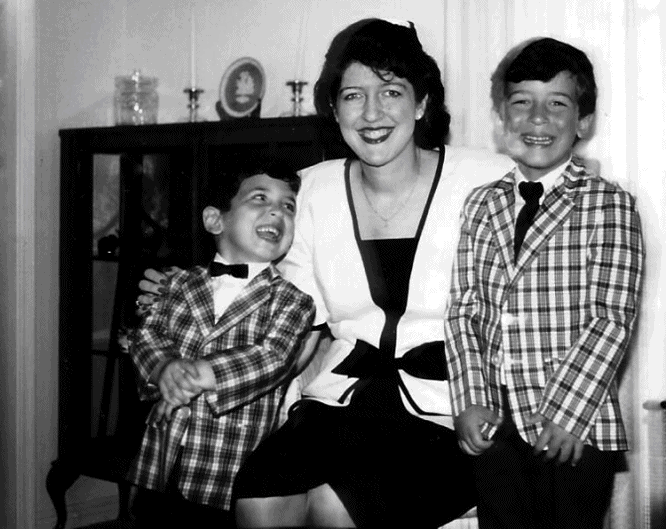
Figure 1-1: Elizabeth with Andy (left) and Jeremy (right), about thirty minutes before she was struck by lightning. September 2, 1988.
I got the boys in their car seats and backed the car out of the driveway into the waning sun of a late summer afternoon. As I turned into the synagogue parking lot fifteen minutes later, a single large thunderhead blocked out the bright sun. It began to rain. Then thunder boomed. Suddenly, I was in the midst of a furious storm with the rain pouring down in sheets. It had come out of nowhere on what had earlier been a sunny, beautiful day. I certainly did not want to get out of the car in that storm. I also didn’t want to sit in the car with the boys, though, because services had already begun, and I didn’t want to risk missing the reading of my grandfather’s name.
As I hovered there over my body, I suddenly got it. I went from “Shit, my shoes are ruined” to “I was so wrong about so much.” Thoughts came rushing in all at once. I thought about those people who believed in an afterlife and who I had secretly ridiculed for years. They had been right all along. I was looking at my body and thinking something like: “What a waste. You were so wrong. How could you have been so wrong? You lived for twenty-eight years and learned so little.”
Sometimes when you go looking for what you want, you run right into what you need.
—Wally Lamb, The Hour I First Believed
As I was processing all of this, really in just a fraction of a second, a warm, inviting, golden glow appeared to my upper right. I sensed it as much as I saw it. It was not a fixed light but more of a moving beacon that seemed to want me to follow it. That is, there was no defined form to the glow. It was not round like the sun. It was more like the glow around the sun. In any case, I understood that I was dead and that my children were safe with my family and the community at the synagogue, so I gave in to the temptation and followed the beckoning glow.
My guide in the Garden gave me knowledge and entertained my questions for the entire two-week period I was there. My questions were answered instantly. As quickly as I could conceive the questions, I received the answers. I understood the passage of time in the Garden realm by observing the movement of the three celestial bodies that orbited and revolved above us. These moon bodies or planets were vividly bright orbs that looked, as best I can describe them, to be what we would call violet, although violet here on earth comes nowhere close to the intensity of violet in the Garden. This ability to read and understand the movement of the orbs as a calendar of sorts was one that I found I already possessed. By instinctively “reading” this “calendar,” I came to know that my visit to the Garden lasted two weeks. I instinctually knew how time worked and passed in the Garden realm, just as I know how it works where we presently reside.
I gasped for air. It filled my lungs and revived every cell in my body, except for my immobile left arm and hand. These were frozen, paralyzed in the same posture and grip I was in when the lightning struck. I don’t think my body had moved at all from the position it was in when I was struck and fell in a heap on the pavement. I really cannot say if I was breathing at all during the couple of minutes here that I was gone. What I can say is that my left arm was still frozen in place, my beautiful new suit was now a permanently greasy gray, and the soles of my once gorgeous new pumps, still on my feet, were no more. They had taken the force of the electrical current as it grounded out through me and then through them.
He’s got to have the ability, and it seems to be fairly rare, to see things as they are and at the same time as they might have been.
—Jack Finney, Time and Again
The experience of being struck by lightning and the immediate effects that it had on me both in the Garden and afterward—the differences in perceiving color and sound, the new knowledge, and the new understanding of time—were just precursors of the ways in which I was about to change. Something in me had “opened.” I also now thought differently. I was much more comfortable now with ambiguity and complexity, less infatuated with black-and-white thinking or judging. I even literally saw differently. It began with the colors.
One of the first things that struck me within the near-death experience itself was the shift from black and white to an otherworldly vision of brilliant, vibrant, living colors. This was not just a visual change. It was also a symbolic one. The Garden was suffused with astonishing light and color. It was all alive. What a contrast to the grays and grease of the parking lot!
And the living colors were just the beginning. The new convictions and capacities I had acquired in the Garden began to show themselves in other ways, ways that surprised and frankly shocked me. Indeed, these convictions and capacities were so strange at first that I honestly believed I was losing my mind.
As I have already made clear, many exceptional things have happened to me since my near-death experience. One of the earliest and strangest took place in the spring of 1990, a year and a half after the lightning strike. I had recently found out I was pregnant with my third child. Barry and I were sound asleep in bed. It was about 3:30 a.m. when the phone on my side of the bed rang. This was back when people only had landlines plugged in to the wall. I think we are all conditioned to expect the worst when the phone rings in the wee hours. It is usually news that is urgent, important, and not good. No one calls at 3:30 a.m. to give you good news.
It is not that Mom lacks any spiritual experiences. Quite the contrary. As I alluded to earlier, Mom is a spiritual person. When I was a child, she never told me things like “death is the end of a person’s existence” or “when people die, they are gone forever and you won’t see them anymore.” Because of her spiritual nature, it does not surprise me that she has stories to tell about strange things that have happened to her. What has really stunned me is my dad.
In 1971, when I was moving into a new suite of dental offices, Pop gave me a tiny little potted plant for the new office. It was a Dracaena compacta and was about three inches tall. This is a very slow-growing plant. I always took great care to water it and take special care of it. In 1977, it moved with me to my new office, and then in 1984 it moved to the balcony at our home when I retired from dentistry. It was about the healthiest plant I have ever seen. By 1987, it stood eighteen inches tall and was lushly vibrant. I remember watering it on September 4, 1987, and thinking to myself how remarkably healthy it was for a houseplant that was sixteen years old. The next day, September 5, 1987, Pop passed away. I had always watered all of the plants on the balcony every other day, so I went out there on September 6 to water them. I was shocked to see that the sixteen-year-old Dracaena that had been amazingly healthy two days earlier was dead. It was as if when Pop died, the life energy he had always supplied was gone, and the perfectly healthy, vibrant, lush plant literally wilted over and died.
There is another story, if you want to hear it. When Ronnie [my dad’s younger brother] died, and we were at his funeral, do you remember what happened, Elizabeth? As the rabbi was eulogizing him and everyone was around the gravesite, a big black grackle bird flew into the tree right above the rabbi. It was cawing and cawing so loudly the rabbi had to stop talking. This bird actually interfered with the funeral service. I know that was my brother commenting on his own funeral.
We do have words for some of this, of course. Jeff would call them “strange words,” by which he means that they occupy ambiguous or uncertain places in our language and culture: We use them, but we don’t quite believe in them, and we often make fun of them. These words are disreputable, never quite respected, and yet they do not go away either. I think Jeff would say that they do not go away because they name something that is real, something that is a part of our world and probably our own nature.
The object becomes aesthetically significant when it becomes metaphysically significant.
—Joseph Campbell
The precognitive dreams, the phone call from the dead, and the woman (not) upstairs—these things do not exhaust the portfolio of strange occurrences that is now my life. Sometimes, for example, I feel that inanimate objects have a unique “vibe” to them. It is not an aura that I can see exactly. It is more that I can sense certain energies around or within the object. Even though I understand that they are not living beings, I cannot deny that I sense at times that a nonliving object possesses a certain living energy. Such was the case with my necklace.
In 2005, I had planned to meet a friend for lunch in Rice Village, a shopping district in Houston near Rice University. I was running early, and she typically runs late, so I knew I had some time to shop before lunch. I walked into a women’s boutique, just planning to browse for a few minutes. This was not a store where I often bought clothing, and in fact I do not really care for their clothing. But something drew me in there that day. I quickly lost interest in browsing the clothing and made my way over to the accessories.
I do not understand the connection between all of the phenomena I have experienced since September 2, 1988. They appear to be related, but how? Clearly, the near-death experience has changed my life, and the paranormal currents that emanate or radiate from this original explosion continue to change me almost daily. It is as if the voltage I received when that tiny finger of electricity touched me charged me with an energy that pulses through everything. It is as if the energy of that lightning was somehow alive and has somehow made me more alive, more sensitive to my surroundings. I can see this energy now. I can also feel it. This is not a question of faith or belief. It is all about sensing new dimensions of the world. To see and palpably feel the energy is proof to me that my experiences are real. Perhaps the most obvious example of this is my ability to see and sense “auras.”
Another odd result of my near-death experience is that I now have what neuroscientists call synesthesia. Actually, I don’t know if the synesthesia is a result of the near-death experience itself or is a function of being electrocuted. Either way, I never had it before September 2, 1988, and it wasn’t until decades after my trip to the Garden that I first heard the word, much less understood what it meant.
One interesting theory about synesthesia is that it may be genetic in some cases. My parents don’t have it, nor do my sisters. However, my daughter, Mallory, has it to a mild degree, as do my aunt and my oldest son, Jeremy. The fact that I didn’t have it until after I was struck by lightning leads me to believe that in my case it was either not genetic, or that the necessary genes were there but were dormant until the lightning strike activated them. The lightning strike might also explain the fact that Mallory experiences synesthesia as well. After all, I conceived her following my contact with lightning, which may have activated that particular gene expression. Again, I don’t know. I am certainly no geneticist. I do wish someone would study these things, though.
I often wonder if the color associations I make with my synesthesia have any bearing on the colors of the auras I see around people. What I am learning but still am unable to interpret is that, while the color of a person’s aura may change, the colors for a number or day of the week are fixed for me. For example, I can look at Mallory and see a green aura in the morning and a blue one in the afternoon. However, when I hear or see the number five, it is always red. The synesthesia colors are constant and unchanging. Aural colors are never constant and can turn on a dime. Still, I do think these two abilities are connected somehow. I personally believe that whatever internal capacity compels me to associate color with certain things can also somehow make allowances for the moods, feelings, and health that affect humans. And yet, that same capacity within me knows that five is ever five and Monday is always Monday. Both are red to me and immutable in the quantity they represent and their unchanging place on the calendar.
I think that ordinary people who are placed in extraordinary circumstances find themselves pushed beyond their limits, and learn new truths about themselves.
—Jodi Picoult
As time has gone by, I have gradually found comfort in my newfound capacities. The lightning strike happened half my lifetime ago. I have now lived as long with these abilities as I did without them. But accepting them has been a very gradual process. It took years after the lightning strike and near-death experience before I could admit to myself that the powers I had developed were not just figments of my imagination, that they were real. I was as skeptical as anyone else. I really tried to suppress what in my prestrike life I would have called crazy. But the facts simply wore me down. So did the convictions of the Garden. I have now accepted and adapted to these inexplicable enhancements to my daily life as best I can. I think I’ve done pretty well.
While there is very little that I find inspiring in attending services in a synagogue, or any structured religious environment for that matter, I have encountered one relatively obscure prayer that actually means something to me. This prayerful meditation appears in a slim little paper prayer book at Congregation Emanu El in Houston, Texas. Oddly, the passage is the only one in the book that is cited as “Source Unknown.” During the course of working on this book, I found the source of this beautiful prayer. It is paraphrased from a sermon given in St. Paul’s Cathedral in London on May 15, 1910. The sermon, given by Henry Scott Holland, followed the death of King Edward VII, whose coffin lay in state in Westminster Hall.4
Death is nothing at all. I have only slipped away into the next room. I am I, and you are you. Whatever we were to each other, that we still are. Call me by my old familiar name, speak to me in the easy way in which you always used. Put no difference in your tone, wear no forced air of solemnity or sorrow. Laugh as we always laughed at the little jokes we enjoyed together. Play, smile, think of me, pray for me. Let my name be ever the household word that it always was. Let it be spoken without effect, without the trace of a shadow on it. Life means all that it ever meant. It is the same as it ever was; there is unbroken continuity. Why should I be out of mind because I am out of sight? I am waiting for you, for an interval, somewhere very near, just around the corner. All is well.5
It was through my great-aunt and great-uncle that Mom came to know Nancy.6 My great-aunt and uncle were kind and very spiritual people who had sought Nancy out because of her reputation as a healer. They introduced Mom to Nancy, and then Mom brought me to meet her.
But that brief interchange with Nancy planted a seed. I had toyed with the idea of possibly doing psychic readings, or channeling, for a while. After all, it was so easy for me. I could simply look at someone and know quite a bit about him or her. And if I spoke to them for a few minutes, I could receive all kinds of information. Personally, I had always been skeptical about this type of thing—until I found I had the ability to do it myself. Ever since my near-death experience, I have been able to tap into other people’s spirit guides. These were the companions I saw people with in the Garden. I also discovered that if a person posed a question to his or her spirit guide, I could sense the response. It was this capacity that Nancy was referring to when she urged me to put my abilities to work.
Okay, so I can see auras and precognize events before they happen. I don’t know why I have these abilities, and my cluelessness about how to put them to use frustrates me to no end. If I could understand this, I really and truly think my life would be much easier, or at least more sensible. Is it possible that writing this book and getting the fact out there that there is an afterlife is what I am supposed to be doing with these unearned gifts? I don’t know. But I do know that writing this book in Houston feels much more “right” than doing psychic readings in Seattle.
But time is yet another of God’s creations, and as such, it has a life of its own.
—Rebbe Menachem Mendel Schneerson
Suppose time is a circle, bending back on itself. The world repeats itself, precisely, endlessly.
—Alan Lightman, Einstein’s Dreams
I mentioned earlier that one of the things I came to understand in the Garden involved the nature of time. I also explained how my later precognitive dreams gave me actual experiences or confirmations of what I had been taught about time. There is really no way around it. Since the lightning strike and near-death experience, I have been able to see through time, as if it were somehow transparent. I have thought a great deal about this. Who in my situation wouldn’t?
The slipping through time that I do, then, is not of my choice. Neither, unfortunately, are my precognitions. The distinction between my dreams and precognitive nightmares is the level of control that I can exert over them. In dreams, I am generally able to instruct myself to look away or close my eyes. I can tell myself that this is a dream, or to wake up. Once awake, I never remember my dreams. As soon as my eyes are open, the dream is gone. I can tell myself, “That was just a dream,” but I cannot for the life of me remember what it was.
I am a lifelong Texan. Earthquakes are not of any realistic concern here. But there I was, in one of those nightmares, walking down a sidewalk in a city that I knew to be San Francisco. In my nightmare, I saw “snapshots” of damage from an earthquake. I saw that the sidewalk was split open as if it had been unzipped. I also saw a police officer peering over the edge of a broken section of the San Francisco–Oakland Bay Bridge, where cars had fallen through the break to the level below. A photo of the scene, which appeared in the news, is exactly the image I saw two days before the earthquake happened.7
In January 2009, Matt and I were vacationing in Jerusalem. We had spent the morning of January 15 walking up and down the cobbled streets of the Old City. Jerusalem is a magical city. With its ancient white limestone edifices and its strong sunlight, even in winter the city gives off a glow that seems to touch all who visit. I remember where we ate lunch that day. It was in a restaurant across the alley from our hotel just off Ben Yehuda Street on the second floor of a two-story building overlooking Jaffa Road. I recall feeling a crackling energy, but I figured it was my surroundings. There is a very unique energy in Jerusalem that is perceptible to many people.
From: Elizabeth Krohn <NDEexperiencer@gmail.com>
To: Elizabeth Krohn <NDEexperiencer@gmail.com>
Date: 01/15/09 at 2:57 PM IST
Mid-size commercial passenger jet (80–150 people) crashes in NYC. Maybe in River. Not Continental Airlines. Not American Airlines.
It is an American carrier like Southwest or US Airways.
Early on February 2, 2015, we were at home and sound asleep when I had another of my nightmares. I awoke and emailed this to myself:
From: Elizabeth Krohn <NDEexperiencer@gmail.com>
Date: February 2, 2015 at 5:52:15 AM CST
To: Elizabeth Krohn <NDEexperiencer@gmail.com>
Subject: Plane Crash
Passenger plane with propellers. Plane is white. Foreign airline—maybe Asian. Crashes in a big metropolitan city right after takeoff. Right wing of plane is pointed straight up right before crashing. Most on board killed, but some survivors.
Sent from my iPad
On March 11, 2011, a massive earthquake and tsunami hit Japan. The magnitude 9.0 earthquake struck at 2:46 p.m. JST (Japan Standard Time), a mere eighty miles off the east coast of Miyagi, Japan. Readers may recall that this was the tsunami that instigated a major nuclear accident at a power station along the coast. Almost twenty thousand people died in the disaster and its aftermath. The tsunami was so enormous that the wave actually reached the coast of Antarctica and caused a portion of the Sulzberger Ice Shelf to break off its outer edge.
From: Elizabeth Krohn <NDEexperiencer@gmail.com>
Date: March 10, 2011 at 3:48 AM CST
To: Elizabeth Krohn <NDEexperiencer@gmail.com>
Subject: EARTHQUAKE! And Tsunami
In Japan again. Terribly powerful earthquake. Terribly terribly terribly powerful! Like a 9.0 maybe. And then a tsunami that wiped out villages. Thousands dead.
Sent via BlackBerry by AT&T
Taking into account the time differences between Japan and Houston, this email was sent about twenty hours before the devastating earthquake and tsunami occurred.
Each case is quite different. Here is a more complicated example of a dream that turned out to be very accurate, that is, that reflected an actual plane crash, but which I wanted to retract or not count, since the crash happened before the dream. One interesting feature of this dream is that it occurred while we were working on this book. I sent Jeff and myself this email immediately after I wrote it:
From: Elizabeth Krohn < NDEexperiencer@gmail.com>
Date: November 29, 2016 at 1:52:17 AM CST
To: Elizabeth Krohn < NDEexperiencer@gmail.com>
CC: Jeffrey Kripal
Subject: Plane crash
Smallish plane. Fewer than 100 people on board. Several may have survived. Crashed in South America. Bogota? Probably somewhere in Colombia. Athletic team on board.
Sent from my iPhone
From: Elizabeth Krohn <NDEexperiencer@gmail.com>
Date: November 29, 2016 at 4:20 AM CST
To: Jeff Kripal
Subject: Disregard last email
It happened, but before I sent the email. :(. I woke up and sent the email at 1:52am but the plane had already crashed a couple of hours earlier. Sorry.…
Sent from my iPhone
Tell me and I forget, teach me and I may remember, involve me and I learn.
—Benjamin Franklin
There is no particular order to the things I have come to know since I was in the Garden. I have, however, come to understand that the general direction that much of this knowledge takes me is along paths that are remarkably parallel to places described in texts of the Asian religions, especially in their more mystically oriented expressions.
Over the course of our conversations, Jeff has encouraged me to clarify my understanding of the relationship between the lightning strike, the Garden, and the new capacities. He has also asked me to be more specific about exactly how I received the new understandings about things like the nature of time and reincarnation. Was I told these things in the Garden by my spirit guide there? Did I think these things out afterward as conclusions of the Garden experience, or of my precognitive nightmares? Do I simply believe these things but am claiming them as things I actually know? Or what?
Another lesson I received in the Garden is that knowledge, like energy, can neither be created nor destroyed. All the knowledge that there is already is. Knowledge, however, must be discovered. It is like an onion with an infinite number of layers. One revealed bit of information uncovers the next. While there is no end to it, it is already complete.
One of the main lessons I learned through my conversations with God, or what I believe to be God, is that the kernel of every being is a spark of eternal light, a spark that derives its existence from an energy that permeates our universe, that is, from God the eternal light. Despite the many connotations that the word “soul” conjures, calling this spark the soul gives it a meaning to which most people can relate. In the Garden I learned that this soul-spark is a flourishing, evolving force. It seeks its own course and is programmed to persist like a plant that grows in the direction of the sunlight. Like a plant, the soul also requires nourishment in its cultivation and evolution. Each person must nourish his or her soul if it is to progress. Each human being is an incarnation of this eternal spark.
Events initiated by the lightning strike and the near-death experience that followed have made a much more direct path for my soul toward whatever destination it has in mind for me. I think that the speed of its evolution has been accelerated through these means. I believe this to be the case because, prior to that fateful day in 1988, I was a different person. Something in my soul clearly changed … or evolved. However we understand these things, the fact that I survived my near-death experience allows me to know things that I will not encounter or feel again until the death of my body frees my soul.
What I have recently learned is that in many forms of Hinduism, Buddhism, and other Asian religions, the goal of the reincarnation process is to attain a state where one no longer has to reincarnate and can “jump out of the system” of birth and death. This end or purpose is variously described in these traditions as the goal of “liberation,” “release,” or “enlightenment.” This is not exactly what I was taught in the Garden. In a metaphor that is easier for me to absorb, I was told that the point of reincarnation is to graduate, but that this “graduation” comes with a duty or calling. More specifically, I was told that one’s soul, having slipped into a stream of frictionless movement in concert with the force that permeates everything, “graduates” and becomes a beacon and companion for others on the path.
Religion is a system of wishful illusions together with a disavowal of reality, such as we find nowhere else but in a state of blissful hallucinatory confusion. Religion’s eleventh commandment is “Thou shalt not question.”
—Sigmund Freud, The Future of an Illusion
Congregation Emanu El in Houston is a Reform Jewish synagogue that I have attended all my life. There is much that I love about the congregation. Five generations on both sides of my family have attended Emanu El since its founding seventy-three years ago. The names of my parents and grandparents are inscribed throughout the building in thanks for the generosity of their contributions. It is my family connections—the weddings, funerals, baby-naming ceremonies, and other life cycle events—that keep me so closely tied to Congregation Emanu El. It is not the religious aspect of Judaism that holds me there.
Having sat beside someone I believe to be God on the bench in the Garden, and having held my newborn children, gazing into their already familiar faces, I know beyond any doubt that God exists. Yet, what I have always struggled with is the gross mismatch between what I know to be God and the dogma of organized religions that claim to speak for God. What was revealed to me in the Garden is that God’s guiding light is indivisible, and that it illuminates all of humanity with the same light. There is no evil dark enough or plentiful enough to snuff it out. The disbelievers cannot doubt sufficiently to diminish it. I can see very clearly now that any denomination, religion, or mode of belief that claims a particular doctrine to be the sole, exclusive path to God is both delusional and selfish.
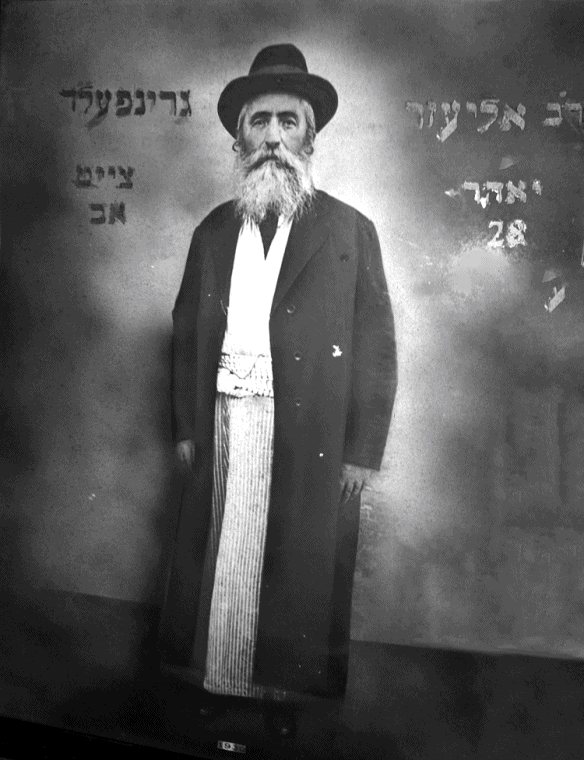
Figure 8-1: Rabbi Eliezer Greenfield (1854–1930), Elizabeth’s great-great-grandfather and a highly respected rabbi, is buried in Safed, srael a few steps away from the grave of Isaac Luria. Luria is considered to be the father of contemporary Kabbalah.
I do not recall the politicization of my religion being such an issue when I was growing up or, for that matter, when I was a young adult. However, Reform Judaism has increasingly become a force for secular change. For so many, Reform Judaism is egalitarianism in a tallit. That is an inside joke of sorts. The tallit is the traditional shawl used to cover oneself while praying in synagogue. Jews do work for freedom and social justice. We marched alongside the leaders of the civil rights movement in the 1960s as they protested exclusion and unfair laws. Indeed, if I were to point to three aspects of Judaism that I think Reform Judaism has come to hold the strongest, I would put these, in this order, as (1) social justice, (2) ritual and religion, and, lastly, far below these first two, (3) spirituality.
Adherents of Hasidic Judaism (a much more conservative and strict branch than Reform Judaism) seem to be more aware of matters of the soul than members of any other sect of Judaism. My understanding is that the Hasidic movement was founded partly to emphasize and integrate mysticism into Jewish life. Their care and concern for me are palpable when I am in their midst. In my experience, Hasidic Jews are kinder toward fellow Jews than those in other sects. When I attend any Hasidic gathering, they seem genuinely happy that I am there. The same cannot be said of the other branches of Judaism. “Welcoming” is not a term I have ever associated or heard anyone else associate with Orthodox, Conservative, or especially Reform synagogues.
The ridicule that I may be subjected to as a result of “outing” myself with this book is a risk I am willing to take. I simply don’t care as much as I once did about what the critics, skeptics, and disbelievers will have to say about me. Many who express doubt will be those whose minds are molded in the rigor of scientific inquiry. These are brilliant people who will never be convinced that what I have put forth has any foundation in reality.
Whoever lacks the capacity to put on blinders, so to speak, and to come up to the idea that the fate of his soul depends on whether or not he makes the correct conjecture at this passage of his manuscript may as well stay away from academics.
—Max Weber, quoted in Jonathan Garb’s Yearnings of the Soul
All dreams follow the mouth.
—Babylonian Talmud
The point of this second half of the book is to read—as in to interpret—what Elizabeth has just written. This is not some optional, “merely academic” exercise, as we say in our lazy moments. As I have signaled above with the ancient saying from the Babylonian Talmud (an important commentary on the Torah or Hebrew Bible held to be especially authoritative by a number of Jewish traditions), the meaning of a dream or dream-like vision (in this case, Elizabeth’s near-death experience) depends on its later retelling and interpretation: “All dreams follow the mouth.”12
There are two things to underline up front, before we begin. The first involves my own professional location and explicitly comparative perspective. The second involves the central idea that I want to get across through these pages. These two things are in fact related.
Ideally speaking, the comparative quest may be about the whole of human religious experience, but it understands perfectly well that it can only arrive at such an understanding through a careful and long look at individual religions and figures. Ideally, at least, it understands the whole through the parts and each part through the entire whole.
Some of the best and most popular science fiction writers of all time had jaw-dropping paranormal experiences, and that’s why they wrote the stories they wrote. It’s the paranormal that produces the science fiction, and then the science fiction loops back and influences the paranormal.… The whole history of religions is essentially about weird beings coming from the sky and doing strange things to human beings … historically, those events or encounters have been framed as angels, or demons, or gods, or goddesses, or what have you. But in the modern secular world we live in they get framed as science fiction.
—Jeff in Brad Abrahams’s Love and Saucers (2017)
There is another way to frame our reading practice here. We could say that the interpretations that follow are all designed to do one thing: make the impossible possible. By this I mean to suggest that we are after a set of new perspectives, a new way of looking, that can change, instantly, the meaning of a set of otherwise unbelievable events and so render them not only possible but plausible. What makes certain kinds of human experiences impossible, after all, is not those experiences (they happen all the time), but our assumptions that they cannot happen. Put simply, the problem is not the events themselves. The problem is us.
Here is the gorilla (and bully) in the living room of our conversation: classical materialism, that is, the belief that there is only matter, and that this matter, deep down, is lifeless and devoid of mentality or mind. “Up here,” where our forms of awareness work, there appear to be life and mind, but these are all surface illusions that disappear as soon as we go “deeper down” and discover the “real” nature of reality, which is entirely material, completely dead, and utterly mindless. In this model, human minds are nothing more than extremely complex illusions of brains, which are themselves purely material and entirely restricted to bodies and skulls and their most immediate physical surroundings, which are accessible only through the physical channels of the senses. No leaving your body here (you don’t really have a soul). No precognition (you are stuck in time). No clairvoyance (you are stuck in space). All of that is, by definition and in principle, meaningless and impossible. It can’t happen.
Part of this imagining the future involves thinking about writing and reading in new ways. Actually, reading and writing are our main methods in these pages. There is no laboratory, no multimillion-dollar machines or equipment here. There are no statistics or numbers. But there are words to read and stories to imagine. As outrageous as it might seem, reading and writing are the primary ways that we are changing the afterlife.
I have seen this human mirroring and self-creation work its magic so many times that I have taken up the role of facilitating it. In the fall of 2016, I invited Elizabeth and her husband Matt to the Esalen Institute in Big Sur, California, where I often teach and work. There I introduced them to a collective of scholars and scientists who work on anomalous experiences. As codirector of the institute’s Center for Theory and Research, I regularly help plan and host these private symposia.
I am speaking mythically, of course, but also perfectly seriously. This same deep resonance between science fiction and the paranormal was the main theme of my book Mutants and Mystics.17 There I argued that much of science fiction is based on the actual paranormal experiences of the psychically gifted writers and artists who have helped create this particular genre (hence my opening epigraph). In other words, there is an invisible experiential foundation to what we now call science fiction, and this invisible baseline is spiritual in nature, if in a nontraditional or very modern way.
There are other modern ways of getting at the same spiritual paradox. Riesebrodt’s definition of religion as a legitimate form of science fiction, for example, comes with a number of further gifts of insight and new direction, some of them no doubt unintended. One of the most important of these is how it provides us with a very powerful metaphor through which we might balance both the fictional components and the potential reality of the near-death experience through a single image: the image of projected light in a movie theater.
The most important places in Elizabeth’s story where I think the sci-fi or psi-fi reading works best are those moments in which she reflects on how her extraordinary experiences were both revelations of the way things really are and yet are also visionary projections of her imagination. Here is the paradox of religious experience again, that confusing mix of fiction and truth. And here again is where the metaphor of the movie theater and the projector works so well. This metaphor, after all, can help us to understand much more easily how and why a near-death experience feels “more real than real,” and probably is, even if it is being expressed through a fictional, film-like narrative. There are at least three separate issues here: one a matter of neurobiology; one that we might gather under the rubric of intensity; and one that we can refer to as the invisible projector.
When I started writing about life after death, I had Plato in mind. He was the founder of the academia, the man who formed the institution that gave people MDs and PhDs and the like.
—Raymond Moody, Paranormal: My Life in Pursuit of the Afterlife
Whew. I must immediately remind my readers that the discussion above is about a set of metaphors, not literal facts. I do not think there is some kind of literal projector in the back of our heads, or that our internal 3-D worlds we (mistakenly) take for reality are actual movies. I think it is no doubt much more complicated than all of that. But we have to start somewhere. We have to start with our ordinary experience to understand our extraordinary experience.
This orbiting of the Planet of Powers and observing it from as many perspectives as possible is important for another reason. Human beings will seldom, if ever, accept a set of events for which they have no adequate framework. Give them that framework, however, that model in which the particular experience or claim makes some sense and so becomes plausible, and they will usually at least consider it. The true skeptic (that is, the thinker who is skeptical of any philosophical position, including scientific materialism) possesses as much integrity as the thoughtful believer here: each doubts or accepts the data depending on his or her own previously established framework. If the new data fits into that framework, it is tentatively accepted. If the new data does not fit into that framework, it is doubted or rejected. Again, the key is not the story or the historical facts themselves, but whether or not we possess a model or set of metaphors in which these can be accommodated and rendered plausible.
What we now almost effortlessly call the near-death experience is in fact a modern, very recent expression, just a little over forty years old at the time of this writing. It was first coined and brought into broad use by a medical student with a PhD in philosophy (that is, by someone who knew both the humanities and the sciences). It was Raymond Moody, in his best-selling 1975 book Life After Life, who first brought the expression into contemporary use. He used it to describe a number of cases that he had either encountered in his medical training or read about in the literature. These cases involved people emerging from potentially deadly circumstances to tell remarkable stories of encounters with a pure presence, often experienced as a brilliant, beneficent conscious lightform (the light at the back of our movie theater).
It is often pointed out that there was no “hell” in Moody’s book, and that the Light appears as universally accepting and loving in the stories. This is true of a number of studies and books on the near-death experience, actually. So too here, with Elizabeth’s experience. As she stressed, the love she experienced was utterly unconditional: it did not require any particular set of beliefs, any ethnic identity, or any religion. That may be good news to many modern people, but it is pure heresy and very bad news in the context of the history of the Western monotheisms, where one’s afterlife is generally conditional on following a religious contract or set of purity codes and moral rules, belonging to a particular ethnic or religious community, or holding to the correct set of beliefs.
The “near-death experience,” then, is one expression that allows us to see things and listen to things that we otherwise might not. They make the culturally invisible visible. But they also can blind us to other things, just as any focus on a particular object in the distance renders everything else in view fuzzy and indistinct. The trick, of course, is to use many focal points, many new expressions, each of which gives us something while taking other things away.
Conventional materialists are generally neo-Darwinians, by which we mean that they believe that evolution is random and without purpose or intent, and that every feature or characteristic that survives the long journey of biological evolution does so because it helps the organism to adapt to its environment, survive, and procreate. But this is exactly how paranormal abilities also often function.
I’m the kind of guy who sees Paul, e.g., as a guilt-ridden persecutor of his own people who also suffered from temporal lobe epilepsy, or something similar. In other words, I’m one of those materialists you wrote your article for. However, I have a veridical hallucination of my own to tell you, or rather one that happened long ago to an uncle, in 1918 in the Meuse-Argonne sector of the Western Front.
My uncle was a Greek immigrant serving as a platoon sergeant in an Illinois National Guard regiment. His unit was dug in facing the west bank of the Meuse, and on this portentous night, as he told us over a poker game at a Thanksgiving family gathering some 60 years ago, he was observing the Germans across the river in a sandbagged firing pit (aka, “foxhole”) ahead of the main trench line. The Germans were mortaring these positions sporadically to keep the Americans awake, and my uncle was keeping his head down among the random, distant blasts.
Then he heard a voice, a Greek voice, that he was sure was his father’s voice. “Demetri, Demetri, get out of there.”
My uncle shuffled down the communications trench to his platoon, which was filled with Greek immigrant boys, and asked them, “Have any of you guys been calling for me?”
“No, Sergeant Moskhopoulos,” they all said.
All this time, my uncle had been telling us this story with his eyes down, looking at his cards. Now he looked at us all and said, “When I started to go back a shell blew up the whole place where I’d been. After the war, when I went back to the family in Greece. I found out that day was the day my father [had] died.”31
The modern near-death accounts are made possible in their increasing number and depth by the advances of biomedical technology, which can “pull us back” from further and further into the death process. This might look like a minor observation, but it has major implications for how we think about the near-death literature as a whole. What we have in the near-death stories, after all, is essentially a new mystical or visionary literature made possible by new biomedical technology.
And Jesus said, “Whoever finds the meaning of these words will not taste death.”
—Gospel of Thomas, logion 1
In the previous two chapters, we looked briefly at the nature of “science” and “religion” and what they have to do with Elizabeth’s experiences. In this chapter, I want to return to the “imagination,” which we have already engaged through the metaphor of the film being projected from the back of the movie theater. I want to return in an attempt to dislodge from the reader’s mind any notion that what is imagined is always imaginary. I want to take what I consider to be Elizabeth’s instinctive understanding of the religious imagination and turn it into something more akin to a fully conscious and discussable model. Put a bit differently, I want to take up Elizabeth’s precognitions and revelations and try to transform them into something the rest of us can think about and use—take a little lightning from the bottle/book, as it were, and put it to good use. I want to get a little sizzle and spark on the page.
As a first attempt to think about the religious imagination, let us think of it as that organ or dimension of consciousness that gives us access to communications that can only reach us in symbolic or mythical form, that is, in fantastic images and strange stories akin to science fiction. The religious imagination is what acts as a medium or diplomat between us and that which is attempting to communicate with us (which may be some alienated part of us).
What we would need, of course, is translation. Their language or form of communication would need to be translated into ours, and vice versa. Perhaps we should distinguish here between contact and communication. Contact is fairly easy and extremely common (if often violent—consider the poor octopus on my plate). Communication, adequate communication anyway, is really difficult and very rare. We could have contact without such translation, but we could not have effective communication. There must be some kind of interface or translation process from one species to another for true communication to occur.
I wrote the bit above about octopi well before I saw the science fiction film Arrival (2016), which features octopi-like aliens communicating symbolically through inky language-circles, which, to the historian of religions anyway, look a lot like the calligraphy of Japanese Zen artists expressing the Buddhist teaching of emptiness. Elizabeth saw the film shortly after it was released in Houston the week after we returned from Esalen. She was so moved by it that she insisted I go see it, and that we meet immediately.
Such films raise the question of what exactly these alien forms of mind are communicating and how they are communicating it. A number of writers have noted how modern science fiction film has been playing with the themes of illusion and reality and how we might recognize the illusion and move toward the real. Such modern commentators have also observed how the modern movie theater is an especially apt ritual space with which to do this. Indeed, this modern space replicates in nearly every detail the layout and potential purpose of Plato’s cave discussed earlier (okay, except for the chains). My Rice University colleague April DeConick has been particularly eloquent about this in her book The Gnostic New Age: How a Countercultural Spirituality Revolutionized Religion from Antiquity to Today (2016).
There are some very big questions wrapped up in such thoughts, such as: How did Elizabeth know what she “just knew” in the near-death state and in the subsequent paranormal cognitions? And, more complexly, how are we to think about and coordinate the obvious symbolic or imaginal components of what she knew (that is, her visions of the Garden, the mountains, the bench, and so on) and the empirical, objective, or historical nature of her subsequent precognitions (that is, the precise visual details of the actual plane crashes), which were also clearly mediated by some form of the imagination in her dreams? In what sense was she in a 3-D synesthetic movie of her (and our) own making? And in what sense was she also stepping out of that movie into some kind of transcendent hyperspace or superplace?
Everything, of course, depends upon what we mean by that word: imagination. Most people use it without having the slightest idea what they actually mean. Or they think that the expression always means the same thing to everyone, when in fact different people mean very different things by it. To speak bluntly, colloquial English and, with it, conventional secular society, are pretty dumb here, as they recognize no such distinctions and collapse all imagined things into imaginary things, that is, into the realm of the nonreal. This is simply wrong.
Simple fair comparison can easily reveal this position to be what it is: deeply problematic. The basic problem here is that different people see different things, even those raised in the same general religious environment or community.
Many people in the death process, moreover, see (or at least remember seeing) absolutely nothing, regardless of the intensity and sincerity of their beliefs. Again, there does not appear to be any reliable, clear, or stable relationship between the presence of belief and the likelihood of having a near-death experience. I know that is difficult for some to hear, but that is what the evidence suggests at this stage.
If we still want to insist on an exclusive literal reading of the religious imagination, we are forced into one of two options: (1) either we conclude that there are many objective and perfectly real afterlives that different people experience differently; or (2) we revert to the deeply dubious practice of declaring some near-death experiences “genuine” and others “not real,” or, worse yet, “false” or “demonic” (as Raymond Moody’s colleague did) so that we can preserve whatever exclusive literalist view of the afterlife we ourselves happen to hold (usually, because we were born into it). And there is where the religious intolerance begins. To press the point further, there are social, moral, and even political consequences of this exclusive literalist model of the religious imagination, and none of them are good.
There are ways to preserve the experienced literalness or hyperreality of revelation or extreme religious experiences like the near-death experience, however. I have offered one earlier (at the end of Chapter Nine) and will offer a few more thoughts below.
This second reading gives us a great deal, including an easy ability to explain why every near-death experience is different: because people bring different life experiences and shaping influences to the events. Its gifts should not be underestimated or set aside lightly. It can include and understand all forms of religious visionary experience but, please note, only at a great cost: it must declare them to be culturally relative hallucinations with no bearing on the afterlife or our place in the cosmos.
Cost or no cost, the basic problem with this model is that it contradicts the honest experiences of those who have known such a near-death event. Such people know quite well what a subjective hallucination feels and looks like. They have all dreamed. They also know that what they have experienced in and around death is not at all like such a dream. They may be wrong, of course, about this. Near-death experiences may be superrealistic dreams. Therein lies the crunch.
The same model, of course, also fails us completely in providing a model of how one can accurately dream the future, that is, how the imagination might actually perceive something down the timeline. The only response here is that such dreams do not happen or are pure coincidences. That seems altogether too convenient. It feels like a cop-out or a failure of nerve.
Here, the image or story is neither entirely objective and exclusively true (as in the literalist model) nor entirely subjective and exclusively false (as in the hallucinatory model)—rather, the visionary experience is what erupts “in between” the subject and the object to effect contact, communication, or communion. In some profound sense, it creates or brings about that of which it speaks. It is “literally true” in the sense that it is actually communicating or transmitting something profoundly real to the experiencer.
We have seen this model at work already, of course, in my discussion of the science fiction movie analogy—the light might be very real, even if the show itself is not literally true. We might also add here now: and there might be real and important messages coming through the story on the screen. The movie might actually mean something.
In this third model, a near-death event is a very special moment in a human life when the imagination functions in very different ways, when it becomes supercharged and functions as a special organ of knowing that no on-off neuron can handle. The imagination here is not a literal sensory organ seeing something perfectly objective, but neither is it simply a projector of subjective fantasy. Words like “objective” and “subjective” or “true” and “false” cease to have much meaning here. The empowered imagination collapses or fuses these two realms in the “in-between,” a both-and realm that can only appear to the subjective ego as a series of fantastic images and strange narratives or stories that is nevertheless somehow ultimately real.
And the bizarreness of the imagery and narratives is itself significant. Such strangeness cannot be reasoned or explained away, since the strangeness is part of the message. Put another way, what the imagination as alien translator is communicating can only be bizarre and paradoxical to the subjective ego “seeing” into this both-and realm, an ego that assumes that the world is about simple subjects interacting with simple objects that never mix or really meet, that an event like a near-death experience must be either “literally true” or “literally false.”
The situation appears to be fundamentally different with phenomena like precognitive dreams, where there is a close one-to-one correspondence between what is seen and what will really happen in the external, physical, historical world. Here there is very little translation going on. It is more of a direct seeing into the future along the temporal stream. Even here, though, if one looks closely, one will often recognize mistakes and translations. One will see the imagination at work behind the literal scenes.
Although it is hardly perfect, and although it will offend both the exclusive literalist religious believer and the dogmatic materialist, I personally see few problems with this third “in-between” option. It preserves the felt “literally true” sense of the experience (since the light in and through which the visionary is experiencing is indeed real, and since the message might in fact be true in some sense), but it also recognizes the constructed or imagined nature of the visions (since what the visionary is seeing is indeed being constructed and imagined in the moment and relies on vast, unimaginable amounts of human labor and creativity in the historical past).
So, clearly, not everyone is going to see Jesus. Or Krishna. Or a Buddha. Or a Jewish panel of judges. Or anything else in particular. And all of these beliefs that we will or must see so-and-so or such-and-such are functions of an insufficiently nuanced understanding of the religious imagination and how it actually works.
There is nothing anyone could say that would convince me that what I experienced was a twist of nature, an odd blip. I am convinced that it was an intentional act to help me understand the ways in which time, space, and energy interact.
—Elizabeth
Obviously, Elizabeth’s life after the lightning strike has been riveted with exceptional events and the dramatic appearance of new psychic capacities, many of which are clearly related to ancient religious lore and now contemporary sci-fi themes. Some of these strange events and new mutant abilities have also been connected to electromagnetic phenomena: the dramatic lightning strike itself first and foremost, of course, but also the perceived energy fields around human bodies and the odd behavior and content of modern technology (a ringing phone, the popping light bulbs, and the malfunctioning electronic devices).
One question that keeps emerging, for me anyway, is the question of why paranormal events so often get connected to various languages of energy, and whether this energy has anything to do with the particles, waves, and physical laws that physicists study and describe. “Enlightenment” or spiritual “illumination,” after all, are not always simple metaphors. Nor, I doubt, was Elizabeth simply being metaphorical when she described a glowing form that she followed after the lightning strike.
One initial and very basic way to better understand Elizabeth’s experiences is to place them in a larger comparative context, that is, to look for cases like hers in other cultures and times. As it turns out, we find similar stories and similar people pretty much everywhere we look, if only we will look (and if we know where and how to look). Elizabeth is not the complete freak she thinks she is. She is a weirdo only in relationship to our present materialistic assumptions and conventional public culture. Once we compare her experiences to those of other times and climes, she becomes much more understandable, even if she never quite becomes “ordinary” or “normal.” Indeed, once we make this comparative move, we can easily see that Elizabeth is in good company precisely by being extraordinary, special, or set apart from the ordinary lot of us dullards, Muggles, and nonmutants.
There are other possible frameworks to consider with some of Elizabeth’s phenomena. She herself has invoked the set of fantastic phenomena captured under the umbrella of synesthesia, a neurological gift that appears to run in her family and may have been awakened in her by the electric shock of the lightning strike. Thanks to the work of neuroscientists like Richard E. Cytowic and David M. Eagleman, we know quite a bit about synesthesia, even if we are very far from understanding it in any full way. Very briefly, synesthesia is the fairly common condition of “joint sensation” (syn-esthesia) within which sensory streams that are separated in other individuals are joined and combined in the synesthete. So a voice or a shape might be tasted; or a day of the week, a letter, or a number might be seen or sensed as a color; or a number might take on a three-dimensional form.67
This fact brings us back to a central point—namely, that reality is much more subjective than most people suppose. Far from being objectively fixed “out there” in the physical world and passively received by the brain, reality is actively constructed by individual brains that uniquely filter what hits the outside senses.72
Allow me to end this chapter on both a historical and a contemporary note. As we have seen above, and true to my theory of religion as a kind of practiced science fiction, Elizabeth often resonated deeply with different science fiction movies and books that we talked about over the two years that we worked toward this book. One of these, again, was Mircea Eliade’s Youth Without Youth. I have written about this deep resonance elsewhere (including just above), but it is also worth exploring in a different direction here, as this new direction speaks to the deep connection between “energy” and “consciousness” so apparent in the near-death literature and so dramatically displayed in Elizabeth’s lightning strike.73
Now he has departed from this strange world a little ahead of me. That means nothing. People like us, who believe in physics, know that the distinction between the past, present, and future is only a stubbornly persistent illusion.
—Albert Einstein on the death of his friend Michele Besso (1955)
The dreaming brain is simply feeling its future.
—Eric Wargo, Time Loops
Elizabeth’s problem with watches may be more than simply electronic. It may also be symbolic. Many of her exceptional experiences, after all, clearly violate our ordinary experience of time, that is, the way we think of time on a watch face as faithfully ticking or spinning away in a regular, orderly fashion and from whose regular, straight-arrow direction we can never escape. By “dreaming the future,” that is, entering an altered state of consciousness and cognizing events that have not yet happened (at least from our perspective in the present), Elizabeth in effect “breaks” our ordinary linear experience of time. She leaps forward into the future, or the future reaches back to her, or some part of her steps out of time altogether and scans the entire temporal landscape, as if she were in a balloon floating above ordinary history. Whatever is happening, time is no longer functioning like it usually does. It is “broken.” And so her watch breaks to signal this. Ordinary time stops.
There are more modern versions of the sense that time is not homogenous, that it can change its speed, nature, or even direction. These, of course, are generally devoid of any reference to the afterlife, eternity, or sensing the future, but they are nevertheless quite striking and well worth discussing here.
I claim no originality with the suggestion that time might be a brain-created illusion and not an objective feature of the external cosmos. As the opening epigraph to this chapter makes clear, Albert Einstein thought the same, as do many physicists with whom I have interacted over the years. It is by no means an uncommon conviction among such professionals. Einstein famously described time as “a stubbornly persistent illusion.” What is so interesting about this overused quote is that it is almost never quoted in full. The context is also usually removed: the death of the physicist’s lifelong friend, Michele Besso. Einstein, it turns out, was not just speaking about time; he was also speaking about death.
As a perfect cinematic example, I encourage the reader to watch the sci-fi film Next (2007), based on a short story by Philip K. Dick. The protagonist of the film is a Las Vegas magician and gambler named Cris Johnson, played by Nicolas Cage, who can see a few minutes into the future. Johnson makes a living by gambling, but he has to be careful not to be too successful lest he get recognized and caught. He gets noticed anyway, by the intelligence services of the U.S. government, which need his extraordinary ability to prevent a terrorist threat. They come after him, he thinks, to arrest him. He runs. The next scene, a chase through a casino lobby in which Johnson easily slips through dozens of secret agents like some invisible ninja (since he knows which direction each will look and when), is a powerful example of how just a few seconds of reliable precognition would make one basically invincible, and practically invisible, in these situations. Johnson will later learn that there is one way to magnify his powers in super ways: loving sex.
This is a Hollywood exaggeration, but it is an exaggeration of something that appears to be quite real on a much more humble level. There is in fact laboratory evidence pointing to a few-second version of precognitive ability in the work of researchers like Daryl Bem and Dean Radin, both of whom have also demonstrated a connection between these forms of “ESP” or “presentiment” and erotic stimulation.83 This, of course, also makes good evolutionary sense, since erotic arousal is a classic evolutionary reward toward reproduction and survival. If precognition serves an evolutionary function, one would expect to find something like this. And, indeed, one does.
Wargo goes one step further with the laboratory research by engaging Benjamin Libet’s famous research on volition or human agency. What Libet appears to have shown is that the decision to perform a manual act (say, the moving of a finger) actually occurs about one-fifth of a second after the finger moves. The conventional claim here is that our conscious sense of having free will is illusory, and that this false sense of agency is only an after-the-fact interpretation of something our bodies were in fact doing on their own and had already “decided” without us.84
Wargo flips this standard deterministic reading to suggest that, actually, what Libet’s results might well show is that our true acting, deciding selves exist one-fifth of a second or so in the future and reach back to the body to manipulate and guide it, as if the body were some kind of Golem or meat puppet. In this thought experiment, we actually live in the near-future, where we already know the outcome of our actions and so can act in uncannily successful and “lucky” ways. In yet another provocative flash, Wargo suggests that this might explain the subtle but real altered sense of things one gets in moments of intuition, literary creativity, and athletic flow. Being “in the zone” is, in effect, acting from the near-future and sensing this.
In yet another moment of insight, still in this evolutionary current, Wargo links the survival advantage of acting from the slight future to a theme treated in these pages: the key role that trauma so often plays in paranormal events. Trauma, Wargo points out, is another word for survival: “Although psychical phenomena and ESP have always been linked to ‘trauma,’ this notion masks the fact that they really seem to key in on signals of survival: Implicitly, if you’re traumatized, then you’ve survived. If psi, as precognition, is a biological function, it has to have emerged and prevailed as an adaptive trait, orienting the organism toward its own future survival/reproduction or that of its kin.”85
Recall the earlier story of my correspondent and the ways that the strange event in the trenches allowed a particular genetic line to survive and pass on:
Then he heard a voice, a Greek voice, that he was sure was his father’s voice. “Demetri, Demetri, get out of there.”
My uncle shuffled down the communications trench to his platoon, which was filled with Greek immigrant boys, and asked them, “Have any of you guys been calling for me?”
“No, sergeant Moskhopoulos,” they all said.
All this time, my uncle had been telling us this story with his eyes down, looking at his cards. Now he looked at us all and said, “When I started to go back a shell blew up the whole place where I’d been. After the war, when I went back to the family in Greece. I found out that day was the day my father died.”
But there is also the sense in which human beings do not just receive meaningful information but also create it. We call this meaning-making “interpretation.” I know that most people think of interpretation as finding something that is already there, but I trust that the reader realizes by now that this is not how this second kind of meaning actually works. As George Bernard Shaw is supposed to have put it, “Life isn’t about finding yourself. Life is about creating yourself.” That seems simple, even cute, but, again, the implications are vast, and they bear directly on paranormal events like precognition for Wargo, who argues that a future interpretation or meaning-making act actually causes or helps create the events in the past that are going to be interpreted as such! He turns everything upside down. We do not interpret past events that are already determined.
Meaning arrives from the future and guides the present and past events that will find their ends in the future interpretation or meaning.
Wargo commonly invokes science fiction concepts to explain this mind-boggling thought. Indeed, he turns to the same movie that so moved Elizabeth: Arrival. Wargo reads the movie as an uplifting film that gets it just right, that functions as “a brief and inspiring peek into a world where we realize that we are prophetic beings but just don’t know it.”86
When Wargo writes that we are prophetic beings without knowing it, he does not mean to say that we are called by some god to proclaim this or that local revelation. He means something much more universal, and much more significant. He means to say that we really can “see” or “feel” the future a few seconds, days, sometimes even years out, and that these acts of vision, intuition, and interpretation are all about helping us to adapt, survive, and create the future, which is in turn reaching back to us to create us. It is not, then, that we choose an arbitrary interpretation of a past event (or scripture), or that anything goes. Not at all. It is more that our future interpretations help determine what happens in the past. Time flows both ways. It’s a circle, not a line. It’s a loop.
Remember Elliot Wolfson?
For Wargo, then, the deepest message of Arrival is that “meaning always is something that arrives from the future. We make our lives meaningful, and renew those meanings in our actions; and our best and most creative insights seem to come from reaching into the Not Yet in obscure and subtle ways.” Or, if you prefer, our best and most creative insights seem to come when the Not Yet reaches back to us in obscure and subtle ways. Again, it’s a loop, not a line.
Perhaps not accidentally, Wargo sees the genre of film or the movie as the best metaphor for this meaning-making message: “It seems no accident that (as my wife pointed out when we saw Arrival) the heptapods’ glass screen is the same dimensions as a movie screen, and the whole experience of the film is staged to express the idea that we are basically spectators of something.”87 There is the sci-fi movie metaphor again, in a sci-fi movie no less. It just goes round and round.
Wargo’s writing on this subject orbits around one of the classics of parapsychological literature, J. W. Dunne’s An Experiment with Time (1927). Dunne was an important early aviator inventor with a distinguished military career in World War I. Significantly, he was also an avid reader of Jules Verne, that is, of early science fiction. Dunne first honed his theory of time through his own precognitive dreams of historical events, including the eruption of Mont Pelée on the Caribbean island of Martinique. He eventually realized that these precognitive dreams were not of the event itself but of himself reading newspaper accounts of those events. He also had numerous dream precognitions about events that would play out in his own life (that is, in his own brain) in the near future or the next day, including one involving a stopped pocket watch (there is the stopped watch again) and another involving a crazed horse that escaped a fence.
Dunne was a trained engineer and had a skeptical mind. He did not just believe these things. He tested them. To test whether his precognitions were false memories, he began to scrupulously record his dreams (like Elizabeth). He concluded that these were genuine dream precognitions, even if they were often slightly distorted, like all dreams. “No, there was nothing unusual in any of these dreams as dreams. They were merely displaced in time.”88
He called his theory of time Serialism. Wargo is worth quoting in full here as he explains the basic idea (I hope you are sitting down):
Dunne’s dreams seemed to him evidence for what Einstein and other physicists and mathematicians were just beginning to assert: that since the present moment depends entirely on where you stand in relation to objects—what might be in the past for one observer may still be in the future for another observer, and vice versa—then the future must in some sense already exist.
Einstein’s theory of relativity suggested time was a dimension like space; to help visualize this, his teacher, Hermann Minkowski, pictured “spacetime” as a four-dimensional block. Let’s make it a glass block, so we can see what is happening inside it. Our lives, and the “life” of any single object or particle in the universe, is really a line—a “world line”—snaking spaghetti-like through that glass block. The solid three-dimensional “you” that you experience at any moment is really just a slice or cross section of a four-dimensional clump of spaghetti-like particles that started some decades ago as a zygote and gradually expanded in size by incorporating many more spaghetti-strand particles, and then, after several decades of coherence (as a literal “flying spaghetti monster”) will dissipate into a multitude of little spaghetti particles going their separate ways after your death. (They will re-coalesce in different combinations with other spaghetti-strand particles to make other objects and other spaghetti beings, again and again and again, until the end of the universe.89) What we perceive at any given moment as the present state of affairs is just a narrow slice or cross-section of that block as our spaghetti-clump-bound-consciousness traverses our world-line from beginning to end.90
Precognitive dreams, Dunne argued, show that at night, as well as other times when the brain is in a relaxed state, our consciousness can wriggle free of the present moment and scan ahead (as well as behind) on our personal world-line, like a flashlight at night illuminating a spot on the path ahead. This ability to be both rooted mentally in our body, with its rich sensory “now,” and the possibility of, as novelist Kurt Vonnegut would later put it, “coming unstuck in time,” suggested to Dunne that human consciousness was dual: We possess an “individual mind” that adheres to the brain at any given time point; but we also are part of a larger, “Universal Mind,” that transcends the now and the body. The Universal Mind is ultimately shared—a consciousness-in-common—that is equivalent to what has always been called “God.” Universal Mind is immortal. The body-bound individual mind is, in some sense, a “child of God and Man.”91
Let me return to my proposal. Whether we are thinking in terms of an abstract formal description of the block universe of a philosopher of science or a physicist, as we have it in the work of Minkowski, Skow, and Greene, or an emergent theory of precognition as we have it in a gifted writer like Eric Wargo, we arrive at the same striking suggestion, namely, that the future already exists.
We are told that when each person dies, the guardian spirit (daimon) who was allotted to him in life proceeds to lead him to a certain place, whence those who have been gathered there must, after having been judged, proceed to the underworld with the guide who has been appointed to lead them thither from there.
—Plato’s Phaedo
The transmigration of souls is no fable. I would it were, but men and women are only half human.
—Ralph Waldo Emerson
This last chapter is about last things. As I noted earlier, in the study of religion, we call this branch of religious thinking “eschatology,” from the Greek adjective eschaton for “last” or “final.” The word and notion carry more than simply a place in a list or group, though. “Last” or “final” here also mean the “end” of a thing, as both its final destiny and its ultimate purpose or meaning. So when scholars refer to a religion’s eschatology, they are really speaking about the ultimate end, purpose, and meaning of human life in a particular religious tradition. They are referring to who or what we might yet become.
I have grown more and more intrigued by the many spiritual pairs, doubles, twins, and doppelgängers of the history of religions (including the literature on telepathy between identical twins92). I was especially interested, then, when Elizabeth began talking about how everyone in the afterlife is paired up, and how the other half of the pair acts as a kind of guide both in this life and in the next. But I was also especially interested because I had been reading Charles Stang’s Our Divine Double on the same theme in the ancient world of the Greek philosophers, the early Christians, and some ancient religious communities.93 The shared details were remarkable and simply impossible to ignore.
At the end of the day (and this book), what Elizabeth’s visions and experiences are about is the soul: its double nature, its fantastic abilities to know things outside or before the ordinary senses, and its multiple futures both in the other world (via biological death) and in this one (via reincarnation). “Soul,” to be sure, is an old-fashioned word, and one that has been on the defensive for some time. Indeed, most of modern science seems hell-bent on convincing us that there is no such thing.
another factor that most modern people are uncomfortable trying to explain, because it is irrational, but it has happened and still happens and will happen over and over again: rapture. The spontaneous religious experience. The sudden overwhelming revelation. The ecstatic encounter with transcendence, with ultimate reality, with the God Beyond All Gods.
But alas, such a splitting and uniting often require a great deal of violence. One of the most basic aspects of the human experience of soul is that, generally speaking, this realm of soul is not apparent or even accessible to the person unless the “container” of the body-ego is somehow broken, compromised, punctured, or temporarily taken offline. This is why so many of us have no experience of being Two, of being a public persona and a secret soul. We have not been sufficiently broken, pierced, or cracked open. Perhaps this is also why so many eschatologies, so many visions of the “end of the world,” are so violent and destructive: to make something new, one must first destroy that which is old. An eschatology in this symbolic reading is a vision of human suffering writ large onto the cosmos, a vision that sees the breaking as a breaking open.102
J: Was [the early childhood sexual abuse] connected to the NDE in some way? Did you feel somehow that you had some kind of need to tell your parents after the NDE?
E: Yeah, I did. It was within a year after the NDE that I felt like I had to tell them. And they honestly had no clue and felt really guilty about it. Because I had tried to drop hints when I was little, like, “I don’t want him to babysit,” “I hate him,” “He’s mean to Debbie,” and so on.
J: Yeah, the way a six-year-old would talk. As soon as you said something about your childhood and how good it was, my immediate unspoken guess was that there was something else, like this. And I think it’s significant. I don’t think we need to talk a lot about it now. Whitley [Strieber] is the same way.
E: What do you mean?
J: Well, he describes how he had some incredible trauma as a little boy on a military base in San Antonio. Apparently, his dad volunteered him for some kind of experiment on the base. Whatever they did to him was so bad that his immune system collapsed. He had to be hospitalized for weeks.
E: What did they do to him?
J: We don’t know. He has no memory of it. But he thinks that his later visitor experiences were made possible by this early trauma. He does not think that they are the same, or that the early trauma “caused” the later abduction events. He thinks that what trauma does in some cases is “crack open” the psyche, as it were, so that it can “let in” these other kinds of experiences.
E: I can tell you that when I was being raped, I went somewhere. I didn’t stick around and hover. I left. I would go walk on beaches. That was my thing. As a six-year-old, I would go to the beach.
J: You disassociated.
E: I totally was not there.
J: Yeah.
E: I couldn’t be there.
J: Right.
E: So I think that when I had the NDE I was already accustomed to leaving. I knew how.
J: Right. See, that’s the point. That’s the observation that Whitley has made.
E: I never even thought about that until you brought it up.
Elizabeth speaks of the long cosmic process by which the human soul becomes its own double, becomes an angel, in two different vocabularies that have become historically linked in Western culture in the last century and a half. She speaks of “spiritual evolution” and of “reincarnation.” Here we are in a situation not unlike the one above when we tried to relate the physics of the light encountered in mystical and near-death experiences and the various electromagnetic effects of paranormal events. There we addressed the rather shocking phrase: the “physics of consciousness.” Here we address an equally shocking expression: the “evolution of the soul.” Obviously, we are in the double structure of the paranormal again, that third language somewhere between and just beyond the languages of science and religion.
As you think about it, it is important to also understand that the meaning and experience of something like “reincarnation” shifts dramatically from culture to culture and time period to time period. Numerous cultures assume some kind of reincarnation process, and most of the models differ profoundly—the nature of the preexistence of the soul before it takes on a body; what spiritual or moral mechanisms determine the future birth; how long a temporal “gap” the soul waits between births; the nature of the intermediate world one encounters at death; whether this process is something to embrace or escape from; whether one can reincarnate as an animal, an insect, or a simpler life form still; and finally, what the point of it all might be. To put the matter bluntly, reincarnation is not one thing. Models of what it is and how it works are extremely diverse, and they are still morphing, still changing right in front of our eyes up to this very day.103
What to make of all of this, here at the end, not of the world or of a life, but of this little book? What follows are my thoughts—obviously speculative, but also entirely sincere.
Again, I am speculating here. Please remember that. Please do not misread me as claiming that I somehow know this, or that I think that this must be the case. I am not saying that. Still, it is true, perfectly true, that I think these things, and that I find them plausible given the total witness of the history of religions (as opposed to just this or that religion, community, or individual). I also honestly think that much of this speculation on my part is already carried in Elizabeth’s visionary experience in the afterlife.
My central contention throughout these pages has been that we are changing the afterlife. In light of the above, I probably need to qualify this outrageous claim. I need to say that the afterlife we are changing is likely the near-afterlife, the imaginations that we die into and often return from. To speak in the mythical terms of Elizabeth’s visionary landscape, I suspect that we can and do change the Garden, but not the glowing Presence on the other side of the mountains.
Probably the most famous instance of the garden motif in Jewish lore occurs in the second and third chapters of Genesis, the famous Adam and Eve story. But there are other gardens in the Jewish tradition. For example, the Song of Songs describes a “locked garden” (4:12), an image and even title that later kabbalistic traditions take up to name an esoteric space or realm that is not fully accessible to us here, much as Elizabeth describes her own experience of the Garden: “Many things about my visit to the Garden I now struggle to describe. They are simply not imaginable or thinkable. We simply cannot perceive the Garden ‘where’ and ‘when’ we are now. And so the words to describe them do not yet exist here. Maybe they never will. Perhaps they are not supposed to exist here.”
Elizabeth did not just get struck by lightning, talk to God, and come back to dream the future. She also came back to dream this book.
Hi Jeff.
Holy shit. I had a dream just now that I was talking to a man named Corny (??? Must be a nickname) Last name was not Kripal. I think it started with a “W” or a “U.” You were there too. This man is no longer living, but was a close relative of yours. I think he died on December 10, but I don’t know what year. He told me he died the same date as my grandmother (Dec 10th), but that my grandmother died the same year as his wife … 14 or 15 years before him I think. We were standing in front of a movie theater at the corner of Lincoln and 5th, but I don’t know what city. Looked like a small town. Theater name started with an “M.”
Did you also have this dream? It was very vivid to me. There were lots more details, but I want to know if you were part of the conversation also.
Elizabeth
Sent from my iPhone
Elizabeth,
Holy shit is right. Here are the exact details, all of which you hit.
My maternal grandfather’s name was/is Cornelius. People called him “Cornie.” A nickname.
His last name was/is Wiedel.
He died on December 10, 2010.
Here he is: https://www.findagrave.com/cgi-bin/fg.cgi?page=gr&GRid=62910410
His wife, Wilma, died in 1997, two months short of 14 years before him. Here she is:
https://www.findagrave.com/cgi-bin/fg.cgi?page=gr&GRid=115822137
The movie theater in my hometown of Hebron is called “Majestic,” and it is on Lincoln Ave. and 5th Street.
Here it is: http://hebronmajestic.com/
I do not recall any dream, Elizabeth, alas.
very, very impressed (as usual),
Jeff
But how did Elizabeth get all of those historical details exactly right? These were no metaphors or dream symbols. Nor did they speak to any anxieties on my or her part. These were precisely correct.
Jeff, I’m about 1/3 of the way through the book. Maybe what I’m about to suggest is roughly where you are going with it, or maybe not, but … Has it occurred to you that you yourself had a major hand in shaping Elizabeth’s experiences, even as far back as her lightning strike?
I’m reading her story and it’s almost as if she is a fictional character you would have created if you were a fiction writer (and everyone tells you [that] you should write fiction). Think about it: Given whatever is going on in her brain, she is much more responsive than most of us to what happens in her future. This includes not just the occasional air crash dream—those vivid experiences are likely the tip of a largely unconscious iceberg.
What if she is literally in some sense your creation, her experiences during and since the lightning strike framed and shaped through a three-decade premonition of her collaboration with you, the world expert on zapping and mutation? It seems clear from what I’ve read so far that this collaboration with you has been “super” important in her life, helping transform her curse into a superpower. I really, literally think that as far back as 1988 her story was being shaped by this framing you would ultimately provide, well in her future at that point.
This struck me all of a sudden when I read your passage about lending her Eliade’s novel [Youth Without Youth]. I haven’t read that (I need to), but one of the recurring themes in what I’m writing are the time loops between friends, between colleagues, between spouses, between doctors and patients, that center on books and book-lending, sharings and convergences that are precognized and therefore that much more powerful because of it (I think there’s a possible model of religious conversion in this notion of coming to a book or idea we’ve dimly precognized). These moments get called “synchronicity” (or Koestler’s “library angel”) but that term obfuscates more than it reveals. I think you and Elizabeth are an outrageously clear example of this.
And another thing—you call yourself a Muggle—but don’t you think your whole paranormal oeuvre since encountering an X in a parking lot (a little bit like being struck by lightning) has been precognitive of Elizabeth’s “case”? I mean, the whole thing is uncanny—I think you say she was struck in a parking lot just a couple blocks from your work (?). This collaboration is a precognized convergence from both sides.
And it’s super powerful.
Eric
Come and see what is written of Daniel, “The mystery was revealed to Daniel in a night vision” (Daniel 2:19), and it is written “Daniel saw a dream and a vision of his mind in bed; afterward he wrote down the dream.”
—The Zohar in Elliot Wolfson’s A Dream Interpreted Within a Dream
As I have lectured on Elizabeth’s experiences over the last two years, audiences are often taken aback by the apparent empirical nature of the time-stamped emails. They are used to hearing stories about religious experiences, but they have generally never heard a story or vision that interacts so clearly with the physical and historical world. In the question-and-answer sessions that follow the lectures, I am often asked the same two questions about the emails. How many precognitive dreams did not come true? And could Elizabeth have faked the date and time stamps? Both questions really boil down to the same question: Do these emails constitute scientific evidence for precognition?
Allow me to begin on a personal note. I have had probably a few hundred thousand dreams in my life, but only one that I remember as precognitive, and only then after the fact. That is, I recognized it as precognitive only after the events that it encoded in symbolic form played out the following day. In light of Eric Wargo’s work, I strongly suspect that my later interpretation of the dream as precognitive of the day’s forthcoming events was what retrocaused the dream from the future to the previous night. It was an extremely important dream. Indeed, this particular dream (interpretation) helped me to respond to these events in a way that would prove crucial for my family’s well-being and my own professional survival. The symbolic dream actually encoded the answer to a series of events and an urgent moral question that would not arise until later that day and the next. My realization that it was all encoded in the dream allowed me to respond correctly and precisely to the situation.
One email that did pass the forensic test and did preserve the metadata was the 2009 Captain Sully landing in the Hudson River. This is a very good example of just how complicated things can get, and how quickly.
Finally, I should add that this book is not a finish line but a snapshot of an ongoing conversation and living experiment. The security expert recommended that Elizabeth switch email accounts to Google, since Google has a very reliable date- and time-stamped system that would give us strong and reliable evidence for any future precognitive dreams. As of November 6, 2017, Elizabeth has agreed to send me any emails about her precognitive dreams through a new Gmail account. And the security expert has offered to look at new data. So we are moving forward now with those instructions and that promise.
Elizabeth would like to thank the following people, without whom this book could not have been written:
Please note that index links to approximate location of each term.
Adams, Amy, 182
afterlife
hallucinatory imagination and, 194
NDE literature changing, 205
revelations in this book about, 5
visions of final destiny as Light, 5–6, 25, 29
Alexander, Philip, 206
Alice in Wonderland, time in, 83
aliens. see also science fiction
communications from, 180
as contact between cultures, mind forms, and languages, 180–181
our framework is for invasion of, 180
All is one, consciousness of, 183–184
angelic double (or twin). see also evolution of double soul, angelic destiny of
experience in Garden of, 27–28
as guiding spirit of Greek/Romans, 260
Human as One and, 282
pairs in afterlife, with one acting as, 256–261
revelations in this book about, 5
in Youth Without Youth, 147–148, 225
angels
electricity, magnetism and, 226
as heavenly double in Christianity, 260
lightning-like in Matthew, 216
presence of in Bible, 258
annual memorial (yahrtzeit), 15
anomalous events, deep significance of, 298
apostle Paul, struck by light, 213–214
apparitions
as altered state of energy, 212–213
electricity, magnetism and, 226
as heavenly double in Christianity, 260
NDEs in Victorian England and, 162
in seances, 304
as the woman (not) upstairs, 48–50
Arrival sci-fi film
translation and communication in, 181–184
art
creating out of near-death experiences, 175
religions funding for sake of vision, 174–175
Asian religions
experience in the Garden parallels, 95–96
goal is liberation from birth and death, 104
multiple-life model in, 275–277
Atmanspacher, Harald, 142
auras
Elizabeth is clueless about how to use, 76–77
Elizabeth matter-of-fact reports on, 210
seeing in synesthesia, 221–222
synesthesia vs. seeing of, 65–66
Authors of the Impossible (Kripal), 181
ayahuasca rituals, visions, 149, 150
Bacon, Francis, on altered states, 162
Balkin, Andy (son)
ability to see apparitions, 49
grandfather’s memorial and, 16
interest in mother’s experiences, 43, 50
during lightning strike, 17–19
rabbinic ordination of, 43–44, 115
Balkin, Barry (husband)
call from Elizabeth’s grandfather and, 42–44
denies precognitions of Elizabeth, 38–39
divorce from Elizabeth, 39
as more of believer in recent years, 44
psychic readings in Seattle and, 73–75
revelations in Garden about divorce from, 31
at time of lightning strike, 15–16
Balkin, Elizabeth. see Krohn, Elizabeth (introduction); Krohn, Elizabeth (story of)
Balkin, Jeremy (son)
experiences of synesthesia, 64–65, 224
grandfather’s memorial and, 16
during lightning strike, 17–19
Balkin, Mallory (daughter)
birth of, 39
experiences of synesthesia, 64
foretold in Garden about future birth of, 30–31
interest in mother’s experiences, 43, 50
paranormal, procreation and, 170–173
Bem, Daryl, 243
beyond measure, quantum physics, 228–229
beyond the mountains
beyond the immediate afterlife, 281
how Elizabeth knew what she “just knew,” 187
levels of soul in Elizabeth’s story, 263
stage-theory of afterlife and, 280–282
visions of final destiny as Light, 5–6, 25, 29
Bible
God’s divine double is his angels, 257
lightning also signaling divinity, 216
lightning as sign of God’s wrath in, 215–216
biological purpose,NDEs/psychic phenomena, 170
biomedical technology, NDEs due to, 173–175
black auras
negative cultural meanings of black, 211
block universe model. see also Wargo, Eric
built on theory of relativity, 237
Elizabeth’s experiences and, 238
looking down on universe in NDEs, 237–238
theory of relativity and, 249
book, writing of this
effects in lives of the two authors, 139–140
how Elizabeth dreamed this book, 285–291
precognized book sharing of authors and, 291–294
as snapshot of ongoing experiment, 303
books
on shelves of Aldous Huxley, 8
brain
awareness and, 168
in classical materialism, 134, 168–169
dreams as form of consciousness, 203
Elizabeth knew what she “just knew,” 187–188
as filter or reducer of reality, 188–189
hallucinatory imagination from dying, 193–195
left and right hemispheres of, 167
perceiving reality without function of, 189
precognizing its own future, 247–252
in sacred plant cultures of Latin America, 149
Brazilian soccer team, plane crash of 2016, 92–94, 251
Brinkley, Dannion, 97
Buddhist traditions
enlightenment experience of glass block, 241, 253
goal of reincarnation in, 104
multiple-life model in, 275–277
reincarnation in, 271
Bush, Nancy Evans, 163
Chabad-Lubavitch tradition
Andy ordained as rabbi in, 115, 270
focus on Jewish mysticism, 114–115
inspired by Rabbi Schneerson, 272
journey of soul important to, 115
reincarnation in, 272
childhood sexual abuse
Elizabeth knew before she reincarnated, 103
Elizabeth learns dissociative skills in, 269
Elizabeth learns to leave body during, 21, 104
how trauma becomes revelation, 266–268
Christianity
altered states in Greek Orthodox, 212
angels and apparition in conservative, 260
reincarnation in early, 271
stories/truths of ancient gnostic, 186
Chronicle of Higher Education manifesto (Kripal), 171–172
clairvoyance
brain precognizes its own future and, 247
classical materialism
as belief there is only matter, 134–135
Elizabeth’s experiences are not, 135
paranormal offends premise of, 168–169
coincidence of opposites, religious experiences, 166–167
colors
association of days/months/numbers with, 62–64
of auras depends on health/emotional state, 58, 222
energy communicated to Elizabeth via, 210
experience of brilliant and living, 35–36
in precognitive dreams, 84
communications
with aliens in Arrival sci-fi film, 181–184
as difficult with other species, 179
“from the heavens,” “up there”, or “alien”, 180
saving the world in Awake, 183–184
through barrier of ego or body-brain, 180–181
communion between humanity, differences vs., 198
companion. see also angelic double (or twin); evolution of double soul, angelic destiny of
pairs in afterlife, with one acting as, 257
comparative religion
ending all religious exclusive literalisms, 198
overview of, 130
scientific method/pure objectivity not possible in, 139
symbolic approach to, 147
Congregation Emanu El
Elizabeth’s family attending, 107–109
prayer that death is not final at, 69–70
as Reform Jewish synagogue, 107
consciousness
Elizabeth’s conviction of immortality and, 204
energy and, 210
future of human knowledge and, 137
paranormal experiences and, 136
prophecy in Jewish tradition as, 200
rabbis on why dreams are form of, 203
revelation, interpretation and, 203–205
science denies fundamental reality of, 136
theology of electricity and physics of, 225–230
translation between different forms of, 182
contact with other species, vs. communication, 179–181
Cordovero, Moshe, 204–205, 224, 264
culture, death experiences shaped by, 276–279
Daniel, lightning-light in, 216–217
Daoism, multiple-life model in, 275–277
death. see also near-death experience (NDE)
biomedical technology and retrieval from, 173
of Elizabeth’s grandparents, 14
fundamental core lives on after, 5
knowledge that it is not final, 120–121
mourning and shopping after, 15–16
into our imaginations, 175
questions of what happens after, 273–279
technology stopping at moment of, 232
DeConick, April
on gnostic knowing and seeing, 184–186
on gnostic rapture or transcendence, 262–263
on guardian angels/twins, 259–260
dimethyltriptamine (DMT), hyperrealistic visions, 149
dissociation, abused child, 21, 266–268
distant afterlife, revelations in this book, 5
The Distraction, response to Elizabeth’s stories, 7–8
divination practices, 233–234, 303
divine double. see evolution of double soul, angelic destiny of
DMT (dimethyltriptamine), hyperrealistic visions of, 149
documentation, precognitive dreams, 38–39. see also email
doppelgänger, as heavenly double, 260
double soul. see evolution of double soul, angelic destiny of
A Dream Interpreted Within a Dream (Wolfson), 199
dreams. see also precognitive dreams, Elizabeth’s
angelic presence linked to, 258
later interpretation of, 125
in precognitive shaman practices, 218
precognized book sharing of authors and, 291–294
prophecy in mystical Jewish tradition and, 201–203
ritual technologies dedicated to, 233–234
studying in Jewish tradition, 166–167
Duval, Jean Albert (maternal grandfather)
born to French parents in Greece, 108
death of, 14
Elizabeth struck by lightning at memorial of, 17–21
office plant offered by, 45–46, 269–270
phone call from the dead, 40–44
Duval, Minnie (maternal grandmother), 14, 107–108
Earthquake in Western China 2003, precognition of, 40
eating, symbolic connection between sex and, 222
Einstein, Albert
block universe and, 237
insistence on frameworks, not facts, 236
matter is energy, 227
theory of relativity, 237, 249
thought experiments of, 253
on time as stubbornly persistent illusion, 236
electricity
equating with animating corpse, 227
leading to new symbol for God, 226
electromagnetism
altered states of energy and, 212–214
Elizabeth’s abilities linked to, 209–210
psychophysical interpretation and, 210
Eliade, Mircea, 147–148, 225–230
how Elizabeth dreamed this book, 285–287
Hudson River plane vision, 299–303
is not scientific evidence for precognition, 295–297
lost metadata for most of Elizabeth’s, 296
of precognitive visions as evidence, 88
scientific evidence and, 297–299
using Google for reliable evidence, 303–304
empirical material, in significant dreams, 287–291
energy
as alive and eternal, 99
auras as fields of. see auras
consciousness as conscious, 230
as living and conscious for Elizabeth, 210
matter is, 227
other accounts of altered states of, 212–213
paranormal events connected to, 211–212
eschatology
definition of, 265
Elizabeth’s near-death and, 226
must answer what happens after we die, 273–274
as theology that tries to understand last things, 225–226
eternality, scientific method vs., 119
evolution. see also paranormal events, evolutionary function of
belief in telepathy as advance in, 170–171
belief that humanity can hasten its own, 171
implications of reincarnation, 270
meaning as integral to, 245–247
spiritual evolution of soul, 268–271
evolution of double soul, angelic destiny of
comparing reincarnations, 271–273
Elizabeth on pairs in afterlife, 257–261
evolution of the soul, 268–271
Human as One and, 282
from near-death to reincarnation, 273–280
number of souls you are, 261–264
trauma, revelation and, 264–268
Exodus, lightning-light in, 216–217
An Experiment with Time (Dunne), 248–252
Ezekiel, lightning-light in, 216–217
fear of pain vs. death, 120–121
film metaphors
based on current technology, 158
describing NDEs in imagery of, 148–152
we always project our own 3-D, 152–154
flash cards, revelations in this book, 4–6
flash-over effect, lightning strike, 1
framework
accepting events for which we have established, 159–161
alien invasion trope, 180
for expression of gnostic knowledge, 185–186
insistence on, not facts, 236
Frankenstein (Shelley), lightning animates corpse in, 227
fraud
Elizabeth’s emails as, 299–301
as possibility in séances, 304
rejecting notion that Elizabeth’s emails are, 301–303
future
already exists, 252
brain precognizing its own, 247–252
dreams prophetic in foretelling, 202–203
how Elizabeth dreamed this book, 285–291
precognized book sharing of authors and, 291–294
this book as snapshot of ongoing experiment, 303
we actually live in the near-future, 244
Garb, Jonathan, 204–205, 223–224
Garden
abilities given to Elizabeth as part of a plan, 77
alive with light and color, 36
explaining strange aptitudes from experience in, 61–62
nonlinear nature of time revealed in, 28–32, 78
phone call from dead grandfather in, 40–44
precognition awakened after, 36–40
spiritual double remains in, 257
synesthetic reality of colors and senses in, 224
time as everlasting present in, 82
unconditional love in. see unconditional love
Garden, lessons of
all knowledge already exists, 100
comfort in knowing there is more, 120
knowledge given was not earned or deserved, 102
paranormal powers and evolving soul, 102–104
reincarnation and evolving soul, 100–101
that everyone is loved intensely, 120
that no one need fear death, 120
voltage, visitation, and vision in, 96–99
garden stories in Jewish lore, 282–284
gender, fluidity/transgenderism in world’s traditions, 219
genetics
Elizabeth’s family lore and, 268–270
in reincarnation systems, 270
spirituality of Elizabeth’s family line, 44–48
glass-block universe
brain precognizing its own future and, 250–251
precognition, retrocausation and, 241
Wargo proposes we understand, 253
gnostic forms of knowledge
ecstatic rapture or transcendence, 262–263
Elizabeth’s experience/life as, 186–187, 263
releases one into new sense of reality, 185
The Gnostic New Age: How a Countercultural Spirituality Revolutionized Religion from Antiquity to Today (DeConick), 184–186
God
beyond the mountains. see beyond the mountains
Elizabeth does not doubt existence of, 6, 109–110
in Hasidic vs. Reform Judaism, 114–117
as indivisible guiding light for all humanity, 109
matters of spirit/failure of political religion and, 111–114
Gödel, Kurt, 7
Gospel of Thomas
revelation and interpretation in, 177, 203–204
Thomas known as twin of Jesus, 259–260
Grapheme-color synesthesia, 63–64
gravitational field, and altered energy states, 213
Greek Orthodox Christians, altered energy states, 212
Greek philosophers
near-death story of Plato, 162
on pairs in afterlife, 257
“The Parable of Plato’s Cave,” 151
on prophecy, divination and precognition, 233–234
Greenfield, Larry (father), 45–46
Greenfield, Marianne (mother)
belief in Elizabeth’s precognitions, 38
belief in exchanges between two realms, 44
belief in reincarnation, 48
dalliance with supernatural, 46
Greenfield, Max (paternal grandfather), 108–109
Greenfield, Rabbi Eliezer, 110
Greyson, Bruce
Elizabeth understands she is not crazy, 71
looking for confirmation from, 68
near-death studies of, 56–57, 274–275
The Guiding Sign, response to Elizabeth’s stories, 8
hallucinatory model of imagination, 193–195
Hasidic Judaism
Elizabeth’s visions/experiences and, 129–130
heaven, as different to different people, 189
heavenly double, in ancient world, 259–260
Heyoka, Native Americans, 219–220
Hindu traditions
goal of reincarnation in, 104
multiple-life model in, 275–277
reincarnation in, 271
hitorerut, in Jewish mystical tradition, 283
The Hoax, response to Elizabeth’s stories, 6–7
Home, Daniel Douglas, 213
Homer, on prophetic dreams, 203
The Honest Misperception, response to Elizabeth’s stories, 7
Human as One, Elizabeth’s convictions on, 282
Human as Two
Dunne’s classical mystical model of, 249–250
Elizabeth’s visionary narrative of, 281
historical precedents/spiritual implications of, 261
number of souls we are, 261–264
trauma, revelation and, 265–268
we are a spiritual pair, 258
Huxley, Aldous, 8
hyperrealistic visions, Latin American sacred plants, 149
“I,” experienced “in here” vs. in material world, 168–169
“I’m My Own Grandpa” song, 270
images, in gnostic forms of knowledge, 185–186
imagination. see literalist model of imagination; religious imagination
immediate afterlife, revelations in this book, 5
inanimate objects
energies or vibes around, 51
intensity
communication of energy to Elizabeth via, 210
why NDE feels so real, 154
interpretation
of dreams and visions, 207
electromagnetism and psychophysical, 210
is revelation and vice versa, 203–205
as meaning-making, 246
invisible projector, why NDE feels so real, 154–155
Irwin, Lee, 218
Japan earthquake and tsunami of 2011, precognitive dream, 91–92
Judaism. see also Kabbalah
Babylonian Talmud in, 125
dreams and prophecy in mystical, 200–202
Elizabeth’s visions/experiences and, 129–130, 220–221
experience in Garden parallels Kabbalah, 96
failure of political religion/matters of spirit, 112–114
as family/social connections for Elizabeth, 107–109
garden motif in tradition of, 282
God and organized religion in, 109–111
lightning surrounds presence of God in Torah, 215
linking dream and prophecy to angels, 258–259
Reform. see Reform Judaism
reincarnation in mystical branches of, 271–272, 277
study of dreams by Wolfson in, 166–167
synesthesia mystical tradition of, 223–224
word of God in Torah, 111
Kabbalah
Elizabeth’s visions/experiences and, 129–130
experience in Garden parallels, 96, 189
identifies dimensions of soul, 263–264
Isaac Luria as father of contemporary, 110
modern revival/global renaissance of, 273
preserves literal truth of scripture, 198
synesthesia in mystical tradition of, 223–224
traces of Elizabeth’s understandings in, 111
keraunoparalysis (lightning paralysis), Elizabeth, 34
knowledge
how Elizabeth knew what she “just knew,” 187–191
lessons learned in Garden, 99–100, 102
precognition/divination in ancient world as, 234
of reincarnation and evolving soul, 100–101
that death is not final, 120–121
via hermeneutic of trust, 301–302
Krohn, Elizabeth (introduction)
author’s relationship with, 2–3
near-death experience of, 2
possible responses to life of, 6–8
revelations of, 5
struck by lightning in 1988, 1
transformed understanding of world, 2
visions of Light that glows beyond the mountains, 5–6
Krohn, Elizabeth (story of)
death of grandparents, 14
decision to return to life, 28–32
experience during lightning strike, 17–21
experience is beyond Jewish frameworks, 220–221
how she knew what she “just knew,” 187–191
insights right after lightning strike, 20–21
lessons of the Garden. see Garden
lives of two authors when writing, 139–140
new age and. see new age
precognitive dreams and nature of time. see time
seeing energy fields (auras), 57–60
seeing her capacities as gifts, 140–141
strange things. see strange things
structured religious doctrine and, 95
warm glow and the “Garden,” 23–28
Krohn, Matt (husband)
believes stories of Elizabeth, 40, 60
Elizabeth’s precognitive visions while with, 39–40, 84–85, 87–90
at Esalen with Elizabeth, 140–143
as eye-witness of dream, 299–303
Life After Life (Moody), 151, 162–165
light
every being as spark of eternal, 100
God illuminates all as indivisible, 109
in modern religious experiences, 149
movie as display of refracted, 150
as real in NDEs, 155
as single universal in religion, 213–214
tunnel of, 149
lightning paralysis (keraunoparalysis), Elizabeth, 34
lightning strike
Elizabeth knew before she reincarnated, 103
Elizabeth’s experience during, 17–19
engagement and interpretation of, 126–128
likelihood of person being hit by, 1, 102
parallels experience of Dannion Brinkley, 97
physical side effects of, 97–98
receiving knowledge after, 97, 98–99
voltage of, 1
in Youth Without Youth (Eliade), 147–148, 225
lightning strikes, lore from other cultures/times
comparing Elizabeth’s experiences to, 214–215
Jewish tradition, 215
monotheistic traditions, 215
Native American religion, 218
shamans sometimes identified by, 217–218
as sign of God’s wrath in Bible, 215–216
signaling divinity in Bible, 216–217
literalist model of imagination
religious intolerance begins with, 193
translational model of imagination and, 195, 197–198
what happens after death, 275–277
Loma Prieta earthquake of 1989, 85–87, 251
love. see unconditional love
Luna, Luis Eduardo, 150
Luria, Isaac, 110
Magic Eye books, seeing auras in, 58
magnetism
electromagnetism, 209–210, 212–214
healing powers of, 227
leading to new symbol for God, 226
Maimonides, angelic species in, 258
Mani, heavenly counterpart of, 259
material world, conventional materialists and, 168–169
McKenna, Terence, 206
meaning, of paranormal events, 245–247
mental world, conventional materialists and, 168–169
Mesmer, Anton, 227
military, holding back in Awake, 181
mind-brain relations, and telepathy, 170–171
Minkowski space-time
definition of, 237
as four-dimensional block, 249
precognition based on, 241
monotheistic traditions
God as transcendent in, 215
Moody, Raymond
coining term “near-death experience,” 13
“near-death experience” studies, 161–162
PhD from University of Virginia, 275
moral dilemma, of precognitive dreams, 86–87
mountains. see beyond the mountains
Mourner’s Kaddish, 15
Muggle, in Harry Potter, 142–143
multiple-life model
in stages of death process, 278–279
Mutants and Mystics (Kripal), 143
mysticism, Hasidic Judaism, 114–115
Native American religions, lightning lore in, 218–219
natural world
in monotheistic religions, 215
in Native American religions, 218
nature of time, in precognitive dreams, 83–85
near-death experience (NDE)
biological purpose of, 170
challenges deep religious sensibilities, 165
changing afterlife via literature of, 205
corroboration that death is not final, 69–71
of Elizabeth, 2
Elizabeth knew what she “just knew,” 187–191
Elizabeth seeks confirmation about, 68
empowers us all, 130
experiencers are mystics and seers, 259
imagery of film/television describing, 148
before it was called that, 161–162
literalist model of imagination in, 192–193
looking down on universe in, 237–238
in medieval Europe vs. modern America, 276
religious beliefs irrelevant in, 164, 193
sacred plant cultures of Latin America and, 149
story in Plato, 162
as story to be heard, read, and pondered, 126–128
trauma and revelation in, 265–268
University of Virginia studies on, 274–275
visions are like 3-D movies that morph, 205
near-future
we actually live in, 244
working our bodies from, 252
negative near-death experiences (NDEs), 163–164
neo-Darwinians, conventional materialists are often, 170
neurobiology, why NDE feels so real, 152–154
neuroscience, conventional materialists and, 168–169
new age
Kabbalah’s revival in, 273
psychic readings in Seattle, 73–76
truths of ancient gnostic Christians in, 186
Newtonian physics, consciousness as quantum wave vs., 229–230
nightmares. see precognitive dreams, Elizabeth’s
The Nightshirt Blog, Eric Wargo, 238–241
objectivity, literalist model of imagination, 192–193
OCD (obsessive-compulsive disorder), synesthesia and, 63–65
octopi
Arrival film with aliens looking like, 181–184
from contact to communication with, 179–181
Ogren, Brian, 224
one-life model
vs. multiple-life model, 275–277
stages of death process, 278–279
organized religion, Elizabeth’s discomfort with exclusivity of, 109–111
orgasm, synesthetic experiences around, 222–223
Orlov, Andrei, 259
Our Divine Double (Stang), 257–258, 260
out-of-body experiences (OBEs), 277–278
Owens, Ted (PK or PsychoKinetic Man),220
“The Parable of Plato’s Cave”
gnostic forms of knowledge, 185–186
movie theaters reproduce cave in, 184
paranormal events
are about meaning, 168
collapses ordinary experience, 167–168
dreams of Elizabeth as. see precognitive dreams, Elizabeth’s
Elizabeth knew what she “just knew,” 187–191
everyone can interact with, 79–80
lightning in Native American culture and, 219–220
as neither black nor white, 165–170
offends division of mental/material worlds, 168–169
practices of reading and writing as, 138–140, 153–154
relationship between visions, dreams, and, 126
science fiction writers and, 133, 143–144
science is not best method to understand, 136
seeing energy fields (auras) as, 57–60
statistical approaches deny, 298
as supernatural, 220
as supposedly impossible, 136
work best when we are not looking, 304
paranormal events, evolutionary function of
it’s about framework, not just facts, 159–161
NDE before we called it that, 161–162
parable of Raymond Moody, 162–165
paranormal and procreation, 170–173
understanding Elizabeth’s story, 157–158
we die into our imaginations, 173–175
Paul the apostle, struck by light, 213–214
philosophical discussion, gnostic forms of knowledge, 185
physical effects, of lightning strikes, 97–98
PK or PsychoKinetic Man (Ted Owens), 220
Plato
modern movie theater replicates cave in, 184
near-death experience/reincarnation in, 162
“The Parable of Plato’s Cave,” 151–152
political religion, matters of spirit and, 112–114
precognition
brain precognizing its own future, 247–252
Eric Wargo and. see Wargo, Eric
experiences of. see precognitive dreams, Elizabeth’s
Greek philosophers on efficacy of, 233–234
as knowledge of events before they happen, 48
and prophecy in Jewish tradition, 200–201
precognitive dreams, Elizabeth’s
to be heard, read, and pondered, 126
Brazilian soccer team crash of 2016, 92–94
cluelessness about how to use, 76–77
as dreams that are not dreams, 83–85
emailing as evidence, 88
how Elizabeth dreamed this book, 285–291
Japan earthquake/tsunami of 2011, 91–92
Loma Prieta earthquake of 1989, 85–87
regular dreams vs., 84
slicing through layers of time, 82–83
TransAsia Airways Flight 235, 90–91
Western China earthquake of 2003, 40
precognitive dreams of Elizabeth, how to think about
brain precognizing its own future, 247–252
as direct seeing into future, 196–197
future already exists, 252–253
modern sense of time, 233
as part of historical record, 301–302
picking up on future media reports, 251
as prophecy, divination and precognition, 233–234
provisio and proposal, 234–236
resonates with ancient gnostics, 187
time as a persistent illusion, 236
prenotion (precognition), and Francis Bacon, 162
procreation, paranormal and, 170–173
projected light (movie theater)
religion as science fiction and, 148–152
tunnel of light as, 155
prophecy
Greek philosophers on, 233–234
Homer on some dreams as, 203
in Jewish mystical tradition, 200–201
link between angelic presence and, 258
rabbis on dreams as minor forms of, 201–202
psi-fi, as sci-fi, 144
psychic readings
Elizabeth’s short career in, 73–75
psychophysical interpretation, electromagnetism, 210
quantum physics
mystical literature of, 227–228
Radin, Dean, 243
“radioactive” saints, 213
reading
interpretation and revelation in, 205
as paranormal practice, 138–140
reality
synesthetes actually experience different, 223
we cocreate, 223
Reform Judaism
absence of spirituality in, 113–114
as force for political change, 112
reincarnation
comparing reincarnations, 271–273
Elizabeth’s decision to return, 103
Elizabeth’s insistence on reality of, 271–272
Elizabeth’s mother’s belief in, 48
genetics and evolutionary implications of, 270
goal is liberation from birth and death, 104
memories in small children of, 274–276
one-life vs. multiple-life models of, 275–277
revelations in Garden, 30–31, 100–101
revelations in this book, 5
spiritual evolution of soul and, 271–273
story in Plato, 162
we are not who we think we are, 271
what happens after death, 273–279
religion. see also science, religion, and science fiction
Elizabeth’s discomfort with doctrine, 95, 109–111
Elizabeth’s NDE, life events and, 145
funding arts for sake of vision, 174
human-divine twoness in history of, 257–260
paranormal experiences and, 137
as practiced science fiction, 143–148, 225
spirit and politicization of, 112–114
superhuman powers and, 144–145
synesthesia in history of, 223–224
why NDE feels so real, 152–155
religious imagination
Arrival science fiction film, 181–184
from contact to communication, 179–181
dreams, visions, prophecy and secret powers of interpretation, 199–207
dying into our, 175
Elizabeth knew what she “just knew,” 187–191
Elizabeth perceiving through, 189–190
hallucinatory model of, 193–195
how to talk to an octopus, 178–179
models are not exclusive, 197–198
as realm of unreal in secular society, 191–192
as secret of this book, 178
translational model of, 195–197
visionary experiences of, 148–152
what happens after death, 277
what is imagined is not always imaginary, 177
religious intolerance, literalist model of imagination and, 193
Renner, Jeremy, 182
The Republic (Plato)
NDE and reincarnation in, 162
“The Parable of Plato’s Cave,” 151–152
retrocausation
as secret of evolution, 240–241
revelation
prophecy in Jewish tradition and, 200–201
rocks falling from sky, 159–160
Rosenthal, Francine Greenfield (paternal grandmother), 108–109
sacred plant cultures of Latin America, reminiscent of NDEs, 149
sacred powers (wakan), lightning strikes in Native American lore, 219
Schneerson, Menachem M., 271
science
cannot know truth through, 137–138
classical materialist interpretation of, 134, 135
denies fundamental reality of consciousness, 136
Elizabeth’s emails cannot be proved by, 295–297
nature of scientific evidence, 297–299
paranormal events do not play by rules of, 136, 160–161
science, religion, and science fiction
classical materialism and, 134–135
Esalen school for mutants, 140–143
making the impossible possible, 133–134
paranormal experiences of science fiction writers, 133–134
reading/writing as paranormal practices, 138–140
religion as practiced science fiction, 143–148
studying stars at midday and, 136–137
why the near-death experience feels so real, 152–155
science fiction
Elizabeth’s experiences as, 158, 189
Elizabeth’s resonance with, 224–225
paranormal experiences of writers, 133–134, 140, 142–144
recognizes illusion and moves towards real, 184
religion as practiced, 143–148
truths of ancient gnostic Christians in, 186
scientific method
Elizabeth’s experiences do not follow rules of, 135
vs. eternality, 119
hermeneutic of trust is opposite to, 301–302
impossible when interpreting religious texts, 139
inhibits paranormal effects, 304
as only way to know the world, 137
scriptural interpretation, prophecy in Judaism, 200
séances, 304
Secret Body (Kripal), 294
sensory capacities, Elizabeth knew what she “just knew,” 187–191
Serialism, Dunne’s theory of time, 248
sex
connection between ESP and, 243
reincarnation and evolution requiring, 270
synesthetic experiences around orgasm, 222–223
sexual abuse. see childhood sexual abuse
sheep-goat” effect, parapsychology, 301–302
Skow, Brad, 237
SLIders (Street Light Interference), 212–213
social justice, focus in Reform Judaism, 112
Song of Songs tradition, 282–283
soul
dimensions or levels of, 263–264
double. see evolution of double soul, angelic destiny of
paranormal powers and evolving, 102–104
reincarnation and evolving, 100–101
returning back to physical body, 32–34
revelations in this book about, 5
as spark of eternal light, 100
trauma, revelation and, 264–268
spirit guide
as greeter for recently departed, 106
lessons of the Garden, 104–106
for new arrival in Garden, 27–28, 104–105
pairs in afterlife, with one acting as, 257
tapping into other people’s, 73, 106
spirituality
absence in Reform Judaism, 113–114
paranormal powers and, 103
Stevenson, Ian, 274
stories, gnostic forms of knowledge as, 185–186
strange things
knowing events in advance, 36–40
phone call from the dead, 40–44
the woman (not) upstairs, 48–50
Street Light Interference (SLIders), 212–213
Strieber, Whitley
abduction experiences of, 140
participation in Esalen symposium, 142
tells Elizabeth to help transition the dying, 141, 184
Sullenberger, Chesley B. “Sully”
metadata preserved for email about, 299–303
US Airways Flight 1549 crash, 90
supernatural
Elizabeth’s mother’s dalliance with, 46
haunted necklace leading to study of, 56–57
paranormal events as, 220
as part of Elizabeth’s life abilities, 77
survival, from living in the slight near-future, 244
survival rate, for lightning strikes, 1
symbolic material, precognitive dreams, 287–291, 297–299
synesthesia
color associations of, 60–63, 222
definition of, 221
Grapheme-color, 64
how Elizabeth dreamed this book, 288
role in history of religions, 223–224
seeing of auras, 65–66, 221–222
sensing different realities, 221–224
Talmud
defined, 129
technology
dedicated to divination and dream, 233–234
lore around death and stopping of, 232
tales of NDEs due to biomedical, 173–175
telepathy, survival advantage of, 170–172
television, NDEs described in imagery of, 148–152
theology
intellectually describes nature of God, 225–226
The Theology of Electricity (Benz), 226–227
theory of relativity. see block universe model
Thunder dreamers, Native American, 219–220
time
block universe and its model of, 238
Brazilian soccer team plane crash of 2016, 92–94
dreams that are not dreams and, 83–85
Elizabeth’s problem with watches, 231–233
as illusion in Arrival, 183–184
J. W. Dunne’s theory of, 248
Japan earthquake, tsunami of 2011 and, 91–92
as layer cake of infinite proportion, 81–83
Loma Prieta earthquake of 1989, 85–87
Minkowski space-time, 237
modern sense of, 233
nonlinear nature of, 23, 27–30, 78–79
prophecy, divination, precognition and, 234–236
revelations in this book about, 5
TransAsia Airways Flight 235, 90–91
time loops
precognized book sharing of authors and, 291–294
remembering future and creating, 252
Time Loops (Wargo), 238
Torah
Elizabeth’s visions/experiences and, 129–130
lightning surrounds presence of God in, 215
linkages between dreams and prophecy, 200–201
rabbis on dreams/visions, 201–202
revelation and interpretation in, 204–205
ritual dimension of Judaism and, 112–113
word of God in, 111
TransAsia Airways Flight 235, 90–91, 251
translation
communicating with other species via, 179–182
of emotional fields in colors of auras, 222
genetics works through information and, 245
precognitive dreams and, 196–197
translational model of imagination
in study of religion, 199
what happens after death, 277
translation-distortion, 180–181, 200
trauma
spiritual transcendence and sexual, 269
trickster effect, parapsychology, 303
trust, hermeneutic of, 301–302
UFOs, around altered states of energy, 212–213
unconditional love
experience in Garden of, 25–26
as lesson learned in Garden, 120
in Moody’s book/Elizabeth’s story, 162–163
reminder to Elizabeth to feel, 32, 42–43
stays with Elizabeth forever, 29
unity between humanity, 198
Universal Mind, Dunne’s belief in God as, 250
University of Virginia studies on, 274–275
US Airways Flight 1549
Elizabeth”sees” future media on, 251
precognitive dream about, 87–90
preserved metadata for email about, 299–303
veridical hallucinations, NDEs in Victorian England, 162
Verne, Jule, 248
Victorian England, near-death experiences in, 162
visions
as biotechnological projections, 148
dream space in Judaism linked to, 200–202
of end or purpose of human life, 226
engaging and acting on, 174
as knowledge given, 97
religions fund art for sake of, 174–175
religious beliefs in NDEs and, 164
of sacred plant cultures of Latin America, 149–150
from voltage or visitations, 99
“Visions of the Impossible” (Kripal), 171–172
vision-work, story of Elizabeth requires shared, 126–128
visitations
in the Garden, 97
vision coming from, 99
voltage
receiving knowledge after, 97, 99
vision coming from, 99
Vonnegut, Kurt, 250
wakan (sacred powers), lightning strikes in Native American lore, 219
Wargo, Eric
on brain precognizing its own future, 247–252
on glass-block universe, 241–242
on precognition and retrocausation, 240–242
precognition interest of, 238
on retrocausation and time loops, 238–240
Wednesday Is Indigo Blue: Discovering the Brain of Synesthesia (Cytowic and Eagleman), 222–223
Western China earthquake of 2003, 40, 84–85
Wolfson, Elliot
on interpreting dreams and visions, 207, 301
mystical literature of quantum physics, 228
on quantum physics and dreams, 205–207
on religious imagination, 199
revelation and interpretation in, 203–204
writing
interpretation and revelation in, 205
paranormal experiences of science fiction, 143–148
paranormal practice of, 138–140, 153
X, found in parking lot, 292–293
X-Men: The Last Stand, 292
yahrtzeit (annual memorial), 15
Youth Without Youth (Eliade)
Elizabeth’s resonance with, 224–225
energy and consciousness in, 225–226
precognized sharing of, 293
religion as form of science fiction, 147–148
Zaleksi, Carol, 276
Zeitoun, Virgin of, 213
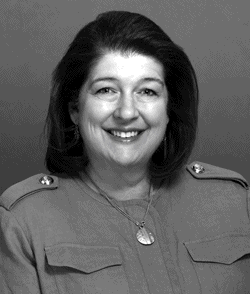
Elizabeth Greenfield Krohn was a wife and mother of two young boys when she was struck by lightning in the parking lot of her Houston synagogue, and her most fundamental understandings of what the world is and how it works were completely transformed. She is now a grandmother living in Houston.
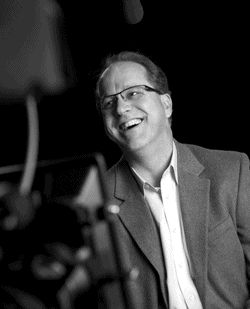
Jeffrey J. Kripal is a well-known professor of religion at Rice University and the codirector of Esalen’s Center for Theory and Research. He is the author of many books on religion and unexplained phenomena, including, with Whitley Streiber, The Super Natural. He is a key figure in consciousness studies within academia and beyond.
North Atlantic Books (NAB) is an independent, nonprofit publisher committed to a bold exploration of the relationships between mind, body, spirit, and nature. Founded in 1974, NAB aims to nurture a holistic view of the arts, sciences, humanities, and healing. To make a donation or to learn more about our books, authors, events, and newsletter, please visit www.northatlanticbooks.com.