TEXTS
RELATING TO
THE MYTH OF HORUS
COLLECTED
IN THE TEMPLE OF EDFU
AND
PRECEDED WITH AN INTRODUCTION
BY
EDOUARD NAVILLE

Bunker Pressler Books
2022
TEXTS
RELATING TO
THE MYTH OF HORUS
COLLECTED
IN THE TEMPLE OF EDFU
AND
PRECEDED WITH AN INTRODUCTION
BY
EDOUARD NAVILLE
Bunker Pressler Books
2022
Texts Relating to the Myth of Horus
Collected in the Temple of Edfu
and preceded with an Introduction
by Edouard Naville
Copyright ©2022 by John M. Bunker & Karen L. Pressler
Original text ©1870 by Edouard Naville
ISBN: 978-1-7325792-9-3
Bunker Pressler Books
“Two and a Guide”
Questions regarding this book can be addressed to:
Bunker Pressler Books
8829 Heffelfinger Rd.
Churubusco, IN 46723
Bunker.Pressler@gmail.com
https://sites.google.com/site/edgarcayceandthehallofrecords/
Translator’s Note
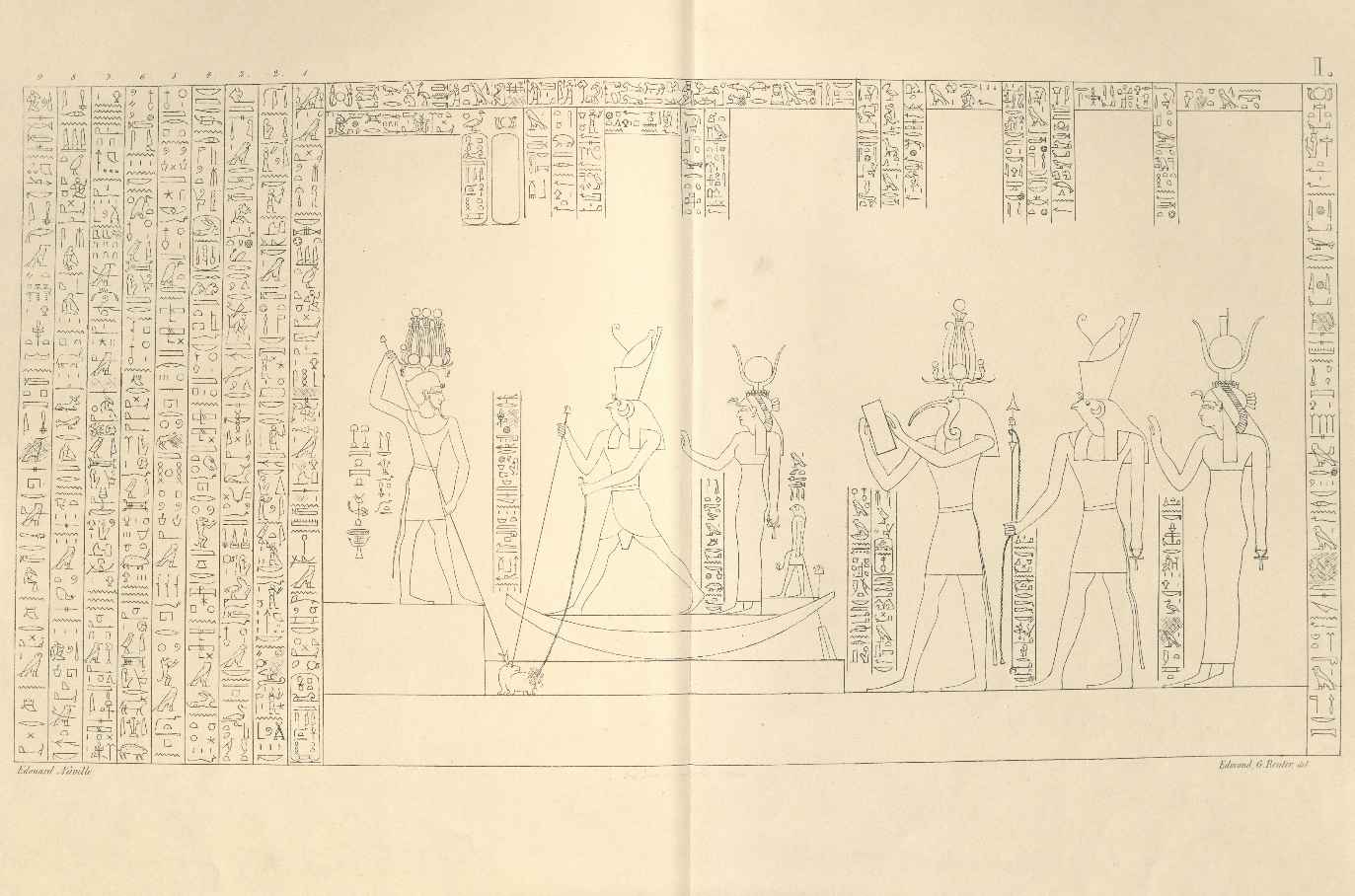
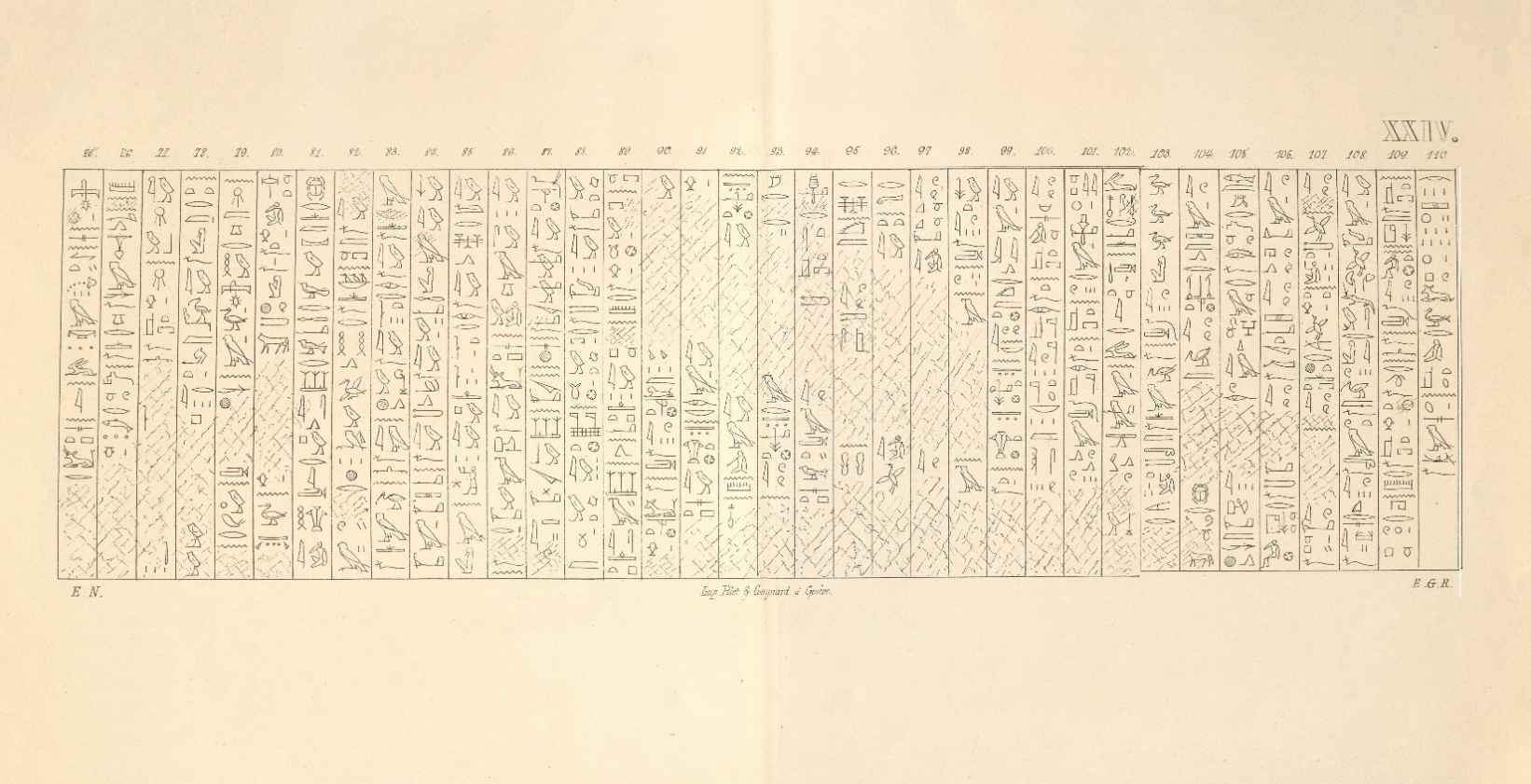
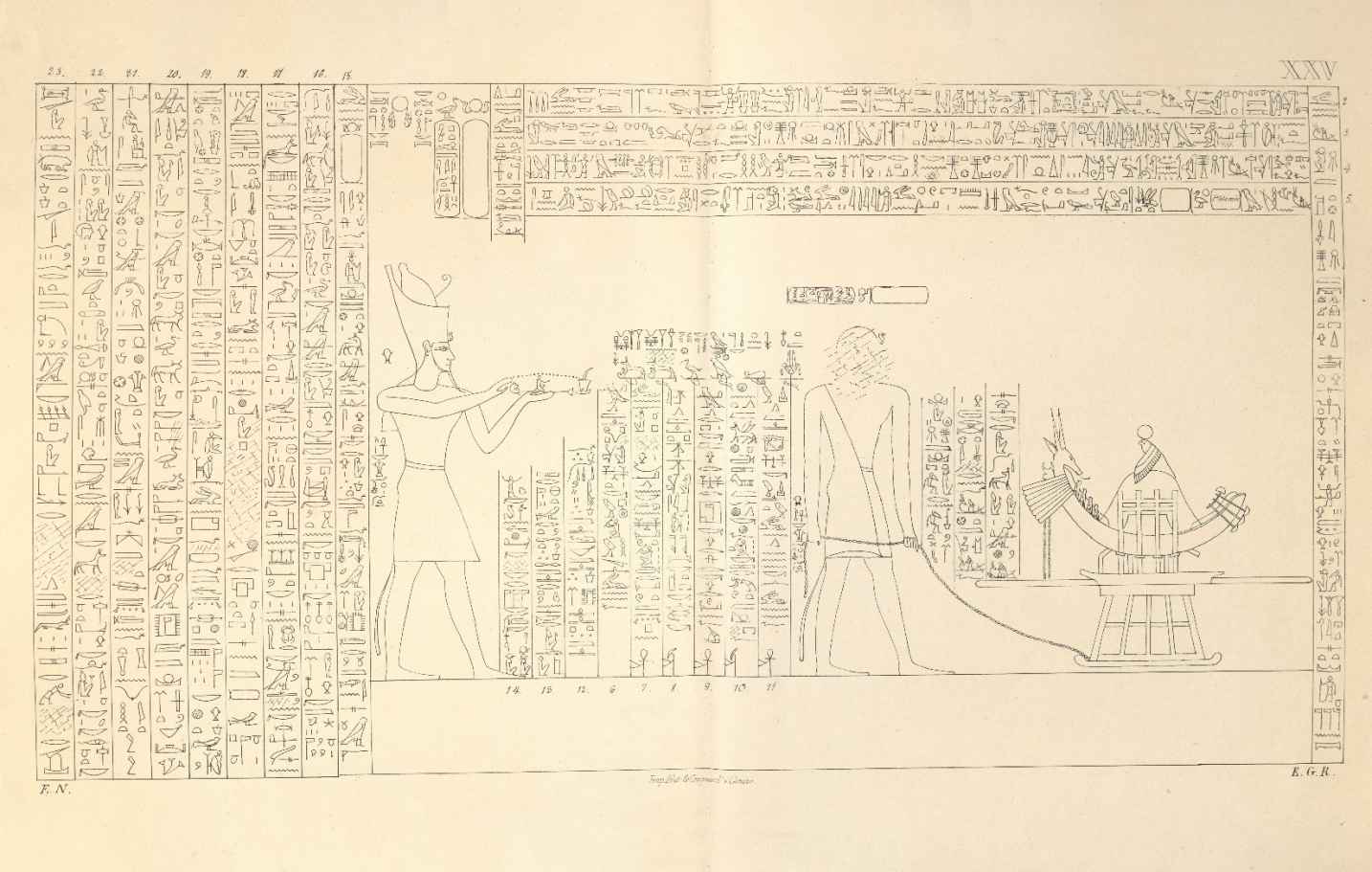
This rare book has previously been available only in the original French format. In translating it, we had a dual purpose. One was of course to make an English translation available. The other was to include the French version in its entirety so that the original language version could be made more accessable. To that end, you will find the text presented en face, that is, the French language version on the left page with the English translation facing it on the right page. All of the 25 original plates are included in the back of the book.
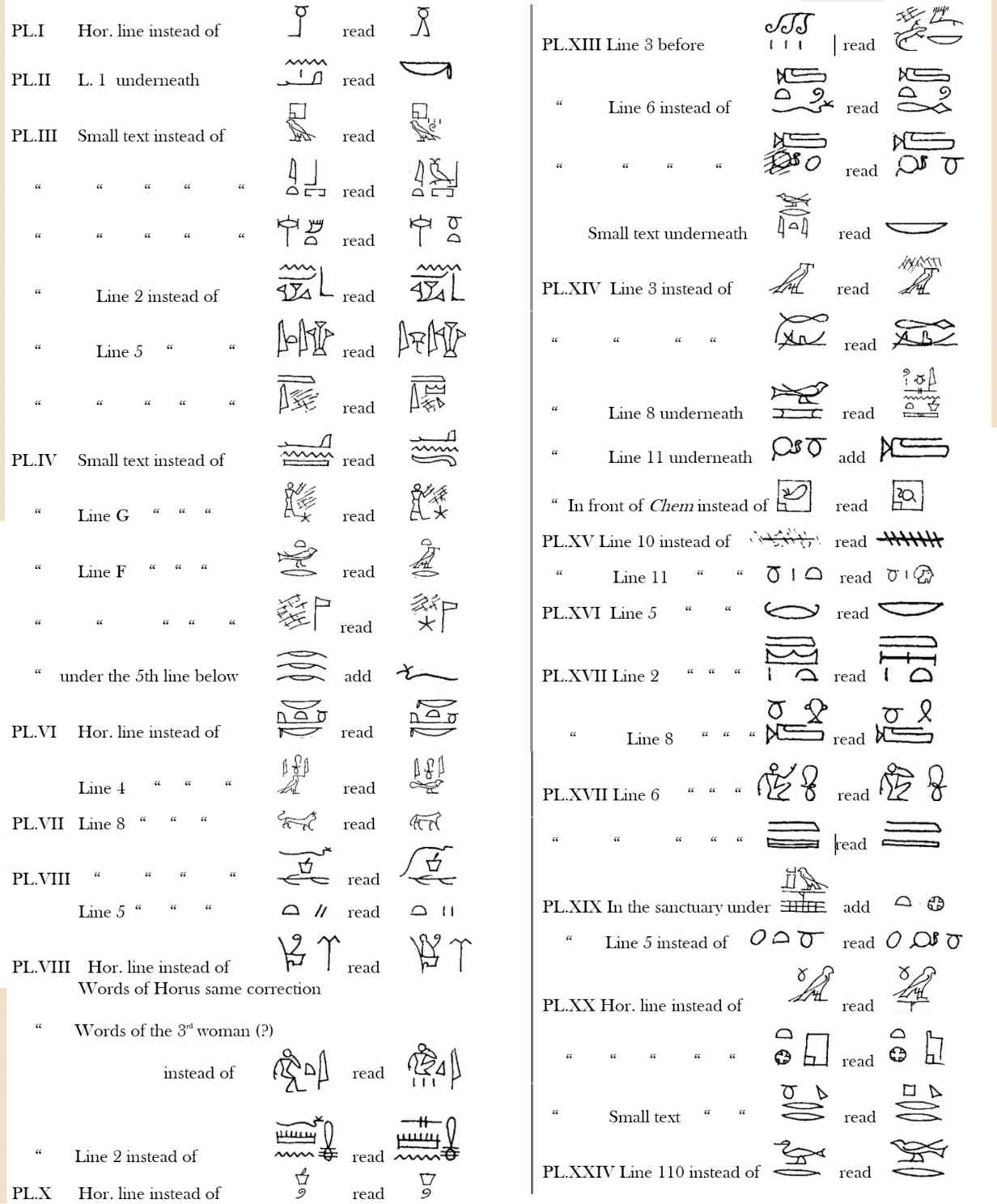
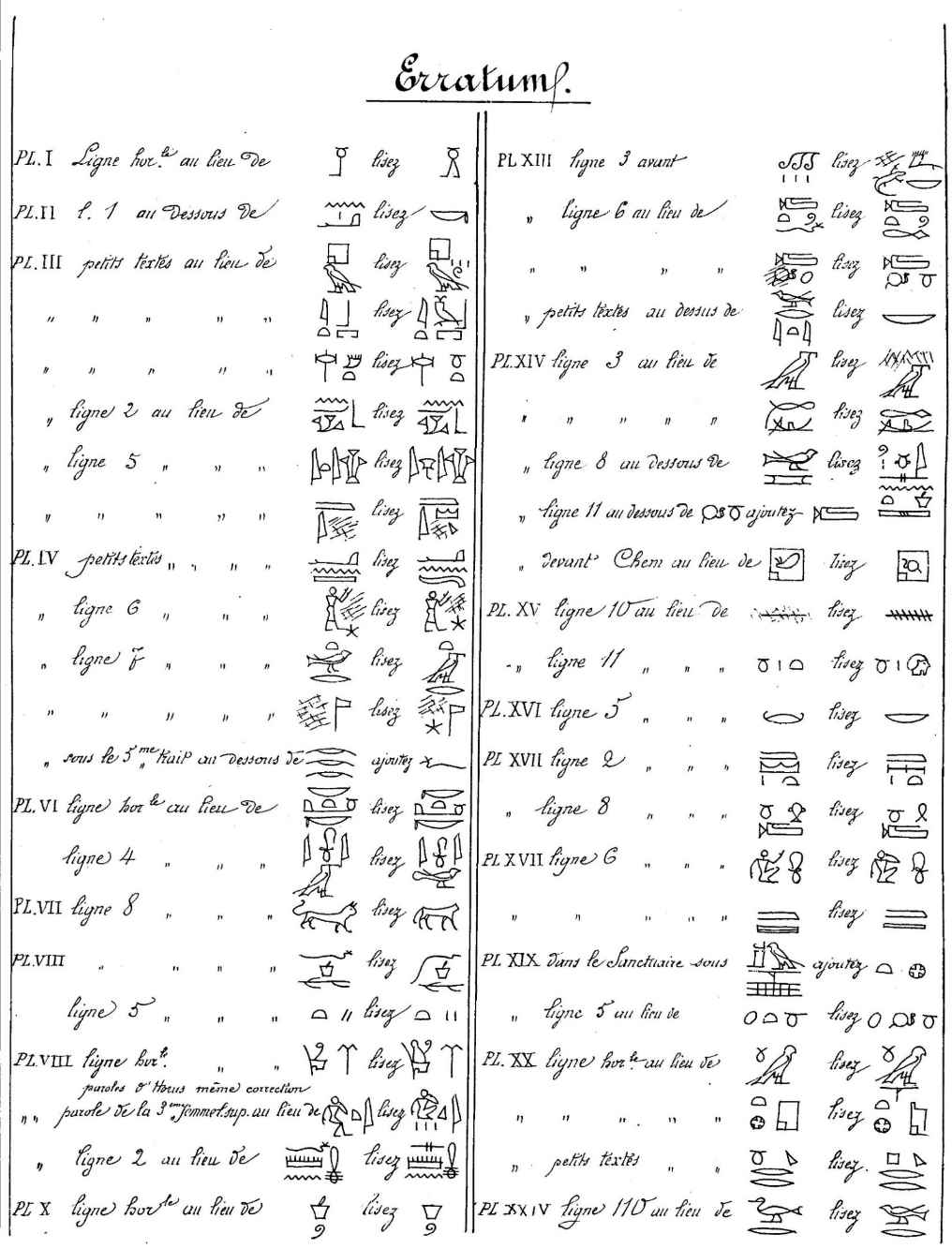
The original transcriptions for this book were made at Edfu 1865, and Naville returned to Egypt in 1872 with a group that was doing excavations throughout the Nile Delta. During that second trip he revisited Edfu and created an Erratum to his original work, included here following the plates.
[This is not a new translation of the hieroglyphic text.]
Contents
THE ENGLISH TEXT
The hieroglyphic texts that I have the honor to deliver today to the public, are the fruit of a journey undertaken especially with a scientific purpose. As a lover of Egyptian studies, to which I had devoted myself under the kind guidance of a revered master, Professor Lepsius, I left at the end of 1868 for Egypt, whose admirable monuments kept me there all winter. From December to the end of April, I constantly strived to collect as many unpublished inscriptions as possible, with the intention of making them known later on. Ibsamboul, Philae, Abydos, Dendérah, but especially Edfu, and the tombs of Biban-el-Molouk, offered me inexhaustible riches, where I had only to choose.
The temple of Edfu, entirely revealed, is of all the works produced by the indefatigable zeal of Mr. Mariette, the one for which science will always owe him the most gratitude. On these immense walls, where time has hardly left any traces, are engraved a multitude of inscriptions, whose catalog alone would require long works. You have to resign yourself to it at all costs, take only a fragment of it, and turn away from precious texts, otherwise you will soon lose the fruit of your labor.
During the seventeen days that I spent in this beautiful temple, I became attached to mythological inscriptions, which seemed to me to form an interesting whole. These are the ones I have gathered in this volume. With the exception of three plates, they are all engraved on the western outer wall of the corridor, covering the two lower registers. The Ptolemaic temples are now the ones that Egyptologists study most readily. It is therefore important to deliver these texts as soon as possible to the work of Egyptian science. Returning to my homeland during the summer, I immediately undertook this task with the firm intention of discharging it promptly. But a second trip to Egypt, on the occasion of the inauguration of the Suez Canal, interrupted my work. Thanks to the generous hospitality of H.H. the Khedive, I had the good fortune to ascend the Nile a second time in the company of a large number of scholars, literati and artists, who had come from France and Germany; I spent a day in Edfu, and found there an unexpected opportunity to compare my already printed plates with the original. It is to this second trip that I owe the Erratum which accompanies this volume.
I would have liked to add a more extensive explanatory text, and a more complete introduction. Two questions, to which I reserve the right to return perhaps one day, particularly attracted me: the philology itself, and the mythological inferences that can be drawn from these inscriptions. But the desire to put these texts at the disposal of Egyptologists as soon as possible made me renounce my original intention, and I only claim to give here the general idea of the two accounts contained in this volume, and a summary of the content of each plate. A consideration of another order settled it for me. Professor Brugsch, who had also collected a part of them, renounced in my favor to publish his copies, with only the condition that I would hasten to publish mine. I could only respond to such kindness by doing my best to satisfy Mr. Brugsch's desire.
I would also like to express my gratitude to two men who have kindly lent me their assistance for this work: to my learned compatriot Mr. Zündel, from Bern, to whom I owe several of the Greek quotations I have used, and to my travel companion, Mr. Edmond Reuter, who was in charge of the execution of these plates. A thankless task, which he has performed with a merit that every Egyptologist is able to appreciate.
Desirous above all that these inscriptions may be useful to someone in these beautiful creations, several of which appear each year, I ask the friends of Egypt for their benevolence for this modest work. I will be happy if it brings a small offering to this treasure that Champollion has discovered, and that many disciples are constantly enriching, with as much perseverance as success.
Edouard NAVILLE
Geneva, 31 December, 1869

Egyptian mythology is still an unexplored land, the boundaries of which we hardly know. Hidden, better than any other, by this veil of mystery which covers all of Egypt, she has been too much left in the shadows, and it is only recently that she has been asked to reveal her ancient wisdom. Her gods were too bizarre, her ingenuity too fantastic. Was it not necessary to run as quickly as possible; first establish the series of Pharaohs and tell us about their exploits? Was it not more urgent to give us a solid philological basis on which we could build new discoveries? The idea was well founded, and the results that it brought to its continuation show us its perfect truth. But it is now time to study what, according to the expression of Mr. de Bunsen, is one of the poles of the existence of any nation: mythology. For too long we have looked upon it with reverence; we have seen in it impenetrable secrets, a mysticism that was beyond our means of investigation. The time has come to fill this gap, and to approach frankly the study of a system which will perhaps not be up to the prestige it has long enjoyed, but from which we can nevertheless expect great results.
Two means will mainly contribute to enrich our knowledge about the religion of the Egyptians. For the Pharaonic era, more extensive studies of the Ritual, its first form and its development. For the Ptolemaic period, where history is no more, and where religion seems to absorb more and more the life of the heads of the nation, the innumerable inscriptions of the temples, such as Edfu and Dendérah, are a goldmine that several generations alone will be able to exhaust. Mr. de Bunsen, Mr. Lepsius, Mr. de Rougé and others took the first steps in this direction, and approached the question of Egyptian theogony, of which Mr. Mariette in a recent writing[1], recognizes all the advancements. It is also with the aim of facilitating, to some extent, this fine research that these texts have been collected and presented to the friends of Egyptian studies, who will not be able to ignore their importance.
These texts are not from an ancient period; they date from a Ptolemy whose name is almost always written incompletely, and whom Mr. Lepsius believes to be Ptolemy Caesarion. They relate exclusively to the myth of Horus, to its justification, or rather to the way in which he avenges his father, and to the places to which this legend was attached. They contain two different accounts: one, showing more especially how Typhon was punished for the murder of Osiris, and the other, the conquests of Horus which ensured him the kingship of Egypt.
It is perhaps the first time outside of the Ritual we find something that can be called the history of the gods, something that tells us in detail an episode of their life, and which explains to us several of the mystical allusions widespread in so many formulas of worship. They are perfectly circumscribed legends, commemorated by religious ceremonies; they took place in specific places, and one is even dated as a historical event.
Such documents vividly highlight the immense value that Ptolemaic temples have for us. In these vast buildings, religion occupies the whole place, which is no longer disputed by accounts of battles and conquests. Uses, ceremonies, feasts, offerings, litanies, everything is in such great detail that it seems that we wanted at all costs to save these things from oblivion. In the midst of all these riches are also myths, and the interpretation given by the Egyptian priests. Although it is not the Pharaonic temples that have preserved them for us, I believe that they are nonetheless of a high antiquity, and that they should in no way be considered as traditions from abroad. The death of Osiris, and the revenge that Horus derives from it, are one of those legends that are told to us by many authors, and of which the Greeks spoke to us most willingly. Nevertheless, it is impossible not to attribute to this fable, as it is reported to us on the walls of the temple of Edfu, a purely Egyptian origin, because it is a fundamental point in popular beliefs. It would be superfluous to quote the innumerable allusions of the Ritual to the justification of Horus when he killed his enemy, whether this one is called Typhon or Apophis. It is because Horus was justified first that the Osirian also hopes to be absolved by his judges. It is for this reason that he asks Thoth for the protection that he granted to Horus before the same tribunal of the gods of Unnofris. It is possible that the legend has been modified in the course of the centuries; but the substance is the same, and the moral teaching has not changed.
The fact that the Egyptian priests relate these legends to us in this way testifies to a need to be aware of the ceremonies and the bizarre names that certain places bore. How does it come about that a hippopotamus figure is torn to pieces on a feast day? This is because Horus cut Typhon into pieces, and followed the same prescriptions which the priest still obeys. Where does the name of this or that lake come from? It is because Horus sailed there and fought the crocodiles. One can even wonder if it was not their intention to spread this interpretation abroad, and thus to rehabilitate among a degenerate population a religion which was going away. For we cannot see in there a secret tradition, of which the priests alone would have had the key. If there was an explanation hidden from the people, it is more likely the one that Plutarch, Horapollo and others tried to give us when they indicated the historical or physical fact that this or that symbol represented. The meaning of the symbol itself is nowhere to be found. I believe, on the contrary, that by thus giving a rough interpretation of the sacred myths, the priests wished to restore honor to the localities where Horus was worshiped, and to give their festivals a divine sanction, by showing that they were linked to the history of the gods, which perhaps tended to be forgotten. Be that as it may, we cannot be surprised enough at the contrast that exists between the inscriptions that the pharaonic temples have preserved for us, and texts such as these. There, hardly the name of the gods, and a few banal formulas to which we do not find any meaning; here, their names, their lives, their homes, their offerings; nothing is missing. It would be intriguing to study more deeply the causes which brought about such a radical change.
In the first part of our collection (pl. I to XI), we see Horus and a hippopotamus. We already know from Plutarch[2] that the hippopotamus was one of the forms of Typhon, because it was the symbol of impudence (άναίδεία). We would already have sufficient confirmation of this assertion by seeing that the names of Typhon (Tep, Tebh) Baal and Set are attributed to him. But we have an even clearer testimony in this sentence taken from another inscription, relating to the same subject[3]: literally: Behold, Set made his body like a red hippotamus. I insist all the more on this sentence because it mentions another fact also reported by Plutarch[4]: it is that Typhon was represented of red color. From this comes that red oxen were sacrificed to him, and that the Egyptians looked with superstitious fear at men whose hair was red or blond.
Horus must kill the animal, in order to avenge his father Osiris, who was himself a victim of Typhon's cruelty: for he was defeated, his body was cut into pieces, and his limbs scattered. His son does not let the crime go unpunished; accompanied by his mother Isis, guided by Thoth, he declares war on Typhon, pierces him with ten blows, and puts him in chains. These ten strokes or spears of Horus, which are the subject of five plates, and of long inscriptions, where one sees strange spirits appear, are one of the most obscure parts of these texts. Is this a symbol of some astronomical phenomenon? What does this number ten have to do with? Who are these spirits? So many questions that we cannot yet answer. I mention only a passage of Eusebius,[5] which refers, if not to the very paintings published in this volume, at least to an exactly similar representation. He speaks about a sacred symbol of the city of Apollinopolis, which consists of a man with the head of a hawk, who strikes Typhon in the form of a hippopotamus with a sword. This symbol would be that of the light of the moon.[6] One must always be wary of the explanations given by the Greek authors of the last days; it would seem however, according to this passage, that we have to look for some astronomical fact under this image.
The victory consummated, the god approaches Edfu, King Ptolemy comes to meet him, followed by the Mesennou. These men appear here as the inhabitants of Mesen, that is to say of Edfu; they seem, at first sight, to be a college of priests. But we shall see, in the following series, that they have an important legendary history. Then it is the mother of the king, Cleopatra, who comes with the priestesses of two temples to congratulate the hero for the fact that, by his valor, he deserves to be raised to the royal dignity of his father Horchuti. Isis, then, advises Horus to cut into pieces the hippopotamus that he has defeated, and indicates to him the gods to whom he must give each of its members. To this end, Horus brings him to one of the halls of the temple. At this moment the god no longer appears, and we only see a commemorative sacrifice, made by the menhu, while the high priest of the temple reads the book whose analysis we are giving here, and which is called: the book of the justification of Horus. This is the first part of these mythological texts, where we see more particularly the way in which Osiris is avenged. Typhon is killed by Horus, his body is torn to pieces, as he had done to his adversary; Horus is declared righteous when he has exercised the law of retaliation.
The second part (pl. m) is perhaps even more important than the first. It has a more precise character, it is closer to history. Typhon is no longer simply the god of evil, the personal adversary of Osiris; he is a ruler who occupies with his allies the greater part of Egypt, from Edfu to the east of the Delta. Horchuti reigns in Nubia, where he is as if relegated; but in the year 363 of his reign, his son Horhut, the Horus of Edfu, gathers an army, and, accompanied by his father, goes down to Egypt to make the conquest of it. I insist on this beginning in several respects. Horchuti is, par excellence, the god of Nubia; It is to him that several of the pharaonic temples that exist along the Nile, between Ouadi Halfa and Philae, are dedicated; it is him whose image is sculpted next to the great colossi of Ibsamboul. But his cult has spread far beyond; he has ceased to be a local deity. In these texts, for example, Horchuti represents the living Osiris. The name of Osiris himself appears only rarely, and always, when he is not the god of a certain locality, to designate the dead being whose murder Horus must avenge. The divine king, the father of Horus, the god with whom Horus must eventually identify himself, and whose insignia he must, so to speak, put on, is the one who is called here the king of Nubia; he is Horchuti.
In the 363rd year of his reign, the god left with his son for Egypt. This is a precise date of one of those kings who, according to Egyptian traditions, had occupied the throne of Egypt before the native rulers. In this year, Horhut drives Typhon out of Egypt, and establishes himself as king over the whole country. This would therefore agree with what Manetho and Eusebius tell us, that in the first dynasty of the gods, Typhon immediately preceded Horus. The succession would have been made by right of conquest.
Horus has with him companions who are called everywhere his followers; the Schesou Hor. Mr. de Rougé has already pointed out that, in several inscriptions, these men are considered as the primitive inhabitants of Egypt, the contemporaries of the divine dynasties. These are the Mesennu of whom we have already spoken in the previous series. The role they play in this story shows, even more clearly, that the period in question is the end of the mythological times to which Mena was to succeed. It is a tradition relating to events which must have preceded historical times by only a short time.
Horhut climbs into the boat of his father, who follows him during the whole expedition, and gives him his support and advice. The gods follow Typhon all along the river; Horhut fights several battles in places which will receive proper names to recall his exploits, and which will be more particularly dedicated to his cult. It is in Edfu that the first battles took place, then in the 16th nome of Upper Egypt. The nome of Mert, that of Fayum and of the lake Moeris, is the theater of several episodes of the fight. It is in the city of Sutenchenen, called here Nanrutef, an important sanctuary of Osiris, that the Schesou Hor are established. Finally, when Set was driven out of the nome of Chent ab, the 14th of Lower Egypt, the country was delivered, and the royalty was assured to Horhut. His father, who, with each new victory, gave him some special honor, granted him to be represented under the form of the winged disc, or of the scarab, on all the temples of Upper and Lower Egypt. Horus becomes the lord of the two regions, sits in a sanctuary where he is worshipped like Horchuti, with whom he ends up merging.
Such is this second legend, much better characterized than the first, because it is attached to known localities, and to a determined time. It even seems to me clear enough for us to see in it a tradition, which would have at its base a historical fact. Set is a well known god in the history of Egypt; he is the god of the enemies, and particularly of the Semitic populations, who once conquered the country and often put it in danger. If we consider that he is driven out by Horus, the god who succeeded him in the kingship, and by the primitive inhabitants of the country; at a given moment of the divine annals, is it not natural to explain this myth by a war between the Egyptians who came from Nubia, and the Semites who would have been driven out of the country; either that this war is older than the historical times, or that, coming later, it passed into the domain of the legendary history? Texts relating to the divine dynasties are still too rare for us to be able to push this research very far. The temple of Edfu will perhaps provide us one day with new indications about these prehistoric times, and about the very mysterious origin of the civilization of Egypt.
Without dwelling on the four plates that follow, the first three of which are a different account of the struggle of Horus and Typhon, and the last one an appendix that has no connection with these legends, I come to a more detailed analysis of the content of these texts.
We have here the title and the introduction of the book which is to tell us about the struggle with Typhon, and the victory of Horus. This book is called (l. 2): the justification of Horus against his enemies, it belongs to the priest in charge especially of the worship of the sacred spear. The king himself, Ptolemy Caesar, fulfills the priestly functions; but from the beginning, he is attributed a divine origin, and he will end up identifying himself with the god that he adores.
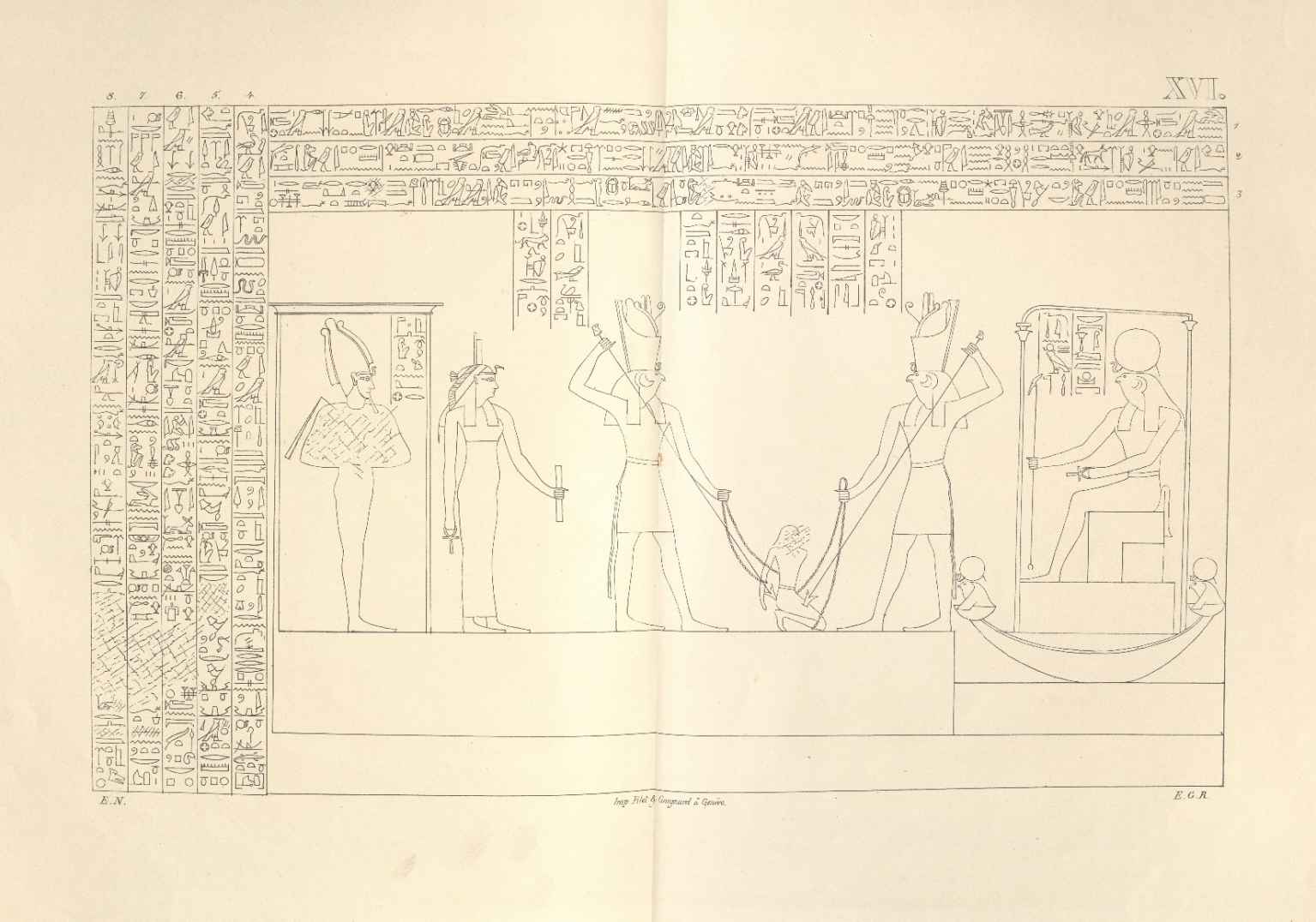
The painting represents two different moments in the story. First we see the two heroes, Isis and Horus, appearing on the scene. Horus is armed with his spear, and the rope with which he must bind the enemy. He is called: Hor hut, the great god, the lord of the Mesen, the shining ray that appears on the horizon, the brave, the valiant one who has gone to destroy (Set); his mother Isis protects him. Then Horus goes up on his boat; his mother is behind him, and says to him: Your heart is firm, my son Horus, you have destroyed the hippopotamus [enemy] of your father. He is already seen piercing the monster with his spear, and binding its feet, while the king, the valiant hunter (secheti) (l. 1) cooperates in the victory. The god invites him to take part in it in these words: My sword is in my hand, my spear is in my fist; let us tame the nefarious with our line.
This figure of Horus piercing and chaining the animal is found in the first ten plates, even where there is no longer any question of combat. It is obvious that this spear, this defeated hippopotamus, these bonds, are the attributes of a special form of Horus, the one described by Eusebius,[7] and whose exploits are celebrated here. His name is given to us: it is Hor enter (l. 9), literally Horus who strikes or who pierces, and who I called, by changing the epithet a little, Horus destroyer. At the time when these inscriptions were composed, the different forms of the same god were already so separated that they had hardly any common name, and they had become different deities, having their own role and an individual existence. Thus, on the boat of Horus the destroyer, we see another form of the same Horus: it is the divine pilot who stands at the helm.
But Horus is not alone in this struggle; the god Thoth directs his journey, for he is often called the guide of the Rehhui (pl. VIII), that is to say of Horus and Typhon considered together as the opposite personifications of good and evil, and he presides, as it were, over their struggle. Moreover, as he is par excellence the tutelary god of the souls in judgment, it is he who will proclaim the victory of Horus and will award him a day of celebration, after his justification has been pronounced (l. 3) by the supreme tribunal of the great gods (tatasu) of Ra. All this is purely Egyptian mythology, and of the greatest analogy with what we read in chapters 1, 8, 19 and 20 of the Ritual.
Thoth says (l. 3) a feast day to Horus the lord of this land, the son of Isis the beloved, the justified lord, the child of Osiris, the son of Unnofris, who is valiant in all places where he is. Then he determines in a rather obscure way the time of this feast, indicating all the divisions of time, from the hour to what we would call the century. The inscription ends with a hymn in honor of Horus: praises (pronounced) when they laugh at you in the year of the feast. In this piece, sometimes the god is supposed to speak himself, sometimes his worshiper addresses him, and we thus pass from one person to another with this ease which characterizes the Egyptian language. We find there a sentence which will reappear several times in these religious texts (l. 7) I threw (my line) on the right, I threw it on the left, like a valiant hunter.[8]
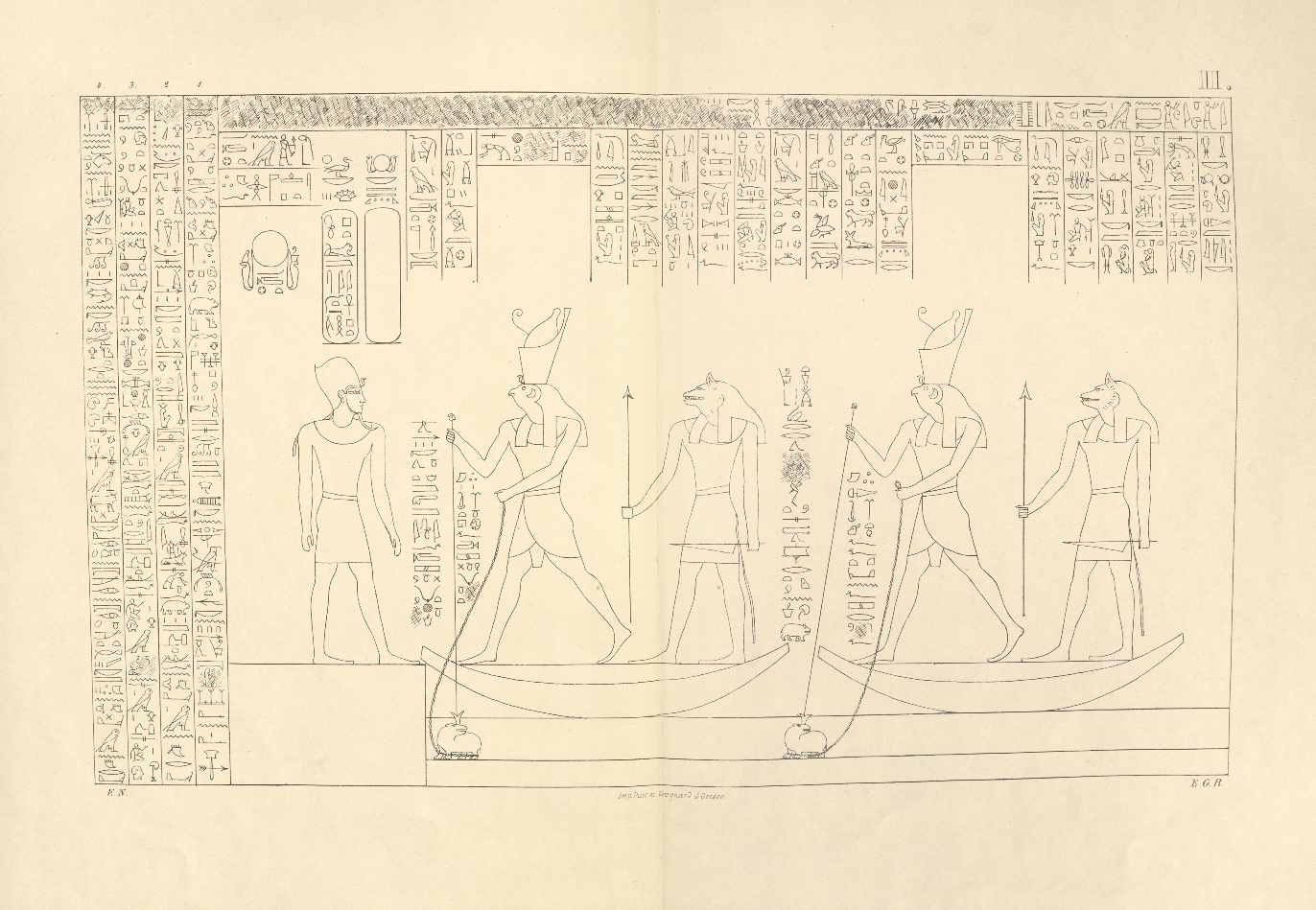
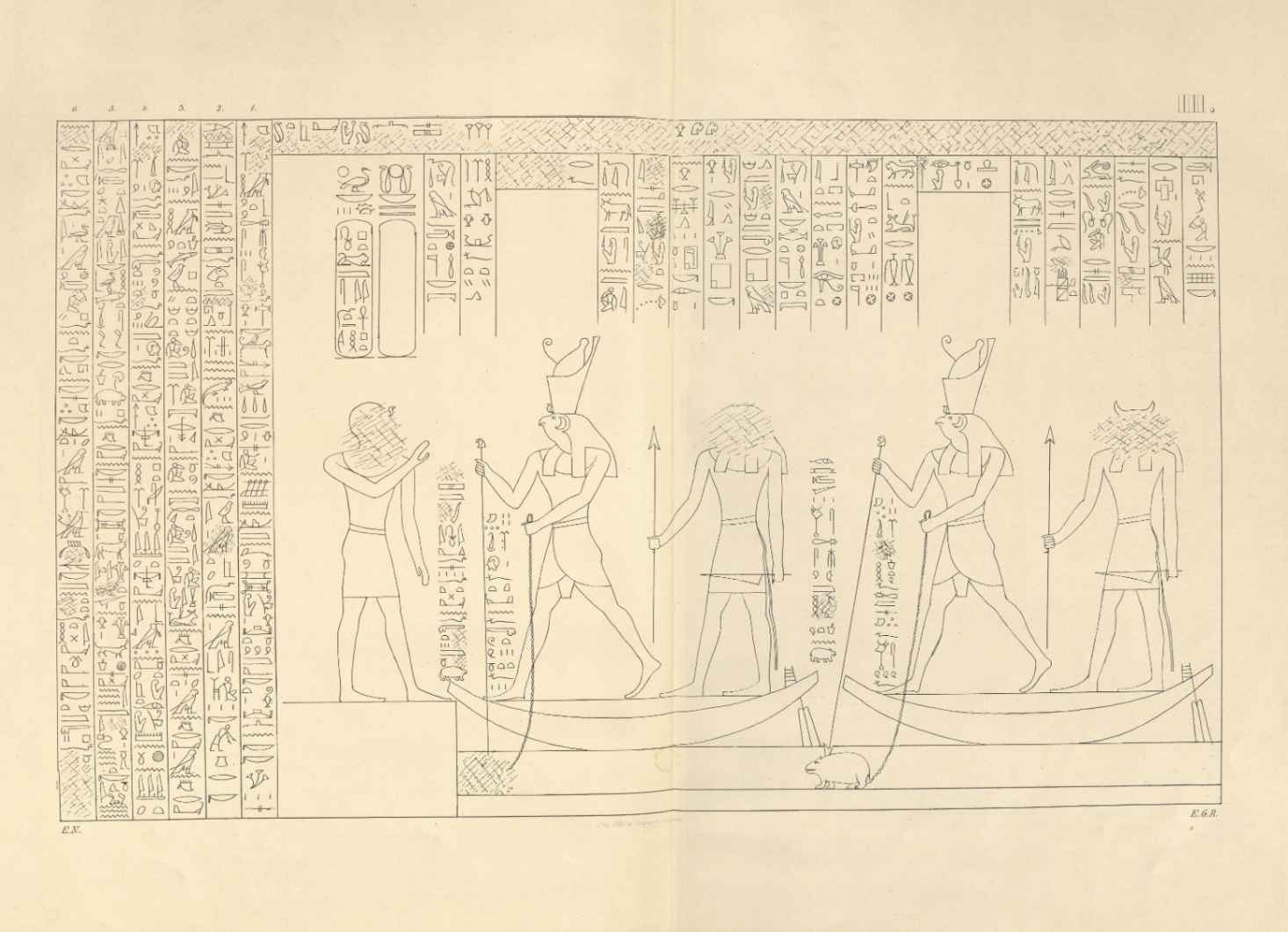
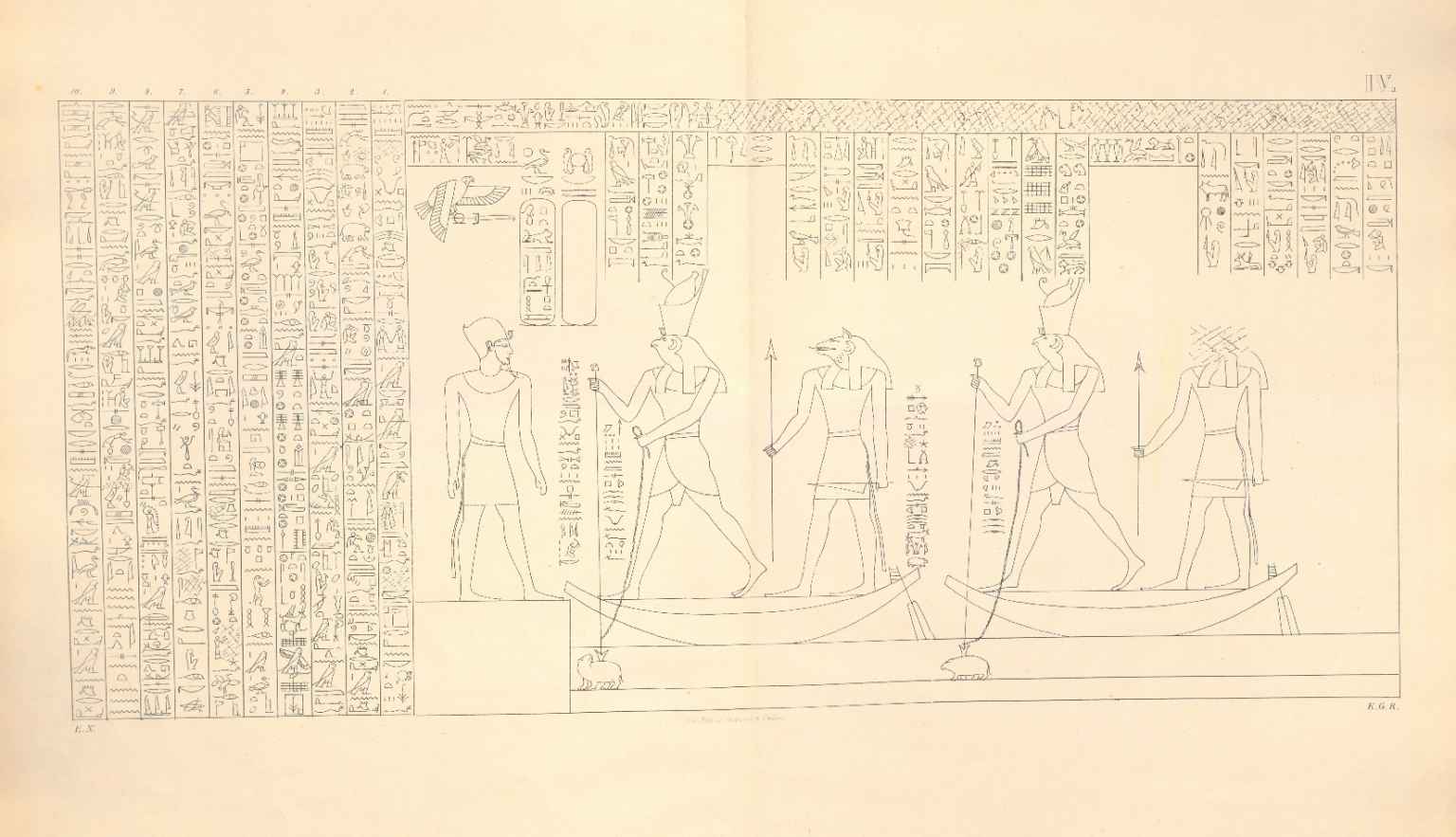
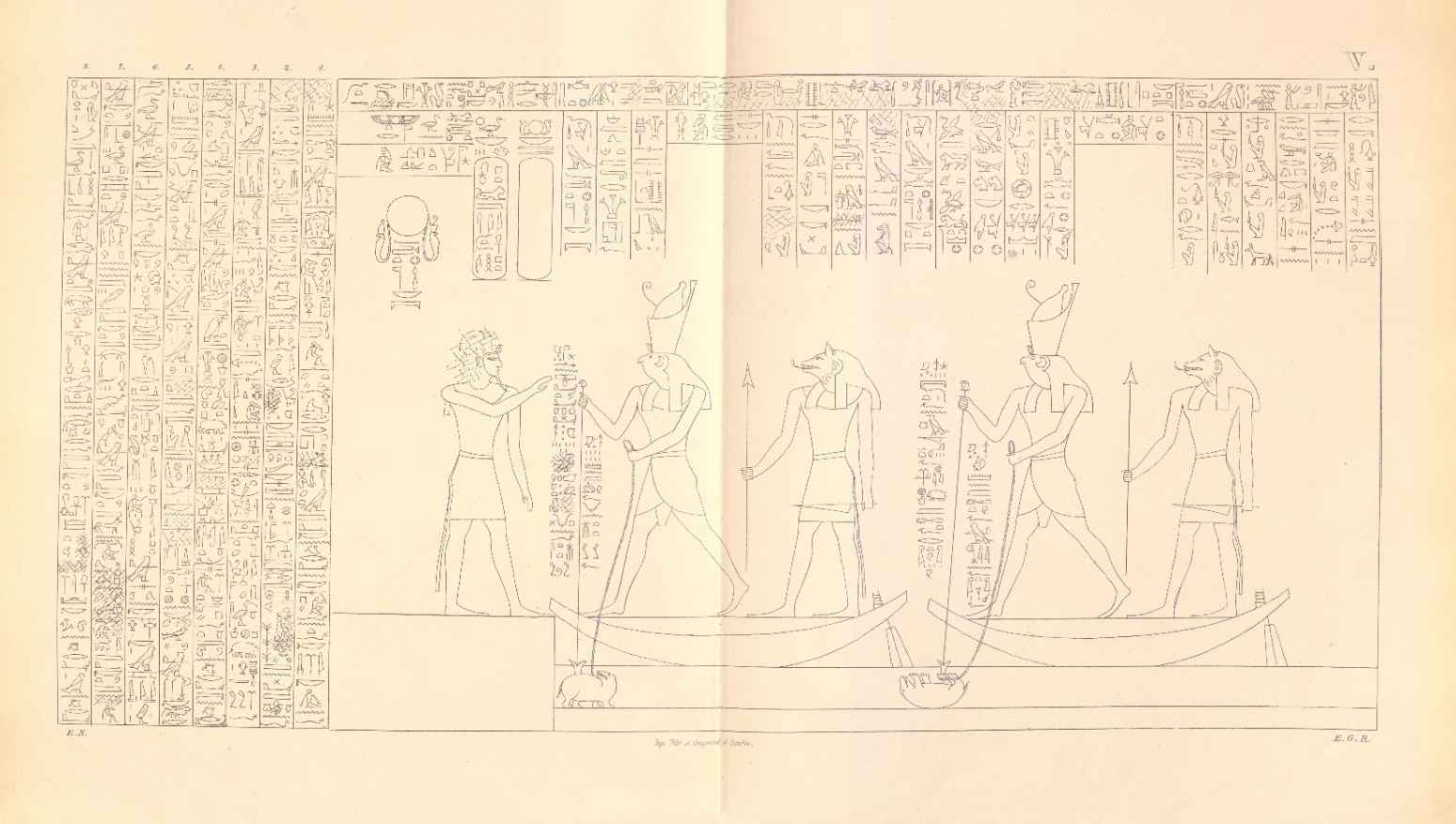
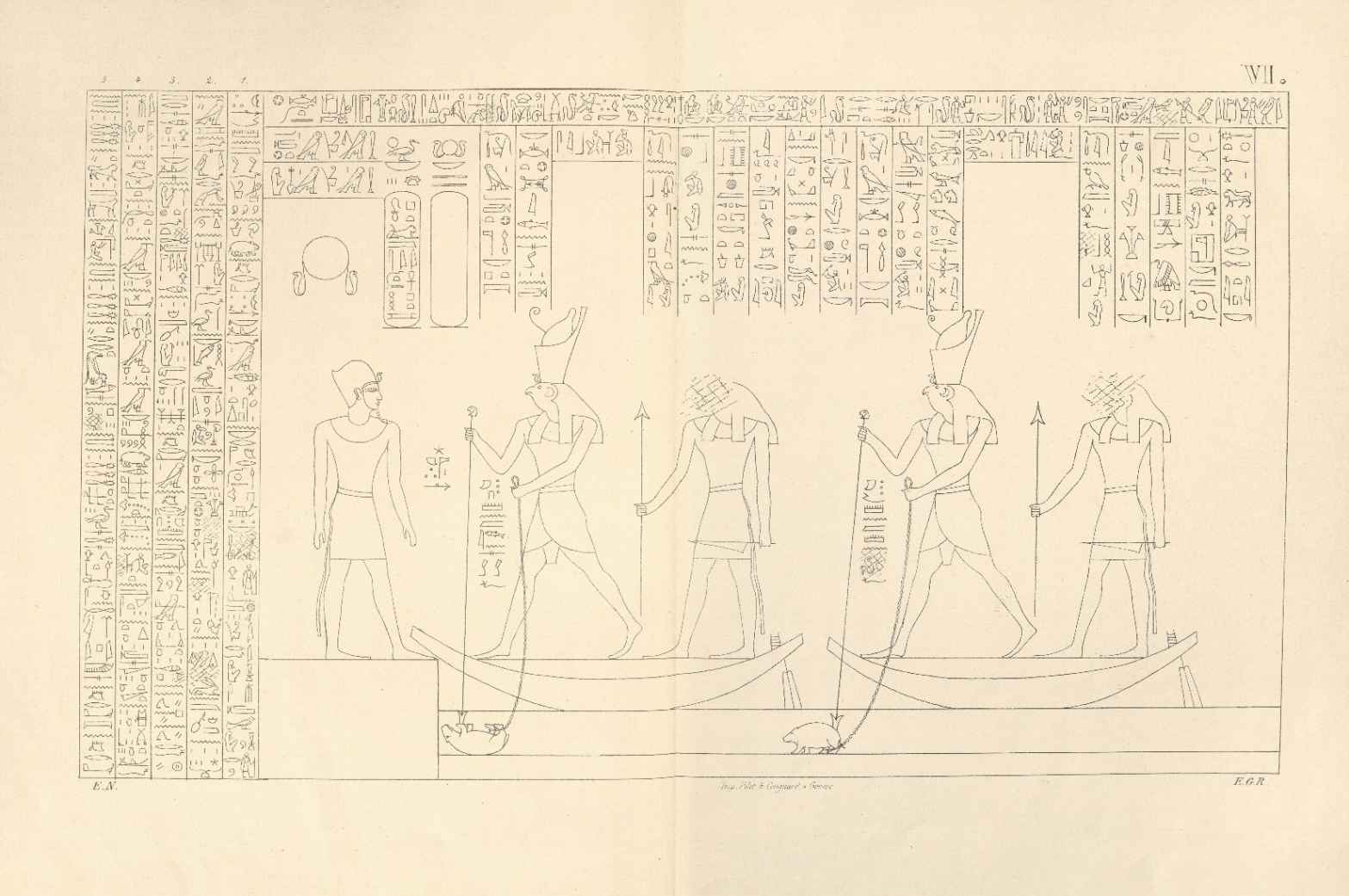
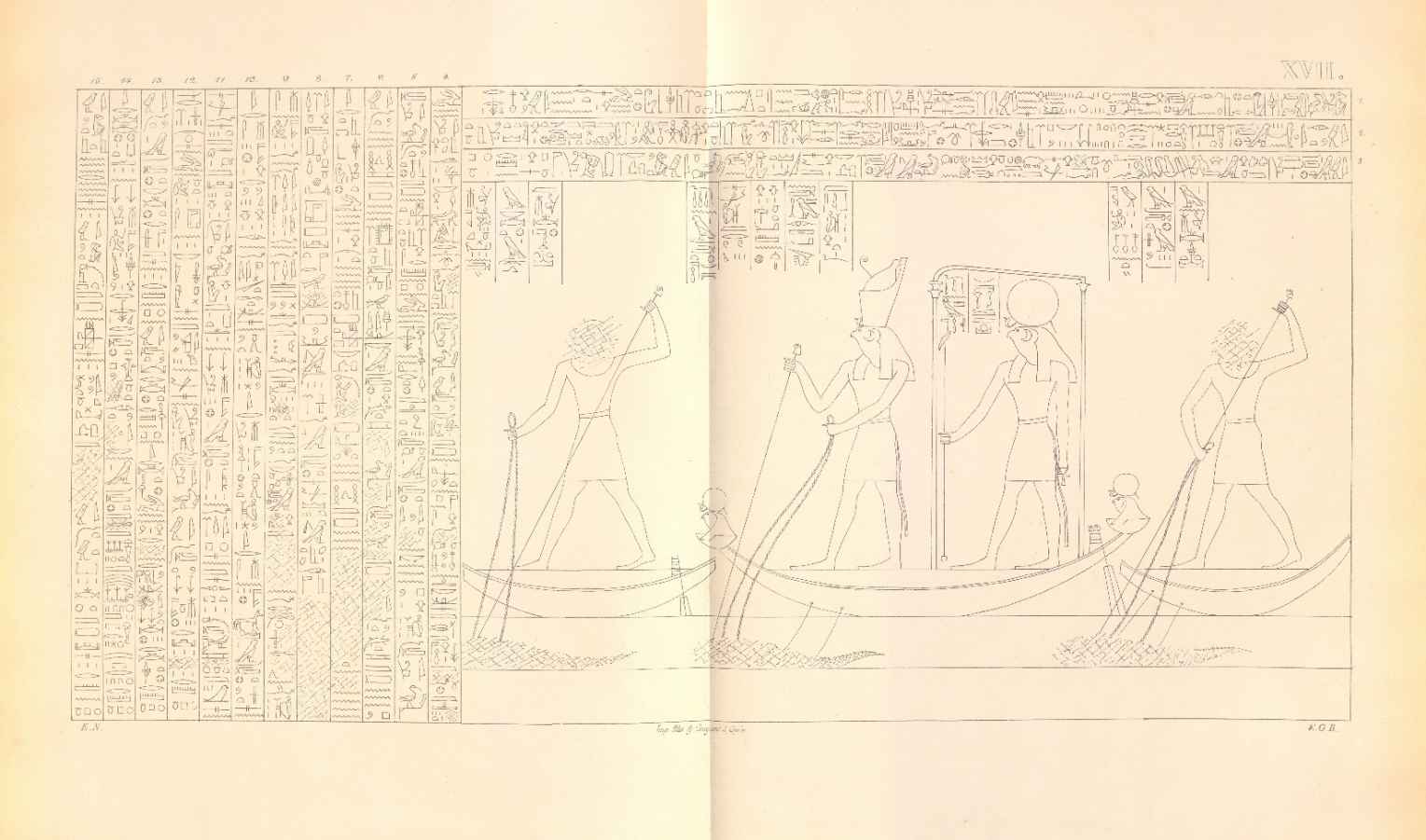
Here begins a series of five plates, each of which contains a double scene. Horus pierces Typhon with ten darts; each of these darts hits a different part of the animal; a special spirit directs each hit, and protects Horus in his exploits. On all these pictures, the god is represented making two wounds, and the king, fulfilling the functions of priest of Edfu, pronounces in the honor of the god and of his spear two different hymns. These songs always end with the invocation of Hor enter, Horus destroyer. This sort of rhyme, or refrain, is thus found twice in each of the following paintings. Unfortunately, the top horizontal line, which was also part of this hymn, is missing almost everywhere.
In the first scene, Horus is named the lord of Mesen, one of the names of Edfu and the great city; another designation from the same location; the great god who rules over Tes, the lion tam who reigns over the nome of Chent ab,[9] the lion ..... of Egypt, the good guardian of the two countries ..... the protective god who protects Egypt. The spirit promises to keep him and his boat. The first line is fixed in his nose, he broke his nostrils; another small text tells us: He took the breath away from the nose of the hippopotamus. A spirit, whose name is as bizarre as the first, witnesses Horus' second blow, and says to him: I pierce the...... of your enemy, I cut his bones, I break his back, I crush his flesh, I drink his venom. The stroke is fixed in the forehead, it has split the head of the hippopotamus. The four vertical lines that follow contain more especially the two hymns to the spear of the god. They were pronounced by the priest of Horhut, who celebrates the god and his spear. These hymns, which vary in length, present a kind of rhythm, and an often very marked parallelism. Sometimes they are put in the mouth of Isis herself. We can rightly consider them as pieces of Egyptian poetry, and although it is not always easy to arrive at a complete understanding of their content, it is easy to see that the repetitions are numerous. The same idea often comes back, in different terms, and the circle is quite restricted.
In Plate III, the spirits have bull heads, and again promise Horus to guard his temple and help him destroy his adversaries. The god's blows reach the neck and the head of the hippopotamus. Horus is called the one who keeps Typhon away from Egypt, the good guardian of the city of Sen. I would point out that Egypt is represented here by a group which must be read Kebti, and which does not seem to me to be without analogy to the name from Coptic and Aiguptos.
The fifth and the sixth blow (pl. IV) reach, one the back, the other the sides of the hippopotamus. The spirits always promise Horus to lend him their weapons and even their claws; thus, Kachu says to him: I cut the heart of Baal in Edfu, I take the heart of the adversaries, I drink the venom of the defeated in the city, I open my mouth against the enemies.
The following hymn, much longer than the previous ones, celebrates the temple that Horus built, and of which he himself stretched out the cord (l. 1), a ceremony which precedes the laying of the first stone. The principal cities of Egypt, the list of which is given to us (l. 5), rejoice and are happy when they see this very beautiful edifice that Horus, the son of Isis, built.
The following spirits (pl. V) are spirits of fire, judging by their names and by these words of one of them: I burn his bones with my flame. The author tries to vary the expressions indicating that Horus is the guardian of Egypt. He is spoken of as the one who keeps the layman from behind his temple, who stands behind him, like a wall of stone (or iron?), And who guards him on all sides. Elsewhere this last figure is repeated: Horus is a stone wall behind his town of Mesen du midi (Edfu), he watches over his town of Mesen from the north. This is the city of Tar, which was the means to Egypt on the east coast. The hymn is spoken entirely by Isis: Words addressed by Isis, the goddess, to her peerless son (?) When he fights with Typhon (l. 1); your heart is steadfast, my son Horus, you will pierce your father's enemy; give him no rest.
Finally, the victory is complete when Horus further injured the leg and foot of the hippopotamus (pl. VI). This plate is the only one that gives us a complete example of the text in the top line; they are, moreover, only banal formulas of adoration; very few ideas, hidden under a wide variety of words.
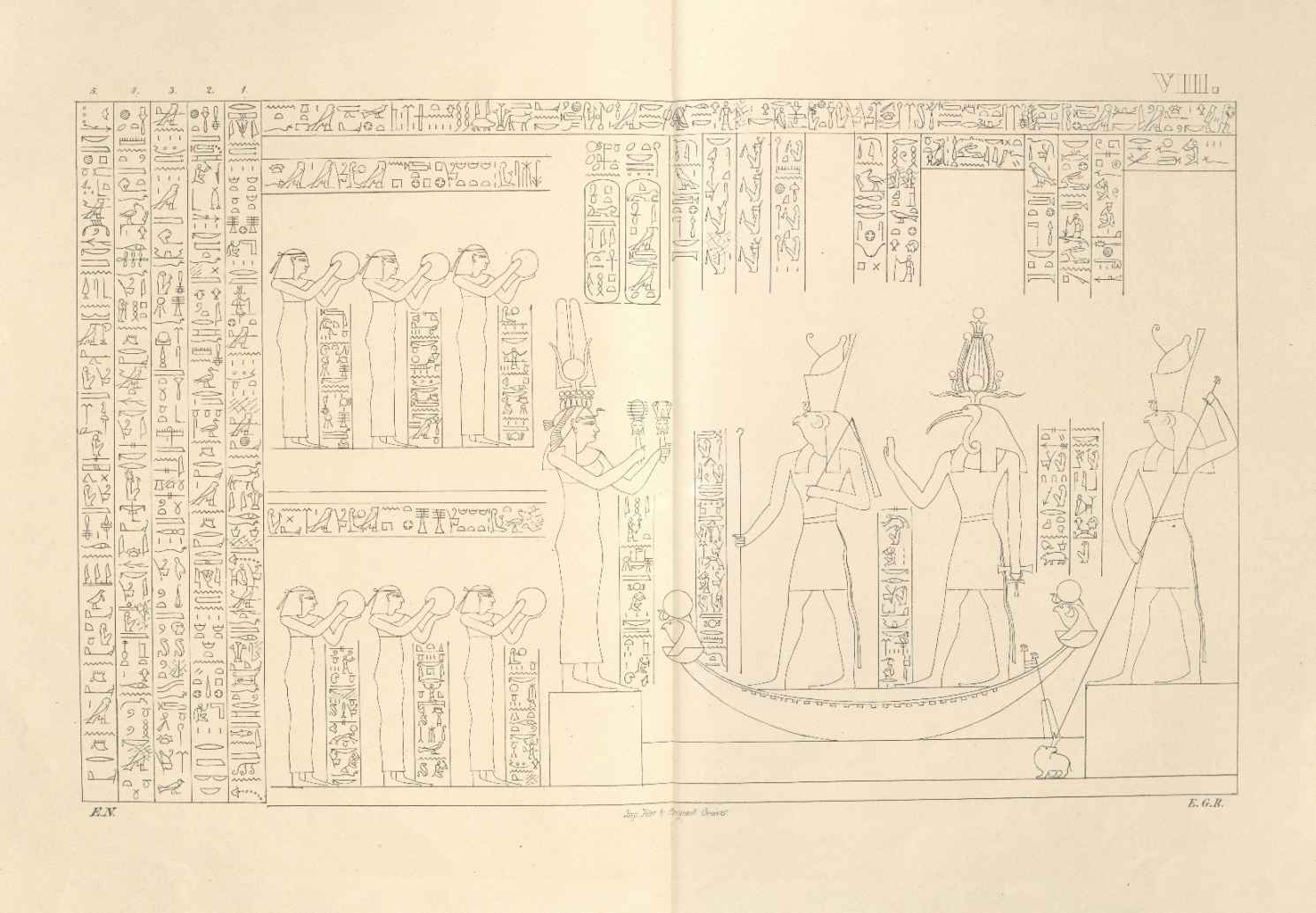
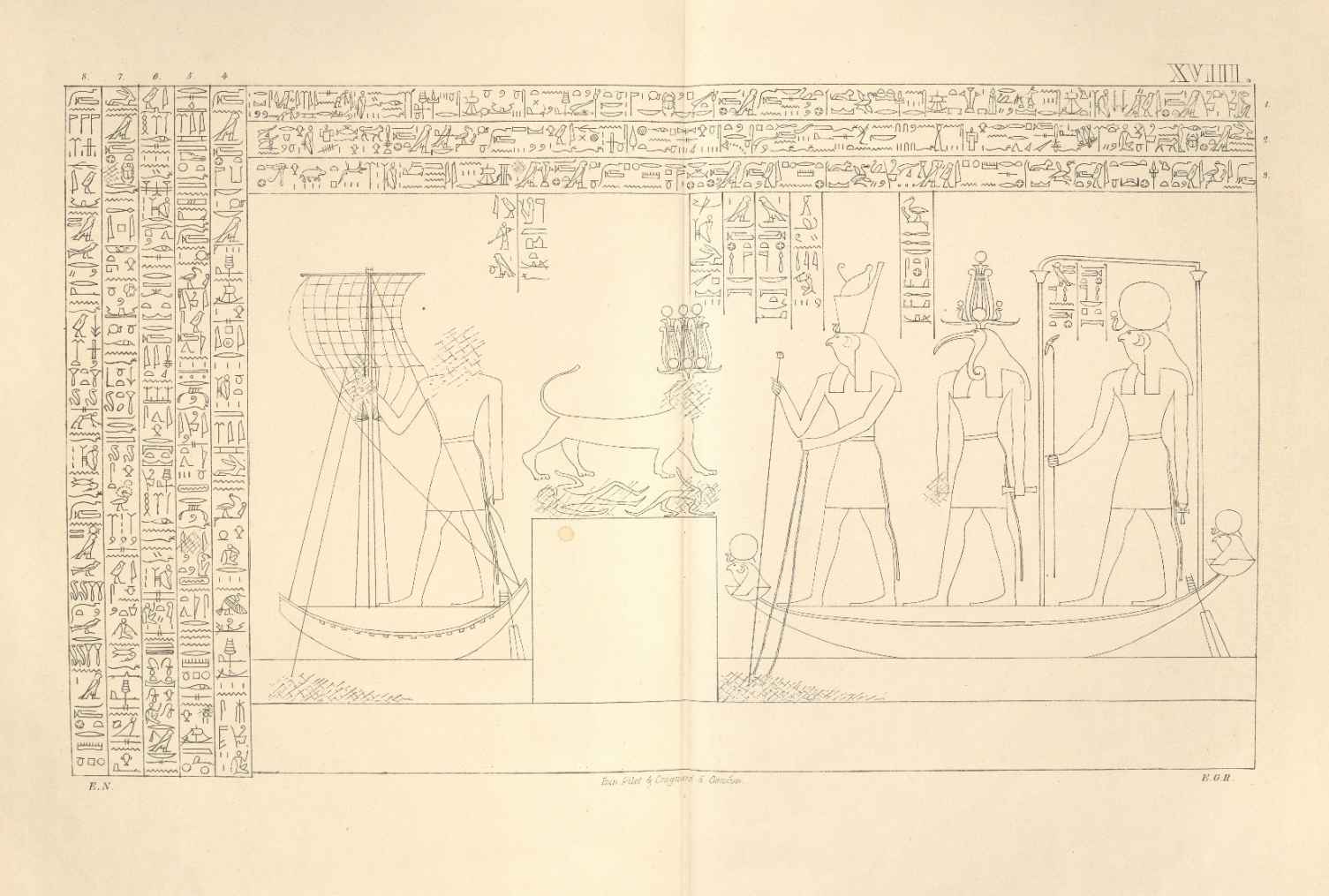
The struggle is over; Horus pierced Typhon ten strokes, and his boat approached Edfu, where his victory will be celebrated. He has the same emblems as in the first plate, he pierces the nose of his enemy. Isis is with him, and holds the chains that surround the monster. The king comes before the god, and, as he is himself the victorious Horus whose story is told to us, he strikes the hippopotamus with his spear.
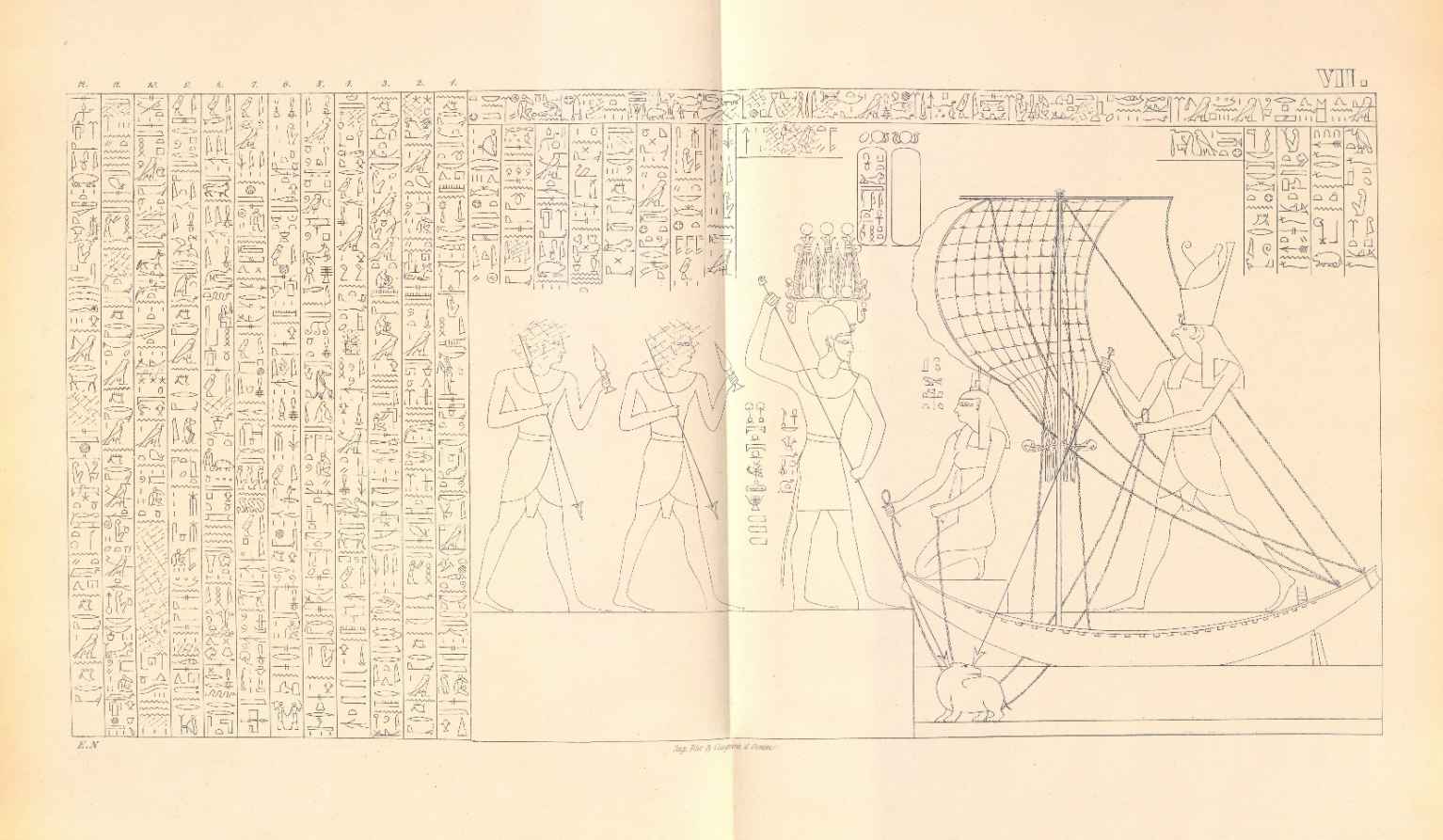
He is followed by two men called the royal children, the companions of Horus, the Mesennu who are in the lord of Mesen, the brave Mesennu who are in Horhut. These personages, who appear here for the first time, are, as we shall see later, the followers of Horus who fight with him, and who take a very active part in his conquests. In the second series of these texts, which tells of how Horus took a large number of Egyptian cities from Set, the god grants his faithful companions a home in the Fayum.[10] For the moment, they are the ones who come to congratulate him on his victory, and celebrate his exploits with their acclamations: Come on, let's run towards the lake of Horus; let us see the god in his boat; let us see the son of Isis in his boat, like Ra in the boat Sekti; his line is in his hand, etc ....
The long hymn before us differs from the previous ones, in that it is divided into three parts, separated, as always, by the invocation of the destructive Horus. It is first the Mesennu who speak, and who praise Horus in a style quite similar to what we have seen previously. Then comes (l. 3) what can rightly be called the hymn to the boat. It is because it is the main object of this piece that the artist has represented it in great detail.
Isis herself speaks, and speaks directly to her son Horus. I do not hesitate to name this text one of the most interesting in this collection. Although it was written at a time when Egypt was fallen, and when it seems that its cult and institutions should have felt a deep attack by the fact of Greek influence, it nevertheless has a completely Egyptian or rather Oriental character. It is perhaps too ambitious to call poetry that which is distinguished neither by the richness of ideas, nor especially by inspiration; however, there is originality in this piece: it is the fruit of a rather strange imagination, which reminds us of certain parts of Hebrew poetry.
It is a question of praising a boat which, for the inhabitants of Edfu, was a sacred object that was carried in triumph at certain festivals. Isis enumerates all its parts, comparing each one to some remarkable object worthy of admiration. One of them resembles Horus on the knees of his mother Isis (l. 4). Another one is as Horus who governs this country (l. 5). Another is like two brothers of one mother (l. 6); another is like the ornaments of the royal children, or known as the columns of a temple (l. 7), and so on for everything that goes into the construction of the boat.
This hymn presents, moreover, another utility to Egyptian science: it is to give us several new words, and a rather extensive nomenclature of the tackle of a boat. The determination will be facilitated by the drawing which accompanies this text. Some of these words are found in chapter 99 of the Ritual, where the dead man talks with the sacred boat, and is questioned by each of the parts which compose it. The comparisons used by the author of our hymn are sometimes close to the mystical name which the dead man gave to the object in question. For example, when the yardarm asks the Osirian his name, he answers: Your name is Nut (the sky). Here we see that the yardarm is compared to Nut, who gives birth to the two goddesses Isis and Nephthys (l. 5). We have here again traces of an older legend, which has perhaps been much amplified, but which is nevertheless the starting point of the one we are studying.
After the song of the boat, Isis speaks to the Mesennou. In the last part of the hymn several phrases of the first are repeated. This part ends with the ordinary invocation of Horus the destroyer.
The king does not go to meet Horus alone to congratulate him on his victory. His mother Cleopatra, wearing the priestly headdress, and holding a sistrum in each hand, presents herself before the victorious god. She is followed by six women, playing the tambourine, who are named the royal girls, the women of the city of Tet, and those of the great city of Tep. Who are these followers of queen Cleopatra, attached to the cult in the cities of Busiris and Tep, and bearing no other title than that of king's daughters? It seems natural to me to see in them an institution analogous to those queens called, by Diodorus of Sicily, and Strabo, pallacides or pallads of Ammon, who belonged to the temple of the god, and whose tombs, unfortunately very dilapidated, are still to be seen in a valley close to Medinet Habou. There would thus have been also priestesses of royal blood for two sanctuaries, one of which was that of Osiris, as there were for that of Ammon. If we cannot establish this fact in a positive way, it is nevertheless evident that we are dealing here with two colleges of priestesses, of which the queen had the presidency in her capacity as ahit, and not with half-mythological characters, like the Mesennu, whose significance is much more difficult to discover.
These women each express to Horus, in a different way, the joy they feel at his victory. The Egyptian language was wonderfully suited to this; it is remarkably rich in all ideas relating to adoration; thus, in this text, the idea of praise is rendered by a variety of words which embarrass the translator, as long as we are only imperfectly aware of the nuances which distinguish them: We celebrate you, we rejoice when we see you, for you shine upon us like Ra. - We beat our tambourines in your honor when we see you, for you have taken upon yourself the dignity of Horchuti. - We give our praise to your person, for you shine upon us like Ra who lights up the horizon. - We celebrate you, we rejoice when we see you, we exalt you when we see you. - We give you our acclamations that reach to heaven, for you have pierced the most criminal of your enemies. - We celebrate you, we praise your majesty, for you have struck down the enemy of your father.
Several of these sentences refer to a fact which is only indicated here, but which is developed at length in the following series. Once the enemy is defeated, Horus assimilates himself to his father, and receives the kingship of Egypt. Indeed, we see that he leaves his emblems of Horus the destroyer, and that he takes, instead, those which distinguish Osiris and the rulers of Egypt. I receive, he says, the sceptre and the scourge, I am the lord of this country; I take the two flowers and the schent; I have struck down my enemy; I reign, like Ra, forever.
The two hymns celebrate, one the valour of Horus, the other the beauty of his clothes and the merits of his lance (l. 2). Rejoice, women of the great city of Tep, who dwell towards ....... come, see Horus on the front of his boat, like Ra, who shines on the horizon. He is adorned with the green garment, he is clothed with precious cloths, he is adorned with byssus; the two crowns are on his head, the two uraeus girdle his temples; he has received the scepter and the scourge, he shines covered with the schent. Sechet is on his head, Thoth protects him. Ptah says to him: Your spear has pierced (the enemy.) Sokaris says to him: Your weapon has struck (the adversary). Haihotep of Senefer said to him, when he......your line is made of pieces of keb, your spear of fig tree from the land (of Egypt). I threw (my line) to the right, I threw it to the left like a valiant hunter.
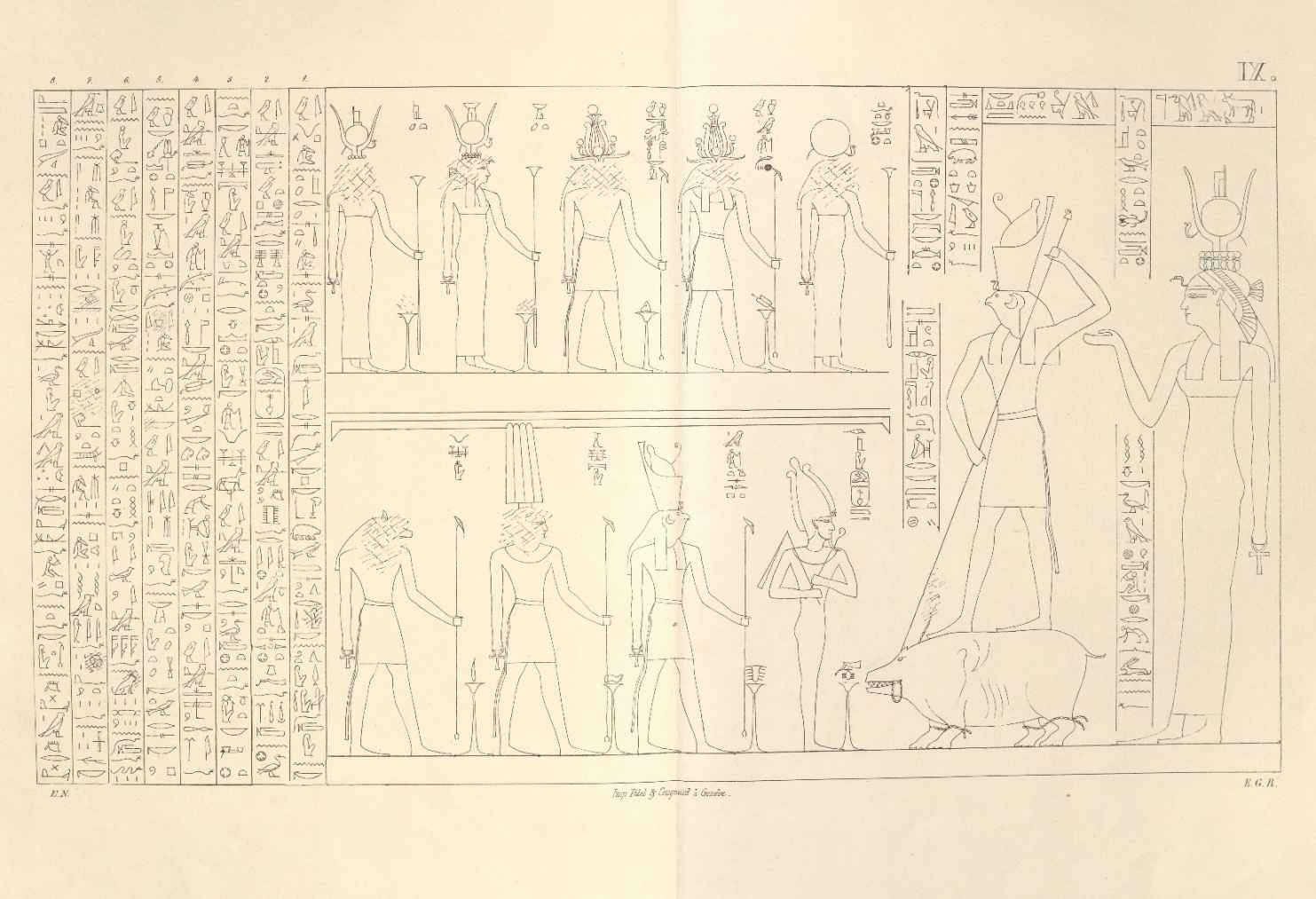
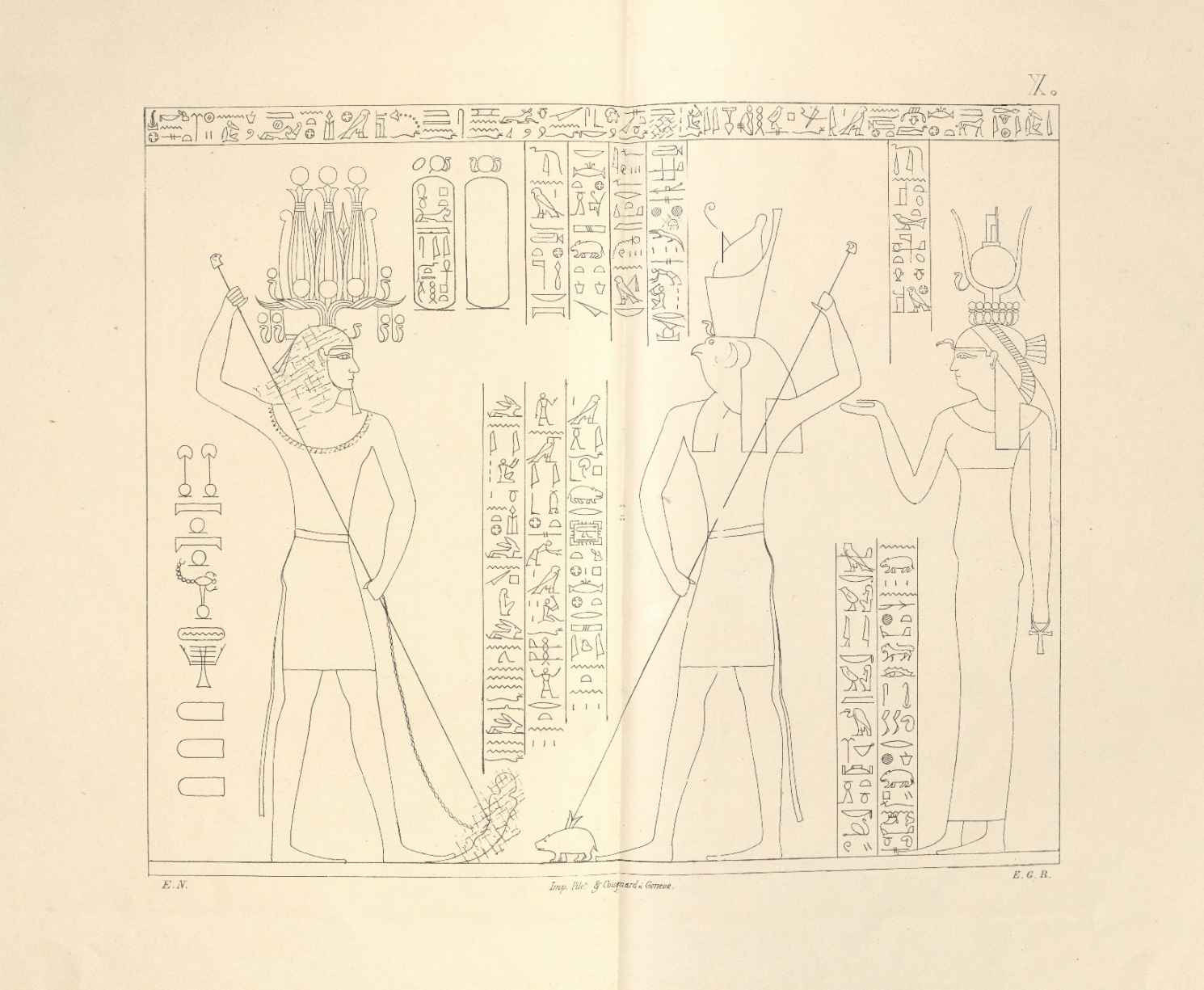
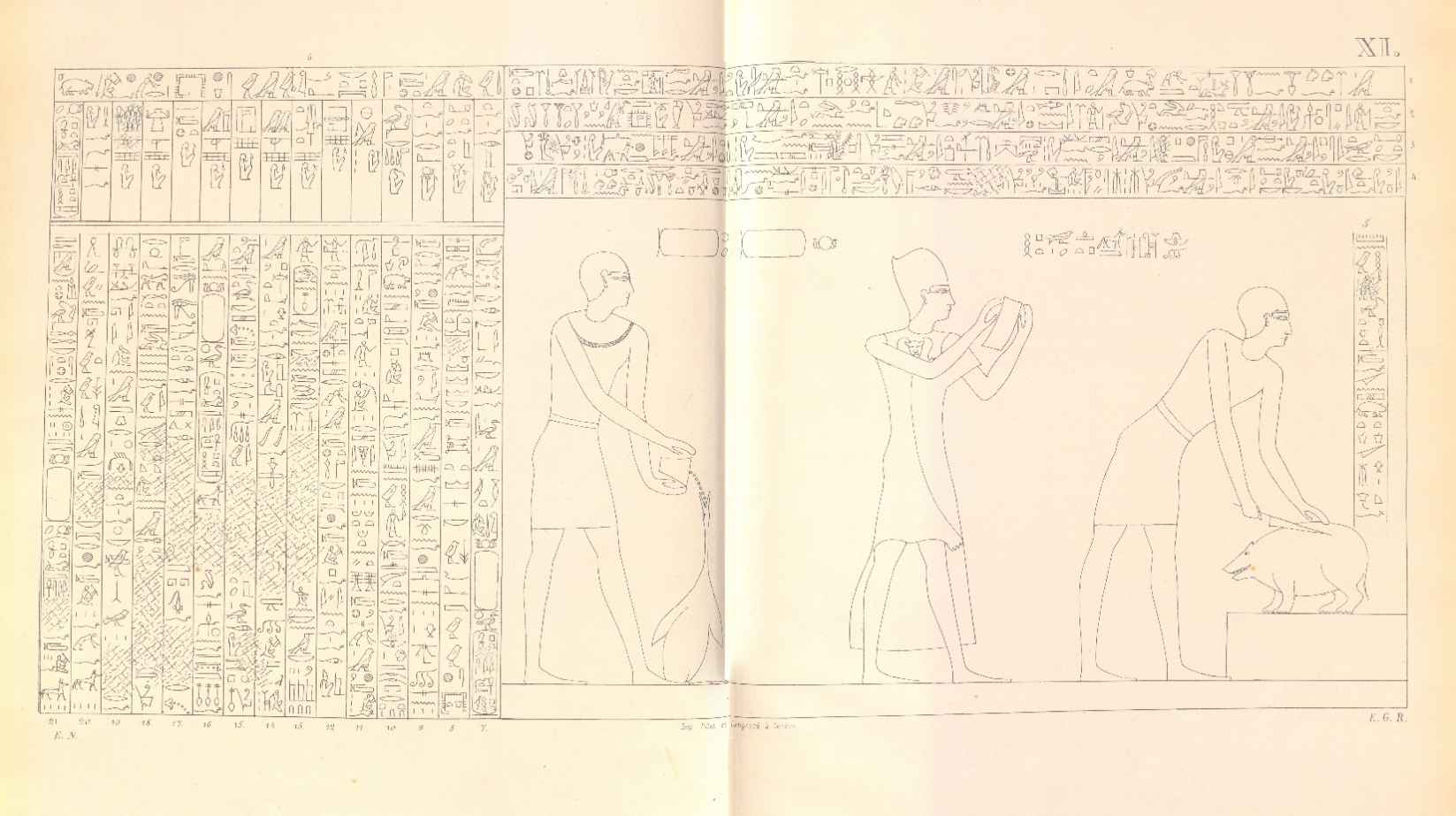
The following scene is one of the most characteristic of the whole story. Typhon has been defeated; he has been pierced and bound; but revenge is not enough; he will have to undergo the same treatment as he inflicted on Osiris. His body will be divided among different cities of Egypt, or rather among the gods who reside there.
We still have only incomplete data on the division of the body of Osiris, which, according to Herodotus, had been divided by Typhon into fourteen, and, according to the great text of Dendérah,[11] into sixteen parts, each of which had been attributed to a different nome. Here we have precisely the counterpart of this famous legend: the division of Typhon's body among the gods, nine in number. It is Isis herself who orders her son to cut the hippopotamus into pieces, and who gives him detailed indications on the distribution of its limbs. The deities in question are all represented on this plate; in front of each one is a small altar on which is the member of the animal which has fallen to him in sharing. Isis speaks to her son (l. 2): You shall carry his thigh to Tettou, to your father Osiris Unnofris the justified; you shall carry his back to Ai, to the great Horus the lord of Sechem; his leg to Ten,[12] to your father the great Anher. You will carry his shoulder to Het, to your brother the great Apher (Anubis); you will carry his front leg to Siut, to Tafnut the lady of Oxyrynche, and so on. The goddess herself reserves the head and the rump (l. 6), and she adds: You shall give his bones to the cats, and his flesh to the worms. The Mesennu following Horus must also have their share.
One would be tempted to see in this text a list of cities often called Typhonian. But I do not believe that one can conclude from the fact that a locality posessed one of the members of Set, that it was especially devoted to this god, and opposed to the cult of Osiris. The places mentioned by Isis have a completely different character. At the head of the list is the city of Tettou, which, with Abydos in Upper Egypt, is par excellence the city of Osiris. The following belong to the second nome of Lower Egypt, where a part of the body of Osiris was also kept. The city of Het (10th nome of Lower Egypt[13]), the 13th nome of Upper Egypt, that of Nubia, are also ranked, in the inscription of Denderah, among the places where the great god heads were celebrated. Nowhere, neither in these texts, nor even in the following series, is there any mention of two cities where Set or Sevek was particularly adored, Avaris and Ombos. I cannot therefore believe that the author of this inscription wanted to give us here a list of Typhonian cities. I rather see in it allusions to local legends, which would have received this kind of interpretation. Just as, in the following narrative, we shall see the names of the various localities visited by Horus explained by the episodes of his struggle with Set; so too, it may be that they wanted to link the traditions relating to Horus, which existed in those cities, to his exploits on the hippopotamus. We are given to understand that, although he was not the tutelary god of these localities, he was nevertheless worshipped there alongside other divinities of the same family, just as, it was said, he had brought there the remains of his adversary.
Horus sets out to carry out the orders of his mother. He brings the hippopotamus into one of the rooms of the temple, whose name indicates that it was used for the sacrifices. This last act of the god is accomplished amidst the cries of joy of the inhabitants. The king himself is represented piercing a prisoner with his spear; his exploits are always linked to those of the god; he has defeated his Asian enemies, as Horus defeated Typhon.[14]
The god does not appear any more; we have here only a religious ceremony which one celebrated at Edfu in the honor of the victories of the god or those of the king (l. 7 and 8).
In the last plates we have considered, it is difficult to distinguish whether the artist wanted to represent a hippopotamus or a pig. It is natural that both being impure animals, and having between them a great resemblance, one was easily mistaken for the other. One would be tempted, for example, to see in this drawing the sacrifice of a pig, rather than that of a hippopotamus. But the text tells us that it is only a representation of the monster, made of a substance called sa, which I will translate as paste (l. 10). This strange custom of sacrificing a figure of an animal in this way is confirmed by two passages (Greek authors). Herodotus[15] tells us that on the day of the full moon a pig is offered as a sacrifice, and that the poor people, who cannot obtain this living victim, make one of dough which they cook and sacrifice; and Plutarch[16] reports that on the feast of the 7th day of the month of Tybi, which is called the arrival of Isis from Phoenicia, the image of a bound hippopotamus is put on the sacred cakes.
It is a hippopotamus of the same kind that is cut into pieces by the priest, called the menhu, the sacrificer, who is always represented with a knife in his hand. He conforms to the instructions of Isis to her son, which, repeated here, are not absolutely consistent with the former. The distribution of the members is not the same. During the operation, the priest cherheb, covered with a leopard skin, reads the book of the justification of Horus. This priest, Imhotep uer si Ptah, is of particular interest to us, because not only was he invested with one of the highest priestly offices in the temple of Edfu, but also because he was its architect, or at least directed the construction of certain parts of the building.[17] This monument is the only one where we find the signature of the artist who drew the plan.
Imhotep proclaims Horus justified in the usecht (l. 6), that is, in one of the great halls of the temple, for there were several bearing this name. This is the name given also to the hall where the tribunal of Osiris sits, before which each of the deceased must appear; it is the hall of judgment, and, according to the papyri, it was a hall with columns.
Horus is declared righteous, because he destroyed the hippopotamus enemy of his father Osiris, of his mother Isis, of his father Ra, of Thoth, the lord of the divine words, of the cycle of the gods, of the nome of the sanctuary, of the nome of Abydos, of the nome of the two Horuses, of the nome of the temple, of the nome of Tes Hor, of Hut, of the nome of Tentyra, of the nome of Chent ab, of his Majesty himself, of the son of Ra, Ptolemy. During the sacrifice, the priests and the women play a hymn to Horus (l. 11).
The rest of the text is unfortunately quite destroyed, and we can hardly explain to ourselves the completion of the ceremony; one brings your goose, one pours tehteh in its mouth (l. 15). In the last sentences, the king definitively takes the place of the god; they must, like those which end the following account, be repeated four times.
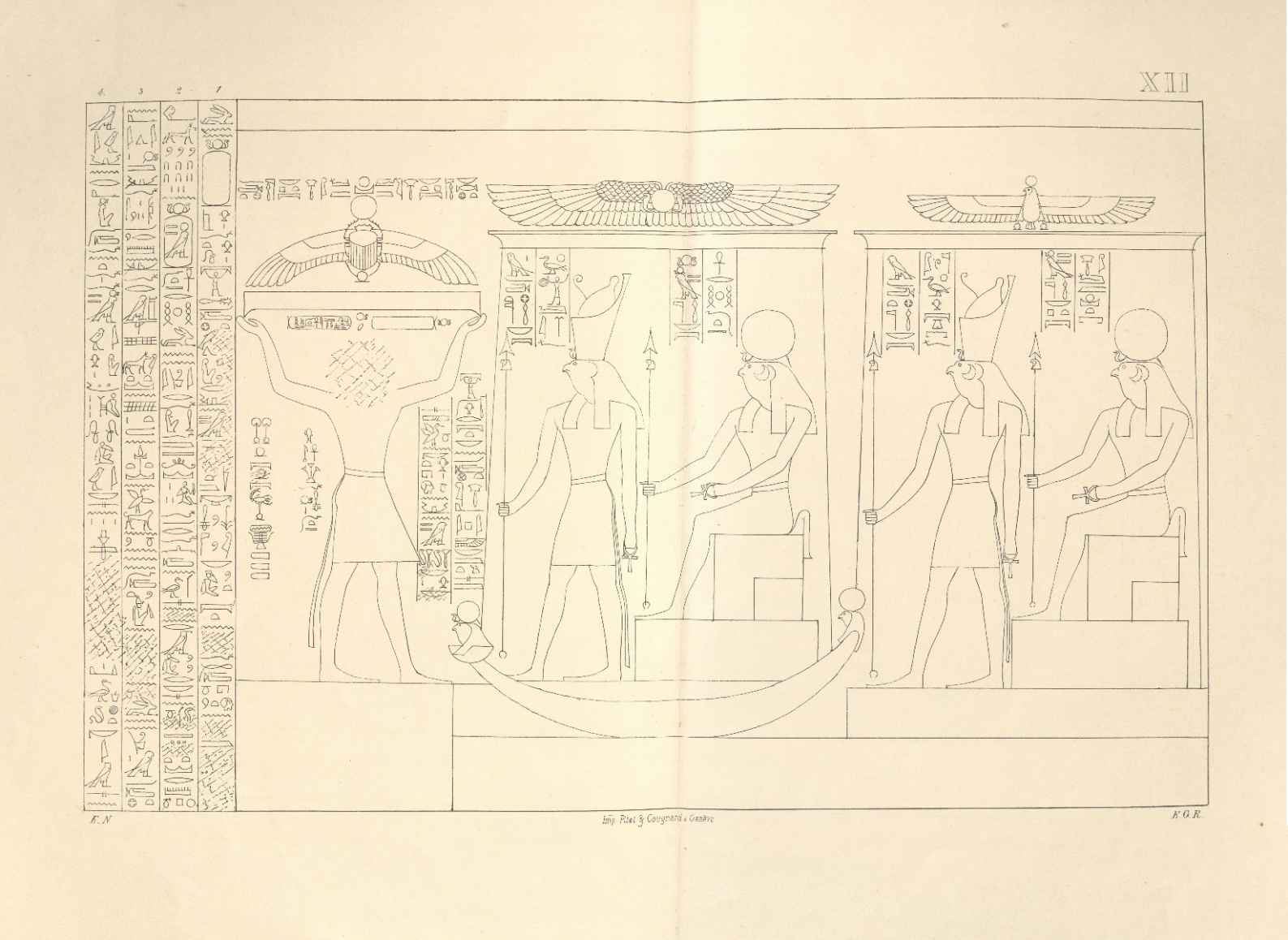
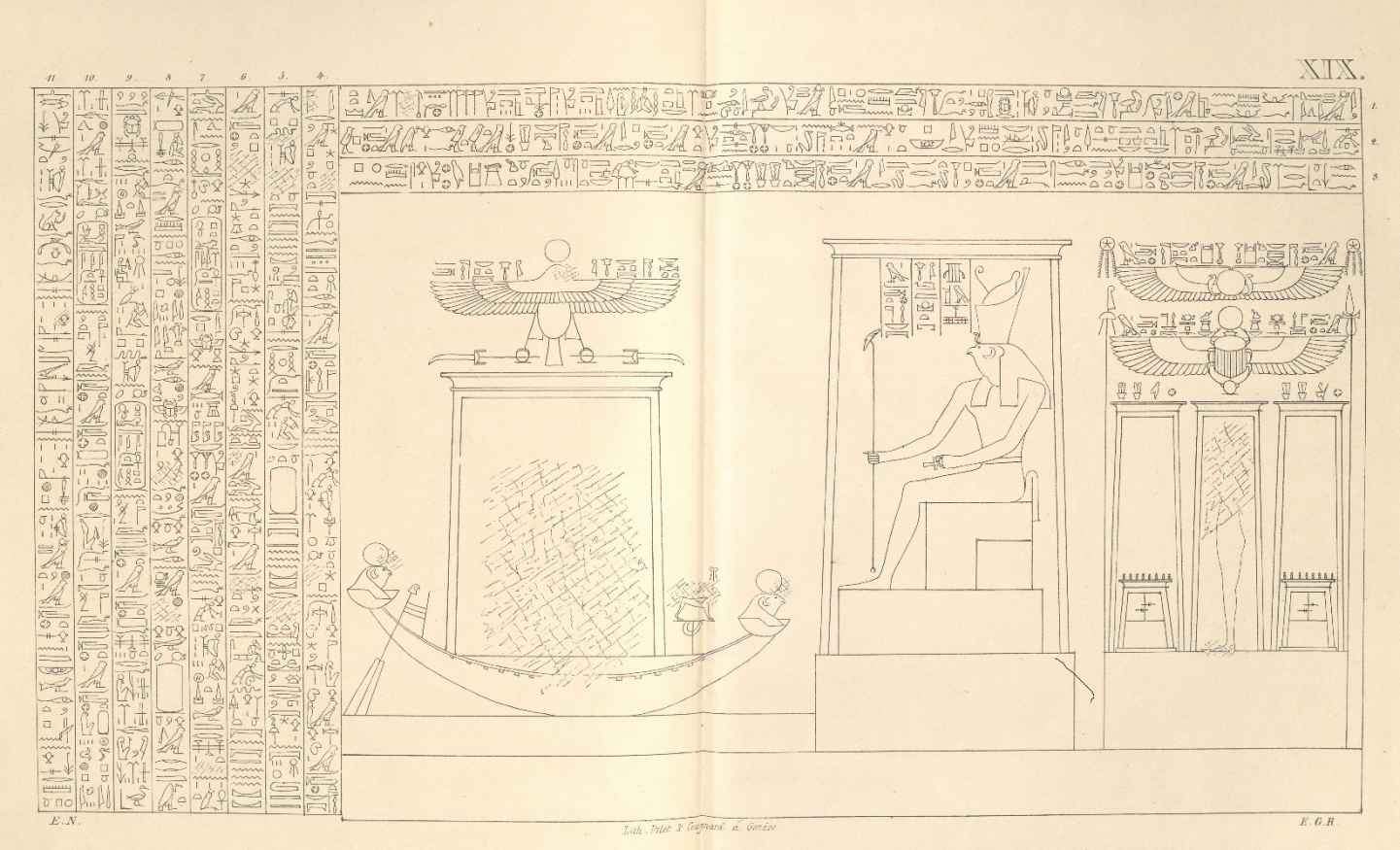
We have here, as in Plate I, the introduction to the second story, which will be the subject of Plates XII to XXI. We see in a sanctuary the principal characters; it is: Horchuti the great god, the lord of the sky, the ray of light which shows itself on the horizon, and Hor hut, the great god, the lord of the sky, the divine Shu, the son of the sun on his throne. These gods ride on the boat of Horchuti, while the priest makes them the offering of the sky surmounted by the scarab with extended wings.
This scarab, which in Egyptian is called apai, was itself a symbol of Horhut, as the legend written above indicates. It is in this form, as we will see later, that the god wins some of his victories over Typhon and his satellites. Horus was therefore often offered this image of his own person. Thus, in Philae, the emperor Tiberius presents himself with this symbol in his hand, before Hor hut the great golden apai who protects all the gods in their temples, and he pronounces these words: I have come to you, Chepi, ruler of the gods, a precious being that still exists. I bring you your body, I lift up your person to you, which pleases your heart, in the form of the great creator of multitudes of men.[18] In our plate, the text tells us nothing of the meaning of the ceremony: we raise the sky to the Lord of Hut, the ray of light; the apai is above, when you are stationed on the bow of the boat of Horchuti, the lord of the two regions.
The narrative begins in the vertical columns that follow. The form is exactly that of a historical inscription (l. 2). In the year[19] 363 of king Horchuti, who lives forever, his Majesty was in Nubia, his soldiers without number with him, worshipping their lord. Here is already a geographical name whose origin is related to the expedition of the god. From the word tennu, which means number in the preceding sentence, the name of Tennu is given to a country whose sign is erased, but which can only be that of Nubia. Such plays on words are found in the whole series of these inscriptions. Wherever the god approaches and fights, the localities receive a name in connection with an episode of the fight, or an action, even insignificant, of the god. The expedition leaves for Egypt. Ra went in his boat, his followers were with him; he landed at Tes Hor, to the east of this nome, to the east of Chennu ………........ Hor hut was in the boat of Ra, he said to his father Horchuti: I see the enemies who revolt against their lord ....... So the gods arrived in Egypt, in the nome of Edfu.
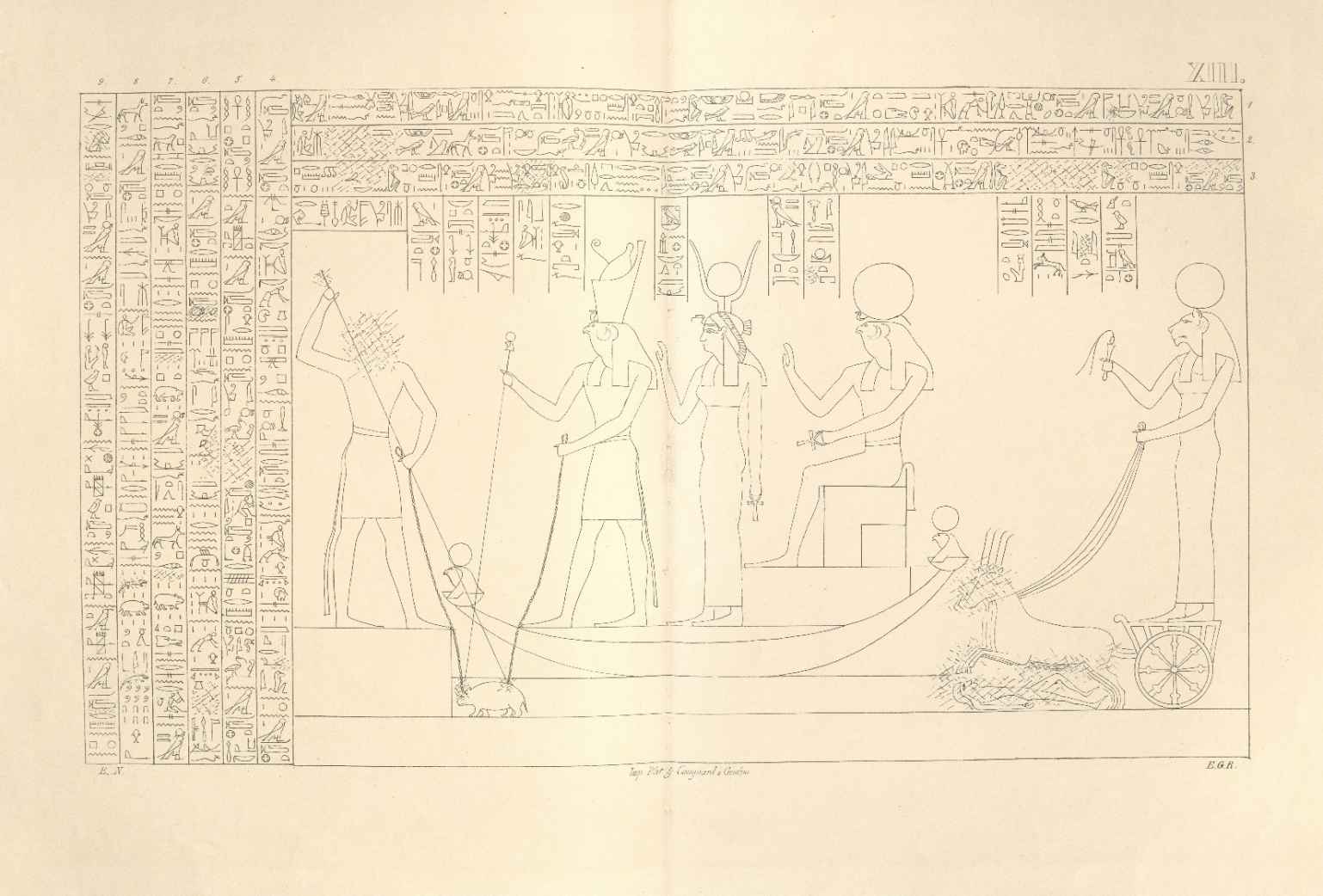
The first battle that illustrates the name of Horhut took place at Teb (Edfu), and it is in memory of this event that the principal localities of the nome received their respective names. This picture shows us, armed with his spear, Hor hut, the great god, the lord of the sky, the image of Ra in the southern country, who kills his enemies in front of his house. He is helped by one of his companions, the brave Mesen, who stands before him. Behind him are: his companion Hathor, the lady of the boat trip; Horchuti, who extends her hand as if to promise him help; finally, a foreign divinity whose name is not rare in the hieroglyphic texts: Astarte,[20] the queen of horses, the lady of the chariot, who presides over the city of Uteshor.
It is interesting to find the name of this goddess here; we know from the relations that the Pharaohs had with the Semitic peoples that she was adored by the Chetas as the companion of Sutech. Here, on the contrary, she has taken her place in the Egyptian pantheon; it is as the sucessor of Ra that she appears to us; she comes to attend the triumph of Horus, and tramples his enemies under her chariot.
The three horizontal lines give us the abbreviated history of the fight. Said by the majesty of Ra to the divine lord, Hor hut the son of Ra. Illustrious son! strike the enemy before you in an instant. Hor hut flies to the horizon in the form of the great apai; he is called the great god, the lord of the sky from that day on. He saw the enemies above him; he came upon them in the form of the great apai; misfortune was upon them, before him; their eyes do not see, their ears do not hear; one kills his followers in an instantaneous slaughter; there is no longer any living among them.
After the victory, Horus, without changing form, returns to the boat of Ra, and is granted the honors he deserved (l. 3): and is called Horus of Hut; Horus of Hut and Teb; his father Ra embraces him, and makes him present offerings of wine and water.
The story continues in the vertical lines: Words of Hor hut: Come, Ra, see your enemies thrown to the ground under your feet, in this place. Here went the majesty of Ra, Astarte with him; he saw the enemies fallen to the ground, their heads were cut off. Said by Ra to Hor hut ..... the sanctuary of Hor hut will be called netem anch from this day ..... this name will be called Teb. Said by Thoth to Horus .... the barque of Hor hut will be called aamak from this day forward.
Then the gods ask him to embark with them, and, on this occasion, the name of Chen is given to the sea of Edfu (l. 7), that is, as Mr. Lepsius and Jacques de Rougé have proved, to the main canal of the nome. But the fight is not finished (l. 7). Here the enemies go into the water, they are like crocodiles and hippopotamuses. A new fight begins; Horus and the Mesennu strike the crocodiles and the hippopotamuses (l. 8) and bring back 651 prisoners at the same time. In honor of this new triumph, the sanctuary of Horus will be named sanctuary of victory (l. 9). Several of these names are found in a text from the same part of the temple, published by Mr. Duemichen.[21] It is entitled: Names of the city of Tes hor, and further on (l. 5): Names of the hall of this god, the first of which is netem anch.
Although the enemy of Horus is still represented in the form of a hippopotamus, we see in the text that crocodiles are also mentioned. These animals are often difficult to recognize because of the care taken to hammer them out. The destructions attributed to the Christians of the first centuries were made in Edfu with discernment. The figures and texts that were erased were not closed books, the contents of which were completely ignored; thus, while the hippopotamus was generally respected, the crocodile, the sacred animal of Umbos, was nowhere respected; as well as the sparrowhawk, and, other signs representing a divinity. Plutarch[22] confirms that at Edfu the crocodile was an impure animal. "In Apollinopolis," he says, "it is accepted that everyone eats the flesh of the crocodile, and that on a given day as many as possible are seized; they are killed and thrown before the temple, for it is said that Typhon escaped from Horus by taking the form of a crocodile.”
The list of names of Karnak[23] tells us that the patron god of the nome of Meh,[24] the 16th of Upper Egypt, was Horus. This nome and its capital Heben had been the scene of the god's exploits; Ra's boat had landed there, and Horus, victorious, had brought prisoners there (l. 10). But this victory had been won only after several successive encounters, in different places that we cannot all identify.
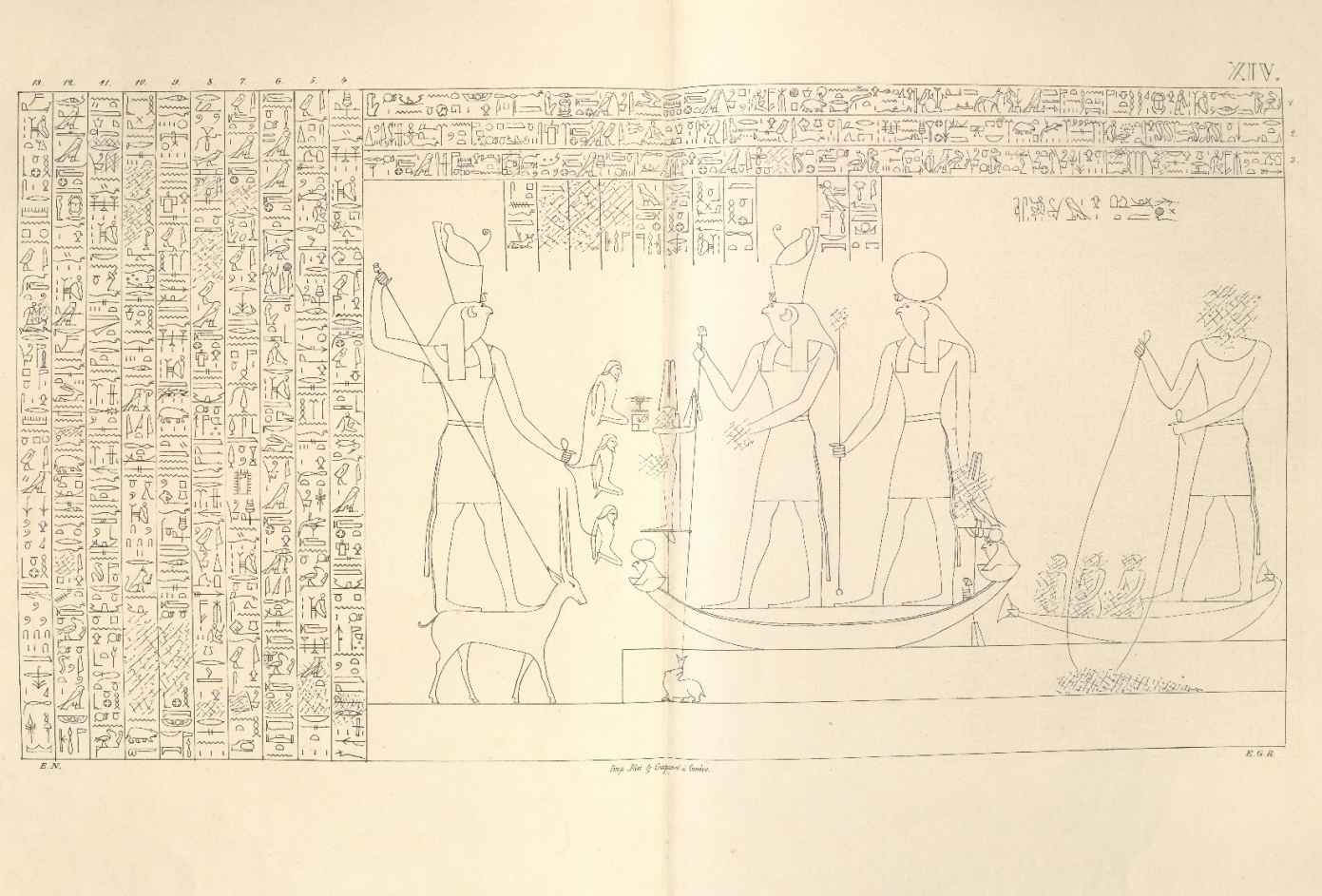
As in the previous battle, Horus changes form (l. 1). Hor hut made his form like the apai, on the front of your boat of Ra; he has the head surmounted by the two urseus, which, like arrows or burning rays, can pierce the limbs of crocodiles and hippopotamuses in all the places where they walk, in Upper and Lower Egypt (l. 2). It is said that the fugitives stop before him first; their face towards the city of Tohat, perhaps the same one which is quoted by Mr. Brugsch,[25] with a variant, and which must have been in the neighborhood of Hermonthis. The enemies do not have the courage to resist; Horus pursues them with his companions, reaches them, and makes a great slaughter of them. The place where this happens, south-east of Thebes (l. 3), receives the name of Tetem in memory of his victory. In this city there was a temple of Ra, where Ra, Hor hut and Chem were worshipped. It is these three gods that we see in the boat of Ra.
The enemies stop again before him; the face of the god is towards the city of To mehit: their heart lacks fear. Hor hut is behind them, in the boat of Ra, his spear and his rope are in his hands, his followers with him (l. 5); he prepares his weapons, his lictors[26] are with him; he was one day in pursuit of them; he saw them to the north-east of Tentyra; new stop in the pehu of this nome. Horus prepares again to give them battle; he was four days and four nights on the water, behind them (l. 9). They did not see one of the fleeing enemies, in the form of crocodiles and hippopotamuses which are in the water. Finally, he sees them; here the text is missing, it is about the city of Heben. Horus made a great massacre among them (l. 10); he brought 142 of them to the boat of Ra. He distributed their spoils to his companions, and to Ra himself, on the shore of Heben. In memory of his victory, Horus becomes the protector of the city; his high priest receives a special title, and the uu of Heben must extend to 342 poles to the south, north, west and east.
In the drawing, Horus of Heben is depicted before Hor hut; he is standing on the antelope, which is the ideographic expression of the name of the nome. It is perhaps in this form, analogous to those seen at Edfu and Coptos, that he was worshipped in the 16th nome of Upper Egypt.
The next battle was fought in the 19th nome of Upper Egypt, the extent of which seems to have changed. Although, in the lists of Ptolemaic and Roman times, it has sometimes been confused with the 20th, its name goes back very far, and is already on a funerary inscription of the ancient empire, exhibited in the museum of Boulaq.[27]
The enemies, fleeing from Horus, take refuge in the water of the western nome of Mert; they meet in the water of Mert, to that ally of Set who is in that place. It becomes more difficult to follow the god's path; the first two canals mentioned are not in the lists published so far.
Horus is in pursuit of his enemies on the meh canal (l. 2); behold, he was a day and a night sailing to seek them; he did not see them, he did not know the place in which they are. They approach Pererhu; said by the majesty of Ra to Hor hut: Behold, the fugitives are gathered in the western water of the nome of Mert, to the ally of Set, who is in this place; in the place which they call Uabti. Said by Thoth: They shall call the nome of Mert Uabti from this day on; they shall call the water that is in that nome temi.[28]
The rest of the account gives us curious details about the battle, and about the city of Pererhu, which was probably one of the most important of the nome. Horus asks Ra to grant him the use of his boat; the text is unfortunately a little faded. The gods went to the western water of Mert, and Horus saw the enemies on the shore (l. 4). Hor hut marched against them with his companions; he hurled all his weapons, he made a great massacre in their midst, he brought back 381 prisoners, he slaughtered them in front of the boat of Ra; he gave one of them to each of his companions. Behold, Set came out with a war cry, giving a shout, like Hor hut, when he kills his enemies. Said by Ra to Thoth: These are the mouths of Haha, which exalt what Horus has done against him. Said by Thoth to Ra: These shall be called the mouths of Haha, from this day forward. The Haha, or Hahi, is a designation of the crocodile represented on this plate; as for (l. 10), what receives the name of mouths of the Haha, the Egyptian word may refer, as in French, to the mouth of a canal, or even to any opening, such as a door.
Hor hut fought with his enemy for a long time; he threw his shaft against him, he threw him to the ground in that place which was called Pererhu (?) from that day. Horus went away, took his enemy; his ..... is in his neck; he bound his arms, the wood of Horus is curved to close his mouth. He brought him into the presence of his father. Said by Ra to Thoth: The sanctuary of Horus shall be called neb aa uab from this day on; the priest shall be called uer tenten from this day on. Said by Ra to Thoth: They will give the companions of Set to Isis with her son Horus, they will do to them all that they want. She will secure, with her son, her line to the enemy, the scourge of this place; it will be called the lake (or basin) of combat, the sacred lake, from this day on. Horus, the son of Isis (l. 10) cut off the head of his prisoner with his companions, in the presence of his father Ra, and of all the great gods gathered. He dragged him by the feet in his uu. He thrust his spear into his head and back. Said by Ra to Thoth: Behold the son of Osiris betrays the monster in the uu. Said by Thoth: This uu shall be called ateh from this day on.
It is this last scene in the drawing; Isis and Horus, that is to say the local deities, kill the prisoners delivered to them by Horus.
This inscription has already provided us with important geographical data: the ancient name of the nome, and the existence of that western water where Set was supposed to have met his ally, and on the edge of which was the city of Pererhu.
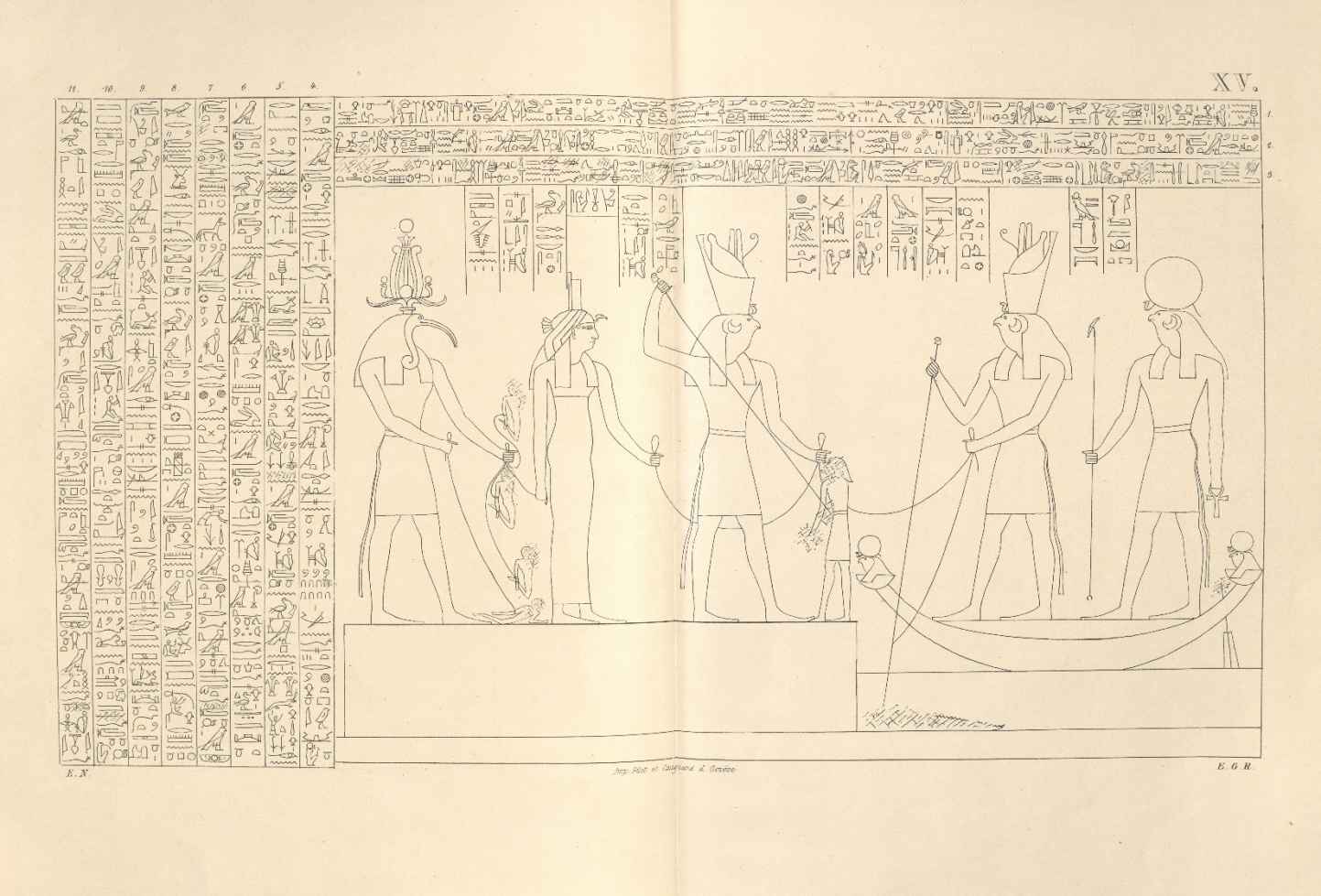
The theater of the fight has not changed much; we are still in the vicinity of the city of Pererhu; the gods who preside over the fight, and who come to assist Horus, are those of the capital of the 20th nome, the one which, in several lists, has been united with the 19th.[29]
Hor hut and Hor si Isis are busy killing their prisoners; Hor si Isis took the form of Hor hut, and together they slaughter Set's ally to the west of Pererhu, by the water's edge. Horus landed[30] the day Set reunited with his ally (l. 2); this day is the 7th of the month of Tybi. The place in question is called aa sa or aa sein. This place is mentioned, with a variant, in the dedicatory inscription of the round corridor,[31] where it is said: He killed the enemies of Ra in the house of the sword, as they joined their allies. This name has a great resemblance with that of the later name Arsinoïte. The water of this city is the same as that of Pererhu (l. 2). The day Horus disembarked, the 7th Tybi, was given the name neb chen.
At this moment Typhon takes on a new form, that of a roaring snake, which enters the earth, and which Hor si isis wants to prevent from leaving (l. 3). So Thoth orders that it be called the roaring serpent of this place, probably some sacred reptile that was worshipped there. The boat of Ra lands in the city of Pecher. It is often difficult to identify with the many denominations attributed to the same locality, but the drawing indicates that Pecher is just another designation of the city of Aa sa, which is the theater of combat. The text adds (l. 5): The front (of the boat) is out of the wood of the palm tree, the stern is out of acacia; they are sacred trees from this day. It is probable that there is an allusion to the name of the Arsinoïtes. As the sycamore tree does not appear at all, the reading neh must be abandoned, and we must call these nomes: Sen chent and Sen peh.
Horus returns to Ra's boat. His father urges him to fight again (l. 6). The hero sets out for the second time in pursuit of the enemies; he reaches them, massacres them in the presence of Ra, in a place which can only be Se ab, the city, which we get to know by the following plate.
We have here a description of the city of Se ab; it is said that it is on the water's edge (l. 1), and that it faces the south. The text adds that all the ceremonies in honor of Horus are performed on the first day of Thoth, the twelfth of Tybi, the twenty-first and the twenty-fourth of Mechir, in Se ab and Nanrutef. It is clear from the rest of the text, and especially from the fact that they have the same sanctuary, that these cities form only one; the last one was perhaps included in the other; but it is not necessary to see them as two separate places. Horus has his boat land there, to watch over the great god Nanrutef in this place (l. 2), and to prevent the enemy, with his allies, from coming during the night from the land of Mert to the west of this place. Isis herself (l. 4) keeps the enemy away from the abode of the god.[32] The sanctuary receives the name of se nefer (l. 5), the priest is called neb cher, and the priestess, or rather the singer, will be called neb peh; the palm tree and the acacia are the sacred trees (l. 8).
Now, an inscription, coming from another part of the temple, which we have published in this volume, determines in an exact manner where Nanrutef must be sought. It says, speaking of a fight between Horus and the crocodile, that Horus found his umet (phallus), and buried it in the temple of Sutenchenen, and that he called this place Nanrutef, from that day on: Nanrutef is thus the same city as Sutenchenen, the capital of the 20th nome,[33] and one of the most famous places in Egypt for the cult that was celebrated there. A particular form of Osiris with the head of a ram, crowned with Yatef, was worshipped there, and which was designated under the name of Herschefi.
The continuation of the inscription speaks to us not of the enemies, but of the Mesennu, the followers of Horus, who were established in two cities or two suburbs, each of which had its own name, as a reward for having killed his enemies for him, says Ra himself (l. 12). These two cities are the ruu heru (l. 10) where Horus made a massacre among his enemies. This word heru, which two examples are not sufficient to determine, seems to mean here entrance; they are the cities by which one enters the sanctuary, or the city of Horus. Indeed, these cities, represented by the men who inhabit them, are placed on either side of the dwelling of Horus; they are called here Eastern Mesen and Western Mesen, and, in an inscription already quoted,[34] Right Mesen and Left Mesen. They are arranged like the two halls of the temple of Dendérah, which give access to the usechi, and which are also called hert.[35] Ceremonies to Horus were to be celebrated in these cities on the second day of Thoth, on the 24th of Choiak, the 12th of Tybi and the 21st of Mechir.
It is not without interest to know the place of Restoration of the Schesou Hor in this way. Mr. de Rougé[36] pointed out that the followers of Horus are considered to be the most ancient type. Tradition would have assigned them a dwelling on either side of the temple of Horus, in the capital of the nome Arsinoite.
Bringing together the information given to us in these three plates, we can draw important conclusions regarding the geography of these places.
The 19th nome should not be placed on the eastern bank of the Nile, as Mr. Brugsch says.[37] It is in the immediate vicinity of the 20th; it has the same water, whether it is a canal or a lake, and nowhere in the account of the god's travels is it said that he crossed the Nile to go from one to the other.
The 19th, 20th and perhaps also the 21st nome, i.e. the province now called Fayum, were formerly included under the general name of Mert. This name is already known to us as that of a place dedicated to Sutech.[38] It has been preserved in the name of the metropolis of the 19th nome;[39] it is still found in the name of the pehu of the 21st. Now, if Mert was a country of considerable extent, the water of Mert, on the edge of which several cities are built, and where Set meets his allies, is not other than the famous lake Moeris, whose name would come, not from the Coptic word mother (flood), as Mr. Lepsius states,[40] or from the pehu mert, as Mr. Brugsch believes,[41] but from the country itself in which this great basin was located.
We know that the crocodile Sevek was worshipped in the Fayum. Herodotus names the main city of the province: the city of crocodiles. But the capital of the 20th nome, Sutenchenen, was the center of a cult of Osiris, as opposed to that of Sevek, generally widespread in this region. This is what is meant by these inscriptions, which say that Set threatens the sanctuary of Nanrutef; Hor hut comes to the aid of the god, and Isis herself is called (pl. XVII): the one who drives away the enemy of Nanrutef. Local tradition, confirmed by an inscription from Philae,[42] said that in this place Horus had defeated the allies of Set.
Words of Ra to Hor hut (l. 1): Here the enemies are sailing north, towards the end of An in the north, they are sailing east towards Tar ...... Said by Hor hut: You rule, lord of the world, Ra, lord of the gods, you are the lord of order. They untie Ra's boat; they are sailing east. Here he saw the enemies; some are driven into the sea, others over the mountains. Hor hut made his face like a lion .... he is adorned with the the atef (l. 2); he carried his sword of combat; he pursued them, he brought back 142 prisoners, he tore them with his talons, he made their venom come out of their mouths, in this high place; he gave their flesh (lit. what is in them) to his companions while he was on the mountain. The place in which this massacre takes place receives the name of Chent ab, and the city that of Tar; then the gods sail in the sea,[43] and drive out the hippos and crocodiles from the kingdom (l. 3).
It is therefore in the 14th nome of Lower Egypt that the last of Horus' great victories over Typhon takes place, after which the kingdom is delivered, and the gods return to Nubia. The city of Tar[44] is often mentioned in the annals of Egypt; several texts, such as the stele from the year 400, tell us that it was a fortress, the key to Egypt on the east side, its rampart against the Sasu and other nomads in the east. More recent inscriptions recall Mesen du Nord, whose defense was entrusted to Horus, like that of Mesen du Midi. The god, the guardian of the gate of Egypt, was represented there in the form of a lion named tam; for, says Manetho,[45] “the lion never sleeps."
The geography of these places presents here some curious particularities. When the gods have arrived at Tar, Ra proposes to Thoth to go around the country in all its extent (l. 5), and around the sea in all its extent. Thoth gives this sea the name of the sea of the circular journey; and, after the gods have spent a day and a night in this navigation, they find themselves in Nubia, in the country of Sasher, very close to the enemies, who are in the country of Ouaoua. They thus returned to the point of departure.
M. Brugsch, in his beautiful work on the geography of Egypt, thought he found in Tar the Heroopolis of the Septuagint. This opinion still seems to me to be the most valid. Lately, the same scholar,[46] following further research in Egypt, suggested that Tar was nothing other than Avaris, famous by the cult of Sutech, and who later bore the name of Peluse. Despite the authority that Mr Brugsch's name gives to this idea, it does not seem to me to be in harmony with what we know of the town of Tar. If ever a city could be called typhonian, it is Avaris, where the Hyksos themselves lived for a long time, and especially the god Set, to whom Ramses II felt obliged to pay homage. But if Tar was the city that the Shepherds built in Typhon, why do so many texts formally declare that Horus is its guardian as well as Edfu; that he is the protective lion of Chent ab (pl. II)? Why is the metropolis of the nome called the abode of Horus?[47] How, finally, can we read to Dendérah, in an invocation to Osiris[48]: You are in Tar in the land of Chent ab, which is Teb of Lower Egypt .... your son guards the gates of Egypt.
Not only is Tar not a Typhonian city, but it is, par excellence, the city of Horus in the Delta; it is his title to kingship over the two parts of Egypt (pl. IV). It is because he is master of it that his sovereignty is assured, and that he carries the two uraeus (l. 8). Moreover, if Tar were a city of Set, it would not reappear after Edfu, Heneb and Nanrutef at the end of a catalog of the cities of Horus, where the temples of the god, his priests, his priestesses, and even his sacred boats are listed.
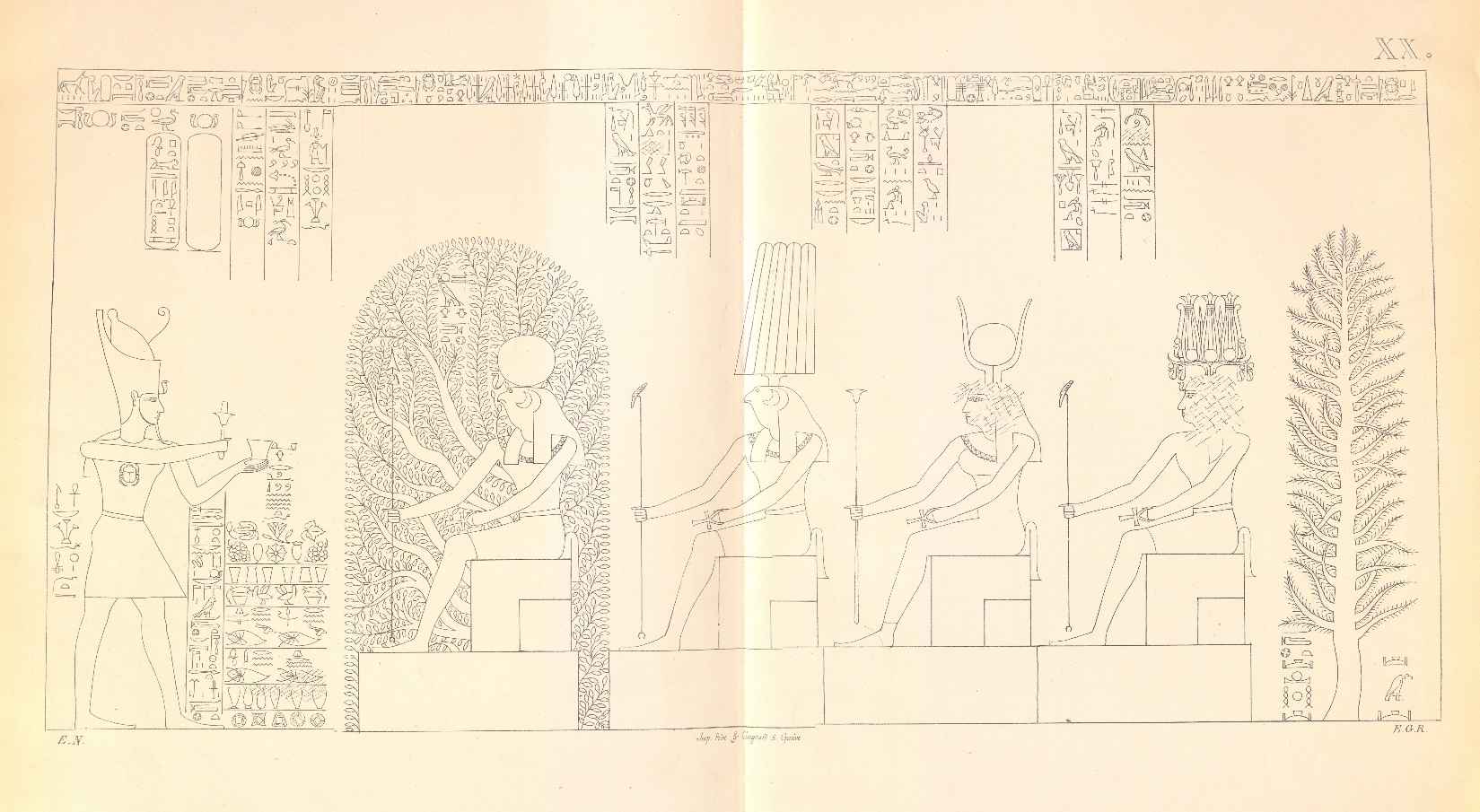
Horus' victory was complete; he established himself as master in several cities of Egypt; his father Horchuti bestows upon him the honors he has deserved. Horus will become the protector of all the temples in the country. Horchuti gets into his boat, he lands at Tes Hor. Said by Thoth: The ray of light which appears on the horizon, it has destroyed enemies in this form; it will be called the ray of light that appears on the horizon from this day forward. It is the god adorned with this title that we see sitting in a sanctuary, similar to that of Edfu. Then Horchuti gives Thoth the following order: We will make this record in all the places where I rest; on all the dwellings of the gods of Upper Egypt, on all the dwellings of the gods of Lower Egypt ........ because he drove the enemies out of their neighborhood. Thoth carries out the order given to him. The following description of the apai (l. 2) seems to refer not to the beetle, but to the bird which is to the left of the table. It is very difficult to grasp; I only risk the explanation as I understand it. It means that the right side of the apai symbolizes Hor hut, the great god, the lord of the sky, the protector of southern Egypt, who has Sebnut for uraeus; while the left part (l. 3) symbolizes Hor hut, the great god, the lord of the sky, the lord of Mesen, the protector of the temples of Lower Egypt, whose uraeus is Uot. The two parts together would be the symbol of Hor hut, the great god, the lord of the sky, the lord of Mesen, the protector of the two religious divisions of Egypt. This explanation seems to me to be confirmed by the drawing, especially by the arrangement of the two small sanctuaries.
The continuation of the text is a hymn to Horus, who illuminates the two regions by the rays of his eyes (l. 1). Hail to you, Hor hut, great god, lord of the sky, who has struck down the serpent and the enemies, ..... of the sky, of the water, of the earth and of the mountains; they will not raise their heads, forever, eternally (l. 4). In this hymn, king Ptolemy Caesarion is likened to Horus himself (l. 9). It is he who is the valiant god who appears to Hut; Hor hut is his name; come to him, you followers of Ra, followers of Shu, followers of Seb, followers of Set. Ptolemy who lives forever, the friend of Ptah, it is he who appears at Hut; Hor hut is his name (four times). Said by the king himself (l. 10). It is I who am the valiant god who appears to Hut; Hor hut is my name (four times).
These two plates form in reality only one picture, which I had to divide, because of its size. It closes the second legend that we have just studied, that of the exploits of Horus in the land of Egypt. It is in a way the apotheosis of the god. He is identified with Horchuti; behind him is the triad of Edfu, of which he himself is a member, but with a hairstyle that is not usual, and with titles different from those he usually wears. Before him, Ptolemy gives him the honors which were promised to him at the time of his first victory[49]; he makes libations of water, and a great offering of all good things, to you Ra, the lord of the gods, Hor hut the great god, the lord of the sky, and to all the great gods who live in Hut. Here again Ptolemy confuses himself with the god to whom he pays these tributes; it is I who am the golden scarab that appears to Hut, Hor hut the great god, the lord of heaven is my name.
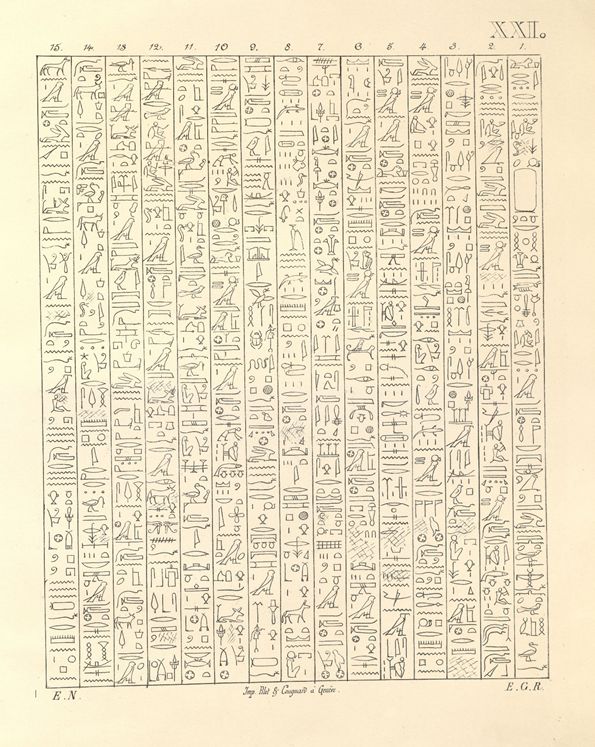
The long text which follows, and which forms plate XXI, gives us new details on these ceremonies, and on the layout of the temple of Edfu and the canals which watered it. Horchuti (l. 2) is with his followers, south of Tes Hor, after he has destroyed the enemies in that place. Horchuti says: The cowardly enemies are ..... wounded, they flee (?) towards the south where Kush is; they flee towards the north, where the Aamu are; they flee towards the west where the Tamahu are, they flee towards the west where the Sasu are, the south of the city of Tes Hor shall be called the house of Ra, from this day on. Horchuti (l. 4) rested on this day, the 27th of Tybi. It will be called from now on the great offering of Ra, in honor of the ceremony that will be celebrated on this day. Further on, Ra enumerates the places where he willingly rests (l. 6). These are first Tes Hor and Hut, then the places in which Horus has been, and which are : Meh, the cities of Fayum, Pecher and Se ab, with the dwellings of the Mesennu, Mesen of the west and Mesen of the east; Tar, which is here called Hut of the north and Kauti, a name already known[50]; the sea of the circle journey, and the land of Sasher. These places are the provinces or nomes of Horus, in the two regions of Egypt (l. 7).
The rest of the inscription applies more especially to Edfu. We are taught the name of the basin or lake which is south of Teb, east of the dwelling of Ra; it is called the royal basin of Hut, from which water was to be brought into the palace (1:9). There was also a sacred spear (l. 10) which Horchuti put in his hands to strike all his enemies; it is called the spear of Ra, Horchuti put it in the hand of Hor hut at Tes hor, to strike all cowardly enemies. A battle of Hor-si-isis with Set, in which Isis and Thoth take part, caused the name Aru Seb (l. 14) to be given to a mineral substance (?) which is found in abundance to the south of all the countries in which Hor hut walked, and the name hu to the water which is east of Teb.
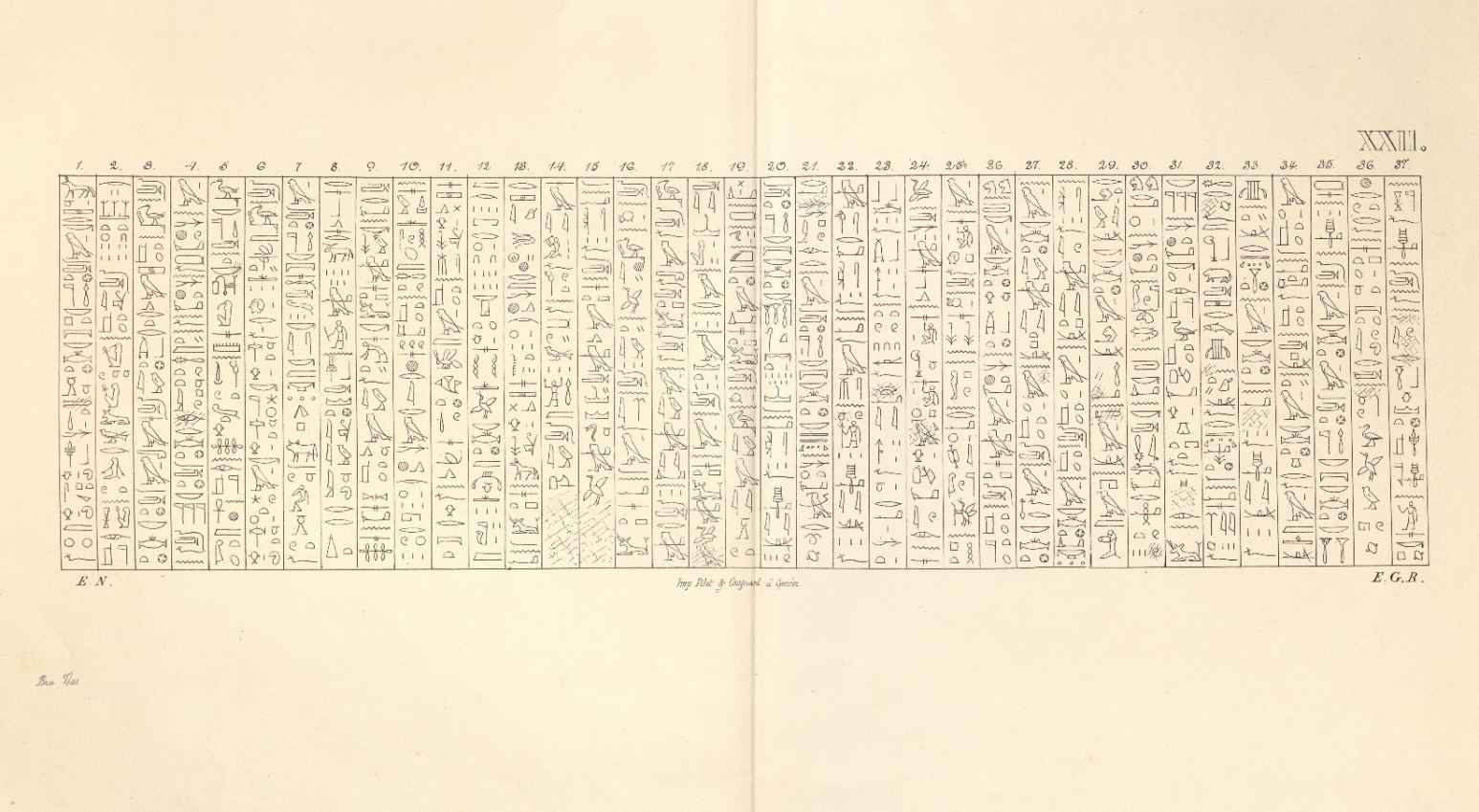
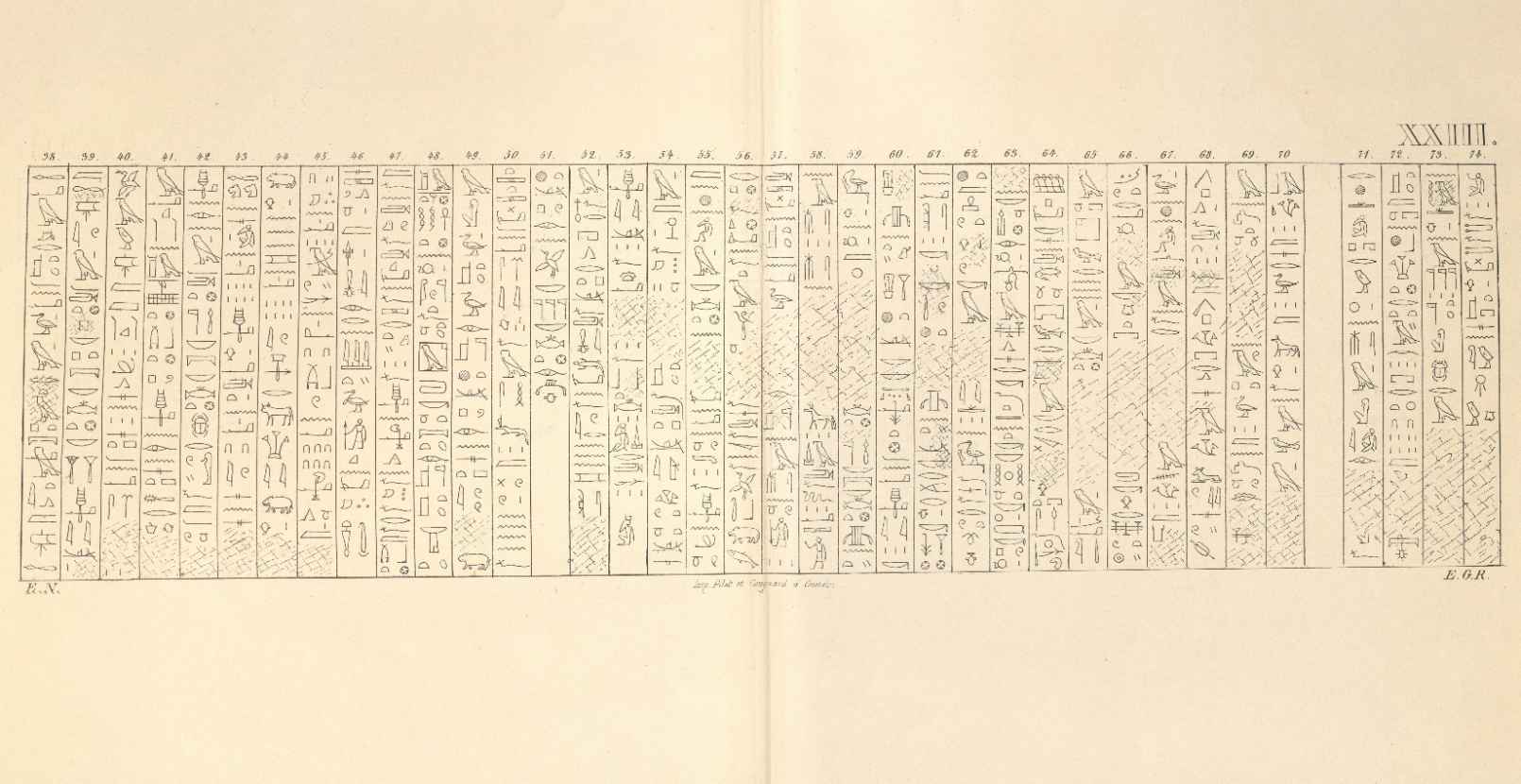
The same round corridor, which provided us with the first 21 plates of this work, contains, on the opposite side, on the lower part of the wall, a long inscription relating to the birth of Horus and his struggle against Set. This text is unfortunately very mutilated; the nature, very crumbly stone of which the temple of Edfu is built, causes it to be destroyed more and more day by day. It is preceded by a picture where one sees the king standing, offering a spear to Hor hut, Isis and Hathor. The words that follow are supposedly written and read by Thoth.
This text, which we have already made use of on several occasions, is interesting either by the dates it contains or by the geographical names found there. We see, for example, that on 18 Paophi, Isis declares to Thoth that she is pregnant by her brother Osiris (l. 2). After months and days, Horus was born in the city of Cheb, in Lower Egypt (l. 11). The voice of the goddess reached the sky; It was the 28th Pharmuthi, and all the gods and goddesses were overjoyed. After months and years (l. 13), Set came with his companions, and uttered a loud cry, to provoke Horus into battle. During the struggle, the gods change their appearance several times; Set takes the form of a red hippopotamus (l. 31), then probably that of a crocodile. This fight, which takes place in Edfu, ends with the destruction of the hippopotamus and its allies the crocodiles.
The rest of the inscription is too destroyed for us to be able to give its content with any certainty. We are still taught the day of the birth of Horus, which is the 28th Pharmuthi (l. 72), while that of the conception of Isis was (l. 110) the 9th Epiphi. It is regrettable that the gaps in the text make us lose a great deal of important geographical data[51]; for we see that it is a question of a journey of Horus to several of the cities of Egypt; we find, in particular, the mention of Memphis (l. 92). I have quoted above the last lines which tell us what the city of Nanrutef was.
I have added as an appendix this text which comes from the same wall, but which has no connection with the preceding subject. It gives us some interesting details about a ceremony celebrated at Edfu, which consisted in dragging the boat of Sokaris around the temple. Here, as before, it is the king himself who acts as priest; the ceremony is called: the manifestation or appearance of Sokaris. He pronounces on this subject these words: I drag the god on his boat Mafech all around Mesen, as he goes around the city of Hun, on his boat Hun. He is the great god of the horizon, who shines on the horizon, Ra the child who becomes young a second time. Before him are represented the emblems that were carried in the processions, as we see in chapter 1 of the Ritual. There are two of Anubis, one of Thoth, one of Horus, one of Chonsu and one of Tum. The king, covered with the sacred garment, offers perfumes while pronouncing a hymn in the pompous style of the inscriptions
TEXTES
RELATIFS AU
MYTHE D’HORUS
RECUEILLIS
DANS LE TEMPLE D’EDFOU
ET
PRECEDES D’UNE INTRODUCTION
PAR
EDOUARD NAVILLE
Geneve & Bale
H. Georg, Libraire-Editeur
1870
Les textes hiéroglyphiques que j'ai l'honneur de livrer aujourd'hui au public, sont le fruit d'un voyage entrepris spécialement dans un but scientifique. Ami des études égyptiennes, auxquelles je m'étais adonné sous la direction bienveillante d'un maître vénéré, M. le professeur Lepsius, je partis à la fin de l'année 1868 pour l'Égypte, dont les admirables monuments m'ont retenu tout l'hiver. Du mois de décembre a la fin d'avril, je me suis appliqué constamment à réunir le plus grand nombre possible d'inscriptions inédites, avec l'intention de les faire connaître plus tarde. Ibsamboul, Philae, Abydos, Dendérah, mais surtout Edfou, et les tombeaux de Biban-el-Molouk, m'ont offert des richesses inépuisables, où je n'avais qu'à choisir.
Le temple d'Edfou, mis entièrement à découvert, est de tous les travaux qu'a produits le zèle infatigable de M. Mariette, celui dont la science lui devra toujours le plus de reconnaissance. Sur ces immenses murailles, où le temps a à peine laissé quelques traces, sont gravées une multitude d'inscriptions, dont le catalogue seul nécessiterait de longs travaux. Il faut à tout prix se résigner à n'en emporter qu'un fragment, et se détourner de textes précieux, sous peine de perdre bientôt la fruit de son travail.
Pendant les dix-sept jours que j'ai passés dans ce beau temple, je me suis attaché à des inscriptions mythologiques, qui me paraissaient former un tout intéressante. Ce sont celles que j'ai réunies dans ce volume. A l'exception de trois planches, elles sont toutes gravées sur la muraille extérieur occidentale du couloir de ronde, dont elles couvrent les deux registres inférieurs. Les temples ptolémaïques sont maintenant ceux que les égyptologues étudient le plus volontiers. Il important donc de livrer ces textes le plus tôt possible aux travaux de la science égyptienne. Revenu dans ma patrie dans le courant de l'été, j'entrepris aussitôt cette tâche avec la ferme intention de m'en acquitter promptement. Mais un second voyage en Égypte, à l'occasion de l'inauguration du canal de Suez, m'a interrompu dans mon travail. Grâces à la généreuse hospitalité de S.A. le Khédive, j'ai eu le bonheur de remonter une seconde fois le Nil en compagnie d'un grand nombre de savants, de littérateurs et d'artistes, venus de France et d'Allemagne; j'ai passé un jour à Edfou, et j'y ai trouvé une occasion inespérée de comparer avec l'original mes planches déjà imprimées. C'est à ce second voyage que je dois l'erratum qui accompagne ce volume.
J'aurais voulu ajouter un texte explicatif plus étendu, et une introduction plus complète. Deux questions, auxquelles je me réserve de revenir peut-être un jour, m'attiraient particulièrement : la philologie proprement dite, et les inductions mythologique qu'on peut tirer de ces inscriptions. Mais le désir de mettre le plus tôt possible ces textes à la disposition des égyptologues, m'a fait renoncer à mon intention primitive, et je ne prétends donner ici que l'idée générale des deux récits renfermés dans ce volume, et un résumé du contenu de chaque planche. Une considération d'un autre ordre m'a décidé. M. le professeur Brugsch, qui en avait aussi recueilli une partie, a renoncé en ma favour à publier ses copies, en y mottant la seule condition que je me hâterais de faire paraître les miennes. Je ne pouvais répondre à tant d'obligeance qu'en m'efforçant de satisfaire de mon mieux au désir de M. Brugsch.
Je voudrais aussi exprimer ma reconnaissance à deux hommes qui ont bien voulu me prêter leur concours pour ce travail: à mon savant compatriote M. le professeur Zündel, de Berne, auquel je dois plusieurs des citations grecques dont j'ai fait usage, et à mon compagnon de voyage, M. Edmond Reuter, qui s'est chargé de l'exécution de ces planches. tâche ingrate, dont il s'est acquitté avec un mérite que tout égyptologue est à même d'apprécier.
Désireux avant tout que ces inscriptions puissent être utiles à quelqu'un de ces beaux travaux, dont chaque année voit paraître plusieurs, je réclame des amis de l'Égypte leur bienveillance pour ce modeste travail. Je serai heureux s'il apporte une faible offrande à ce trésor que Champollion a découvert, et que de nombreux disciples enrichissent sans cesse, avec autant de persévérance que de succès.
Édouard NAVILLE
Genève, le 31 décembre 1869
La mythologie égyptienne est encore une terre inexplorée, dont nous connaissons à peine les abords. Cachée, mieux que toute autre, par ce voile de mystère qui recouvre toutes les de l'Égypte, elle a trop été laissée dans l'ombre, et ce n'est que tout dernièrement qu'on lui a demandé de révéler son antique sagesse. Ses dieux étaient trop bizarres, ses génies trop fantastiques. Ne fallait-il pas courir au plus pressé; établir d'abord la série des Pharaons et nous raconter leurs exploits? N'était-il pas plus urgent de nous donner une base philologique solide sur laquelle on pût édifier de nouvelles découvertes? L'idée était bien fondée, et les résultats qu'elle a amenés à sa suite nous démontrent sa parfaite vérité. Mais il est temps maintenant d'étudier ce qui, selon l'expression de M. de Bunsen, est l'un des pôles de l'existence de toute nation : la mythologie. Trop longtemps nous l'avons regardée avec vénération; nous y avons vu des secrets impénétrables, un mysticisme qui dépassait nos moyens d'investigation. Le moment est venu de combler cette lacune, et d'aborder franchement l'étude d'un système qui ne sera peut-être pas a la hauteur du prestige dont il a joui longtemps, mais duquel nous pouvons cependant attendre de grands résultats.
Deux moyens contribueront surtout à enrichir nos connaissances sur la religion des Égyptiens. Pour l'époque pharaonique, des études plus étendues du Rituel, de sa forme première et de son développement. Pour l'époque ptolémaïque, où l'histoire n'est plus rien, et où la religion semble absorber de plus en plus la vie des chefs de la nation, les innombrables inscriptions des temples, tels qu'Edfou et Dendérah, sont une mine que plusieurs générations pourront seules épuiser. MM. de Bunsen, Lepsius, de Rougé et d'autres ont fait les premiers pas dans cette voie, et ont abordé la question de la théogonie égyptienne, dont M. Mariette, dans un écrite récent[52], reconnaît toute l'élévation. C'est dans le but aussi de faciliter, en quelque mesure, ces belles recherches que ces textes ont été recueillis et présentés aux amis des études égyptiennes, qui ne pourront en méconnaître l'importance.
Ces textes ne sont point d'une époque ancienne; ils datent d'un Ptolémée dont le nom et presque toujours écrit incomplètement, et que M. Lepsius croit être Ptolémée Césarion. Ils se rapportent exclusivement au mythe d'Horus, a sa justification, ou plutôt a la manière dont il venge son père, et aux lieux auxquels cette légende se rattachait. Ils contiennent deux récits différents : l'un, montrant plus spécialement comment Typhon est châtié du meurtre d'Osiris, et l'autre, les conquêtes d'Horus qui lui assurent la royauté de l'Egypt.
C'est peut-être la première fois qu'en dehors du Rituel nous trouvons quelques chose qu'on puisse appeler de l'histoire des dieux, quelque chose qui nous raconte avec détails un épisode de leur vie, et qui nous explique plusieurs des allusions mystiques répandues en si grand nombre dans les formulas d'adoration. Ce sont des légendes parfaitement circonscrites, commémorées par des cérémonies religieuses; elles se sont passées dans des lieux déterminés, et l'une même est datée comme un événement historique.
De tels documents font ressortir d'une manière frappante la valeur immense qu'ont pour nous les temples ptolémaïques. Dans ces vastes édifices, la religion occupe toute la place, qui ne lui est plus disputée par des récits de batailles et de conquêtes. Usages, cérémonies, fêtes, offrandes, litanies, tout se trouve en si grand détail qu'il semble qu'on ait voulu à tout prix sauver ces choses de l'oubli. Au milieu de toutes ces richesses se trouvent aussi des mythes, et l'interprétation qu'en donnaient les prêtres égyptiens. Quoique ce ne soient pas les temples pharaoniques qui nous les ont conserves, j'estime qu'ils n'en sont pas moins d'une haute antiquité, et qu'il ne faut nullement les considérer comme des traditions venues de l'étranger. La mort d'Osiris, et la vengeance qu'en tire Horus, sont l'une de ces légendes qui nous sont racontées par de nombreux auteurs, et dont les Grecs nous ont parlé le plus volontiers. Néanmoins, il est impossible de ne pas attribuer à cette fable, telle qu'elle nous est rapportée sur les murs du temple d'Edfou, une origine purement égyptienne, car elle est un point fondamental dans les croyances populaires. Il serait superflu de citer les allusions innombrables du Rituel à la justification d'Horus lorsqu'il a tué son ennemi, que celui-ci s'appelle Typhon on Apophis. C'est parce que Horus a été justifié le premier que l'osirien espère aussi être absous par ses juges. C'est à ce titre qu'il demande à Thoth la protection qu'il a accordée a Horus devant le même tribunal des parèdres d'Unnofris. Il est possible que la légende se soit modifiée dans le cours des siècles; mais le fond est le même, et l'enseignement moral n'a pas changé.
Le fait que les prêtres égyptiens nous rapportent ces légendes de cette manière, témoigne d'un besoin de se rendre raison des cérémonies et des noms bizarres que portaient certains lieux. D'où vient qu'a un jour de fête on met en pièces une figure d'hippopotame? C'est qu'Horus a coupe Typhon en morceaux, et a suivi les memes prescriptions auxquelles obeit encore le sacrificateur. D'ou vient le nom de tel ou tel lac? C'est qu'Horus y a navigué et y a combattu les crocodiles. On peut même se demander s'il n'y avait pas de leur part l’intention de répandre cette interprétation au dehors, et de réhabiliter ainsi auprès d'une population dégénérée une religion qui s'en allait. Car on ne peut pas voir là-dedans une tradition secrete, dont les prêtres seuls auraient eu la clef. S'il y avait une explication cachée au peuple, c'est bien plutôt celle que Plutarque, Horapollon et d'autres ont tenté de nous donner, lorsqu'ils ont indiqué le fait historique ou physique que représentait tel ou tel symbole. Le sens même du symbole ne se trouve ici nulle part. Je crois, au contraire, qu'en donnant ainsi une interprétation grossière des mythes sacrés, les prêtres désiraient remettre en honneur des localités où Horus était adore, et donner a leurs fêtes une sanction divine, en montrant qu'elles se rattachaient à l'histoire des dieux, qui tendait peut-être à s'oublier. Quoi qu'il en soit, on ne peut assez s'étonner du contraste qui existe entre les inscriptions que nous ont conservées les temples pharaoniques, et des textes comme ceux-ci. Là, à peine le nom des dieux, et quelques formules banales auxquelles nous ne trouvons point de sens; ici, leurs noms, leurs vies, leurs demeures, leurs offrandes; rien n'y manque. Il serait curieux d'étudier une fois plus profondément les causes qui ont amené un changement aussi radical.
Dans la première partie de notre recueil (pl. I à XI), nous voyons en présence Horus et un hippopotame. Nous savons déjà par Plutarque[53] que l'hippopotame était l'une des formes de Typhon, parce qu'il était le symbole de l'impudence (άναίδεία). Nous aurions déjà une confir-mation suffisante de cette assertion en voyant que les noms de Typhon (Tep, Tebh) Baal et Set lui sont attribues. Mais nous avons un témoignage encore plus clair dans cette phrase tirée d'une autre inscription, relative au même sujet[54] : littéralement : Voici que Set fit son corps comme un hippotame rouge. J'insiste d'autant plus sur cette phrase qu'elle mentionne un autre fait également rapporte par Plutarque[55] : c'est que Typhon était représenté de couleur rouge. De là vient qu'on lui sacrifiait des bœufs rouges, et que les Égyptiens regardaient avec une crainte superstitieuse les hommes dont les cheveux étaient rouges ou blonds.
Horus doit tuer l'animal, afin de venger son père Osiris, qui a lui-même été victime de la cruauté de Typhon: car il a été vaincu, son corps a été coupé en morceaux, et ses membres dispersés. Son fils ne laisse pas le crime impuni; accompagné de sa mère Isis, guidé par Thoth, il déclare la guerre à Typhon, le perce de dix coups, et l'enchaîne. Ces dix traits ou lances d'Horus, qui font le sujet de cinq planches, et de longues inscriptions, où l'on voit paraître des génies étranges, sont l'une des parties les plus obscures de ces textes. Avons-nous là un symbole de quelque phénomène astronomique? A quoi ce nombre dix a-t-il rapport? Qui sont ces génies? Autant de questions que nous ne pouvons pas encore résoudre. Je mentionne seulement un passage d'Eusèbe,[56] qui se rapporte, sinon aux tableaux mêmes publiés dans ce volume, du moins à une représentation exactement semblable. Il parle d'un symbole sacré de la ville d'Apollinopolis, qui consiste en un homme à tète d'épervier, qui frappe d'un épieu Typhon sous la forme d'un hippopotame. Ce symbole serait celui de la lumière de la lune.[57] Il faut toujours se défier des explications que nous donnent les auteurs grecs des derniers temps; il semblerait cependant, d'après ce passage, que nous avons à chercher sous cette image quelque fait astronomique.
La victoire consommée, le dieu aborde à Edfou, le roi Ptolémée vient à sa rencontre, suivi des Mesennou. Ces hommes apparaissent ici comme les habitants de Mesen, c'est- à-dire d'Edfou; ils ont l'air, à première vue, d'être un collège de prêtes. Mais nous verrons, dans la série suivante, qu'ils ont une histoire légendaire importante. Puis c'est la mère du roi, Cléopâtre, qui vient avec les prêtresses de deux temples féliciter le héros de ce que, par sa vaillance, il a mérité d'être élevé à la dignité royale de son père Horchuti. Isis, alors, conseille à Horus de couper en morceaux l'hippopotame qu'il a vaincu, et lui indique les dieux auxquels il doit donner chacun de ses membres. A cet effet, Horus l'amène dans l'une des salles du temple. A ce moment le dieu ne parait plus, et l'on ne voit plus qu'un sacrifice commémoratif, fait par le menhu, pendant que le grand prêtre du temple lit le livre dont nous donnons ici l'analyse, et qui se nomme: le livre de la justification d'Horus. Telle est la première partie de ces textes mythologiques, où nous voyons plus particulièrement la manière dont Osiris est vengé. Typhon est tué par Horus, son corps est mis en pièces, comme il l'avait fait pour son adversaire; Horus est déclaré juste lorsqu'il a exercé sur lui la loi du talion.
La seconde partie (pl. XII-XXI) est peut-être plus importante encore que la première. Elle a un caractère plus précis, elle se rapproche davantage de l'histoire. Typhon n'est plus simplement le dieu du mal, l'adversaire personnel d'Osiris; c'est un souverain qui occupe avec ses alliés la plus grande partie de l'Égypte, depuis Edfou jusqu'a l'orient du Delta. Horchuti règne en Nubie, où il est comme relégué; mais l'an 363 de son règne, son fils Horhut, l'Horus d'Edfou, rassemble une armée, et, accompagnè de son père, descend en Égypte pour en faire la conquête. J'insiste sur ce commencement à plusieurs égards. Horchuti est, par excellence, le dieu de la Nubie; c'est à lui que sont consacrés plusieurs des temples pharaoniques qui existent le long du Nil, entre Ouadi Halfa et Philae; c'est lui dont l'image est sculptée à còté des grands colosses d'Ibsamboul. Mais son culte s'est étendu bien au delà; il a cessé d'être une divinité locale. Dans ces textes, par exemple, Horchuti représente Osiris vivant. Le nom d'Osiris lui-même n'apparaît que rarement, et toujours, quand ce n'est pas le dieu d'une certaine localité, pour désigner l'être mort, dont Horus doit venger le meurtre. Le roi divin, le père d'Horus, le dieu avec lequel Horus doit finir par s'identifier, et dont il doit pour ainsi dire revêtir les insignes, c'est celui qui est appelé ici le roi de la Nubie; c'est Horchuti.
La 363me année de son règne, le dieu part avec son fils pour l'Égypte. Voilà donc une date précise de l'un de ces rois qui, selon les traditions égyptiennes, avaient occupé le trône de l'Égypte avant les souverains indigènes. Cette année-la, Horhut chasse Typhon de l'Égypte, et s'établit en roi sur tout le pays. Cela concorderait donc avec ce que nous disent Manéthon et Eusèbe, que, dans la première dynastie des dieux, Typhon précéda immédiatement Horus. La succession se serait faite par droit de conquête.
Horus a avec lui des compagnons qui sont nommés partout ses suivants; les Schesou Hor. M. de Rougé a déjà fait remarquer que, dans plusieurs inscriptions, ces hommes sont considérés comme les habitants primitifs de l'Égypte, les contemporains des dynasties divines. Ce sont ces Mesennou dont il a déjà été question dans la serie précédente. Le rôle qu'ils jouent dans ce récit montre, plus clairement encore, que l'époque dont il s'agit est la fin des temps mythologiques auxquels Ména devait succéder. C'est une tradition relative aux événements qui ne doivent avoir précédé que de peu les temps historiques.
Horhut monte dans la barque de son père, qui le suit pendant toute l'expédition, et lui donne son appui et ses conseils. Les dieux poursuivent Typhon tout le long du fleuve; Horhut livre plusieurs batailles dans des lieux qui recevront des noms propres à rappeler ses exploits, et qui seront plus particulièrement voués à son culte. C'est à Edfou qu'ont, lieu les premiers combats, puis dans le 16me nome de la Haute-Egypte. Le nome de Mert, celui du Fayoum et du lac Moeris, est le théâtre de plusieurs épisodes de la lutte. C'est dans la ville de Sutenchenen, appelée ici Nanrutef, un sanctuaire important d'Osiris, que s'etablissent les Schesou Hor. Enfin, lorsque Set a été chassé du nome de Chent ab, le 14me de la Basse-Egypte, le pays est délivré, et la royauté est assurée à Horhut. Son père, qui, à chaque nouvelle victoire, lui a décerné quelque honneur spécial, lui accorde d’ètre représenté sous la forme du disque ailé, ou du scarabée, sur tous les temples de la Haute et de la Basse-Egypte. Horus devient le seigneur des deux régions, s'assied dans un sanctuaire où il est adoré comme Horchuti, avec qui il finit par se confondre.
Telle est cette seconde légende, bien mieux caractérisée que la première, car elle est rattachée à des localités connues, et à une époque déterminée. Elle me semble même assez claire pour qu'on puisse y voir une tradition, qui aurait à sa base un fait historique. Set est un dieu bien connu dans l'histoire d'Égypte; c'est le dieu des ennemis, et particulièrement des populations sémitiques, qui conquirent une fois le pays et le mirent souvent en danger. Si nous considérons qu'il est chasse par Horus, le dieu qui lui a succédé dans la royauté, et par les habitants primitifs du pays; a un moment donne des annales divines, n'est-il pas naturel d'expliquer ce mythe par une guerre entre les Égyptiens venus de Nubie, et les Sémites qui auraient été chasses du pays;
soit que cette guerre soit plus ancienne que les temps historiques, soit que, venue plus tard, elle ait passe dans le domaine de l'histoire légendaire? Les textes relatifs aux dynasties divines sont encore trop rares pour que nous puissions pousser très-loin ces recherches. Le temple d'Edfou nous fournira peut-être un jour de nouvelles indications sue ces époques préhistoriques, et sur l'origine si mystérieuse de la civilisation de l'Égypte.
Sans m'arrêter aux quatre planches qui suivent, dont les trois premières sont un récit différent de la lutte d'Horus et de Typhon, et la dernière un appendice qui n'a aucun rapport avec ces légendes, j'en viens a une analyse plus détaillée du contenu de ces textes.
Nous avons ici le titre et l'introduction du livre qui doit nous raconter la lutte avec Typhon, et la victoire d'Horus. Ce livre ce nomme (l. 2): la justification d'Horus contre ses ennemis; il appartient au prêtre charge spécialement du culte de la lance sacrée. Le roi lui-même, Ptolémée Césarien, remplit les fonctions sacerdotales; mais des le début, ou lui attribue une origine divine, et il finira par s'identifer avec le dieu qu'il adore.
Le tableau représente deux moments différents du récit. Nous voyons d'abord les deux héros, Isis et Horus, qui paraissent sur la scène. Horus est arme de sa lance, et de la corde avec laquelle il doit lier l'ennemi. Il se nomme: Hor hut, le grand dieu, le seigneur du Mesen, le rayon brillant qui parait a l'horizon, le brave, le vaillant qui est parti pour détruire (Set); sa mère Isis le protège. Puis Horus monte sur sa barque; sa mère est derrière lui, et lui dit: Ton cœur est ferme, mon fils Horus, tu as détruit l'hippopotame [ennemi] de ton père. On le voit déjà perçant le monstre de sa lance, et lui liant les pieds, tandis que le roi, le vaillant chasseur (secheti) (l. 1) coopère a la victoire. Le dieu l'invite a y prendre part en ces mots: Mon épieu est dans ma main, ma lance est dans mon poing; domptons l'infâme par notre trait.
Cette figure d'Horus perçant et enchaînant l'animal, nous retrouverons dans les dix premières planches, même la ou il ne s'agit plus de combat. Il est évident que cette lance, cet hippopotame vaincu, ces liens, sont les attributs d'une forme spéciale d'Horus, celle qui est décrite par Eusebe,[58] et dont on célèbre ici les exploits. Son nom nous est donne: c'est Hor enter (l. 9), littéralement Horus qui frappe ou qui perce, et qui j'appellarai, en changeant un peu l'épithète, Horus destructeur. A l'époche où ces inscriptions ont été composées, les différentes formes d'un même dieu sont déjà tellement séparées qu'elles n'ont plus guère que le nom de commun, et qu'elles sont devenues des divinités différentes, ayant un rôle propre et une existence individuelle. Ainsi, sur la barque d'Horus destructeur, nous voyons une autre forme du même Horus: c'est le pilote divin qui se tient a la barre.
Mais Horus n'est pas seul dans ce combat; le dieu Thoth dirige son voyage, car il est souvent appelé le guide des Rehhui (pl. VIII), c'est -a-dire d'Horus et Typhon considérés ensemble comme les personnifications opposées du bien et du mal, et il préside pour ainsi dire a leur lutte. En outre, comme il est par excellence le dieu tutélaire des âmes en jugement, c'est lui qui proclamera la victoire d'Horus et lui décernera en récompense un jour de fête, après que sa justification aura été prononcée (l. 3) par le tribunal suprême des grands dieux (tatasu) de Ra. Tout cela est de la mythologie purement égyptienne, et de la plus grande analogie avec ce que nous lisons dans les chapitres 1, 8, 19 et 20 du Rituel.
Thoth dit (l. 3) un jour de fête a Horus le seigneur de ce pays, le fils d'Isis la bien-aimée, le seigneur justifie, l'enfant d'Osiris, le fils d'Unnofris, qui est vaillant dans tous les lieux ou il se trouve. Puis il détermine d'une manière assez obscure l'époque de cette fête, en indiquant toutes les divisions du temps, depuis l'heure jusqu'à ce que nous appellerions le siècle. L'inscription se termine par un hymne en l'honneur d'Horus: louanges (prononcées) lorsqu'on rient vers toi l'année de la fête. Dans ce morceau, tantôt le dieu est censé parler lui-même, tantôt son adorateur s'adresse à lui, et l'on passe ainsi d'une personne à l'autre avec cette facilite bien comme qui caractérise la langue égyptienne. Nous y trouvons une phrase qui reparaitra plusieurs fois dans ces textes religieux (l. 7) J'ai lance (mon trait) a droite, je l'ai jeté a gauche, comme un vaillant chasseur.[59]
Ici commence une serie de cinq planches, dont chacune contient une double scène. Horus perce Typhon de dix traits; chacun de ces traits atteint une partie différente de l'animal; un génie spécial dirige chaque coup, et protége Horus dans ses exploits. Sur tous ces tableaux, le dieu est représenté faisant deux blessures, et le roi, remplissant les fonctions de prêtre d'Edfou, prononce en l'honneur du dieu et de sa lance deux hymnes différents. Ces chants se terminent toujours par l'invocation d'Hor enter, Horus destructeur. Cette sorte de rime, ou de refrain, se trouve donc deux fois dans chacun des tableaux qui suivent. Il manque malheureusement presque partout la ligne horizontale du haut, qui faisait aussi partie de cet hymne.
Dans la première scène, Horus est nomme le seigneur de Mesen, l'un des noms d'Edfou et de la grande ville; une autre désignation du même endroit; le grand dieu qui domine sur Tes, le lion tam qui règne sur le nome de Chent ab,[60] le lion ..... de l'Égypt, le bon gardien des deux pays ..... le dieu protecteur qui protége l'Égypte. Le génie lui promet de le garder, lui et sa barque. Le premier trait est fixé dans son nez, il a brise ses narines; un autre petit texte nous dit: Il a enlève le souffle au nez de l'hippopotame. Un génie, dont le nom est aussi bizarre que le premier, est témoin du second coup d'Horus, et lui dit : Je perce les...... de ton ennemi, je coupe ses os, je brise son dos, je broie sa chair, je bois son venin. Le trait est fixe dans le front, il a fendu la tète de l'hippopotame. Les quatre lignes verticales qui suivent contiennent plus spécialement les deux hymnes à la lance du dieu. Ils étaient prononces par le prêtre de Horhut, qui célèbre le dieu et sa lance. Ces hymnes, qui varient de longueur, présentent une sorte de rythme, et un parallélisme souvent très-marqué. Quelquefois ils sont mis dans la bouche d'Isis elle-même. Nous pouvons, à juste titre, les considérer comme des morceaux de poésie égyptienne, et quoiqu'il ne soit pas toujours facile d'arriver à une intelligence complète de leur contenu, il est aise de voir que les répétitions y sont nombreuses. Une même idée revient souvent, en des termes différents, et le cercle en est assez restreint.
Dans la planche III, les génies ont des têtes de taureau, et promettent encore a Horus de garder son temple et de l'aider a détruire les adversaire. Les coups du dieu atteignent la nuque et la tète de l'hippopotame. Horus est appelé celui qui écarte Typhon de l'Égypte, le bon gardien de la ville de Sen. Je ferai remarquer que l'Égypte est représentée ici par un groupe qui doit se lire Kebti, et qui ne me parait pas sans analogie avec le nom de Copte et d'Aiguptos.
Le cinquième et le sixième coup (pl. IV) atteignent, l'un le dos, l'autre les cotes de l'hippopotamus. Les génies promettent toujours Horus de lui prêter leurs armes et même leurs griffes; ainsi, Kachu lui dit: Je coupe le cœur de Baal a Edfou, je prends le cœur de les adversaires, je bois le venin des vaincus dans la ville, j'ouvre ma gueule contre les ennemis.
L'hymne qui suit, beaucoup plus long que les précédents, célèbre le temple qu'Horus a construit, et dont il a lui-même étendu le cordeau (l. 1), cérémonie qui précédent la pose de la première pierre. Les principales villes d'Egypte, dont la liste nous est donnée (l. 5), se réjouissent et sont dans le bonheur, lorsqu'on voit cet édifice, très-beau, qu'a fait Horus, le fils d'Isis, celui qui a bâtila grande ville.
Les génies suivants (pl. V) sont des génies du feu, à en juger par leurs noms et par ces paroles de l’un d’eux : Je brûle ses os de ma flamme. L’auteur s’efforce de varier les expressions indiquant qu’Horus est le gardien de l’Egypte. Il est parle de lui comme de celui qui éloiqne le profane de derrière sou temple, qui se tient derrière lui, comme un mur de pierre (ou de fer?), et qui le garde de tous les côtés. Ailleurs cette dernière figure est répétée : Horus est un mur de pierre derrière sa ville de Mesen du midi (Edfou), il veille sur sa ville de Mesen du nord. Il s’agit ici de la ville de Tar, qui était la clef de l’Eypte du cote de l’Orient. L’hymne est prononce entièrement par Isis : Paroles adressées par Isis, la déesse, à son fils sans pareil (?) lorsqu’il combat avec Typhon (l. 1) ; ton cœur est ferme, mon fils Horus, tu perceras l’ennemi de ton père; ne lui donne point de repos.
Enfin, la victoire est complète lorsque Horus a blessé encore la jambe et le pied de l’hippopotame (pl. VI). Cette planche est la seule qui nous donne un exemple complet du texte de la ligne supérieure; ce ne sont, du reste, que des formules banales d’adoration; fort peu d’idées, cachées sous une grande variété de mots.
La lutte est terminée; Horus a percé Typhon de dix traits, et sa barque aborde à Edfou, où l’on célébrera sa victoire. Il a les mêmes emblèmes que dans la première planche, il perce le nez de son ennemi. Isis est avec lui, et tient les chaînes qui entourent le monstre. Le roi vient au-devant du dieu, et, comme il est lui-même l’Horus victorieux dont l’histoire nous est racontée, il frappe de sa lance l’hippopotame.
Il est suivi de deux hommes appelés les enfants royaux, les compagnons d’Horus, les Mesennu qui sont au seigneur de Mesen, les braves Mesennu qui sont à Horhut. Ces personnages, qui apparaissent ici pour la première fois, sont, comme nous le verrons plus loin, les suivants d’Horus qui combattent avec lui, et qui prennent une part très-active à ses conquêtes. Dans la seconde série de ces textes, qui raconte comment Horus prit sur Set un grand nombre de villes d’Egypte, le dieu accorde à ses fidèles compagnons une demeure dans le Fayoum[61]. Pour le moment, ce sont eux qui viennent le féliciter de sa victoire, et célébrer ses exploits par leurs acclamations : Allons, courons vers le lac d'Horus; voyons le dieu dans sa barque; voyons le fils d’Isis dans sa barque, pareil à Ra dans la barque Sekti; son trait est dans sa main, etc....
Le long hymne que nous avons sous les yeux diffère des précédents, en ce qu’il est divisé en trois parties, séparées, comme toujours, par l’invocation d’Horus destructeur. Ce sont d’abord les Mesennou qui parlent, et qui louent Horus dans un style tout à fait analogue à ce que nous avons vu précédemment. Puis vient (l. 3) ce qu’on peut appeler, à juste titre, l’hymne à la barque. C’est parce qu’elle est l’objet principal de ce morceau que l’artiste l’a représentée dans les plus grands détails.
Isis elle-même prend la parole, et s’adresse directement à son fils Horus. Je n’hésite pas à nommer ce texte l’un des plus intéressants que contienne ce recueil. Quoiqu‘il ait été écrit à une époque où l’Égypte était déchue, et où il semble que son culte et ses institutions auraient dû ressentir une profonde atteinte par le fait de l’influence grecque, il n’en a pas moins un caractère tout à fait égyptien ou plutôt oriental. C’est peut-être trop ambitieux que d’appeler poésie ce qui ne se distingue ni par la richesse des idées, ni surtout par l’inspiration ; cependant il y a dans ce morceau de l’originalité : c’est le fruit d’une imagination un peu bizarre, qui nous rappelle de très-loin certaines parties de la poésie hébraïque.
Il s’agit de faire l’éloge d’une barque qui, pour les habitants d’Edfou, était un objet sacre qu’on portait en triomphe à certaines fêtes. Isis en énumère toutes les parties, en comparant chacune à quelque objet remarquable ou digne d’admiration. L’une ressemble à Horus sur les genoux de sa mère Isis (l. 4). Une antre à Horus qui gouverne ce pays (l. 5). Une autre est semblable à deux frères d’une seule mère (l. 6) ; une autre encore est comme les ornements des enfants royaux, ou connue les colonnes d’un temple (l. 7), et ainsi de suite pour tout ce qui entre dans la construction de la barque.
Cet hymne présente, du reste, une autre utilité à la science égyptienne: c’est de nous donner plusieurs mots nouveaux, et une nomenclature assez étendue des agrès dune barque. La détermination en sera facilitée par le dessin qui accompagne ce texte. Quelques-uns de ces mots se retrouvent dans le chapitre 99 du Rituel, où le mort s’entretient avec la barque sacrée, et est interrogé par chacune des parties qui la composent. Les comparaisons qu’emploie l’auteur de notre hymne se rapprochent quelquefois du nom mystique que le mort a donné à l’objet dont il s’agit. Par exemple, quand la vergue demande à l’osirien son nom, il répond : Tu t’appelles Nut (le ciel). Ici nous voyons que la vergue est comparée à Nut, qui enfante les deux déesses Isis et Nephthys (l. 5). Nous avons là encore des traces d’une légende plus ancienne, qu’on a peut-être beaucoup amplifiée, mais qui cependant est le point de départ de celle que nous étudions.
Après le chant de la barque, Isis parle aux Mesennou. Dans la dernière partie de l’hymne se répètent plusieurs phrases de la première. Cette partie se termine par l’invocation ordinaire d’Horus destructeur.
Le roi n’est pas seul à aller au-devant d’Horus pour le féliciter de sa victoire. Sa mère Cléopâtre, portant la coiffure sacerdotale, et tenant un sistre de chaque main, se présente devant le dieu vainqueur. Elle est suivie de six femmes, jouant du tambourin, qui sont nommées les filles royales, les femmes de la ville de Tet, et. celles de la grande ville de Tep. Qui sont ces suivantes de la reine Cléopâtre, attachées au culte dans les villes de Busiris et de Tep, et ne portant pas d’autre titre que celui de filles de roi? Il me semble naturel d’y voir une institution analogue à ces reines appelées, par Diodore de Sicile, et Strabon, pallacides ou pallades d’Ammon, qui appartenaient au temple du dieu, et dont les tombeaux, malheureusement fort délabrés, se voient encore dans une vallée voisine de Medinet Habou. Il y aurait eu donc aussi des prêtresses de sang royal pour deux sanctuaires, dont l’un était celui d’Osiris, comme il y en avait pour celui d’Ammon. Si nous ne pouvons établir ce fait d’une manière positive, il est pourtant évident qu’il s’agit ici de deux collèges de prêtresses, dont la reine avait la présidence en sa qualité d’ahit, et non de personnages à demi mythologiques, comme les Mesennou, dont la signification est bien plus difficile à découvrir.
Ces femmes expriment chacune à Horus, d’une manière différente, la joie qu’elles ressentent de sa victoire. La langue égyptienne s’y prêtait à merveille ; elle est d’une richesse remarquable pour toutes les idées qui se rapportent à l’adoration; ainsi, dans ce texte, l’idée de louange est rendue par une variété de mots qui embarrasse le traducteur, tant que nous ne connaissons qu’imparfaitement les nuances qui les distinguent : Nous te célébrons, nous nous réjouissons en te voyant, car tu brilles sur nous comme Ra. — Nous frappons en ton honneur nos tambourins en te voyant, car tu as pris sur toi la dignité d'Horchuti. — Nous donnons nos louanges à ta personne, car tu brilles sur nous comme Ra qui éclaire l’horizon. — Nous te célébrons, nous nous réjouissons en te regardant, nous t’exaltons en te voyant. — Nous te donnons nos acclamations gui vont jusqu’au ciel, car tu as percé le plus criminel de tes ennemis. — Nous te célébrons, nous louons ta majesté, car tu as frappé l’ennemi de ton père.
Plusieurs de ces phrases se rapportent à un fait qui n’est qu’indiqué ici, mais qui est développé lus longuement dans la série suivante. Une fois l’ennemi vaincu, Horus s’assimile à son père, et reçoit la royauté d’Égypte. En effet, nous voyons qu’il quitte ses emblèmes d’Horus destructeur, et qu’il prend, au contraire, ceux qui distinguent Osiris et les souverains de l’Égypte. Je reçois, dit-il, le sceptre et le fléau, je suis le seigneur de ce pays; je prends les deux fleurs et le schent; j’ai frappé mon ennemi; je règne, comme Ra, à toujours.
Les deux hymnes célèbrent, l’un la vaillance d’Horus, l’autre la beauté de ses vêtements et les mérites de sa lance (l. 2). Réjouissez-vous, femmes de la grande ville de Tep, qui habitez vers.......venez, voyez Horus sur te devant de sa barque, pareil à Ra, qui brille sur l’horizon. Il est orné du vêtement vert, il est revêtu d’étoffes précieuses, il est orné de byssus; les deux couronnes sont sur sa tête, les deux uraeus ceignent ses tempes; il a reçu le sceptre et le fléau, il brille couvert du schent. Sechet est sur sa tête, Thoth le protège. Ptah lui dit : Ta lance a percé l’ennemi). Sokaris lui dit : Ton arme a frappe (l’adversaire). Haihotep de Senefer lui dit, lorsqu'il......ton trait est en morceaux de keb, ta lance en figuier du pays (d’Egypte). J’ai lancé (mon trait) à droite, je l’ai jeté à gauche comme un vaillant chasseur.
La scène suivante est l’une des plus caractéristiques de tout le récit. Typhon a été vaincu; il a été percé et lié; mais la vengeance n’est pas suffisante; il faudra qu’il subisse le même traitement qu’il a infligé à Osiris. Son corps sera divisé entre différentes villes d’Égypte, ou plutôt entre les dieux qui y résident.
We still have only incomplete data on the division of the body of Osiris, which, according to Herodotus, had been divided by Typhon into fourteen, and, according to the great text of Dendérah,[62] into sixteen parts, each of which had been attributed to a different nome. Here we have precisely the counterpart of this famous legend: the division of Typhon's body among the gods, nine in number. It is Isis herself who orders her son to cut the hippopotamus into pieces, and who gives him detailed indications on the distribution of its limbs. The deities in question are all represented on this plate; in front of each one is a small altar on which is the member of the animal which has fallen to him in sharing. Isis speaks to her son (l. 2): You shall carry his thigh to Tettou, to your father Osiris Unnofris the justified; you shall carry his back to Ai, to the great Horus the lord of Sechem; his leg to Ten,[63] to your father the great Anher. You will carry his shoulder to Het, to your brother the great Apher (Anubis); you will carry his front leg to Siut, to Tafnut the lady of Oxyrynche, and so on. The goddess herself reserves the head and the rump (l. 6), and she adds: You shall give his bones to the cats, and his flesh to the worms. The Mesennu following Horus must also have their share.
Horus se met en devoir d'exécuter les ordres de sa mère. Il amène l’hippopotame dans l’une des chambres du temple, dont le nom indique quelle servait aux sacrifices. Ce dernier acte du dieu s’accomplit au milieu des cris de joie des habitants. Le roi lui-même est représenté perçant de sa tance un prisonnier; ses exploits sont toujours rattachés à ceux du dieu; il a vaincu ses ennemis d’Asie, comme Horus a vaincu Typhon[64].
Le dieu ne paraît plus; nous n’avons ici qu’une cérémonie religieuse qu’on célébrait à Edfou en l’honneur des victoires du dieu ou de celles du roi (l. 7 et 8).
Dans les dernières planches que nous avons considérées, il est difficile de distinguer si l’artiste a voulu représenter un hippopotame ou un porc. 11 est naturel que tous deux étant des animaux impurs, et ayant entre eux une grande ressemblance, on ait facilement pris l’un pour l’autre. On serait tenté, par exemple, de voir dans ce dessin le sacrifice d’un porc, plutôt que celui d’un hippopotame. Mais le texte nous apprend qu’il n’est question ici que d’une représentation du monstre, faite en une substance nommée sa, que je traduirai par de la pâte (l. 10). Cette coutume étrange de sacrifier ainsi une figure d’animal, nous est confirmée par deux passages (fauteurs grecs. Hérodote[65] nous dit qu’au jour de la pleine lune on offre un porc en sacrifice, et que les pauvres gens, qui ne peuvent pas se procurer cette victime vivante, en font une de pâte qu’ils cuisent et qu’ils sacrifient; et Plutarque[66] nous rapporte qu’à la fête du 7""' jour du mois de Tybi, qu’on nomme l’arrivée d’Isis de Phénicie, on met sur les gâteaux sacrés l’image d’un hippopotame lié.
C’est un hippopotame du même genre qui est coupé en morceaux par le prêtre, nommé le menhu, le sacrificateur, celui qui est toujours représenté un couteau à la main. Il se conforme aux prescriptions d’Isis à son fils, qui, répétées ici, ne concordent pas absolument avec les premières. La répartition des membres n’est pas la même. Pendant l’opération, le prêtre cherheb, couvert d’une peau de léopard, lit le livre de la justification d’Horus. Ce prêtre, Imhotep uer si Ptah, nous intéresse particulièrement, parce que non-seulement il était revêtu d’une des plus hautes charges sacerdotales dans le temple d’Edfou, mais aussi parce qu’il en fut l’architecte, ou du moins qu’il dirigea la construction de certaines parties de l’édiíice.[67] Ce monument est le seul où nous trouvions la signature de l’artiste qui en a fait le plan.
Imhotep proclame Horus justifié dans l’usecht (l. 6), c’est-à-dire dans l’une des grandes salles du temple, car il y en avait plusieurs qui portaient ce nom. C’est celui qui est donné aussi à la salle où siège le tribunal d’Osiris, devant lequel chaque défunt doit comparaître; c’est celle du jugement, et, d’après les papyrus, on volt que c’était une salle à colonnes.
Horus est déclaré juste, car il a détruit l’hippopotame ennemi de son père Osiris, de sa mère Isis, de son père Ra, de Thoth, le seigneur des paroles divines, du cycle des dieux, du nome du sanctuaire, du nome d’Abydos, du nome des deux Horus, du nome du temple, du nome de Tes Hor, de Hut, du nome de Tentyra, du nome de Chent, ab, de sa Majesté elle-même, du fils de Ra, Ptolémée. Pendant le sacrifice, les prêtres et les femmes font entendre un hymne à Horus (l. 11).
Le reste du texte est malheureusement assez détruit, et nous ne pouvons guère nous explique le complément de la cérémonie; on apporte ton oie, on lui verse du tehteh dans la bouche (l. 15). Dans les dernières phrases, le roi prend définitivement la place du dieu; elles doivent, comme celles qui terminent le récit suivant, être répétées quatre fois.
Nous avons ici, comme dans la planche I, l’introduction au second récit, qui fera le sujet des planches XII à XXI. Nous voyons dans un sanctuaire les personnages principaux; c’est : Horchuti le grand dieu, le seigneur du ciel, le rayon de lumière qui se montre à l'horizon, et Hor hut, le grand dieu, le seigneur du ciel, le divin Schou, le fils du soleil sur son trône. Ces dieux montent sur la barque d’Horchuti, tandis que le prêtre leur fait l’offrande du ciel surmonté du scarabée aux ailes étendues.
Ce scarabée, qui, en égyptien, se nomme apai, était lui-même un symbole de Horhut, comme l’indique la légende écrite au-dessus. C’est sous cette forme, comme nous le verrons plus loin, que le dieu remporte une partie de ses victoires sur Typhon et ses satellites. Aussi offrait-on souvent à Horus cette image de sa propre personne. Ainsi, à Philae, l’empereur Tibère se présente avec ce symbole à la main , devant Hor hut le grand apai d’or gui protège tous les dieux dans leurs temples, et il prononce ces paroles : Je suis venu vers toi, Chepi, souverain des dieux, être précieux gui existe toujours. Je t’apporte ton corps, j’élève vers toi ta personne, gui fait plaisir à ton cœur, sous la forme du grand créateur des multitudes d'hommes.[68] Dans notre planche, le texte ne nous dit rien du sens de la cérémonie : on élève le ciel au seigneur de Hut, le rayon de lumière; l‘apai est au-dessus, quand tu stationnes sur la proue de la barque d’Horchuti, le seigneur des deux régions.
La narration commence dans les colonnes verticales qui suivent. La forme est exactement celle d’une inscription historique (l. 2). L’an[69] 363 du roi Horchuti gui vit toujours, éternellement, sa Majesté était en Nubie, ses soldats sans nombre avec lui, vénérant leur seigneur. Voici déjà un nom géographique dont on rapporte l’origine à l’expédition du dieu. Du mot tennu, qui signifie nombre dans la phrase précédente, on donne le nom de Tennu à un pays dont le signe est effacé, mais qui ne peut être que celui de Nubie. De tels jeux de mots se retrouvent dans toute la série de ces inscriptions. Partout où le dieu aborde et combat, les localités reçoivent un nom en rapport avec un épisode de la lutte, ou une action, même insignifiante, du dieu. L’expédition part pour l’Égypte. Ra alla dans sa barque, ses suivants sont avec lui; il aborde à Tes Hor, à lé orient de ce nome, à l'orient de Chennu....... Hor hut était dans la barque de Ra, il dit à son père Horchuti : Je vois les ennemis qui se révoltent contre leur seigneur....... Les dieux sont donc arrivés eu Égypte, dans le nome d’Edfou.
Le premier combat qui a illustré le nom de Horhut s’est livré à Teb (Edfou), et c’est en mémoire de cet événement que les principales localités du nome ont reçu leurs dénominations respectives. Ce tableau nous présente, armé de sa lance, Hor hut, le grand dieu, le seigneur du ciel, l’image de Ra dans le pays du midi, qui tue ses ennemis devant sa demeure. Il est aidé par l’un de ses compagnons, le brave Mesen, qui se tient devant lui. Derrière lui sont : sa compagne Hathor, la dame du voyage en barque; Horchuti, qui étend la main comme pour lui promettre son secours; enfin, une divinité étrangère dont le nom n’est pas très-rare dans les textes hiéroglyphiques : Astarte,[70] la reine des chevaux, la dame du char, qui préside à la ville d’Uteshor.
Il est intéressant de retrouver ici le nom de cette déesse; nous savons, par les rapports que les Pharaons eurent avec les peuples sémitiques, qu’elle était adorée par les Chétas en qualité de compagne de Sutech. Ici, au contraire, elle a pris sa place dans le panthéon égyptien; c’est comme la suivante de Ra quelle nous apparaît; elle vient assister au triomphe d’Horus, et foule ses ennemis sous son char.
Les trois lignes horizontales nous donnent l’histoire abrégée du combat. Dit par la majesté de Ra au seigneur divin, Hor hut le fils de Ra. Illustre fils! frappe l’ennemi devant toi en un instant. Hor hut vole a l’horizon sous la forme du grand apai; il est appelé le grand dieu, le seigneur du ciel à partir de ce jour. Il vit les ennemis au-dessus de lui; il se dirigea sur eux sous la, forme du grand apai; un malheur fut sur eux, devant lui; leurs yeux ne voient pas, leurs oreilles n’entendent pas; l’un tue son second dans un massacre d’un instant; il n’y a plus de vivant parmi eux.
Après la victoire, Horus, sans changer de forme, revient à la barque de Ra, et on lui accorde les honneurs qu’il a mérités (l. 3) : on le nomme Horus de Hut; Horus de Hut et de Teb; son père Ra l’embrasse, et lui fait décerner des offrandes de vin et d’eau.
Le récit continue dans les lignes verticales : Paroles de Hor hut : Viens, Ra, vois tes ennemis jetés à terre sous tes pieds, dans ce lieu. Voici qu’alla la majesté de Ra, Astarte est avec lui; il vit les ennemis tombés à terre, leurs tètes sont coupées. Dit par Ra à Hor hut..... on appellera netem anch le sanctuaire d'Hor hut à partir de ce jour..... on appellera Teb ce nome. Dit par Thoth à Horus.... on appellera aamak la barque d’Hor hut à partir de ce jour.
Puis ce sont les dieux qui lui demandent de s’embarquer avec eux, et, à cette occasion, on donne le nom de Chen au mer d’Edfou (l. 7), c’est-à-dire, ainsi que l’ont prouvé MM. Lepsius et Jacques de Rougé, au principal canal du nome. Mais la lutte n’est pas terminée (l. 7). Voici que les ennemis s’en vont dans l’eau, ils sont comme des crocodiles et des hippopotames. Un nouveau combat s’engage; Horus et les Mesennou frappent les crocodiles et les hippopotames (l. 8) et de la même partie du temple, et qu’a publié M. Duemichen.[71] Il est intitulé : Noms de la ville de Tes hor, et plus loin (l. 5) : Noms de la salle de ce dieu, dont le premier est netem anch.
Quoique l’ennemi d’Horus soit encore représenté sous la forme d’un hippopotame, nous voyons dans le texte qu’il est question aussi de crocodiles. Ces animaux sont souvent difficiles à reconnaître, à cause du soin qu’on a mis à les marteler. Les destructions attribuées aux chrétiens des premiers siècles ont été faites à Edfou avec discernement. Les figures et les textes qu’on effaçait n’étaient pas des livres fermés, dont on ignorât entièrement le contenu; ainsi, tandis que l’hippopotame a été généralement respecté, le crocodile, l’animal sacré d’Ombos, ne l’a été nulle part; de même que l’épervier, et, d’autres signes représentant une divinité. Plutarque[72] nous confirme qu’à Edfou le crocodile osait un animal impur. « A Apollinopolis, » dit-il, « il est reçu que chacun mange de la chair du crocodile, et qu’à un jour donné on en saisit le plus grand nombre possible; on les tue, et on les jette devant le temple, car on dit que Typhon échappa à Horus en prenant la forme d’un crocodile. »
La liste de nomes de Karnak[73] nous apprend que le dieu protecteur du nome de Meh,[74] le 16me de la Haute-Égypte, était Horus. C’est que ce nome et sa capitale Heben avaient été le théâtre des exploits du dieu; la barque de Ra y’avait abordé, et Horus vainqueur y avait amené des prisonniers (l. 10). Mais cette victoire n’avail été remportée qu’après plusieurs rencontres successives, dans différents endroits que nous ne pouvons pas tous identifier.
Comme dans la bataille précédente, Horus change de forme (l. 1). Hor hut fit sa forme pareille à l’apai, sur le devant de ta barque de Ra; il a la tête surmontée des deux urseus, qui, comme des flèches ou des rayons brûlants, peuvent percer les membres des crocodiles et des hippopotames dans tous les lieux où ils marchent, dans la Haute et la Basse-Égypte (l. 2). Il est dit d’abord que les fuyards s’arrêtent devant lui; leur face est vers la ville de Tohat, peut-ètre la même qui est citée par M. Brugsch,[75] avec une variante, et qui devait être dans le voisinage d’Hermonthis. Les ennemis n’ont pas le courage de résister ; Horus les poursuit avec ses compagnons, les atteint, et en fait un grand carnage. Le lieu où cela se passe, au sud-est de Thèbes (l. 3), reçoit le nom de Tetem en souvenir de sa victoire. Dans cette ville, il y avait un temple de Ra, où l’on adorait Ra, Hor hut et Chem. Ce sont ces trois dieux que nous voyons dans la barque de Ra.
Les ennemis s’arrêtent de nouveau devant lui ; la face du dieu est vers la ville de To mehit: leur cœur leur manque de crainte. Hor hut est derrière eux, dans la barque de Ra, sa, lance et sa corde sont dans ses mains, ses suivants avec lui (l. 5) ; il prépare ses armes, ses licteurs[76] sont avec lui; il fut un jour à leur poursuite; il les vit au nord-est de Tentyra; nouvel arrêt dans le pehu de ce nome. Horus se prépare encore à leur livrer bataille; il fut quatre jours et quatre nuits sur l’eau, derrière eux (l. 9). Ils ne virent pas un des ennemis fuyards, sous la forme de crocodiles et d’hippopotames qui sont dans l’eau. Enfin, il les aperçoit; ici le texte manque, il est question de la ville de Heben. Horus fit un grand massacre parmi eux (l. 10); il en ramena 142 à la, barque de Ra. Il distribua leurs dépouilles à ses compagnons, et à Ra lui-même, sur le rivage de Heben. En souvenir de sa victoire, Horus devient le protecteur de la ville; son grand prêtre reçoit un titre spécial, et l’uu de Heben doit s’étendre à 342 perches au sud, au nord, à l’ouest et à l’est.
Dans le dessin, Horus de Heben est représenté devant Hor hut; il est debout sur l’antilope, qui est l’expression idéographique du nom du nome. C’est peut-être sous cette forme, analogue à celles qu’on voyait à Edfou et à Coptos, qu’il était adoré dans le 16me nome de la Haute-Égypte.
La bataille suivante a lien dans le 19me nome de la Haute-Égypte, dont l'étendue paraît avoir changé. Quoique, dans les listes des temps ptolémaïques et romains, il ait quelquefois été confondu avec le 20 me, son nom remonte très-haut, et se trouve déjà sur une inscription funéraire de l’ancien empire, exposée au musée de Boulaq.[77]
Les ennemis, s’enfuyant devant Horus, se réfugient dans l’eau du nome de Mert occidental; ils se réunissent dans l‘eau de Mert, à cet allié de Set qui est dans ce lieu. Il devient plus difficile de suivre la marche du dieu; les deux premiers canaux cités ne sont pas dans les listes publiées jusqu’ici.
Horus est à la poursuite de ses ennemis sur le canal meh (l. 2); voici qu’il fut un jour et une nuit à naviguer pour les chercher ; il ne les aperçut pas, il ne sut pas le lieu dans lequel ils sont. Ils approche de Pererhu; dit par la majesté de Ra à Hor hut : Voici que les fuyards se réunissent dans l’eau occidentale du nome de Mert, à l’allié de Set, qui est dans ce lieu; dans le lieu qu’ils nomment Uabti. Dit par Thoth : On appellera Uabti le nome de Mert à partir de ce jour; on appellera temi [78] l’eau qui est dans ce nome.
La suite du récit nous donne des détails curieux sur la bataille, et sur la ville de Pererhu, qui probablement était l’une des plus importantes du nome. Horus demande à Ra de lui accorder l‘usage de sa barque; le texte est malheureusement un peu effacé. Les dieux s’en vont dans l’eau occidentale de Mert, et Horus aperçut les ennemis sur le rivage (l. 4). Hor hut marcha contre eux avec ses compagnons ; il lança toutes ses armes, il fit un grand massacre au milieu d’eux, il ramena 381 prisonniers, il les égorgea en face de la barque de Ra; il donna l’un d’eux à chacun de ses compagnons. Voici que Sel sortit avec un cri de guerre, faisant entendre un cri, comme Hor hut, lorsqu’il tue ses ennemis. Dit par Ra à Thoth : Ce sont les bouches du Haha, qui exaltent ce qu’Horus a fait contre lui. Dit par Thoth à Ra : On appellera cela les bouches du Haha, à partir de ce jour. Le Haha, ou Hahi, est une désignation du crocodile représenté sur cette planche; quant à ce qui reçoit le nom de bouches du Haha, le mot égyptien peut Rappliquer, comme en français, à l’embouchure d’un canal, ou même à une ouverture quelconque, telle qu’une porte.
Hor hut combattit avec son ennemi longtemps; il lança son trait contre lui, il le jeta à terre dans ce lieu qui a été appelé Pererhu (?) à partir de ce jour. Horus s’en alla, emmena son ennemi; son..... est dans son cou; il a lié ses bras, le bois d’Horus est recourbé pour fermer sa bouche. Il l’amena en présence de son père. Dit par Ra à Thoth : On appellera neb aa uab le sanctuaire d’Horus à partir de ce jour; on appellera uer tenten le prêtre, à partir de ce jour. Dit par Ra a Thoth; on donnera les compagnons de Set à Isis avec son fils Horus, ils leur feront tout ce qu’ils veulent. Elle fixera, avec son fils, son trait dans l’ennemi, le fléau de ce lieu; on appellera lac (ou
bassin) du combat, le lac sacré, à partir de ce jour. Horus, le fils d’Isis (l. 10), coupa la tête de son prisonnier avec ses compagnons, en présence de son père Ra, et de tous les grands dieux réunis. Il le traîna par les pieds dans son uu. Il enfonça sa lance dans sa tête et dans son dos. Dit par Ra à Thoth : Voici que le fils d’Osiris trahie le monstre dans l’uu. Dit par Thoth : On appellera ateh cet uu à partir de ce jour. Dit, par Isis en présence de son père Ra: qu’on me donne lapai pour protéger mon fils Horus, qui a coupé la tête de l’ennemi et de ses compagnons.
C’est cette dernière scène que représente le dessin; Isis et Horus, c’est-a-dire les divinités locales, tuent les prisonniers que leur a livrés Horus.
Cette inscription nous a déjà fourni des données géographiques importantes. L’ancien nom du nome, et l’existence de cette eau occidentale où Set était censé s’être réuni à son allie, et au bord de laquelle était la ville de Pererhu.
Le théâtre de la lutte n’a pas beaucoup changé ; nous sommes toujours dans le voisinage de la ville de Pererhu; les dieux qui président au combat, et qui viennent assister Horus, sont ceux de la capitale du 20me nome, celui qui, dans plusieurs listes, a été réuni au 19me.[79]
Hor hut et Hor si isis sont occupés à tuer leurs prisonniers; Hor si isis a pris la forme de Hor hut, et ils massacrent ensemble l’allié de Set à l’occident de Pererhu, au bord de l’eau. Horus a débarqué[80] le jour où Set s’est réuni à son allié (l. 2); ce jour est le 7me du mois de Tybi. Le lieu dont il s’agit se nomme aa sa ou aa sein, Cet endroit est mentionné , avec une variante, dans l’inscription dédicatoire du couloir de ronde,[81] où il est dit : Il a tué les ennemis de Ra dans la maison du glaive, tandis qu’ils se joignent à leurs alliés. Ce nom a une grande resemblance avec celui du nome Arsinoïte postérieur. L’eau de cette ville est la même que celle do Pererhu (l. 2). Le jour où Horus a débarqué, le 7 Tybi, reçoit le nom de neb chen.
A ce moment Typhon prend une nouvelle forme, celle d’un serpent rugissant, qui entre en terre, et que Hor si isis veut empêcher de sortir (l. 3). Aussi Thoth ordonne qu’on appelle le rugissant le serpent de ce lieu, probablement quelque reptile sacré qu’on y adorait, La barque de Ra aborde dans la ville de Pecher. Il est souvent difficile de s’y reconnaître parmi les nombreuses denominations attribuées à la même localité, mais le dessin indique que Pecher n’est qu’une autre designation de la ville de Aa sa, qui est le théâtre du combat, Le texte ajoute (l. 5) : Le devant (de la barque) est en bois de palmier, la poupe est en acacia; ce sont des arbres sacrés à partir de ce jour. Il est vraisemblable qu’il y a là une allusion an nom des nomes Arsinoïtes. Le sycomore n y paraissant nullement, la lecture neh doit être abandonnée, et nous devons appeler ces nomes : Sen chent et Sen peh.
Horus retourne à la barque de Ra. Son père l’engage de nouveau à combattre (l. 6). Le héros se met une seconde fois a la poursuite des ennemis; il les atteint, les massacre en présence de Ra, dans un lieu qui ne peut être que Se ab, la ville, que nous apprenons à connaître par la planche suivante.
Nous avons ici une description de la ville de Se ab; il est dit qu’elle est au bord de l’eau (l. 1), et qu’elle regarde le midi. Le texte ajoute que toutes les cérémonies en l’honneur d’Horus sont faites le 1er jour de Thoth, le 12me de Tybi, le 21 et le 24 de Méchir, à Se ab et à Nanrutef. Il ressort clairement de la suite du texte, et surtout du fait qu’elles ont le même sanctuaire, que ces villes n’en forment qu’une; la dernière était peut-être comprise dans l’autre; mais il ne faut pas y voir deux localités séparées. Horus y fait aborder sa barque, pour veiller sur le grand dieu Nanrutef dans ce lieu (l. 2), et pour empêcher l’ennemi, avec ses alliés, de venir pendant la nuit du pays de Mert à l’occident de ce lieu. Isis elle-même (l. 4) écarte l’ennemi de la demeure du dieu.[82] Le sanctuaire reçoil le nom de se nefer (l. 5), le prêtre est nommé neh cher, et la prêtresse, ou plutôt la chanteuse, s’appellera neb peh; le palmier et l’acacia sont les arbres sacrés (l. 8).
Or, une inscription, provenant dune autre partie du temple, et que nous avons publiée dans ce volume, détermine dune manière exacte où il faut chercher Nanrutef. Il est dit, en parlant d’une lutte entre Horus et le crocodile, qu'Horus trouva son umet (phallus), et l’enterra dans le temple de Sutenchenen, et qu’il appela ce lieu Nanrutef, à partir de ce jour : Nanrutef est donc la même ville que Sutenchenen, la capitale du 20me nome,[83] 3et Lune des localités les plus fameuses d’Égypte par le culte qu’on y célébrait. On y adorait une forme particulière d’Osiris à tête de bélier, couronné de Yatef, et qu’on désignait sous le nom de Herschefi.
La suite de l’inscription nous parle non plus des ennemis, mais des Mesennou, les suivants d’Horus, qu’on établit dans deux villes ou deux faubourgs, dont chacun avait son nom particulier, en récompense, dit Ra lui-même (l. 12), de ce qu’ils ont tué pour lui ses ennemis. Ces deux villes sont les ruu heru (l. 10) où Horus a fait un massacre parmi les ennemis. Ce mot heru, que deux exemples, ne suffisent pas à déterminer, parait signifier ici d'entrée: ce sont les villes par lesquelles on entre dans le sanctuaire, ou la ville d’Horus. En effet, ces villes, figurées par les hommes qui les habitent, sont placées de chaque côté de la demeure d’Horus; elles se nomment ici Mesen oriental et Mesen occidental, et, dans une inscription déjà citée,[84] Mesen de droite et Mesen de auche. Elles sont disposées comme les deux salles du temple de Dendérah, qui donnent accès dans Yusechí, et qui se nomment aussi hert.[85] On devait célébrer dans ces villes des cérémonies à Horus, le 2me jour de Thoth, le 24 Choiak, le 12 Tybi et le 21 Méchir.
Il n’est pas sans intérêt de connaître ainsi le lieu Rétablissement des Schesou Hor. M. de Rougé[86] a fait remarquer que les suivants d’Horus sont considérés comme le type de l’antiquité la plus reculée. La tradition leur aurait assigné une habitation de chaque Côté du temple d’Horus, dans la capitale du nome Arsinoite.
Réunissant les indications qui nous sont données dans ces trois planches, nous pouvons en tirer des conséquences importantes relativement à la géographie de ces lieux.
Le 19me nome ne doit pas être placé sur la rive orientale du Nil, comme l’admet M. Brugsch.[87] Il est dans le voisinage immédiat du 20me; il a la même eau, que ce soit un canal ou un lac, et nulle part, dans le récit des voyages du dieu, il n’est dit qu’il ait passé le Nil pour aller de l’un à l’autre.
Le 19 me, le 20 me et peut-être aussi le 21me nome, c’est-à-dire la province appelée aujourd’hui le Fayoum, étaient compris autrefois sous le nom général de Mert. Ce nom nous est déjà connu, comme celui d’un lieu consacré à Sutech.[88] Il s’est conservé dans celui de la métropole du 19me nome;[89] il se retrouve encore dans celui du pehu du 21me. Or, si Mert a été une contrée d’une étendue assez considérable, l’eau de Mert, sur le bord de laquelle plusieurs villes sont bâties, et où Set se réunit à ses alliés, n’est pas autre chose que le fameux lac Moeris, dont le nom viendrait, non du mot copte mère (inondation), comme l’admet M. Lepsius,[90] ou du pehu mert, comme le croit M. Brugsch,[91] mais du pays même dans lequel se trouvait ce grand bassin.
Nous savons que le crocodile Sevék était adoré dans le Fayoum. Hérodote nomme la ville principale de la province : la ville des crocodiles. Mais la capitale du 20 me nome, Sutenchenen, était le centre d’un culte d’Osiris, en opposition à celui de Sevek, généralement répandu dans cette région. C’est ce que signifient ces inscriptions, disant que Set menace le sanctuaire de Nanrutef; Hor hut accourt au secours du dieu, et Isis elle-même est appelée (pl. XVII) : celle qui écarte l'ennemi de Nanrutef. La tradition locale, confirmée par une inscription de Philae,[92] disait que dans cet endroit Horus avait vaincu les allies de Set.
Paroles de Ra à Hor hut (l. 1) : Voici que les ennemis naviguent vers le Nord, vers l’extrémité d’An du Nord, ils naviguent à l’Orient vers Tar...... Dit par Hor hut : Tu ordonnes, seigneur du monde, Ra, seigneur des dieux, toi tu es le seigneur de l‘ordre. Ils détachent la barque de Ra ; ils naviguent à l’Est. Voici qu‘il aperçut les ennemis ; les uns sont chassés dans la mer, les autres sur les montagnes. Hor hut a fait sa figure pareille à un lion.... il est orné de l’âtef (l. 2); il porte son glaive de combat; il se mit à leur poursuite, il ramena 142 prisonniers, il les déchira, avec ses serres, il fit sortir de leur gueule leur venin, dans ce lieu élevé; il donna leur chair (litt. ce qui est en eux) à ses compagnons lorsqu’il était sur la montagne. Le lieu dans lequel se passe ce massacre reçoit le nom de Chent ab, et la ville celui de Tar; puis les dieux naviguent dans la mer,[93] et chassent du royaume les hippopotames et les crocodiles (l. 3).
C’est donc dans le 14me nome de la Basse-Ëgypte que se place la dernière des grandes victoires d’Horus sur Typhon, après laquelle le royaume est délivré, et les dieux retournent en Nubie. La ville de Tar[94] est souvent mentionnée dans les annales de l’Égypte; plusieurs textes, tels que la stèle de l’an 400, nous apprennent que c’était une forteresse, la clef de l’Égypte du côté de l’Orient, son boulevard contre les Sasu et les autres nomades de l’Est. Des inscriptions plus récentes rappellent Mesen du Nord, dont la défense était confiée à Horus, comme celle de Mesen du Midi. Le dieu, le gardien de la porte de l’Égypte y était représenté sous la forme d’un lion nommé tam; car, dit Manéthon,[95] «le lion ne dort jamais.»
La géographie de ces lieux présente ici des particularités curieuses. Quand les dieux sont arrivés à Tar, Ra propose à Thoth de faire le tour du pays dans toute son étendue (l. 5), et le tour de la mer dans toute son étendue. Thoth donne à cette mer le nom de mer du voyage en cercle; et, après que les dieux ont passé un jour et une nuit à cette navigation, ils se retrouvent en Nubie, au pays de Sasher, tout près des ennemis, qui sont dans le pays de Ouaoua. Ils sont donc revenus au point de départ.
M. Brugsch, dans son beau travail sur la géographie de l’Égypte, croyait retrouver dans Tar l’Heroopolis des Septante. Cette opinion me semble encore la plus fondée. Dernièrement, le même savant,[96] à la suite de nouvelles recherches faites en Egypte, a émis l’idée que Tar n’était pas autre chose qu’Avaris, fameuse par le culte de Sutech, et qui porta plus tard le nom de Péluse. Malgré l’autorité que le nom de M. Brugsch donne à cette idée, elle ne me paraît pas être en harmonie avec ce que nous savons de la ville de Tar. Si jamais une ville pût être appelée typhonienne, c’est bien Avaris, où se maintinrent longtemps et les Hyksos eux-mèmes, et surtout le dieu Set, auquel Ramsès II se croyait obligé de rendre hommage. En revanche, si Tar a été la ville que les Pasteurs ont bâtie à Typhon, pourquoi tant de textes déclarent-ils formellement qu‘horus en est le gardien au même titre que d’Edfou; qu’il est le lion protecteur de Chent ab (pl. II)? Pourquoi la métropole du nome est-elle appelée demeure d’Horus?[97] Comment, enfin, pouvons-nous lire à Dendérah, clans une invocation à Osiris[98] : Tu es à Tar dans le pays de Chent ab, qui est Teb de la Basse-Égypte.... ton fils garde les portes de l‘Égypte.
Non-seulement Tar n’est pas une ville typhonienne, mais c’est, par excellence, la ville d’Horus dans le Delta; c’est son titre à la royauté sur les deux parties de l’Égypte (pl. IV). C’est parce qu’il en est maître que sa souveraineté est assurée, et qu’il porte les deux uraeus (l. 8). En outre, si Tar était une ville de Set, elle réapparaîtrait pas après Edfou, Heneb et Nanrutef à la fin d’un catalogue des villes d’Horus, où l’on nous énumère les temples du dieu, ses prêtres, ses prêtresses, et jusqu’à ses barques sacrées.
La victoire d’Horus a été complète; il s’est établi en maître dans plusieurs villes de l’Égypte; son père Horchuti lui décerne les honneurs qu’il a mérités. Horus va devenir le protecteur de tous les temples du pays. Horchuti monte dans sa barque, il aborde à Tes Hor. Dit par Thoth : Le rayon de lumière qui paraît à l’horizon, il a détruit les ennemis sous cette forme; il sera appelé le rayon de lumière qui parait à l’horizon, à partir de ce jour. C’est le dieu orné de ce titre que nous voyons assis dans un sanctuaire, pareil à celui d’Edfou. Puis Horchuti donne à Thoth l’ordre suivant: On fera ce disque sur tous les lieux où je me repose; sur toutes les demeures des dieux de la Haute-Égypte, sur toutes les demeures des dieux de la Basse-Egypte........ parce qu’il a chassé les ennemis de leur voisinage. Thoth exécute l’ordre qui lui a été donné. La description de l’apai qui suit (l. 2) paraît se rapporter non pas au scarabée, mais à l’oiseau qui est à la gauche du tableau. Elle est fort difficile à saisir; je ne hasarde que sous toutes réserves l’explication telle que je la comprends. Elle veut dire que la partie droite de Tapai symbolise Hor hut, le grand dieu, le seigneur du ciel, le protecteur de l’Égypte du midi, qui a Sebnut pour uraeus; taudis que la partie gauche (l. 3) symbolise Hor hut, le grand dieu, le seigneur du ciel, le seigneur de Mesen, le protecteur des temples de la Basse-Égypte, dont l’uraeus est Uot. Les deux parties réunies seraient le symbole de Hor hut, le grand dieu, le seigneur du ciel, le seigneur de Mesen, le protecteur des deux divisions religieuses de l’Égypte. Cette explication me paraît confirmée par le dessin, surtout par la disposition des deux petits sanctuaires.
La suite du texte est un hymne à Horus, qui éclaire les deux régions par les rayons de ses yeux (l. 1). Salut à toi, Hor hut, grand dieu, seigneur du ciel, qui as frappé le serpent et les ennemis, ..... du ciel, de l’eau, de la terre et des montagnes; ils ne relèveront pas leur tête, à toujours, éternellement (l. 4). Dans cet hymne, le roi Ptolémée Césarion est assimilé à Horus lui-même (l 9). C’est lui qui est le dieu vaillant qui apparaît à Hut; Hor hut est son nom; venez à lui, vous les suivants de Ra, les suivants de Schou, les suivants de Seb, les suivants de Set. Ptolémée qui vit éternellement, l’ami de Ptah, c’est lui qui apparaît à Hut, Hor hut est son nom (quatre fois). Dit par le roi lui-même (l. 10). C’est moi qui suis le dieu vaillant qui apparaît à Hut; Hor hut est mon nom (quatre fois).
Ces deux planches ne forment en réalité qu’un seul tableau, que j’ai dû diviser, à cause de sa dimension. IL clôt la seconde légende que nous venons d’étudier, celle des exploits d’Horus dans le pays d’Égypte. C’est en quelque sorte l‘apothéose du dieu. IL est identifié avec Horchuti; derrière lui est la triade d’Edfou, dont il fait lui-même partie, mais avec une coiffure qui n’est pas habituelle, et des titres différents de ceux qu’il porte à l’ordinaire. Devant lui, Ptolémée lui rend les honneurs qui lui ont été promis lors de sa première victoire[99] ; il lui fait des libations d’eau, et une grande offrande de toutes les choses bonnes, à toi Ra, le seigneur des dieux, Hor hut le grand dieu, le seigneur du ciel, et à tous les grands dieux qui habitent Hut. Encore ici Ptolémée se confond avec le dieu auquel il rend ces hommages ; c’est moi qui suis le scarabée d!or qui apparaît à Hut, Hor hut le grand dieu, le seigneur du ciel est mon nom.
Le long texte qui suit, et qui forme la planche XXI, nous donne de nouveaux détails sur ces cérémonies, et sur la disposition du temple d’Edfou et des canaux qui l’arrosaient. Horchuti (l. 2) est avec ses suivants, au sud de Tes Hor, après qu’il a détruit les ennemis dans ce lieu. Horchuti dit : Les lâches ennemis sont..... blessés, ils fuient (?) vers le midi où est Kousch; ils fuient vers le nord, où sont les Aamu; ils fuient vers l’ouest où sont les Tamahu, ils fuient vers l’ouest où sont les Sasu, on appellera maison de Ra le sud de la ville de Tes Hor, à partir de ce jour. Horchuti (l. 4) se reposa ce jour, le 27 de Tybi. Il s’appellera désormais la grande offrande de Ra, en l’honneur de la cérémonie qu’on célébrera ce jour-là. Plus loin, Ra énumère les lieux où il se repose volontiers (l. 6). Ce sont d’abord Tes Hor et Hut, puis les lieux dans lesquels Horus a été, et qui sont : Meh, les villes du Fayoum, Pecher et Se ab, avec les demeures des Mesennou, Mesen de l‘occident et Mesen de l‘orient; Tar, qui s’appelle ici Hut du Nord et Kauti, un nom déjà connu;[100] la mer du voyage en cercle, et le pays de Sasher. Ces endroits sont les provinces ou les nomes d’Horus, dans les deux régions de l’Égypte (l. 7).
Le reste de l’inscription s’applique plus spécialement à Edfou. On nous enseigne le nom du bassin ou du lac qui est au sud de Teb, à l’orient de la demeure de Ra; il se nomme le basin royal de Hut, dont Peau devait être amenée dans le palais (l. 9). Il y avait aussi une lance sacrée (l. 10) qu’Horchuti a mise dans ses mains pour frapper tous ses ennemis; on l’appelle la lance de Ra, Horchuti l’a mise à Tes hor dans la main de Hor hut, pour frapper tous les ennemis lâches. Un combat d’Hor-si-isis avec Set, auquel Isis et Thoth prennent part, a fait donner le nom de Ara Seb (l. 14) à une substance minérale (?) qui se trouve en abondance au sud de tous les pays dans lesquels Hor hut a marché, et le nom de hu à l’eau qui est à l’est de Teb.
Le même couloir de ronde, qui nous a fourni les 21 premières planches de cet ouvrage, contient, du côté opposé, sur la partie inférieure du mur, une longue inscription relative à la naissance d’Horus et à sa lutte contre Set. Ce texte est malheureusement fort mutilé; la nature, très-friable de la pierre dont est bâti le temple d’Edfou, fait qu’il se détruit de jour en jour davantage. Il est précédé d’un tableau où l’on voit le roi debout, offrant une lance à Hor hut, Isis et Hathor. Les paroles qui suivent sont censées écrites et lues par Thoth.
Ce texte, dont nous avons déjà fait usage à plusieurs reprises, est intéressant soit par les dates qu’il renferme, soit par les noms géographiques qui s’y trouvent. Nous y voyons, par exemple, que le 18 Paophi, Isis déclare à Thoth qu’elle est enceinte de son frère Osiris (l. 2). Après des mois et des jours, Horus naît dans la ville de Cheb, en Basse-Égypte (l. 11). La voix de la déesse atteignit le ciel; c’était le 28 Pharmuthi, tous les dieux et les déesses en furent dans la joie. Après des mois et des années (l. 13), Set vint avec ses compagnons, et fit entendre un grand cri, pour provoquer Horus au combat. Pendant la lutte, les dieux changent plusieurs fois d’apparence; Set prend la forme d’un hippopotame rouge (l. 31), puis probablement celle d’un crocodile. Ce combat, qui se livre à Edfou, se termine par la destruction de l’hippopotame et de ses alliés les crocodiles.
La suite de l’inscription est trop détruite pour que nous puissions en donner le contenu avec quelque certitude. On nous enseigne encore le jour de la naissance d’Horus, qui est le 28 Pharmuthi (l. 72), tandis que celui de la conception d’Isis était (l. 110) le 9 Epiphi. Il est regrettable que les lacunes du texte nous fassent perdre un grand nombre de données géographiques importantes[101]; car on voit qu’il s’agit d’un voyage d’Horus dans plusieurs des villes d’Égypte; nous y trouvons, en particulier, la mention de Memphis (l. 92). J’ai cité plus haut les dernières lignes qui nous apprennent ce que c’était que la ville de Nanrutef.
J’ai ajouté comme appendice ce texte qui provient du même mur, mais qui n’a aucun rapport avec le sujet qui précède. Il nous donne quelques détails intéressants sur une cérémonie qu’on célébrait à Edfou, et qui consistait à traîner autour du temple la barque de Sokaris. Ici, comme précédemment, c’est le roi lui-même qui fait l’office de prêtre; la cérémonie se nomme: la manifestation ou l’apparition de Sokaris. Il prononce à ce sujet ces paroles : Je traîne le dieu sur sa barque Mafech tout autour de Mesen, comme il fait le tour de la ville de Hun, sur sa barque Hun. C’est le grand dieu de l’horizon, qui brille à l’horizon, Ra l’enfant qui devient jeune une seconde fois. Devant lui sont représentés les emblèmes qu’on portait dans les processions, comme nous le voyons au chapitre 1er du Rituel. Il y en a deux d’Anubis, un de Thoth, un d’Horus, un de Chonsu et un de Tum. Le roi, couvert du vêtement sacré, offre des parfums en prononçant un hymne dans le style pompeux des inscriptions ptolémaïques.
[1]2 See Notice des principaux monuments exposés dans les galeries provisoires du Musée d'antiquités égyptiennes de S.A. le vice-roi à Boulaq, p. 20 and following.
[2] See Plutarch. Isis and Osiris, p. 89 and 56, ed. Parthey.
[3] See pl. XXII, l. 31 and 32.
[4] Plutarch. Isis and Osiris, p. 52.
[5] Eusebius. Praeparatio evangelica, book III, ch. 12.
[6] Τό δεύτερον φώϛ τήϛ Σελήνηϛ.
[7] See Introduction, p.7.
[8] See pl. VIII l. 5 and pl. XXIII l. 46.
[9] See.pl. XVIII the conquest of this nome by Horus in the form of a lion.
[10] See.pl. XVII the description of the two cities given to them.
[11] See Dümichen, Geographische Inschriften altägyptischer Denkmäler, II, pl. 1 and following.
[12] Variant of the name This, whose god was Anher (Brugsch. Geographische Inschriften, I, p. 207).
[13] Dümichen, Geographische Inschriften altägyptischer Denkmäler, Introd., II, p. 12.
[14] See pl. XI, l. 8.
[15] See Herodotus, bk. II, ch. 47.
[16] See Plutarch. Isis and Osiris, p. 90, Parthey ed.
[17] See Duemichen. Altägyptische Tempelinschriften, I, pl. 97, 10.
[18] Text copied in Philae on the small temple of Horus.
[19] I owe Mr. Brugsch’s kindness for the meaning of year given to the word hasop (l. 2). Variations that I have since found in Edfu have convinced me of the correctness of this interpretation.
[20] See Brugsch, Recueil de monuments égyptiens. eg., I, pl. IV.
[21] See Duemichen. Altägyptische Tempelinschriften, I, pl. 100.
[22] See Plutarch. Isis and Osiris, ch. 50, ed. Parthey.
[23] See Brugsch. Geographische Inschriften, I, pl. 24.
[24] I will give elsewhere the reasons which make me adopt this reading. In the absence of hieroglyphic characters, I must renounce the philological remarks of which these texts suggest a great number.
[25] See Brugsch. Geographische Inschriften, I, p. 196.
[26] This word, which should not be taken in its Latin meaning, is the literal translation of the Egyptian ntetu, which, used as a verb, means to bind. These are the men with no weapon other than a rope, one of whom is shown taking the prisoners on his boat. They are named on the plate: Horus' followers who sail behind him.
[27] This inscription is that of a high priest of Set.
[28] For the temi value of lizard, see next plate, l. 2, and the variations that the lists give us in the spelling of this name.
[29] See Duemichen, Geographische Inschriften altägyptischer Denkmähler, I, pl. 58.
[30] The word chen, which Mr. Birch translates as "place, let," here means to land, as the drawing indicates.
[31] See Duemichen, Geographische Inschriften altägyptischer Denkmähler, I, pl. 102, 21.
[32] See the previous plate.
[33] See the lists published by M. Duemichen, Geographische Inschriften altägyptischer Denkmähler, I.
[34] See Duemichen. Geographische Inschriften altägyptischer Denkmähler, I, 102, 23.
[35] See Duemichen. Resultate der auf Befehl Sr. Majestät des Königs Wilhelm I. von Preussen im Sommer 1868 nach Aegypten entsendeten archäologisch-photographische Expedition, pl. 16.
[36] See Roúgé. Recherches sur les monuments qu'on peut attribuer aux six premières dynasties de Manéthon, p.164.
[37] See Brugsch. Geographische Inschriften, I, p. 229; see the map.
[38] See Brugsch. Geographische Inschriften, I, pl. XXXIV, 701.
[39] See Duemichen, Geographische Inschriften altägyptischer Denkmähler, I, pl. 61,19.
[40] See Lepsius. Brief. Aus Egypten, p. 79.
[41] See Br Brugsch. Geographische Inschriften, I, p. 233.
[42] See Duemichen, Geographische Inschriften altägyptischer Denkmähler, I, pl. 58.
[43] The word iuma can also mean the Nile. See. Brugsch. Dictionnaire géographique de l' ancienne Egypte, p. 236.
[44] See, on the subject of this town, the curious remarks of Mr. Brugsch. Geographische Inschriften, I, p. 260 and following. See also Chabas. Voyage d'un Egyptien en Syrie, p. 97 and 112.
[45] Maneth., fr. 85. See. Muller. Fragmenta Historicorum Graecorum, Vol. II.
[46] See Zeitschrift für ägyptische sprache und altertumskunde., 1869, p. 2.
[47] See Duemichen, Geographische Inschriften altägyptischer Denkmähler, I, pl. 64, 14.
[48] See Duemichen, Geographische Inschriften altägyptischer Denkmähler, I, pl. 99, 21.
[49] See pl. XIII, l. 3.
[50] See Brugsch. Geographische Inschriften, I, pl. LVI, 1742.
[51] See l. 88, the variant of the name of the province of Koptos.
[52] Voy. Introduction a la Notice sur les monuments du musee de Boulaq, p. 20 et suiv.
[53] Voy. Plut. de Is. et Os., p. 89 et 56, éd. Parthey.
[54] Voy. Pl.XXII. l. 31 et 32
[55] Plut. de Is. et Os., p. 52
[56] Euseb. praeparat. evang. l. III, ch. 12
[57] Τό δεύτερον φώϛ τήϛ Σελήνηϛ
[58] Voy. Introduction, p.7.
[59] Voy. pl. VIII l. 5 et pl. XXIII l. 46.
[60] Voy. pl. XVIII la conquête de ce nome par Horus sous la forme d’un lion.
[61] Voy. pl. XVII la description des deux villes qui leur sont données.
[62] See Dümichen, Geographische Inschriften altägyptischer Denkmäler, II, pl. 1 and following.
[63] Variant of the name This, whose god was Anher (Brugsch. Geographische Inschriften, I, p. 207).
[64] Voy. pl. XI, l. 8.
[65] Voy. Herod., l. II, ch. 47.
[66] Voy. Plut. de Is. et Os., p. 90, ed. Parthey.
[67] Voy. Duem. Temp. Inschr., I, pl. 97,10.
[68] Texte copié à Philae sur le petit temple d’Horus.
[69] Je dois à l’obligeance de M. Brugsch le sens l’année donné au mot hasop (l. 2). Des variantes que j’ai trouvées depuis à Edfou m’ont convaincu de l’exactitude de cette interpretation.
[70] Voy. Brugsch, Recueil de mon. eg., I, pl. IV.
[71] Voy. Duem. Temp. Inschr., I, pl. 100.
[72] Voy. Plut. de Is. et Osir., ch. 50, éd. Parthey.
[73] Voy. Brugsch. Geog., I, pl. 24.
[74] Je donnerai ailleurs les raisons qui me font adopter cette lecture. A défaut de caractères hiéroglyphiques, je dois renoncer aux remarques philologiques dont ces textes suggèrent un grand nombre.
[75] Voy. Brugsch. Geog., I, p. 196.
[76]Ce mot, qu’il ne faudrait pas prendre dans son acception latine, est la traduction littérale de l'égyptien ntetu, qui, employé comme verbe, signifie lier. II s’agit ici de ces hommes n’ayant d‘autre arme qu’une corde, et dont l'un est représenté emmenant les prisonniers sur sa barque. Ils sont nommés sur le tableau : les suivants d’Horus qui naviguent derrière lui.
[77] Cette inscription est celle d’un grand prêtre de Set.
[78] Pour la valeur temi du lézard, voyez pl. suiv., l. 2, et les variantes que nous donnent les listes dans l’orthographe de ce nom.
[79] Voy, Duem. Geog. Inschr., I, pl. 58.
[80] Le mot chen, que M. Birch traduit par « place, let, » signifie ici débarquer, ainsi que le dessin l'indique.
[81] Voy. Duem. Temp. Inschr., I, pl. 102, 21.
[82] Voy. la planche précédente.
[83] Voy. les listes publiées par M. Duemichen. Geog. Inschr., I.
[84] Voy. Duem. Temp. Inschr., I, 102, 23.
[85] Voy. Duem. Res. der Arch. Exped., pl. 16.
[86] Voy. de Roúgé. Rech. sur les mon. hist., p. 164.
[87] Voy. Brugsch. Geog., I, p. 229; voy. la carte.
[88] Voy. Brugsch. Geog., I, pl. XXXIV, 701.
[89] Voy. Duem. Geog. Inschr., I, pl. 61,19.
[90] Voy. Lepsius. Brief. Aus Egypten, p. 79.
[91] Voy. Brugsch. Geog.. I, p. 233.
[92] Voy. Duem. Geog. Inschr., I, pl. 58.
[93] Le mot iuma peut aussi signifier le Nil. Voy. Brugsch. Dict., p. 236.
[94] Voy., au sujet de cette ville, les curieuses remarques de M. Brugsch. Géog., I, p. 260 et suiv. Voy. aussi Chabas. Voyage d’un Égypt., p. 97 et 112.
[95] Maneth., fr. 85. Voy. Muller. Frag. Hist. Groec., vol. II.
[96] Voy. Zeitschr., 1869, p. 2.
[97] Voy. Duem. Geog. Inschr., I, pl. 64, 14.
[98] Voy. Duem. Geog. Inschr., I, pl. 99, 21.
[99] Voy. pl. XIII, l. 3.
[100] Voy. Brugsch. Geog., I, pl. LVI, 1742.
[101] Voy. l. 88, la variante du nom de la province de Koptos.